
How to Feed a Dog With Kidney Disease: Stage-by-Stage
This post contains affiliate links. As an Amazon Associate, we earn from qualifying purchases.
Feeding a dog with kidney disease starts with a diet built on reduced phosphorus, controlled protein, added omega-3s, and free access to water. The IVIS energy target is 132 kcal x body weight in kg^0.75 per day, and that figure can swing by up to 25%, so you portion by body weight and body condition score rather than by the scoop printed on the bag.
That 25% swing is why a renal diet is a moving target. A 12 kg dog and a 30 kg dog don’t just get different amounts. The number for the same dog shifts as muscle mass drops, which means the portion you set in March is wrong by June. This is also why how to feed a dog with kidney disease depends on regular reassessment.
Weigh the dog. Run your hands over the ribs. Then set the portion.
What follows covers the four numbers that actually drive the diet, the protein argument between the two main guideline camps, and the slow swap that gets a nauseated dog to eat at all.
Key Takeaways
- In the Finco work, the diet with the lowest phosphorus won on survival, with 75% survival on a low-phosphorus diet versus 33% on a high-phosphorus diet.
- Protein restriction is stage-dependent under AAHA 2023, which says consider it at IRIS stage 2 and recommend it at stage 3, while IVIS holds that every symptomatic chronic renal failure patient should benefit from a protein-restricted diet.
- A BUN:creatinine ratio near 10 suggests the dog is genuinely eating the restricted diet. A ratio near 25 suggests it isn’t.
- Rapid sodium cuts can precipitate a renal crisis. IVIS recommends a gradual change, and VCA doesn’t mention the risk at all.
- IVIS holds that if protein malnutrition appears, dietary protein goes up, not down, until albumin, anemia, and weight loss correct, while AAHA 2023 recommends protein restriction at IRIS stage 3 with quality and quantity carefully managed.
The Four Numbers That Drive Every Kidney Diet
Energy, protein, phosphorus, and the calcium-to-phosphorus product. Get those four into range and most of the rest of the plan follows.
Renal diets for dogs are formulated around four measurable targets: daily energy intake, minimum protein to prevent malnutrition, dietary phosphorus restriction, and a calcium x phosphorus product that stays at or below 60 mg/dL. Each target gets adjusted against serial bloodwork and body condition score rather than set once at diagnosis.
Start with energy, because underfeeding protein and calories at the same time is how a dog ends up malnourished on a diet meant to protect the kidneys. The IVIS nutritional management entry sets the target at 132 kcal x BW(kg)^0.75 per day and warns that individual requirement varies by as much as 25%, which is central to how to feed a dog with kidney disease.
| Target | Value | Source |
|---|---|---|
| Daily energy | 132 kcal x BW(kg)^0.75 | IVIS |
| Minimum protein | 1.33 g/kg/day (20 g/1000 kcal ME) | IVIS, citing NRC 2006 |
| Protein in renal dry diets | 12-18% (30-45 g/1000 kcal) | IVIS |
| Calcium x phosphorus product | 60 mg/dL or below | IVIS |
| BUN:creatinine on a restricted diet | around 10 | IVIS |
| BUN:creatinine on a normal diet | around 25 | IVIS |
Why Do the Guidelines Disagree on Protein?
Two bodies, two rules, and roughly a stage’s worth of difference between them.
The AAHA 2023 senior care guidelines tie protein restriction to IRIS staging. Healthy pets and early renal cases should not require protein restriction. Restriction is to be considered at IRIS stage 2 and recommended at IRIS stage 3.
IVIS takes a wider line. Every patient symptomatic for chronic renal failure should benefit from a protein-restricted diet. That’s a clinical-signs trigger, not a stage trigger.
Both positions are in print, and the article you’re reading shouldn’t pretend otherwise.
| Question | AAHA 2023 | IVIS |
|---|---|---|
| When to start protein restriction | Consider at IRIS 2, recommend at IRIS 3 | Every symptomatic patient benefits |
| Healthy or early-stage dogs | No restriction required | Not staged this way |
| Sodium | Not addressed | Normal to mildly restricted |
| Potassium | Reduce if medications raise hyperkalemia risk | Monitor and supplement individually |
The practical gap is narrow and specific. A dog sitting at IRIS stage 1 or 2 with no clinical signs falls between the two rules. One says leave protein alone. The other says restrict it because the dog is symptomatic.
That’s a conversation to have with the vet holding the bloodwork, not something a bag of food can settle.
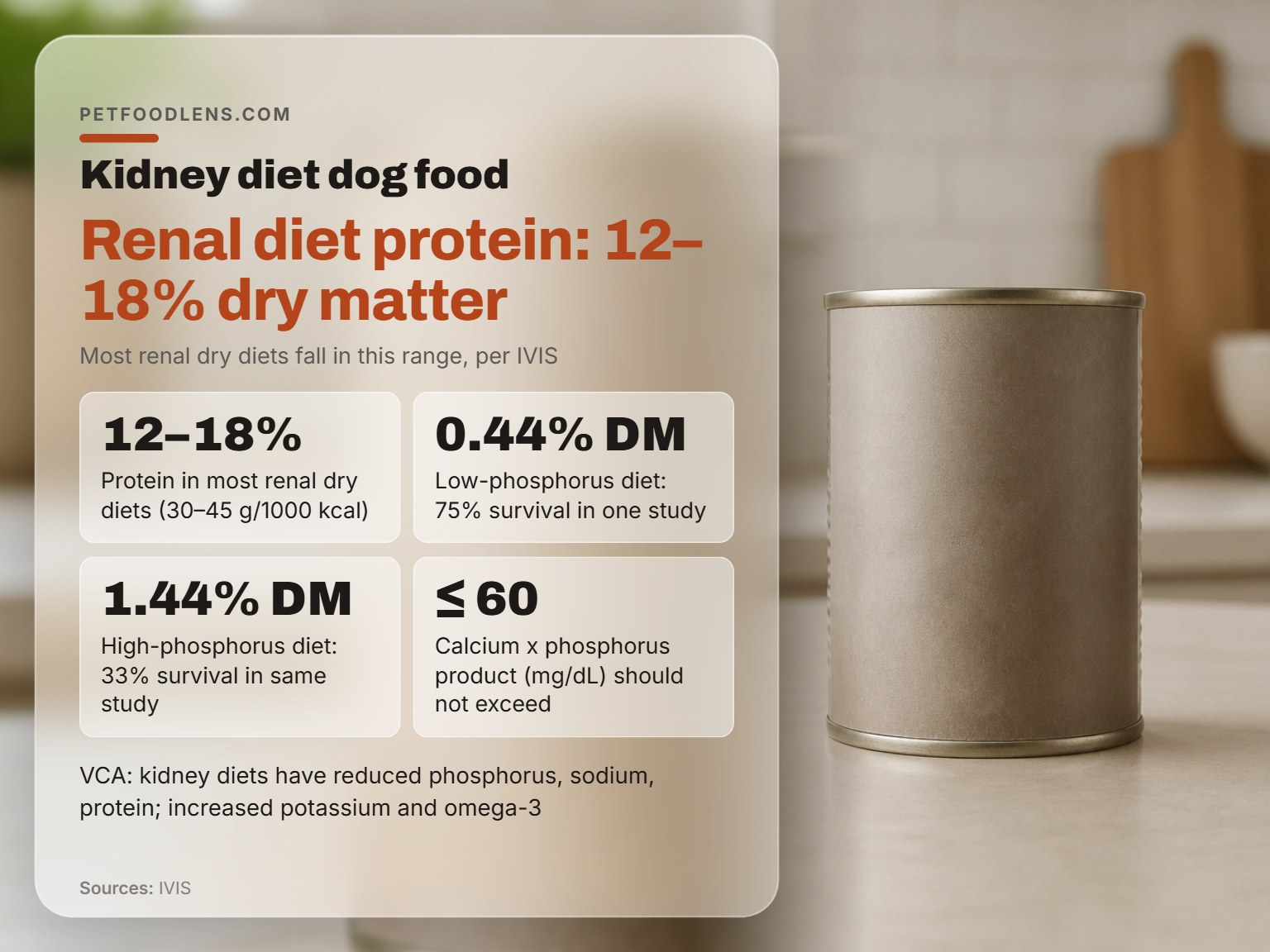
What the diet actually contains matters too. Most renal dry diets land between 12 and 18% protein, which works out to 30 to 45 g per 1000 kcal. The minimum requirement sits at 1.33 g/kg/day, and IVIS notes that degree of restriction is only necessary in profound renal failure. More liberal prescriptions suit dogs with more function left.
Then there’s the reversal almost nobody mentions. If hypoalbuminemia, anemia, weight loss, or loss of body tissue mass shows up, dietary protein gets gradually increased until those abnormalities correct. The direction flips.
If you’re comparing formulas on protein alone, protein restriction is the wrong single lens for how to feed a dog with kidney disease, because the number that matters changes with the stage.
Whether a prescription dog food pros and cons comparison is even the right question depends on where the dog sits on that curve.
Phosphorus Is the Number That Actually Moves Survival
Seventy-five percent versus thirty-three percent. That’s the survival gap between a low-phosphorus diet at 0.44% dry matter and a high-phosphorus diet at 1.44% in dogs with surgically reduced kidney function, reported by Finco and cited in the IVIS encyclopedia.
Worth flagging the caveat: that study used surgically induced renal reduction, not naturally occurring disease. The direction is clear. The magnitude probably isn’t transferable.
The JAVMA dietary modification renal failure study is the one that used dogs with spontaneous disease. Thirty-eight dogs, randomized, double-masked, followed for up to 24 months. Renal food beat maintenance food on uremic crises and mortality in mild and moderate failure, and the renal group showed a slower decline in kidney function.
Note the boundary. Mild and moderate. Not advanced.
Why Binders Get Added at Week Four
Dietary phosphate restriction is the first move. If serum phosphate hasn’t normalized within 2 to 4 weeks of starting it, intestinal phosphate binders get added and given with the food.
Two to four weeks is the window. Not two to four days.
There’s a second ceiling worth knowing. The total calcium x phosphorus product, in mg/dL, should not exceed 60.
Where this goes sideways: Chasing phosphorus down without watching calcium. The product is a multiplication, so a calcium number climbing quietly blows the ceiling even when phosphorus looks controlled.
If you want to know what the phosphorus figure on a can actually means, how to read phosphorus levels covers the dry-matter conversion.
Sodium, Potassium, and the Supplements That Split the Sources
Sodium is the softest recommendation in the whole protocol, and the sources say so out loud.
VCA states plainly that there are no scientific studies showing benefits from modified sodium content in CKD diets. The mild restriction recommendation rests on a belief that it reduces kidney workload and helps hold blood pressure reasonable.
IVIS agrees the ideal concentration isn’t clearly defined and puts current recommendations at normal to mildly restricted.
There’s actual trial data pointing the same direction. Greco and colleagues altered sodium intake from 0.5 to 3.25 g Na per 1000 kcal in dogs with surgically induced renal reduction. It didn’t influence hypertension development and didn’t affect glomerular filtration rate.
So VCA calls sodium restriction an unproven lever, while IVIS still recommends normal to mildly restricted sodium diets.
Where the sources genuinely part company is speed. IVIS warns that a rapid sodium reduction can cause dehydration and volume contraction, with the potential to precipitate a renal crisis, and recommends a gradual transition from the old diet. VCA presents mild sodium restriction as simply beneficial and doesn’t attach that caveat.
IVIS recommends going gradual because rapid reduction can precipitate a renal crisis, while VCA presents mild sodium restriction as simply beneficial without that transition caveat.
One interaction to write on the fridge: if an ACE-inhibitor is prescribed alongside a low-sodium diet, arterial pressure and renal function get checked during the first few days of treatment.
Potassium is messier still. VCA describes kidney support diets as having increased potassium compared with adult maintenance foods. AAHA 2021 points out that many proteinuria and hypertension medications may exacerbate hyperkalemia, and that reducing dietary potassium intake may help. Those two statements pull in opposite directions for the same dog.
IVIS lands on monitoring: check potassium status and adjust intake with oral potassium gluconate on an individual basis. That’s the only honest answer when the direction depends on which drug the dog is taking.
On supplements, the list is shorter than the shelf suggests:
- Water-soluble vitamins are already added to commercial renal diets, and IVIS states further supplementation isn’t required.
- Vitamin A is worth avoiding. IVIS calls it prudent to skip vitamin A supplements in dogs with renal disease.
- Omega-3 from menhaden fish oil is the one with real backing. It reduces inflammation, lowers systemic arterial pressure, alters plasma lipids, and preserves renal function in remnant kidney studies. AAHA 2023 suggests long-chain omega-3 PUFA at IRIS stage 2.
- Omega-6 from safflower oil looks detrimental. It acutely increases glomerular filtration rate in dogs with naturally occurring renal disease.
- Fermentable fiber as a nitrogen trap can’t be recommended yet. IVIS notes the studies documenting those changes haven’t been reported.
Metabolic acidosis is the other piece. Dietary protein restriction reduces acid precursors, but alkalinizing agents such as sodium bicarbonate, calcium carbonate, or potassium citrate may still be required.
I work from labels and published data, so I can tell you what a company prints. I can’t tell you what’s actually in the bag.
How Do You Get a Nauseated Dog to Eat the New Food?
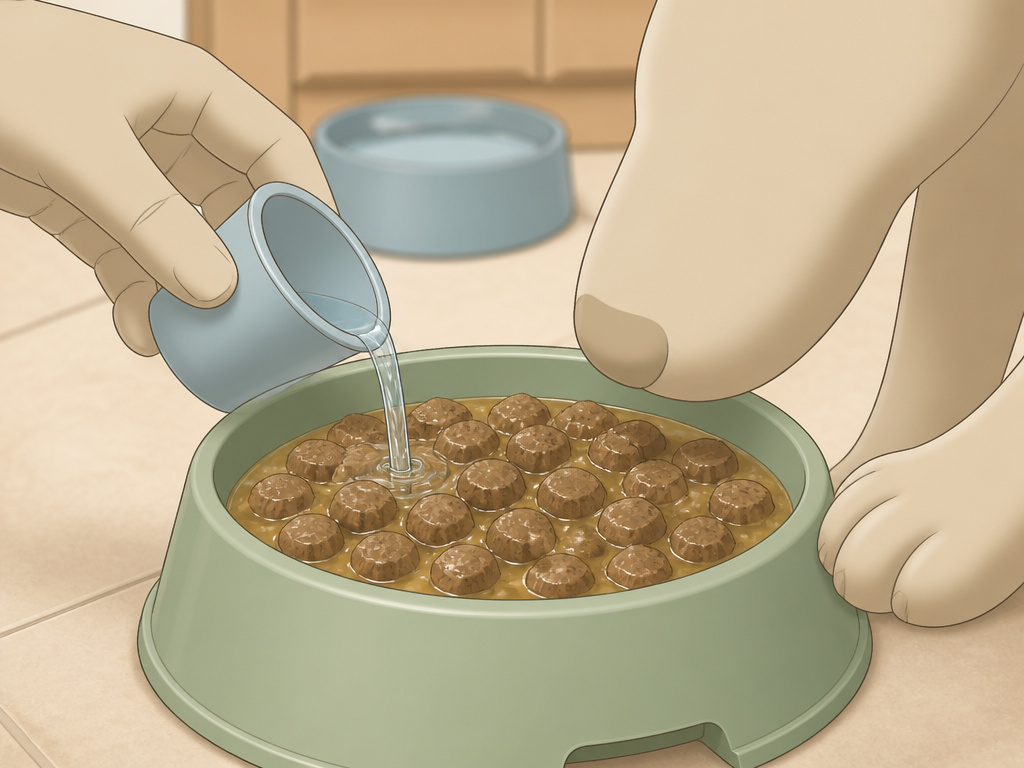
The bowl goes down. The dog sniffs it, takes one bite, and walks away.
Most of my work has been on the cat side of renal diets, and the transition mechanics carry over to dogs almost unchanged.
Before you start: A renal diet is a clinical decision, not a label swap. Restricting protein in an early-stage dog can cost more muscle than it saves, and a dog on an ACE-inhibitor plus a low-sodium food needs blood pressure and renal values checked within the first few days. Get the vet’s sign-off before the bowl changes.
The Two-to-Three-Week Swap
- Add moisture if the dog picks. VCA lists water, tuna juice, or low-sodium broth as acceptable palatability helpers.
- Keep water available at all times, change it several times a day, and clean the bowl daily. CKD dogs lose the ability to concentrate urine, so they drink more and need more.
Low phosphorus is worth exactly nothing if the food stays in the bowl.
When Eating Stops Entirely
If a dog can’t meet daily energy requirements, a feeding tube can deliver nutrition, medications, or fluids. That’s a real option, not a last resort to feel guilty about.
What to Check on the Label Before You Buy
The AAFCO nutritional adequacy statement is the line almost nobody reads, and it’s the one that decides whether the can is a diet or a topper.
I missed it early in my career on a label I was reviewing. The food turned out to be formulated for supplemental feeding, not as a complete diet. Now it’s the first thing I check on anything, and I’ve never stopped feeling slightly stupid about the one that got past me.
Read the back first. Here’s what to look for:
- The adequacy statement naming a life stage or “all life stages.” A “supplemental feeding” or “intermittent feeding” statement means this is not a complete diet.
- Phosphorus on a dry-matter basis, not the as-fed percentage. Wet food looks low in phosphorus until you strip the moisture out.
- The protein percentage alongside the stage, since 12-18% dry matter is the renal range and an early-stage product sits higher than an advanced one.
- Potassium and omega-3, which VCA lists as elevated in kidney support diets compared with adult maintenance food.
- The form: kibble, canned, or liquid. Canned carries far more moisture, which helps water intake.
The Three Names Worth Knowing
The difference between them is where they sit on the early-versus-advanced spectrum. VCA notes that products labeled for early kidney disease carry reduced phosphorus and only moderately reduced protein, while advanced products restrict harder.
That matters given the AAHA position that early cases shouldn’t be protein-restricted at all. An early-stage product may already be doing something the guideline says isn’t necessary yet.
If the prescription route isn’t workable, non-prescription dog food for kidney disease covers what over-the-counter options can and can’t do. For the full comparison of renal formulas, kidney food for dogs lays them out side by side.
I won’t tell anyone to pick a renal diet off a spec sheet alone. Palatability decides the outcome, and palatability is the one thing no guaranteed analysis can tell you. A diet the dog refuses has a phosphorus level of zero.
When the Plan Needs to Change
A stable dog can sit on the same diet for months. Then one blood panel moves and the whole prescription shifts.
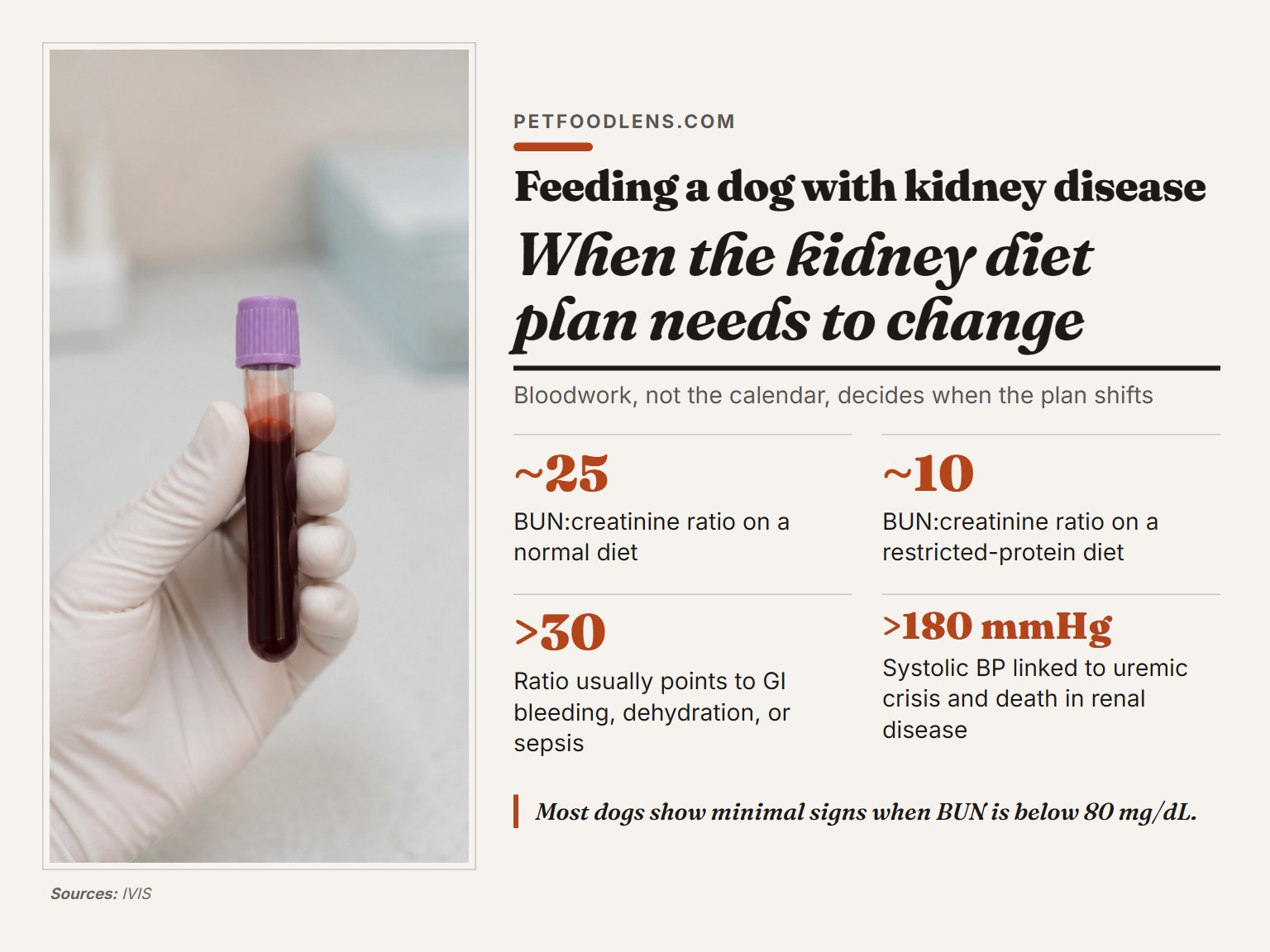
The BUN:creatinine ratio is the cheapest compliance check going. Around 25 means a normal diet. Around 10 means a restricted one. If the BUN:creatinine ratio is around 25 rather than around 10 on a renal food, the dog probably isn’t eating it.
A ratio above 30 usually points somewhere else entirely: gastrointestinal bleeding, dehydration, or sepsis.
Other numbers that should trigger a call:
- Systolic blood pressure above 180 mmHg. Dogs with naturally occurring renal disease and pressures over that line were more likely to develop a uremic crisis and die.
- BUN climbing past 80 mg/dL. Most dogs show minimal clinical signs below that, so crossing it means something changed.
- Any sign of protein malnutrition, including falling albumin, anemia, or visible loss of muscle along the spine. Protein goes up until it corrects.
- A new diagnosis layered on top. AAHA 2021 uses the example of a dog on a low-fat diet for chronic pancreatitis who is then diagnosed with CKD. Change the diet for the kidneys without accounting for the pancreas and the pancreatitis comes back.
Two edge cases break the standard script. Acute kidney injury belongs in critical care when the patient is hypercatabolic, not in the outpatient CKD protocol. And protein-losing nephropathy calls for a 25-50% protein reduction from current intake while still meeting essential amino acid requirements, with low phosphorus only if the dog is azotemic.
The part nobody mentions: A kidney diet is a set of trade-offs, and every trade-off has a failure mode. Restrict protein too early and you lose muscle. Restrict it too late and the dog stays uremic. The bloodwork decides, not the calendar.
Before You Go
One rule worth weighing: AAHA 2023 says dogs at IRIS stage 1 or 2 with no clinical signs should not require protein restriction, while IVIS holds that every symptomatic chronic renal failure patient should benefit from a protein-restricted diet. AAHA 2023 is explicit that early renal cases shouldn’t require it, and IVIS’s broader position assumes a symptomatic patient. Those aren’t the same dog.
The single thing to do this week is smaller than a diet change. Ask for the actual IRIS stage and the phosphorus number, in writing, and write both on the food container. Everything else below keys off those two figures.
Here’s my concession. This whole plan assumes a dog that will eat. The moment a dog stops eating, the nutrient math stops mattering and the conversation turns to warming bowls, palatability helpers, and eventually a feeding tube. I’d rather see an owner get calories into a dog on a diet I wouldn’t have chosen than watch a perfect formulation go untouched.
Read the back first. Then feed the dog in front of you.
Frequently Asked Questions
Can I feed my dog homemade food for kidney disease?
Only with a formulated recipe from a veterinary nutritionist, not an internet one. The hard part isn’t restricting protein, it’s hitting the calcium x phosphorus product at 60 mg/dL or below while keeping the diet complete.
Is protein restriction always necessary with kidney disease?
No. AAHA 2023 states healthy pets and early renal cases should not require protein restriction, and that it should be considered at IRIS stage 2 and recommended at stage 3. IVIS takes a broader position that every symptomatic patient benefits, so the two rules diverge on when protein restriction should begin.
How much water should a dog with kidney disease drink?
There’s no fixed number, and that’s the point. CKD dogs lose the ability to concentrate urine, so they compensate by drinking more. VCA recommends unlimited fresh clean water, changed several times daily, with the bowl cleaned daily. Canned food adds moisture on top of what the bowl provides.
Can I give my dog treats on a kidney diet?
Yes, but they count. The renal diet was balanced as a complete food, and adding uncontrolled protein and phosphorus on top of it undoes the restriction. low-phosphorus treats covers the ones that fit inside the plan rather than outside it.
What if my dog refuses the kidney diet entirely?
If the dog still can’t meet daily energy requirements, VCA notes a feeding tube can deliver nutrition, medications, or fluids, and AAHA 2023 acknowledges that for palliative patients, getting any food in beats getting the perfect food in.
