
Types of Protein Sources in Dog Food: How to Compare
This post contains affiliate links. As an Amazon Associate, we earn from qualifying purchases.
Types of protein sources in dog food fall into four groups: fresh meat, rendered meals (including by-product meal), plant proteins, and novel or hydrolyzed proteins. The differences that matter are amino acid profile and digestibility of the finished ingredient, which the front of the bag never shows.
Digestibility is the thread worth pulling. A protein can post a high crude-protein number on a guaranteed analysis and still leave much of its nitrogen in the yard, because crude protein measures nitrogen, not usable amino acids. That gap is where the types of protein sources in dog food marketing lives.
What follows walks the four groups in order, then the label math that lets you compare them without trusting a single claim on the front of the bag.
Key Takeaways
- Rendered meals are not a downgrade by default. Chicken meal has already given up its water, so a smaller weight of it carries more protein than the fresh chicken listed ahead of it.
- Pollock fillet and salmon outscored beef, pork, and chicken breast on crude protein and essential amino acids in a 2010 ileal assay, yet at 30% of the diet the dog-level digestibility differences disappeared.
- Processing can outweigh species. A low-temperature fluid-bed dried chicken scored a protein efficiency ratio of 5.33 while chicken by-product meal sat at the bottom of the poultry group in the same chick assay.
- “Limited ingredient” is a marketing phrase, not a manufacturing control. Count the animal proteins on the panel before you believe the front.
- Convert to dry matter first. Two protein percentages describe two different amounts of water until you do.
The Types of Protein Sources in Dog Food, Grouped by Form
AAFCO’s ingredient definitions sort every protein source on a label into one of four buckets, and the bucket tells you how much water you are paying for.
AAFCO defines a named meat meal as the rendered product of a single species, with water and a portion of the fat removed during rendering. Fresh meat enters the formula with original moisture intact, so the two forms cannot be compared directly on an ingredient list ranked by weight.
Here is the short version of each group:
- Fresh or frozen meat (chicken, beef, salmon). High moisture, low protein density as weighed into the mixer.
- Named meals (chicken meal, lamb meal). Rendered first, so protein is concentrated per pound of ingredient.
- By-product meals (poultry by-product meal, meat and bone meal). Rendered tissue beyond striated muscle, which can include organs, bone, and connective tissue.
- Plant proteins and isolates (soybean meal, pea protein, corn gluten meal). Wider spread in amino acid profile, generally thinner on the sulfur amino acids.
None of those groups wins on its own. The meat protein sources used in commercial dog food differ far more by how they were processed than by which animal they came from.
Ingredient splitting is the trick that follows from all this. A formula can list peas, pea protein, and pea fiber as three separate lines, and no single plant ingredient lands near the top even when the three together outweigh the named meat.
Fresh Meat, Meat Meal, and By-Product Meal Are Not the Same Number
The word “meal” is doing less work than the marketing around it suggests.
A few years back I ran a bag with chicken meal first against a bag with fresh chicken first and converted both to dry matter. The meal-first formula delivered more animal protein. That is the opposite of what either front panel implied.
The reason is water. Fresh chicken enters the mixer at high moisture, so most of its weight on the ingredient list is water that cooks off in the extruder. Chicken meal enters dry, so a shorter line on the label carries more actual protein into the finished kibble.
| Label form | What it actually is | Where it helps or hurts |
|---|---|---|
| Fresh chicken | Muscle tissue with original moisture | Palatability and front-panel appeal; overstates protein share |
| Chicken meal | Rendered, water and fat removed | Concentrated protein per pound; less front-panel glamour |
| Poultry by-product meal | Rendered organs, bone, connective tissue | Nutrient-dense but variable; quality swings with ash content |
| Pea protein / soybean meal | Plant-derived concentrate | Cheap protein; thinner methionine and cysteine |
| Hydrolyzed protein | Enzymatically broken into small peptides | Low allergen recognition; expensive and poorly palatable |
Why “Chicken First” Overstates the Chicken
Ingredient lists are ordered by weight before processing, and that single rule explains most of the confusion. A fresh-meat line at the top of the panel can contribute less total protein than a meal line sitting third.
Read the panel with that in mind and the ordering stops being a protein signal. It becomes a moisture signal.
What By-Product Meal Actually Contains
Owner surveys show widespread avoidance of by-products, and the Frontiers 2023 palatability paper notes that this uncertainty drives purchasing even while the same paper states animal by-products “contribute a source of dietary protein.”
The quality data is messier than either side admits. In the chick growth assay behind the poultry meal comparison, chicken by-product meal and chicken meal ranked lowest among the poultry proteins on protein efficiency ratio and lysine availability. So the pro-by-product framing and the measured quality point in opposite directions, and I will come back to that.
Easy to miss: Splitting one plant source into starch, protein, and fiber lines. Three pea entries on one panel can outweigh the chicken, and nothing on the front of the bag has to mention it.
Which Protein Sources Actually Deliver in the Bowl?
Pollock fillet tested at 96.9% crude protein on a dry matter basis, the highest of the five meat and fish substrates in a 2010 Journal of Animal Science comparison.
The same assay put salmon at 92.8%, chicken breast at 90.3%, pork loin at 86.2%, and beef loin at 82.7%. Essential amino acid content tracked the same order.
| Substrate | Crude protein (DM) | Standardized true essential AA | Enzyme assay score |
|---|---|---|---|
| Pollock fillet | 96.9% | 90.4% | 0.71 |
| Salmon | 92.8% | Not reported | 0.64 |
| Chicken breast | 90.3% | 86.6% | 0.52 |
| Pork loin | 86.2% | Not reported | 0.62 |
| Beef loin | 82.7% | Not reported | 0.63 |
Here is the part that gets skipped. When those same substrates were built into complete diets at 30% inclusion, the ileal and total-tract digestibility differences between them were not significant. Ileal crude protein landed between 88.9% and 90.5% across all five.
Composition and delivered digestibility are two different measurements, and the bag only ever shows you the first one.
How much protein a dog actually needs shifts with protein requirements by life stage, and a source that looks ordinary on paper can still clear that bar once the whole diet is balanced.
Plant Proteins: Where They Hold Up and Where They Don’t
Plant proteins are not a downgrade across the board.
In the chick assay ranking sixteen pet food protein ingredients, potato protein isolate scored a protein efficiency ratio of 3.60 and soybean meal 3.48. The top of that table was animal: spray-dried egg white at 5.37, low-temperature processed chicken at 5.33, and spray-dried egg at 5.18.
A four-by-four Latin square trial with twelve beagles found the chicken-based diet produced the highest-quality protein without any amino acid supplementation. That is the strongest single argument for animal protein in the file.
Plant-forward formulas still work when the amino acids are balanced deliberately. If you are weighing that route, the practical detail lives in plant-based dog food formulation rather than in the marketing copy, and the same is true of vegan dog food that leans on isolates and synthetic taurine.
Why Processing Beats Species
Low-temperature fluid-bed dried chicken scored 5.33 on the same assay where chicken by-product meal and chicken meal sat at the bottom of the poultry group. Same species. Different process.
Heat damages lysine availability, and lysine is the first limiting amino acid in most cereal-heavy dog formulas. That is the mechanism behind the gap, and it is why an ingredient name alone predicts very little.
If a bag names a protein and never names the process, you are reading half a specification. Rendering temperature and drying method move the number more than the animal does.
Do Novel and Hydrolyzed Proteins Beat Chicken and Beef?
A bag on the shelf says “limited ingredient” across the front. The back panel lists chicken, chicken meal, chicken fat, and chicken liver.
That is the category I trust least. I have counted three or four distinct animal proteins on bags making that claim, and nothing on the packaging suggests the plant runs any cross-contact controls between batches.
For a genuine elimination trial, what you want is a veterinary hydrolyzed protein diet protocol with one protein source and one carbohydrate, or a true novel protein dog food built on something the dog has never eaten. Kangaroo, alligator, and venison show up here for exactly that reason.
A real single protein dog food has one animal source on the panel. Count them. Chicken, chicken meal, and chicken fat are one source; chicken, fish, and egg are three.
Where this goes sideways: A bag labeled limited ingredient with four animal proteins in the panel. You switch the dog onto it for a suspected allergy, see no improvement over eight weeks, and conclude the dog is allergic to everything. The trial never had a chance.
What “Limited Ingredient” Actually Promises
Nothing enforceable. The phrase has no AAFCO definition tied to a maximum protein count, so a manufacturer can use it on a formula with six animal sources.
How Do You Compare Two Bags Without Trusting the Front?
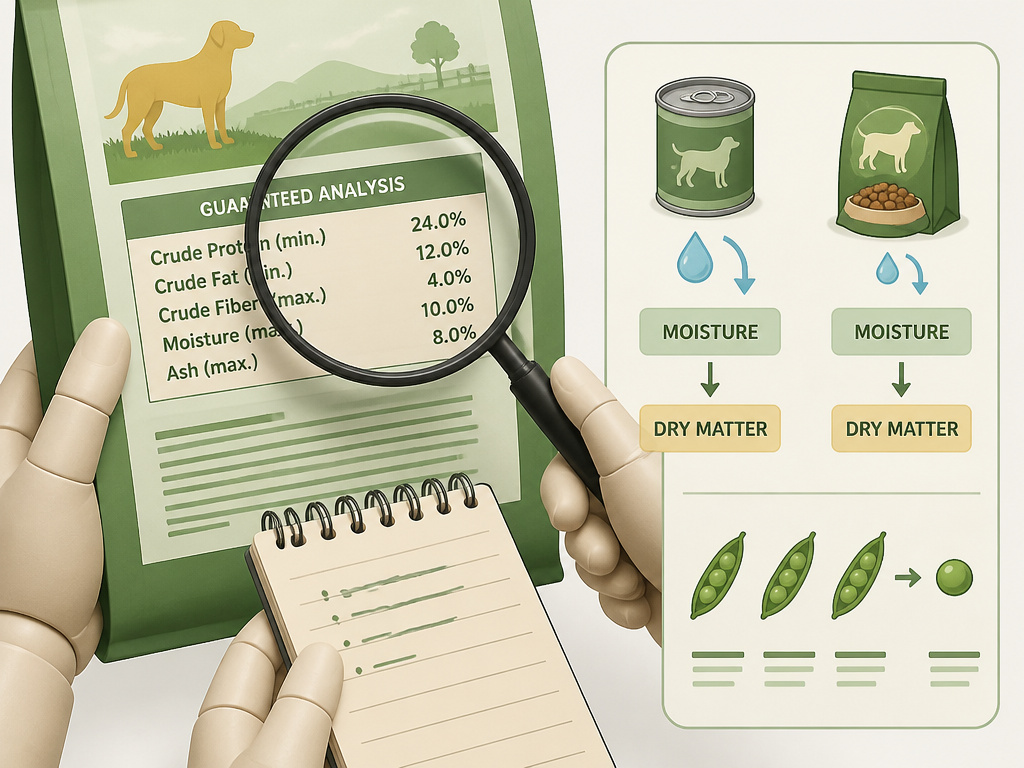
The guaranteed analysis is the only part of the bag with legal teeth behind it, and even that needs one conversion before it means anything.
- Write down the first five ingredients. Skipping this leaves you arguing from memory about a bag you looked at in a store aisle two weeks ago.
- Note the protein and moisture percentages from the guaranteed analysis. Protein alone tells you nothing until you know how much water it is sitting in.
- Subtract moisture from 100 to get dry matter. A food at 78% moisture is only 22% dry matter, so every other number gets divided by a small fraction.
- Divide protein by the dry matter fraction. This is the step that makes a canned food and a kibble comparable at all.
- Regroup split ingredients before you judge the order. Three pea entries count as one pea entry, and that regrouping changes the ranking more often than not.
Worth knowing before you start: Kibble poured over old kibble carries the previous batch’s oxidized fat with it. Empty the bin completely, wash it with hot soapy water, and let it dry fully before the next bag goes in. Damp plastic plus fat residue turns rancid fast.
I learned that one the hard way. I dumped out a bin at the bottom of a pantry once and found a yellowish, tacky film on the walls and a sharp crayon-and-paint smell. Months of fresh kibble had been poured over that residue, so every new batch met oxidized fat on day one.
The high-protein versus moderate-protein argument matters less than which source is supplying the protein and whether the process preserved it.
Where the Research Contradicts Itself
The literature does not agree with itself, and anyone who tells you otherwise has not read it closely.
Three disputes are worth knowing before you spend money on a bag:
- Poultry by-product meal. The beagle trial found chicken by-product meal had lower crude protein and energy digestibility than every other diet tested. A systematic review of seventeen studies concluded poultry offal meal increases digestibility coefficients of nutrients and energy. Same ingredient class, opposite conclusions.
- Composition versus delivery. The 2010 substrate work found large differences in crude protein and amino acid content, then found no significant digestibility differences once those substrates were built into diets at 30% inclusion.
- The reference pattern problem. Protein quality scores shift depending on whether NRC adult-maintenance, AAFCO, or FEDIAF reference amino acid patterns are applied, and NRC consistently produces the lowest values. There is no single stable protein quality number across jurisdictions.
The systematic review also flags that processing conditions go unreported in most of the underlying studies, which makes cross-study digestibility comparisons shakier than the tables suggest.
Frequently Asked Questions
Is chicken meal better than fresh chicken in dog food?
Per pound of ingredient, yes. Chicken meal has already been rendered, so the water is gone and the protein is concentrated. Fresh chicken weighs more on the ingredient list partly because it is mostly water, which is why list position overstates its contribution.
Are by-products bad in dog food?
The evidence is split. By-products include nutrient-dense organs, and one review describes them as a protein source. But the chick assay data put chicken by-product meal at the bottom of the poultry group on protein efficiency ratio, and one beagle trial found it less digestible than the alternatives tested.
What is the best protein source for a dog with allergies?
Hydrolyzed diet or a true novel protein diet, prescribed after a veterinary exam. Over-the-counter limited ingredient bags often contain several animal proteins, which defeats the purpose of an elimination trial.
Do dogs digest plant protein as well as animal protein?
Plant proteins score lower on protein efficiency ratio in chick assays, with potato protein isolate at 3.60 and soybean meal at 3.48 against spray-dried egg at 5.18. They can still support a complete diet when the amino acid profile is balanced deliberately.
How do I compare protein in wet and dry dog food?
Convert both to dry matter. Subtract the moisture percentage from 100, then divide the protein percentage by that dry matter fraction. Without that step, the two numbers describe different amounts of water and cannot be compared.
The Bottom Line
Here is the practical takeaway. If a bag calls itself limited ingredient and lists three or more animal proteins on the panel, treat it as marketing and nothing more. That is the one threshold I would apply before anything else on this page.
Your first step this week: flip one bag in your kitchen, write down the first five ingredients, and convert the protein to dry matter. It takes four minutes and it will change how you read every bag after it.
Fair enough, but I should be straight about the limit here. My day-to-day work is commercial cat formulations, and dog nutrition is a smaller slice of what I see. If your dog has a diagnosed adverse food reaction, a chronic GI issue, or a condition affecting protein tolerance, the general guidance above stops and your vet’s exam starts. A hydrolyzed trial is a clinical decision, not a label-reading one.
