
Hydrolyzed Protein Dog Food Pros and Cons: The 8-Week Rule
This post contains affiliate links. As an Amazon Associate, we earn from qualifying purchases.
Hydrolyzed protein dog food splits the evidence down the middle: hydrolysis shrinks allergenic protein fragments enough that many dogs stop reacting, but 20 to 50 percent of dogs sensitive to a parent protein still flare on its hydrolysate. Weighing hydrolyzed protein dog food pros and cons matters before you commit. Plan on a full 8-week trial before judging either way.
That 20 to 50 percent figure is the one worth sitting with. It comes from a 2025 Frontiers in Veterinary Science trial of two hydrolyzed diets, and it means a bag labeled hydrolyzed can still fail a dog that is genuinely allergic to the protein it’s built from.
Here’s what the trials actually measured, where the marketing overshoots, and the timeline that catches most owners out.
Key Takeaways
- Plan for 8 weeks, not 2. Over half the dogs diagnosed with a food reaction in the 2025 trial needed more than four weeks before their itch score moved.
- Hydrolysis lowers the risk without erasing it. Twenty to fifty percent of dogs sensitive to a parent protein still react to its hydrolysate.
- Softer stools are the most common complaint. Owners reported loose stool in 21 of 57 dogs, and the poultry feather diet scored 4.2 against 3.7 for salmon.
- “Hydrolyzed” is not one ingredient. Source and inclusion level change the outcome, so the specific formula matters as much as the category.
- The mechanism is still argued about. A Cornell trial found dogs on an intact mixed-protein control diet improved too.
What Hydrolysis Does to a Protein
Hydrolysis is a chemical break in a protein chain, and the marketing department gets to it afterward. A manufacturer takes a commonplace protein, chicken or salmon or feather, and splits it into shorter peptide chains. Cornell University’s clinical sciences team describes the process as chemically “smashing” proteins into smaller pieces to potentially avoid stimulating the immune system.
Hydrolysis breaks an intact protein into peptide fragments small enough to slip past IgE antibodies. Mean molecular weight matters more than the word on the bag: the poultry feather diet in one trial averaged under 1,000 Da, while the salmon hydrolysate averaged 2,000 Da. Neither figure guarantees a dog will tolerate the food.
What the molecular weight numbers actually mean
A dalton is one atomic mass unit. It’s the number that separates a real hydrolysate from a protein that’s been cut once and labeled.
Smaller fragments carry a lower chance of triggering an IgE-mediated reaction, per the 2024 Journal of Animal Science paper on chicken hydrolysates. They also need less enzymatic digestion in the small intestine, which is where the digestibility argument comes from.
That digestibility gain is largest for lower-quality proteins, the same paper notes. Hydrolysis does more work on a cheap base ingredient than on a high-quality one.
Formula choice now matters more than the category label, which is why the hydrolyzed protein dog food pros and cons debate has filled the hydrolyzed protein dog food market with options that behave differently from each other.
What the Guaranteed Analysis Won’t Tell You
Open a bag of hydrolyzed kibble and the first thing you notice is the smell. Flat, faintly biscuit, closer to a crushed vitamin than to meat.
That’s hydrolysis working on aroma as well as protein. It doesn’t make the diets interchangeable, and the guaranteed analysis on the back is where the differences hide.
In my first year reading labels I judged a food by its first ingredient and got it wrong. Chicken sat at the top of the list. Once I converted to a dry matter basis, which strips out water so wet and dry food can be compared fairly, plant proteins were carrying a large share of the total protein.
The two diets in the Frontiers trial make the same point with numbers. Per 100 kcal, the salmon diet carried 7.19 g of protein and 0.55 g of omega-3 fatty acids. The feather diet carried 4.66 g of protein and 0.16 g of omega-3.
Those aren’t small gaps. The salmon diet met the recommended 25 to 30 percent dry matter protein for dogs with nutrient-responsive skin disease.
Reading the panel in the right order
Three things on a hydrolyzed label do more work than the front of the bag:
- The protein named in the hydrolysate. Salmon hydrolysate and poultry feather hydrolysate are different ingredients, not the same one with a different flavor.
- The omega-3 figure. 0.55 against 0.16 g per 100 kcal is a real spread, and fatty acids take 4 to 12 weeks to show clinical effect.
- The fiber line. Fiber is the lever the authors name for softer stools.
This is also why high protein dog food and hydrolyzed food aren’t the same conversation, even though both advertise protein on the front panel.
The Case For Hydrolyzed Diets
Fifty-seven dogs enrolled in the 2025 crossover trial and 47 finished it. The authors read that 82.4 percent completion rate as a sign of compliance and satisfaction, which is a useful counterweight to the assumption that dogs won’t eat these diets.
The pros that hold up:
- Fewer intact allergens to react to. Smaller peptide fragments carry a lower chance of triggering an IgE-mediated response.
- It works when novel proteins don’t. Truly novel proteins are hard to source, and cross-reactions between commonplace and unfamiliar proteins do happen.
- Both trial diets reduced itch and lesions.
- Atopic dogs improved too. Dogs diagnosed with atopic dermatitis alone showed numerical drops in both scores, which makes these diets a possible adjunct.
- Gut changes showed up in healthy dogs. Butyrate rose while isovalerate, phenol and indole fell on a 25 percent chicken liver and heart hydrolysate diet.
The itch-score figures come from the restrictive diet trials in pruritic dogs published in Frontiers in Veterinary Science. The gut data comes from the hydrolyzed protein digestibility study in adult Beagles, which also found no difference in serum cytokines, oxidative stress markers, or skin and coat scores.
That last finding matters. Hydrolysis is a protein story, and the 2024 paper found the immune and skin benefits did not follow automatically from it.
The hydrolyzed dog food brands differ enough on protein, fiber and fat that treating them as one product category is where most shopping mistakes start. These are veterinary-exclusive diets, so the buying decision runs through a clinic rather than a supermarket shelf.
How Long Does a Hydrolyzed Diet Trial Take Before You Can Judge It?
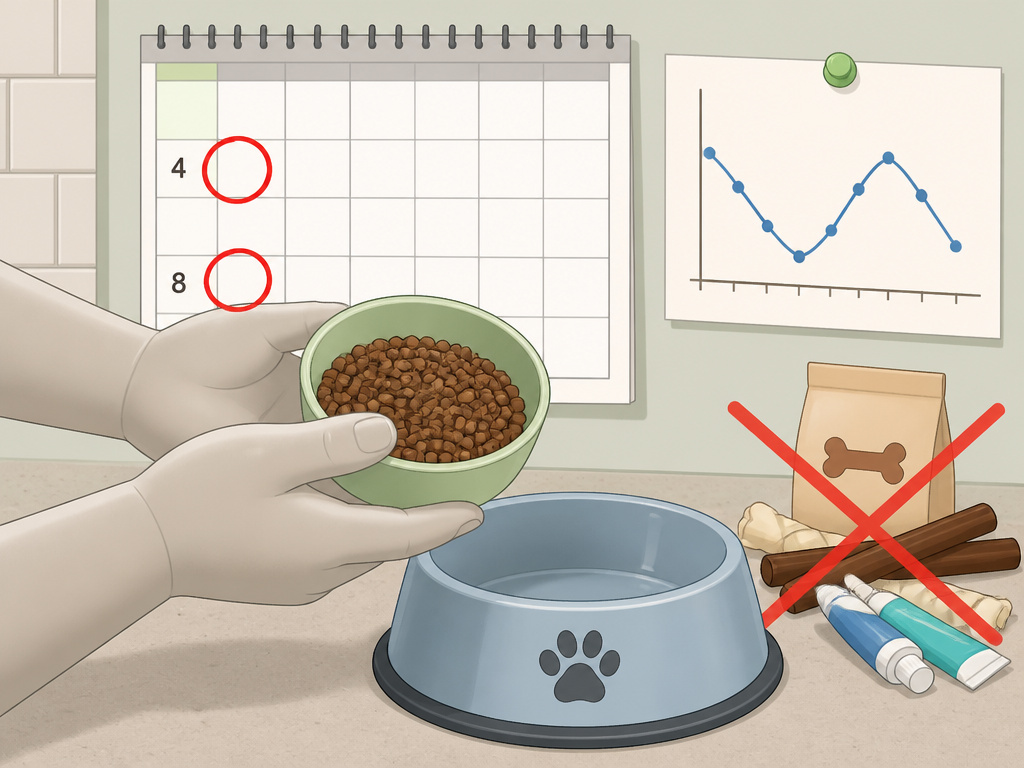
The Frontiers 2025 trial supports a full 8-week or longer trial, while Cornell’s trial implies longer timelines, with almost all dogs responding by three months.
Of 21 dogs ultimately diagnosed with a food reaction, only 10 (47.6 percent) had a PVAS drop of 2 or more by week 4. Of the 14 dogs diagnosed with the food reaction alone, 8 (57.1 percent) needed more than four weeks to show any CADESI-4 reduction at all.
Owners expect a verdict in two or three weeks. The data says otherwise, and in 4 of 21 dogs the lesion score got worse before it got better, rising through week 4 and falling by week 8.
The trial protocol is worth copying:
- Stop every treat, supplement, flavored medication and toothpaste. The Frontiers protocol required it, and one flavored chew delivers exactly the protein you’re testing against.
- Feed the same quantity as before, then adjust at each check. Owners started at their existing portion size, then adjusted at each examination based on weight changes.
- Book rechecks at week 4 and week 8, not week 2. Judging early catches the dogs in that 19 percent who look worse before they look better.
- Plan the provocation challenge before you begin. A food reaction is confirmed by relapse when the old diet returns, and owners were asked to recheck 7 days after the challenge.
Where this goes sideways: Ending the trial at week 4 because the itching hasn’t budged. Nearly half the diagnosed dogs in the 2025 trial hadn’t hit the 2-point itch threshold by then, and 19 percent had actually gotten worse.
The washout rules matter as much as the diet. The trial required eight weeks off lokivetmab or long-acting glucocorticoids, four weeks off short-acting steroids or cyclosporine, and two weeks off oclacitinib, fatty acids, or antihistamines.
Hydrolyzed vs Limited Ingredient vs Single Protein
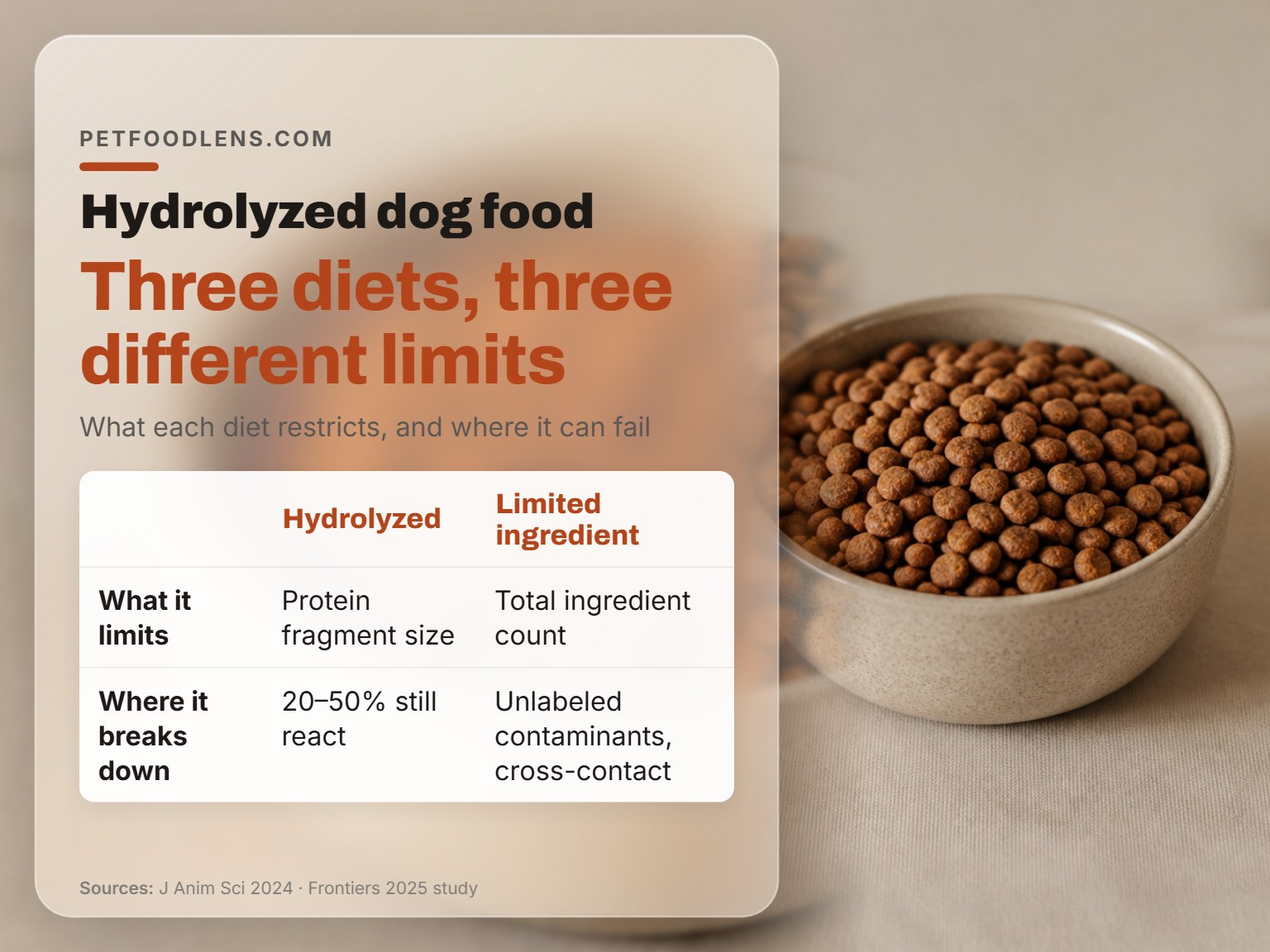
The bag makes these three look like siblings. They solve different problems, and picking the wrong one burns eight weeks.
All three categories exist to reduce what a dog is exposed to. They reduce different things.
| Diet type | What it limits | Where it breaks down |
|---|---|---|
| Hydrolyzed | Protein fragment size | 20 to 50 percent still react |
| Limited ingredient | Total ingredient count | Unlabeled contaminants, cross-contact |
| Single protein | Number of protein sources | Novel proteins are hard to source |
When limited ingredient beats hydrolyzed
If Cornell’s hypothesis holds and non-protein ingredients or additives drive some reactions, then a limited ingredient dog food that strips the suspect additive out does something a hydrolysate can’t. Hydrolysis changes the protein. It leaves the rest of the formula alone.
When single protein is the wrong tool
A single protein dog food works only if the protein is genuinely new to the dog and genuinely absent from everything else in the bowl. The Frontiers authors point out that truly novel proteins are hard to source and that cross-reactions between commonplace and seemingly novel proteins occur.
When you compare a hydrolyzed protein dog food pros and cons, if I had to pick one for a dog with a suspected food reaction and no other information, I’d pick hydrolyzed. It removes the sourcing problem that novel-protein diets depend on. Start there rather than with a boutique “hypoallergenic” bag that has no feeding trial behind it.
Most of these are sold as prescription hydrolyzed diets, and that supervision is the point. A prescription dog food comes with a diagnostic plan attached, and a diet trial without a plan is just an expensive bag of kibble.
Why Does My Dog Still Itch on Hydrolyzed Food?
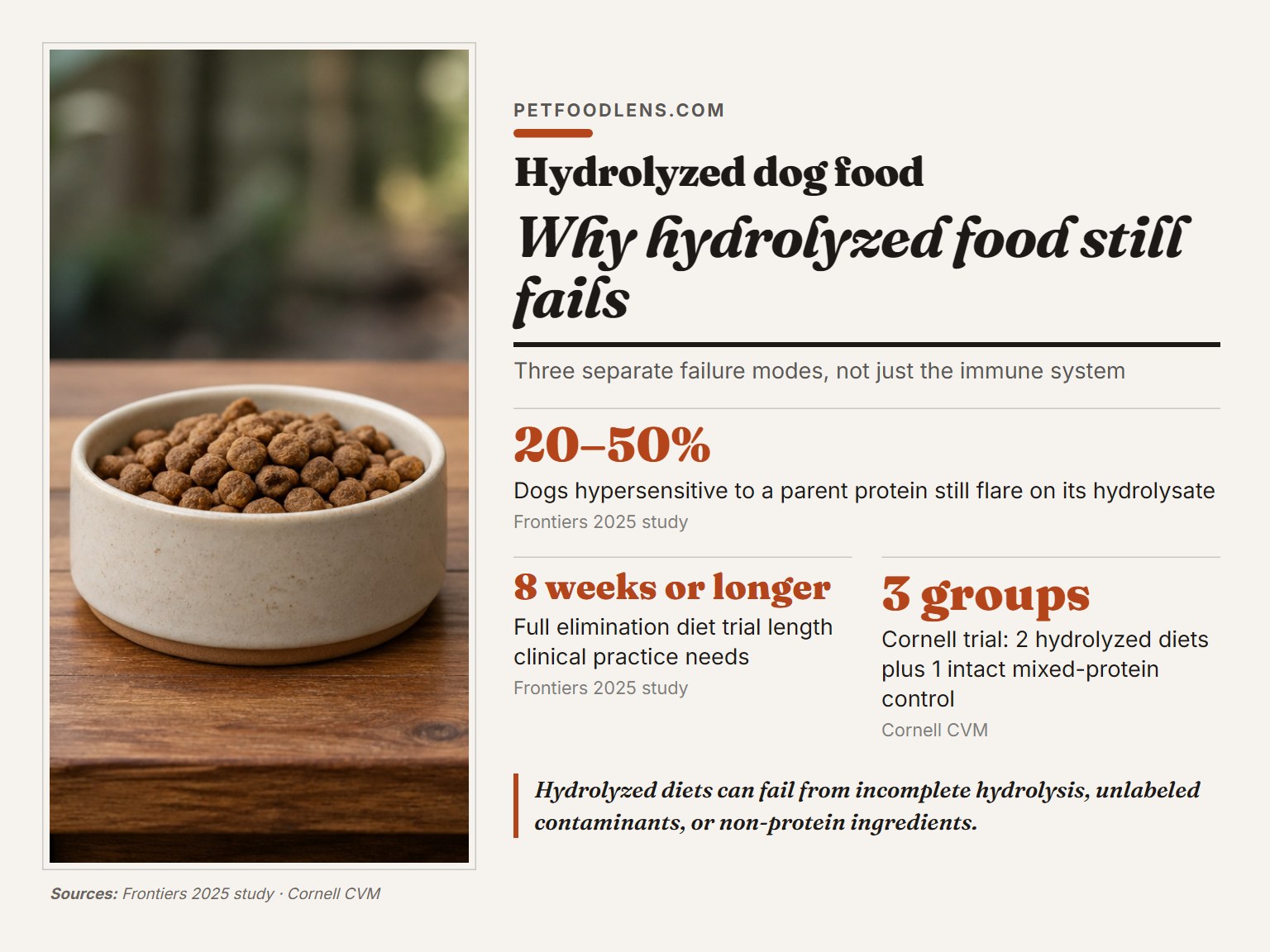
A hydrolyzed diet can fail for three separate reasons, and the dog’s immune system is only one of them.
Start with the number that gets buried. Twenty to fifty percent of dogs hypersensitive to a parent protein will keep flaring on a diet containing its hydrolysate, per the Frontiers authors.
The three ways a hydrolyzed diet fails
- Incomplete hydrolysis. If the parent protein isn’t broken down far enough, the fragment is still large enough to be recognized.
- Unlabeled contaminants. A diet can contain a protein the label never lists. The Frontiers authors ran an ELISA on a sample of the salmon diet for unlabeled intact pork, soy, beef and poultry contaminants and found none.
- Non-protein ingredients. Cornell’s investigator suggested additives or non-protein components may be driving some reactions.
That third possibility is the uncomfortable one. In the Cornell trial, dogs on a high-quality intact mixed-protein control diet improved alongside the hydrolyzed groups. At three months, almost all dogs across all three groups had responded.
Kenneth Simpson, the Cornell investigator, wrote that the positive responses to an intact mixed-protein diet “suggest they are not a simple allergic response to intact protein.”
That’s the population where a hydrolyzed diet earns its keep, and also the population where a single trial tells you the least.
A hydrolyzed diet is a diagnostic tool with a food label on it. Treat the eight weeks as the test, not the treatment.
The Stool and Weight Trade-Off
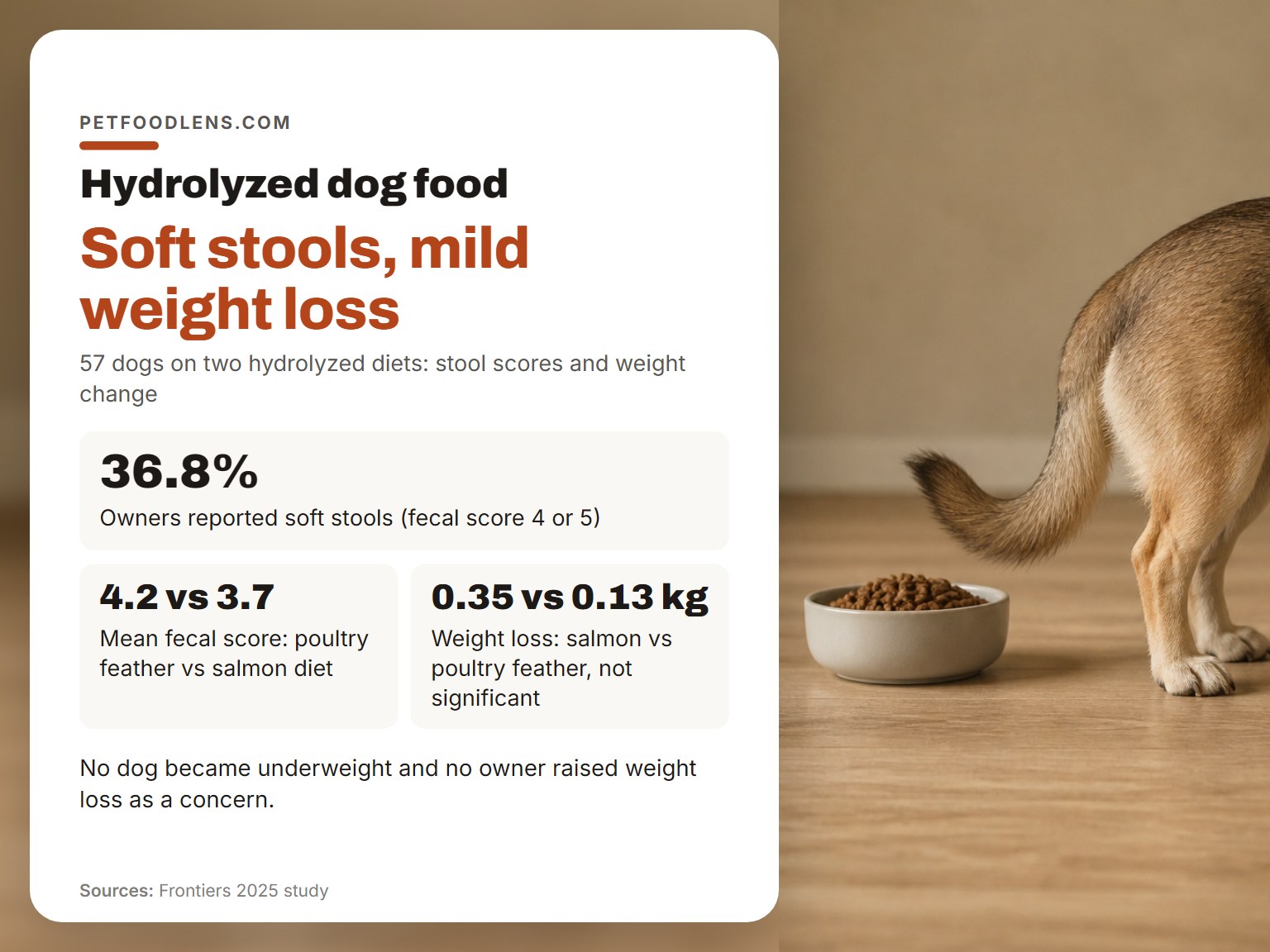
The stool changes are real, and they’re the most common reason owners stop.
A fecal score of 4 is soft enough to flatten when you pick it up. A 3 holds its shape. Owners reported scores of 4 or 5 in 21 of 57 dogs, or 36.8 percent, and the poultry feather diet averaged 4.2 against 3.7 for salmon.
No dog in the trial had diarrhea, which is a score of 6 or 7.
| Fecal score | What it looks like | What the trial linked it to |
|---|---|---|
| 3 | Holds shape when picked up | Baseline for most dogs |
| 4 | Soft, flattens easily | Osmolarity; 36.8 percent of owners |
| 5 | Loses shape entirely | Higher hydrolysis; fiber helps |
| 6 to 7 | Liquid | Not reported in the trial |
The mechanism is generally related to osmolarity and degree of hydrolysis, though Cornell’s investigator suggests non-protein ingredients or additives may drive some reactions. A heavily hydrolyzed diet pulls water into the gut, and the authors name added dietary fiber as the moderating lever.
Weight loss showed up on both diets, 0.35 kg on salmon and 0.13 kg on feather, with no significant difference between them. No dog became underweight and no owner raised weight loss as a concern.
Adverse events were lopsided. Sixty-eight percent of them were reported on the feather diet, and pruritus was the most common, 6 events against 2 on salmon.
The part nobody mentions: A diet that suits one dog may not suit the next. The two trial diets differed in protein, fiber and omega-3 content, and those differences showed up in stool scores and adverse events inside 8 weeks.
Where the Evidence Disagrees

Two well-run studies can both be right and still point in different directions.
| The question | One position | The other |
|---|---|---|
| Does hydrolysis explain it? | Frontiers: reduced allergenicity | Cornell: control dogs improved too |
| Will the dog eat it? | Frontiers: anorexia in 2 and 3 of 57 | Cornell: severe PLE dogs often refuse |
| Is hydrolyzed one category? | Marketing treats it as one | Source and inclusion level change results |
| How long before judging? | Frontiers: 8 weeks or longer | Cornell: three months |
The protein-losing enteropathy question is the sharpest split. Cornell’s PLE dogs were on steroids, antibiotics and multiple medications alongside diet, and roughly 50 percent of dogs with the condition die of it. Diet was one input among several.
The Frontiers trial excluded any dog with a concurrent disorder requiring a therapeutic diet. It tested hydrolyzed food as the only intervention, in dogs less sick than Cornell’s PLE group.
So when someone tells you hydrolyzed diets have good evidence behind them, both halves of that sentence need a qualifier: good evidence for what, and in which dogs.
Frequently Asked Questions
Is hydrolyzed protein dog food worth it?
For a dog with a suspected food reaction, yes, with conditions. Both diets in the 2025 Frontiers trial reduced itch and skin lesion scores, and 82.4 percent of enrolled dogs finished the protocol. The catch is that over half needed more than four weeks to respond, so a two-week trial tells you almost nothing.
Can I feed hydrolyzed food to a dog that isn’t allergic?
You can, and the 2024 Journal of Animal Science work found chicken hydrolysate performed as a comparable protein source to chicken meal in healthy adult dogs. Whether it’s worth the cost is a separate question. There’s no evidence it does anything extra for a dog with no reaction to food.
Does hydrolyzed dog food actually stop itching?
Sometimes, and often slowly. Dogs diagnosed with atopic dermatitis alone improved numerically rather than dramatically, which is why the authors describe these diets as an adjunct for that group.
What’s the difference between hydrolyzed and hypoallergenic?
Hydrolyzed describes how the protein was processed. Hypoallergenic is a marketing word that can cover hydrolyzed diets, novel-protein diets, or both. The processing method is checkable on the label. The marketing word isn’t.
Can a dog stay on hydrolyzed food long-term?
Most owners in the Frontiers trial chose to. Ten kept their dog on the salmon diet, five on the feather diet, and six moved to an over-the-counter novel-protein option. No dog in the study became underweight, though both diets produced mild weight loss during the trial period.
Is hydrolyzed protein the same as grain-free?
No, and the two claims have nothing to do with each other. Hydrolysis changes the protein. Grain-free describes what’s absent from the carbohydrate side of the formula. A hydrolyzed diet can contain grain, and a grain-free diet can be built on intact proteins.
The Bottom Line
Here’s the threshold I’d hand any owner: score the itch daily, and if there’s no movement by week 4, extend to week 8 rather than switching diets. If week 8 is worse than day 0, look at additives and non-protein ingredients rather than another hydrolyzed brand.
One concession. I read labels and published trials for a living. I can’t examine your dog, and a dog with a skin infection, a yeast overgrowth, or a protein-losing enteropathy needs clinical management that no bag of kibble provides.
Start with the label, not the slogan. Then give it eight weeks and write the score down.
