
Limited Ingredient Dog Food Pros and Cons: Worth It?
This post contains affiliate links. As an Amazon Associate, we earn from qualifying purchases.
The limited ingredient dog food pros and cons split cleanly: a shorter list gives an elimination trial fewer variables to trip over, but the term has no agreed definition, and DNA testing has found undeclared animal proteins in most over-the-counter products. Cornell research found dogs improved on shorter lists regardless of which protein was used.
That definitional gap is where the money goes. A bag can carry “limited ingredient” on the front while the panel behind it lists several animal proteins, because neither the pet food industry nor pet nutritionists have settled on what the term means. The front of the bag sells a promise. The back is the only part you can check.
What follows is the honest ledger: where a short list genuinely helps a dog, where the testing says it doesn’t, and the four places the published research contradicts itself. You’ll also get the trial timeline that separates a real diagnosis from a hopeful guess with a calendar attached.
Key Takeaways
- No agreed definition exists for “limited ingredient,” so the phrase describes marketing intent rather than a regulated composition.
- Contamination is the norm. DNA testing found undeclared mammalian protein in 21 of 21 over-the-counter dry diets and 6 of 11 dietetic wet diets.
- Cornell’s randomized trial found 19 of 23 dogs improved on their assigned diet, with responses independent of whether the protein was hydrolyzed.
- Plan on at least 8 to 10 weeks for an elimination trial. Gut signs move within 2 weeks; skin signs take 8 to 12.
- Try several diets before drugs. Cornell’s lead author says a single trial may not identify the right diet for your dog.
What “Limited Ingredient” Actually Means on a Bag
The phrase on the front of the bag has no agreed definition anywhere in the industry. Katy Nelson, a senior veterinary relations manager at Chewy, described “limited ingredient” as a term “neither defined nor agreed upon by the pet food industry or pet nutritionists.” She said the consideration that matters is what the ingredients are, not how many there are.
Elimination-protocol guidance describes a limited-antigen diet as built around one protein and one carbohydrate source the animal has not previously eaten, though Cornell’s findings question whether antigen identity drives response. Veterinary guidance describes the elimination diet as the diagnostic standard, run for at least eight to ten weeks, followed by reintroduction of the original food to confirm that clinical signs return. No ingredient count is specified anywhere in that protocol.
Dana Paris, chief marketing officer at Canidae, stated the category’s logic plainly: “Limited-ingredient diets are based on the premise of what’s not in the food.” That’s the positioning, said out loud. It also tells you nothing about what the food contains.
So the number on the bag is decoration. Elimination-protocol guidance holds that ingredient identity carries the diagnostic weight, and the count does not, though Cornell’s findings question the antigen-specific model. A five-ingredient food built on chicken and wheat is a worse trial diet for a chicken-sensitive dog than a nine-ingredient food built on rabbit and pea.
A comparison of limited ingredient dog food only earns its keep when it names the animal proteins per formula, because the front of the bag won’t.
I keep a running log of ingredient panels for the foods I review, and the drift is what surprises people. Formulas change quietly between batches. A bag you trusted two years ago can carry a different protein order today, with the same artwork and the same claim on the front.
Read the back first.
The Real Pros: Fewer Variables in a Trial That Has to Be Clean
A shorter ingredient list does one genuinely useful thing: it reduces the number of suspects. Fewer proteins in the bowl means fewer candidate antigens, and fewer places for a labeling error or a cross-contact event to introduce something nobody planned for.
Cornell University’s College of Veterinary Medicine ran the first randomized, controlled study on this question, published in the Journal of Veterinary Internal Medicine and funded by Farmina Pet Foods. The team enrolled 23 dogs with chronic enteropathy, an umbrella term for gastrointestinal disease lasting three weeks or longer. Each dog was randomly assigned one of three diets with similar calorie and macronutrient profiles.
Nineteen of the 23 dogs responded to the diet they were assigned, with reduced disease activity and improved stool consistency. The four that didn’t respond were switched to a different diet, and all four improved.
The finding that unsettled the researchers was the comparison. Responses were independent of whether the diet was hydrolyzed, and independent of whether the dog had previously eaten the proteins in question. The Cornell study on dog GI issues directly questions the assumption that one specific dietary antigen drives the disease.
Separately, eight dogs with protein-losing enteropathy, a more severe form, were fed hydrolyzed diets. Seven gained weight and held GI remission, and for two of them diet alone produced clinical remission.
None of that makes hydrolyzed protein dog food pointless. Hydrolyzed diets break proteins into peptides under 3 kDa, a size associated with low antigenic stimulation. The mechanism may still be doing work that the Cornell comparison couldn’t isolate.
I’ve watched owners spend eight weeks on a bag that listed three animal proteins. That trial was never going to tell them anything. If the panel doesn’t name one protein and one carbohydrate, you’re running a guess with a calendar attached.
Fewer suspects, cleaner read.
The Cons Start With the Label, Not the Recipe
Previous studies demonstrated undeclared ingredients in commercial limited-antigen dry diets that can compromise elimination trial results and efficacy.
What the DNA Testing Found
The wet side isn’t much better. A separate study tested 11 canine and feline antigen-limited wet diets from five manufacturers, all declared as dietetic complete pet food under European law 2008/38/EC.
The methodology detail matters more than the headline. The same study recommends that checks use PCR for species-specific classes rather than just zoological class. The limited-antigen wet diet contamination research recommends that producers switch to species-specific PCR rather than class-level checks.
What most people get wrong: Treating a short ingredient list as proof the bag is clean. Every one of the 21 dry products tested carried DNA from a mammal the label never named.
Here’s where the sources genuinely split. The authors of the dry-diet DNA work caution that PCR detects “a miniscule amount of DNA which might not be clinically significant.” The wet-diet authors treat contamination as a factor that can compromise an elimination trial outright. Neither paper resolves the threshold dose, so nobody can tell you how much stray protein it takes to restart a reaction.
If you’re shopping the dry category, limited ingredient dry dog food deserves more scrutiny than the wet aisle, because the dry contamination rate cited in the literature runs higher.
Why a Shorter Ingredient List Is Harder to Formulate
Formulators describe the opposite of what the marketing implies. Reaching nutrient requirements gets harder as the ingredient list shrinks, and hitting the right flavor profile gets harder still when you’re limited on animal-origin ingredients. That’s the trade the bag doesn’t advertise.
There’s a commercial consequence too. Many functional marketing claims require guarantees for specific nutrients or ingredients, so a limited-ingredient food supports fewer call-outs on the front. The shorter the panel, the less there is to say about it.
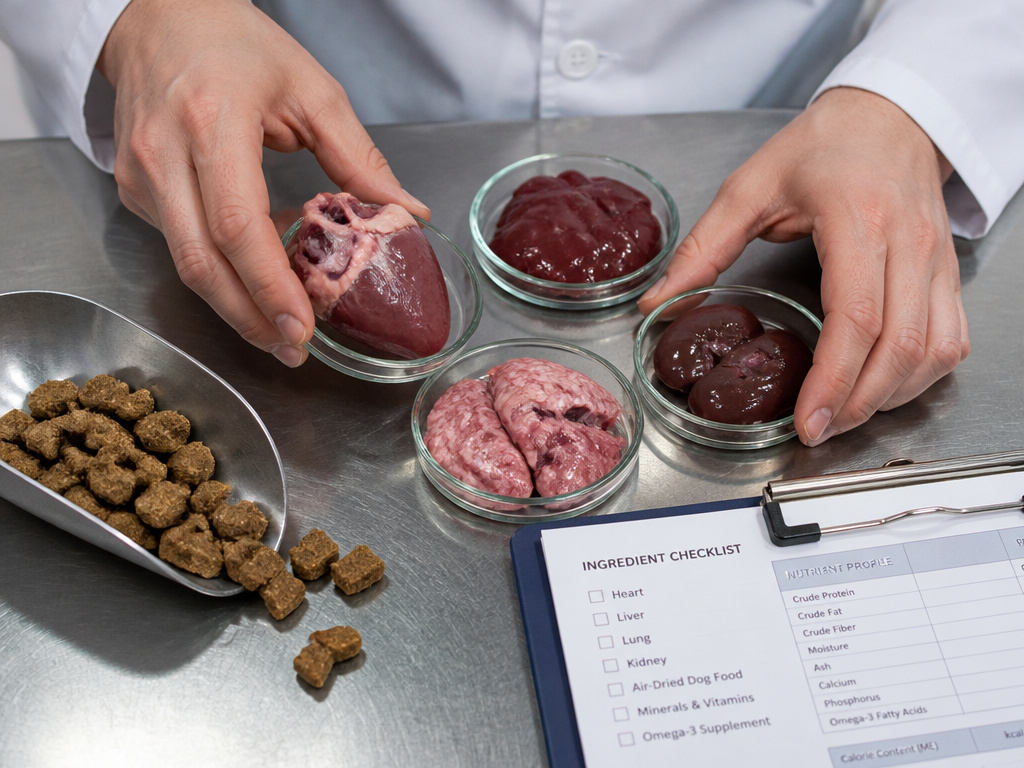
A complete and balanced claim against AAFCO nutrient profiles is the floor here, and clearing that floor with five ingredients takes deliberate sourcing. That’s why the brands doing it well lean on organ meat, which carries micronutrients muscle meat doesn’t.
Ziwi includes heart, liver, lung, tripe, and kidney in all of its cat and dog foods and its air-dried dog treats, and uses only organs from the same protein source as the muscle meat in each recipe. Its twin-stage air drying produces a food the company says can store for up to 21 months. Air-dried food feels dense and slightly tacky in the hand, closer to jerky than to kibble, and it doesn’t rattle in the bag.
- Nutrient adequacy: the hardest constraint, and the one most likely to be quietly missed.
- Palatability: limited animal-origin ingredients means fewer tools for flavor.
- Fewer allowable front-of-bag claims, which is why these bags sell on absence instead.
If you want the format where a short list is easiest to defend, limited ingredient wet dog food gives a formulator more room than extrusion does.
Which Protein Actually Works: Venison, Chicken, or Hydrolyzed?
Start with what dogs actually react to. Victoria Carmella, director of veterinary services at Blue Buffalo, identified the most commonly implicated food allergens in dogs as beef, dairy, chicken, and wheat. In cats the list runs beef, fish, chicken, and wheat.
Novel proteins entered the category to sidestep that list. Blue Buffalo and Mars Petcare point to alligator, lamb, and venison as options for animals with food sensitivities, and commercial limited-antigen diets typically build on venison, quail, rabbit, or duck combined with green peas, rice, or potatoes.
The Venison Problem
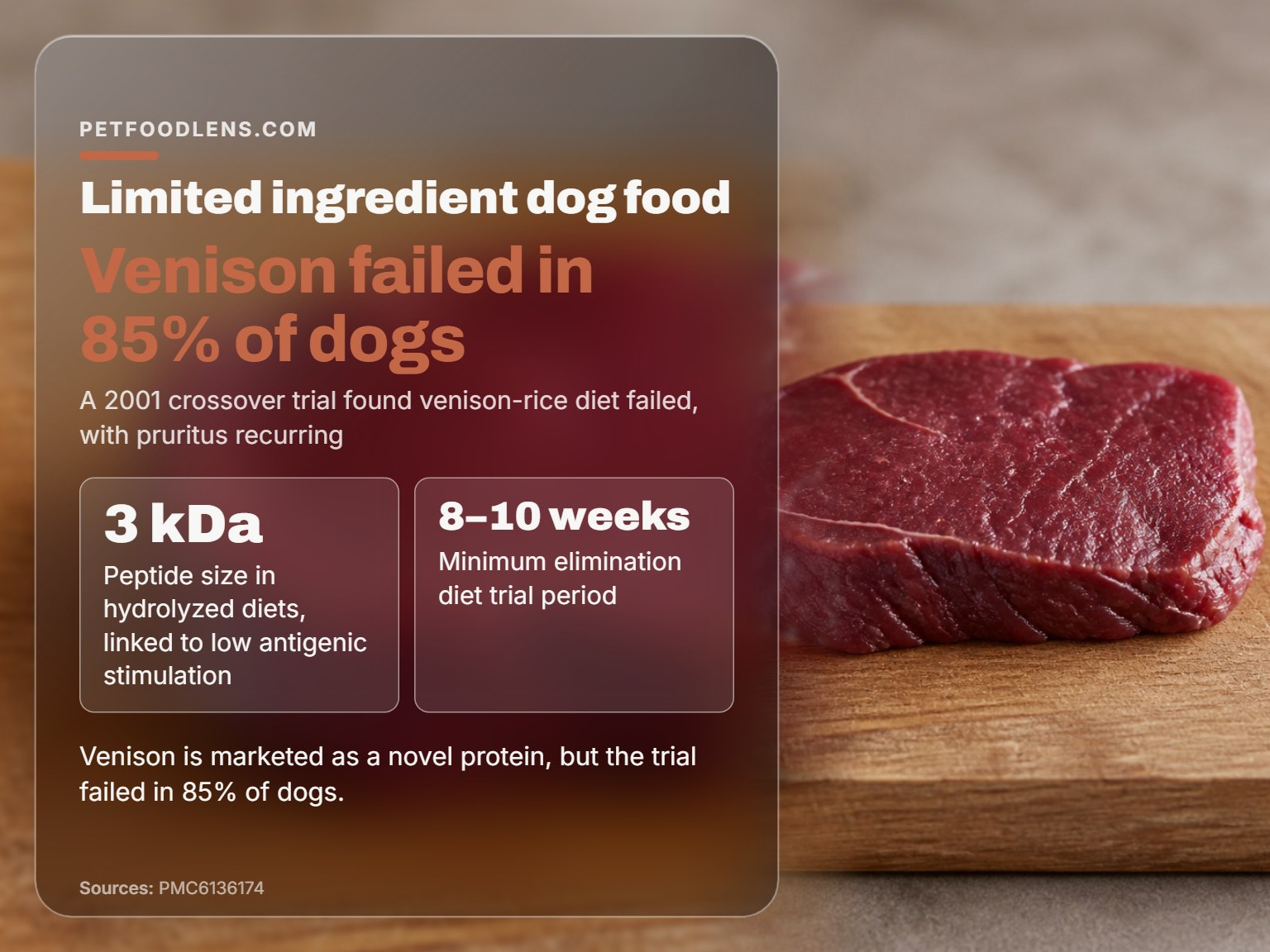
Venison is marketed as a successful novel protein option, but a 2001 crossover trial found it failed in 85% of dogs. A 2001 crossover trial in the Journal of the American Veterinary Medical Association found that a venison-rice diet failed, with pruritus recurring, in 85% of dogs.
So venison failed in that trial, even though it is marketed as a successful novel protein option for food-sensitive pets. No published source reconciles the two, and I’d treat any venison bag as an open question rather than a safe default.
A novel protein is only novel to your dog. Venison is marketed as a successful novel protein option, but a 2001 crossover trial found it failed in 85% of dogs, so treat it as an open question.
What Hydrolyzed Actually Changes
Hydrolyzed diets take a different route entirely. The proteins are broken into small peptides below 3 kDa, which is associated with low antigenic stimulation. The same body of research notes that hydrolyzed efficacy has not always been confirmed, and that residual allergenic fragments can remain.
That’s the honest state of the evidence. For a dog with a suspected food allergy, limited ingredient dog food for allergies is only as good as the protein choice behind it.
If you’d rather work with whole proteins, single protein dog food narrows the variable to one animal source, which is the minimum a trial needs.
How Long Does a Limited Ingredient Trial Take to Work?
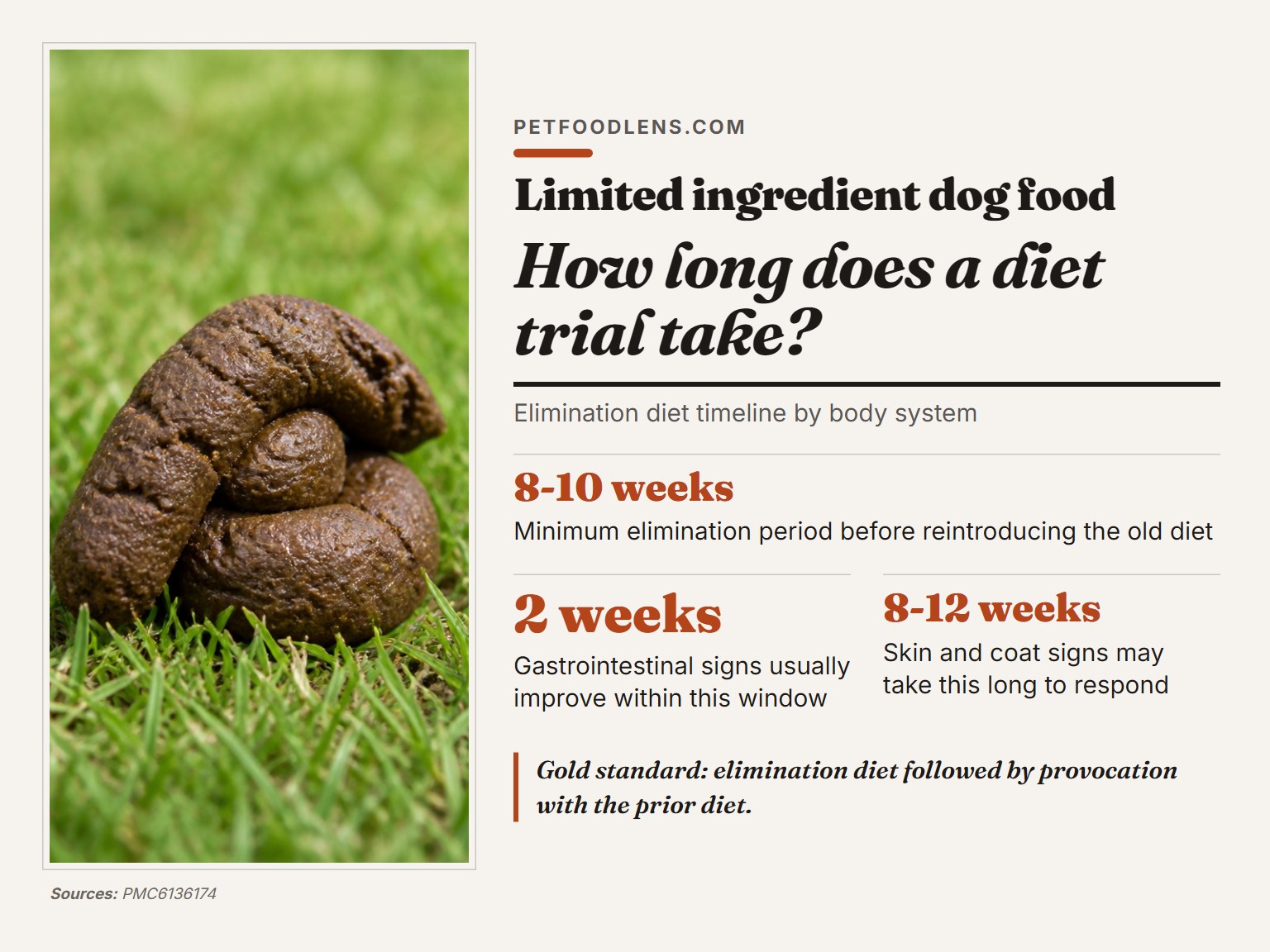
At least 8 to 10 weeks is the number to plan around. Veterinary guidance puts the minimum elimination period at 8 to 10 weeks, with the original diet reintroduced afterward to confirm that signs return. That elimination-then-provocation sequence is the diagnostic standard.
The timeline inside those weeks splits by body system, and this is where owners give up too early.
| What you’re watching | Typical response window | What it means |
|---|---|---|
| Gastrointestinal signs | Within 2 weeks | Stool firms up first; this is not the finish line |
| Skin and coat signs | 8 to 12 weeks | Slowest system, longest wait, most abandoned trials |
| Full elimination period | At least 8 to 10 weeks | Cutting it short wastes the whole attempt |
| Provocation challenge | After the trial | Reintroduce the old diet to confirm recurrence |
The first thing that changes is what you scrape off the lawn. Firmer, darker, less volume, usually inside two weeks. That visible improvement is the most seductive part of the process, because it arrives long before the skin has had a chance to answer.
Before you start: A diet trial fails quietly. Flavored chews, toothpaste, and table scraps all count as off-diet food, and one shared sandwich can restart the clock. Cornell’s researchers suspect off-diet feeding explains why some dogs failed earlier trials. Put the trial dates on the fridge and get everyone in the house on the same page.
The sequence that actually produces an answer:
- Get a diagnosis before you shop. Chronic enteropathy means three weeks or more of signs. Ruling out other causes first stops you from running a diet trial on a dog that needed a different workup.
- Pick one protein and one carbohydrate the dog has never eaten. Skipping this turns the trial into a food change, and a food change tells you nothing about causation.
- Feed nothing else for the full window. No chews, no scraps, no flavored medication. Off-diet food is the most common reason a trial produces a false negative.
- Log stool and skin weekly. Without a written record you’ll argue with your own memory in week six, and memory loses.
- Reintroduce the old diet at the end. Skipping the provocation step means you never confirm the reaction, and you’ll be back here in a year.
Cornell’s Kenneth Simpson is direct about what to do when the first attempt fails: try several different diets, with or without protein-losing enteropathy, before escalating to antimicrobial or immunosuppressive agents. A single trial may simply not be enough to identify the right diet.
That’s the sharpest disagreement in this whole area. Cornell’s position is that one trial is often insufficient and you should cycle through diets, while the elimination-protocol literature describes a defined 8 to 10 week sequence as the gold standard. Both can be true: run each diet properly, then run another one.
If skin is the main complaint, dog food for skin allergies needs the full 8 to 12 week window before you judge it.
Limited Ingredient Dog Food Pros and Cons: The Honest Ledger

Three things a short list genuinely buys you, and three it doesn’t.
The pros:
- A smaller suspect pool. Fewer proteins means fewer candidate antigens and fewer places for a labeling error to hide.
- A defensible trial structure, provided the panel names one protein and one carbohydrate.
- A cleaner read on what your dog actually tolerates, which is worth more than any front-of-bag claim.
The cons:
- No definition. The phrase isn’t regulated, so the bag can mean almost anything.
- Contamination. Undeclared protein showed up in 21 of 21 dry products and 6 of 11 wet dietetic products in published testing.
- Nutrient and palatability risk. Formulators say hitting requirements gets harder as the list shrinks.
Where the evidence splits, and it splits in four places:
| Question | One position | The other position |
|---|---|---|
| Does allergen identity drive response? | Cornell: response was independent of prior antigen exposure | Elimination protocols still select novel or hydrolyzed proteins |
| Does PCR contamination matter clinically? | Wet-diet study: contamination compromises trials | Dry-diet authors: detected DNA may be clinically insignificant |
| Is venison a reliable novel protein? | Marketed as a successful novel option | 85% pruritus recurrence in a 2001 crossover trial |
| Is one trial enough? | Cornell: try several diets before drugs | Protocols describe one 8 to 10 week sequence as the standard |
My read, after years of label work: when you compare a limited ingredient dog food pros and cons, the pro is real but narrow, and it only shows up when the product is a defined single-protein, single-carbohydrate formula. Everything else in this category is packaging.
For dogs with a broader history of reactions, dog food for food sensitivities is where the protein-by-protein comparison actually pays off.
When a Limited Ingredient Diet Is the Wrong Tool
This is the wrong purchase for a healthy dog with no symptoms. If your dog is eating comfortably, holding weight, and producing normal stool, a limited ingredient bag buys you a shorter panel and nothing else. There’s no evidence it prevents a problem from developing.
There’s also a con most owners never hear about.
Skip this if: your dog has no symptoms and is eating a complete and balanced food. Switching categories delays nothing that needed delaying.
Two more situations where I’d push back on the purchase. Don’t start a limited ingredient trial while the dog is still getting flavored chews or dental treats, because the signs never resolve and you burn 8 to 10 weeks learning nothing. And don’t use an over-the-counter bag to investigate active skin disease, because the skin window runs 8 to 12 weeks and you’ll have spent it on a product with no defined protein source.
Ziwi’s air-dried line is the over-the-counter option I’d point to when someone wants a genuinely short panel with organ meat in it.
The Bottom Line
One trigger decides this for you. If your dog has had gastrointestinal signs for three weeks or longer, stop shopping and get a diagnosis first, because chronic enteropathy is defined at that mark and the workup comes before the food.
The first step I’d take this week: buy one veterinary hydrolyzed diet and one novel-protein diet with a single named protein and a single named carbohydrate, and plan to run them in sequence rather than in parallel. Cornell’s data says the second diet often does what the first didn’t.
Here’s the concession, and it’s a real one. Nothing in the published research tells you which diet your individual dog will respond to. The studies can’t predict it, and neither can I. What the evidence does tell you is that a defined protein, a defined carbohydrate, and a full 8 to 10 weeks beat a bag with a wolf on the front and four animal proteins in the panel.
Frequently Asked Questions
Is limited ingredient dog food good for allergies?
The category name won’t answer that. What matters is which proteins are in the food and whether your dog has eaten them before. Beef, dairy, chicken, and wheat are the most commonly identified dog allergens, so a formula built on one of those four isn’t doing the job an elimination diet needs.
What’s the difference between limited ingredient and hydrolyzed?
Limited-antigen diet uses whole proteins from sources the dog hasn’t encountered. A hydrolyzed diet breaks the protein into peptides under 3 kDa, small enough to carry low antigenic stimulation. The first relies on choosing the right protein. The second tries to remove the protein’s shape entirely.
Can I just switch foods and see what happens?
You can, and you’ll learn less. A real trial runs at least 8 to 10 weeks with nothing else in the bowl, then reintroduces the old diet to confirm the reaction returns. Skipping the provocation step means you never know whether the improvement came from the food or from something else.
Do I need a prescription diet?
Not always, but the veterinary channel is where the protein source is defined and the quality control is specified. Cornell’s lead author recommends trying several diets before escalating to antimicrobial or immunosuppressive drugs, which is easier to do with products that state exactly what’s in them.
Are grain-free limited ingredient foods better?
Grain-free swaps corn for peas, potato, or tapioca, and the carbohydrate load barely moves. It’s a marketing category rather than a nutritional upgrade. Judge the panel by what the first five ingredients actually contribute, not by which grain is missing.
