
How to Stop a Dog From Begging for Treats: Step-by-Step
This post contains affiliate links. As an Amazon Associate, we earn from qualifying purchases.
To stop a dog from begging for treats, remove every payoff at the table and give the dog a different job during meals. Feed the dog before you sit down, send it to a bed or crate with a food toy, and keep treats under 10% of daily calories.
Replacement behavior carries much of the weight in that answer, though the SF SPCA presents management techniques and training solutions as parallel options without ranking them. A dog sent to a mat with a stuffed toy has a job for its mouth and its feet, and that job is what holds up when guests arrive and the table smells like roast chicken. This is also how to stop a dog from begging for treats.
What follows covers the calorie ceiling, the three management setups, the five-step place command, and the three places where the veterinary sources flatly disagree.
Key Takeaways
- 10% of daily calories is the ceiling for treats, with the other 90% coming from the complete food. VCA Animal Hospitals and PetMD state the same split.
- Feed before you eat, or occupy the dog with a food toy during the meal. A hungry dog parked at a table is being set up to fail.
- Never punish or yell. The San Francisco SPCA notes that negative attention is more than enough reinforcement to keep the behavior going.
- Rule out hunger first. Persistent begging in a dog that leaves food in the bowl is a veterinary question, not a training one.
- Expect an extinction burst. PetMD describes the whining, pawing, and barking getting louder before the behavior stops.
Why Does Your Dog Beg When the Bowl Is Already Full?
The San Francisco SPCA calls begging a clever strategy that works, and that framing explains more than any obedience cue.
A dog is a scavenger by design. One morsel handed over at the table, or one piece that simply falls from a plate, teaches the dog that the dining area is a place where food appears, which is the whole how to stop a dog from begging for treats problem in miniature. From that point the dog watches the table the way you watch a kettle.
A dog that receives food from a plate learns a reliable sequence: approach the seated human, wait, receive calories. The behavior persists because the payoff is immediate and consistent, and extinction requires that the payoff stop entirely rather than slow down. A single scrap dropped at the table rebuilds the whole pattern.
The same mechanism runs in other species. Anyone who has dealt with begging for food in cats will recognize the shape of it: the animal is not hungry, it is working a system that has paid out before.
The dog begging behavior fact sheet from the San Francisco SPCA puts the trigger plainly: a dog fed a juicy morsel from the table, or lucky enough to catch one that fell, is likely to become a committed beggar.
Common mistake: Deciding the dog is “just food motivated” and leaving it at that. A dog that has been paid at the table has learned a rule, and the rule keeps paying out until somebody changes the terms.
The 10% Ceiling and the Biscuit That Becomes Eight Treats
A few years back I spent three sessions dialing in a client’s cat food while the cat quietly gained weight. The formula was fine. The treats were the problem, and nobody had counted them. I ask about treats first now, before I look at a single guaranteed analysis.
The species changes; the arithmetic does not. VCA Animal Hospitals states that a maximum of 10% of a dog’s daily calories should come from treats and snacks, with 90% from the main food. PetMD gives the same split: treats should never make up more than 10% of the diet.
That ceiling is where most begging problems actually live, and it is where how to stop a dog from begging for treats usually gets decided. A begging dog is usually a dog collecting calories in small, uncounted installments.
Here is the habit that fixes it, and it costs nothing. Break a store-bought biscuit into pea-sized bits. One medium biscuit becomes several separate rewards, and the dog does not notice the difference. You feel the biscuit snap under your thumb and the crumbs scatter across the counter, and that is the whole technique.
Cutting pieces smaller also protects the dog’s throat. Dogs that gulp choke on chunks, not crumbs. For a fast eater, cut soft treats smaller than a pea and hand them over one at a time instead of tossing a fistful.
If you want the arithmetic worked through, the treat calories piece covers the math, and the daily treats breakdown shows what a realistic allowance looks like.
Three Setups That Keep the Dog Out From Under the Table
A baby gate is one management option: the SF SPCA presents management techniques like prevention alongside training solutions without ranking them, while VCA calls training the pet to do something else during mealtimes the key to stopping begging.
VCA Animal Hospitals recommends keeping the dog in a separate place during family meals and meal preparation: a dog bed, a separate room, or a crate. The San Francisco SPCA lists the same options and adds a gate across the kitchen doorway. Pick whichever one your floor plan allows and set it up before dinner, not during it.
- Baby gate across the kitchen door. Blocks sightlines and stops the hover at the edge of the room.
- Crate with a stuffed KONG, frozen, so the dog works at it instead of watching you chew.
- A dog bed in the corner of the room, for dogs that settle easily and just need a boundary.
- Tethering. The SF SPCA is the only one of the four sources that recommends it: a short leash tied to a heavy piece of furniture, plus a bed or blanket.
The SF SPCA preventing begging resource is blunt about consistency across all of these: no scraps from you, and no scraps from friends, family, or well-meaning strangers either.
Where this goes sideways: A timed feeder left out for a large dog or a dog with a history of destructive chewing. VCA warns that the dog may grow impatient and simply destroy the dispenser, which leaves you with a broken unit and a dog that has learned persistence pays.
The chew toy is doing more work than it looks like. A frozen stuffed toy keeps the mouth busy for the length of a meal, which is exactly the window where begging used to pay. If you are watching calories, use low-calorie treats or frozen vegetables in the stuffing.
Training the Alternative Behavior That Replaces Begging
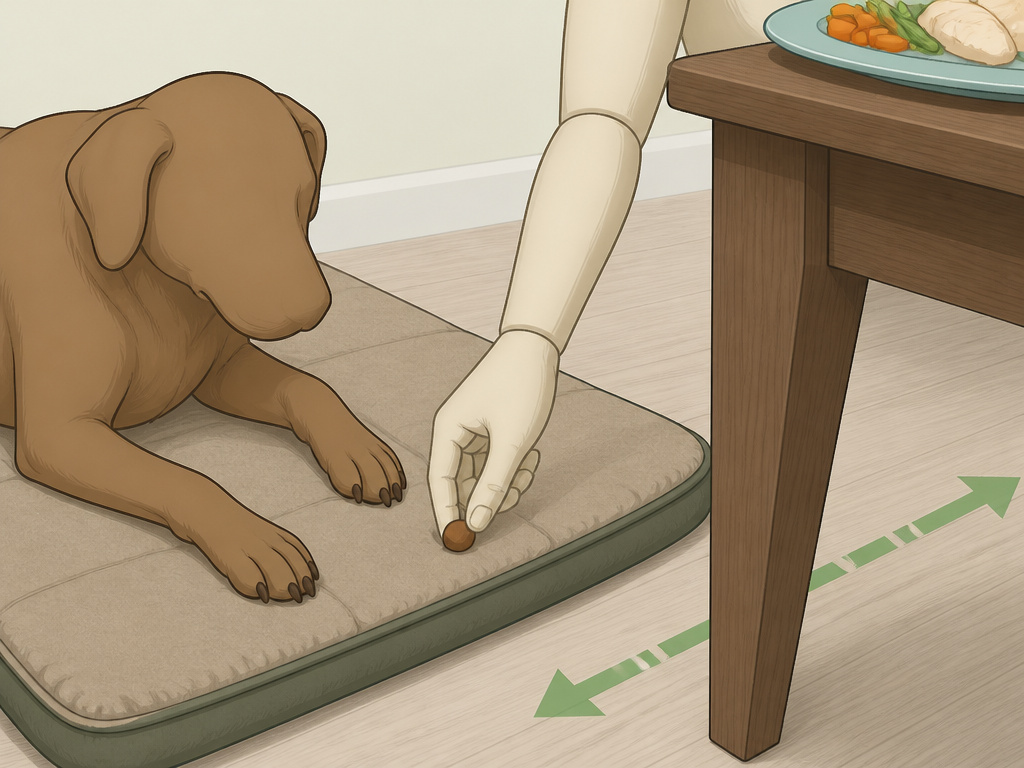
Training the place command starts with the bed, not the word.
VCA Animal Hospitals calls this the key to stopping begging: teach the pet to do something else during mealtimes, specifically to go to a bed or crate while you eat. The San Francisco SPCA frames it as an incompatible behavior, something the dog can do that makes begging physically impossible at the same time.
The Five Steps, and What Breaks If You Skip One
- Choose the spot and make it good before you ever use it. VCA is explicit that the bed must be a positive space with treats and cuddles, and that it must never be used as punishment. Skip this and the dog reads the bed as a time-out zone, and the cue collapses.
- Reward the dog on the bed, in small pieces, while you eat. PetMD suggests asking the dog to lie down in its place and giving a treat every so often while it stays relaxed. Skip the reward and you are asking for a stay with no paycheck.
- Start with the mat close, then move it. PetMD recommends keeping the mat or bed near the table at first so you are not getting up constantly, then increasing the distance over time. Skip the progression and the dog only holds position when you are within arm’s reach.
- Stretch the interval until the dog settles for the whole meal. PetMD describes the end state as one treat when the dog lies down and one at the end of the meal. Skip the stretch and you build a dog that pops up repeatedly looking for another payment.
- Fade the food once the behavior is solid. The fade treats sequence covers how to move from every-rep payment to occasional reinforcement without losing the behavior.
I would not start this with a high-value treat like a piece of chicken. A dog that knows better food exists will hold out for it and quit the mat the moment you switch back to kibble. Start boring, and use high-value treats only when you are proofing the behavior with guests in the house.
Keep basic cues in the mix. The AKC begging-at-the-table training guide quotes trainer Melissa McCue-McGrath recommending “Sit,” “Stay,” and “Leave it” as the foundation, because those commands interrupt the impulse before it becomes a full begging routine.
One scheduling note from the same source: train after a walk or other exercise, when the dog is calmer and less likely to be working an angle.
Reward at a Distance or Right Beside the Table?
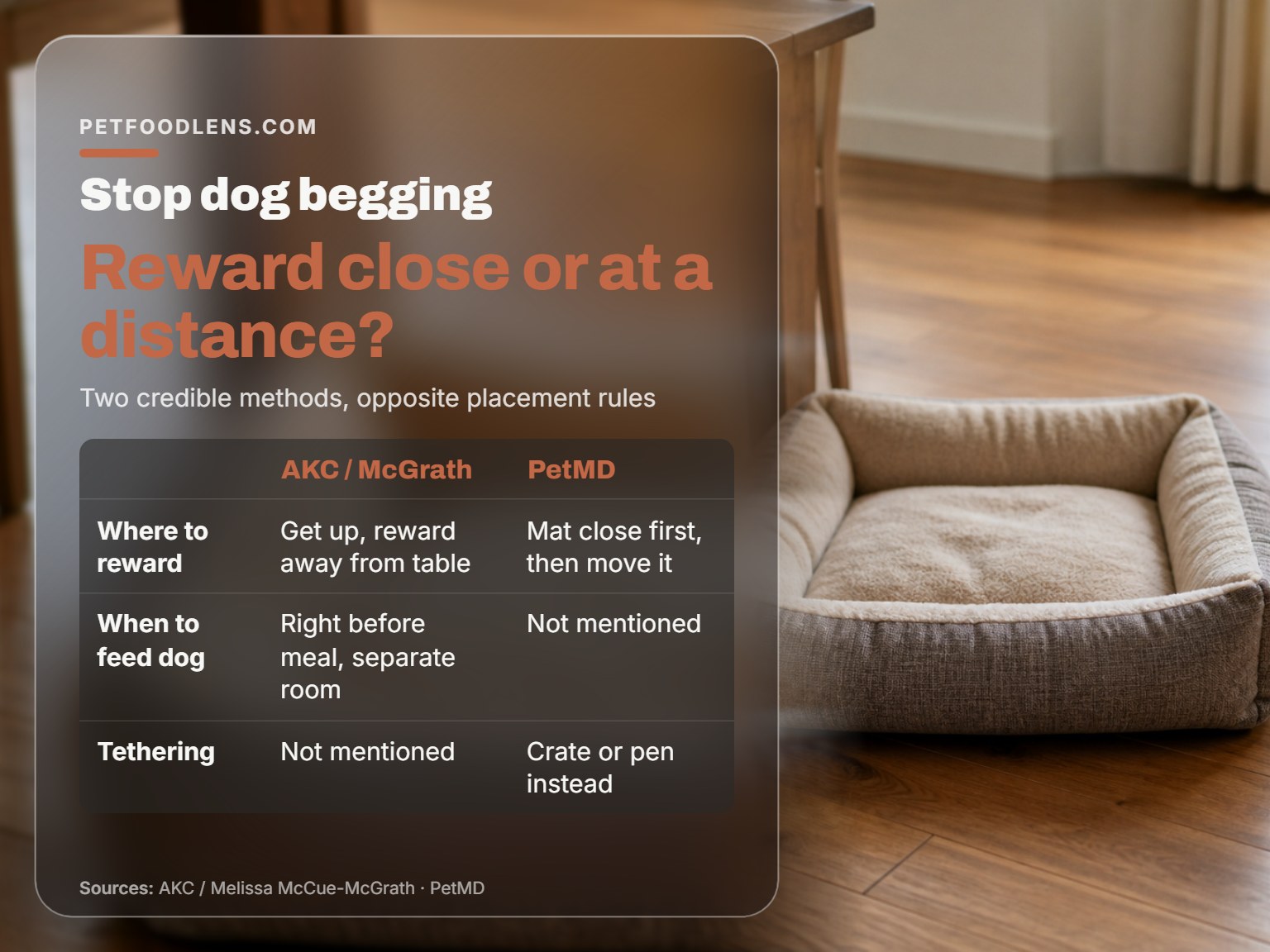
Two credible sources hand you opposite instructions about the same treat, and both of them are describing a method that works.
PetMD says keep the mat or bed close to the table so you do not have to get up to reward the dog, then gradually move it farther away. The AKC, through McGrath, says get up and give the treat when the dog is sitting away from the table and not begging, and floats a remote-controlled treating device so you are not getting up multiple times per meal.
Neither source contradicts the other on principle. They differ on where the payment happens, and the practical answer depends on your dog.
| Decision | AKC / McGrath | PetMD | VCA / SF SPCA |
|---|---|---|---|
| When to feed the dog | Right before the meal, separate room | At the same time, in food toys | VCA: separate place with a chew toy |
| Where to reward | Walk over, reward at distance | Mat close first, then move it | SF SPCA: silent on placement |
| Tethering | Not mentioned | Crate or pen instead | SF SPCA: short leash, heavy furniture |
The second split is about feeding time. The AKC recommends feeding the dog right before you sit down, preferably in a separate room. PetMD suggests feeding at the same time you eat, with the ration divided into food-dispensing toys. VCA keeps the dog in a separate place with a Kong or chew toy and does not endorse co-timed feeding as a rule.
Tethering is the third gap. The SF SPCA recommends a short leash on a heavy piece of furniture for dogs that need to be in the room. VCA and PetMD both prefer a crate, gate, or pen, and neither mentions tethering at all.
The One Thing All Four Sources Agree On
Every source in this set lands on the same instruction: do not feed the dog from your eating area. PetMD reduces prevention to that single rule, and the SF SPCA calls prevention far easier than curing a chronic beggar.
If you are choosing a starting point, use the training treats framework to decide what gets paid and when, and pick the placement rule that matches your dining room. A dog that settles on a mat near the table is not failing because the mat is not across the room.
What Happens When You Finally Stop Giving In?
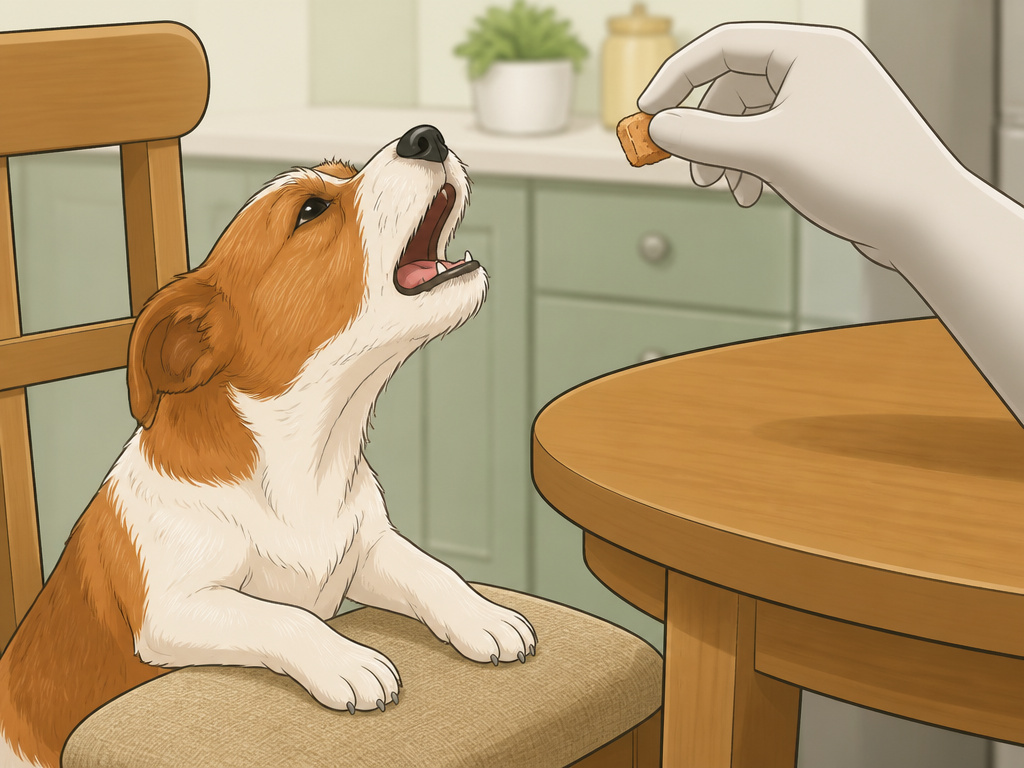
Ever noticed the whining gets worse right before it stops? PetMD has a name for that phase: the extinction burst.
The description is specific. The dog whines louder, paws harder, paces faster, and barks louder, because those exact tricks earned table scraps in the past. The escalation is the behavior testing whether the old rules still apply.
PetMD gives no duration for the burst, and I will not invent one. What the source does say is that giving in during escalation teaches the dog that pushing harder is what gets food.
If you cannot ride out the escalation without cracking, do not run a pure ignoring protocol. Teach the replacement behavior instead. A dog that has a mat and a stuffed toy does not have to sit in frustration while the rules change.
That warning matters because PetMD flags a real risk: a dog left to simply be ignored can become stressed, frustrated, and confused. The source suggests a replacement behavior or an occupying toy as the better route for those dogs.
The part nobody mentions: The burst gets louder in a house with guests. Holiday dinners are where a training plan quietly dies, which is why the AKC recommends an alternative activity like a puzzle toy filled with treats whenever visitors are likely to sneak scraps.
The sound is the tell. Listen for the whine getting louder and holding there, and you are hearing the burst, not a dog that has suddenly gotten worse.
When Begging Is Not a Training Problem
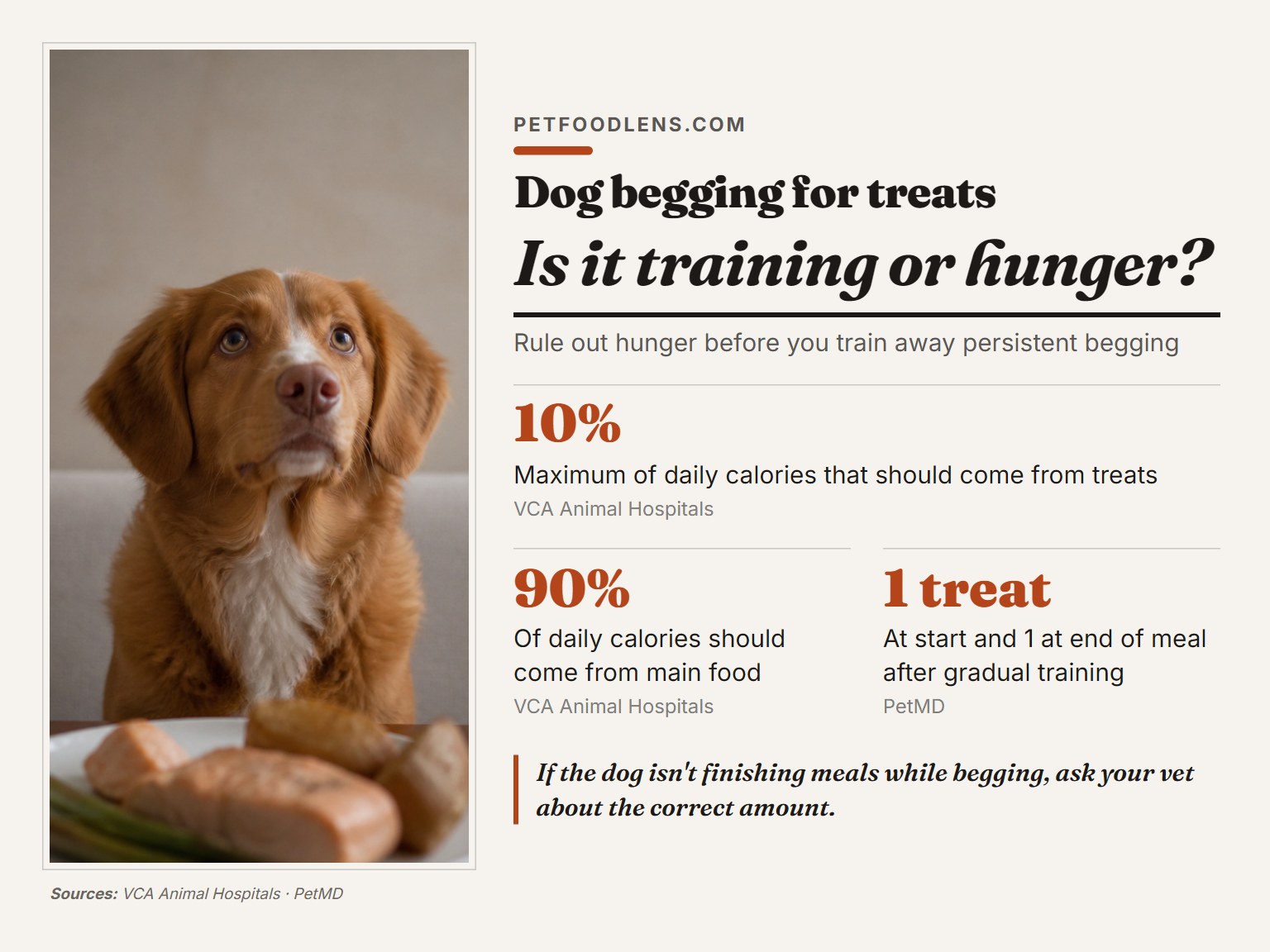
Persistent begging sometimes has nothing to do with training, and no amount of mat work will fix it.
The San Francisco SPCA is direct about this: always rule out hunger as a reason for persistent begging, and ask your vet for the correct amount of food for the dog. A dog that is genuinely underfed will work the table no matter how consistent you are.
The AKC adds a related signal. If the dog is not finishing its meals while still coming over to beg during dinner, it is probably time for a change in diet.
| What you see | Likely cause | What to change |
|---|---|---|
| Begs, then leaves food in the bowl | Portion or schedule mismatch | Ask the vet for the correct amount |
| Inhales dinner, then begs | Speed eating, no satiety | Muffin tin, puzzle feeder, several small portions |
| Begging starts at the counter, not the table | On-the-go snacking | Stop eating outside the eating area |
| Escalates sharply when ignored | Extinction burst | Hold the line, add a replacement behavior |
Speed eating is worth separating out. VCA notes that eating fast can lead to regurgitation and can leave a dog not feeling full when the meal ends. A muffin tin with kibble in each cup, several small portions hidden around the house, or an interactive toy that releases a few kibbles at a time all stretch the meal out.
For dogs with big appetites and low calorie needs, VCA raises veterinary therapeutic diets, which have to be prescribed by your veterinarian. That is a conversation for your vet, and it is one I stay out of. My own work centers on cat formulations, so on canine therapeutic diets I defer.
If the treat supply is the thing running out fastest, the small treat pieces approach keeps the payments small enough to stay under the ceiling.
Frequently Asked Questions
Should I feed my dog before my meal or during it?
The sources split. The AKC recommends feeding right before you sit down, preferably in a separate room. PetMD suggests feeding at the same time you eat, with the ration split into food-dispensing toys. VCA keeps the dog in a separate place with a Kong or chew toy and does not endorse co-timed feeding as a rule.
How long does it take to stop a dog from begging?
No source in this set gives a timeline, and PetMD does not put a duration on the extinction burst. What the sources do agree on is that consistency decides the outcome, and that a single scrap dropped at the table rebuilds the pattern.
Is it cruel to ignore a begging dog?
PetMD warns that pure ignoring can leave a dog stressed, frustrated, and confused, and suggests teaching a replacement behavior instead. The SF SPCA is firm on the other side of the line: never punish or yell, because negative attention reinforces begging just as well as food does.
Can I ever give my dog table food?
PetMD says sharing dog-appropriate food is fine in moderation if you are careful about when and where you share, and it keeps the 10% ceiling in place. The AKC notes that some human-safe foods are dangerous for dogs, so check before you share anything.
What about begging at cafés or restaurants?
The SF SPCA recommends the same techniques adapted to the setting: tether the dog at enough distance to prevent pawing or jumping up, or bring a chew toy for the dog to work on during the meal.
The Bottom Line
Here is the threshold I would give anyone: if consistent place training, no table scraps, and a counted treat allowance has changed nothing, and the dog is leaving food in the bowl, stop training and book a vet visit. Hunger and diet problems do not respond to a mat.
The concession is worth stating plainly. Everything above assumes a dog on a complete, correctly portioned food. If the dog is on a prescription or therapeutic diet, the calorie ceiling still applies, but the food choice belongs to your veterinarian, not to a label comparison.
And the contrarian bit, since it needs saying: I would rather see a dog parked on a mat with a frozen KONG than a dog that has been “trained” out of begging by being yelled at. The first dog learns a rule. The second dog learns to wait until you leave the room.
