
Chicken Feet for Dogs Pros and Cons: Safety and Benefits
This post contains affiliate links. As an Amazon Associate, we earn from qualifying purchases.
Chicken feet for dogs pros and cons rest on three verifiable points: dehydrated feet are a high-protein chew, the joint-health claim has no standardized dose per foot, and raw feet carry real bacterial risk.
A chicken foot is mostly skin, tendon, cartilage, and small bones. Its glucosamine content varies with bird size, age, and how the foot was dried, and no label standardizes milligrams per foot, which is central to the chicken feet for dogs pros and cons. Any bag claiming joint support is asking you to take that on faith.
What follows walks the actual trade-offs: the contamination data, the joint-claim evidence, the raw-versus-dehydrated-versus-cooked disagreement, and the specific dogs that should never get one.
Key Takeaways
- Dehydrated, nail-free feet are one format; Campfire Treats calls them safe and digestible, while The Spruce Pets and Canine Joint Science (citing the FDA) warn that dried bones may turn brittle and pose a hazard.
- Salmonella showed up in 20 to 48 percent of commercial raw meat-based diets in a 2013 JAVMA review.
- No label standardizes glucosamine per foot, so treat joint support as a marketing claim, not a dose.
- Canine Joint Science advises skipping feet for gulpers, dogs with pancreatitis, and calorie-restricted dogs, while
What Are Chicken Feet Actually Made Of?
A chicken foot is skin, tendon, cartilage, and a cluster of small bones. That composition is why it behaves nothing like a strip of chicken breast, and it’s also why the marketing gets slippery.
A chicken foot consists of skin, tendon, cartilage, and numerous small bones. In a Brazilian digestibility trial, feet carried the highest crude protein and mineral content among chicken neck, back, and feet, while the back carried the highest fat. Cooking did not significantly change chemical composition, though digestibility coefficients for feet rose after heat treatment.
The Brazilian digestibility trial on chicken parts is worth reading for one reason: it separates what a foot is made of from what a foot can do for a joint. Feet won on crude protein and mineral content. The back won on fat. Cooking didn’t move the chemical composition either way.
Here’s what’s actually in the average commercial foot:
- Skin and subcutaneous fat: varies by trim, and this is where the fat content lives.
- Tendon and cartilage: the collagen source brands market.
- Small bones: the mechanical hazard and the dental-chew claim in one package.
- Residual meat: minimal on a commercial foot, despite what the bag photo suggests.
The protein number looks good on paper. It doesn’t tell you anything about glucosamine dose, which is the claim most bags lead with, so keep the chicken feet for dogs pros and cons in mind. Hold that thought.
The Salmonella Numbers Behind the Raw Feeding Debate
That range comes from a 2013 review in JAVMA, and it’s the number every other claim on this page has to survive.
What most people get wrong: Treating “commercial” as a safety guarantee.
Here’s the contamination picture from that review, laid out by diet type:
| Diet Type | Contaminant | Prevalence |
|---|---|---|
| Commercial raw meat-based | Salmonella | 20-48% |
| Commercial raw meat-based | Non-type-specific E. Coli | 60% (143 of 240) |
| Commercial dry extruded | Non-type-specific E. Coli | 33% (8 of 24) |
| Commercial cooked moist | Non-type-specific E. Coli | 8% (2 of 24) |
| Commercial raw meat-based | Clostridium spp | 20% |
| Home-prepared raw chicken | Salmonella | 8 of 10 diets |
Read the last row twice. The 2013 JAVMA review of raw meat-based diets is blunt about why: A home-prepared raw diet built from grocery-store chicken inherits that load.
Raw poultry has a cold, faintly metallic smell that clings to a cutting board even after a hot wash. That smell is a useful warning sign, not a guarantee of safety.
I’d start with the home-prepared row if you make your own. The raw diet question is bigger than chicken feet, and the same contamination logic runs across raw feeding.
Do Chicken Feet Actually Help Dog Joints?
I’ve read the fronts of a lot of joint-support bags, and the pattern holds: “supports” and “promotes” in large type, no milligram dose on the back. Chicken feet are no exception.
Vendors point to the cartilage in a foot and infer a glucosamine dose. The inference is where the argument falls apart.
Where this goes sideways: Assuming a natural chew delivers a measured dose. Canine Joint Science notes that no label standardizes milligrams of glucosamine or chondroitin per foot, which is why clinicians cannot prescribe a number of feet per day.
The Glucosamine Claim Under the Microscope
A chicken feet joint support claim review makes the case plainly: feet contain skin, tendon, small bones, and a small amount of articular cartilage, and vendors extrapolate from that anatomy to a joint benefit. Foot size differs by bird and age, dehydration concentrates some fractions while heat degrades others, and USDA nutrient listings reflect variability rather than a defined dose.
Campfire Treats and Natural Farm both market their feet as rich in glucosamine and chondroitin. Campfire Treats calls them a support for joint health and mobility. Natural Farm says the nutrients support hip and joint health and can help alleviate hip dysplasia. Those are brand claims. Neither company publishes milligrams per foot, and the review’s author is direct about what would change the conclusion: a randomized canine trial showing a defined preparation and daily amount improves a validated mobility score.
If joint support is the goal, a glucosamine supplement with a milligram dose on the label is the tool that matches the job. Feet are enrichment.
If a bag can’t tell you how many milligrams of glucosamine are in a foot, it can’t tell you the feet will help a joint. Buy the chew for the chew and the supplement for the dose.
Raw, Dehydrated, or Cooked: What the Sources Disagree On
The “never cook a bone” rule has a lab result pointing the other way. The sources are measuring different things.
| Format | What the Sources Say | Main Risk |
|---|---|---|
| Raw | Total.vet: safe if properly sourced and handled hygienically. The Spruce Pets: risks outweigh benefits. | Bacterial load, kitchen cross-contamination |
| Commercial dehydrated | Campfire Treats: bones crush, fully digestible. The Spruce Pets: 130-140F drying may turn bones brittle. | Bone fragments, variable pathogen control |
| Home-dehydrated | American Paws: not automatically a pathogen-kill step. | Unverified Salmonella control |
| Cooked (boiled, roasted, fried) | American Paws and Total.vet: brittle, splintering bones. | Splintering, GI injury |
Before you start: Raw poultry carries Salmonella and Campylobacter that transfer to hands, tools, and countertops. Keep raw feet on a dedicated tray, sanitize surfaces with hot soapy water, and skip rinsing poultry in the sink, which aerosolizes bacteria across the kitchen.
The Cooking Conflict in Plain Terms
American Paws is categorical: don’t boil, roast, grill, air-fry, or fry whole bone-in feet, because cooked poultry bones become brittle and splinter. The Spruce Pets agrees, calling cooked bones potentially as sharp as a scalpel blade. Total.vet adds fried feet to the no list for fat, oil, seasoning, and hardened bones, though it suggests gentle cooking such as boiling or dehydrating preserves nutritional value, and Tavares et al.
Then there’s the Brazilian trial, which found cooking increased digestibility coefficients for feet across dry matter, organic matter, crude protein, and metabolizable energy. That’s a nutrition finding. It doesn’t address splintering, and the two concerns don’t cancel each other out. Cooked feet can be more digestible and more dangerous at the same time.
Natural Farm advises that feet should be neither raw nor overcooked, a middle position between Total.vet (raw feet safe when properly sourced) and The Spruce Pets (advises against raw feet entirely).
I’d skip home dehydration entirely. The raw bones for dogs debate runs on the same split: Freeman et al. Note that the raw-versus-cooked bone obstruction and perforation frequency has not been evaluated, so the raw-bone advocates’ claim of fewer problems is unsupported rather than refuted. Nobody has run the study.
How Many Chicken Feet Can You Give a Dog?
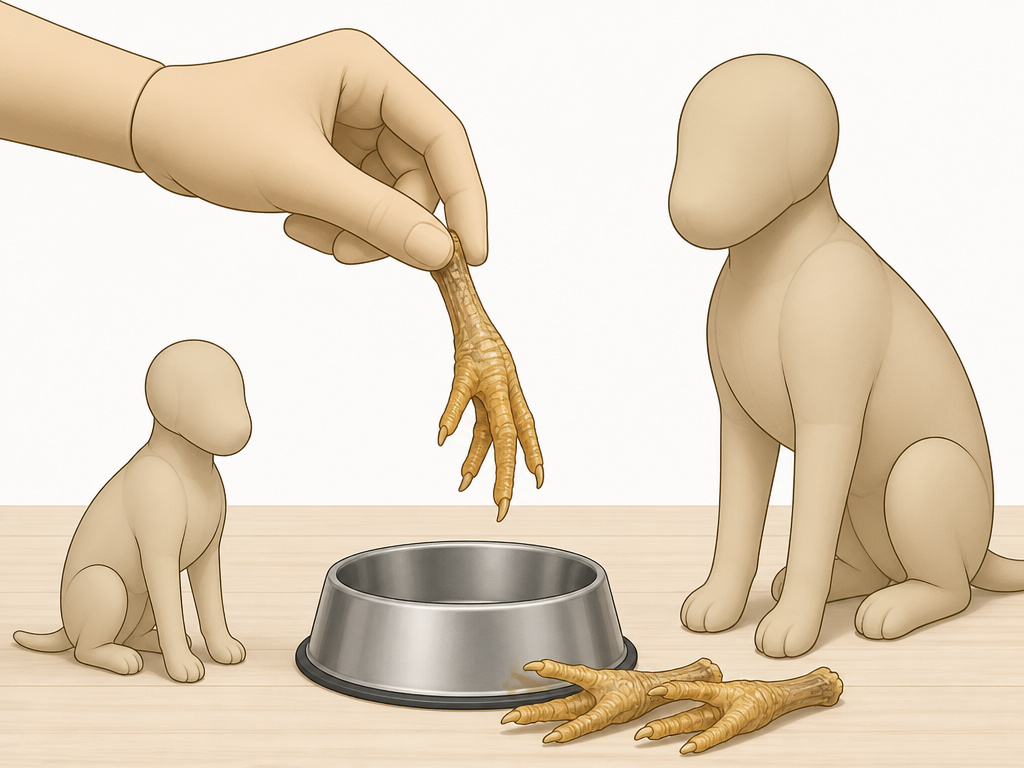
One to three dehydrated feet per day is a brand recommendation, not a clinical dose. Campfire Treats recommends that range depending on dog size and diet. Canine Joint Science counters that clinicians cannot prescribe a number of feet per day because no defined joint dose exists.
Both statements can be true. A feeding range for a treat is a different thing from a therapeutic dose for a joint condition.
What the Brands Say vs What Clinicians Can Prescribe
Canine Joint Science refuses to put a number on it at all, on the grounds that no label standardizes milligrams of glucosamine or chondroitin per foot. Both are describing the same product from different angles.
What actually changes the number:
- Dog size: a 10-pound terrier and a 70-pound retriever don’t get the same count.
- Chew style: a gulper gets none, regardless of size.
- Daily calorie budget: feet are a treat, not a meal replacement.
- Fat tolerance: pancreatitis-prone dogs get zero.
That’s the window to watch. If your dog vomits, goes off food, or strains to defecate inside that window, call your vet and stop the chews.
I’d start with one foot and watch the stool for a day. If you want a longer-lasting chew for a dog that finishes a foot in under a minute, long-lasting chews like bully sticks are a different format with a different risk profile.
Who Should Skip Chicken Feet Entirely

Some dogs should never get a chicken foot. Full stop.
- Gulpers and dogs that swallow without chewing.
- Dogs with pancreatitis or a history of it.
- Dogs on calorie restriction.
- Dogs with a diagnosed chicken allergy.
- Dogs with painful teeth or difficulty swallowing.
- Households with immunocompromised people.
Skip this if: Your dog guards food or chews. A bone-in chew in a resource-guarding dog turns a treat into a bite risk, and the fix is a different format, not a longer training session.
The Pancreatitis and Allergy Cases
Chicken is among the most common food allergens in canine diets. Total.vet lists pruritus, ear infections, and gastrointestinal distress as the typical reactions. Natural Farm flags the pancreatitis concern on the grounds that feet have a higher fat content, though the Brazilian trial found the back carried the most fat, not the feet. Trim and skin vary, so the fat concern is real even if the anatomy is more complicated than the marketing suggests.
The immunocompromised-household point comes from the same research that led the Delta Society Pet Partners Program to adopt a 2010 policy barring raw-fed animals from therapy programs. Pathogen shedding by raw-fed therapy dogs has been studied directly through a peer-reviewed raw feeding pathogen study, and the policy followed.
I wouldn’t argue with anyone who skips the category entirely. For dogs that need a chew but can’t handle bone, collagen chews are the usual substitute.
How to Pick a Bag and Handle It Safely
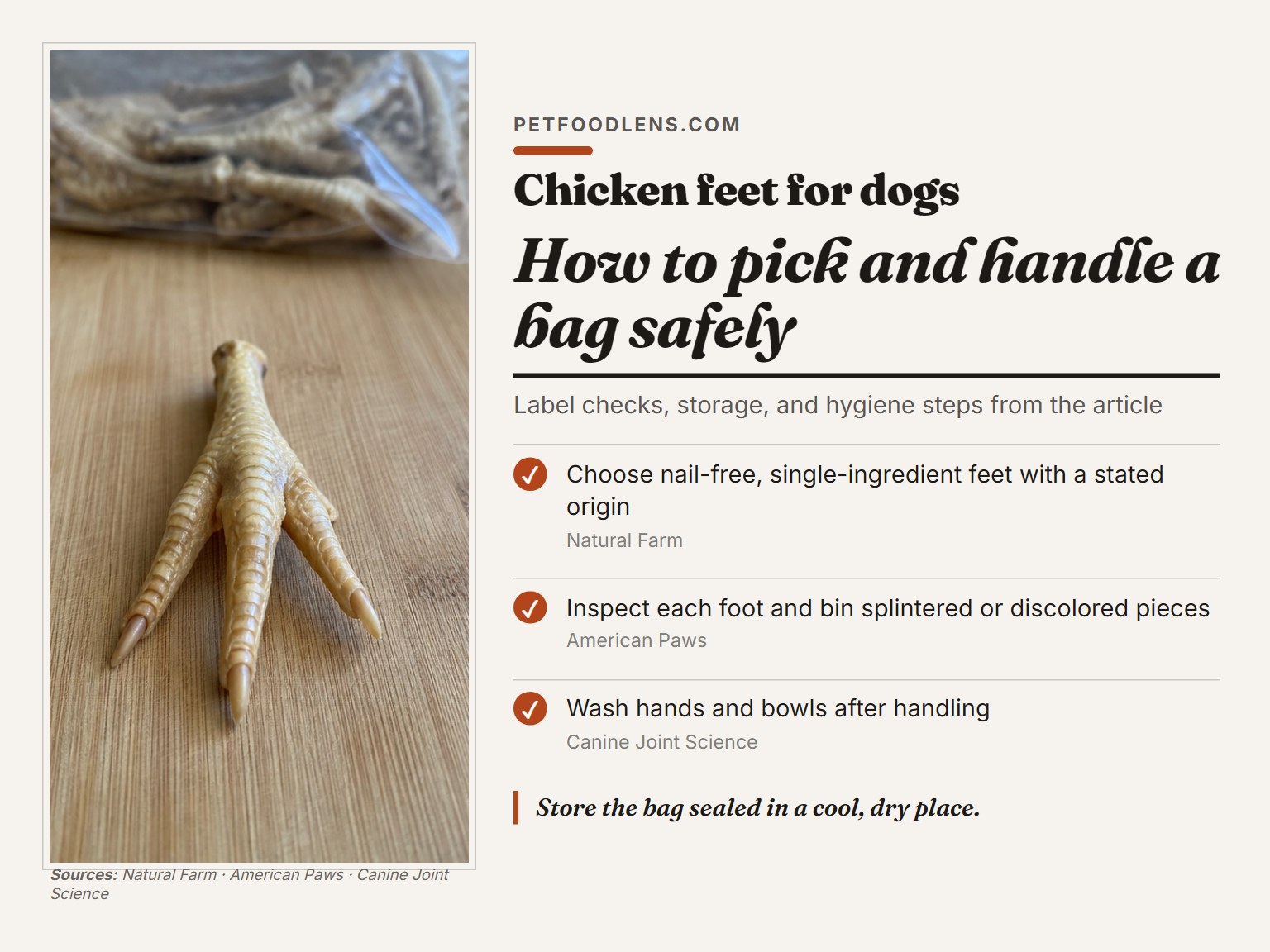
Turn the bag over. The front says joint support; the back tells you whether the feet are nail-free, single-ingredient, and where they were made.
A properly dried foot is rigid and matte, with no soft spots at the joint. A bag that smells faintly of ammonia or feels damp at the knuckle has been sitting somewhere warm, and that’s a return, not a treat.
Three brands do the label work for you. Campfire Treats dehydrated chicken feet are nail-clipped, made in Rocklin, California from USA-hatched birds, and certified by Global Animal Partnership under the Better Chicken Commitment. Natural Farm sells nail-free feet and positions them for puppies over three months, seniors, light chewers, and dogs with sensitive stomachs.
Here’s the handling sequence I’d follow:
- Inspect each foot before it goes in the bowl. A splintered or discolored piece gets binned, because a sharp fragment is the exact hazard the FDA warns about.
- Supervise the whole chew, start to finish. A foot that disappears in under a minute means your dog is a gulper, and the next one should be a different format.
- Provide fresh water alongside. Chewing works up a thirst.
- Wash hands and bowls after handling. Campylobacter and Salmonella transfer from the treat to you.
- Store the bag sealed in a cool, dry place.
I’m not a clinician, so I can’t tell you whether a specific foot is safe for a specific dog with a specific condition. What I can tell you is what the label commits to, and a bag that lists one ingredient and a US origin commits to more than a bag that lists “natural flavor.”
If you want a poultry alternative with a different texture, duck feet for dogs follow the same rules. Fish skin chews are the option for dogs that can’t do poultry at all.
Frequently Asked Questions
Are chicken feet safe for dogs?
Dehydrated, nail-free feet from Campfire Treats are one format; Campfire Treats calls their bones crushable and digestible, while The Spruce Pets and Canine Joint Science (citing the FDA) warn that dried bones may turn brittle and pose a hazard. Raw feet carry documented bacterial loads, and the sources disagree on whether the risk is worth it. The Spruce Pets advises against raw feet entirely; Total.vet says raw feet are safe when properly sourced and handled.
Do chicken feet really help with joint health?
The evidence doesn’t support a joint benefit. Feet contain cartilage and collagen, but no label standardizes milligrams of glucosamine or chondroitin per foot, so there’s no measurable dose. Treat feet as an occasional chew and buy a joint supplement with a milligram dose if joint support is the goal.
Can I give my dog raw chicken feet?
You can, and the sources split on whether you should. Total.vet says raw feet are safe when properly sourced and handled hygienically. The Spruce Pets says the risks outweigh the benefits. Natural Farm advises that feet should not be raw or overcooked. If you go raw, the kitchen hygiene burden is real.
How many chicken feet should I give my dog?
Start with one foot, watch the stool and behavior for 24 hours, and adjust from there.
Are dehydrated chicken feet better than raw?
Dehydrated feet are easier to store and handle, and commercial dehydration is a controlled process. Home dehydration is not automatically a pathogen-kill step, per American Paws, and a consumer dehydrator dial isn’t a Salmonella test. Commercial dehydrated feet from a maker with published sourcing are the lower-effort choice.
What happens if my dog swallows a chicken foot whole?
Choking and blockage are the risks, and they’re the reason gulpers should skip feet entirely. Call your vet if you see vomiting, straining, or refusal to eat.
The Bottom Line
Here’s the threshold I’d use: if your dog swallows a chew in under a minute, chicken feet are the wrong format. Pick a collagen chew or a bully stick instead.
For everyone else, a dehydrated, nail-free foot is a reasonable occasional chew and a poor joint supplement. Buy a bag you can read the label on, give one foot, and watch the stool for a day. If it comes out soft or your dog vomits, you have your answer.
And if your dog has pancreatitis, a chicken allergy, or a household member on immunosuppression, skip the whole category. Put the money toward a glucosamine supplement with a milligram dose on the label instead.
