
Bully Sticks Pros and Cons: Calories and Bacteria
This post contains affiliate links. As an Amazon Associate, we earn from qualifying purchases.
Bully sticks pros and cons are decided by two numbers: a 6-inch stick carries 54 to 132 kcal, and testing found bacterial contamination in 1 of 26 samples. They don’t splinter like bones, though cheap thin sticks can. Feed them as a treat, and count the calories.
The 54-to-132-kcal range is the part that gets buried on the bag. Two sticks can differ widely in calories, because density tracks thickness and drying as much as length. That spread is why the bully sticks pros and cons question comes down to the calorie math more than the “single ingredient” line on the front.
What follows is the honest split of bully sticks pros and cons: the calorie numbers, the splintering claims and who makes them, the bacteria data, and how to size a stick for a 12-lb terrier versus a 90-lb shepherd. By the end you’ll know whether a bully stick fits your dog’s diet or just your dog’s jaw.
Key Takeaways
- A 6-inch bully stick runs 54 to 132 kcal, and one 6-inch stick daily is 30% of a 10-lb dog’s daily calories.
- Splintering claims split by source: AKC, Chewy, and Natural Farm Pet say they don’t splinter; Bully Sticks Direct says cheap thin sticks often do.
- The Tufts study found C. Difficile, MRSA, and tetracycline-resistant E. Coli, each in 1 of 26 sticks tested.
- Remove the stick at 2 to 3 inches, or earlier if your dog’s muzzle is shorter than the remaining stick.
- Frequency is unsettled: Chewy’s expert feeds once a month, Natural Farm Pet says daily or every other day.
The Calorie Math Nobody Puts on the Bag
Grab a bag of bully sticks and check whether it carries a calorie statement. Most don’t carry one, because calorie information isn’t required on pet treats. That leaves the buyer guessing at a number the Tufts researchers had to measure in a lab.
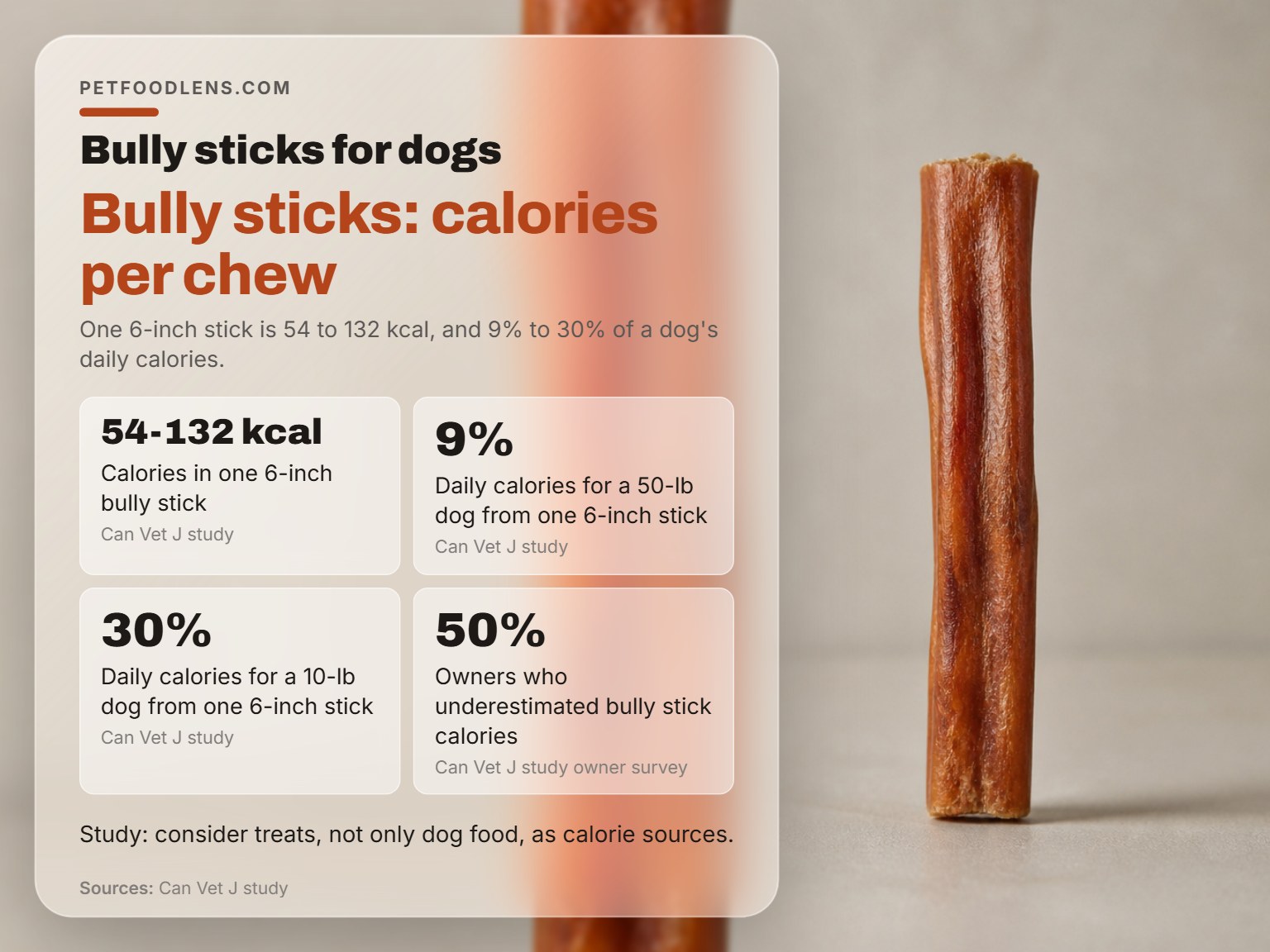
A 6-inch bully stick provides 54 to 132 kcal, and a 12-inch stick provides 108 to 264 kcal, according to proximate analysis published in the Canadian Veterinary Journal. Caloric density averaged 15 kcal per inch, with a range of 9 to 22 kcal per inch.
Read the label, not the packaging. The peer-reviewed bully stick treat research behind those numbers is the only public dataset that measures bully stick calories directly. The range is wide because density tracks thickness and drying, not just length. A fat 6-inch stick can out-calorie a skinny 12-inch one.
| Measure | Value | Note |
|---|---|---|
| 6-inch stick | 54-132 kcal | 9% of daily calories for a 50-lb dog |
| 12-inch stick | 108-264 kcal | Double the 6-inch range |
| Per inch | 9-22 kcal | Varies by thickness and drying |
| Per gram | 2.96-3.07 kcal | Tight range across samples |
That’s the range the bag doesn’t print.
I’ve read the fronts of enough bags to know the pattern: “supports” and “promotes” are the verbs that mean nothing, and “digestible” is the one bully stick packaging leans on hardest.
What 90 Calories Actually Looks Like
The Tufts authors used 90 kcal as the mean for a 6-inch stick, and that mean is 30% of a 10-lb dog’s daily calorie requirement. The same 90 kcal is 9% for a 50-lb dog. Half the owners surveyed in the same study underestimated bully stick calories, which is the gap this section is trying to close.
Run the math on your own dog. If your 10-lb dog gets a whole 6-inch stick every day, that’s about 30% of her daily calories coming from a chew. Cut the stick in half, or feed it every other day.
Do Bully Sticks Splinter? It Depends Who You Ask
The short answer: mainstream sources say no, and a specialist retailer says yes for cheap thin sticks. Both positions are on the record, and the disagreement is worth understanding before you buy.
| Source | Position on splintering |
|---|---|
| AKC | Don’t splinter like bones or some chews |
| Chewy | Won’t splinter like some chews |
| Natural Farm Pet | 100% digestible, won’t splinter |
| Bully Sticks Direct | Cheap thin sticks often splinter |
Where the Splintering Claims Come From
AKC and Chewy both compare bully sticks to bones and rawhides, which is the comparison that makes the “no splinter” claim sound absolute. Bully Sticks Direct is arguing from the opposite end: the failure mode it describes is a thin, cheap stick under heavy chewing, not a thick one.
Bully Sticks Direct tested over 50 power chewers across 40+ breeds and found standard sticks gone in under 15 minutes; it states its 12-inch monster braided sticks deliver 90 to 120 minutes of chew time. That gap is the whole argument for paying attention to construction.
Where this goes sideways: A thin, tapered stick concentrates force at the tip and poses greater tooth-fracture risk, according to Bully Sticks Direct. If the stick flexes easily at the end, it’s the wrong shape for a heavy chewer.
The practical takeaway: a thick or braided stick from a brand that tests its product is the safer bet for a dog that destroys standard chews. A cheap thin stick is the one the splintering warnings are about.
The Bacteria Question, and Where the Advice Splits
The Tufts study tested 26 retail bully sticks and found three pathogens across the sample: toxigenic C. Difficile in 1, MRSA in 1, and tetracycline-resistant E. Coli in 1. That’s a 4% contamination rate per pathogen. Each pathogen was found in 1 of 26 sticks tested.
The Tufts veterinary nutrition bully sticks summary is blunt about the limits. The sample was small, the authors called for larger studies, and the practical advice was awareness and handwashing. The authors didn’t recommend a specific brand.
Cooked vs Raw: A Difference the Sources Don’t Settle
Chewy’s expert buys cooked sticks and treats them as a monthly splurge. The Tufts authors didn’t recommend cooking as a mitigation; they recommended awareness, handwashing, and caution for high-risk households. Those are two different answers to the same hazard, and the sources don’t reconcile them.
What most people get wrong: Treating “single ingredient” as a safety claim. The Tufts study found pathogens in retail product, and the ingredient list doesn’t tell you how the stick was dried or handled.
What Size Bully Stick Should You Buy, and How Often?
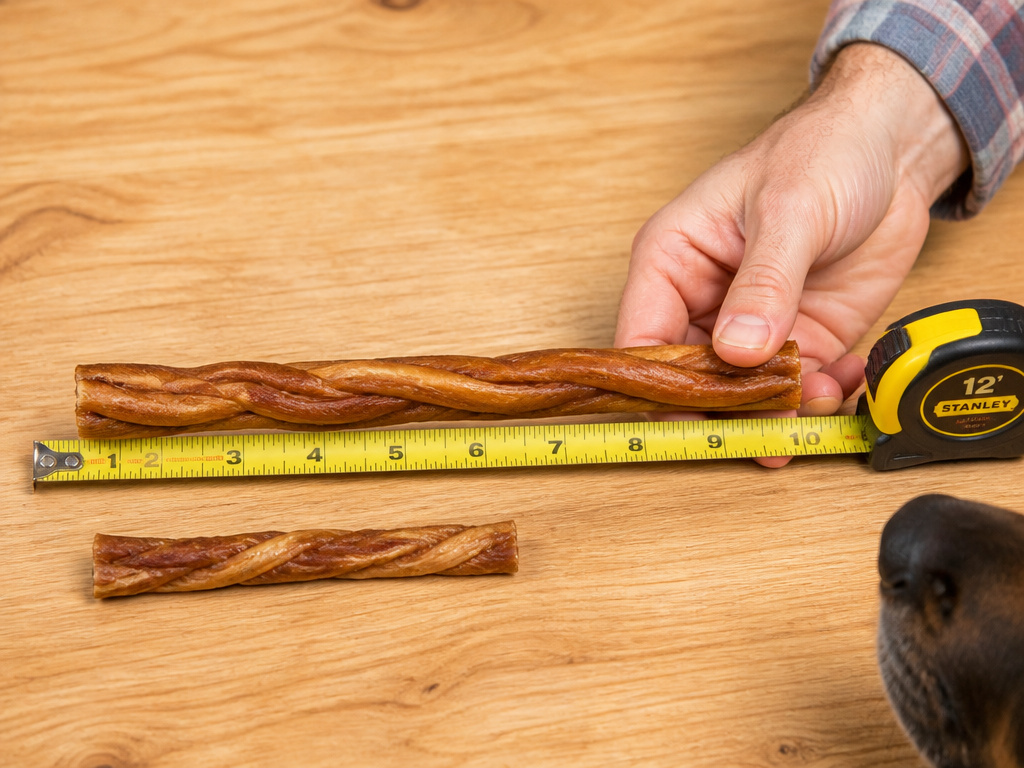
Three sources give three different starting sizes, and the disagreement is worth knowing before you buy a bag. If you’re still choosing between categories, the types of dog chews breakdown is the place to start.
Puppies: Three Sources, Three Answers
The AKC bully stick buying guide treats them as suitable for puppies that can chew hard food. Chewy says start with smaller, thinner sticks and move up as the puppy grows, and adds that bully sticks take too long to finish to work as a training treat. Natural Farm Pet says wait until adult teeth, around 6 months, and start with 10-to-15-minute chewing windows.
All three agree on supervision. None of them recommends leaving a puppy alone with a stick.
For sizing by weight:
- Under 15 lb: a thin 6-inch stick, or move up to Jumbo, Power Chews, or Cold-Dried if your dog finishes a 6-inch in under 30 minutes.
- 35 to 70 lb: a 9-inch stick; Bully Sticks Direct’s 9-inch product ran 60 to 90 minutes for this weight range.
Bully Sticks Direct recommends a chew longer than your dog’s muzzle measurement. That’s a better rule than weight alone, because a short-muzzled dog can choke on a stick a long-muzzled dog of the same weight handles fine.
On frequency, the sources split again:
- Chewy’s expert: about once a month, as a special treat.
- Natural Farm Pet: one per day or every other day for most dogs, every 2 to 3 days for small dogs.
- The Tufts authors: no specific frequency, but treats should count toward daily calories.
I’d split the difference. A bully stick is a treat. The calorie math in the first section is the number that should set the ceiling for your dog.
Bully Sticks vs Rawhide, Collagen, No-Hide, and Antlers
Bully sticks sit in a crowded category. The honest comparison is what each chew does under force, and how many calories it adds.
Rawhide is the traditional comparison, and the digestibility gap is real: rawhide chews are the traditional alternative, while bully sticks break down more readily.
For a broader ranking, the best chew treats list covers the whole category.
When to choose which:
- For a dog that finishes everything quickly: a braided bully stick.
- For a puppy: a thin bully stick, supervised, in a 10-to-15-minute window.
How to Pick a Stick: The Bend Test and the Nub Rule
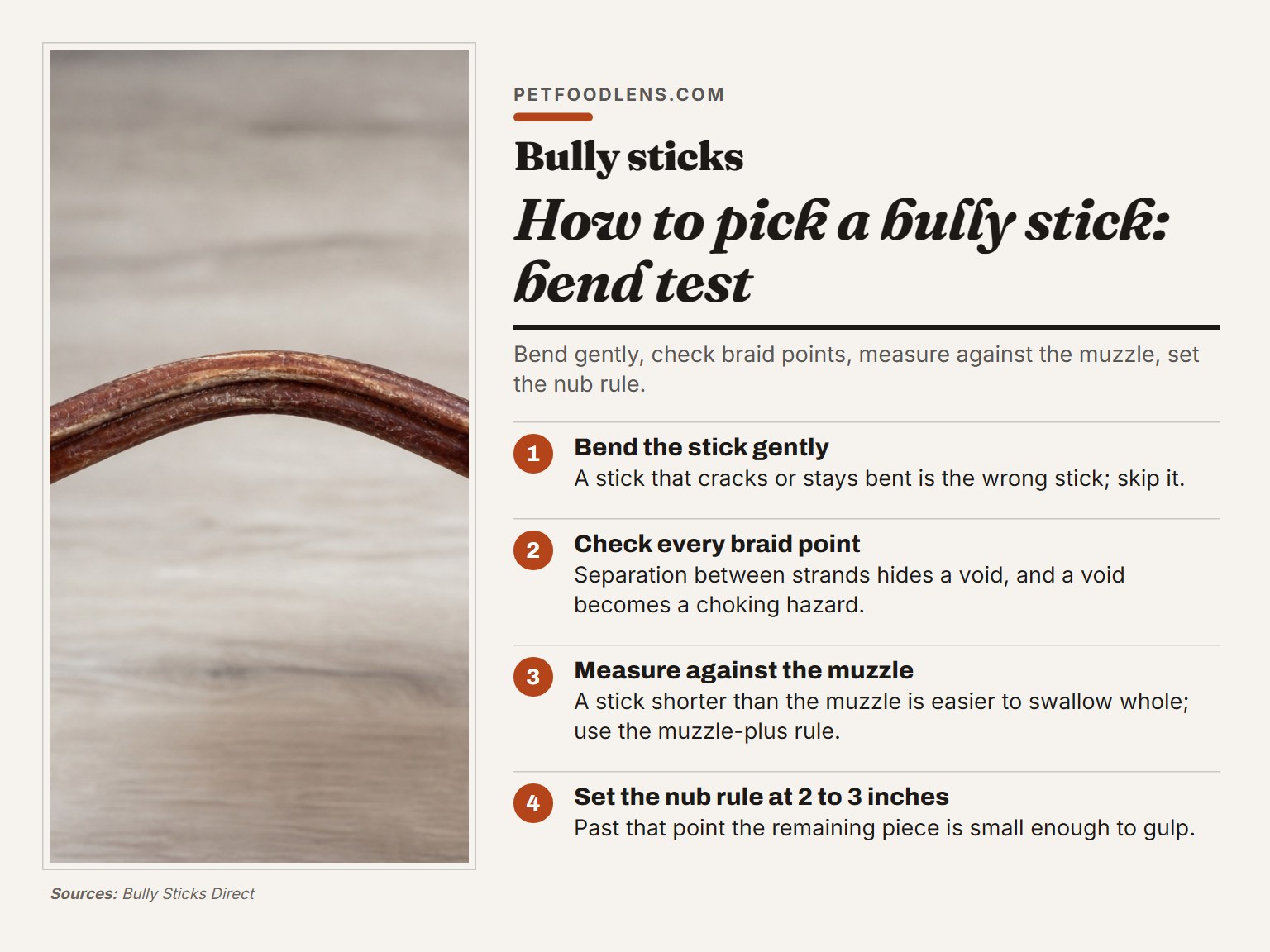
Hold the stick at both ends and bend it gently. A properly dried stick flexes a few degrees and springs back; a brittle one cracks before it breaks.
Before you start: Wear gloves if you suspect the stick may splinter, and test over a hard floor so fragments don’t catch in a rug. Discard any stick that cracks or shows separation between braid points.
The Bend Test, Step by Step
- Bend the stick gently at both ends. A stick that cracks or stays bent is the wrong stick; skip this and you find out under your dog’s back molars.
- Check every braid point on a braided stick. Separation between strands hides a void, and a void becomes a choking hazard mid-chew.
- Measure the stick against your dog’s muzzle. A stick shorter than the muzzle is easier to swallow whole; the muzzle-plus rule is the cheapest fix.
- Set the nub rule at 2 to 3 inches. Past that point the remaining piece is small enough to gulp, and a gulp is where most choking incidents start.
- Offer one stick at a time, and supervise. Two sticks in the same room means a dog can guard one and swallow the other; one at a time removes the competition.
A properly dried stick bends a few degrees and springs back. A brittle one cracks audibly before it breaks, and that crack is the sound of a stick that will splinter under a heavy chewer.
If your dog finishes a 12-inch stick in under 30 minutes, the next one should be braided, jumbo, or cold-dried. A standard stick that disappears in 15 minutes is a calorie delivery system. Move up to a construction that lasts.
The brands that test their product are the ones worth buying. Bully Sticks Direct’s 12-inch Monster Braided is the reference point for power chewers.
I read labels for a living. X-rays are the vet’s job. If your dog has a cracked tooth or a sensitive gut, the vet’s call beats mine.
Frequently Asked Questions
Are bully sticks safe for puppies?
They can be, with conditions. The AKC says they’re suitable once a puppy can chew hard food, Chewy recommends starting with smaller, thinner sticks, and Natural Farm Pet says to wait until adult teeth around 6 months. All three agree on supervision and short chewing windows.
How many calories are in a bully stick?
6-inch stick runs 54 to 132 kcal, and a 12-inch stick runs 108 to 264 kcal, per the Tufts study. The mean used for daily-calorie math is 90 kcal for a 6-inch stick, which is 30% of a 10-lb dog’s daily requirement.
Do bully sticks splinter?
Mainstream sources (AKC, Chewy, Natural Farm Pet) say no. Bully Sticks Direct says cheap, thin standard sticks often do under heavy chewing. The disagreement is about construction quality, and the bend test is the practical way to tell which stick you have.
How often can I give my dog a bully stick?
There’s no consensus. Chewy’s expert feeds about once a month, Natural Farm Pet says one per day or every other day for most dogs, and the Tufts authors say to count the calories against the daily total. For a small dog, the calorie math is the binding constraint.
What size bully stick should I buy?
Bully Sticks Direct’s muzzle-plus rule is the most practical: choose a chew longer than your dog’s muzzle measurement. For weight-based sizing, a thin 6-inch fits dogs under 15 lb, a 9-inch fits 15 to 70 lb, and a 12-inch braided fits dogs over 70 lb.
Are bully sticks better than rawhide?
For digestibility, yes. Rawhide can sit in the stomach for days, while bully sticks break down more readily. It depends on which problem you’re trying to solve.
The Bottom Line
The threshold I’d give a friend: if your dog is under 15 lb and you’re feeding a whole 6-inch stick more than twice a week, the calories are the problem before the bacteria are. Cut the stick in half, or move to a thinner 6-inch and count it against dinner.
The splintering debate won’t be settled by one article. What will settle it is the bend test in your own kitchen, on the actual stick in front of you.
I’d rather see a dog work on a braided 12-inch stick for 90 minutes than inhale a thin 6-inch in 10. Duration is the point. A bully stick that lasts is a chew; one that disappears in 15 minutes is a calorie.
