
Types of Dog Chews: What Digestibility Numbers Say
This post contains affiliate links. As an Amazon Associate, we earn from qualifying purchases.
There are three types of dog chews you’ll meet on a shelf: minimally processed animal parts (bones, ears, bully sticks, antlers), extensively processed animal products (rawhide, compressed rawhide), and non-animal chews (plant-based, plastic, rubber). EU Regulation 142/2011 requires 90 degrees Celsius heat treatment for animal by-product chews other than ungulate hides/skins or fish.
That 90-degree line only covers chews built from animal by-products. Hides, skins and fish get a different test altogether: treated well enough to destroy Salmonella, and dry at the point of sale. Two bags of different types of dog chews can sit side by side on the same shelf, made to two different rulebooks, and neither front panel tells you which.
What follows is the three-class breakdown, the digestibility numbers that separate a bully stick from a knotted rawhide, and the four named chews you’re most likely holding right now. Plus the calorie arithmetic almost no chew bag prints.
Key Takeaways
- Gastric dry matter disappearance across 25 commercial treats ranged from 8.40% to 92.20%, and rawhide showed the widest spread of any category.
- Keep treats under 10% of calories. Veterinary nutrition guidance puts the ceiling at no more than 10% of daily caloric intake, while FEDIAF allows the same 10% averaged over a week or a day, and most chew bags never mention it.
- A chew should be too big to fit entirely in your dog’s mouth. That single sizing rule does more than any hardness claim on the packaging.
- Minimally processed chews are exempt from AAFCO registration and aren’t required to carry a calorie statement or a guaranteed analysis.
- Retire nylon and polymer chews once they wear into thin sections. Those sections break off and get swallowed.
The Three Classes of Dog Chews, and Why the Regulator Counts Differently
EU Regulation 142/2011 defines a dog chew as a product for pet animals to chew, produced from untanned hides and skins of ungulates or from other material of animal origin. That definition is a lot narrower than the aisle you’re standing in.
Chews made from hides, skins, or fish must be treated enough to destroy pathogenic organisms including Salmonella, and must be dry. Chews made from other animal by-products must be heat-treated to at least 90 degrees Celsius throughout their substance. Random samples are taken during production or storage to verify Salmonella and Enterobacteriaceae compliance.
Now the clinical view. A 2024 peer-reviewed review in Today’s Veterinary Practice sorts chews into three top-level classes, and it counts plastic and rubber items as chews. The regulator does not. Hold both definitions in your head and the rest of this article makes sense.
| Class | Typical examples | Best for | Avoid if |
|---|---|---|---|
| Minimally processed animal | Bones, ears, hooves, antlers, bully sticks | Slow chewers, supervised sessions | Your dog has fractured a tooth before |
| Extensively processed animal | Rawhide, compressed rawhide, meat-meal chews | Moderate to light chewers | Your dog tears off and swallows chunks |
| Non-animal | Plant-based edibles, nylon, rubber | Heavy chewers that destroy edibles | The item has worn into thin sections |
The class predicts the failure mode. Minimally processed animal parts fail by being hard: fractured teeth, splinters, a slab of bone that doesn’t budge in the stomach. Extensively processed chews fail by coming apart in chunks. Non-animal chews fail at the end of their life, when the worn tips go thin and snap off.
Before you buy anything, run the class check first. The safe chew guide puts the same three categories into a five-minute checklist.
What the Digestibility Numbers Actually Say
Gastric dry matter disappearance across 25 commercial treats ranged from 8.40% to 92.20%. That’s the closest thing the literature has to a safety score, and it’s worth understanding before you spend anything.
Dry matter disappearance, or DMD, measures how much of the chew dissolved in a simulated stomach and then a simulated intestine. Higher means more of it breaks down. Lower means more of it reaches the gut intact.
In that peer-reviewed assay, intestinal-phase DMD ran from 35.10% to 100%. Meat, dental, chew, biscuit and cat treats all cleared 85% at the intestinal phase. Rawhide ranged from 35.10% to 95.70%, the widest spread of any category. Individual rawhide samples landed at 8.41%, 15.63%, 42.05% and 86.90% in the gastric phase. The in vitro pet treat evaluation study separated rawhide from every other category on principal component analysis, which is a statistical way of saying it didn’t behave like the rest of the shelf.
Three numbers worth carrying into the store:
- 8.40% was the lowest gastric dry matter disappearance across the 25 commercial treats tested.
- 85% is the intestinal DMD that meat, dental, chew, biscuit and cat treats all cleared.
- Bone finished last in both phases across a separate 19-treat study, with gastric DMD from 6.9% to 88.8% and intestinal DMD from 10.7% to 100.0%.
If a chew’s gastric digestibility is very low, treat it as an occupier, not a food. It’s holding your dog’s attention for a while. It isn’t feeding him, and it shouldn’t be counted as if it were.
A chew at 8% gastric DMD still has a job. It stays largely intact in the stomach, which is exactly what you want from something designed to occupy and exactly what you don’t want from something your dog swallows in chunks. I had to look up what DMD stood for the first time I read one of these papers, and I read labels for a living. The acronym is doing a lot of quiet work.
Are Rawhide Chews Actually Safe? Two Sources, Two Answers
Ask that question of two credible sources and you get two different answers, which is the most useful thing about it.
The ASPCA treats rawhide as an ordinary chew category. Its ASPCA dog chew position statement advises limiting how much rawhide a dog consumes at any one time and discouraging consumption of significant pieces. It also notes that obstruction may be more likely in smaller dogs.
The digestibility research lands somewhere else. That same assay flagged rawhide as the category with the lowest and most variable gastric DMD, down to 8.40%, and named low gastric DMD as a concern because it may pose a risk for gastrointestinal blockage.
Both are describing the same product. The ASPCA is talking about portion control in a normal chew. The study is talking about what fraction of it survives the stomach. Neither one is wrong, and neither one is the whole picture. My read: rawhide is a supervised, occasional chew for a moderate chewer, and a poor default for a dog that tears chunks off and swallows them.
There’s a third risk that has nothing to do with digestibility. In 2017 United Pet Group, a division of Spectrum Brands, recalled multiple rawhide brands after its own facilities in Mexico and Colombia and a supplier in Brazil used a quaternary ammonium compound mixture as a processing aid. The compound is approved for cleaning food-processing equipment. It was not approved in the US as a processing aid in rawhide production.
Easy to miss: The recall covered American Beefhide, Digest-eeze, Healthy Hide, Healthy Hide Good-n-Fit and Healthy Hide Good-n-Fun, with expiration dates from 06/01/2019 through 05/31/2020. American Beefhide lots started with AH; the other brands used AH, AV, A, AI, AO or AB. Reported signs were reduced appetite, diarrhea, vomiting and gastric irritation.
The FDA rawhide chew recall notice is the primary record if you still have a bag in the cupboard. The rawhide chews comparison lays the digestibility spread and the recall history side by side, which is the honest way to read this category.
Most Chew Labels Give You Nothing to Size Against
Most chew labels give you nothing to size against. There’s no legal hardness standard for dog chews anywhere, and minimally processed chews are exempt from AAFCO registration and labeling, so a calorie statement and a guaranteed analysis aren’t required either.
What you do control is size. The AKC’s rule is the one I’d keep: pick an edible chew large enough that the dog can’t get the entire thing in its mouth at once.
Hardness is murkier, and the two main sources test it differently. Dr. Lori Teller at Texas A&M suggests trying to indent a nylon toy with a thumbnail and avoiding options hard enough to break teeth. FEDIAF frames it as avoiding chews that aren’t bendy and malleable or don’t soften quickly when chewed, and notes there’s no legal hardness standard to fall back on. Both point the same direction, and neither hands you a number. The Texas A&M vet chew toy guide is the fuller version of that thumbnail test.
Before you start: A chew small enough to swallow whole is a choking risk, and a chew hard enough to resist a thumbnail can fracture a carnassial tooth. Match the chew to your dog’s body weight and run the thumbnail test before the first session. Supervise every chew until you know how that particular dog chews.
Four checks, done before the bag is open:
- Fit test. If the whole chew disappears into your dog’s mouth, it’s too small. Matching the chew size to your dog’s body weight reduces choking risk, and it costs you nothing but shelf space.
- Thumbnail test. Press a thumbnail into the surface. A chew that won’t take a mark is in antler territory, and when antlers became popular, veterinarians and veterinary dentists noticed an uptick in fractured teeth and began cautioning owners to avoid them.
- Bend test. Try to flex it. A chew that won’t bend and won’t soften in the mouth is the exact profile FEDIAF warns about.
- Wear check. Look at the ends before every session. Nylon and polymer chews develop thin, flexible sections as they wear, and those sections are what break off.
The chew size breakdown covers the weight bands in more detail if you’re between two sizes.
Bully Sticks, Antlers, Yak Cheese, and No-Hide: Four Named Chews
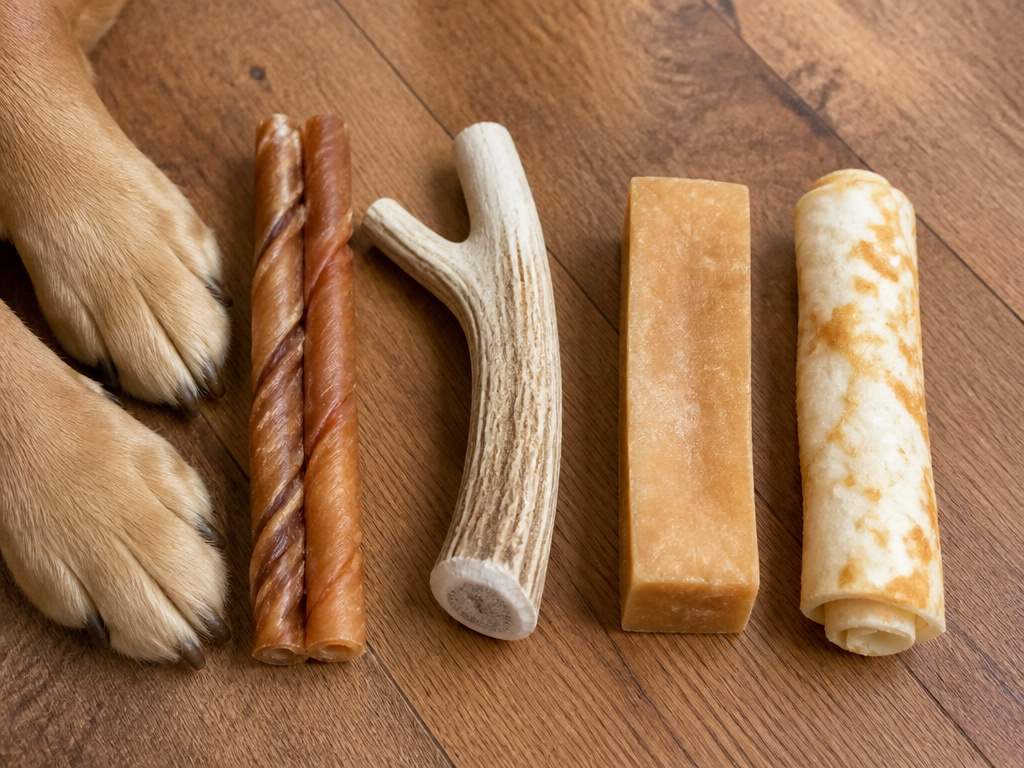
Four chews come up more than any others in my inbox, and they fail in four different ways.
Bully Sticks
Single-ingredient beef muscle, and they don’t splinter. The end softens as the dog works it down and acts like a toothbrush against the tooth surface. That softening is the reason they sit in a different risk band from a bone, and it’s the reason a heavy chewer can finish one in a sitting. The bully sticks breakdown covers thickness, braiding and how fast each format disappears.
Antlers
Antlers are hard enough to be genuinely long-lasting, and hard enough to break teeth. When they became popular, veterinarians and veterinary dentists noticed an uptick in fractured teeth and started cautioning owners to avoid them. The FDA warns against real bones for the same reason: cuts in the mouth and fractured teeth. The antler chews write-up collects the fracture reports in one place.
Yak Cheese Chews
Yak’s milk, sometimes cow’s milk, plus salt and lime juice. Lactose content is low, and they’re hard enough to last a while. They’re hard enough to last a while, so follow the general guidance to avoid excessively hard chews. Small leftover pieces can go into the microwave in short bursts until they puff, then cool and crunch as a treat. The yak cheese chews comparison covers the lactose question and the microwave method.
Common mistake: Handing over a bully stick and leaving the room because it “doesn’t splinter.” Splintering is one failure mode. Swallowing a length whole is another, and it can happen in the moments you’re in the other room.
Rawhide’s variability sends a lot of people looking for a substitute. No-hide chews are the category to read up on next, and the same sizing and supervision rules follow them over.
The Ten Percent Rule and the Calories Nobody Prints
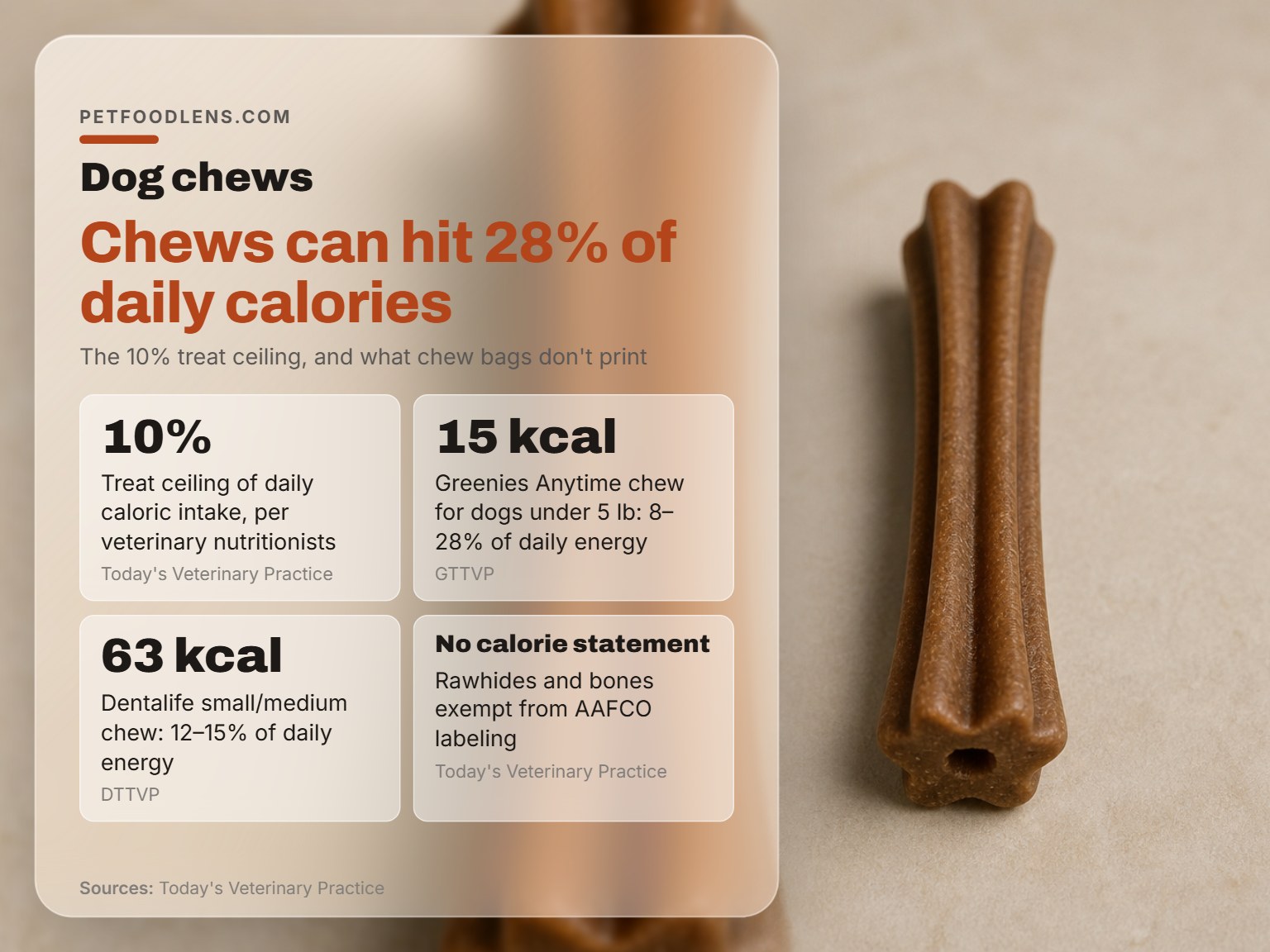
Ten percent is the ceiling most veterinary nutritionists put on treats, stated as no more than 10% of daily caloric intake, while FEDIAF allows the same 10% averaged over a week or a day, and it’s a ceiling almost no chew bag mentions.
The 2024 review in Today’s Veterinary Practice states it as no more than 10% of the dog’s daily caloric intake. FEDIAF states it as no more than 10% of a pet’s caloric average intake over a week or day. Same number, different accounting window, and the daily version is the stricter of the two.
Chews complicate this because they aren’t “food” by the FDA’s reckoning. Minimally processed bones, other body parts, rawhides and compressed rawhides are exempt from AAFCO registration and labeling, and labels don’t have to carry a calorie statement or a guaranteed analysis. A chew can deliver a real share of the day’s calories and print nothing at all.
| Product | Size band | kcal per chew | % daily energy |
|---|---|---|---|
| Greenies Teenie | 5-15 lb | 26 | 6-14% |
| C.E.T. Chews small (Virbac) | 11-25 lb | 32 | 5-10% |
| Dentalife small/medium (Purina) | 15-20 lb | 63 | 12-15% |
| Milk-Bone Brushing Chews Mini | 5-25 lb | 30 | 5-17% |
Look at the small-dog rows. Greenies Anytime for dogs under 5 lb is 15 kcal, which lands at 8% to 28% of daily energy requirement depending on the dog. That’s one chew, and at up to 28% of daily energy requirement it can take a large share of the day’s calories before dinner is served.
What the calorie table doesn’t tell you
The percentage column is calculated as 1.4 times (70 times body weight in kilograms to the 0.75 power), applied across the whole weight band. A 6-pound dog and a 14-pound dog both sit in the Teenie row, and their percentages aren’t the same. The table gives you a range because it has to.
This is where I’d do the arithmetic myself. Weigh the dog, work out the daily energy requirement, take 10% of it, and see how many chews actually fit. The front of the bag is the showroom shine. The calorie math is the engine spec, and the engine spec is what decides whether your dog gains weight.
I’m not a clinician, and I don’t treat dogs. If your dog is on a therapeutic diet or has a diagnosed condition, the 10% rule isn’t the tool you need. That’s a conversation for your vet.
Where Chewing Goes Wrong: Supervision, Multi-Dog Houses, and Worn Chews
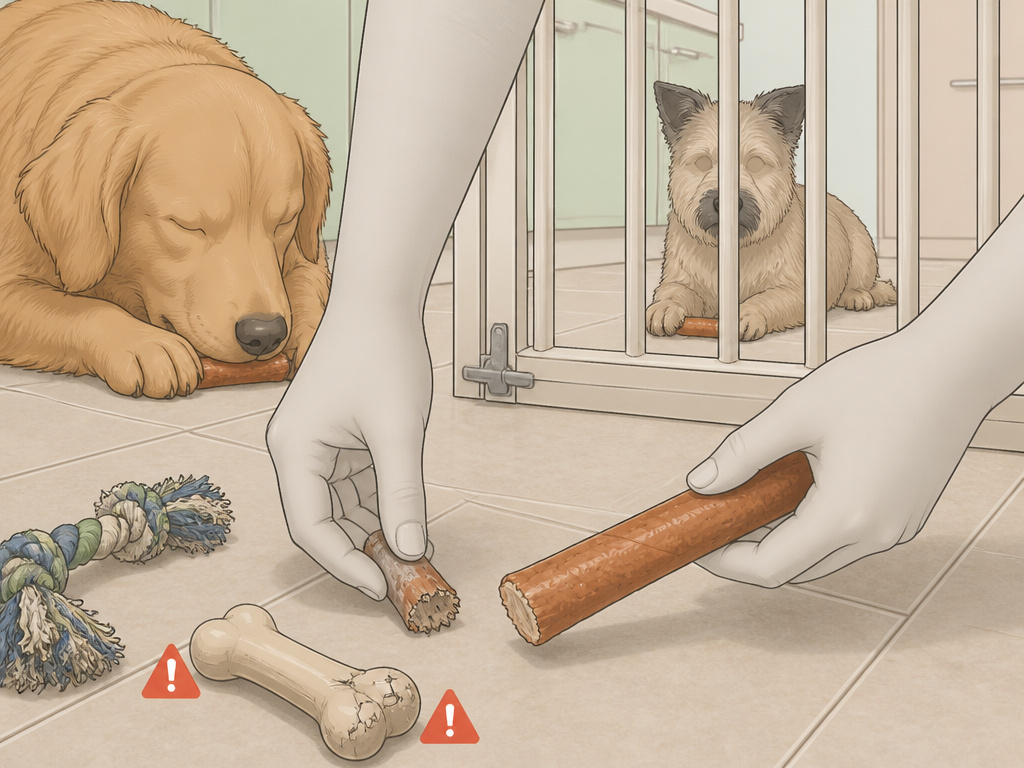
Two dogs, one kitchen, one bully stick. The faster dog swallows half of it quickly because the slower one is watching.
Texas A&M’s guidance is to separate dogs when giving chew treats, to remove competition and the urge to gulp before another dog takes it. That single change removes competition and the urge to gulp a treat before another dog can steal it, and it costs you nothing.
Supervision covers the rest. The ASPCA recommends actively observing a dog while chewing and calling a vet immediately if the dog consumes a chunk of chew material. FEDIAF says dogs should always be supervised with chews and treats. The chew items for dogs and cats criteria from the AHVMA make a checklist for what a chew should do: interesting enough to hold attention, long-lasting or safely frequent, low calorie for its nutritional contribution, proven to reduce plaque, not excessively hard, and low risk of choking or obstruction. Six criteria, and a lot of products on the shelf fail at least two.
Stop the session when any of these shows up:
- The chew has worn down to a piece small enough to swallow whole.
- A nylon or polymer chew has developed thin, flexible sections at the ends.
- A rope toy has started to fray. Loose string in the GI tract is a surgical problem.
- Your dog has switched from chewing to gulping.
- You’ve found a chunk missing and you didn’t see it go.
The part nobody mentions: Raw chews may carry no use-by date and no storage-time indication at all. That’s a spoilage and mold risk you won’t find on a processed chew, and it’s why a bully stick that’s been in a cupboard since spring smells different from a fresh one.
How long a session should run is its own question. The chew duration piece covers the timing and the signs that a dog has had enough.
Frequently Asked Questions
What are the main types of dog chews?
Three top-level classes: minimally processed animal parts like bones, ears, hooves, antlers and bully sticks; extensively processed animal products like rawhide and compressed rawhide; and non-animal chews, which covers both plant-based edibles and plastic or rubber items. The class tells you the likely failure mode before you buy.
Is rawhide bad for dogs?
Two credible sources frame it differently. The ASPCA treats rawhide as a normal chew category and advises limiting how much a dog consumes at any one time. The digestibility literature flags rawhide as the category with the lowest and most variable gastric dry matter disappearance, down to 8.40%. Both are describing the same product from different angles.
Are antlers safe for dogs?
They’re hard enough to be long-lasting and hard enough to fracture teeth. When antlers became popular, veterinarians and veterinary dentists noticed an uptick in fractured teeth and began cautioning owners to avoid them. FEDIAF’s general guidance is to avoid chews that aren’t bendy and malleable.
How big should a dog chew be?
Large enough that your dog can’t get the entire thing in its mouth at once. That’s the AKC’s rule and it’s the sizing lever you actually control, since there’s no legal hardness standard and most chew labels give you nothing to measure against.
How many calories should a chew be?
Under 10% of your dog’s daily caloric intake per veterinary nutrition guidance, or the same 10% averaged over a week or a day per FEDIAF. FEDIAF allows the same 10% averaged over a week or a day. Watch the small-dog products especially: Greenies Anytime for dogs under 5 lb is 15 kcal, which can run 8% to 28% of daily energy requirement.
Are bully sticks safer than rawhide?
Bully sticks are single-ingredient beef muscle and they don’t splinter, which removes one failure mode. They still present a choking risk if a dog swallows a length whole, and they’re still calorie-dense. Neither category is safe without supervision and correct sizing.
The Bottom Line
Here’s the threshold I’d actually use. If your dog can get the whole chew in his mouth, or if your thumbnail won’t leave a mark on it, put it back on the shelf. Those two tests catch most of what goes wrong, and neither one asks you to trust the front of a bag.
This all changes if your dog has fractured a tooth before, has a sensitive gut, or destroys everything you hand him in under a minute. In those cases the class table matters more than any individual product, and your vet should be picking rather than me.
I’d rather see a plain, correctly sized chew from a company that prints a calorie statement than a novelty antler with a story on the front. Read the label, not the packaging.
