
Duck Feet for Dogs Pros and Cons: Is It Worth It?
This post contains affiliate links. As an Amazon Associate, we earn from qualifying purchases.
Duck feet for dogs pros and cons start with composition: Carnos puts them at 60% bone and 40% meat, sold as a supplemental chew, not a meal. The pros are crunch, collagen, and a chicken-free protein. The cons are hard bone texture, feeding limits that differ tenfold between brands, and no clear fit for small dogs.
That 60/40 split is one seller’s number. Empaw Raw describes the same product as mostly bone and cartilage with minimal meat, and both descriptions can be accurate depending on how much tissue is left on the foot after processing.
Which matters, because a foot that’s 40% meat is a different treat from a foot that’s 10% meat. The bag won’t tell you which one you’re holding.
What follows is the label-level version: what’s in the foot, why the feeding charts can’t agree, which dogs should skip it, and what the joint numbers on the bag are actually worth.
Key Takeaways
- Carnos publishes 60% bone and 40% meat, while Empaw Raw calls the same product mostly bone and cartilage. Expect a hard, crunchy chew, not a meaty one.
- Use the chart on the bag in your hand.
- Two of the three brands that publish a weight cutoff put the floor at 15 to 20 lb, while Carnos lists small dogs as suitable.
- Farmland Traditions recommends starting new chewers with sessions of just 3 to 5 minutes. Bella & Ni Pets calls the same category a longer-lasting chew.
- Farmland Traditions publishes joint numbers on its bag. Those numbers are worth comparing before you treat joint support as the reason to buy.
What Are Duck Feet Actually Made Of?
Carnos publishes the only bone-to-meat ratio in this category: 60% bone, 40% meat, on average.
A duck foot consists of skin, tendon, cartilage, and bone, with the amount of attached meat varying by supplier and processing method. Freeze-drying and air-drying remove moisture without cooking the tissue. Farmland Traditions describes the resulting bone as soft, porous, and fully edible, and single-ingredient labels list one item because nothing else is added.
Empaw Raw looks at the same product and calls it mostly bone and cartilage with minimal meat. Both descriptions hold up. The difference is how much tissue stays on the foot after processing, and only Carnos puts a percentage on it.
Here’s what you’re actually paying for:
- Skin and tendon, the collagen-bearing parts. This is what makes the foot chewy rather than just hard.
- Cartilage, the gristly tissue at the joint ends.
- Bone, the structural part, and the reason the chew is as hard as it is.
- Meat, if any is left on. Carnos says 40%. Empaw Raw says minimal.
An air-dried foot cracks dry and hollow under a dog’s back teeth, closer to a stale crouton than to a knuckle bone. That texture is the whole point of the product.
Duck is also used as duck dog food protein for dogs that react to chicken, and Farmland Traditions positions its feet the same way.
Why the Feeding Charts Disagree by a Factor of Ten
Before you start: A duck foot is bone, and bone breaks into pieces small enough to swallow whole. Feed one foot at a time on a floor you can sweep, and take away any fragment smaller than a thumbnail before it goes down. Keep fresh water within reach for the entire chew.
Here are the published numbers, side by side:
| Brand | Published daily limit | Published calories |
|---|---|---|
| Bella & Ni Pets | 1 foot at 20-50 lb; 2 feet over 50 lb | 51 kcal per foot |
| Farmland Traditions | 8 feet at 24-49 lb; 12 feet at 50+ lb | 44 kcal per foot |
| Freezbone | 3 feet at 30-50 lb; 4 feet at 50-75 lb | 4,200 kcal/kg |
Run the arithmetic on Farmland’s chart and it gets strange. Eight feet at 44 calories each is 352 calories from treats, before the dog eats any food. Bella & Ni Pets sets a far smaller allowance, at 1 foot per day for a 20 to 50 lb dog.
The calorie densities don’t line up either. Bella publishes 3,595 kcal/kg, Farmland 3,385 kcal/kg, and Freezbone 4,200 kcal/kg, all for what the labels call single-ingredient duck feet.
That’s a wide spread across products that are supposedly the same thing. Fat content varies across the same three brands.
My read: the charts are internally consistent with each brand’s own product, and useless as a general rule. Use the bag you bought.
Are Duck Feet a Long-Lasting Chew?
Bella & Ni Pets sells duck feet as a bigger, longer-lasting chew that keeps dogs busy. Empaw Raw answers the same question on its own product page with a flat no.
Farmland Traditions splits the difference by recommending short chewing sessions of just 3 to 5 minutes for new chewers. That’s the most useful number in this whole category, and it tells you the chew is a snack.
If you want a longer quiet chew, bully sticks are the closer comparison. Harder options like antler chews last longer and carry their own fracture risk.
Rule of thumb: If a chew is gone quickly, buy it for the crunch and the collagen, and buy something else for the longer chew you actually wanted.
New chewers need a ramp. Farmland recommends starting with sessions of just 3 to 5 minutes and building over the week, which is the opposite of what most people do with a new bag.
Duck Feet vs Chicken Feet
Duck feet sit in the same family as chicken feet, just larger. Empaw Raw describes them as slightly bigger with a firmer crunch.
The practical difference is size, not nutrition. A chicken foot is the easier starting point for a dog new to boney chews, and a duck foot is the step up once the dog has the hang of it.
The Dogs That Should Skip Duck Feet
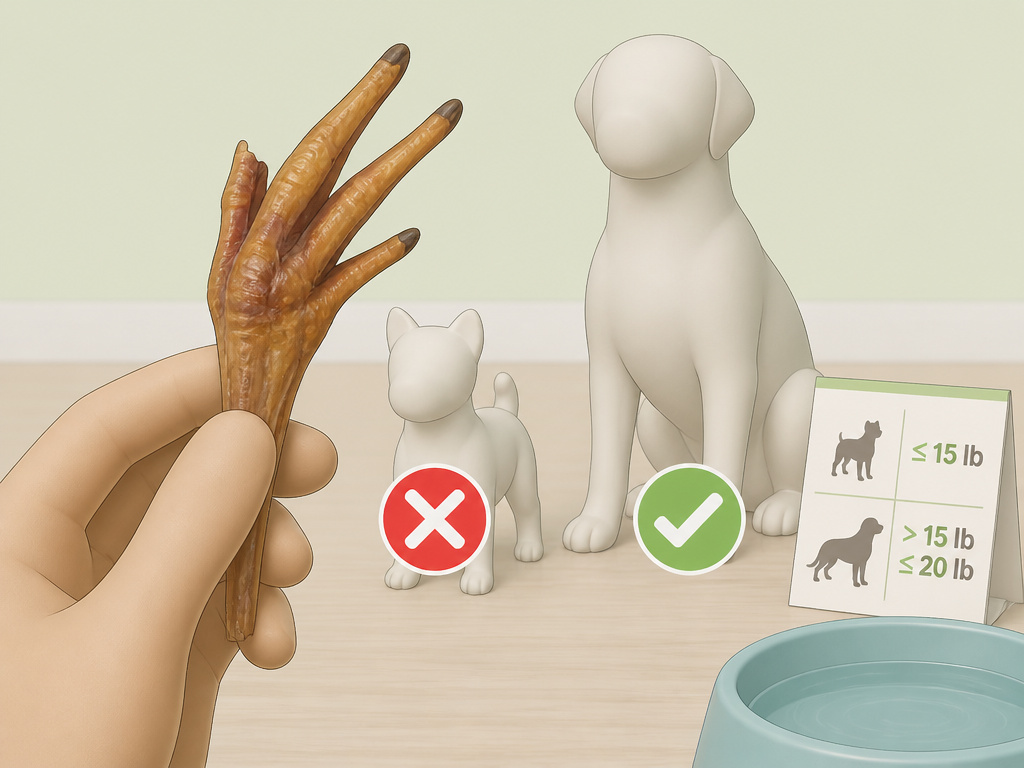
A 12 lb terrier and a 70 lb lab should not get the same chew, and the brands don’t agree on where the line sits.
| Dog | Verdict | Reason |
|---|---|---|
| Under 15 lb | Skip | Farmland says not suitable; Bella says one foot exceeds the daily allowance |
| 15-20 lb | Read the bag | Farmland allows 15 lb up; Bella does not recommend under 20 lb |
| Puppies | Conflicting advice | Carnos lists puppies; Farmland says not for puppies |
| Dogs that gulp | Skip | Bella excludes dogs that swallow without chewing |
| Cats | Conflicting advice | Carnos says dogs and cats; Bella and Empaw say dogs |
Carnos lists small dogs as suitable alongside seniors, pregnant dogs, and high-activity dogs, while Bella & Ni Pets does not recommend duck feet under 20 lb and Farmland Traditions sets the floor at 15 lb. Two brands publishing a cut-off both put it at 15 lb or higher.
Where this goes sideways: A dog that swallows without chewing never gets the crumble-and-break behavior the brands describe. The foot goes down whole, and the bone reaches the stomach intact. Watch the first foot closely, not the tenth.
Supervision is the one instruction every brand repeats. Farmland goes further and tells you to remove small pieces as they appear, because breaking apart is normal for an air-dried foot.
Fresh water matters too. A dehydrated chew pulls moisture, and a dog working through bone will drink more than usual afterward.
What the Glucosamine Number on the Bag Actually Means
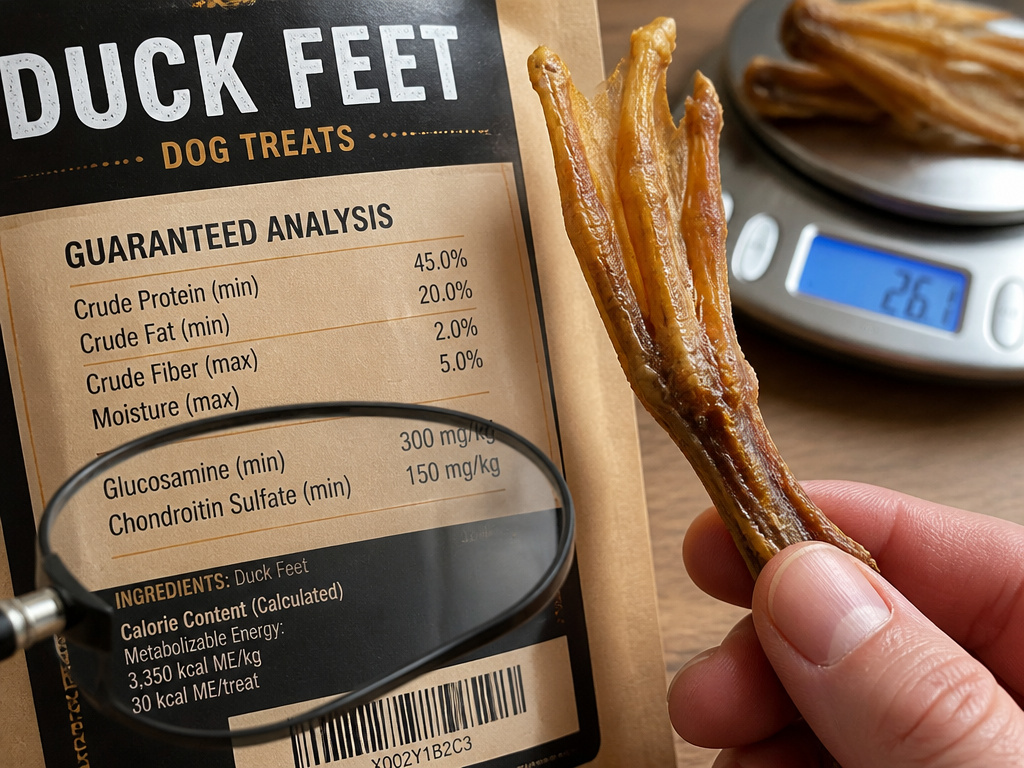
Farmland Traditions publishes specific joint numbers in the category, though the fact sheet does not list the exact amounts.
Those figures are published per kilogram rather than per foot. Those are real, checkable figures, and they’re rare in a category that usually says “naturally occurring” and stops there.
The asterisk matters. Glucosamine and chondroitin aren’t listed as essential nutrients in the AAFCO Dog Food Nutrient Profiles, which is why these amounts sit outside the guaranteed guarantees rather than inside them.
So what do you do with the joint numbers? Compare them against whatever glucosamine for dogs you already use, and decide whether the chew is contributing or just decorating the label.
I’ve stopped treating joint claims on chews as a reason to buy. Farmland deserves credit for publishing milligrams per foot instead of a vague sentence. But the published amounts are small, and the chew should earn its place on crunch and protein.
Carnos makes a broader claim, describing the ligaments and connective tissue as a natural source of collagen, glucosamine, and chondroitin. That’s a description of what’s in the tissue, not a dose.
Air-Dried, Freeze-Dried, or Your Own Dehydrator
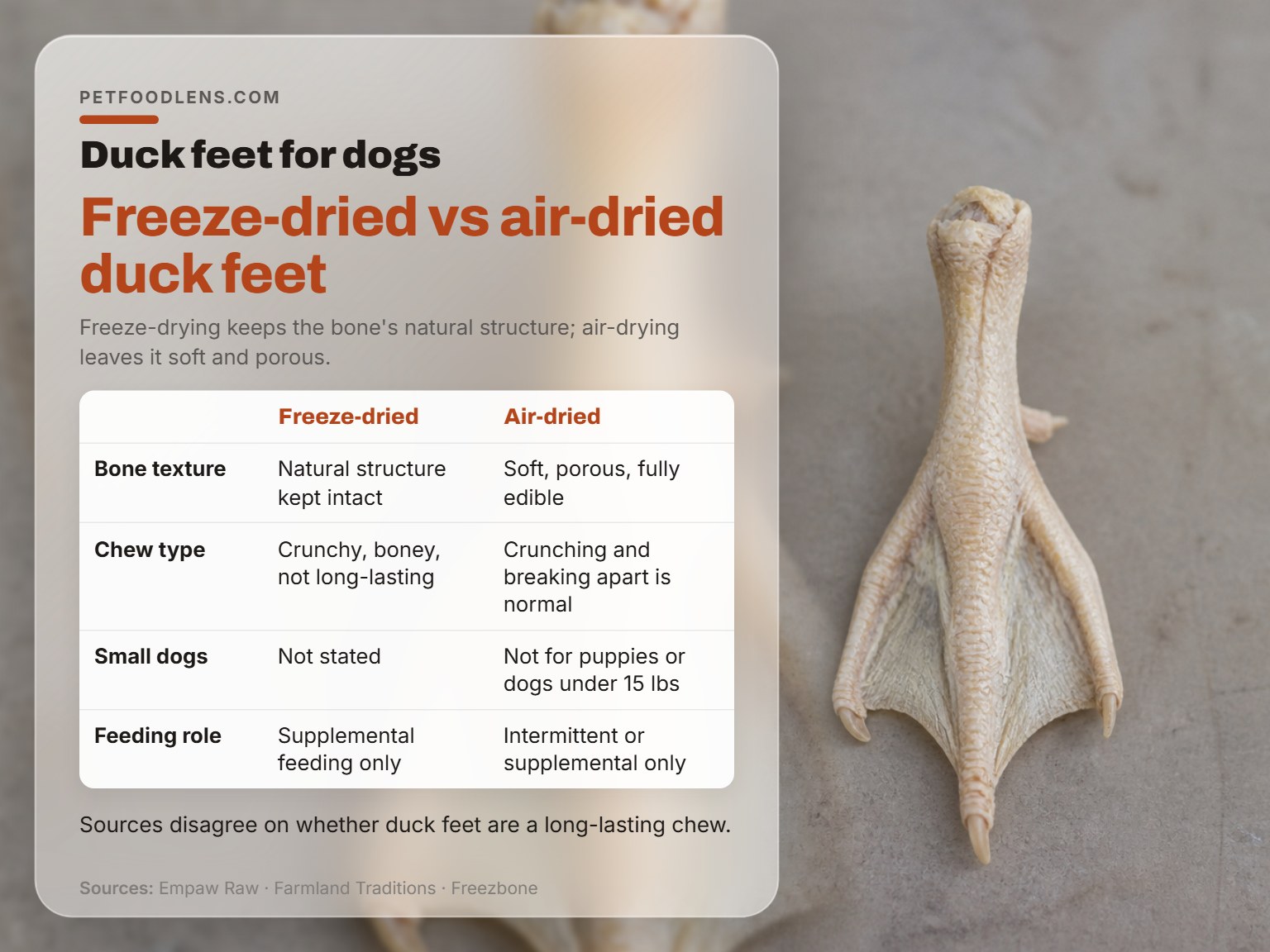
Three formats, three textures: air-dried, freeze-dried, and home-dehydrated.
Why Freeze-Drying Changes the Chew
Freeze-drying keeps the natural structure of the bone, per Empaw Raw. Air-drying leaves it soft and porous, per Farmland Traditions. Those are different objects in the dog’s mouth.
A freeze-dried foot still looks like a foot. Webbing, toes, the curve of the tendon, all intact and pale.
Freezbone adds a third option: push a foot into an enrichment toy before freezing for a longer challenge. That takes a short snack and stretches it into something closer to a project.
Home dehydration is the cheapest route if you have the machine. Here’s the process, with the part that goes wrong:
- Start with 2 pounds of duck feet. Trimming with scissors or clippers is optional. Tonya Wilhelm’s batch went in unskinned, and skipping the trim just leaves more skin to dry.
- Space the feet evenly on the racks. Piling them up means overlapping surfaces that never dry, and those spots stay soft while the rest goes crunchy.
- Run the dehydrator on low for 24 to 72 hours. Time depends on the machine and the size of the feet. Wilhelm’s batch took 28 hours to reach a crunchy chew.
- Cool them, then freeze what you won’t use this week and thaw as needed. Home-dried feet carry no preservatives, so the freezer is doing the work a sealed bag does commercially.
Common mistake: Pulling the feet at the low end of the range because the outside feels dry. The joint is the last part to finish, and a foot that still bends there hasn’t dried through.
Where the Duck Feet for Dogs Pros and Cons Actually Land
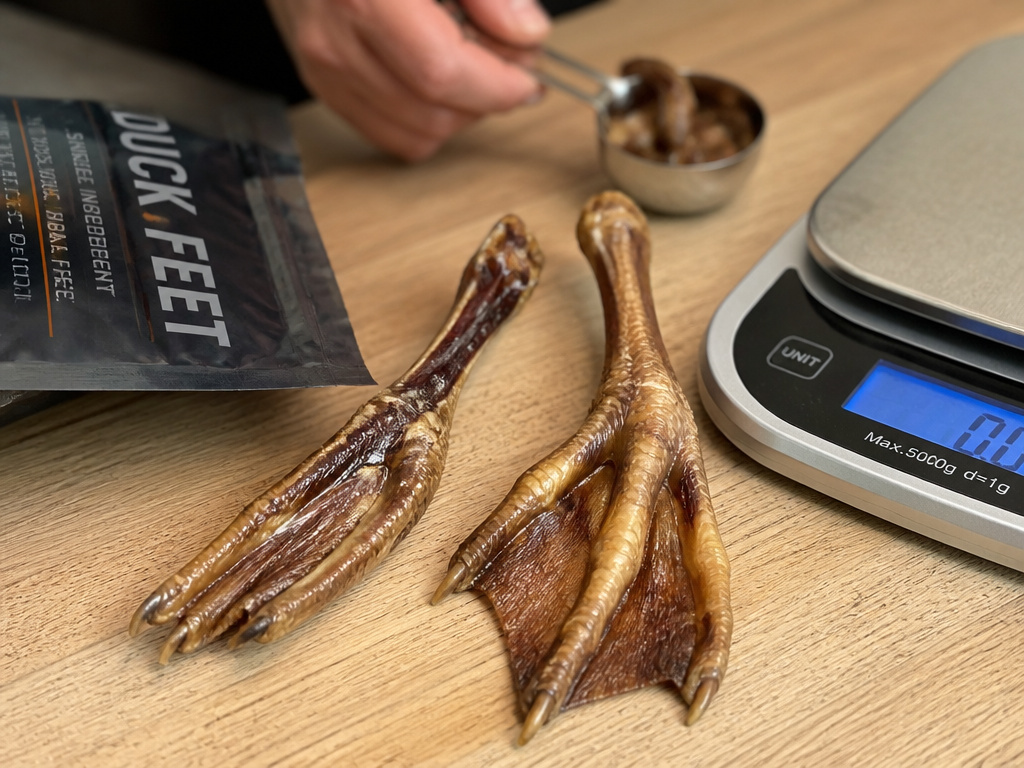
The pros are real and the cons are real, and they don’t weigh the same for every dog.
On the plus side: one ingredient, a protein that isn’t chicken, a texture most dogs find genuinely interesting, and connective tissue that carries collagen. Freezbone sources from free-range ducks in the USA with no hormones, antibiotics, or preservatives. Carnos uses antibiotic-free, hormone-free, non-GMO duck.
On the minus side: it’s bone, the feeding charts contradict each other, some brands exclude small dogs while Carnos lists them as suitable, and the chew is over in minutes.
If you want a single answer for a dog over 20 lb, Farmland Traditions Wilder Made Duck Feet is the one I’d pick, because it publishes the most complete numbers of any brand here. For a dog over 20 lb where you want a bigger, meatier foot, Bella & Ni Pets Dehydrated Duck Feet fits. If your dog needs the chew to last, Freezbone Whole Duck Feet plus an enrichment toy is the only version that stretches the clock.
What “Single Ingredient” Does and Does Not Tell You
It tells you nothing else was added. That’s it.
It doesn’t tell you the meat-to-bone ratio, the calorie density, or the size of the foot in the bag. Freezbone states plainly that individual feet vary in size and shape, and that’s true of every brand in this category.
I once read the fronts of several OTC “urinary health” cat foods. Every one said “supports” or “promotes,” and none said “dissolves.” Treat bags run the same play. “Longer-lasting” is a front-of-bag word.
Turn the bag over and check these instead:
- Calories per kilogram, so you can compare across brands and formats without guessing.
- The feeding chart, and the weight band it was actually written for.
- A weight cutoff, if the brand publishes one. Two of three here do.
- Glucosamine and chondroitin in mg/kg, not just “naturally occurring.”
- The word “supplemental,” which every brand in this category uses and most buyers skim past.
Soft, pressed rawhide chews behave nothing like an air-dried foot, and raw bones for dogs raise the same supervision question with far more meat attached.
Frequently Asked Questions
Are duck feet safe for dogs?
They’re safe for the right dog under supervision. Every brand in this category requires it, and Farmland Traditions tells you to remove small pieces as they break off. The dogs most at risk are small dogs, puppies, and dogs that swallow without chewing, though Carnos lists puppies and small dogs as suitable while Farmland Traditions does not.
How many duck feet can a dog have per day?
It depends entirely on the brand. Bella & Ni Pets allows 1 foot a day for a 20 to 50 lb dog. Farmland Traditions allows 8 feet a day for a 24 to 49 lb dog. Freezbone allows 3 a day for a 30 to 50 lb dog. Use the chart on your bag.
Can cats eat duck feet?
The sources disagree. Carnos lists duck feet as appropriate for dogs and cats. Bella & Ni Pets says dogs only, and Empaw Raw says the product is primarily intended for dogs. If you’re feeding a cat, that’s a conversation for your veterinarian.
Are duck feet good for a dog’s teeth?
Chewing scrapes the tooth surface, and that’s the mechanism behind every dental chew claim. Farmland Traditions estimates 3 to 10 minutes of crunching per foot, which is a short session. A chew that’s gone quickly isn’t a dental program.
Do duck feet splinter?
The brands frame this differently. Bella & Ni Pets says gentle dehydration produces a texture that crumbles rather than splintering like cooked bone. Farmland Traditions says air-dried bone is soft, porous, and fully edible, and that breaking apart is normal. None of them cite testing.
Are duck feet a meal replacement?
No. Carnos calls them a snack or the meaty bone component of a DIY diet. Bella & Ni Pets and Farmland Traditions both label them intermittent or supplemental feeding only. They’re a treat, and they should be counted against the day’s calories.
The Bottom Line
Here’s the threshold I’d use. If your dog is under 20 lb, check the bag carefully: Bella & Ni Pets does not recommend duck feet under 20 lb and Farmland Traditions sets the floor at 15 lb, while Carnos lists small dogs as suitable. Two of the three brands that publish a cutoff put the floor at 15 to 20 lb, and Bella’s own math says one foot already exceeds a small dog’s daily treat allowance.
Above that weight, the duck feet for dogs pros and cons land in a simple place. You’re buying a crunchy, single-ingredient, chicken-free chew that is a short snack. Buy it for that, and ignore the joint language on the front.
One concession, and it’s the important one. None of this applies to a dog that swallows without chewing. Bella excludes those dogs outright, and no feeding chart fixes a swallowing habit. That’s a training problem, and a chew is the wrong tool for it.
