
How to Handle Raw Dog Food Safely: Step-by-Step
This post contains affiliate links. As an Amazon Associate, we earn from qualifying purchases.
To handle raw dog food safely, treat it like raw meat for your own dinner: thaw in the refrigerator, keep it at 40°F or below, never rinse it in the sink, and disinfect every surface it touches. A 2014 FDA-CVM study found about 1-in-3 frozen raw diets bought online carried a foodborne pathogen.
The 1-in-3 figure comes from a study published in 2014, and Cornell notes it predates the freeze-dried boom that now fills grocery shelves. That timing matters. Freeze-dried meat is sold with no warning label that the contents are uncooked, and it sits right next to the cooked products. Knowing how to handle raw dog food safely matters for these uncooked products.
What follows walks the routine in order, then covers three places standard advice breaks down: thawing method, freeze-dried products, and households with high-risk members.
Key Takeaways
- Thaw in the fridge, not the sink. CDC, Canada, and the UK FSA all specify refrigerator thawing; VCA adds the microwave as an option.
- Cook to 165°F internal if you cook a raw product before feeding, per Cornell.
- About 1-in-3 frozen raw diets bought online carried a pathogen in the 2014 FDA-CVM study.
- Close to half of Salmonella-infected dogs show no symptoms, so a healthy-looking dog can still shed.
- Under-5s, adults 65+, pregnant, and immunocompromised should not handle raw product or the dog, per Cornell, UK FSA, and Canada.
What Does the Evidence Actually Say About Raw Dog Food Risk?
About 1-in-3. That’s the odds your frozen raw diet purchased online carries Salmonella, Listeria, or toxigenic E. Coli, per a 2014 FDA Center for Veterinary Medicine study cited by Cornell evidence-based raw feeding.
Raw pet food is not necessarily healthier than cooked food. Both raw and cooked products can be made with high-quality or low-quality ingredients, and both can be nutritionally balanced or inadequate. The category describes a processing method, not a nutritional standard.
The 2014 number is the headline. It’s also over a decade old, and Cornell flags that it predates the freeze-dried product wave. Treat the 1-in-3 as a conservative floor.
A separate 2011-2012 study cited by VCA Animal Hospitals found nearly 25% of raw dog food samples tested positive for harmful bacteria, including Salmonella and Listeria monocytogenes. That’s the salmonella risk measured in a lab, not a marketing claim.
A University of Pennsylvania study cited by Cornell found 10% of canine raw food products contained Gram negative bacteria producing extended spectrum beta-lactamases (ESBLs), enzymes that degrade penicillins and cephalosporins. CDC attributed over 9,000 deaths of hospitalized US patients in 2017 to ESBL-producing bacteria.
The pig ear outbreak is the clearest real-world example. A Lancet Regional Health report cited by Cornell describes contaminated pig ear treats sickening at least 154 people with salmonellosis over four years. No deaths, but the majority of strains were multidrug resistant, and more than half of the hospitalized people were outside the high-risk age ranges.
The 5-Step Handling Routine That Covers Most of the Risk
The routine below is the baseline every major agency agrees on, plus the steps most owners skip.
Before you start: Raw product can splash contaminated drips onto counters, sponges, and the floor. Keep a dedicated spray bottle of disinfectant within reach before you open the package. Never handle raw product in a household with a pregnant person, an immunocompromised adult, or a child under 5 present.
- Wash your hands for at least 20 seconds with soap and hot water before and after handling, per the FDA safe handling of pet food. Skip this and the contamination moves to your phone, your face, and every door handle between the kitchen and the bathroom.
- Thaw in the refrigerator, not on the counter or in the sink. CDC, Canada, and the UK FSA all specify fridge thawing.
- Do not rinse the product in the sink. Cornell calls this out directly. Rinsing splashes bacteria onto dish racks, sponges, and nearby utensils.
- Use a dedicated scoop and dedicated bowls. The FDA says don’t scoop with the pet’s bowl, and wash bowls and utensils with soap and hot water after every use. Reusing the family measuring cup spreads the contamination to whatever you cook next.
- Disinfect every surface the product touched. Cornell says contain splashes and drips, then clean and disinfect all surfaces and dishes afterwards. A quick wipe with a damp cloth moves the bacteria around; it doesn’t kill it.
The how to handle raw dog food safely order matters less than the completeness. Owners who do four of five steps still leave a transmission route open.
Thawing: Fridge Only, or Does the Microwave Count?
Here’s where the agencies split.
CDC, the Public Health Agency of Canada, and the UK Food Standards Agency all say thaw in the refrigerator. VCA Animal Hospitals says the microwave is also acceptable, as long as you don’t thaw in the sink or on the counter.
| Method | Who Endorses It | Risk If You Skip the Rule |
|---|---|---|
| Refrigerator | CDC, Canada, UK FSA, VCA | Slow thaw keeps surface cold |
| Microwave | VCA only | Uneven heating warms edges |
| Sink or counter | None of the six sources | Surface enters the danger zone |
When the microwave is acceptable
That sheen is the tell.
The thawing raw food walkthrough covers portion sizes and timing if you want the longer version. And before you thaw anything, run a signs of spoilage check on the package: sour smell, tacky surface, or a color shift toward grey.
Freeze-Dried Is Not Cooked: The Edge Case That Breaks Standard Procedure
Freeze-drying removes water under vacuum. It doesn’t reach a temperature that kills Salmonella, Listeria, or E. Coli, and Cornell points out that freeze-dried meat is sold with no warning label that the contents are uncooked.
Canada lists freeze-dried alongside fresh and frozen as raw. The CDC raw pet food fact sheet lists it as one of four raw formats, along with raw, raw frozen, and dehydrated. The shelf placement is the problem: freeze-dried liver treats sit next to the milk carton and the cooked chicken, and nothing on the bag suggests they belong in the same handling category as raw chicken.
The part nobody mentions: Freeze-dried treats and toppers count as raw under CDC and Canadian guidance. Handling them with the same casualness as a Milk-Bone is how a household ends up with a Salmonella case and no obvious source.
The full raw feeding safety picture includes treats and toppers, not just the main diet.
Who Should Never Touch Raw Dog Food
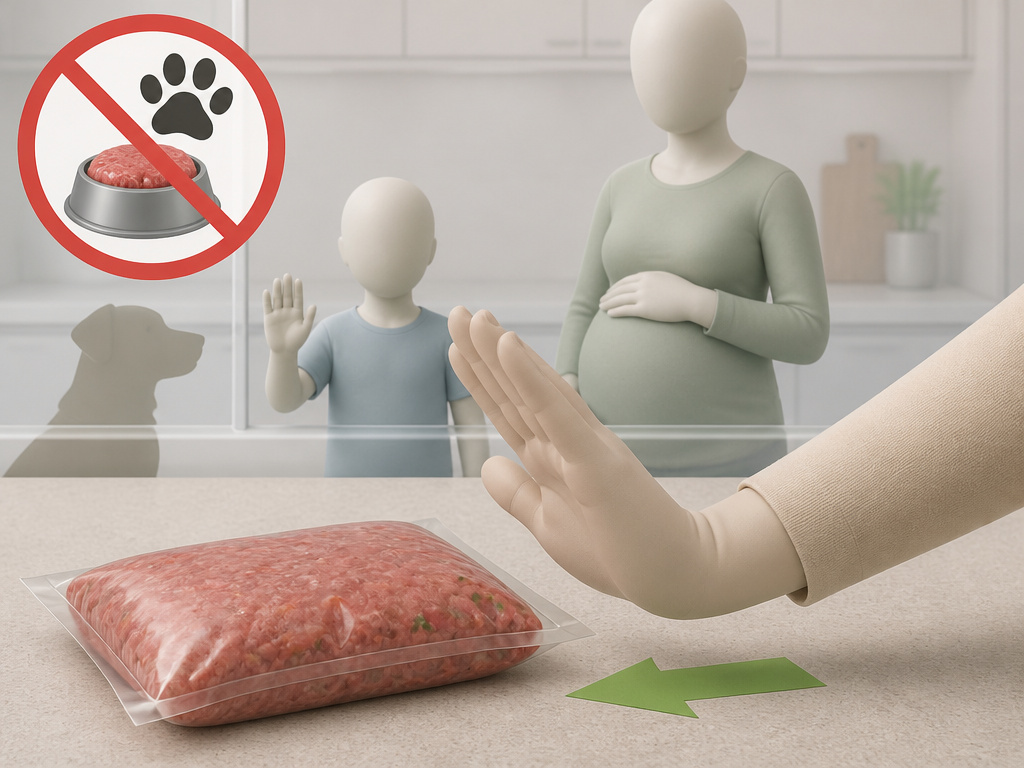
Three agencies name the same four groups, and the UK adds a stricter rule for the youngest.
Households with kids under 5
The FSA raw pet food guidance says children under 5 should not touch or eat raw pet food or treats at all. CDC and Canada put the same age group on the do-not-handle list. The reason is simple: a toddler’s immune system is still developing, and a dose of Salmonella that gives an adult a bad afternoon can put a small child in the hospital.
Pregnant and immunocompromised adults
CDC, Canada, and the UK FSA all list pregnant people and immunocompromised adults as high-risk. Cornell adds a specific warning: don’t let anyone in high-risk groups come in contact with the raw product or the dog. That second clause catches owners off guard. A dog shedding Salmonella in its stool or saliva is a transmission route even when the food bowl is clean.
| Group | CDC | UK FSA | Canada |
|---|---|---|---|
| Children under 5 | Yes | Yes, no touch or eat | Yes |
| Adults 65+ | Yes | Yes | Yes |
| Pregnant | Yes | Yes | Yes |
| Immunocompromised | Yes | Yes | Yes |
The consensus is rare. All three agencies agree on the same four groups, and Cornell’s advice goes a step further by extending the no-contact rule from the food to the dog itself.
If a household has a child under 5, a pregnant person, or an immunocompromised adult, the safest handling routine is not to bring raw product into the house at all. No amount of disinfecting fixes a transmission route you keep reopening.
Storage, Sanitation, and the Bin Mistake I Made
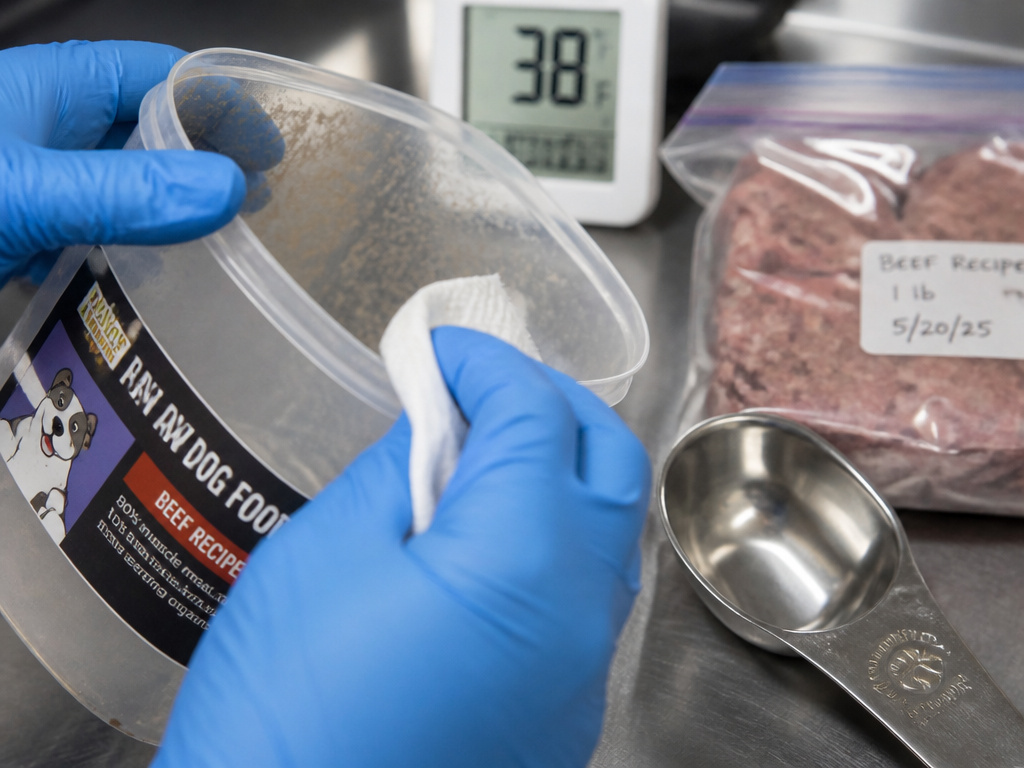
I dumped out a pantry bin once and found a yellowish, tacky film on the walls and a sharp crayon-and-paint smell. Months of fresh kibble had been poured over that residue, so every new batch met old oxidized fat on day one.
The same how to handle raw dog food safely principle applies to raw storage. A container that held raw product yesterday is not a clean container today just because you emptied it.
CDC says freeze raw pet food until you’re ready to thaw it, and keep it in a sealed container in the freezer and refrigerator, separate from other foods. FDA says set the refrigerator to 40°F or below. The separation matters as much as the temperature. A raw package sitting next to an open container of leftovers is a cross-contamination event waiting for a spill.
The raw food storage rules go further than the fridge temperature. Dry it fully. Damp plastic plus fat residue is a bad pairing, and it’s the same mistake I made with the kibble bin.
The freeze raw portions approach cuts the number of thaw cycles per package, which cuts the number of times you handle the product.
The dedicated-scoop rule
The FDA says don’t use your pet’s food bowl as a scoop, and don’t use the same scoop for pet food and human food. Use a clean scoop, spoon, or cup, and keep it for pet food only. Bowls and utensils get washed with soap and hot water after every use. This is the cheapest risk reduction in the whole article.
The sanitize surfaces routine after feeding covers the counters, the sink, and the floor around the bowl. If you want a quick spoilage checklist for the fridge, keep these in mind:
Cooking It to 165°F: The Harm-Reduction Option
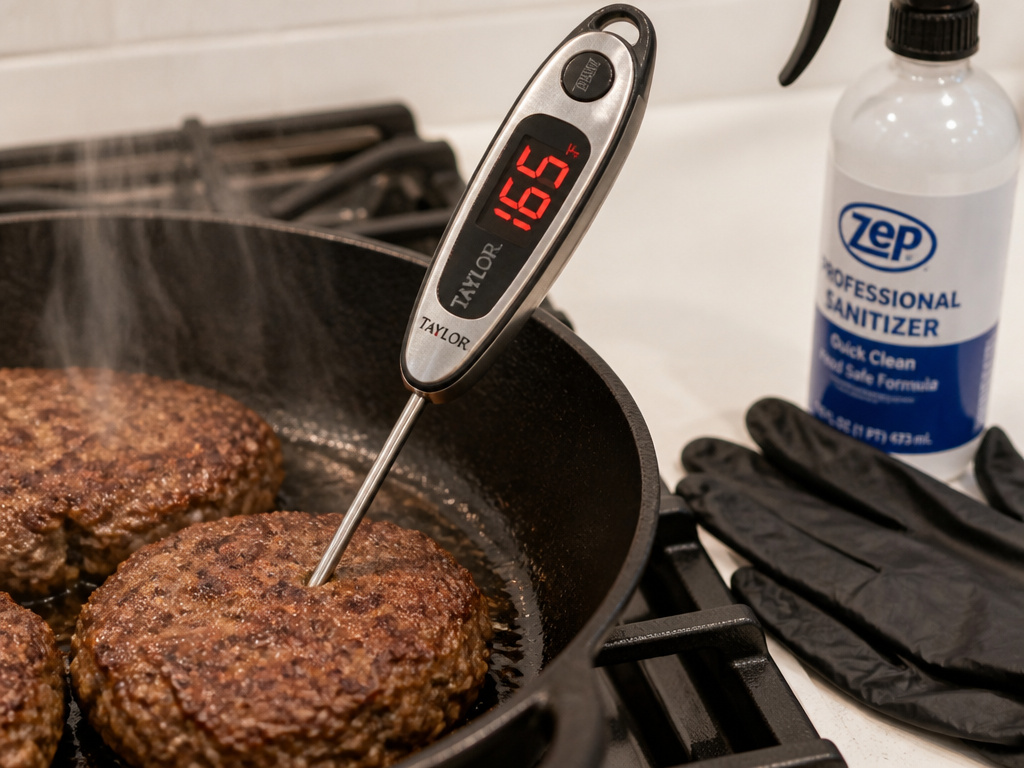
Cornell names a specific cooking endpoint: 165°F internal temperature, if you’re cooking a raw product before feeding it.
Every other step in this routine contains the pathogen; cooking is the one that eliminates it.
A cooked raw product is cooked meat. The nutritional case for raw feeding doesn’t survive the cooking step, which is why owners who cook usually switch to a commercial cooked diet instead.
Where this goes sideways: Cooking a raw product to 165°F kills the bacteria, but it also destroys the enzymes and probiotics that raw feeders claim as a benefit. If you’re cooking, you’re not raw feeding anymore. You’re feeding cooked meat, and you might as well buy a complete-and-balanced cooked diet.
Nutritional Adequacy: The Part the Bag Doesn’t Tell You
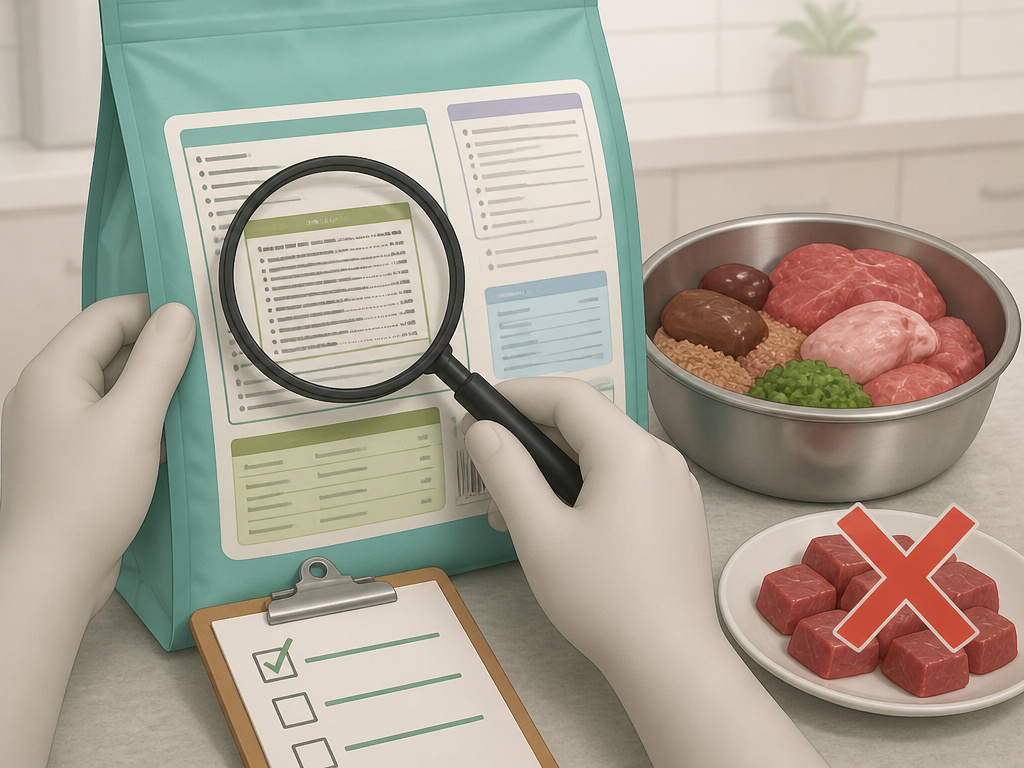
The bag shows a wolf on the front. The dog on your couch has never met a wolf and does not plan to.
CDC says pet dogs prefer and need foods lower in protein and higher in fat and carbohydrates than wolves do. That’s the first thing the marketing skips. The second thing is the adequacy statement.
What the adequacy statement actually means
VCA notes that many, but not all, commercial raw food diets do not contain a nutritional adequacy statement. Without it, you’re guessing. Homemade raw diets are likely not complete and balanced unless a recipe has been formulated by a nutritionist.
I used to compare foods on the guaranteed analysis alone. I stopped because it only gives minimums and maximums on an as-fed basis, and I now work from dry matter figures and calories instead. Turn the bag over.
That’s the mistake I see most often in raw feeding: muscle meat, no bone, no liver, and a hopeful assumption that the dog will balance it out. Dogs don’t balance it out.
If you’re going to feed raw despite the evidence, feed a complete-and-balanced commercial raw product with a clear adequacy statement.
The raw food sourcing question matters here too. A company that tests every batch for Salmonella, E. Coli, and Listeria and tells you what it does to kill germs is a different risk profile from a company that doesn’t.
The portioning raw food side is where a lot of owners guess.
Frequently Asked Questions
Is it safe to feed raw dog food?
Not according to the CDC, FDA, or Public Health Agency of Canada. All three agencies explicitly do not recommend feeding raw pet food. Cornell and VCA advise avoidance but provide harm-reduction steps for owners who choose to feed raw anyway. The 1-in-3 pathogen exposure figure from the 2014 FDA-CVM study is the clearest risk number.
Can I thaw raw dog food in the microwave?
VCA Animal Hospitals says yes, as long as you don’t thaw in the sink or on the counter. CDC, Canada, and the UK FSA specify refrigerator thawing only.
Is freeze-dried dog food raw?
Yes, under CDC and Canadian guidance. Freeze-drying removes water under vacuum but doesn’t reach a temperature that kills Salmonella, Listeria, or E. Coli. Cornell points out that freeze-dried meat is sold with no warning label that the contents are uncooked. Handle freeze-dried treats and toppers the same way you’d handle raw chicken.
What temperature should I cook raw dog food to?
165°F internal temperature, per Cornell. Cooking is the only step in the handling routine that kills the pathogen. It also changes the food from raw to cooked.
Who shouldn’t handle raw dog food?
Children under 5, adults 65 and older, pregnant people, and immunocompromised individuals. CDC, Canada, and the UK FSA all name the same four groups. Cornell extends the no-contact rule to the dog itself, because a healthy-looking dog can shed Salmonella without showing symptoms.
Do I need to wash raw dog food before feeding it?
No. Cornell explicitly says not to wash the product in the sink first. Rinsing splashes bacteria onto dish racks, sponges, and nearby utensils. Contain splashes and drips instead, then clean and disinfect all surfaces and dishes afterwards.
The Bottom Line
The evidence points one direction: the CDC, FDA, and Public Health Agency of Canada all say don’t feed raw, and the 1-in-3 pathogen figure from the 2014 FDA-CVM study is the number to keep in your head.
If you’re going to feed raw anyway, the first step this week is to buy a dedicated scoop and a dedicated cutting board for the dog’s food. Keep them in a separate drawer and wash them separately. That one change eliminates the most common cross-contamination route in a raw-feeding household.
One concession: this article is written from a formulation and label-reading perspective, not a veterinary one. If your dog has kidney disease, diabetes, or a compromised immune system, the handling advice here is secondary to whatever your vet says about the diet itself. I’m not the person to override a therapeutic diet.
Most raw feeders I’ve talked to are more careful about the food than they are about the dog. The dog is the one licking faces and sleeping on the couch. If you’re going to feed raw, the handling routine has to extend to the animal, not stop at the bowl.
