
How to Store Raw Pet Food: Fridge, Freezer, Cleanup
This post contains affiliate links. As an Amazon Associate, we earn from qualifying purchases.
To store raw pet food safely, keep it frozen until you need it, thaw it in the refrigerator in a sealed container on the lowest shelf, and hold your fridge at 40 F or below. The FDA screened 196 raw samples and found Salmonella in 15 and Listeria in 32.
Those two numbers explain why raw food gets its own storage rules. Nothing in the product was heated high enough to kill Salmonella or Listeria before it went into the tube, so the refrigerator is slowing down a contaminated product rather than preserving a clean one. Your job is to keep that slowdown working and keep the bacteria off your counters.
What follows covers the fridge temperature, the freezer wrap, the thawing argument between three agencies, and the cleanup that actually kills what’s left behind.
Key Takeaways
- Set the fridge to 40 F or below. That’s the FDA’s number for keeping pet food cold.
- Thaw in the refrigerator on the lowest shelf, sealed. The CDC and Canada’s public health agency allow only the fridge; the FDA/Nebraska brochure also permits a microwave.
- Wash hands for at least 20 seconds with soap and water before and after handling raw pet food.
- Disinfect with 1 tablespoon of bleach per quart of water on anything the food touched.
- Handle what the pet doesn’t finish carefully. The FDA/Nebraska brochure says to cover and refrigerate leftovers or throw them out, Canada says not to re-freeze leftovers, GOV.UK says to throw away uneaten raw food promptly, and the CDC says to throw away leftovers left out at room temperature.
What the FDA Actually Found in Raw Pet Food
Fifteen of 196 raw pet food samples tested positive for Salmonella. Thirty-two tested positive for Listeria monocytogenes. Those figures come from an FDA Center for Veterinary Medicine study that ran from October 2010 through July 2012 and screened more than 1,000 pet food samples overall.
The CVM study added 196 commercially available raw dog and cat food samples in the study’s second year. Products were purchased online from multiple manufacturers and shipped directly to six participating laboratories. Raw samples were typically frozen in tube-like packages made from ground meat or sausage. Before this study, CVM had not investigated Listeria in pet food.
Two details in that block matter more than the headline numbers. The samples were bought online from different manufacturers, so the risk isn’t concentrated in one brand you can learn to avoid. And the product arrived frozen, which means freezing didn’t sterilize it on the way to the lab.
If you want to cut the odds before the food reaches your kitchen, source raw pet food safely and ask the manufacturer whether they test finished product for Salmonella and Listeria.
The FDA’s own raw pet food diet facts page spells out the mechanism. You infect yourself by touching your mouth while preparing the food, or after handling a contaminated utensil. Nobody licks the cutting board on purpose. It happens through a hand-to-face motion you never notice.
I’ll be straight about my own footing. My bench time is with commercial cat food formulations, not raw. So here I’m reading the regulators closely rather than drawing on hands-on raw formulation, and you should weigh the advice that way.
How Cold Does Raw Pet Food Actually Need to Be?
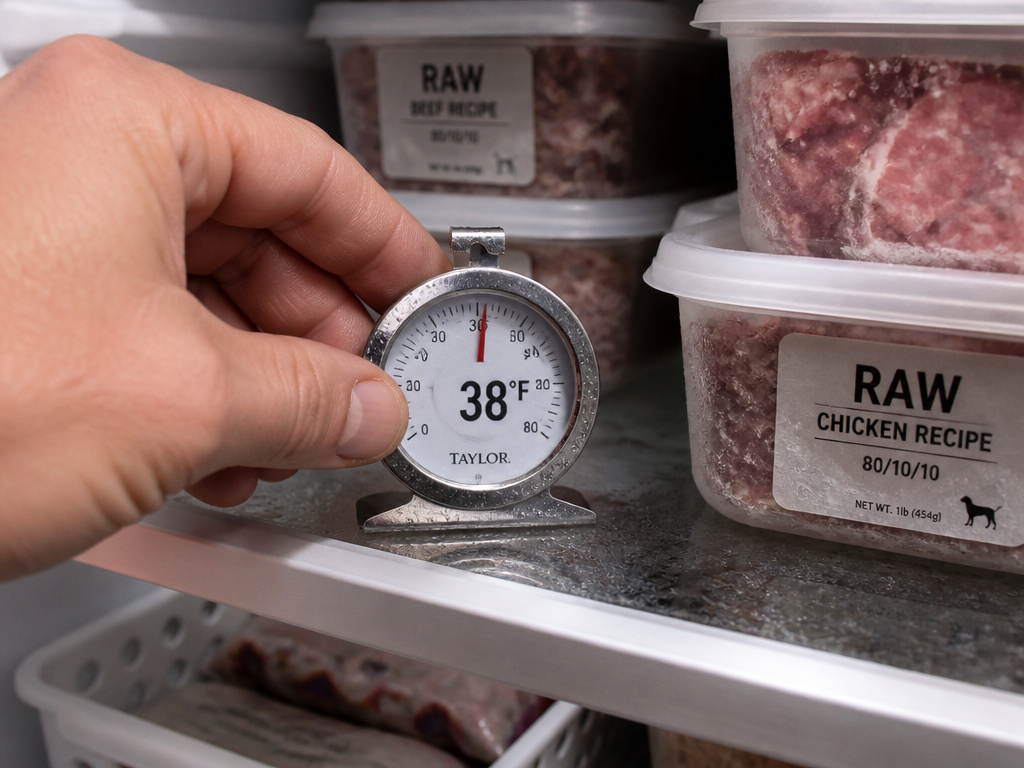
Set the refrigerator to 40 F or below. That’s the FDA’s number, and it applies to any pet food you’re keeping cold, raw or cooked.
Dry pet food and unopened canned food go the other direction. Store those below 80 F, because excess heat or moisture breaks down the nutrients in the food. A hot garage in summer fails that test.
The FDA’s number is 40 F or below. If your fridge has never been checked with a thermometer, you don’t know which side of it you’re on.
Buy an inexpensive fridge thermometer and leave it on a middle shelf. The dial on the front of the fridge is a setting, not a measurement. I’ve seen units set to “4” that ran warm because the door gasket had gone soft.
Every other rule below, including how to store raw pet food, assumes the fridge is doing its job. If it isn’t, the storage advice is decoration.
Where Raw Pet Food Sits in the Fridge
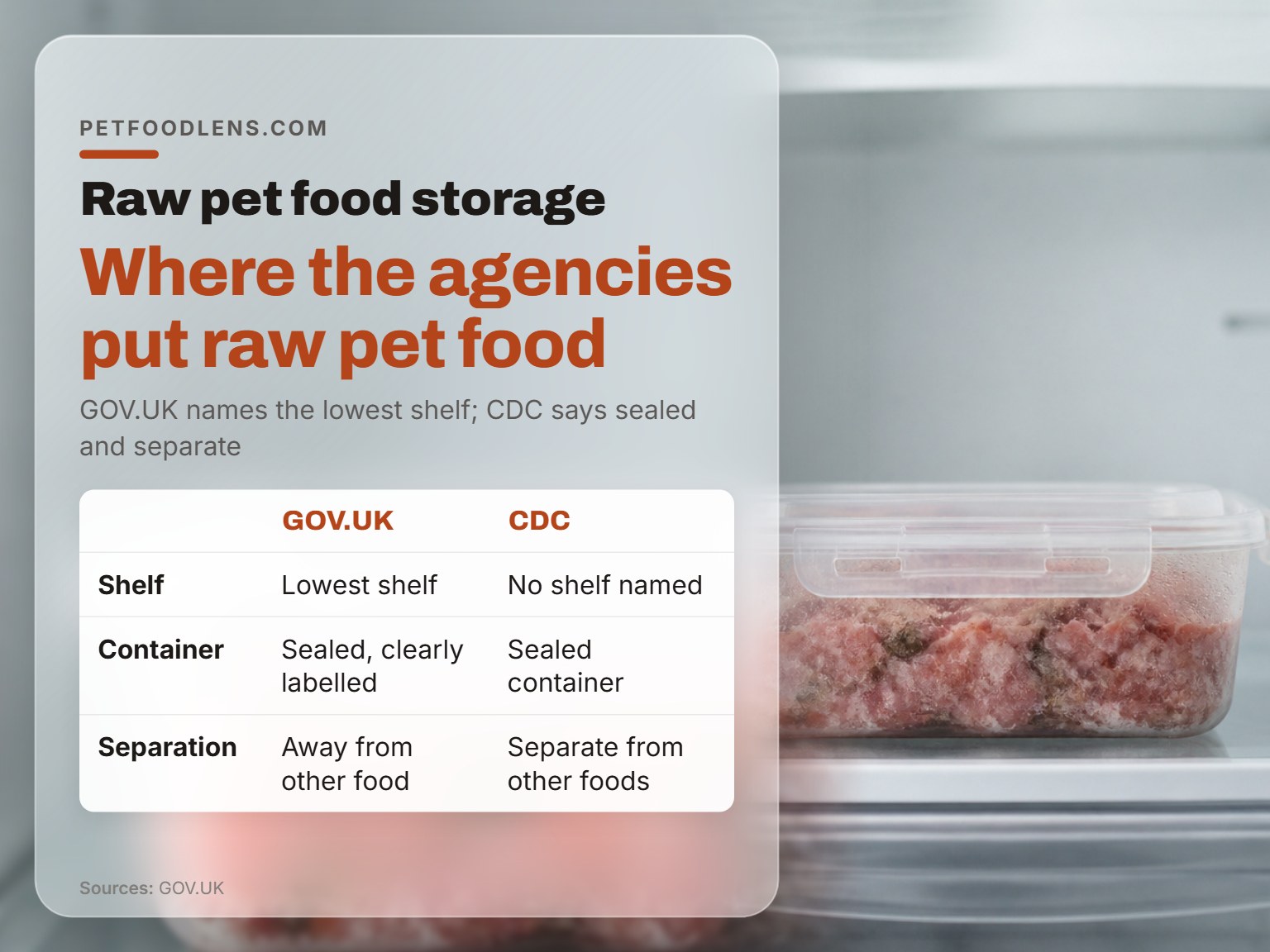
The lowest shelf is the one GOV.UK specifies, and the reason is drip physics. Anything that leaks from a package on the bottom shelf lands on the shelf itself. Anything that leaks from a middle shelf lands on your lunch.
The three agencies line up like this:
- GOV.UK: lowest shelf, sealed, clearly labelled, kept away from other food in the fridge or freezer.
- CDC: sealed container, separate from other foods, no shelf named.
- Public Health Agency of Canada: bottom shelf, sealed container.
Where this goes sideways: Storing a raw pack on a middle shelf beside the butter. One slow leak and the contamination has moved to food you eat uncooked. You won’t see it, because the pack still looks sealed.
The practical answer is the intersection of all three: bottom shelf, sealed container, labelled, away from everything else. Label it with what it is and when it went in, because a grey tube in a plastic box is anonymous otherwise.
If you’re making the food yourself rather than buying it, the same shelf rule applies. Store homemade pet food in a sealed, labelled container rather than an open bowl, and don’t park it next to the leftovers you plan to eat cold.
Why the Thawing Advice Doesn’t Match Across Agencies
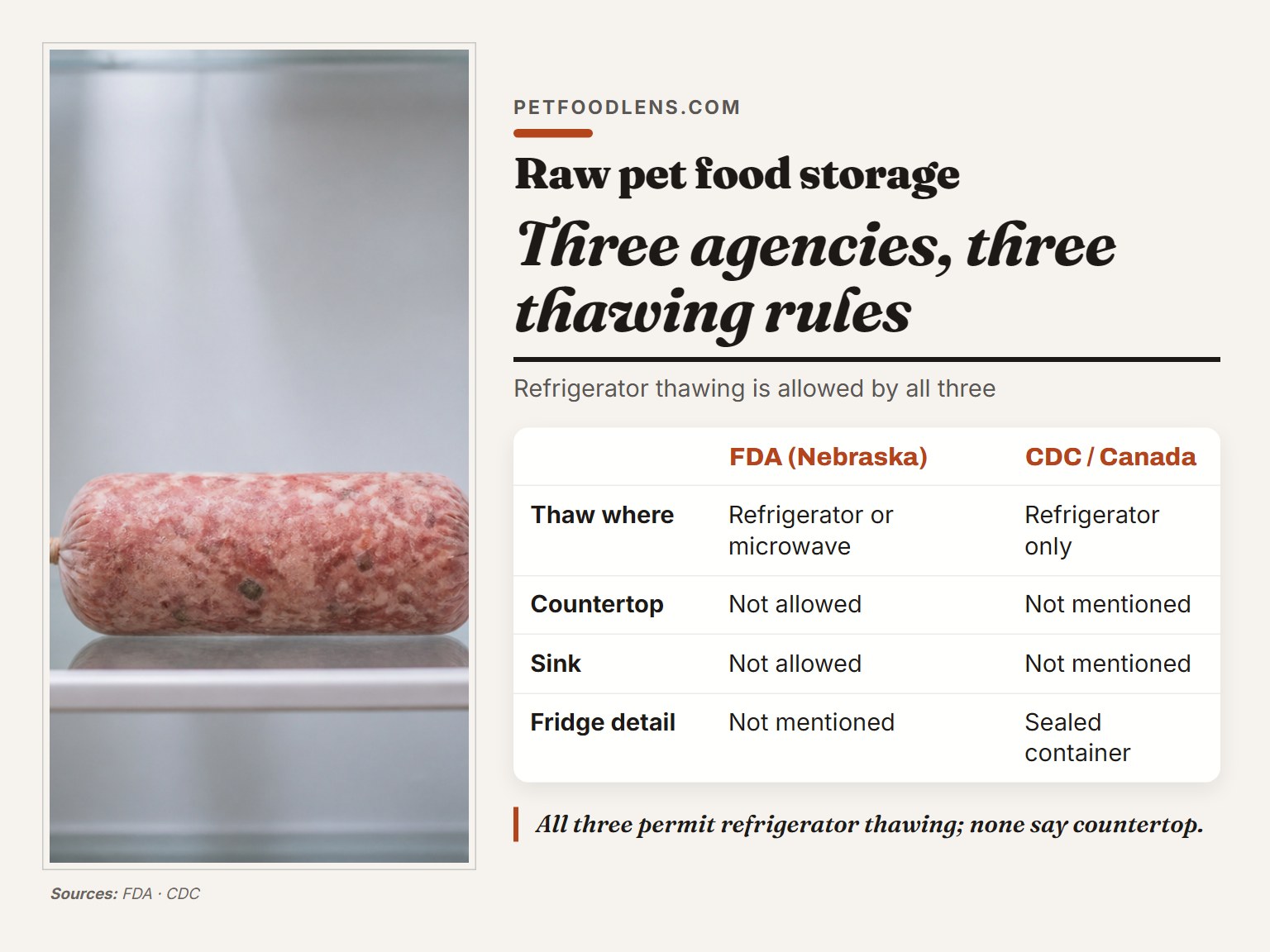
Three regulators, three different answers, and none of them say countertop. Here’s the split, laid out plainly.
| Source | Where it says to thaw | Microwave allowed? |
|---|---|---|
| FDA (Nebraska brochure) | Refrigerator or microwave | Yes |
| CDC | Refrigerator | Not mentioned |
| Public Health Agency of Canada | Bottom shelf of fridge, sealed container | Not mentioned |
The FDA/Nebraska brochure is explicit that the countertop and the sink are both out. The CDC says refrigerator and stops there. Canada adds the bottom-shelf and sealed-container detail.
The Case for Fridge-Only
If you want one rule that satisfies all three, thaw in the refrigerator on the bottom shelf in a sealed container. That’s the only method every agency permits.
It’s also the slowest, which is the part people underestimate. A frozen tube pack takes a long time to thaw. Move it to the fridge the night before, or the morning of, and plan around it.
One more thing the FDA is firm on: don’t rinse raw meat, poultry, fish, or seafood. Bacteria in the raw juices splash and spread to other food and surfaces. Rinsing feels like cleaning and does the opposite.
If you want the full method, thaw frozen pet food safely covers the timing and the container setup.
Freezer Storage: Wrap It Right or Lose It
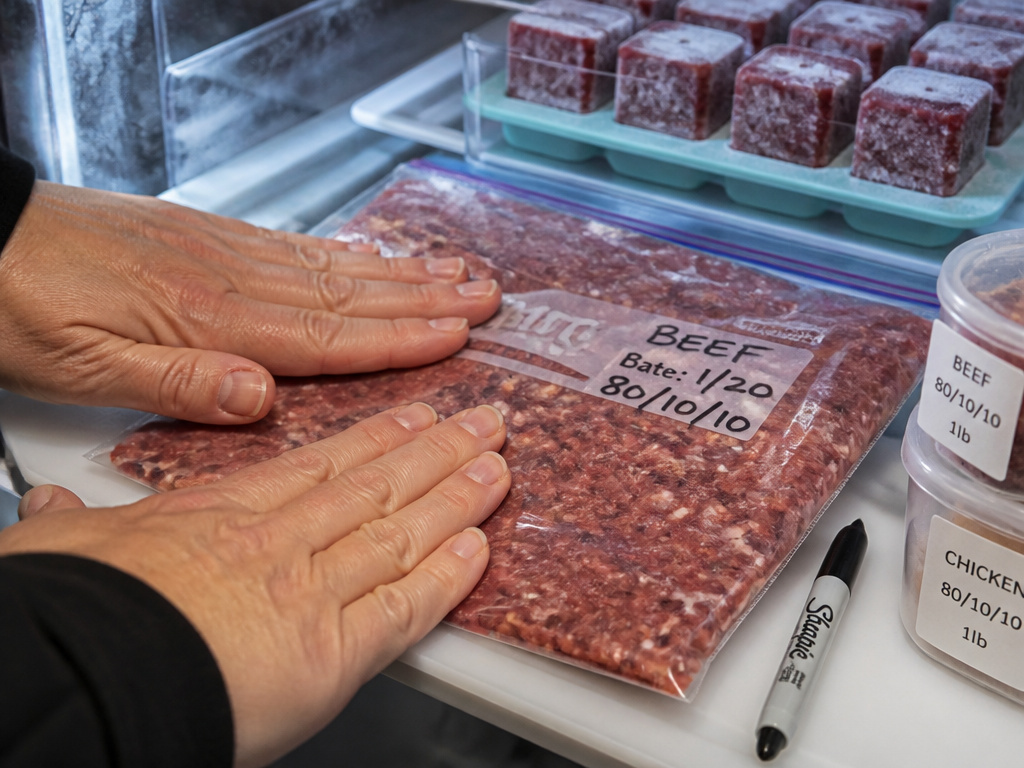
The agencies agree on the basics here. Freeze raw pet food until you’re ready to use it. Keep it in a sealed container in the freezer, separate from other foods. Label it clearly so you know exactly what it is.
What to Wrap It In
Portion before you freeze, not after. A single large block forces you to thaw the whole thing to get one meal out of it, and you can’t refreeze what you’ve thawed.
- Freezer bags, air pressed out, flattened so they stack and thaw faster.
- A reusable silicone bag if you’d rather not throw the bag away each time.
- Small rigid containers for anything that would get crushed at the bottom of the freezer.
Easy to miss: That’s the fat oxidizing, and it happens faster on a loose-wrapped portion than a sealed one.
The portioning trick I use for wet food transfers to raw. Spoon single servings into an ice cube tray or small silicone molds, freeze, then bag the cubes. Pop out one or two the night before and thaw them in the fridge. Don’t refreeze what you’ve thawed.
For more on wrap and timing, freeze raw dog food portions walks through the bagging order.
What to Do With What the Cat Doesn’t Eat
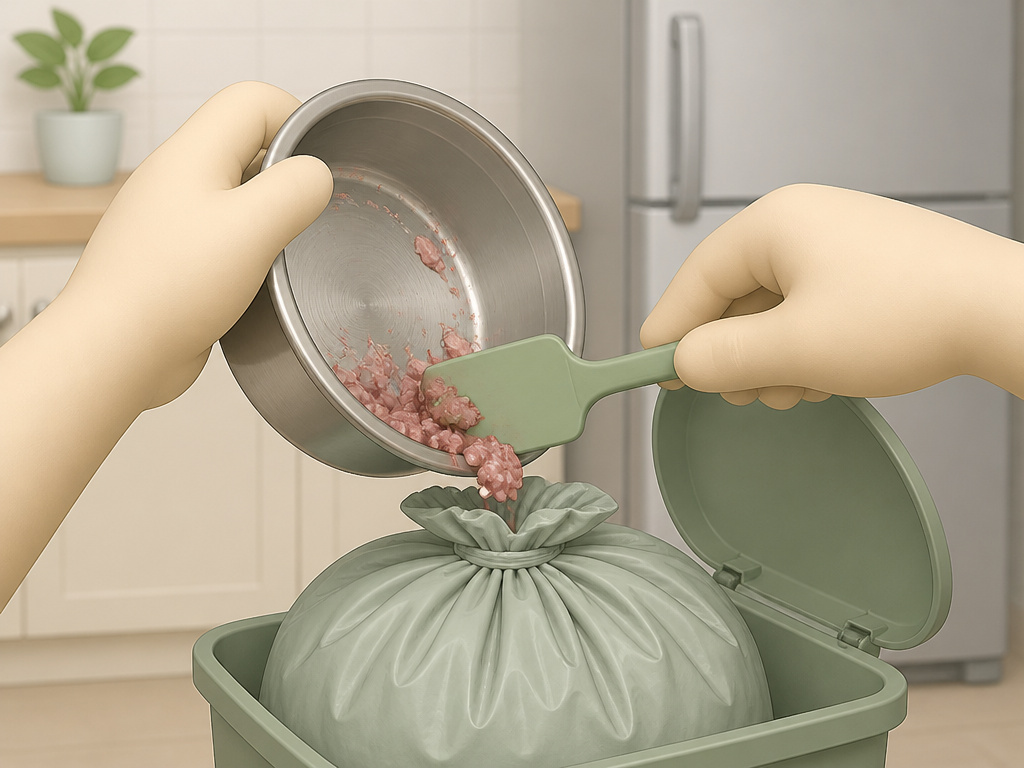
Throw it out.
That’s a short answer to a question the agencies answer three different ways, and it’s the one place I’d ignore the most permissive reading.
- The FDA’s brochure says to cover and refrigerate what the pet doesn’t eat, or throw the leftovers out safely.
- Canada’s public health agency says plainly not to re-freeze leftovers.
- GOV.UK says to throw away any raw pet food that isn’t eaten as soon as reasonably practical.
- The CDC says to throw away leftovers that have been out at room temperature.
I don’t refrigerate raw leftovers. Between the extra handling, the re-freeze question, and a cat that may refuse the food on the second pass, the portion is worth less than the risk. Scrape it into a tied bag and put it in a covered bin.
Notice the shape of that disagreement. The FDA permits refrigeration. Canada forbids re-freezing. If you refrigerate and then don’t re-freeze, you’ve bought a short window and a second round of contaminated dishes for a spoonful of food.
If you’re ever unsure whether a portion has turned, tell if pet food has gone bad covers the smell and texture cues.
How to Store Raw Pet Food Without Cross-Contaminating the Kitchen
Start with the counter, not the food. Everything the package touches becomes a surface you have to disinfect, so clear the area before you open anything.
Before you start: Raw pet food can carry Salmonella and Listeria that splash onto counters, utensils, and hands. Wash for at least 20 seconds with soap and water before and after handling, and never rinse raw meat under the tap, because the splash carries bacteria onto nearby surfaces.
Here’s the order that works:
- Clear the counter and set out dedicated gear. A board, a knife, and a bowl that never touch human food. Skipping this means disinfecting your good cutting board every day, and eventually you’ll stop.
- Take out only the portion you need and put the rest straight back in the freezer. Leaving the tub on the counter while you portion turns a quick job into a warm one.
- Thaw in the fridge, bottom shelf, sealed and labelled. A countertop thaw gives bacteria hours at room temperature.
- Wash hands for at least 20 seconds with soap and water before and after. The Nebraska brochure says hot water and soap; the FDA says at least 20 seconds. Do both.
- Wash, then disinfect. Hot soapy water first, then a disinfectant. Skipping the wash means you’re wiping fat around, and the disinfectant can’t reach the surface underneath it.
- Run bowls, utensils, and containers through the dishwasher after each use. Hand-washing a bowl that held raw food is where most of us cut the corner.
- Bag the uneaten portion and bin it. A securely tied plastic bag in a covered trash receptacle, per the Nebraska brochure.
The Bleach Dilution That Actually Works
The FDA gives two ratios, and both are worth writing down. For a small batch, 1 tablespoon of bleach to 1 quart (4 cups) of water. For a larger supply, 1/4 cup of bleach to 1 gallon (16 cups) of water.
Wash the surface with hot soapy water first, then apply the disinfectant. The order matters. Disinfectant sprayed onto a greasy counter is doing very little.
Don’t use the pet’s feeding bowl as a scoop. The Nebraska brochure is specific about this: use a clean dedicated scoop or spoon. A bowl that sat on the floor is not a measuring tool.
Sanitize surfaces after raw feeding has the full sequence if you want it step by step, and cross-contamination prevention covers the kitchen layout side of it.
Who Shouldn’t Be Handling Raw Pet Food at All?
Children under 5 top the list, per GOV.UK. They put objects and fingers in their mouths, and their immune systems are still developing, so the guidance is that they should not touch or eat raw pet food or treats at all.
The rest of the higher-risk group:
- Older people, flagged by GOV.UK as a higher-risk group.
- Anyone with a weakened immune system, per GOV.UK.
If someone in that group shares a kitchen with a raw-fed pet, the handling rules don’t relax. They get stricter, and the dedicated utensils stop being optional.
The Bigger Disagreement
There’s a stance question underneath all of this, and the agencies split on it too. Canada’s public health agency states plainly that it does not recommend feeding pets raw food or treats. The CDC says it does not recommend feeding raw pet food or treats to dogs and cats. GOV.UK stops short of a non-recommendation and issues handling and storage guidance instead.
That’s worth knowing before you read the rest of any raw feeding article, including this one. Storage reduces risk without removing it, and two of the three agencies whose guidance I’ve used here would rather you didn’t feed raw at all.
Raw cat food safety covers the nutritional side of the same decision.
The Kibble in the Same Pantry
You tip the last of a bag into the bin and it’s there: a yellowish, tacky film on the plastic, and a smell like crayons left in a hot car. That’s oxidized fat from every bag you’ve poured in, and your fresh kibble has been sitting on top of it since day one.
That’s the mistake I see most. Topping up an old container with new food so stale fat residue contaminates the fresh batch. If you use a bin at all, empty it completely and wash it with hot soapy water between bags. Dry it fully, which takes longer than people think, because damp plastic plus fat residue is a bad pairing.
Dry food storage has its own numbers. Keep it below 80 F. Keep it in the original bag, and put the whole bag inside a lidded container rather than pouring kibble straight in. The bag carries the UPC code, lot number, product name, manufacturer, and best-by date, and the FDA notes that less than half of the pet food complaints it receives include the lot number.
If you want a bin, choose one that holds a full bag with the top folded over. Neither one is magic. The bag inside is doing the work. Best pet food storage containers covers the sizes if you’re shopping.
| What you notice | What it usually means | What to do |
|---|---|---|
| Yellowish, tacky film inside the bin | Oxidized fat from earlier bags | Empty it, hot-wash, dry fully |
| Sharp crayon-and-paint smell | Rancid fat | Discard the food, not just the bin |
| White, dry patches on a frozen portion | Freezer burn | Safe, but the cat may refuse it |
| Raw portion left out on the counter | Bacterial growth | Throw it out, no exceptions |
On bag size, do the arithmetic before you buy. A large bag for a single cat can last for months of feeding. Once it’s open, the last third has had a long time to oxidize, and the per-pound saving disappears if half the bag gets tossed or the cat quits eating it. My rule is to buy what I’ll finish while it’s still fresh.
For the full FDA guidance on temperatures and containers, the FDA proper pet food storage guide is the primary source. The Nebraska safe pet food handling brochure is the same content in a shorter format, and the CDC raw pet food fact sheet covers the consumer side.
Frequently Asked Questions
How long can raw pet food stay in the fridge?
There’s no single number that applies across products. The Nebraska brochure’s guidance is to follow the label on the product and use the manufacturer’s handling instructions where they exist. Where the label is silent, treat it as short-term storage and don’t push it.
Can I thaw raw pet food in the microwave?
The FDA’s brochure permits it. The CDC and Canada’s public health agency name the refrigerator only and don’t mention a microwave. If you want one method every agency accepts, use the fridge.
Can I refreeze raw pet food after thawing?
Canada’s public health agency says not to re-freeze leftovers. The FDA permits refrigerating what the pet doesn’t eat but doesn’t endorse refreezing. Given the split, the safe answer is no.
Does freezing kill Salmonella in raw pet food?
No. The FDA’s 196 raw samples arrived frozen in tube-like packages, and 15 of them still tested positive for Salmonella. Freezing slows bacterial growth without sterilizing the food.
Should I rinse raw pet food before feeding it?
No. The FDA is explicit that you shouldn’t rinse raw meat, poultry, fish, or seafood, because bacteria in the raw juices splash and spread to other food and surfaces.
How do I clean bowls after raw feeding?
Wash and dry bowls, scooping utensils, and measuring tools with hot soapy water after each use, and keep them for pet food only. The FDA also recommends running anything that touched raw pet food through the dishwasher after each use.
The Bottom Line
If your fridge has never been checked with a thermometer, that’s tonight’s job. Nothing about how to store raw pet food is technically hard, but every rule below, from the bottom shelf to the bleach ratio, assumes the fridge is actually holding 40 F or below. A thermometer is the cheapest part of the setup and the one most of us skip.
One concession worth stating plainly. Two of the three agencies I leaned on here, the CDC and Canada’s public health agency, say they don’t recommend feeding raw pet food at all. Nothing below changes that position, and good storage doesn’t either. What storage does is shrink the gap between a decision you’ve already made and the people in your house who didn’t make it.
And if you take one habit out of this, make it the bag size. Buy what you’ll finish, not what’s cheapest per pound. The math only works if the food is still worth eating at the bottom.
