
Chocolate Poisoning in Dogs: The Dose That Matters
This post contains affiliate links. As an Amazon Associate, we earn from qualifying purchases.
Chocolate poisoning in dogs comes from methylxanthines, mainly theobromine and caffeine. Merck’s veterinary manual puts mild signs at 20 mg/kg of body weight, heart effects at 40 to 50 mg/kg, and seizures at 60 mg/kg or higher. Darker chocolate carries more.
The unit that matters is milligrams of methylxanthine per kilogram of dog, not grams of chocolate on the counter. Six ounces of semisweet chips holds 816 mg of theobromine, which works out to 13.6 mg per pound for a 60-pound Labrador and 136 mg per pound for a 6-pound Chihuahua. Same bag, two different outcomes.
What follows is the dose table, the timeline, and the part that usually gets skipped: where the reputable sources actually disagree, and why. By the end you’ll know which three numbers to have ready before you dial a vet.
Key Takeaways
- Dose is per kilogram of dog, not per bar. A 6-pound Chihuahua and a 60-pound Lab eating the same six ounces of semisweet chips land at 136 mg/lb and 13.6 mg/lb respectively, per the FDA’s own worked example.
- Mild signs start at 20 mg/kg per Merck, with heart effects at 40 to 50 mg/kg and seizures at 60 mg/kg and up.
- Call before symptoms appear. Cornell’s guidance is to contact an emergency veterinarian immediately, not to wait and watch.
- Don’t induce vomiting at home. The PDSA is blunt about it, and in one published case an owner’s 2.4 mL/kg hydrogen peroxide dose produced no vomit at all.
- White chocolate is a fat problem, not a theobromine problem. Merck lists it at 0.04 mg/g, which is negligible.
What Methylxanthines Actually Do Inside a Dog
Theobromine and caffeine are the two methylxanthines in cocoa, and theobromine does most of the damage in dogs.
Theobromine and caffeine are absorbed readily from the gastrointestinal tract, distributed widely through the body, and recycled through the liver and gut before excretion. In dogs the half-life of theobromine is 17.5 hours and of caffeine 4.5 hours, so a single ingestion keeps stimulating the heart and central nervous system for well over a day.
That recycling step is the reason a chocolate exposure runs long. The compounds go back into circulation instead of clearing, which is why Merck can talk about signs persisting up to 72 hours in severe cases.
At the cellular level they block adenosine receptors, so the heart speeds up and the gut empties faster. They also push calcium into muscle cells. That second pathway is the one that ends in tremors.
Here is what the numbers actually say, straight from Merck’s content table:
- Cocoa powder: 28.5 mg/g, or 807 mg/oz. The most concentrated form in a normal kitchen.
- Unsweetened baking chocolate: 15.5 mg/g, 440 mg/oz. One square is a real dose for a small dog.
- Semisweet and sweet dark: 5.3 to 5.6 mg/g, 150 to 160 mg/oz.
- Milk chocolate: 2.3 mg/g, 64 mg/oz by Merck’s figure. The FDA lists 57 mg/oz.
- Cocoa bean hulls: 9 mg/g, 255 mg/oz, though some garden mulches have had the methylxanthines stripped out during manufacturing.
- White chocolate: 0.04 mg/g, 1.1 mg/oz. Merck calls it a negligible source.
A dog that has worked through a gift box usually leaves the evidence in plain sight: shredded foil, the plastic tray, and a smear of chocolate on the carpet where the box got pinned down.
Caffeine is the second methylxanthine here and the dominant one in coffee, tea, and energy drinks, which is why a caffeine toxicity case looks like a chocolate case at the clinic.
The Numbers Behind Chocolate Poisoning in Dogs
Twenty milligrams per kilogram is the first line, and it is lower than most owners expect.
Merck sets mild signs at 20 mg/kg: vomiting, diarrhea, increased thirst. Cardiotoxic effects appear at 40 to 50 mg/kg. Seizures occur at 60 mg/kg and above. The reported oral LD50 for both caffeine and theobromine in dogs is 100 to 200 mg/kg, with an explicit caveat that individual dogs vary and deaths have occurred well below that.
| Dose (mg/kg) | What Merck reports | Roughly mg/lb |
|---|---|---|
| 20 | Mild signs: vomiting, diarrhea, increased thirst | About 9 |
| 40 to 50 | Cardiotoxic effects | About 18 to 23 |
| 60 and above | Seizures | About 27 and up |
| 100 to 200 | Reported oral LD50 for caffeine and theobromine | About 45 to 91 |
What the Weight Math Looks Like
Work the arithmetic before you call, because the vet will ask for three things: the type of chocolate, the amount, and the dog’s weight.
Six ounces of semisweet chips at 136 mg of theobromine per ounce comes to 816 mg total. For a 60-pound Lab that is 13.6 mg per pound. For a 6-pound Chihuahua the same 816 mg is 136 mg per pound.
Watch the units, because this is where owners get lost. Merck publishes in milligrams per kilogram. The FDA publishes in milligrams per pound. One kilogram is 2.2 pounds, so 20 mg/kg works out to roughly 9 mg/lb, which is exactly where the FDA puts the threshold for mild signs. The two sources agree. They just speak different languages.
The Leave Chocolate Out of Rover’s Celebrations notice is worth reading for that worked example alone, because it shows a Labrador and a Chihuahua eating the same six ounces and landing in two different clinical categories.
How Much Chocolate Is Toxic to a Dog?
Start with the percentage on the wrapper. It is the single most useful number printed on the package, and it is not a marketing abstraction.
Merck’s rule is that the cocoa percentage tells you how much unsweetened chocolate is in the bar. A 65% bar therefore runs about 10.1 mg of methylxanthines per gram, or 286 mg/oz. That is the whole trick. The label hands you a dose multiplier if you know to look for it.
So a 65% bar is roughly four and a half times the methylxanthine load of milk chocolate per ounce. A 90% bar is higher again. This is why “he only ate a little” is not an answer anyone can work with.
Why the Sources Give Different Numbers
Three reputable sources publish three different theobromine figures for milk chocolate, and none of them is wrong.
Merck lists 64 mg/oz. The FDA lists 57 mg/oz. Another source puts milk chocolate at an average of 60 to 66 mg/oz. Merck attributes the spread to natural variation in cocoa beans and to brand differences, which is the least satisfying explanation available and also the true one.
| Question | One source says | Another says | What it changes |
|---|---|---|---|
| Milk chocolate content | Merck: 64 mg/oz | FDA: 57 mg/oz | About 11% either way; rarely changes a decision |
| Lethal dose | Merck: LD50 100 to 200 mg/kg | TVMDL: 100 to 500 mg/kg | Plan around the low end |
| Onset of signs | Merck: 6 to 12 hours | Cornell: 2 to 12 hours | Earlier than the six-hour figure suggests |
| Duration of signs | Merck: up to 72 hours | Cornell: 12 to 36 hours | Assume the long end |
The Texas A&M chocolate poisoning case is the source of that wider lethal range, and the lab is refreshingly honest about its limits: it measured theobromine in liver at about 21 micrograms per gram by LC-MS/MS and then noted that correlating a liver concentration with a clinical outcome is genuinely difficult. Not every number in this field is settled.
Onset is the disagreement that matters most for a frightened owner. Merck says clinical signs usually appear within 6 to 12 hours, while Cornell says 2 to 12 hours and the PDSA says usually 2 to 4 hours, up to 12. Cornell says 2 to 12 hours. The PDSA in the UK says usually 2 to 4 hours, up to 12. If you are waiting for a symptom to confirm your decision, you may be waiting past the window when treatment is easiest.
The Christmas and Easter chocolate risk study adds the part owners underestimate. Across 2.7 million consultation narratives from 229 UK practices, chocolate exposure was 4.74 times more likely at Christmas and 1.97 times more likely at Easter than on non-festival dates. Valentine’s Day and Halloween did not clear the significance bar.
The First Hour: What to Do and What Not to Do
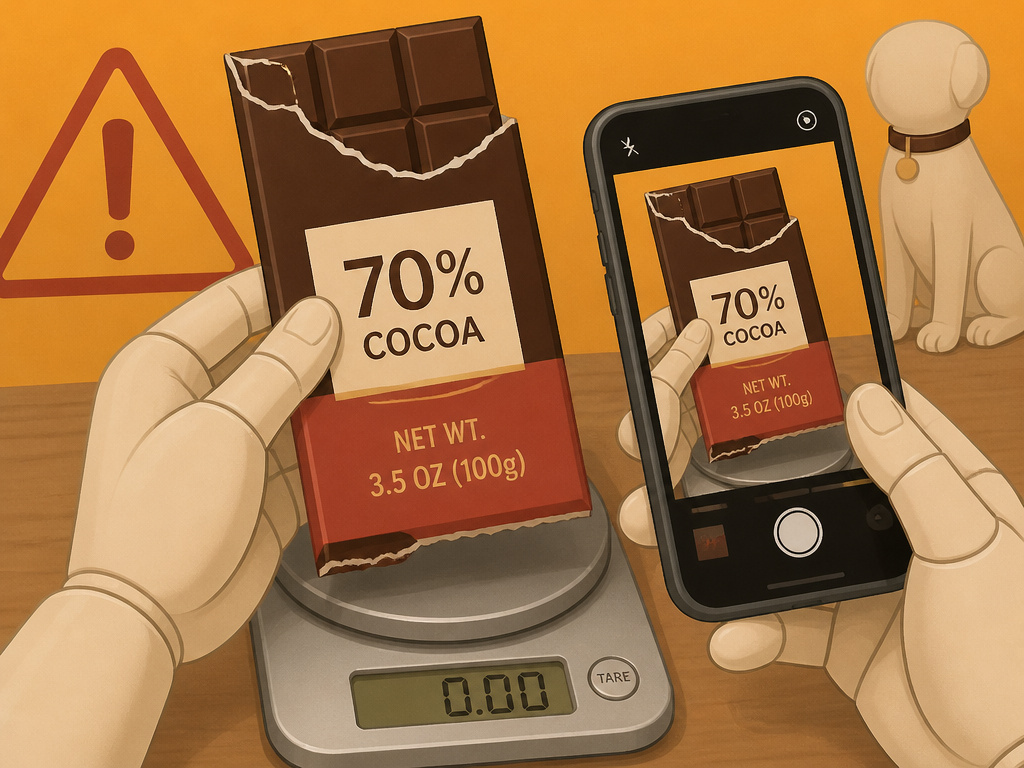
Three things happen in this order: you find the wrapper, you work out the dose, you call someone who can act on it.
Before you start: Keep the packaging, because the cocoa percentage and the net weight are the two numbers a vet needs. Do not guess a hydrogen peroxide dose at home; Merck’s figure is 1 to 2 mL/kg with a 45 mL ceiling, and in one published case an owner’s 2.4 mL/kg produced no vomiting at all. Keep an affected dog calm, since excitement and exertion load a heart that is already being pushed.
- Keep the wrapper and the box. The cocoa percentage and the net weight turn a guess into a dose. Photograph both before anything else. Skip this and the vet is working from “some chocolate,” which is not a dose.
- Weigh the dog, or use the last real weight you have. Every threshold here is per kilogram. Skip this and you can talk yourself out of a genuine exposure in a small dog.
- Estimate how much is actually gone. Missing squares, an empty tray, a chewed wrapper. If two dogs live in the house, you may not know which one ate, and that changes everything.
- Call the vet or a poison service. Cornell’s page on what to do if a dog eats chocolate says contact an emergency veterinarian immediately.
- Go in if the dose clears 40 mg/kg. That is the level at which decontamination gets considered, according to Today’s Veterinary Practice. Skip it and you are relying on a phone assessment for a dog that may need charcoal or fluids.
The signs of poisoning in a chocolate case are not subtle once they start: vomiting, restlessness, a fast heartbeat, and in later stages tremors and incoordination.
Why Inducing Vomiting at Home Backfires
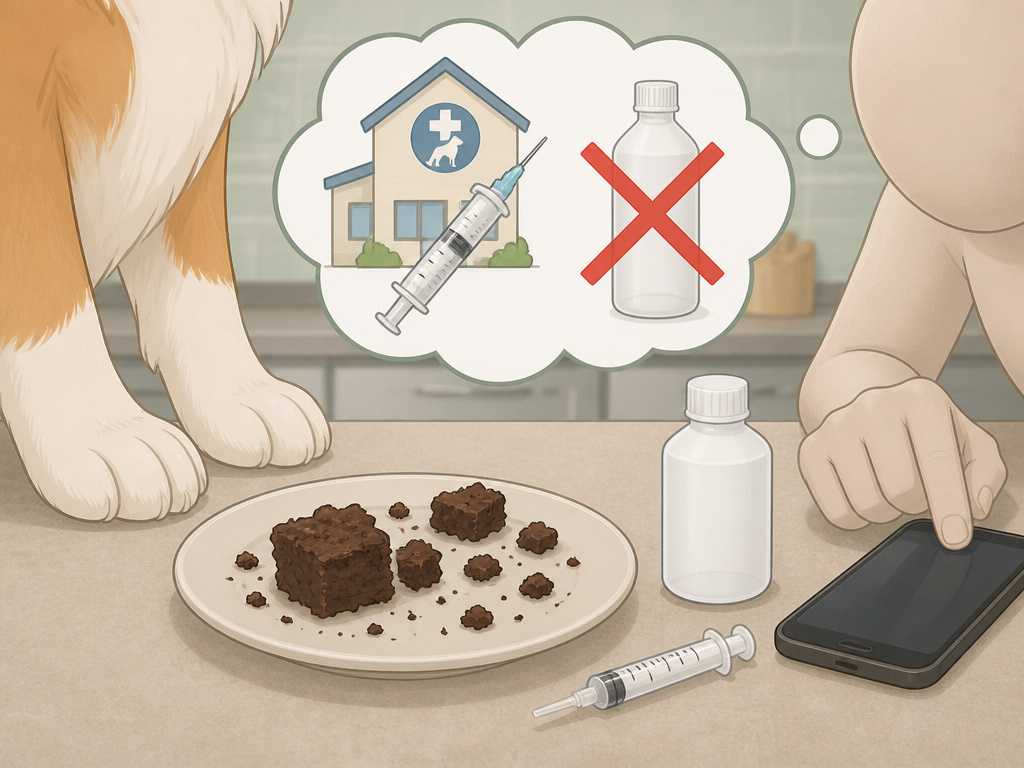
A Corgi eats chocolate brownies. The owner does the thing the internet says and gives hydrogen peroxide. Nothing comes up.
In a published case report, a 7-year-old spayed female Corgi ingested brownies at a theobromine dose of 88.3 mg/kg and was seen 1.5 hours later. The owner had already given 2.4 mL/kg of hydrogen peroxide by mouth at home, and the dog had not vomited. At the clinic the dog was mildly hyperthermic and tachycardic.
That is the case for calling rather than dosing. The PDSA tells UK owners not to make their dog sick at home and to let a vet give an injection instead.
Cornell takes a different line on timing, saying vomiting should be induced even a few hours after ingestion because chocolate absorbs slowly. Both positions can be true at once: the decision belongs to a vet, and a vet has better drugs than peroxide.
If you are standing in the kitchen deciding whether to make a dog vomit, you have already spent more time than the phone call would take. That decision needs a measured dose and a dog that will not aspirate. It is a vet’s call, not a guess made over the sink.
The timing window itself is contested, and the spread is wide. Merck says consider emesis within 2 hours of ingestion, while Cornell says a few hours is still worth it and Today’s Veterinary Practice says up to 8 hours for large ingestions. Cornell says a few hours is still worth it. Today’s Veterinary Practice says emesis can be useful up to 8 hours after a large ingestion and recovers roughly 40% to 60% of stomach contents. Another source defines recent as within 6 hours. That is a range of 2 to 8 hours, which is a lot of room to be guessing in.
And the reflex itself is under question. In the SAVSNET dataset, 75 of 185 cases with a documented or inferable theobromine dose (41%) were below the 20 mg/kg threshold, and 34 of those dogs still received apomorphine as a safety measure. The authors call for more research into the risks and consequences of emetic therapy. That is a polite way of saying the standard move may be causing harm at doses that were never dangerous.
The Activated Charcoal Trade-Off Nobody Warns You About
Activated charcoal can save a dog and can also put one into a near-arrest.
After the Corgi above received activated charcoal with sorbitol at 1.9 g/kg, tremors and seizures appeared 4.5 hours after ingestion. A second charcoal dose without sorbitol, 0.9 g/kg, drove serum sodium to 174 mmol/L against a reference range of 144 to 160. The dog developed neurologic signs and was discharged 57 hours after admission.
The mechanism is easy to see once it is laid out. Activated charcoal is hygroscopic, and it is usually formulated with an osmotic cathartic like sorbitol, which pulls fluid into the gut. Chocolate is itself osmotically active and dehydrates through the diuretic effect of methylxanthines. Put those together in a dog that is already down on water and the sodium concentrates.
Merck’s position is that a single low dose of 1 to 2 g/kg should only be considered with lethal exposures, and only when benefits outweigh risks, while another source recommends several doses repeated every 3 to 6 hours up to 72 hours after ingestion. Today’s Veterinary Practice restricts it further: asymptomatic, well hydrated, and at or above the median lethal dose, with monitoring for hemoconcentration and hypernatremia. Another source recommends several doses, repeated every 3 to 6 hours up to 72 hours after ingestion. Those are not the same instruction, and the case report is why the newer guidance is more cautious.
The hypernatremia after activated charcoal case recommends frequent electrolyte and neurologic monitoring whenever charcoal is used for an osmotically active toxin.
Easy to miss: The signs of hypernatremia look like the signs of methylxanthine toxicosis. A dog that is dull, wobbly, or seizing after charcoal may be sodium-toxic rather than chocolate-toxic, and the treatment is different.
Which Chocolate Is the Real Risk?
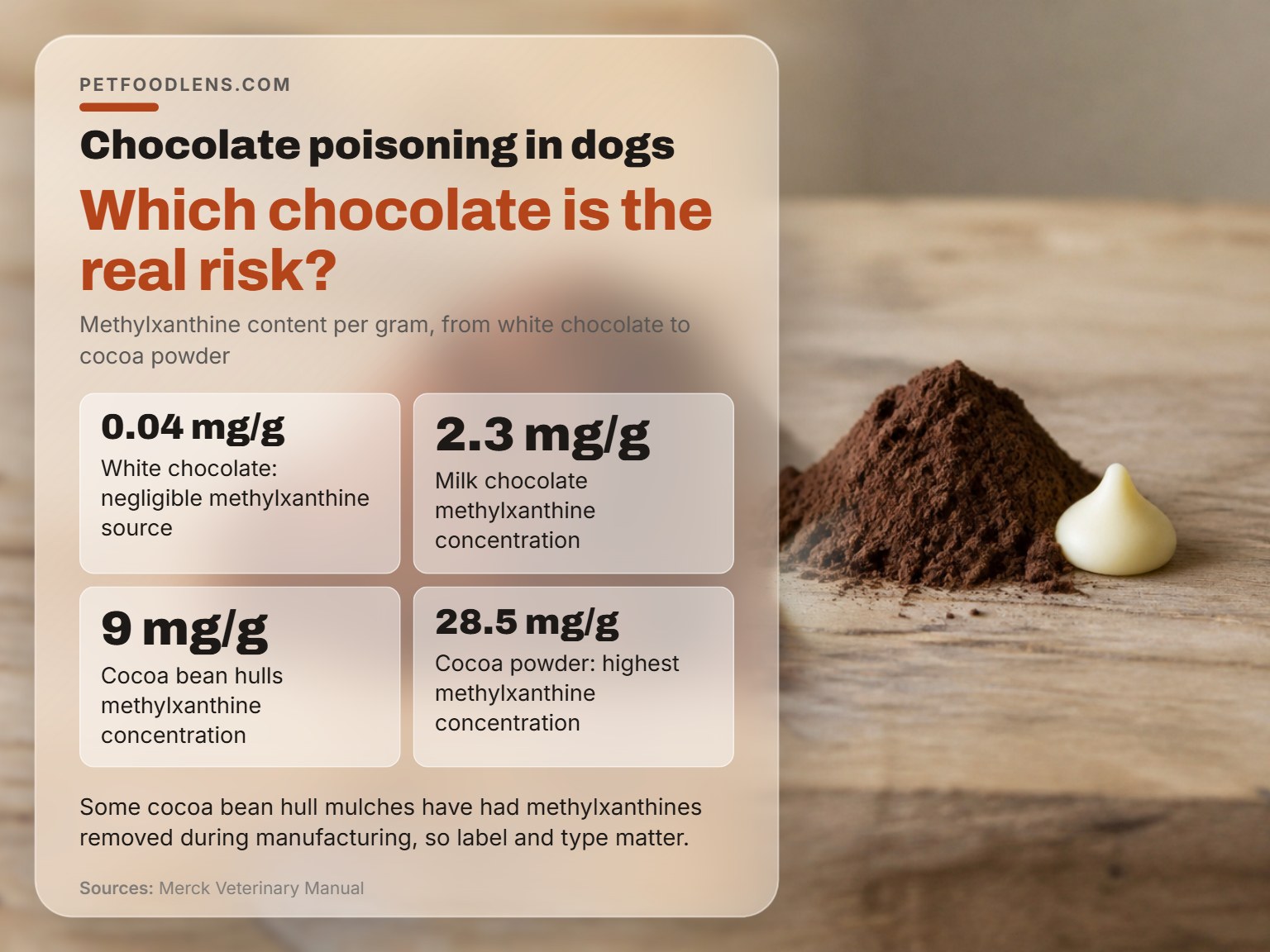
The bag of white chips is the least of it, and the tin of cocoa powder at the back of the cupboard is the worst.
White Chocolate Is a Fat Problem
Merck lists white chocolate at 0.04 mg/g, or 1.1 mg/oz, and calls it a negligible source of methylxanthines. The PDSA agrees that toxicity isn’t the risk because there are no cocoa solids, then points at the real issue: fat and sugar, which can cause stomach upset and in severe cases pancreatitis. A dog that eats a large amount of white chocolate needs a vet for a completely different reason.
The Cocoa Bean Hull Mulch Nobody Checks
Garden mulch made from cocoa bean hulls runs about 9 mg/g, or 255 mg/oz, which is higher than milk chocolate. Merck flags that some mulches have had the methylxanthines removed during manufacturing, so the label and the type matter. A dog that raids a flowerbed is a genuine exposure, and the bag in the garage is the evidence.
Honestly, the mulch case is the one I would have missed before I read the label footnotes.
Four things to check on any package:
- The cocoa percentage, if it is printed at all.
- The net weight in ounces or grams.
- Whether the product is a bar, chips, powder, or garden mulch.
- Whether anything else was in the box, because gift selections rarely contain only chocolate.
That last one matters more than the chocolate. Macadamia nuts turn up in the same assortments, and macadamia nuts have their own mechanism entirely.
What most people get wrong: Treating every chocolate exposure as the same emergency. A single chocolate chip and a whole bar eaten by a 6-pound dog are not the same event, and flattening them into one category is how owners end up ignoring the one that matters.
If the cake on the counter was baked for the dog in the first place, use a dog-safe birthday cake recipe with no cocoa at all and the question disappears.
When It Is Not Chocolate at All
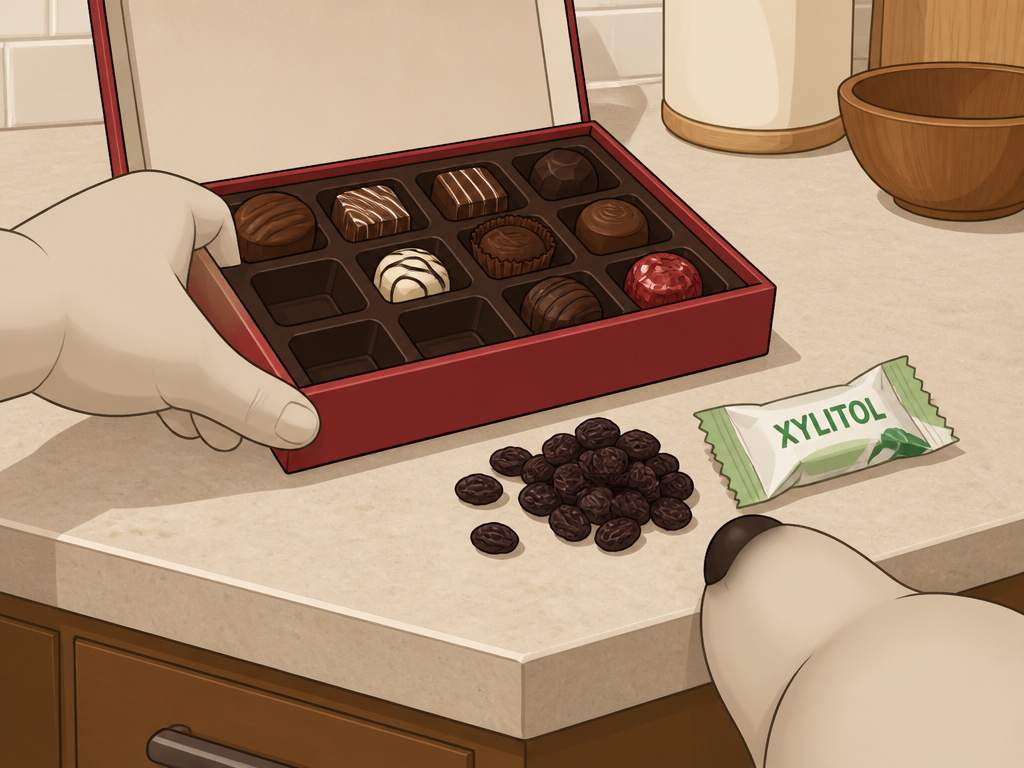
Chocolate gets the attention, and the box on the counter usually contains something worse.
Xylitol Hides in Sugar-Free Candy
Xylitol poisoning in dogs is a hypoglycemia emergency rather than a methylxanthine one.
Grapes and Raisins Are in the Same Box
Grape and raisin toxicity is the other one that hides in gift assortments. Chocolate-covered raisins are a double exposure.
The wider list of foods toxic to dogs is worth reading once, calmly, on a day when nothing is wrong. Reading it in a panic at 11pm with a dog on the kitchen floor is a bad time to learn that onions and garlic are on it.
I formulate food for a living, not emergency medicine, and I’ll say plainly that this is where my expertise stops. What I can tell you is that the owners who do well in these cases tend to be the ones who called early with the wrapper in hand.
Frequently Asked Questions
How long after eating chocolate will a dog show signs?
Merck says usually within 6 to 12 hours, while Cornell says 2 to 12 hours and the PDSA says usually 2 to 4 hours, up to 12. Cornell says 2 to 12 hours. The PDSA says usually 2 to 4 hours, up to 12. The variance is exactly why you call before the window closes rather than after.
How much chocolate is lethal to a dog?
Merck reports an oral LD50 of 100 to 200 mg/kg for caffeine and theobromine, and Texas A&M’s diagnostic lab cites a reported lethal range of 100 to 500 mg/kg. For milk chocolate specifically, Merck puts roughly 62 g/kg (1 oz/lb) as potentially lethal, which matches Cornell’s 1 oz/lb figure.
Is white chocolate poisonous to dogs?
Not from methylxanthines. Merck lists 0.04 mg/g and calls it negligible. The PDSA points to fat and sugar as the real risk, including pancreatitis in severe cases.
Should I make my dog vomit after eating chocolate?
Not on your own. The PDSA says don’t. Cornell says a vet may induce vomiting even hours later because chocolate absorbs slowly. Merck’s window is 2 hours, Cornell says a few hours is still worth it, and Today’s Veterinary Practice says up to 8 hours for large ingestions.
Does a 65% cocoa bar count as dark chocolate?
Yes, and the percentage is a dose multiplier. Merck’s rule is that the cocoa percentage reflects how much unsweetened chocolate is in the bar, so a 65% bar runs about 10.1 mg/g, or 286 mg/oz.
My dog ate one chocolate chip. Do I need the emergency vet?
One chip is a small dose, but small is doing a lot of work in that sentence and it depends entirely on the dog’s weight and the chip’s cocoa content. Weigh the dog, keep the packaging, and get a real calculation rather than deciding from the size of the dog.
The Bottom Line
Two things I’d want you to carry out of this. The first is a number pair: 20 mg/kg is where mild signs start, and 40 mg/kg is where decontamination gets considered. If you can’t produce a dose, you can’t make a decision, so the wrapper and the dog’s weight are the whole game.
The second is a concession. I formulate cat food for a living, and dogs are not my strongest species. Everything above traces back to Merck, the FDA, Cornell, or a published case, and none of it replaces a vet who can put your actual dog on a scale with your actual product in hand.
Chocolate poisoning in dogs is one of the more solvable emergencies in veterinary medicine, provided someone makes the call while there is still time to act on it.
And when the boxes come out at Christmas, remember the surveillance data: exposure is 4.74 times more likely then. That isn’t a fact about dogs. It’s a fact about where we leave the chocolate.
