
Food Allergy vs Food Intolerance in Dogs: Which Is It?
This post contains affiliate links. As an Amazon Associate, we earn from qualifying purchases.
Food allergy vs food intolerance in dogs separates on one question: does the immune system react? An allergy is an immune response to a protein. An intolerance is a digestive or metabolic failure to process a food, with no immune involvement. An 8-week restrictive diet identified more than 90% of dogs with skin reactions to food.
That 8-week figure is where the food allergy vs food intolerance in dogs question starts behaving differently in practice. Skin signs move slowly, so a trial abandoned at ten days tells you nothing and the dog goes back to the same bag with a new story attached. Gut signs can settle within days to weeks, which is exactly why owners credit the wrong change.
What follows walks the mechanism, the trial length the sources genuinely disagree about, the tests worth skipping, and the diet choices that survive a strict trial.
Key Takeaways
- The immune system is the dividing line. Allergy runs through IgE and histamine; intolerance is enzymatic or metabolic, per the Gaschen and Merchant review.
- Trial length is contested. The Canine Dietitian runs 6 to 8 weeks. Chewy and Wilson’s Health both say 8 to 12.
- Blood and saliva panels don’t diagnose this. Low positive predictive value, and not validated for food allergy.
- One off-diet bite resets the clock. Chewy’s own wording is back to day one.
- Grain-free is not a trial diet. Grain is rarely the driver in dogs; animal proteins are.
Where the Immune System Draws the Line
A food allergy runs through IgE antibodies, mast cells and histamine. A food intolerance runs through enzymes, fat load and gut transit, and the immune system stays out of the argument entirely.
An IgE-mediated food allergy begins when a dietary protein is recognised as foreign, binds to mast cells in the intestinal wall, and triggers histamine release. The resulting inflammation produces pruritus, ear disease and skin lesions. A food intolerance produces gastrointestinal signs through enzymatic or metabolic failure, with no antibody involvement at any stage.
That distinction comes from the Gaschen and Merchant review published in Veterinary Clinics of North America, which splits intolerances into three buckets: metabolic, pharmacologic and idiosyncratic. The MSD Veterinary Manual entry on cutaneous food allergy covers the allergy side of the same divide.
Metabolic means an enzyme shortfall. Cow’s milk carries high lactose, and lactase production drops sharply after weaning, so the sugar arrives in the colon intact. Pharmacologic means a compound in the food does something. Histidine in spoiled fish converts to histamine in the gut and drives inflammation. Idiosyncratic means an additive, and nobody can predict which dog reacts to which one.
The published lists of common food allergens consistently include beef and chicken, with dairy, wheat, lamb, corn, soy, eggs and fish appearing depending on the source. Dairy, wheat, lamb, corn, soy, eggs and fish appear or vanish depending on who compiled the list.
Here’s the mechanism that matters for diagnosis. An enzyme supply is finite. Push more lactose, more fat, more of the offending compound through, and the signs scale up with the load. An immune reaction doesn’t scale that way. It fires on exposure, which is why a fragment of the wrong protein can undo three clean weeks. That single difference explains most of what follows.
How Long Does an Elimination Diet Take to Give a Straight Answer?
Eight weeks is the number the Olivry 2015 peer-reviewed work lands on, though the clinical sources disagree on the window around it. Olivry, Mueller and Prelaud, writing in BMC Veterinary Research in 2015, found that an 8-week restrictive diet identified more than 90% of dogs and cats with cutaneous adverse food reactions.
The clinical sources don’t agree on the food allergy vs food intolerance in dogs window around it.
| Source | Trial length advised | What it rests on |
|---|---|---|
| The Canine Dietitian | 6 to 8 weeks, extended for slow responders | Cites the Olivry 2015 review |
| Chewy (vet reviewed) | 8 to 12 weeks | Practice-based, two named DVMs |
| Wilson’s Health | 8 to 12 weeks | Cites veterinary guidelines |
| Olivry, Mueller and Prelaud 2015 | 8 weeks caught over 90% of cases | Critically appraised topic |
Those extra four weeks aren’t free. They’re four more weeks of refusing the treat bowl and explaining the rules to a dog sitter.
My own line: book eight weeks, and extend toward twelve when skin is the main complaint and the trial has taken any contamination hit. Skin takes longer than gut to settle, and the skin barrier doesn’t reset on a schedule. That’s a stance, not a consensus, and the sources above show why the range exists.
A trial that stops when the dog looks better proves nothing. The diagnosis arrives at the challenge phase, when the food goes back in and the signs return.
The elimination diet itself is a controlled feeding trial, not a permanent way to feed a dog. That framing matters, because owners who treat it as a new diet rather than a test tend to stop tracking and stop challenging.
Does the Timing of the Reaction Tell You Which One It Is?
Daiyum states that a true allergic reaction doesn’t usually announce itself within an hour of eating, and doesn’t resolve as cleanly either. Cotswold RAW, citing Gaschen and Merchant, says allergic reactions usually occur soon after ingestion, while intolerance reactions are often delayed by up to 48 hours.
Both positions come from people with clinical credentials. Neither one lets you skip the trial.
A dog arrives with a salmon-pink patch between the toes, a faint yeasty smell from both ears, and a stool that never quite firms up. That picture points toward food. Itch that tracks the seasons points toward environmental allergies, which is a different workup with a different specialist.
| What you’re seeing | What it points toward | Next step |
|---|---|---|
| Year-round itch, ear debris, loose stool | Food reaction worth testing | Strict elimination trial |
| Itch flaring in spring and autumn | Environmental allergy | Vet skin workup first |
| Vomiting within hours of one new food | Intolerance or dietary upset | Remove the food, watch two days |
| Weight loss, blood in stool, repeated vomiting | Not a diet puzzle | Vet before any trial |
The skin question splits the same way. Daiyum frames skin signs as the allergy signature and gut signs as the intolerance signature. Cotswold RAW notes that intolerance can produce skin symptoms too, as a consequence of poor gut health. So a dog with both itch and loose stool could be sitting on either mechanism.
That’s the honest limit of pattern-reading. The signs of food allergies narrow the field. Only the trial settles it.
Why the Blood and Saliva Tests Keep Disappointing Owners

I’ve had owners hand me a two-page panel listing a dozen reactive foods, and three of those foods the dog had never eaten in its life. The list came from a saliva test sold online. The dog was still itchy.
The Buffalo Co. Is blunt about why: serum and saliva antibody tests have low positive predictive value and aren’t recommended for diagnosing adverse food reactions in dogs. Chewy states flatly that there are no reliable blood tests for food allergies. Daiyum’s position matches, adding that these panels aren’t validated as diagnostic tools at all.
Wilson’s Health is the outlier worth naming. It says serum and intradermal tests can serve as supporting information, while also stating they don’t replace an elimination diet as the main diagnostic tool. That’s a narrower claim than the others make, and it’s the most generous reading in the set.
Fair warning: I spend most of my working life on commercial cat formulations, so dogs are the weaker half of my knowledge. On this point I lean on the veterinary literature rather than my own caseload, and the literature is consistent enough that the conclusion holds.
The practical upshot is that food allergy testing in dogs still runs through the bowl. A panel that flags ten ingredients tells you nothing about which one is actually driving the problem.
Choosing the Trial Diet: Hydrolysed, Novel Protein, or Home-Cooked
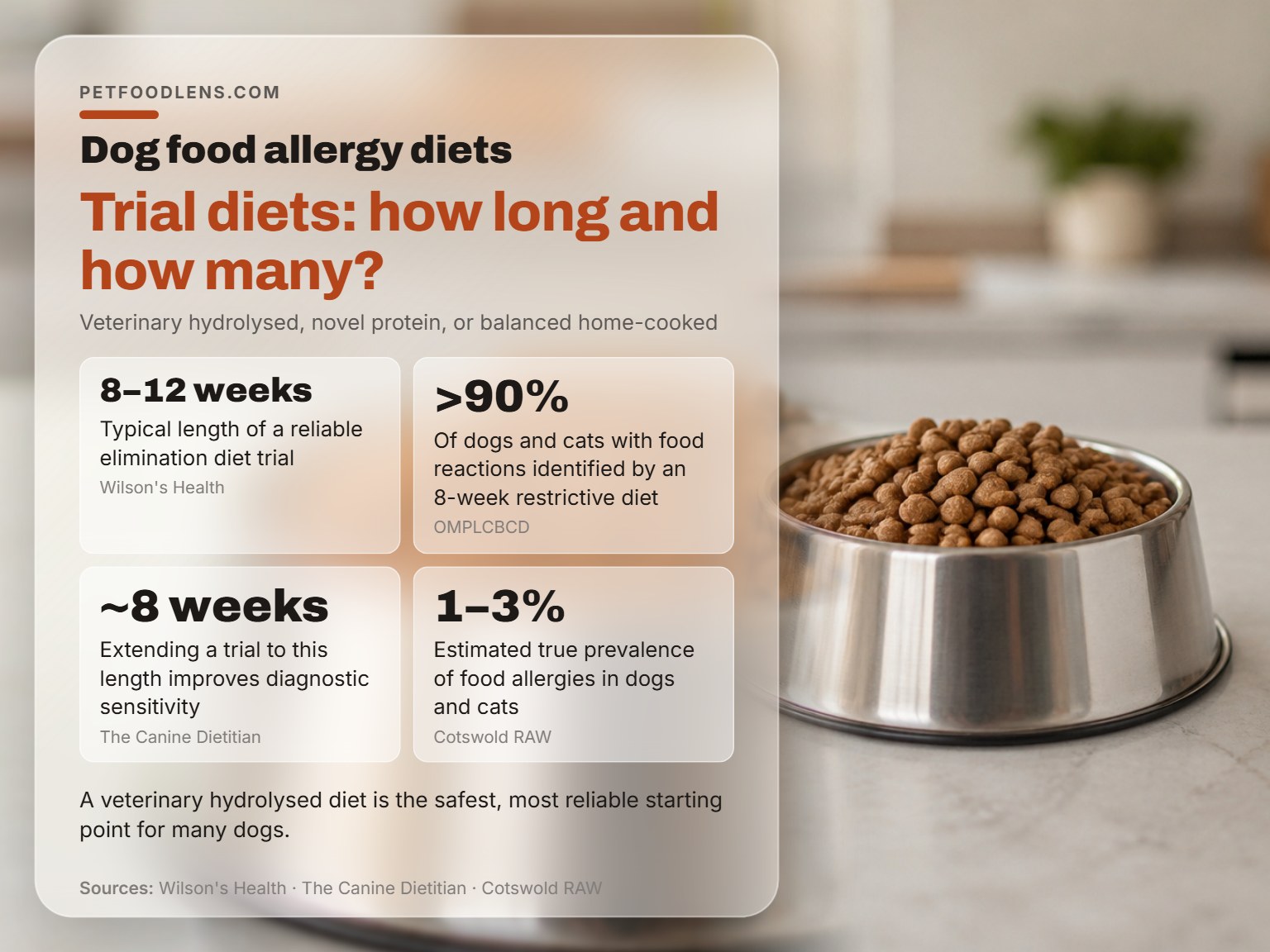
Three options do the real work: a veterinary hydrolysed diet, a genuinely novel protein, and a balanced home-cooked plan. Everything else on the shelf is a compromise.
Why Hydrolysed Protein Is the Usual Starting Point
Hydrolysed diets break the protein into fragments small enough that the immune system has trouble recognising them. The Canine Dietitian calls a veterinary hydrolysed diet the safest and most reliable starting point for many dogs, particularly when symptoms are significant or the diet history is messy.
That’s the practical recommendation for most dogs: a veterinary hydrolysed diet, chosen with your vet rather than off a shelf. These are boring, they’re prescribed, and they’re manufactured with tighter control than any boutique bag.
When a Novel Protein Diet Actually Works
Novel only means new to your dog. Venison stops being novel the moment the dog has had a venison chew, and the same goes for duck, salmon and kangaroo. If the diet history is short and clean, a novel protein can work well. If the dog has cycled through eight proteins in three years, the word has no meaning left.
Protein cross-reactivity is the other reason a fresh protein can fail, and it’s worth understanding before you buy a fourth bag.
The Home-Cooked Route and Its Catch
A home-cooked trial with one protein and one carbohydrate is the most controlled version of this, and the least forgiving. It has to be balanced if it runs past a few weeks, which means a nutritionist, which means most owners don’t do it properly.
The four real options, ranked by how much control they give you:
- Veterinary hydrolysed diet. Tightest manufacturing control, complete and balanced, and the least chance of cross-contamination. Downside: some dogs refuse the taste.
- Novel protein commercial diet. Workable with a short diet history. Downside: vague sourcing and previous exposure quietly wreck it.
- Home-cooked elimination diet. Maximum control when planned by someone who knows what they’re doing, and a nutritional deficiency risk when it isn’t.
- Over-the-counter sensitive food. Easy to buy. Not a trial diet.
Read past the front of the package on that last one. A bag labelled sensitive usually carries multiple proteins and ingredients the dog has already met.
Two more things the sources rule out. Grain-free food is not an elimination diet, and grain is rarely the main issue in dogs compared with animal proteins. Raw food isn’t the preferred option either, especially with gut signs, immune compromise, pancreatitis, IBD, or vulnerable people in the house.
Running the Trial Without Contaminating It
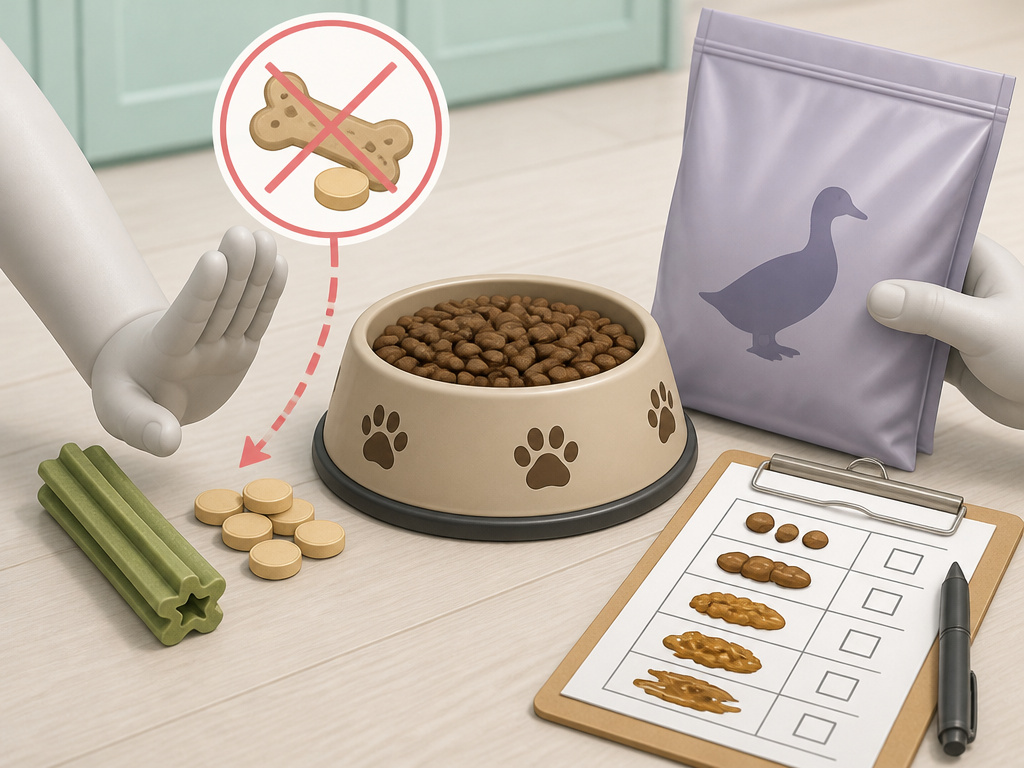
Before you start: Blood in the stool, weight loss, persistent vomiting, severe diarrhoea, pain, lethargy, recurrent infections, or a very young dog all mean a vet visit before any diet change. Pancreatitis, IBD, PLE, kidney and liver disease need veterinary management alongside the trial, because diet alone won’t interpret cleanly against that background.
Contamination is where most trials die. Not the diet choice, not the duration. The treat from a neighbour.
- Build the full diet history first. Meals, treats, chews, dental sticks, flavoured medications, lick mats, stolen cat food. Skip this and novel becomes meaningless, because the dog has already met most proteins somewhere.
- Pick the diet with your vet. Choose it from the history, not from the front of the bag. A hydrolysed diet is the safer call when the history is a mess.
- Feed only the trial diet. No random treats, no dental chews, no flavoured supplements, no plate licking. Chewy’s warning is specific: one bite of an offending food can set you back to day one.
- Log symptoms daily. Stool score, ear redness, paw licking, wind, scratching frequency. Memory is a poor instrument over eight weeks.
- Change nothing else at the same time. Adding a supplement or stopping a medication mid-trial leaves you unable to attribute the result to anything.
- Fix the endpoint before you start. Decide the review date on day one, or the trial drifts until everyone gives up.
Common mistake: Leaving flavoured medications and dental chews in the routine. Both carry proteins, and both can muddy a trial that was otherwise clean.
Reintroducing Foods One at a Time
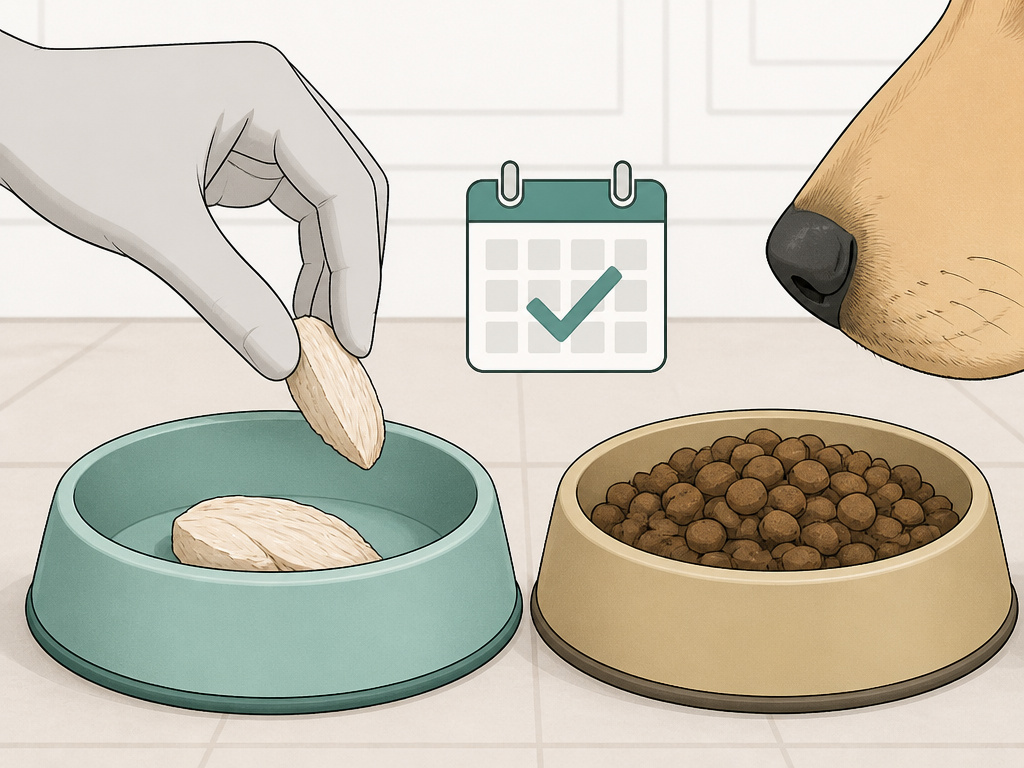
Reintroduction turns a suspicion into a diagnosis. The Canine Dietitian’s protocol is one ingredient at a time, usually a protein, with a return to the safe base diet between challenges.
The base diet is the control. Without it, last week’s reaction is still running when the next food goes in, and you’ve learned nothing about either one.
Where this goes sideways: Challenging two proteins in the same week. When the itching comes back you have two suspects, one flare, and no way to separate them.
Reintroducing foods properly takes longer than the trial itself in some cases. That’s the cost of a real answer.
When the Answer Is Intolerance Instead
Exocrine pancreatic insufficiency is the clearest example of a food problem that isn’t an allergy. The pancreas stops producing enough digestive enzymes, and the dog loses weight while eating well. A JAVMA review cited by Daiyum sets the standard of care: pancreatic enzyme replacement, a low-residue diet with moderate fat, and cobalamin supplementation.
Nothing in that protocol involves the immune system. It’s a mechanical failure with a mechanical fix.
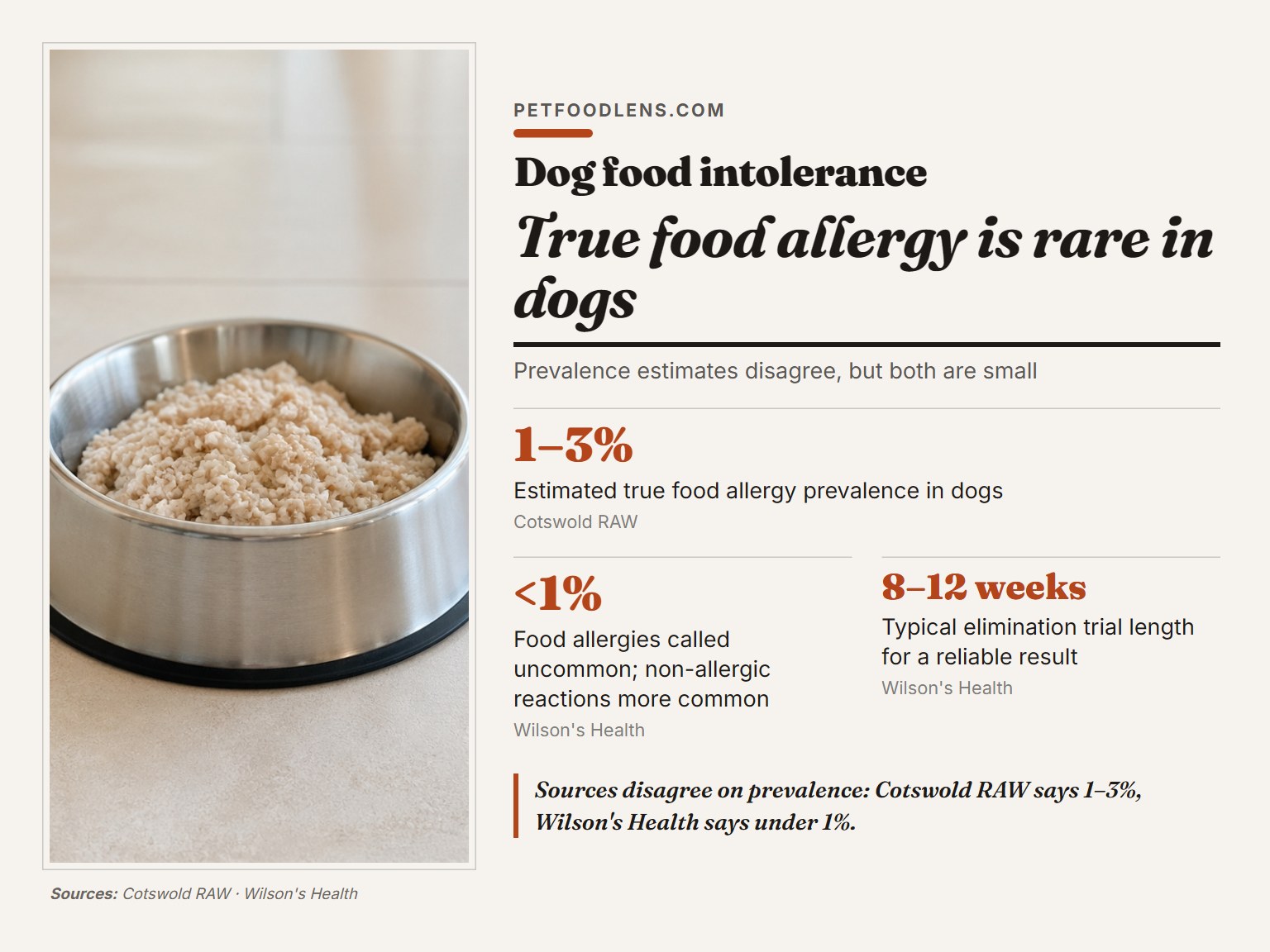
Intolerance is the likelier verdict overall. Cotswold RAW notes that an itchy dog with gut signs is statistically more likely to have an intolerance than a true allergy, and the prevalence estimates support that: roughly 1 to 3 percent for true food allergy per Verlinden and colleagues, against Wilson’s Health figure of under 1 percent. The two numbers disagree, but both are small.
A dog with a true food intolerance often improves on a simpler, lower-fat diet within days, which is faster than any immune reaction resolves. The levers that tend to help:
- Lower the fat load. High-fat meals are a listed intolerance trigger, and the response is dose-shaped.
- Remove the lactose. Post-weaning lactase decline is normal, so cow’s milk is a predictable problem.
- Add gentle fibre. Pumpkin brings soluble and insoluble fibre and sits low in novel proteins, which makes it a reasonable bridge food during a diagnostic window.
- Settle the gut first. Dogs with ongoing intestinal issues need the gut quiet before any trial result can be read.
On whether these resolve: Daiyum says some intolerances fade, particularly transient ones tied to a single new ingredient, while enzyme-linked ones need ongoing management. Chewy and Wilson’s Health both describe allergies as lifelong, with Chewy allowing that some diminish with age. The sources don’t fully agree, and I won’t pretend they do.
Frequently Asked Questions
Can a dog have both a food allergy and a food intolerance at the same time?
Yes, and this is one reason diagnosis gets muddled. A dog with an immune reaction to chicken can also lack the enzymes to handle high-fat dairy, so two separate problems produce overlapping signs. The elimination trial is designed to catch the allergy, but if gut signs persist on the novel diet, a concurrent intolerance may be the reason. Keeping a symptom log that separates skin from digestive signs helps your vet untangle which is which.
How do I tell which food is causing the problem if my dog eats the same kibble every day?
You cannot identify the trigger from the current diet alone, because the dog is already exposed to it. The elimination trial works by swapping to a protein and carbohydrate source the dog has never eaten, then watching whether signs resolve. Only after improvement do you reintroduce the old food to confirm it was the cause. Guessing at ingredients without that controlled step usually leads to repeated wrong conclusions.
Are skin signs or digestive signs more common in dogs with food allergies?
Both appear, and either can dominate. Some dogs show only itching, ear infections and paw licking, while others present with vomiting or loose stool, and many have a mix. Because non-immune intolerances tend to produce gut signs alone, a dog with purely skin-related problems points more strongly toward an allergic mechanism. That pattern is a clue, not a diagnosis, so the diet trial still decides.
What should I feed during an elimination trial if my dog has reacted to many proteins?
Hydrolysed prescription diet is often the practical answer, because the protein is broken into fragments too small for IgE antibodies to recognise. Alternatively, a novel protein the dog has genuinely never encountered can work, provided you verify every treat, chew and table scrap. Home-cooked trials are possible but need a veterinary nutritionist to prevent nutrient gaps. Whichever route you choose, the diet must be the only food source for the full trial period.
The Bottom Line
If the signs are skin and ears, year-round, with no weight loss and no blood, book eight weeks and don’t stop early. If there’s weight loss, blood in the stool, repeated vomiting or a dog that’s simply unwell, the diet isn’t the first move. That’s a vet visit, and the diet can wait a week.
One answer for the dog in front of you, if you want it: a veterinary hydrolysed diet for eight weeks, then one protein at a time back in, with nothing else changed. It’s the least exciting advice here and the one most likely to give you a name for the problem.
The concession is this. Everything above assumes a dog that’s otherwise stable and an owner who can hold the line on treats for two months. If your household has kids, a second dog and a well-meaning neighbour with a biscuit habit, the trial will fail for reasons that have nothing to do with the food. Build the containment plan before you build the diet.
