
Food Allergy vs Environmental Allergy in Dogs: 4 Clues
This post contains affiliate links. As an Amazon Associate, we earn from qualifying purchases.
In the food allergy vs environmental allergy in dogs question, the pattern narrows things down but never settles it. Food allergy tends to run year-round and can bring gut signs; environmental allergy tends to follow pollen season. Only a strict elimination diet with a rechallenge confirms food allergy, OutLeash (citing Olivry et al. 2015) sets it at least 8 weeks, while Caring Hands, Dr. Loudon, Vetified, and K9 Vitality give approximately 8 to 12 weeks, and blood or saliva panels cannot diagnose it.
That gap between pattern and proof is where workups stall. A dog can itch in January and July, eat the same kibble for five years, and still be reacting to dust mites, because dust mites don’t check the calendar. So the pattern gets you to a shortlist. The trial is what turns the shortlist into an answer.
What follows: the four clues worth writing down, the tests that actually mean something, and the places where the veterinary sources flatly disagree about how long a trial has to run.
Key Takeaways
- An elimination diet with a rechallenge is the only reliable way to confirm food allergy, at least 8 weeks per OutLeash (citing Olivry et al. 2015), or approximately 8 to 12 weeks per Caring Hands, Dr. Loudon, Vetified, and K9 Vitality. Blood, saliva, and hair panels are not.
- Year-round itch plus gut signs leans food, but year-round itch on its own also fits dust mites, so treat the pattern as a lead.
- Food allergy turns up in 9% to 50% of atopic dogs across published studies, which is why so many itchy dogs have both problems at once.
- Rule out fleas before you spend anything on allergy testing, K9 Vitality advises treating every pet in the house for two months, while OutLeash simply says to rule out fleas and treat skin infections first.
- Never give human antihistamines without veterinary guidance. Some products contain ingredients that are unsafe for dogs.
Food Allergy vs Environmental Allergy in Dogs: The 4 Clues That Matter
Four clues do most of the work: seasonality, digestive signs, age of onset, and where the itching lands. None of them is decisive on its own.
Food allergy and atopic dermatitis in dogs produce overlapping signs in the same locations: face, ears, paws, belly, and around the anus. Distinguishing the two depends on history, seasonality, digestive involvement, and response to a dietary trial. Skin and serum testing identifies sensitization for immunotherapy planning; neither establishes causation alone.
Start with where the dog itches. Food allergy and atopy both hit the face, ears, paws, and belly, so location alone rarely separates them. Flea allergy picks a different neighbourhood: rump, tail base, and the strip along the back.
Digestive signs are the clue owners underreport. Caring Hands Animal Hospital calls them sometimes present in food allergy and less typical in environmental allergy. K9 Vitality puts a number on it: soft stool, more than two or three bowel movements a day, frequent gas, or occasional vomiting alongside the itch shifts the odds toward food.
Age of onset helps a little. Environmental allergy usually starts between six months and three years. Food allergy can start at any age, including in a dog that has eaten the same food happily for five years, because sensitisation needs repeated exposure.
| Feature | Food allergy | Environmental allergy | Flea allergy |
|---|---|---|---|
| Seasonality | Year-round | Often seasonal, can be year-round | Peaks in flea season |
| Gut signs | Sometimes present | Uncommon | Absent |
| Itchiest spots | Face, ears, paws, belly | Face, ears, paws, belly, armpits | Rump, tail base, back |
| Age of onset | Any age, often 1-3 years | Usually 1-3 years, rarely after 7 | Any age after exposure |
| Confirming test | Elimination diet plus rechallenge | Clinical diagnosis, then testing for immunotherapy | Response to strict flea control |
Treat that table as a set of tendencies. Every row has exceptions, and the exceptions cluster in dogs that have both conditions.
Here is what I would write down for two weeks before booking anything:
- Time of year the itching started, and whether it has ever actually stopped.
- Bowel movements per day, roughly, plus any gas or soft stool.
- Where the dog scratches first when it wakes up.
- What changed in the house or the bowl in the fortnight before the flare.
The food allergy symptoms worth recording are the ones that repeat in the same spots week after week.
One more distinction that gets muddled constantly. Owners use allergy and food intolerance interchangeably, and it matters. A true allergy runs through the immune system and shows up on the skin. An intolerance is mostly digestive and often dose-dependent, so a small amount may be tolerated fine.
Does Year-Round Itching Really Mean Food?
Blue Valley Animal Hospital and Caring Hands both treat constant, non-seasonal itch as a food signal. OutLeash points out that indoor allergens run all twelve months too, dust mites especially, so the pattern rarely settles anything by itself.
It’s February, the ground is frozen solid, and the dog is still working at its flank. That picture is what sends a lot of owners toward food, and it’s a reasonable read.
The disagreement is worth spelling out, because the sources are not being coy about it. Bscly and K9 Vitality both call seasonality the single most useful question. OutLeash argues seasonality loses its value once atopy becomes chronic or dust-mite driven. Dr. Loudon lands with the first camp: a dog that itches in the dead of winter points toward food.
If the itching has a season, write the season down. If it never stops, write down the bowl and the bedding instead. A diet trial run during peak pollen may give a less clear readout.
Bscly offers the most practical resolution I’ve found. A clear year-round baseline with seasonal spikes probably means the baseline is food-driven and the spikes are environmental. That’s two problems, not one, and it’s why Bscly also suggests running any diet trial in a non-peak season for the cleanest readout.
How Do You Actually Diagnose a Food Allergy?
The elimination diet is the only test that settles the food question, and sources disagree on how long it should run, at least 8 weeks per OutLeash (citing Olivry et al. 2015), or approximately 8 to 12 weeks per Caring Hands, Dr. Loudon, Vetified, and K9 Vitality.
I work mostly in cat formulations, so I’ll say this plainly: the dog literature here is not my home turf, and I’ve leaned on the veterinary sources below rather than on my own case files.
Before you start: Changing food without veterinary guidance can make the diagnosis harder rather than easier. Flavored parasite preventives, dental chews, and toothpaste all count as food during a trial. Never give a dog human allergy medication without veterinary guidance, because some products contain ingredients that are unsafe for dogs.
The 8-to-12-Week Trial
- Let a vet pick the diet. A hydrolyzed prescription diet or a novel protein the dog has never eaten. Choose it yourself and you may land on something the dog already tolerates, which wastes the entire run.
- Feed that food and nothing else for the full duration. One table scrap or one flavored heartworm tablet resets the clock, and you won’t know it happened.
- Audit every oral exposure. Dental chews, toothpaste, chewable preventives, and whatever the dog finds on a walk all count. A dog that scavenges street food is not on an elimination diet.
- Keep a daily itch log. Without a baseline you can’t tell a real improvement from a good week.
- Change one thing at a time. New food plus a new shampoo plus a new supplement in the same week gives you three suspects and no answer.
The trial length is where the sources genuinely split.
| Source | Trial length | Wording |
|---|---|---|
| Olivry et al. 2015, via OutLeash | At least 8 weeks | A floor |
| Caring Hands Animal Hospital | About 8 to 12 weeks | A range |
| Dr. Loudon | 8 to 12 weeks | A range |
| Vetified | 8 to 12 weeks | A range |
| K9 Vitality | 8 to 12 weeks | A range |
Here is what the numbers actually say: the sources give a range of 8 to 12 weeks, with Olivry et al. 2015 setting a floor of at least 8 weeks. The elimination diet is only as good as its weakest week, and the weakest week is usually the one where someone felt sorry for the dog and handed over a biscuit.
Ask your vet about cross-reactivity before settling on a protein. The overlap between related meats is one more reason that diet choice belongs with a clinician rather than with a bag.
The Rechallenge Nobody Does
Improvement during the trial is half the evidence. The other half is what happens when you put the original food back.
K9 Vitality is blunt about this: return to the original diet, and if the itch comes back within two weeks you have your answer, while Caring Hands says a controlled food challenge ‘may help confirm’ the suspected ingredient. If it doesn’t come back, food was never the problem and you’ve ruled it out properly. Caring Hands is softer, saying a controlled food challenge “may help confirm” the suspected ingredient. OutLeash treats the rechallenge as part of the only reliable diagnostic method, while Caring Hands says a controlled food challenge ‘may help confirm’ the suspected ingredient.
Common mistake: Ending the trial the moment the itching stops. Without the rechallenge you’ve proven very little, because K9 Vitality states that without it you’ve proven nothing.
Why a Blood or Saliva Panel Can’t Diagnose Food Allergy
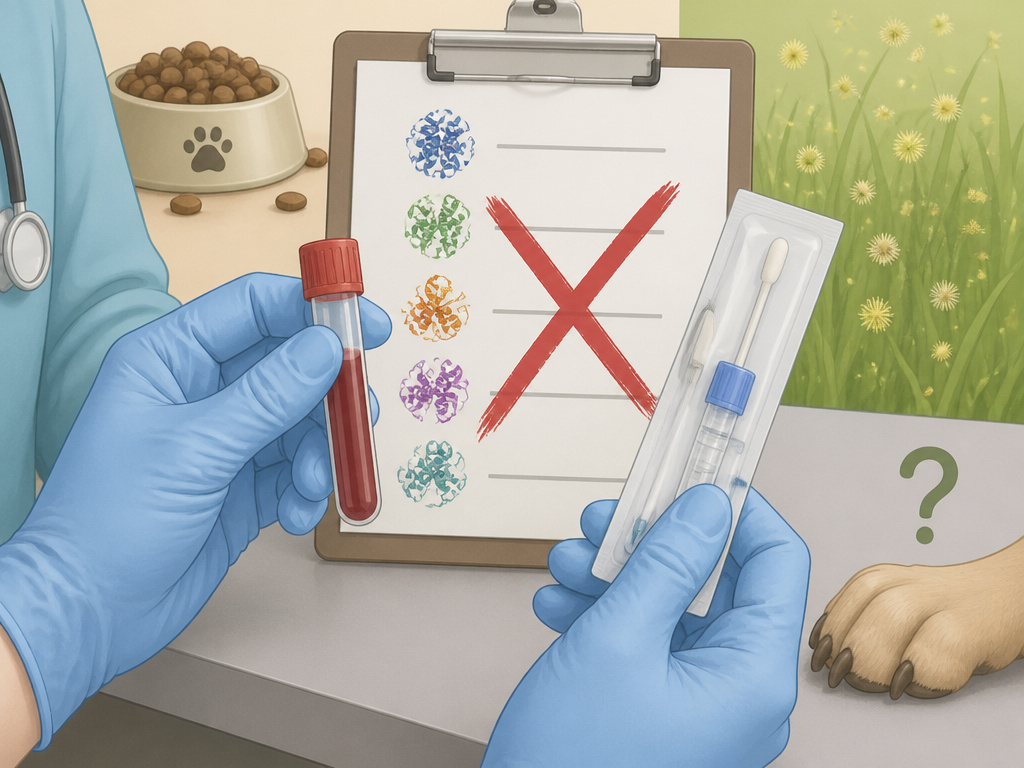
Serum IgE panels and saliva kits measure sensitization. Whether that sensitization produces symptoms is a separate question, and it’s the one that decides what you feed.
The peer-reviewed position is not ambiguous. Blood and saliva food allergy tests are not reliable for diagnosing food allergy. Caring Hands states flatly that blood and saliva tests marketed for food allergies cannot reliably diagnose them. Bscly goes further: no blood test, saliva test, or hair analysis has been validated for this, and serum IgE testing and online intolerance panels have no diagnostic value.
K9 Vitality adds the detail that makes it click for owners. These tests agree poorly with what actually happens when the dog eats the food, and they frequently flag proteins the dog tolerates perfectly well.
What Serum and Saliva Panels Actually Measure
They measure circulating antibodies. A positive result means the immune system has met the protein and made a note of it. Clinical allergy requires that meeting to produce symptoms, and the test can’t see that part.
Ask which of the listed proteins the dog has actually eaten. The answer is usually awkward silence.
Environmental testing is a different animal. Blood testing does have a role there, but the role is choosing what goes into immunotherapy rather than diagnosing the condition, per both K9 Vitality and Caring Hands, while Vetified considers intradermal skin testing the most accurate method for identifying environmental allergens.
What Environmental Testing Can and Can’t Tell You
The dog comes in from the yard, drops on the mat, and goes straight at both front paws. Ten minutes later the muzzle is pink from rubbing the carpet.
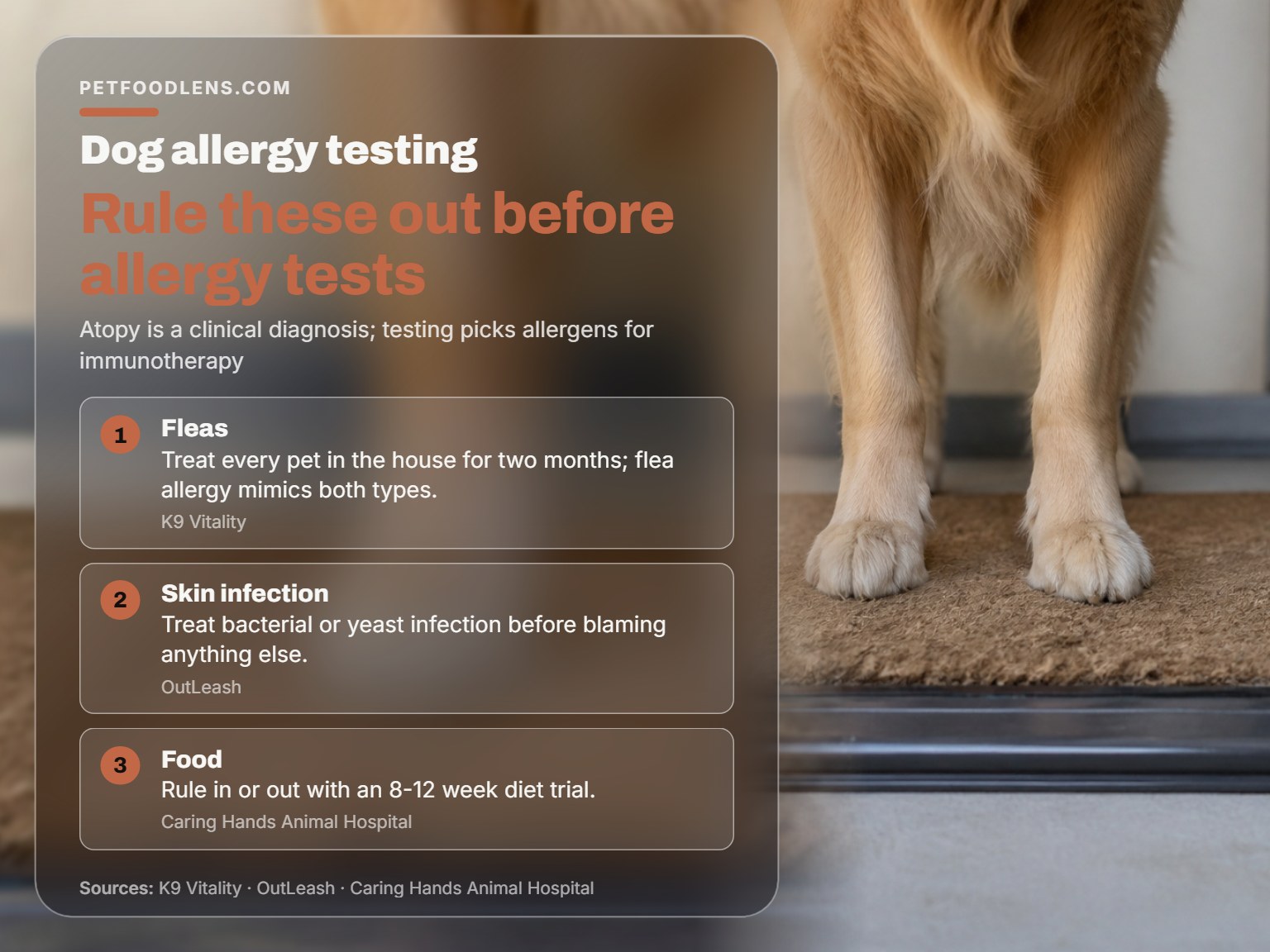
That pattern is atopy until proven otherwise, and the diagnosis is clinical. OutLeash states that atopic dermatitis is diagnosed from the history and exam after other causes are ruled out. Testing comes afterward, to pick allergens for immunotherapy.
Intradermal skin testing, where small amounts of allergen go into the skin and the reaction gets measured, is described by Vetified as the most accurate method for identifying environmental allergens, though Caring Hands notes that a positive result does not independently establish that the allergen causes symptoms. Caring Hands adds the caveat that matters: a positive result does not independently establish that the allergen causes symptoms.
Before any of that, rule out the cheap stuff. In this order:
- Fleas, treated properly on every pet in the house for two months. K9 Vitality is specific about the duration because flea allergy mimics both conditions.
- Skin infection, bacterial or yeast, treated before anything else gets blamed.
- Mange, checked with a skin scraping. Vetified calls the scraping one of the most reliable ways to tell mange from allergies.
- Food, ruled in or out with a diet trial, ideally in a low-pollen month.
Breed matters more than most owners expect. Vetified flags Labradors as genetically predisposed to atopic dermatitis, French Bulldogs as prone to both types because of skin folds that trap moisture and allergens, and Shar-Peis as both highly allergy-prone and susceptible to demodectic mange.
When Your Dog Has Both
Some dogs have both, and that’s the case that breaks the flowchart.
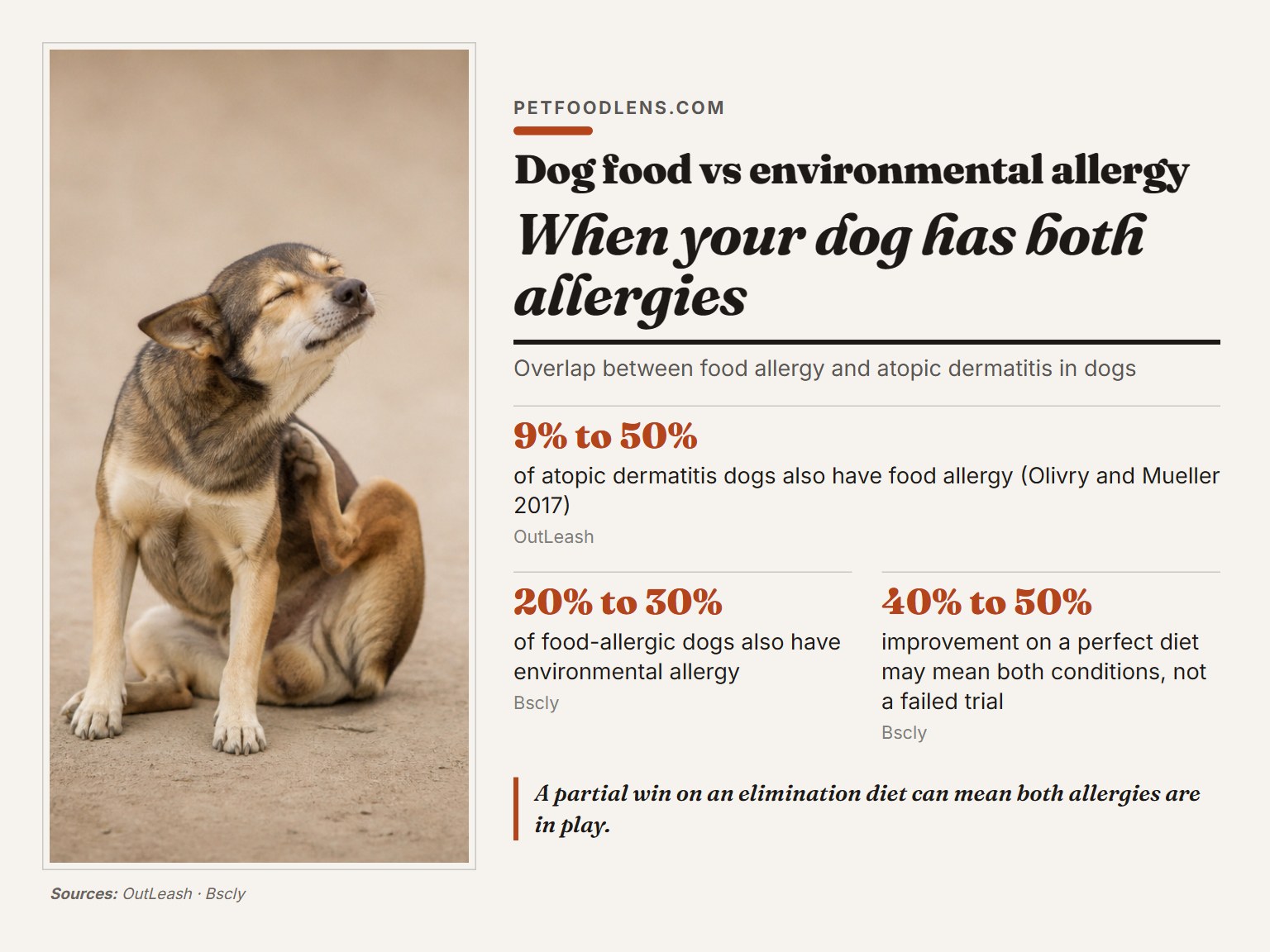
Olivry and Mueller 2017 put food allergy at 9% to 50% of dogs diagnosed with atopic dermatitis across published studies. Bscly puts it from the other direction: roughly 20% to 30% of dogs with food allergy also have environmental allergy. Blue Valley notes that food allergies are less common than environmental ones overall, while OutLeash reports food allergy in 9% to 50% of atopic dogs across studies, a wide co-occurrence range with a lot of overlap.
The trap is the partial win. Bscly describes a dog on a perfect elimination diet who improves by only 40% to 50%, which gets misread as a failed food trial when it actually means both conditions are in play.
Where this goes sideways: Starting a new food, a new supplement, and a new shampoo in the same week. You’ll never know which one mattered, and you’ll have burned three months of trial time on a guess.
What Actually Helps While You Work It Out
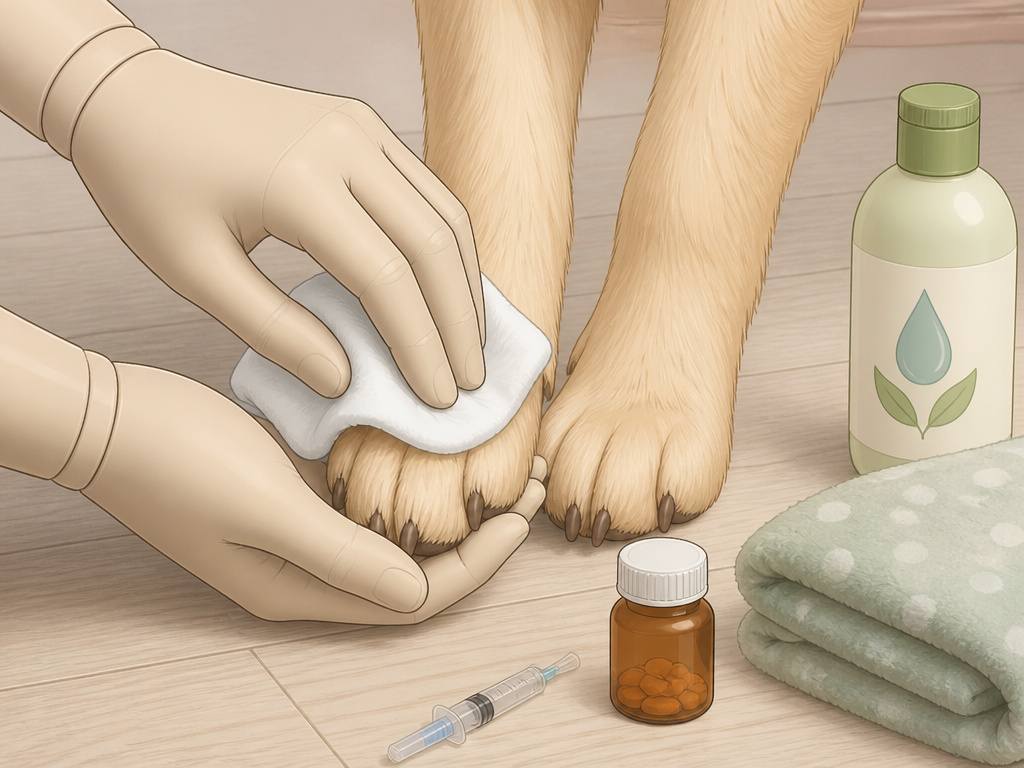
Apoquel is labeled for dogs at least 12 months old. Cytopoint can be used in younger dogs.
Those are the two itch drugs owners ask about most, and the format difference decides it for a lot of households. Apoquel is a daily oral tablet. Cytopoint is an injection given every 4 to 8 weeks. Both are mainly for environmental and other allergic itch, per OutLeash, and food allergy is still managed by avoiding the trigger. The drugs help during flares.
Allergen-Specific Immunotherapy
Vetified calls immunotherapy the only treatment that addresses the root cause of environmental allergies rather than suppressing symptoms. It works over months, not weeks, and it’s built around whatever the testing identified.
Fatty acids are the other lever with actual trial evidence behind them. Dogs with atopic dermatitis given flax oil or an EPA and DHA preparation daily for ten weeks improved on clinical scores while the placebo group did not (Mueller et al., 2004). A separate double-blind crossover study found marine oil significantly improved itching, hair loss, and coat quality against a corn oil control (Logas & Kunkle, 1994).
Then the boring stuff, which I’d start before anything oral:
- Wipe the paws after every walk, before the dog licks them clean.
- Wash the bedding weekly, and keep indoor spaces clean.
- Use a shampoo that holds the skin’s acid mantle near pH 6.2 to 7.2 rather than stripping it.
That load either goes in the laundry or gets licked off between the toes, and one of those is cheaper than the other.
Choosing food for allergic dogs starts with the confirmed trigger, not with the picture on the front of the bag. The most common food allergens in dogs include proteins such as beef, chicken, dairy, and egg, with lamb and fish losing their novelty value as more commercial diets include them.
One disagreement worth flagging honestly. Caring Hands suggests a prescription hydrolyzed diet or a novel-protein diet as the standard approach. Dr. Loudon explicitly advises against ultra-processed prescription diets. Hydrolyzed diets are the more reliable diagnostic tool, and they are also the option some clinicians distrust. Ask your vet which camp they’re in before you commit twelve weeks.
Frequently Asked Questions
Can a dog have both a food allergy and an environmental allergy?
Yes, and it’s common enough that you should assume it until proven otherwise. Published figures put food allergy in 9% to 50% of atopic dogs, and roughly 20% to 30% of food-allergic dogs also react to environmental allergens. A dog that improves only halfway on a strict diet is the classic mixed case.
How long before I see a change on an elimination diet?
Most sources cluster around eight to twelve weeks, with Olivry et al. 2015 setting a floor of at least eight. Plan for twelve. Anything shorter and you risk calling a slow responder a failure.
Are blood or saliva tests for dog food allergies worth doing?
No. The 2017 review by Mueller and Olivry found poor repeatability and highly variable accuracy, and the tests frequently flag proteins the dog eats without any problem. They also can’t distinguish sensitization from clinical allergy.
Does year-round itching always mean food?
No. Year-round itch fits food allergy, but it also fits atopy driven by indoor allergens like dust mites. The sources disagree on how much weight to give this, so use it as a starting point rather than a conclusion.
How do I rule out fleas before starting an allergy workup?
Treat every pet in the house, not just the itchy one, and keep it up for two months. Flea allergy produces the same kind of itching as food and environmental allergy, and it’s the cheapest thing on the list to eliminate.
Can I give my dog an antihistamine while we figure this out?
Not without asking your vet first. Some human allergy products contain ingredients that are unsafe for dogs, and the right choice depends on weight, health, and whatever else the dog is taking.
The Bottom Line
If a genuinely strict trial of at least 8 weeks produces no change at all, stop rotating foods and start the environmental workup. That’s the trigger point. The harder case is a partial win, because 40% to 50% better usually means both conditions are in play and the food half is already handled.
None of this holds if the trial wasn’t strict. A dog that scavenges on walks, gets flavored preventives, or lives with a toddler dropping toast is not on an elimination diet, and the results mean nothing.
I’d rather see one boring twelve-week trial than four clever food switches. The clever switches feel like progress and teach you nothing.
That’s the honest answer to the food allergy vs environmental allergy in dogs question: the pattern points, the trial decides.
