
Common Food Allergens in Dogs: What the Data Shows
This post contains affiliate links. As an Amazon Associate, we earn from qualifying purchases.
The most common food allergens in dogs are beef, dairy products, chicken, and wheat, with lamb rounding out the top five in North America, Europe, and Australia. In a pooled review of 297 dogs, beef accounted for 34% of confirmed reactions, dairy 17%, chicken 15%, and wheat 13%.
That 34% figure comes from dogs whose reactions were confirmed by feeding, not from owner surveys. It also comes from a literature window that closed in January 2015, which is why the ranking works as a starting point for a feeding trial rather than as a diagnosis.
What follows is the ranking with its percentages, the places where published sources flatly disagree, and the trial design that settles the question for one individual dog.
Key Takeaways
- Beef leads at 34% of confirmed reactions in the pooled dog data, ahead of dairy at 17% and chicken at 15%.
- Start challenges with beef and dairy, the two foods Mueller 2016 recommends testing first, though Jeffers 1996 found beef and soy most often caused adverse cutaneous reactions.
- Trial duration is disputed: Remillard puts dietary elimination trials at 4 to 13 weeks, while Mueller 2016 notes individual allergen rechallenges in reviewed studies were typically run 1 week each, and a single unapproved treat resets the clock from zero.
- Cross-reactivity is contested: a 2022 analysis flags high theoretical risk, while a 1996 feeding study found no support for cross-reactivity between beef and cow’s milk or between soy and wheat and could not confirm a chicken meat versus egg link.
- Prevalence climbs to 9-40% of dogs with pruritus, so itching alone doesn’t prove a food cause.
What Are the Most Common Food Allergens in Dogs?
Beef shows up in 102 of the 297 dogs in the pooled data, and that single number shapes the order of every challenge that follows.
Food allergens in dogs are proteins or glycoproteins, the molecular structure required to initiate an antigen-antibody response. The protein survives processing well enough that ordinary commercial diets still provoke reactions in sensitized animals. Changing the cooking method while keeping the same protein changes very little, and the label rarely makes the distinction obvious.
The percentages trace to a review of common food allergen sources in dogs that pooled rechallenge studies published between 1985 and January 2015.
| Allergen | Dogs affected (n=297) | Share |
|---|---|---|
| Beef | 102 | 34% |
| Dairy | 51 | 17% |
| Chicken | 45 | 15% |
| Wheat | 38 | 13% |
| Soy | 18 | 6% |
| Lamb | 14 | 5% |
Below those six the tail gets long and thin:
- Soy at 6% (18 of 297 dogs), a figure that older challenge work treats very differently.
- Lamb at 5%, which climbs into the top five for dogs in North America, Europe, and Australia.
- Corn and egg at 4% each.
- Everything else, including pork, fish, and rice, sits at 2% or below.
Single-dog reports add barley, rabbit, chocolate, kidney bean, and tomato to the list. A published case describes 10 g of fresh tomato producing clinical signs within 30 minutes.
Only five of the dog studies in that review used a standardized rechallenge sequence. Five.
That matters, because the review authors say true prevalence is likely higher than the table suggests. Most studies challenged dogs with a subset of allergens and left out the negative provocations, which flatters the percentages. If the numbers point at beef, the practical next step is managing a beef allergy rather than guessing across the whole list.
Why the Allergen Ranking Shifts With Region and Feeding Habits
A dog in Naples and a dog in Nebraska eat different dinners, and the allergen tables move with the bowl.
The review is blunt about this. Allergen lists “could merely reflect pet feeding habits in the preceding decades,” and they vary by region. Merck makes the same point: the most common food allergens tend to track the most commonly fed food sources.
So a list built on North American and European feeding patterns tells you what veterinarians in those regions were seeing. It tells you less about a dog eating a diet built around a protein that barely appeared in the 1985-2015 literature.
Plan on eight weeks minimum. A trial that ends the moment the scratching settles has skipped the part that confirms the diagnosis.
I spend most of my working life on cat formulations, so I lean harder on the veterinary dermatology literature here than I would for cats. The regional caveat is the piece I’d want every owner to hold onto.
Soy and Dairy: Where the Published Sources Disagree
Mueller and colleagues put soy sixth, at 6% of 297 dogs.
A 1996 JAVMA challenge study by Jeffers and colleagues found beef and soy most often caused adverse cutaneous reactions. Those two positions don’t reconcile, and the honest answer is that the method drives the result.
| Source | Position on soy | Method behind it |
|---|---|---|
| Mueller 2016 review | 6th at 6% (18 of 297 dogs) | Pooled rechallenge data |
| Jeffers 1996 (JAVMA) | Beef and soy most often reactive | Single-ingredient provocation |
| Merck Veterinary Manual | Listed as less common | Reference summary |
The JAVMA 1996 food allergen study fed single ingredients under controlled conditions. Pooled reviews gather many small studies with different designs and different owner reporting. Neither is wrong. They answer slightly different questions.
Where this goes sideways: Treating a pooled percentage as a prediction for one dog. A 6% population figure says nothing about whether the dog in front of you reacts to soy.
The same pattern shows up in cats, where Mueller’s list is beef, fish, and chicken while Merck puts dairy among the less-common feline allergens. Different sources, different ranks, same underlying uncertainty.
What Food Allergy Actually Looks Like on a Dog
The owner describes a dog that licks its feet through the evening news and has rubbed the hair off both ear flaps.
Pruritus is the most commonly reported cutaneous sign in dogs, and the distribution is fairly consistent: pinnae, feet, ventrum, and less commonly the perianal and perigenital skin. A chronically scratched ear flap feels thick and warm, with a leathery ridge along the edge where the cartilage has been worked over.
Other common findings include otitis externa and relapsing Staphylococcus or Malassezia infections. Less common presentations include urticaria, angioedema, and pyotraumatic dermatitis.
Merck puts the numbers in perspective. Roughly 1-2% of dogs receiving any veterinary care have some form of food allergy, but that rises to 9-40% of dogs with pruritus and up to 24% of dogs with any form of dermatitis. Itch is common. Food as the cause is not.
Age of onset runs from under 6 months to 13 years, though most cases show up in young adulthood at 1-4 years. German Shepherd Dogs, Labrador Retrievers, French Bulldogs, and West Highland White Terriers are overrepresented in Western countries. There’s no clear sex predisposition.
Telling a food allergy vs intolerance apart matters here, because intolerance doesn’t involve the immune system and won’t respond to a protein swap. Sorting food allergy vs environmental allergy is the other half of that job. Seasonal itch points one way, year-round itch with ear and foot involvement points the other, and the signs of food allergies overlap enough that owners routinely guess wrong.
How Do You Test for a Food Allergy in Dogs?

A client once brought me a saliva panel that flagged a long list of foods, including some her dog had never eaten. She’d paid for it, trusted it, and changed diets three times on the strength of it.
That report told her nothing. A strict elimination trial followed by a challenge is the only method I trust to confirm a food allergy, and the published standard agrees: the definitive diagnosis rests on an elimination trial followed by a food challenge.
Before you start: Flavored medications and supplements can carry the same protein you’re testing against, so ask the vet for unflavored versions before day one. A single unapproved treat counts as deliberate exposure and voids the trial. Shared manufacturing lines can leave trace protein in a food that never lists it, which is why veterinary diets with stated cross-contact controls beat retail bags for this job.
Here’s the sequence that actually produces an answer:
- Pick one protein and one carbohydrate the dog has never eaten, or use a hydrolyzed diet. A food containing any commonly used protein ingredient won’t do, because the trial can’t distinguish a reaction from background exposure.
- Feed nothing else for 4 to 13 weeks. Published trials run that long, and stopping early is how owners end up with a confident wrong answer.
- Cut every treat, chew, tablet, and supplement that isn’t part of the trial. One slip restarts the clock.
- Score the itch weekly on the same scale, so you have a record instead of a memory.
- Re-challenge with the old diet. Original symptoms should return within 2-14 days if food is the cause.
- Return to the trial diet and confirm the signs resolve again. That reversal is the confirmation.
Tests That Don’t Answer the Question
Blood and saliva panels get marketed hard. Research on food antigen-specific IgE dogs study continues, but the diagnostic standard in the veterinary literature remains the elimination trial followed by challenge. A panel that flags a long list of foods, several of which the dog has never eaten, is measuring something other than a food allergy.
Reading the Challenge Phase
The challenge is where the diagnosis lives. Re-feeding the previous diet should bring the original symptoms back within 2-14 days. If nothing happens, you’ve learned the dog isn’t reacting to that diet, which is still useful information.
An elimination diet trial is an elimination diet trial with a defined endpoint, not an open-ended diet change.
The Limited-Ingredient Label Problem

The limited-ingredient aisle is where most allergy money gets wasted.
Over-the-counter limited-ingredient foods are the category I’m most skeptical of. I’ve counted multiple distinct animal proteins on bags that promised one, and nothing on the packaging says anything about cross-contact controls in the plant.
The labeling rules don’t help. An over-the-counter diet named “venison and sweet potato” guarantees only that the product contains at least 3% of those ingredients. That’s the entire promise.
I won’t call an over-the-counter limited-ingredient diet a diagnostic tool. If the bag can’t tell me what’s in it and where it was made, it can’t answer a diagnostic question.
What Hydrolyzed Actually Does
Hydrolyzed diets break the protein into fragments small enough that the immune system has less to recognize. They’re boring and they cost more, but they’re the most reliable diagnostic tool an owner has. For a real trial I want one protein, one carbohydrate, and a manufacturer willing to talk about the plant.
Each has published feeding guidance and a manufacturer line behind it.
Manufacturer data exists too. In a company-run crossover trial of Blue Buffalo Natural Veterinary Diet HF against a hydrolyzed poultry feather diet, 57 dogs enrolled and 47 completed, with each diet fed for 8 weeks and evaluations every 4 weeks. The feather diet recorded 16 adverse events against 7 on the Blue Buffalo formula, and only the Blue Buffalo diet significantly lowered CADESI scores, a vet-scored measure of visible skin damage. Read that with the sponsor in mind, but the design was reasonable.
If you want a broader starting point before you commit to a trial, the best dog food for allergies shortlist covers the veterinary tier rather than the retail shelf.
Cross-Reactivity and the Novel Protein Assumption
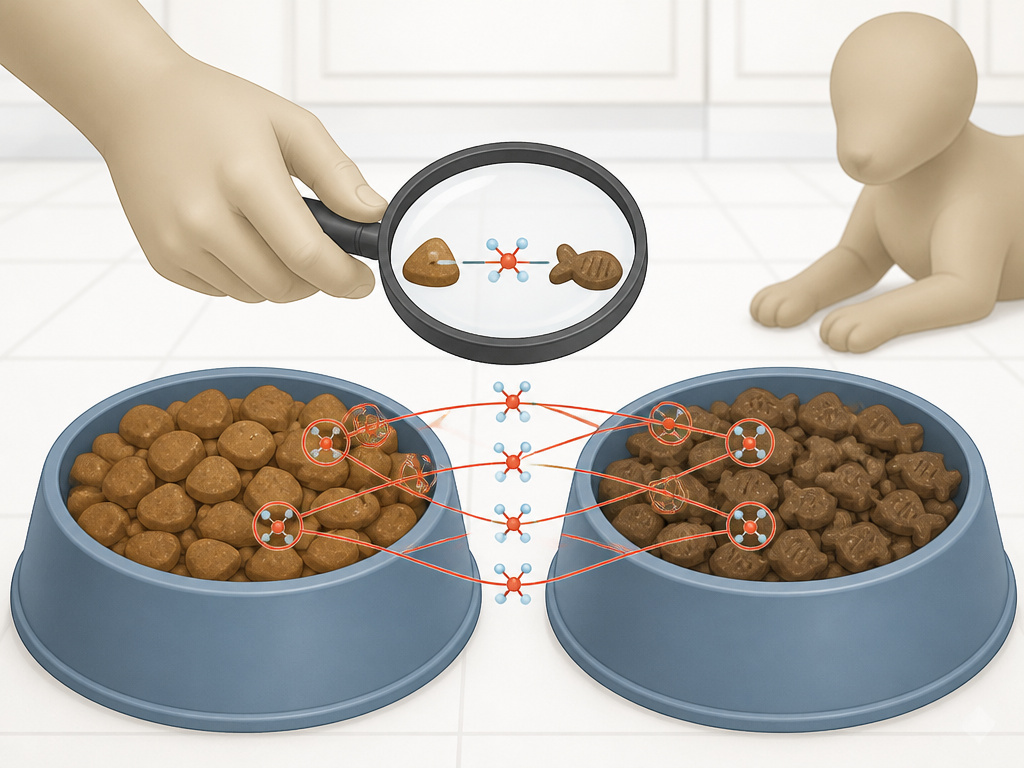
Olivry and colleagues calculated A-RISC indices for dog food allergens and found a high theoretical risk of cross-reactivity between proteins from different species used as food.
The named allergens in that work include ACTA1, ALDOA, CKM, ENO3, GAPDH, PKM, and TPI1 for chicken and fish, TPM1 and TPM2 for fish, PGM1 for beef and lamb, and WAXY for corn and potato. The canine food allergen cross-reactivity analysis also found that the risk isn’t limited to meat.
That finding undercuts a common assumption. Choosing a novel protein diet presumes the new protein shares no cross-reactive allergens with the food the dog was already eating. If the A-RISC work is right, that presumption needs testing rather than assuming.
Jeffers and colleagues reached the opposite conclusion in 1996. That study found no support for cross-reactivity between beef and cow’s milk, or between soy and wheat, and couldn’t confirm a chicken meat versus egg link. Two credible sources, two directions.
- If you follow the 2022 analysis, pick a protein as structurally distant as you can and don’t assume a swap solves anything.
- If you follow the 1996 feeding data, the practical risk during a trial looks smaller.
Either way, cross-reactivity is a reason to run the challenge phase rather than skip it.
Hidden Allergens: Treats, Tablets, and Shared Equipment
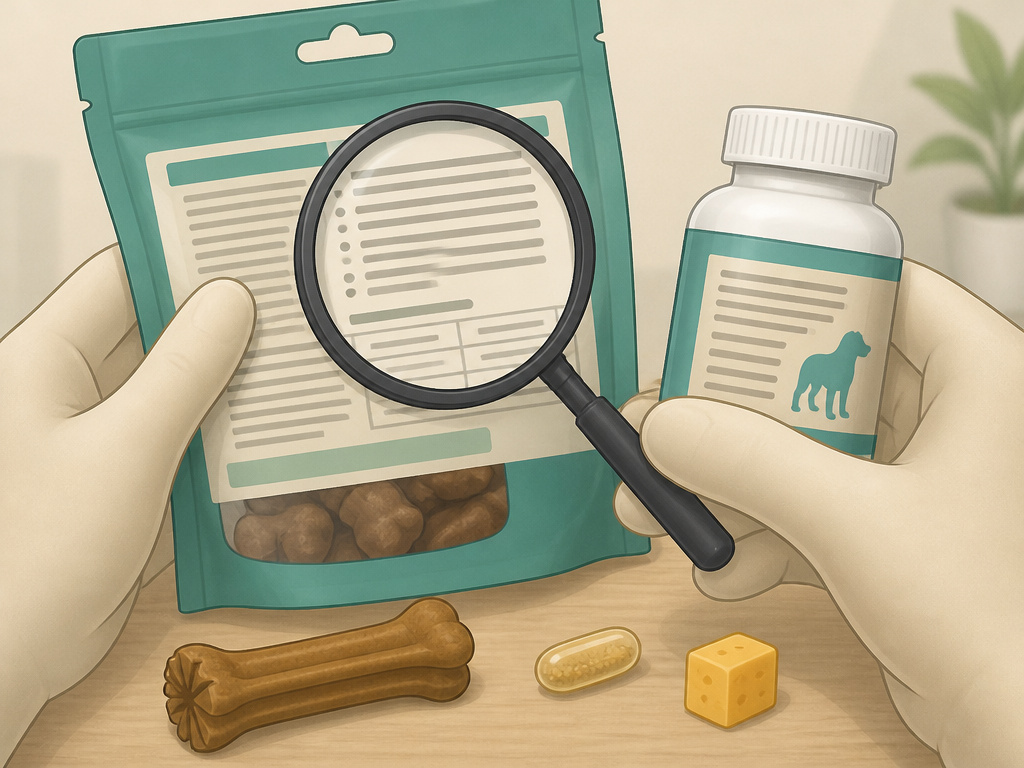
Flip the bag over, then flip the treat bag over, then read the tablet label.
Merck notes that food allergens turn up in flavored medications, supplements, and treats, not just in the main diet. Any of those can break a diet-only elimination trial without the owner noticing.
The routes I check first:
- Flavored chews and dental products, which frequently carry a poultry or beef base.
- Joint supplements and pill pockets, often built around a protein the dog is being tested against.
- Table scraps from a household member who hasn’t been briefed on the trial.
- Shared manufacturing equipment, which can leave trace protein in a food that never names it.
Urticaria from food is uncommon in dogs and extremely rare in cats, but it happens. A canine peanut allergy case report documents exactly that presentation, and food allergy in dogs was first described back in 1967.
The part nobody mentions: A trial often fails when the itching improves, the owner relaxes, and the dog gets one piece of cheese. Symptoms return within 2-14 days of re-exposure, so the failure looks like a diet that stopped working.
Choosing treats for allergic dogs is a smaller decision than choosing the diet, and it breaks more trials than any other single item.
Frequently Asked Questions
What are the most common food allergens in dogs?
Beef, dairy products, chicken, and wheat, with lamb appearing in the top five for dogs in North America, Europe, and Australia. In pooled data covering 297 dogs, beef accounted for 34% of confirmed reactions, dairy 17%, chicken 15%, and wheat 13%.
How long does a food elimination trial take?
Published guidance puts dietary elimination trials at 4 to 13 weeks. The challenge phase afterward should bring symptoms back within 2-14 days if food is the cause.
Can a dog be allergic to more than one food?
Yes. Merck notes that animals can show hypersensitivity to more than one food source, and the pooled data shows reactions spread across beef, dairy, chicken, and wheat in the same population. That’s why challenge phases test one protein at a time.
Is grain the usual cause of dog food allergies?
Wheat is the grain that shows up in the data, at 13% of confirmed reactions. Allergies to rice and corn protein have been reported, but not to a starch or a pure carbohydrate. A grain-free bag swaps carbohydrate sources without addressing the protein that’s more likely responsible.
Do blood or saliva tests diagnose food allergies in dogs?
The veterinary literature treats the elimination trial followed by a food challenge as the definitive method. Panels that flag a long list of foods, including ones the dog has never eaten, don’t substitute for that sequence.
The Bottom Line
If your dog has been itching year-round with ear or foot involvement, the first move this week is a phone call, not a new bag of food. Ask your vet to start an elimination trial and to switch any flavored medication to an unflavored version before you begin.
Then set a calendar reminder for eight weeks out. That date is the earliest point at which the answer means anything.
One concession worth stating plainly: none of this tells you whether your individual dog is allergic to anything. Population percentages rank the order of the challenges. Only the challenge phase ranks your dog. And if the itching comes with vomiting, weight loss, or a dog that stops eating, put the trial aside and get a veterinary workup first, because the common food allergens in dogs are a short list and the differential list is not.
