
How to Spot Food Allergies in Dogs: Step-by-Step
This post contains affiliate links. As an Amazon Associate, we earn from qualifying purchases.
Food allergies in dogs show up as year-round itching of the paws, ears, and face, often with vomiting or loose stools, and they’re confirmed by an 8-week elimination diet followed by a food challenge. Skin and blood tests can’t diagnose them. Roughly 85% of affected dogs improve by week 5, and 8 weeks covers over 95%.
The hard part is that a trial asks an owner to change everything at once: the kibble, the biscuits, the flavored heartworm tablet, the scraps under the table. One slip and the eight weeks restart. That’s how a dog ends up labeled “allergic to chicken” without anyone ever running a clean test. Knowing how to spot food allergies in dogs helps owners avoid that trap.
What follows: the five signs worth writing down, the tests that keep failing dogs, and how to run a trial that actually answers the question.
Key Takeaways
- Year-round itching with ear or gut trouble points toward food; itching that flares in spring and fall points toward the environment.
- An 8-week elimination diet is the only accepted way to confirm it, and VCA advises 8 to 12 weeks.
- Blood and saliva panels flagged between 60% and 100% of 30 healthy dogs on each test at the Cummings School, so a positive result proves nothing on its own.
- Every treat, supplement, and flavored tablet has to go for the full trial, including flavored parasite preventives.
- A food challenge after the trial is what separates a real diagnosis from a guess.
What Does a Food Allergy in a Dog Actually Look Like?
An itchy dog with a food allergy usually scratches in the same places an environmentally allergic dog does: paws, ears, face, and around the rear. That overlap is the entire problem.
Canine food allergy is estimated to account for 25% to 49% of allergic dogs and 8% to 62% of dogs with pruritus, according to a 2023 JAVMA review. Pruritus was the dominant sign in 94% of 825 dogs with cutaneous adverse food reaction, and 38% showed signs before one year of age.
Those figures come from referral populations, so a general practice sees a lower rate. The direction holds: if a dog is itchy, food belongs on the list.
Age is a poor filter. In that same 825-dog dataset, onset ranged from 1 to 13 years with a mean of 2.9 years.
Breed offers a small hint. A Swiss study flagged West Highland White Terriers, Rhodesian Ridgebacks, and Pugs as predisposed, and a PMC adverse food reactions review also lists German Shepherds and Labrador or golden retrievers as over-represented. No sex predisposition was found.
The Five Signs That Point to Food, Not the Environment
Five patterns push a case toward food and away from pollen.
- Itching that never takes a season off. Year-round scratching with ear trouble or loose stools points me toward food. Itching that flares in spring and fall points me toward the environment. It isn’t airtight, which is why the trial exists.
- Ear infections that keep coming back after every course of drops, especially with a yeasty smell.
- Gut signs riding along with the skin signs. Vomiting or diarrhea alongside the scratching is a meaningful cluster.
- A young dog. Over 22% of dogs with cutaneous adverse food reaction showed signs before 6 months of age, and 38% before 1 year.
- A breed on the list. Useful as a nudge, not as a diagnosis.
Gastrointestinal signs also arrive earlier in food-allergic dogs: 48% developed signs under 1 year, against 16% of dogs with atopic dermatitis alone.
If you’re still sorting the two apart, how to spot food allergies in dogs comes down to seasonality and response to a diet change.
Then there’s the ingredient question. The most common food allergens in dogs are beef, dairy, chicken, wheat, and lamb, with soy, corn, egg, pork, fish, and rice showing up less often. VCA puts proteins from dairy, beef, chicken, chicken eggs, soy, and wheat gluten at the top of its own list. Note that almost any ingredient can trigger a reaction, including additives.
Easy to miss: A dog can be allergic to a protein it has eaten for years. A sudden reaction to a food that was always fine is normal for this disease, not evidence that something else is wrong.
Is It a Food Allergy or Just an Intolerance?
The two words get swapped constantly, and the difference changes what you do next.
A true food allergy runs through the immune system. It usually shows as skin trouble, and small amounts can set it off. An intolerance is mostly digestive and tends to follow dose, so a small amount may be tolerated fine. The dog doesn’t care either way.
| Pattern | Food allergy | Food intolerance |
|---|---|---|
| Main signs | Itchy skin, ears, face | Vomiting, loose stools |
| Amount that triggers | Tiny amounts | Dose-dependent |
| Immune system involved | Yes | No |
| Typical timing | Hours to days | Hours |
There’s no cure for a food allergy in dogs. VCA is blunt about it: the only treatment is avoidance. Some dogs need medication during a severe flare, but most are managed on a hydrolyzed or novel-protein diet.
That’s the practical reason how to spot food allergies in dogs matters for getting the label right. If it’s intolerance, you may be able to feed a smaller amount and move on. If it’s allergy, the ingredient has to leave the bowl permanently. Food allergy vs food intolerance is worth settling before you spend eight weeks on a trial.
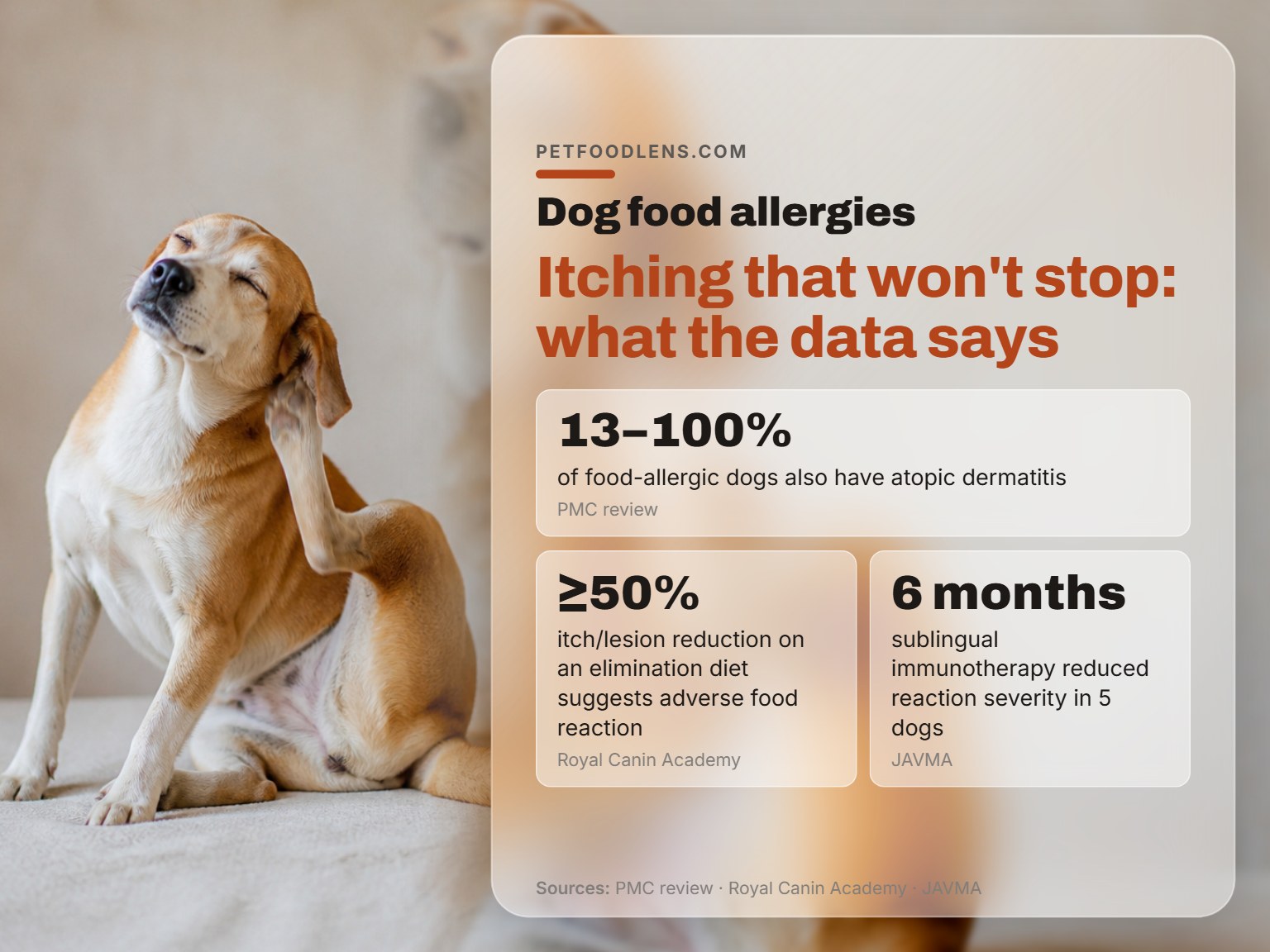
One more thing worth knowing: a dog with a food allergy often has other allergies too. Atopic dermatitis was reported in 13% to 100% of dogs with cutaneous adverse food reaction, and roughly one-third of dogs with atopic dermatitis have a concurrent food reaction.
Why Blood and Saliva Tests Keep Failing Dogs
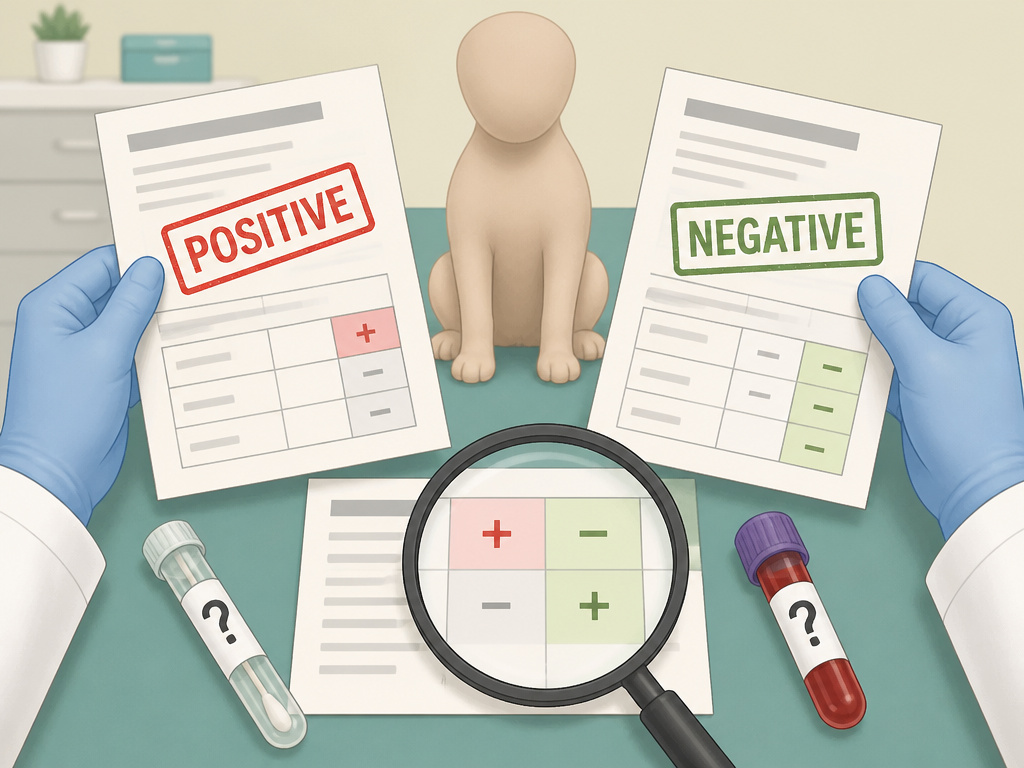
I’ve had owners bring in a saliva panel that flagged a dozen foods, including three the dog had never eaten in its life. They’d already switched diets twice on the strength of that report. It bought them nothing.
Here is what the numbers actually say. In a European study, 20% to 30% of healthy dogs had a strong positive reaction to one or more foods depending on the test type, and another 53% of healthy dogs had weak positive reactions on the saliva test.
At the Cummings School, 30 healthy dogs were tested and between 60% and 100% tested positive for one or more foods on each test. These were dogs with no allergy at all.
Only one of the positive blood tests in the European study matched a known allergy in an allergic dog.
The practical takeaway from the Tufts Petfoodology allergy testing update is that a positive result has never been shown to equal an allergy, and a negative has never been shown to mean an ingredient is safe. That’s a validation problem, not a sensitivity problem.
Serum IgE and IgG testing for foods shows low repeatability across studies, and a canine adverse food reaction systematic review concluded that no alternative test presently replaces the elimination diet and oral food challenge. Hair and saliva testing scored as unsatisfactory on accuracy, as did fecal food-specific IgE and gastroscopic testing.
Skin testing is messier than the internet suggests. JAVMA calls intradermal testing unreliable for diagnosing food allergy. Royal Canin reports that the prick test has high sensitivity but low specificity, and that it can help select foods for a trial and guide a challenge. Both can be true: a test that helps you pick a starting diet is not a test that diagnoses the disease. Patch testing has good negative predictive value but needs 48 hours of skin contact, which is impractical in a clinic.
There is one genuinely interesting lab test. Lymphocyte proliferation testing was reported as 80% accurate with 100% positive predictability and 50% negative predictability. It’s offered only in research facilities.
If you want the fuller breakdown of what each test can and can’t do, testing dogs for food allergies covers the lot.
How Long an Elimination Diet Really Takes
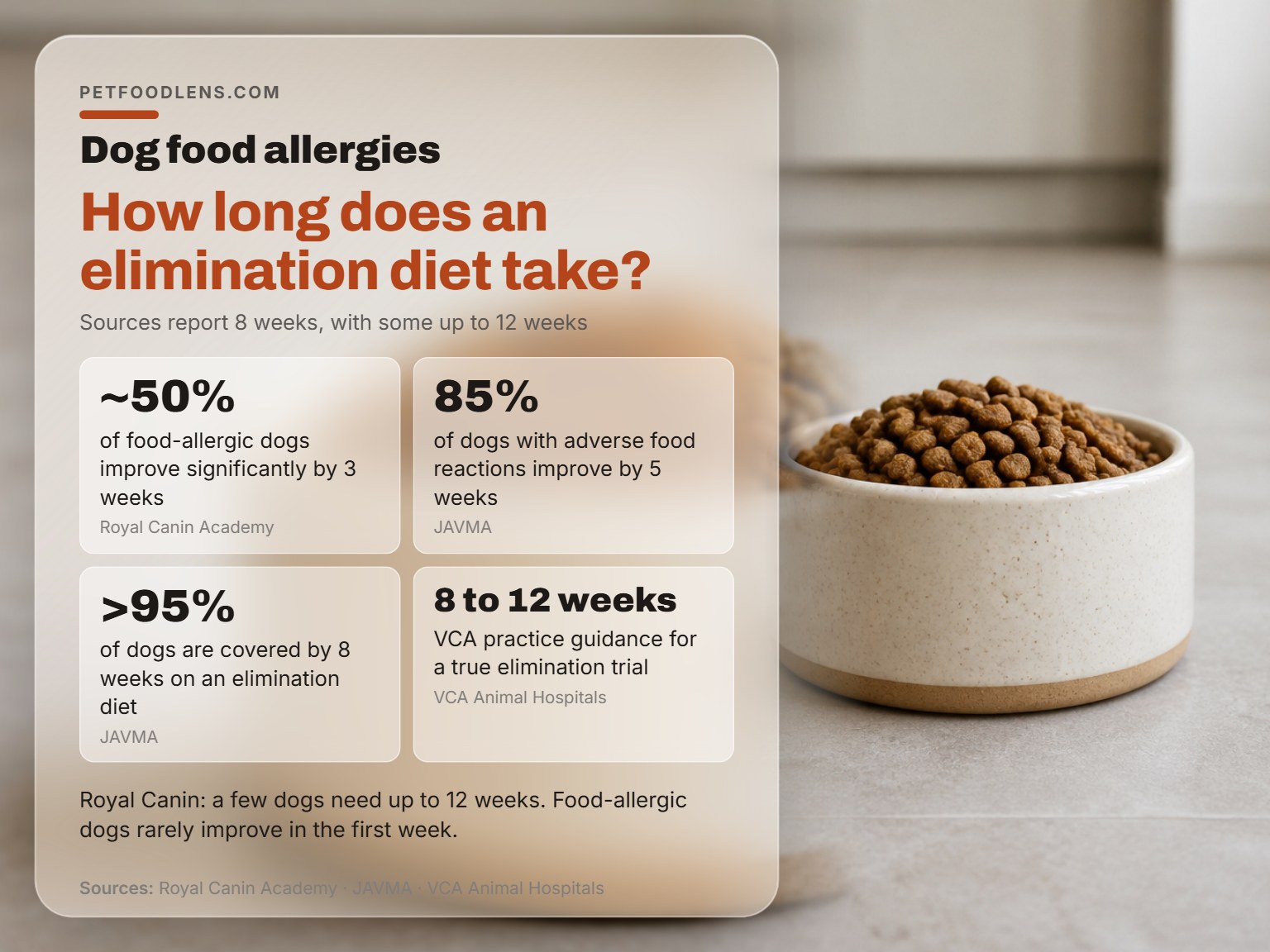
Eight weeks is where the sources converge, and then they stop agreeing.
Here’s the honest comparison, because the three main references do not say the same thing.
| Source | Trial length | Basis |
|---|---|---|
| VCA Animal Hospitals | 8 to 12 weeks | Practice guidance |
| JAVMA review | 8 weeks adequate for over 95% | Analysis of published studies |
| Royal Canin Academy | 8 weeks for over 95%, up to 12 for a few | Industry review |
The JAVMA canine food allergy review reports that 85% of dogs improve by 5 weeks and that extending to 8 weeks covers over 95%. For cats the figures are 80% at 6 weeks and over 90% at 8 weeks. Royal Canin puts roughly 50% of food-allergic dogs at significant improvement by three weeks, more than 85% by five weeks, and over 95% by eight, with a few needing twelve.
Neither source says a dog responds in week one. Royal Canin states plainly that food-allergic dogs rarely improve during the first week of feeding.
Here is the sequence that produces a usable answer:
- Pick a diet with no ingredient the dog has eaten before. VCA is explicit that a true elimination trial excludes anything in the dog’s history. Skip this and you’re testing nothing.
- Remove every other food source. No treats, no supplements, no flavored vitamins, and check the parasite preventive.
- Feed only that diet for a minimum of eight weeks.
- Score the itching weekly on paper. Memory rewrites itself. A dated log is the only way to see a 50% reduction, which Royal Canin uses as the threshold for suspecting an adverse food reaction.
- Challenge at the end. Without the challenge, you have a suspicion, not a diagnosis.
A food trial without a challenge is a diet change with better paperwork. The challenge is what turns a good eight weeks into an answer.
Hydrolyzed vs Novel Protein: Which Trial Diet to Pick
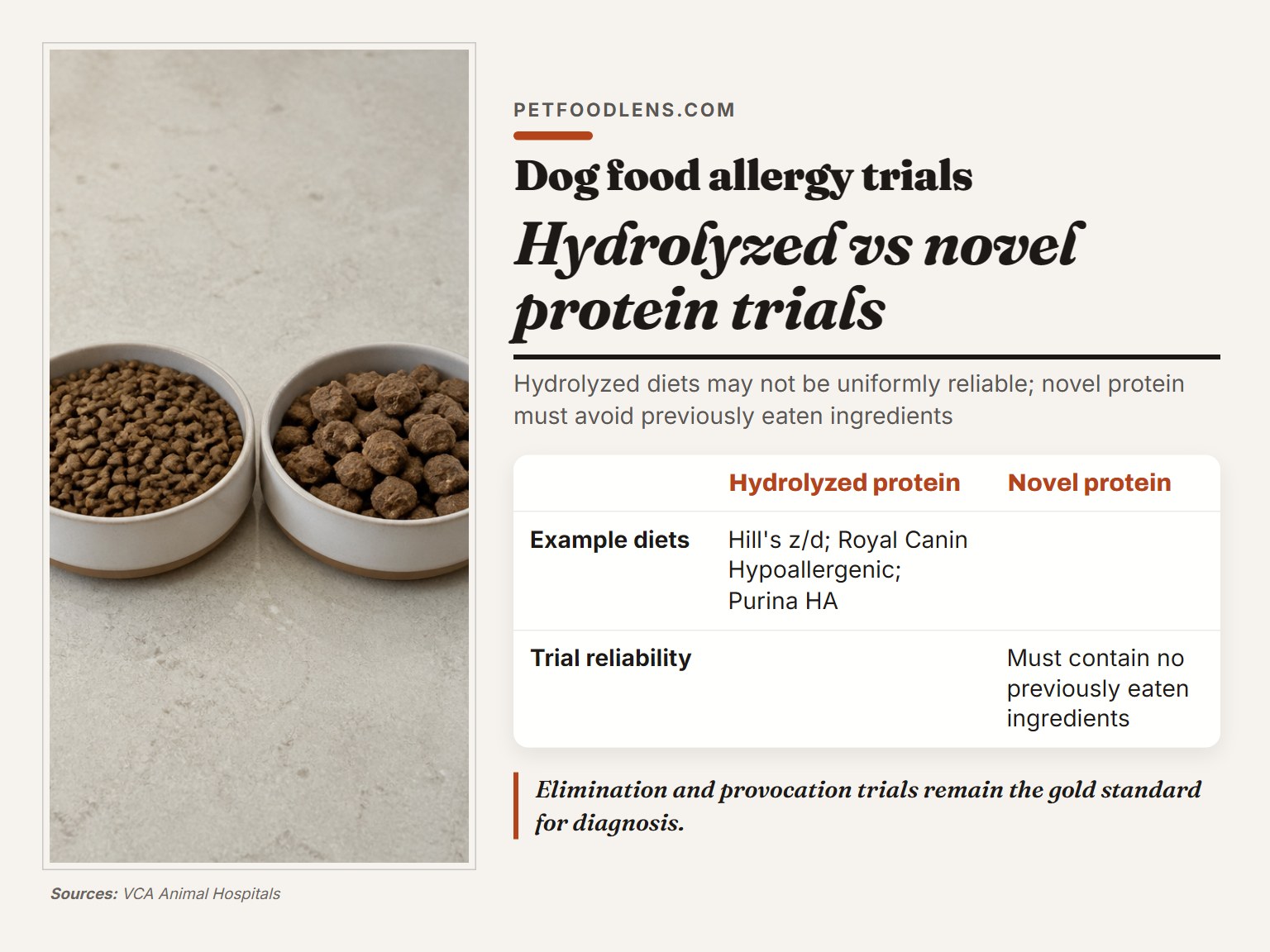
Hill’s Prescription Diet z/d, Royal Canin Hypoallergenic Hydrolyzed Protein, and Purina Pro Plan Veterinary Diets HA Hydrolyzed all sit on the hydrolyzed side of the shelf. Hill’s Prescription Diet d/d, Royal Canin Selected Protein PD, and Rayne Kangaroo-MAINT sit on the novel-protein side.
Hydrolyzed Protein Diets
Hydrolyzed diets break the protein into fragments too small for the immune system to recognize. For a first trial, that’s the safer default, because you can’t accidentally pick a protein the dog has already met.
The catch is real. JAVMA notes that hydrolyzed proteins can still stimulate T-lymphocytes in dogs with suspected food allergy, which suggests these diets aren’t uniformly reliable for trials. Royal Canin reviewed eleven studies and found evidence of reactions to hydrolyzed diets in four of them, with 20% to 50% of food-allergic dogs worsening on partial hydrolysates.
So the degree of hydrolysis matters. Royal Canin’s own conclusion is that hydrolysate diets are probably best used in dogs not suspected of being hypersensitive to their components, rather than as a diagnostic tool. VCA lists them as a standard trial option. Both positions are on the record, and you should know which one your vet is working from.
Novel Protein Diets
Novel protein means an ingredient the dog has never eaten: kangaroo, rabbit, crocodile. Rayne Nutrition’s Kangaroo-MAINT, Rabbit-MAINT, and Crocodilia-MAINT are built for exactly this.
The failure mode here is human, not nutritional. Cross-contact is the whole ballgame in a trial.
The part nobody mentions:
For a straight comparison of commercial options, how to choose food for an allergic dog walks through label reading. If you already know the trigger, managing a dog with a beef allergy and managing a chicken allergy get into the ingredient-list archaeology.
Home-Prepared Diets
A home-cooked novel protein diet has to be formulated by a veterinary nutritionist, and it typically needs a balancing supplement such as Hilary’s Blend for Dogs or Balance IT.
The Food Challenge Is Where Most Trials Fall Apart
A clean eight weeks proves nothing until you put the old food back.
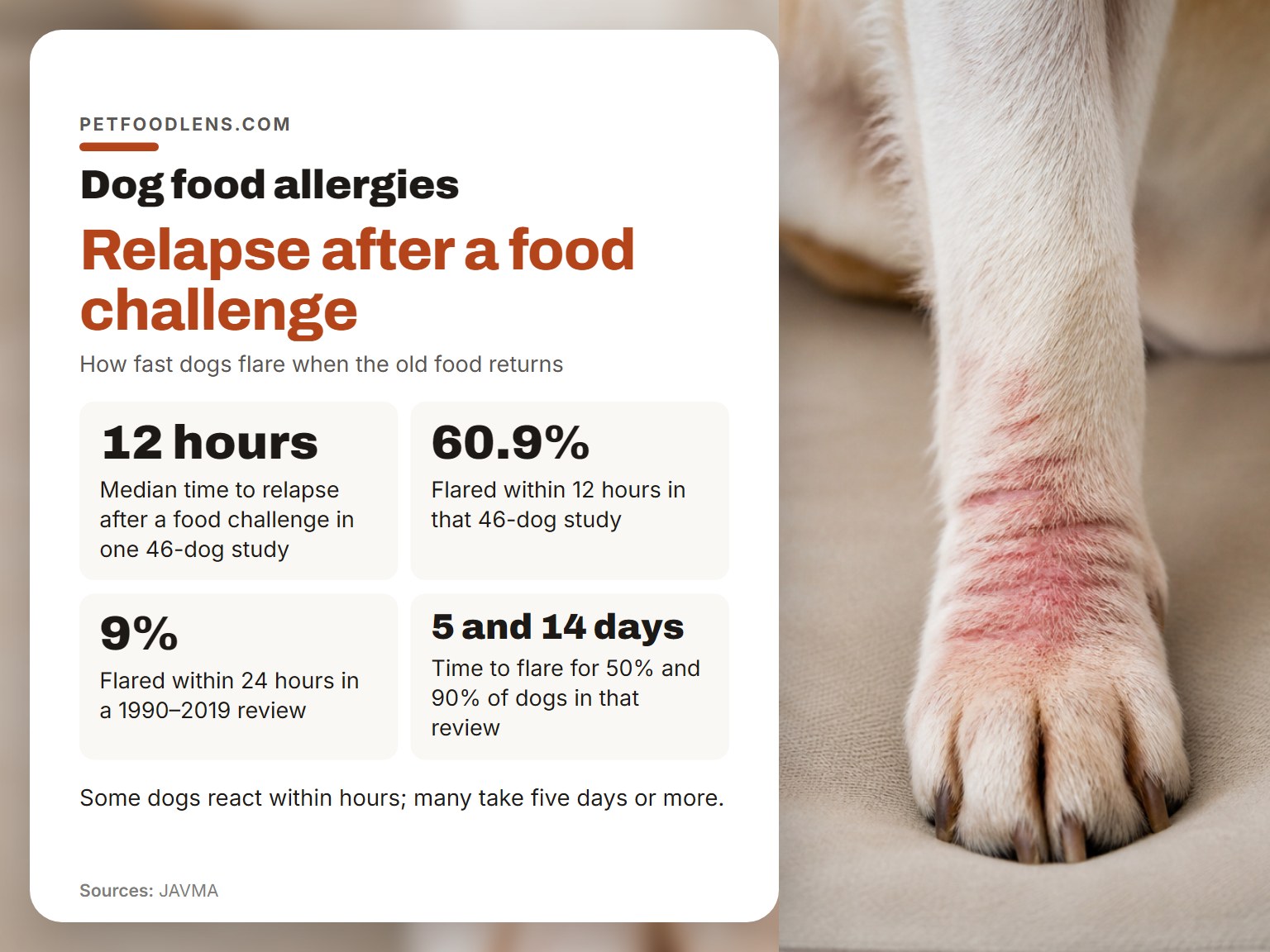
The relapse data is the part that surprises people. In one 46-dog prospective study, the median time to relapse after a challenge was 12 hours, with a range of 1.5 hours to 10 days. Just under a quarter flared within 3 to 6 hours, and 60.9% within 12 hours. In chicken-allergic dogs specifically, 44% became pruritic within 12 hours.
But a retrospective review of 1990 to 2019 publications found only 9% of dogs flared within 24 hours. Time to flare for 50% and 90% of dogs was 5 and 14 days. Royal Canin’s summary of the 46-dog study puts onset anywhere from 12 hours to 5 days, with one dog only on day 10, a mean of 4 days, and a range of 1 to 13.
The practical read: some dogs react within hours, and a lot of them take five days or more.
Royal Canin’s conclusion is that a food challenge should only need a maximum of 14 days. That’s a workable ceiling.
Where this goes sideways: In the 1990 to 2019 review, only 9% of dogs flared inside 24 hours, so an early “no reaction” reading is meaningless and the dog goes back on the wrong diet for another year.
JAVMA recommends running the challenge on a weekend, when someone is home to watch. Where seasonal atopic dermatitis exists, it recommends running the whole trial in winter so a pollen flare doesn’t get mistaken for a food reaction.
The relapse shows up mainly on the limbs and face.
Treats are the other leak. Safe treats for allergic dogs is worth reading before the trial starts, not after.
When the challenge is done, reintroducing foods after an elimination diet covers how to add one ingredient at a time without wrecking the result.
What to Do When the Itching Doesn’t Stop
A dog that scratches straight through a clean eight-week trial usually has something else going on, and the trial itself may not be the failure.
Concurrent atopic dermatitis is the big one. With 13% to 100% of food-allergic dogs also showing atopic dermatitis, complete resolution was never on the table. A partial improvement that plateaus is a real result, not a null one.
Storage mites are the sneaky one. Tyrophagus mites in kibble can trigger flares in dogs already sensitized to Dermatophagoides house-dust mites, so a reaction to a “new diet” may be mite contamination rather than a true food allergy. Buy smaller bags and keep them cool and dry indoors.
Cross-reactivity between apparently unrelated proteins complicates novel-protein selection too.
Owner compliance is the quiet variable. JAVMA recommends trained technicians phone owners during the trial, because the diet drift happens in week three when nobody’s watching. If your clinic offers that follow-up, take it.
Immunotherapy is early. Sublingual immunotherapy reduced reaction severity after 6 months of therapy in 5 dogs. That’s a promising pilot, not a protocol.
Frequently Asked Questions
Can a food allergy in dogs be cured?
No. VCA states there is no cure, and the only treatment is avoidance. Most dogs are managed successfully on a hydrolyzed or novel-protein diet, with medication during severe episodes.
How long before I see any improvement on an elimination diet?
Expect nothing in week one. Royal Canin reports that food-allergic dogs rarely respond during the first week, roughly 50% show significant reduction by three weeks, and more than 85% improve by five weeks.
Are blood tests for dog food allergies worth doing?
No, not for diagnosis. Commercial blood and saliva tests have not been validated, and in one study 60% to 100% of healthy dogs tested positive for one or more foods. A positive result has never been shown to equal an allergy.
Can I just switch to a grain-free or limited-ingredient food instead?
That’s a diet change, not a trial. Without a diet built from ingredients the dog has never eaten, plus eight weeks of strict control and a food challenge at the end, you learn nothing about whether food is involved.
How long does a food challenge take?
Plan for up to 14 days. Some dogs flare within 12 hours, but in a review of 1990 to 2019 publications only 9% reacted within 24 hours, and half took 5 days.
What if my dog is still itchy at the end of the trial?
That points toward a concurrent environmental allergy, storage-mite contamination in the kibble, or cross-reactivity in the chosen protein. It doesn’t automatically mean food isn’t involved.
Before You Go
The single most useful thing you can do this week costs nothing: photograph the paws, the ear canals, and the belly, and start a dated log with a simple itch score. Memory is a terrible witness, and eight weeks from now you’ll need a baseline you can actually compare against.
Two thresholds worth carrying with you. If the itching drops by at least half on the trial diet, you have a legitimate suspect and the challenge will confirm or kill it. If it drops by less than that, stop and talk to your vet about environmental allergy and storage mites before you spend another eight weeks on a second diet.
And a concession, because this advice has limits. Everything above assumes a dog with skin or gut signs and no other major disease.
