
How to Manage a Dog With a Chicken Allergy: Step-by-Step
This post contains affiliate links. As an Amazon Associate, we earn from qualifying purchases.
To manage a dog with a chicken allergy, feed one strictly controlled diet for 8 weeks, remove every other protein source including flavored preventives and chews, then reintroduce the old food to confirm it. University of Illinois guidance puts response at about 95% of dogs by 8 weeks.
The confirmation step is the one most owners skip. A dog that stops scratching on a new food has proved very little on its own, because improvement without a flare on rechallenge does not meet the diagnostic bar in Merck’s veterinary reference text or in the published literature. Learning how to manage a dog with a chicken allergy means understanding why that rechallenge matters.
What follows: the molecular weight cutoff that decides whether a hydrolyzed diet is worth the money, the six everyday items that quietly wreck a trial, and what the flare timing actually looks like when you rechallenge.
Key Takeaways
- Eight weeks is the floor, ten is the safer ceiling. Merck’s literature review and the University of Illinois guidance disagree on the exact number, and both positions are defensible.
- Under 1 kDa or expect failures. A partially hydrolyzed poultry feather diet triggered reactions in 40% of chicken-allergic dogs; the extensively hydrolyzed version triggered none.
- Flavored heartworm and flea chews generally contain beef, pork, or soy protein whether or not the label admits it.
- The median flare after rechallenge is 12 hours, but 90% of dogs have flared by day 14.
- Venison failed 85% of dogs in a 40-dog crossover trial. Novel is not a synonym for safe.
How Common Is a Chicken Allergy in Dogs?
Food allergy is estimated at 25% to 49% of allergic dogs and 8% to 62% of dogs with pruritus, which is a wide enough spread to tell you how soft the underlying data is. Pruritus, for anyone who has not spent a morning in a dermatology clinic, just means itching.
A diagnostic elimination trial feeds a single selected diet, exclusively, for a minimum of eight weeks. Every other protein source is withdrawn, including treats, chews, table food, flavored supplements, and flavored parasite preventatives. Improvement alone does not confirm a diagnosis; confirmation requires a flare when the original diet returns.
Chicken sits in the short list of most common dog allergens. Merck names beef, dairy, chicken, wheat, and lamb; the University of Illinois adds corn and soy to that group. Age is a poor filter. Onset was reported at under 6 months in 22% of dogs and under 12 months in 38%, with the range stretching all the way to 13 years.
Breed matters a little. A Swiss study found West Highland White Terriers, Rhodesian Ridgebacks, and Pugs predisposed, though all three are also commonly atopic, so the signal is muddy.
Here is the part that gets missed clinically: gastrointestinal disease is the most frequently reported comorbidity. Defecating more than 3 times a day counts as a subtle sign. Owners fixate on the skin and never mention the stool.
The itching itself is usually nonseasonal, which is the single most useful thing to write down.
Dogs get a harder diagnostic standard. If you want the symptom side in more depth, the signs of food allergies write-up covers the presentation, and it is worth separating this from a simple food allergy vs intolerance question before you spend anything.
The 8-Week Elimination Trial, Step by Step
The trial has a fixed order, and skipping the first step makes everything after it unreadable.
- Clear the skin and ear infections first. Merck notes it may be appropriate to treat secondary infections before starting the diet. Skip it and the dog keeps scratching from the infection, so you cannot tell whether the food is doing anything.
- Pick one diet and commit to it for the whole run. Switching mid-trial because the bag ran out resets the clock to zero, and prescription backorders make that a real risk. Keep a spare bag.
- Clear every food-based item out of the house. Merck’s list is specific: rawhide chews, pill pockets, table food, flavored vitamin and mineral supplements, oral arthritis supplements, and flavored toys. One rawhide is enough to restart everything.
- Swap parasite prevention to unflavored, injectable, or topical. Chewable and flavored heartworm or flea products generally contain beef, pork, or soy protein regardless of what the label lists.
- Separate the animals or feed them all the same diet. Shared water bowls carry a cross-contamination risk, and a dog with a stool-eating habit needs to be blocked from it for the duration.
- Keep a written diary of itch scores and odd events. Date, extent of pruritus, plus anything unusual like visitors or a dog park trip. Those entries are how you spot a break in the diet you did not notice happening.
Worth knowing before you start: Merck’s guidance is that all food-based items come out, not most of them. A single flavored heartworm tablet mid-trial can undo weeks of work and you will blame the diet.
Treats are where most trials quietly fail. If you need a workable list, the treats for allergic dogs breakdown covers what actually clears a strict trial, and the elimination diet for dogs walkthrough covers the day-to-day logistics.
Now the part nobody agrees on. Merck cites a literature review finding that a minimum of 10 weeks might be required to identify 95% of food-allergic patients. The University of Illinois puts a properly conducted trial at 8 weeks, with roughly 95% of dogs responding by then and over 90% of cats. Neither is wrong. If your dog is still improving at week eight, discuss with your vet whether to continue.
Hydrolyzed or Novel Protein: Which Diet Fits Your Dog?
Hydrolyzed diets are the ones most owners skip because they look boring and cost more. They are also the most reliable single tool in this whole process.
| Diet type | Best for | Main risk |
|---|---|---|
| Extensively hydrolyzed (under 3 kDa, some at or below 1 kDa) | Confirmed chicken allergy, unknown diet history | Palatability; backorders force substitutions |
| Partially hydrolyzed (generally under 5 kDa) | First attempt when cost is the constraint | 40% reaction rate in chicken-allergic dogs |
| Novel protein (venison, kangaroo, rabbit) | Known safe protein from a reliable history | 85% failure rate for venison in one trial |
| Home-cooked elimination | Multiple comorbidities, palatability issues | Nutritional balance over the long run |
The University of Illinois names three diets that meet or closely approach the under-5-kDa criterion: Royal Canin Ultamino, Purina Elemental, and Farmina VetLife Derma HF. Those are the ones to ask your vet about first.
My honest pick for a dog with a confirmed chicken allergy and no reliable diet history: go extensively hydrolyzed. Not because novel proteins cannot work, but because you cannot verify what is in most of them. The hypoallergenic dog food guide covers the label reading in detail, and if you have already decided to go chicken-free rather than hydrolyzed, the best dog food for chicken allergies comparison is the place to start.
The 1 kDa Line That Decides Whether Hydrolyzed Food Works
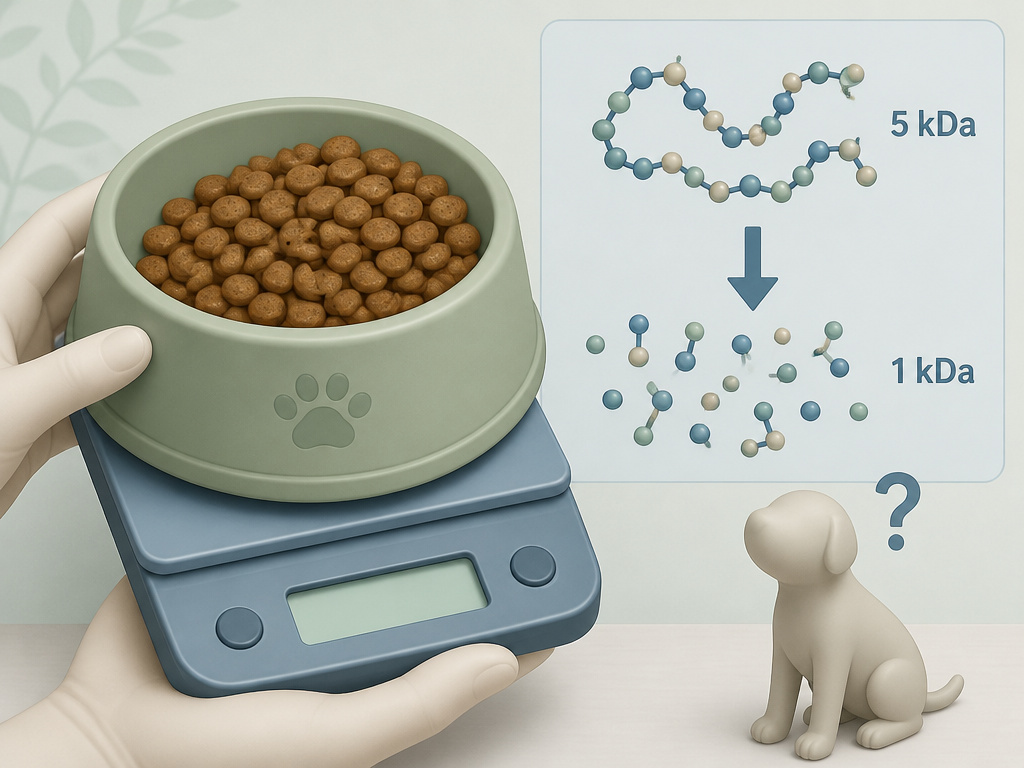
The number that matters is molecular weight, measured in kilodaltons, and the evidence around it is genuinely split.
A study of 10 dogs with proven chicken allergy found no clinical reaction to an extensively hydrolyzed poultry feather diet under 1 kDa. When the same diet was only partially hydrolyzed, 40% of those dogs reacted clinically. That is a large gap from one processing change.
Then the same JAVMA review adds the caveat that complicates the whole picture. Hydrolyzed proteins can stimulate T-lymphocytes in dogs with suspected food allergy, which suggests these diets may not be uniformly reliable for trial work.
Compare that with the University of Illinois position: proteins under 5 kDa are unlikely to cross-link IgE, and are therefore hypoallergenic for most patients. Most is doing a lot of work in that sentence.
So you have two honest readings. One says get under 1 kDa and the failures mostly disappear. The other says even a well-hydrolyzed diet can drive a cell-mediated response in some dogs, and no molecular weight cutoff fixes that. Both come from credible sources, and a dog that fails an extensively hydrolyzed diet has not necessarily been mis-diagnosed.
I would rather see an owner spend the money on a hydrolyzed diet and a kitchen scale than on a serum allergy panel. The panel comes back with a tidy list of numbers, and none of it changes what you have to do next.
That is not a fringe view. Merck states that serum IgE, salivary IgA and IgM, intradermal testing, hair analysis, and ELISA-based tests do not reliably give consistently accurate results. The University of Illinois is equally direct: no serologic, intradermal, saliva, or hair test is currently considered dependable. Patch testing needs allergens in contact with the skin for 48 hours, which Merck calls impractical.
Chicken-Free Doesn’t Mean Chicken-Free
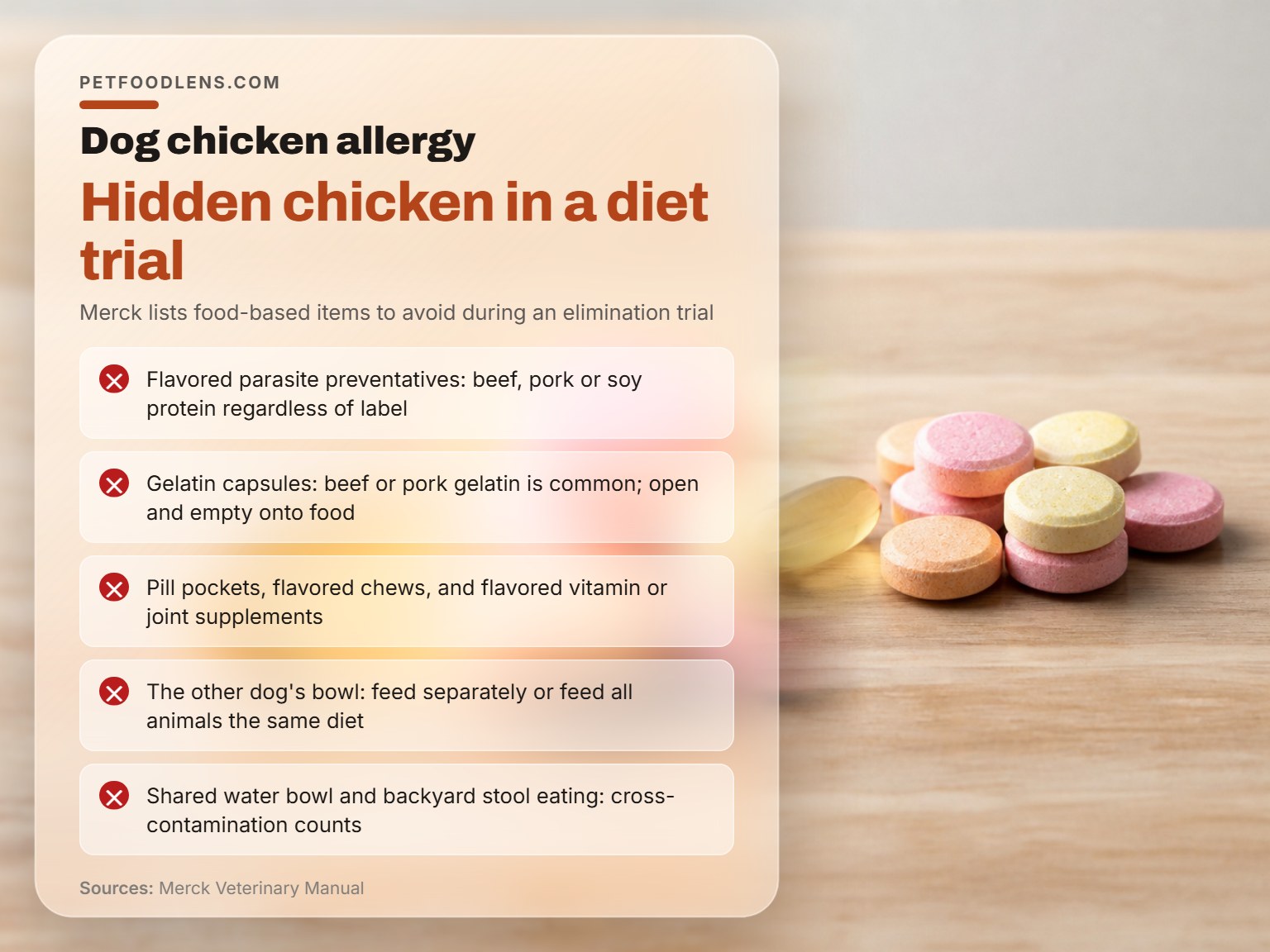
That habit is the same one that catches trial-breakers. The label is where the trial is won or lost, and the things that break it are rarely the things owners are watching.
- Flavored parasite preventatives. Beef, pork, or soy protein, generally present regardless of labelling.
- Gelatin capsules. Beef or pork gelatin is common. Merck’s suggestion is to open the capsule and empty the contents onto the food.
- Pill pockets and flavored chews. Obvious once you say it out loud, easy to forget in the morning rush.
- Flavored vitamin and joint supplements. Oral arthritis products are on Merck’s list by name.
- The other dog’s bowl. Feed separately, or feed every animal in the house the same diet.
- The shared water bowl and the backyard. Cross-contamination and stool eating both count.
The part nobody mentions: A capsule is a food product. If your dog takes anything in gelatin, you are running a diet trial with an unlisted protein in it, and the flare you blame on the kibble may have come from the pill.
If you need a treat that clears a strict trial, the chicken-free treats list covers options to consider.
How Long Before You See a Flare After Rechallenge?
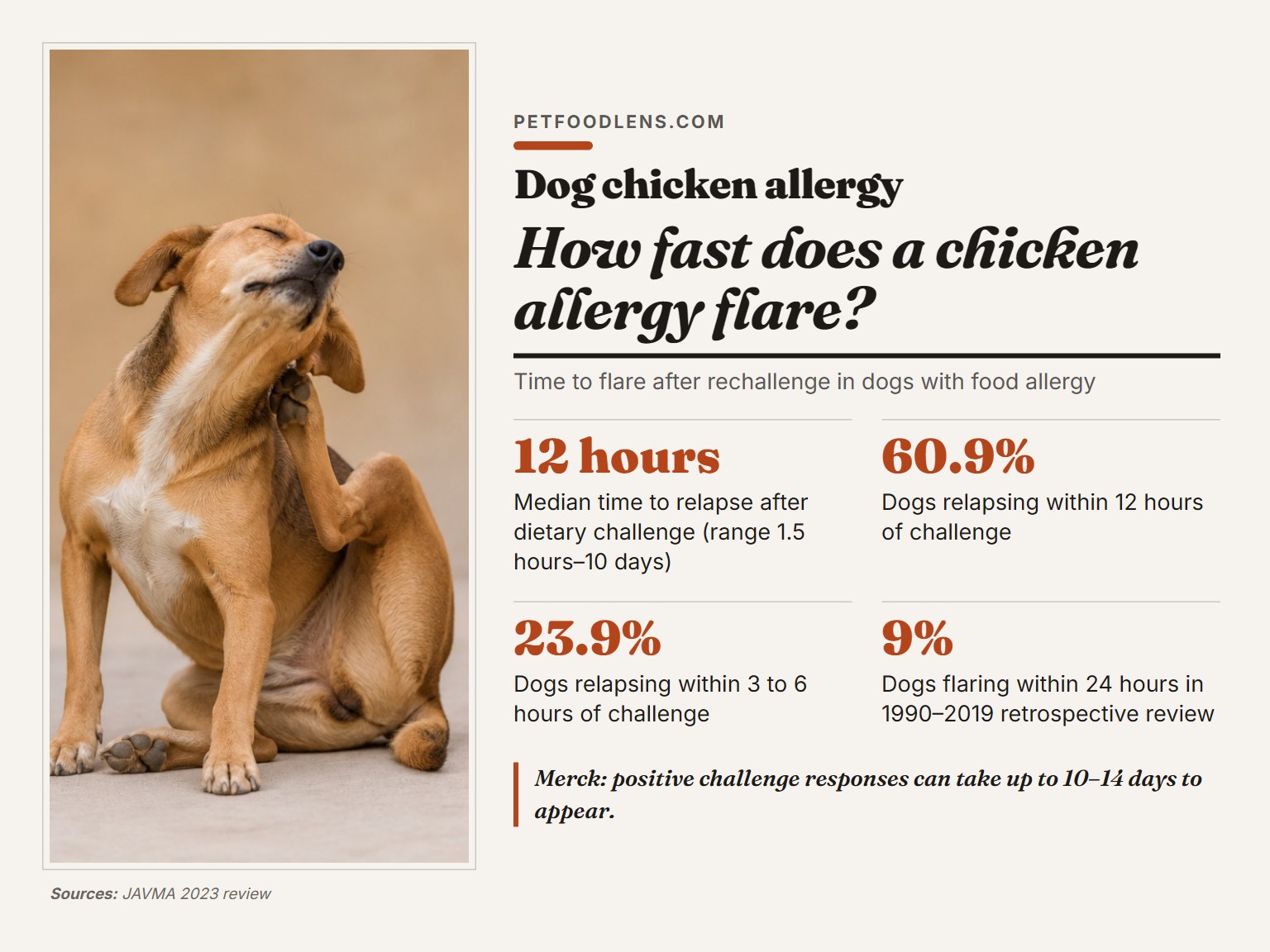
Twelve hours is the median. That surprises people who expect a much longer wait.
| Source | Population | Time to flare |
|---|---|---|
| JAVMA 2023 prospective study | 46 dogs | Median 12 hours; 60.9% within 12 hours |
| JAVMA 2023 retrospective review | Dogs and cats, 1990 to 2019 | 9% of dogs within 24 hours; 50% by day 5, 90% by day 14 |
| Merck Veterinary Manual | General | Up to 10 to 14 days |
| University of Illinois | General | Type I within hours to days; Type IV at 4 to 12 days |
The spread is real and it is explained by mechanism. An IgE-mediated reaction shows up within hours. A cell-mediated one can take a week and a half. In the same JAVMA review, 44% of confirmed chicken-allergic dogs were pruritic within 12 hours of challenge, and 23.9% flared within 3 to 6 hours.
So you rechallenge for up to 2 weeks, and you do not declare victory early.
Two practical rules sit on top of that. Merck advises a withdrawal period of generally 2 weeks from antipruritic agents before the provocative rechallenge, so residual itch does not mask the result. Longer withdrawal may be needed after repositol steroid injections or injectable monoclonal antibodies such as lokivetmab. And individual food items should not be introduced any more frequently than every 2 weeks, or you will not know which one caused the flare.
If a diet change shows improvement within a few days, you have learned almost nothing. Real food allergy responds on a scale of weeks, and it comes back on a scale of hours to days.
One disagreement worth naming: Merck states food-allergic patients can receive any antipruritic medication necessary to control signs during the trial. The University of Illinois position is narrower, describing short-term anti-inflammatory medication during the initial phase, which may shorten the time to visible improvement to 4 to 6 weeks. If your dog is miserable, that is a conversation for your vet, not a decision to make alone.
Cross-Reactivity: Why a Novel Protein Can Still Fail
Ever put a dog on venison because chicken was the problem, then watched the itching come back?
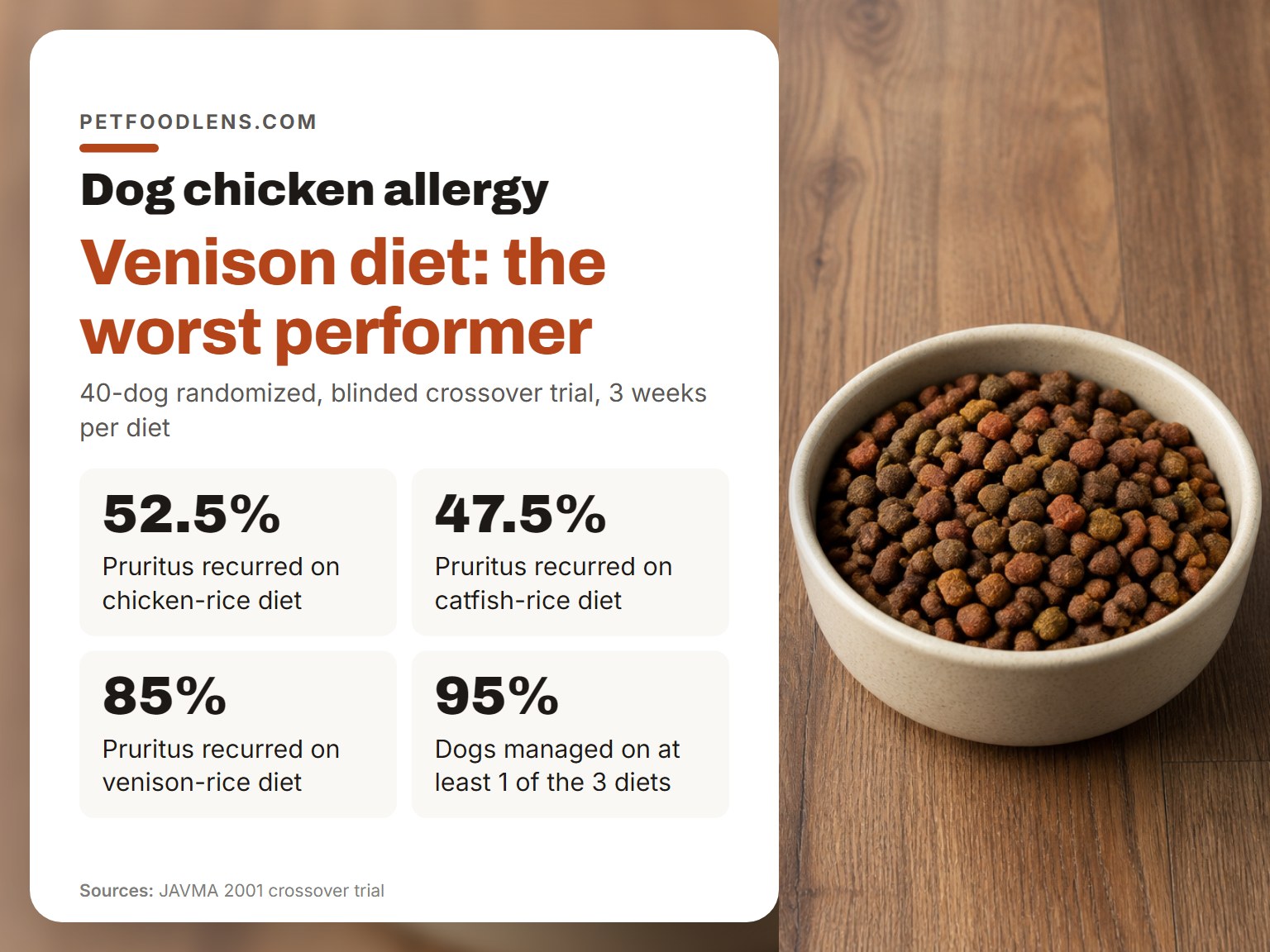
A 40-dog randomized, blinded crossover trial fed three commercial diets for 3 weeks each. Pruritus recurred in 52.5% of dogs on chicken-rice, 47.5% on catfish-rice, and 85% on venison-rice. Overall, 95% of the dogs could be managed on at least one of the three. Read that again: the venison diet, the one sold as the safe option, was the worst performer.
The mechanism is protein cross-reactivity, and it is why “novel” is a claim about your dog’s history rather than about the ingredient.
The sources line up on some of this and not on all of it. Merck says some experimental evidence suggests serological cross-reactivity between chicken, whitefish, and salmon, while the University of Illinois states that dogs allergic to chicken may be at increased risk for cross-reactivity with fish proteins. The University of Illinois goes further, stating that dogs allergic to chicken may be at increased risk for cross-reactivity with fish proteins. On beef, both agree more firmly: a beef-allergic dog has a higher likelihood of reacting to lamb, venison, and bison.
That last point matters when you pick a diet. Merck’s example is avoiding lamb in a patient previously fed beef or milk. If your dog has eaten beef for a long time, venison is a worse bet than it looks on the bag.
Frequently Asked Questions
Can a dog outgrow a chicken allergy?
The honest answer is that nobody has good long-term data. Do not plan around it, and do not test it casually without veterinary supervision.
Is chicken fat safe for a chicken-allergic dog?
Merck’s trial guidance is that all food-based items come out for the duration, and chicken fat is a chicken-derived ingredient. During a diagnostic trial, the safe move is to exclude it and reintroduce later if you want an answer.
How is a chicken allergy actually confirmed?
Only by doing both halves: improvement on the elimination diet, and a flare when the original diet is reintroduced. Merck is explicit that food allergy is not considered confirmed unless both happen. A dog that improves but never flares on rechallenge is not considered confirmed food allergic.
Can I use anti-itch medication during the diet trial?
The two major references differ. Merck states food-allergic patients can receive any antipruritic medication necessary to control signs during the trial. The University of Illinois describes short-term anti-inflammatory use during the initial phase, which may shorten time to improvement to 4 to 6 weeks. Either way, a withdrawal period of generally 2 weeks is advised before rechallenge.
What if my dog gets worse instead of better on the trial?
Check for a break in the diet before you change anything else. Flavored preventatives, gelatin capsules, another pet’s bowl, and the backyard are the usual culprits. If the diet is genuinely clean and there is no improvement, that is a referral conversation, not a reason to buy a different bag.
The Bottom Line
One rule decides most of this: if your dog has not improved by week eight on a genuinely clean trial, do not keep extending on hope. Stop, check for a hidden protein source, and get a veterinary dermatologist involved.
The single most useful thing you can do costs almost nothing. Write down today’s itch level, the food, and anything unusual that happened. Keep it up throughout the trial. That diary is the difference between a diagnosis and more guessing.
And a concession, because this deserves one. Everything above assumes a dog that is otherwise well.
