
What Is Dry Matter Basis in Pet Food? The Conversion Math
This post contains affiliate links. As an Amazon Associate, we earn from qualifying purchases.
Dry matter basis in pet food is a way of stating nutrient percentages with the water removed, so canned food and kibble can be compared on the same scale. To convert, subtract the moisture guarantee from 100 to get dry matter percent, then divide the nutrient percent by that dry matter percent and multiply by 100.
The conversion changes the ranking of foods you thought you had sorted. A kibble that prints 37% protein on the front can land at 42% on a dry matter basis, while a canned food that prints 12% can land at 54.5%. Same units, same scale, completely different answer, which is why what is dry matter basis in pet food matters.
What follows is the actual formula, the FDA’s worked example, the three places the math breaks down, and the source disagreement about moisture that most label guides skip.
Key Takeaways
- Dry matter basis removes water so wet and dry foods can be compared on the same scale.
- The formula is nutrient percent divided by dry matter percent, times 100, where dry matter is 100 minus moisture.
- Canned food moisture varies by source – the FDA says 75-78%, Merck gives 68-78%, and the Pet Food Institute’s example lists 70% – while kibble runs 10-12%, so the raw label numbers are not comparable.
- The guaranteed analysis is a legal minimum or maximum, not a measurement – Merck is explicit on this, and it changes how you read the result.
- Crude fiber excludes soluble fiber, so the DM conversion of fiber understates total fiber.
Why a 37% Protein Kibble Can Rank Below a 12% Canned Food
I used to think the bigger protein number on the bag meant the better food. Then I ran the FDA’s own worked example through the formula and watched a 37% kibble finish last.
The FDA Worked Example
The FDA publishes three products side by side: two canned foods at 78% moisture and one dry food at 12% moisture. On the label, the dry food wins by a mile. On a dry matter basis, it loses.
The AAFCO Cat Food Nutrient Profile for adult maintenance requires a minimum of 26 percent crude protein on a dry matter basis. The guaranteed analysis on the label reports protein on an as-fed basis, so the label number and the AAFCO minimum are expressed in different units until the moisture conversion is applied.
| Product | Label Protein / Moisture | Protein on DM |
|---|---|---|
| Canned Food #1 | 12% / 78% | 54.5% |
| Canned Food #2 | 11% / 78% | 50% |
| Dry Food | 37% / 12% | 42% |
The math is the same for all three. Canned #1: 100 minus 78 equals 22% dry matter. 12 divided by 22, times 100, equals 54.5% protein on a dry matter basis.
The dry food: 100 minus 12 equals 88% dry matter. 37 divided by 88, times 100, equals 42%.
All three clear the AAFCO 26% minimum. The dry food clears it by the smallest margin. Read that again.
If you want to compare wet and dry food without doing the arithmetic yourself, the conversion is the only honest starting point for what is dry matter basis in pet food. The FDA complete and balanced pet food page is where the worked example lives, and it is worth reading in full.
If you want to see the math in action on a real label, grab a can of wet food and a bag of dry food. The can and the bag do not share a moisture guarantee, so the label protein numbers cannot be compared directly.
The Dry Matter Basis Conversion Formula in Plain English
The formula is three steps. You can do it on the back of a receipt.
The Three-Step Conversion
- Find the moisture guarantee on the guaranteed analysis panel. Subtract it from 100. That is your dry matter percent.
- Take the nutrient percent you care about. Divide it by the dry matter percent.
- Multiply by 100. That is the nutrient on a dry matter basis.
Canned food at 78% moisture gives you 22% dry matter. A 12% protein guarantee divided by 22, times 100, gives you 54.5% protein on a dry matter basis. That is the whole trick.
The guaranteed analysis panel is where all three inputs live. The Pet Food Institute guaranteed analysis explainer walks through the same math with a 70% moisture example, which lands on 30% dry matter and 33% protein, illustrating what is dry matter basis in pet food.
Do not compare an as-fed label number to a dry matter basis minimum without converting first. The units do not match, and the comparison is meaningless.
The Same-Moisture Shortcut
If two products share a moisture guarantee, skip the math. The FDA says direct comparison is valid when moisture is equal. Two cans at 78% moisture can be compared on the label numbers alone.
That shortcut matters more than people realize. The conversion only earns its keep when you cross from canned to dry, or from dry to semi-moist.
I have converted labels this way for years, and it has saved me from more bad comparisons than I can count.
What Does the Dry Matter Number Actually Tell You?
Here is the part that gets skipped. The guaranteed analysis is a legal document. Treat it like one.
Merck’s veterinary manual is blunt about this: the guaranteed analysis lists legal minimums and maximums, not actual nutrient content. Two foods with identical guaranteed analyses can have very different proximate analyses. A protein minimum on a dry matter basis is a floor. The actual protein could be higher, and the label won’t tell you by how much.
That changes how you read the result. A converted DM number is a bound. Treat it as a floor, not a measurement.
I tell people to treat the dry matter number as a starting filter, not a verdict. If two foods are close to each other on protein DM, the label cannot tell you which one is actually higher. You need a typical analysis or a lab test for that.
The gap between the typical analysis and the guaranteed analysis is where a lot of label arguments go wrong. The guaranteed analysis is what the manufacturer promises. The typical analysis is what they actually measured.
When you compare protein percentages across two foods, the conversion is step one. Step two is admitting the conversion gives you a floor, not a fact.
Where the Dry Matter Basis Conversion Breaks Down
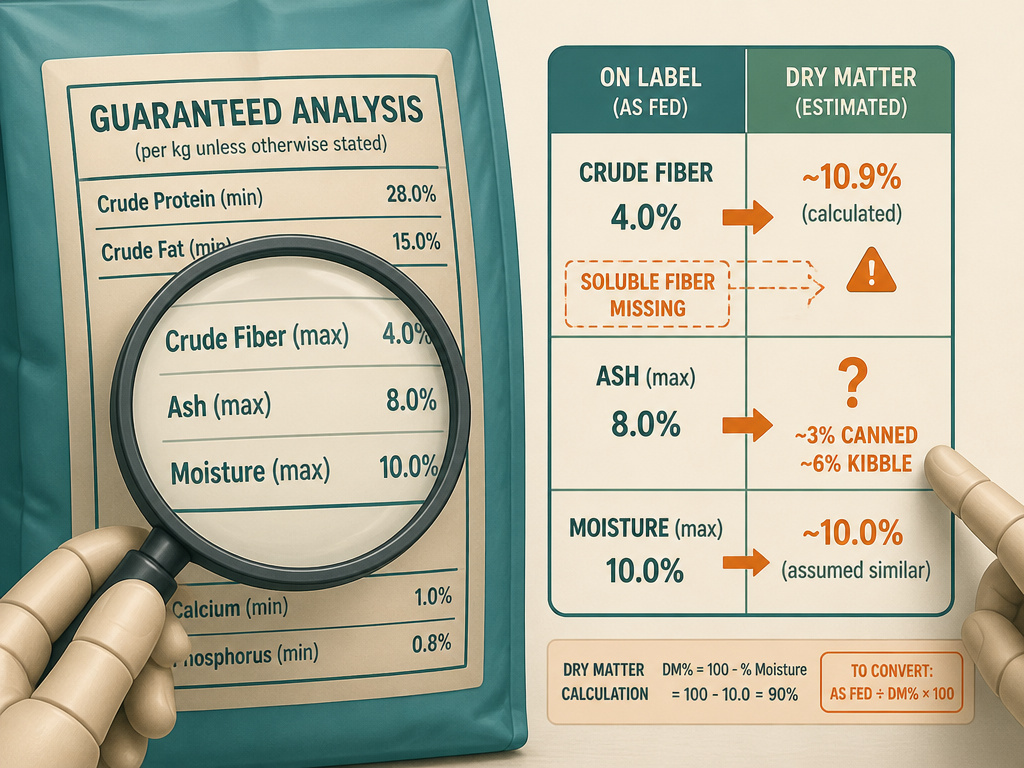
Three places. Fiber, ash, and the difference between a minimum and a measurement.
- Fiber: crude fiber excludes soluble fiber, so the DM conversion understates total fiber.
- Ash: often missing from the panel; estimate 3% for canned and 6% for kibble.
- Minimums versus measurements: a converted minimum is a floor, not the actual value.
The Crude Fiber Problem
Merck notes that guaranteed analysis crude fiber is only an estimate of insoluble fiber. It does not include soluble fiber. Convert fiber to a dry matter basis and you get a number that understates total fiber, sometimes by a wide margin.
That is why two foods with the same crude fiber DM can behave very differently in a cat. The soluble fraction is the part that ferments in the gut, and the label does not show it.
The Ash Estimate
Ash is often not listed. Dr. Jennifer Coates, writing for PetMD, suggests estimating canned food at around 3% ash and kibble at around 6% if the panel omits it. That estimate feeds into the carbohydrate calculation, which is 100 minus the sum of protein, fat, fiber, moisture, and ash.
Her worked example: 100 minus (8 + 6 + 1.5 + 78 + 3) equals 3.5% carbohydrate. That is a ballpark figure. The real number sits somewhere nearby.
Common mistake: Converting a maximum (fiber, moisture) to a dry matter basis and treating the result as the actual value. A maximum converted to DM is a ceiling, not a measurement. The real number sits below it, and sometimes well below.
If you want to go one step further, metabolizable energy is where the label math meets the calorie math. The DM conversion is the first step, not the last.
Why Don’t FDA, Merck, and PFI Agree on Canned Moisture?
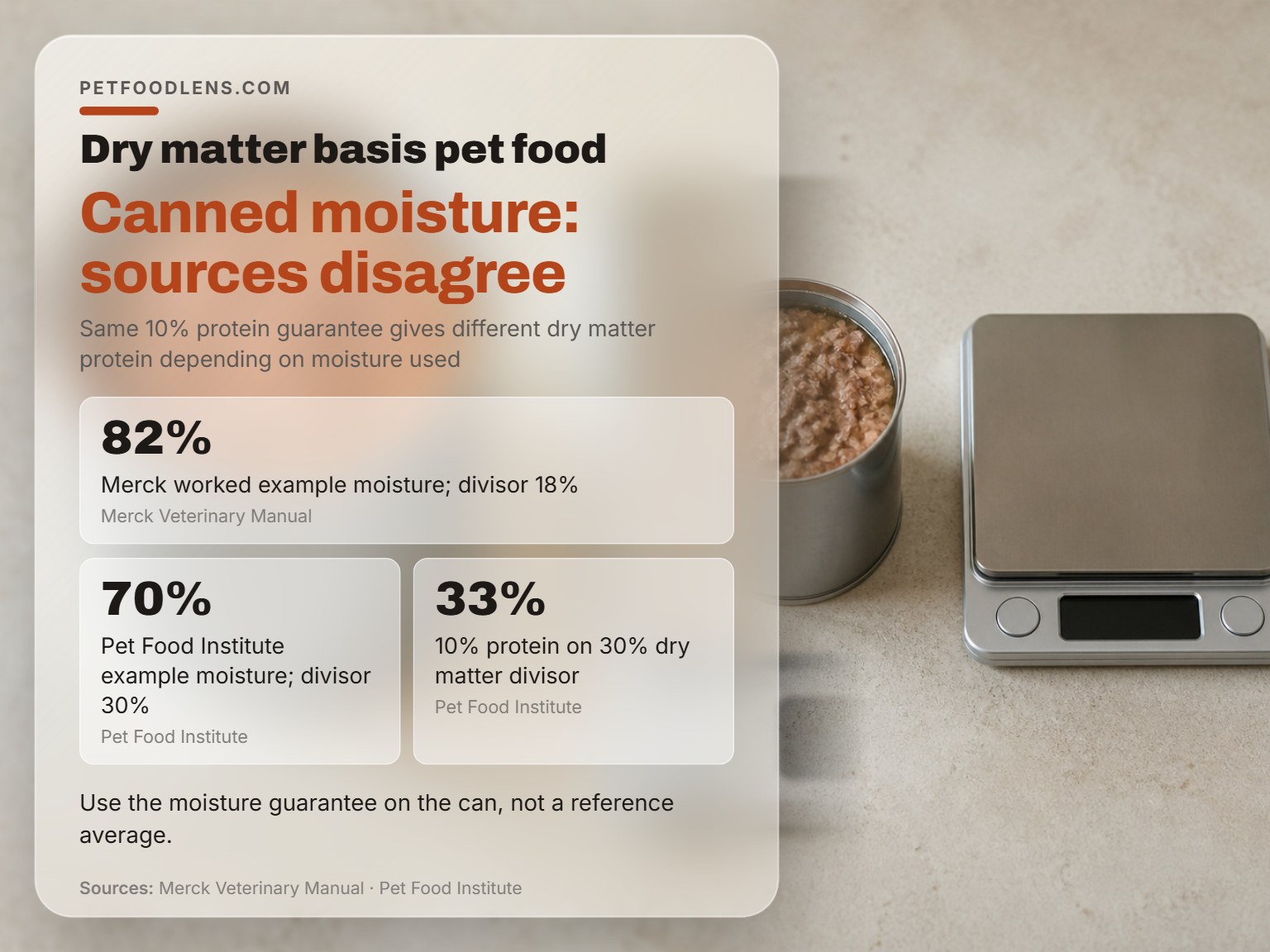
Because they are each working from a different example. The FDA says canned pet food typically runs 75-78% moisture, while Merck gives a range of 68-78% water and the Pet Food Institute’s example lists 70%. Merck’s veterinary manual gives a range of 68-78% water, and its worked example uses 82%. The Pet Food Institute’s example lists 70% moisture on a can of cat food.
Each number produces a different dry matter divisor. That matters when you are converting.
| Source | Canned Moisture | Dry Matter Divisor |
|---|---|---|
| FDA | 75-78% | 22-25% |
| Merck example | 82% | 18% |
| Pet Food Institute example | 70% | 30% |
A 10% protein guarantee on a 22% dry matter divisor lands at a much higher protein DM than the same guarantee on a 30% divisor. The same guarantee on a 30% divisor lands at 33%. Same food, same label, different answer depending on which moisture figure you use.
The lesson is simple: use the moisture guarantee on the actual can in front of you, not a textbook average. The moisture content printed on the label is the only divisor that matters for that product.
Use the moisture guarantee on the can, not the average from a reference table. A swing in moisture moves the protein DM number substantially. The label is the only number that belongs in the formula.
How to Read a Label Step by Step
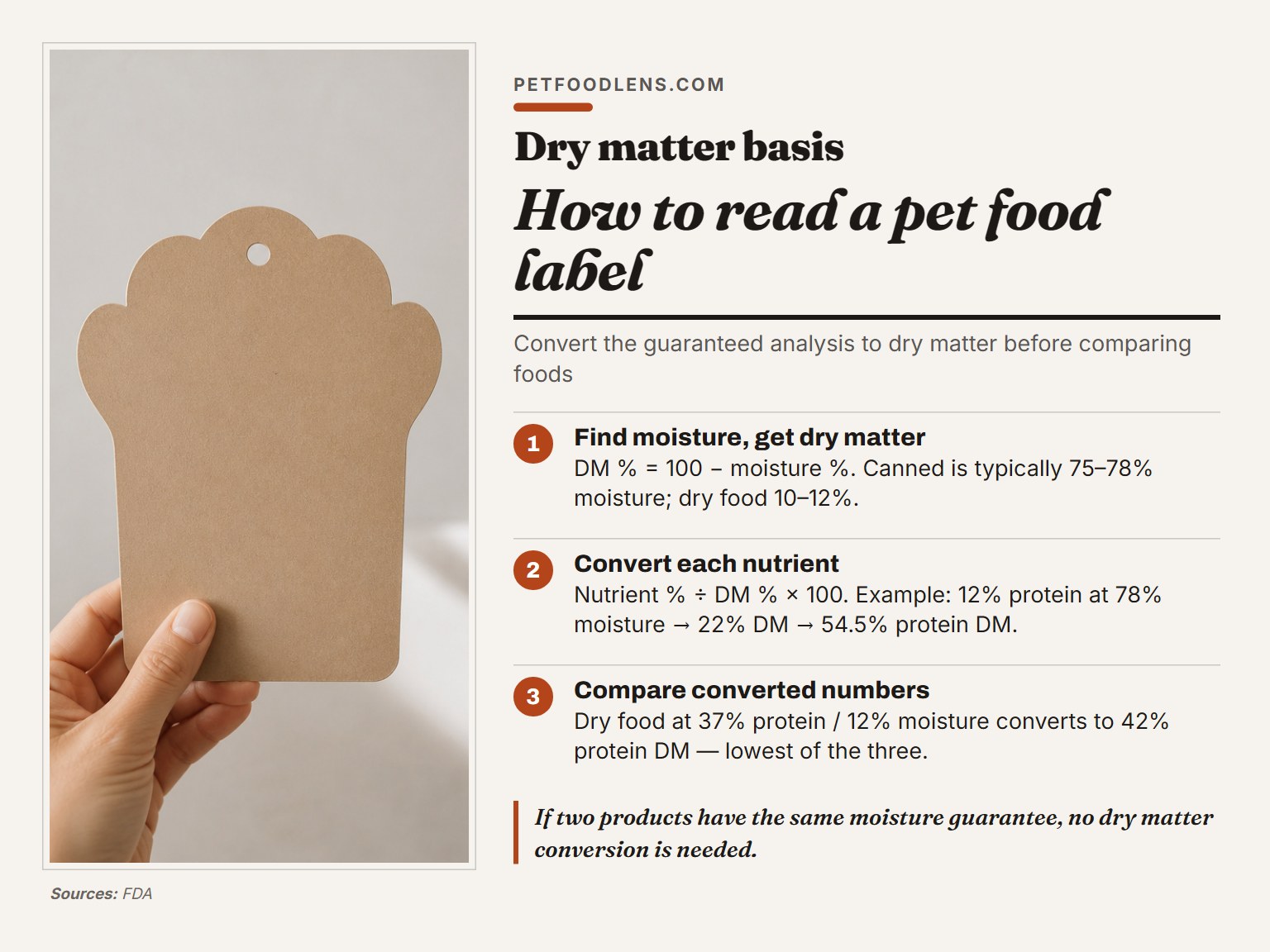
Here is the process I use, in order.
Before you start: A cat that stops eating for more than a day or two during a food transition is a vet call, not a stubbornness contest. Overweight cats are at real risk of hepatic lipidosis, a liver condition that can develop fast when a cat goes off food.
- Find the nutritional adequacy statement. It tells you whether the food was formulated on paper or tested by feeding trial.
- Find the moisture guarantee. Subtract it from 100 to get dry matter percent.
- Convert protein, fat, and fiber using the same formula.
- Estimate ash if it is missing: around 3% for canned, around 6% for kibble.
- Calculate carbohydrate as 100 minus the sum of protein, fat, fiber, moisture, and ash.
- Compare the converted numbers, not the label numbers.
The compare calories step comes after this. Calories are reported on an as-fed basis, so they do not need the same conversion, but they do need to be compared per unit of dry matter if you want a fair read.
Once opened, the last third has had a long time to oxidize, and any savings from the bigger bag evaporate if half of it gets tossed or the cat quits eating it.
I dumped out a bin at the bottom of a pantry once and found a yellowish, tacky film on the walls and a sharp crayon-and-paint smell. Months of fresh kibble had been poured over that residue, so every new batch met old oxidized fat on day one. If you use a bin, empty it completely and wash it with hot soapy water between bags.
The Part Nobody Mentions: Air-Dry vs Absolute Dry Matter
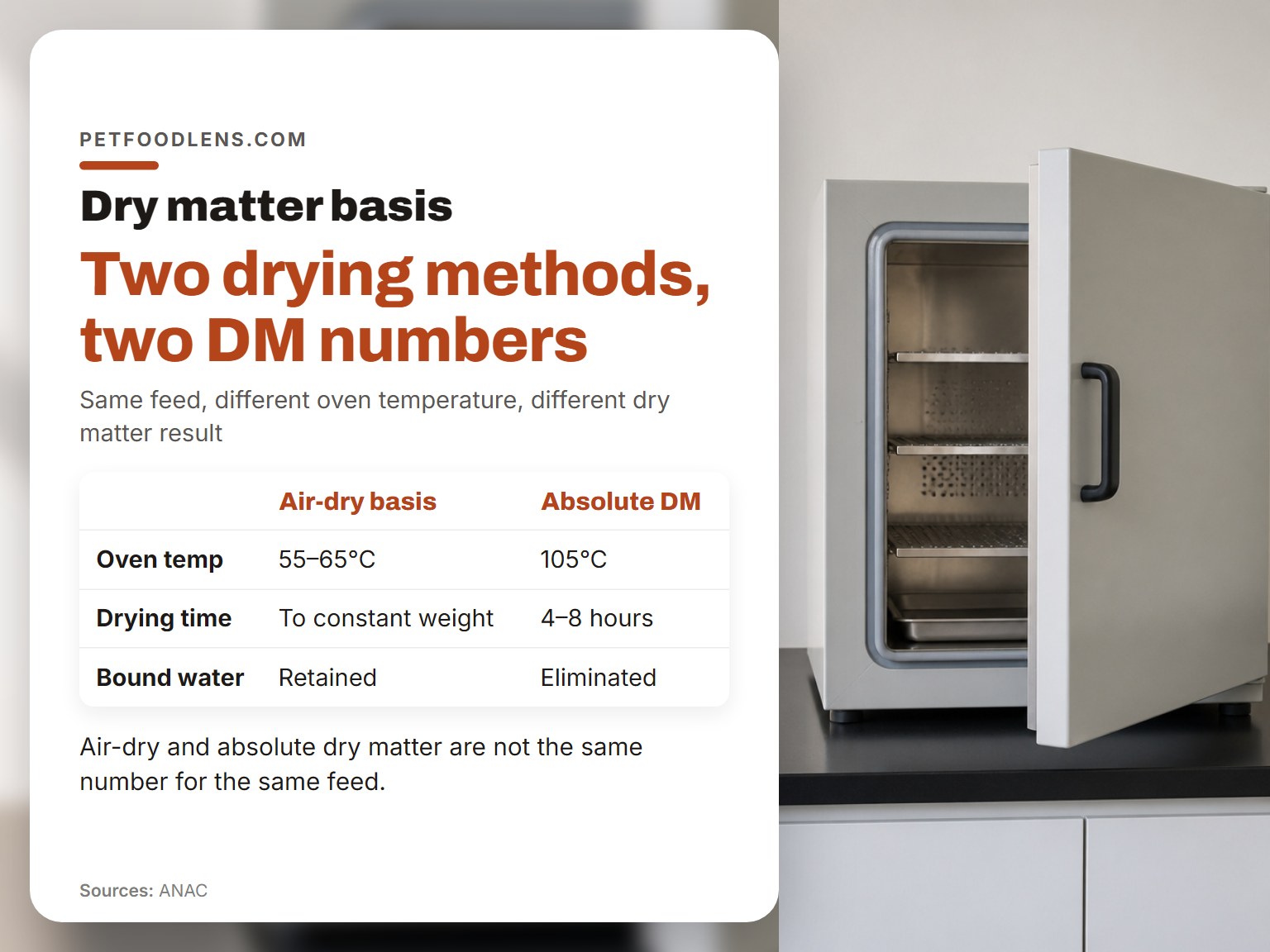
There are two different definitions of dry matter, and they produce two different numbers for the same feed.
The Animal Nutrition Association of Canada draws the line. Air-dry basis means the sample was dried at 55-65°C to the point where its weight stays constant at ambient conditions. Absolute dry matter means the sample was dried at 105°C for 4 to 8 hours, eliminating all free water. The first retains bound water. The second doesn’t.
Air-dry and absolute dry matter are not the same number. A feed dried at 65°C still holds bound water that a 105°C oven drives off. When two labs report different dry matter percentages for the same sample, this is usually why.
The visual difference is obvious once you have seen it.
The Dry Matter vs As-Fed feed composition reference is where the two protocols are spelled out. Nebraska Extension’s Nebraska Extension dry matter conversions guide adds a third layer: the air-dry convention assumes 90% dry matter and 10% moisture, which is a fixed assumption rather than a measured endpoint.
For pet food, the practical answer is simpler. The label gives you a moisture guarantee, and that is the number you use. The 55°C versus 105°C distinction matters for lab work and feed analysis, not for reading a can.
Frequently Asked Questions
What is the difference between dry matter basis and as-fed?
As-fed means the nutrient percentage includes the water in the product. Dry matter basis means the water has been mathematically removed, so the percentage reflects only the solid fraction. The guaranteed analysis on a pet food label is as-fed. The AAFCO nutrient profiles are on a dry matter basis. You cannot compare the two directly without converting.
Do I need to convert if both foods are dry?
No. If two foods share the same moisture guarantee, the FDA says direct comparison is valid. Two kibbles at 10-12% moisture can be compared on the label numbers without converting. The conversion only earns its keep when you cross moisture categories, like wet versus dry or dry versus semi-moist.
Why does my cat food label show a lower protein number than the dry matter calculation?
Because the label reports protein on an as-fed basis, and the water in the can dilutes the percentage. A 12% protein guarantee on a 78% moisture food converts to 54.5% protein on a dry matter basis. The label number is accurate for what it measures. It is reporting on a different basis.
Can I convert fiber the same way I convert protein?
You can run the same math, but the result means less. Merck notes that crude fiber is only an estimate of insoluble fiber and does not include soluble fiber. Converting fiber to a dry matter basis gives you a floor for insoluble fiber, not a total fiber number. The soluble fraction is missing from the label entirely.
What is the difference between guaranteed analysis and typical analysis?
The guaranteed analysis is a legal minimum or maximum that the manufacturer promises. The typical analysis is what they actually measured in a sample. Two foods with identical guaranteed analyses can have different typical analyses, which is why Merck warns against treating the guaranteed analysis as a measurement.
Is dry matter basis the same as dry food?
No. Dry matter basis is a way of expressing any food’s nutrient content with the water removed, whether the food is canned, dry, or semi-moist. A canned food can have a dry matter basis. A dry food can have an as-fed basis. The basis is a unit of measurement. It applies to any food.
The Bottom Line
If the two foods you are comparing share a moisture guarantee, skip the dry matter basis math. The FDA says direct comparison is valid, and the conversion adds nothing.
If they do not share a moisture guarantee, do the conversion. Use the moisture number on the actual can or bag, not a textbook average. Treat the result as a floor, not a measurement. And read the nutritional adequacy statement before you read the guaranteed analysis, because the adequacy statement tells you whether the food was tested or just formulated on paper.
Here is the practical takeaway. Flip the bag over and find the moisture guarantee first. That single number tells you whether you need to do the math at all.
