
Corn in Dog Food Pros and Cons: What the Data Says
This post contains affiliate links. As an Amazon Associate, we earn from qualifying purchases.
Corn in dog food pros and cons weigh a highly digestible starch against two real risks. In beagle trials, corn dry matter digestibility measured 92.95 percent, higher than rice at 92.45 percent and barley at 88.81 percent. The risks are aflatoxin from poor storage and a resistant starch benefit the research has not settled.
The 92.95 percent figure comes from one beagle trial with eight dogs, which is a small sample and a specific diet context. A 2021 review of the same question landed on a very different average, and the gap between those two numbers is where most of the confusion about corn lives.
What follows walks through the digestibility data, the two source disagreements that matter, the aflatoxin recall that gave corn its reputation, and the processing step that changes the answer more than the grain does.
Key Takeaways
- Corn is not a filler by digestibility standards. Beagle trials measured 92.95 percent dry matter digestibility, higher than rice and barley in the same comparison.
- The two source averages disagree by 12 points. A 2021 review reports 80.23 percent, and the gap comes from diet context, not from one side being wrong.
- Aflatoxin is a storage mold issue. The 2021 Midwestern Pet Foods recall traced to one Oklahoma plant and lots with expiry dates on or before 07/09/22.
- Processing changes the starch more than the grain. Extruded corn scored highest for starch cook and lowest for resistant starch; pelleted corn scored the reverse.
- Corn allergy is rare in the data. Zero cases across three separate studies, against 36 percent for beef in the same dataset.
Corn in Dog Food Pros and Cons: What the Digestibility Numbers Show
The 92.95 percent figure is real, but it does not apply to every corn diet.
Corn dry matter apparent total tract digestibility measured 92.95 percent in beagles. Nitrogen-free extract digestibility reached 96.14 percent in the same trial. Rice measured 92.45 percent dry matter and 97.08 percent NFE. Barley and mung bean trailed at 88.81 and 80.74 percent dry matter respectively.
The common carbohydrate sources in pet foods trial is the source for that number. It used four castrated males and four spayed females, mean age 4.58 years, with dry matter intake of 203.0 grams per day. That is a tight, controlled setup, and it is also a narrow one.
The Beagle Trial Setup in Plain Terms
Eight dogs, one diet per carbohydrate source, and a Latin square design that rotates each dog through every diet. The point of that design is to cancel out individual dog differences, so the 92.95 percent is a within-animal comparison rather than a between-animal one.
Here is the comparison in one table.
| Carbohydrate Source | Dry Matter ATTD | NFE Digestibility |
|---|---|---|
| Corn | 92.95% | 96.14% |
| Rice | 92.45% | 97.08% |
| Brown rice | 91.61% | 95.56% |
| Barley | 88.81% | 90.10% |
| Mung bean | 80.74% | 83.38% |
Read that table twice. Corn beats rice on dry matter and loses to rice on nitrogen-free extract, which tells you the two grains are close enough that the “corn is a filler” claim does not survive the comparison.
Why the Review Average and the Beagle Trial Disagree
The 2021 review and the beagle trial do not agree on corn digestibility, and neither one is wrong.
The review reports an average corn-diet dry matter ATTD of 80.23 percent across the studies it compiled. The beagle trial reports 92.95 percent for a single corn diet. That is a 12-point gap, and three things drive it:
- Corn inclusion level. The review only included studies at 30 percent corn or higher.
- Processing method. Extruded, baked, and pelleted corn diets digest differently.
- Dog population. Age, breed, and baseline diet all shift the number.
What the Review Average Covers
The 2021 review compiled data from multiple studies, each with its own corn inclusion level, its own processing method, and its own dog population. Averaging across all of that gives you a number that describes the category, not any single food.
The beagle trial describes one specific diet fed to one specific group of dogs. Neither number is more true than the other. They answer different questions.
Murray et al. 1999 adds a third data point. That work found corn diet dry matter ATTD higher than barley by 2.9 percentage points and higher than sorghum by 5.7 points, in the sorghum and corn as rice alternatives comparison. The direction matches the beagle trial even if the magnitude does not.
The practical takeaway: when a bag says “highly digestible,” ask which study the claim is based on. The 80.23 percent review average and the 92.95 percent beagle figure both support the word “highly,” but they describe very different diets.
Does Corn Cause Allergies in Dogs?
Does corn actually cause food allergies in dogs? The data says almost never.
The 2021 review compiled allergy data from seven studies. Beef caused 36 percent of cases, dairy 28 percent, wheat 15 percent, egg 10 percent, chicken 9.6 percent, pork 4 percent, rabbit 1 percent, and fish 1 percent. Corn caused zero.
The Allergy Prevalence Data
Laflamme et al. 2014 reported no cases of food allergenicity from corn across 198 dogs, with wheat at 15 percent prevalence. Carlotti, Remy, and Prost (1990) reviewed 33 cases of canine food allergy in France and found no dog allergic to corn.
The allergy prevalence data is the strongest thing corn has going for it. Zero cases across three separate studies, and that number never makes it onto a bag because it does not sell food.
If your dog has a confirmed allergy, the ingredient to eliminate is almost always an animal protein. A limited ingredient dog food is the right tool for a confirmed diagnosis, not a suspected one. For a diagnosed protein allergy, hydrolyzed protein dog food is the standard next step.
Wheat sits at 15 percent in the same dataset, which is why wheat in dog food gets its own breakdown. Corn does not.
The Aflatoxin Problem Is a Plant Problem
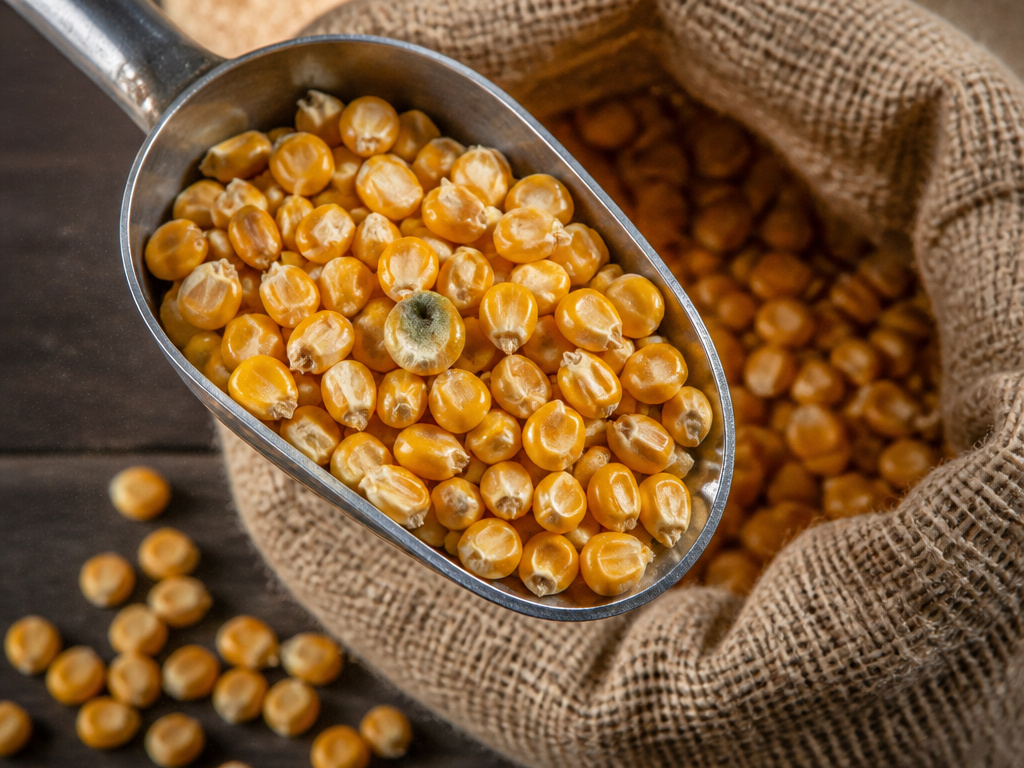
The aflatoxin recall was a plant problem.
On January 11, 2021, Midwestern Pet Foods expanded a recall to all corn-containing Sportmix, Pro Pac, Nunn, and Splash Fat Cat products from its Oklahoma plant. Recalled lots were those with expiry dates on or before 07/09/22. As of January 21, 2021, the FDA was aware of more than 110 pet deaths and more than 210 illnesses, unconfirmed by lab. The recall was terminated on October 25, 2021.
Aflatoxin is a storage mold, Aspergillus flavus, that grows on corn under poor conditions. It is not an intrinsic property of the grain. The FDA sets a limit of 20 ppm in corn used in pet food, and the 2021 review describes mycotoxins as “well controlled” in the corn supply.
What most people get wrong: Treating the 2021 recall as evidence that corn is dangerous. The FDA tied every recalled lot to one Oklahoma plant and one storage mold. A bag with a 2022 expiry date from a different plant was never part of that recall.
Here is what the recall actually covered:
- One plant. The Oklahoma facility, not the corn supply as a whole.
- Corn-containing products only. The recall did not extend to grain-free lines from the same company.
- A specific date range. Lots with expiry dates on or before 07/09/22.
The FDA Midwestern Pet Foods aflatoxin recall notice is the primary document. Read it before you decide corn is the problem.
That smell is the practical warning sign, and it is why storage matters more than the grain.
Processing Method Changes the Answer
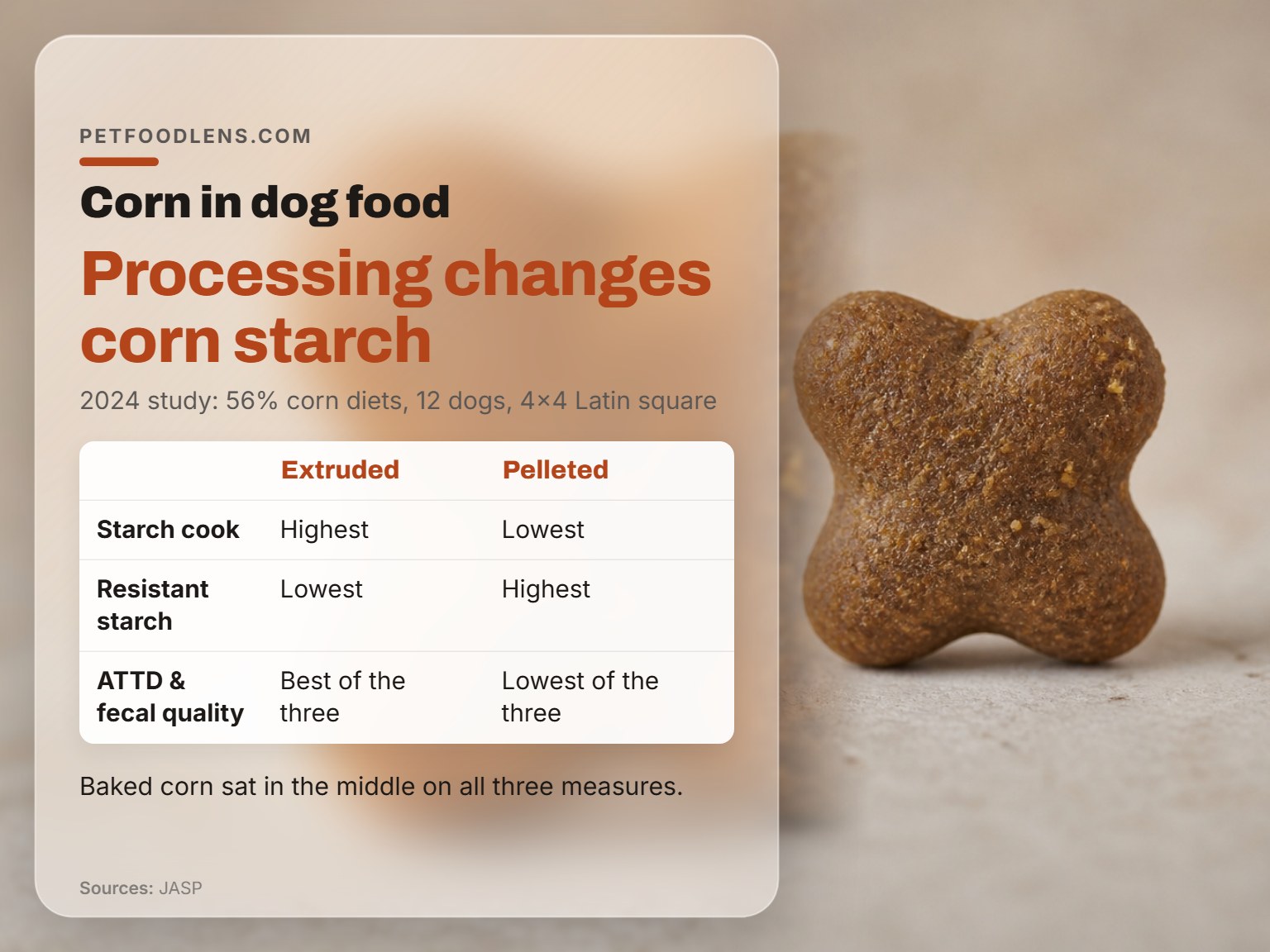
Extrusion, baking, and pelleting each leave corn starch in a different state.
The 2024 processing study fed 56 percent corn diets to 12 dogs in a 4×4 Latin square design, with a 9-day adaptation and a 5-day fecal collection. Extruded corn had the highest in vitro starch cook and the lowest resistant starch. Pelleted corn had the lowest cook and the highest resistant starch. Baked corn sat in the middle.
Extruded vs Baked vs Pelleted
| Method | Starch Cook | Resistant Starch | ATTD and Fecal Quality |
|---|---|---|---|
| Extruded | Highest | Lowest | Best of the three |
| Baked | Intermediate | Intermediate | Intermediate |
| Pelleted | Lowest | Highest | Lowest of the three |
The extruded diet gave the best apparent total tract digestibility and the best fecal quality among the three methods. The extruded diet also tended toward higher fecal butyrate, at P = 0.055.
The corn-based dog food processing study is the source for all three rows. It is also the study that undercuts the resistant starch claim, which I will get to in the next section.
That visual difference is the processing difference, and it shows up in the digestibility numbers.
The dry dog food category covers all three formats, and most bags do not tell you which one you are buying.
Does Resistant Starch Actually Help Your Dog’s Gut?
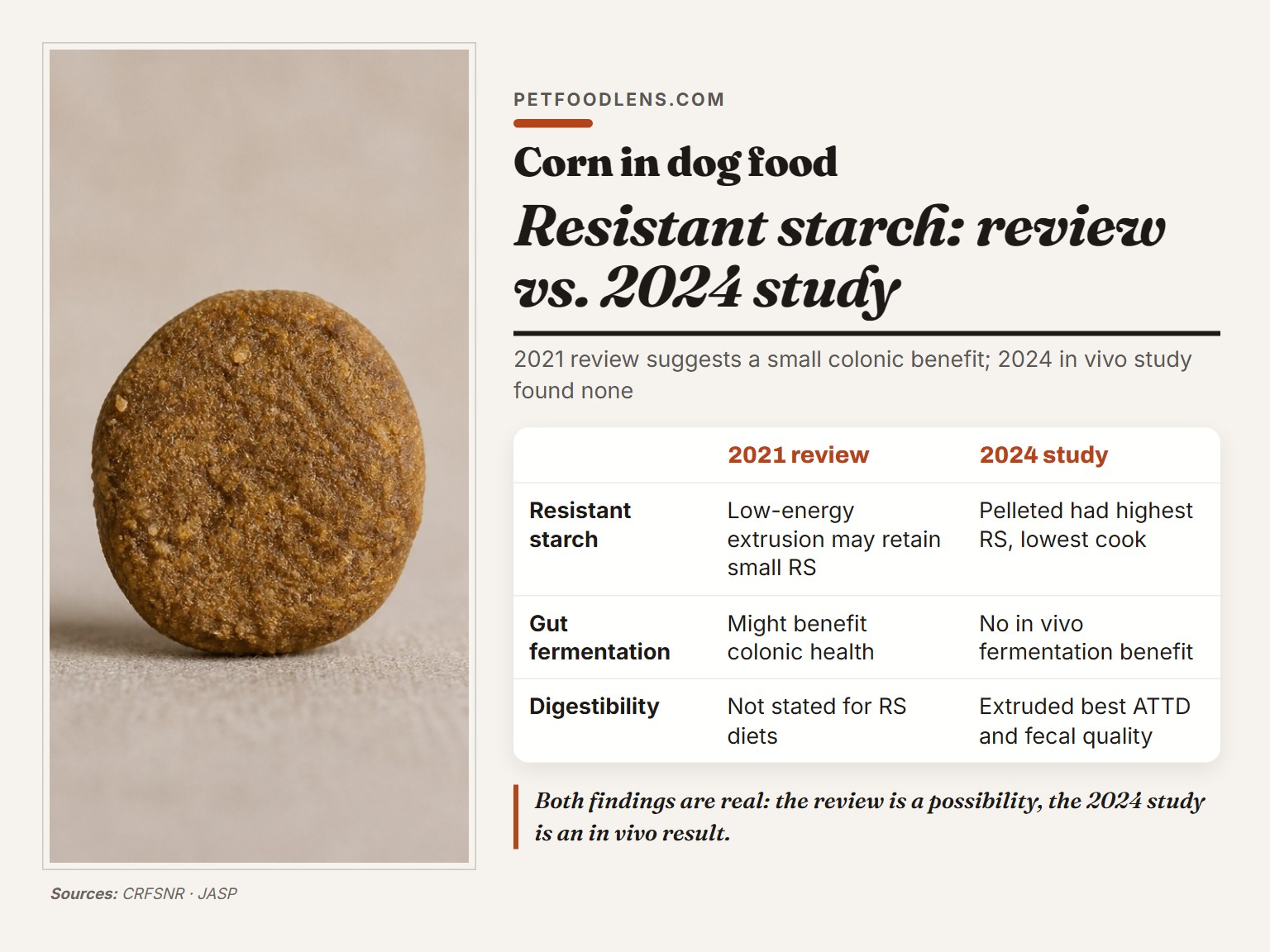
The 2024 processing study found no in vivo fermentation benefit from higher resistant starch, while the 2021 review suggests corn-based foods extruded at low mechanical energy might retain a small amount of resistant starch and benefit colonic health. A bag of pelleted kibble looks identical to an extruded one on the shelf, and the starch inside is not the same.
The 2021 review frames corn-derived resistant starch as a potential colonic health benefit. Corn-based pet foods extruded at low mechanical energy “might retain a small amount of RS and benefit the colonic health of both dogs and cats,” the review says.
The 2024 processing study found the opposite in vivo. Higher in vitro resistant starch did not translate to better in vivo fermentation in dogs. The pelleted diet had the most resistant starch and the worst digestibility of the three.
Both findings are real. The 2021 review suggests corn-based foods extruded at low mechanical energy might retain a small amount of resistant starch and benefit colonic health, while the 2024 processing study found higher in vitro resistant starch did not translate to better in vivo fermentation in dogs.
If you want the earlier literature on starch digestibility, the high-starch flours in canine diets paper is the starting point.
What Corn Actually Brings to a Formula
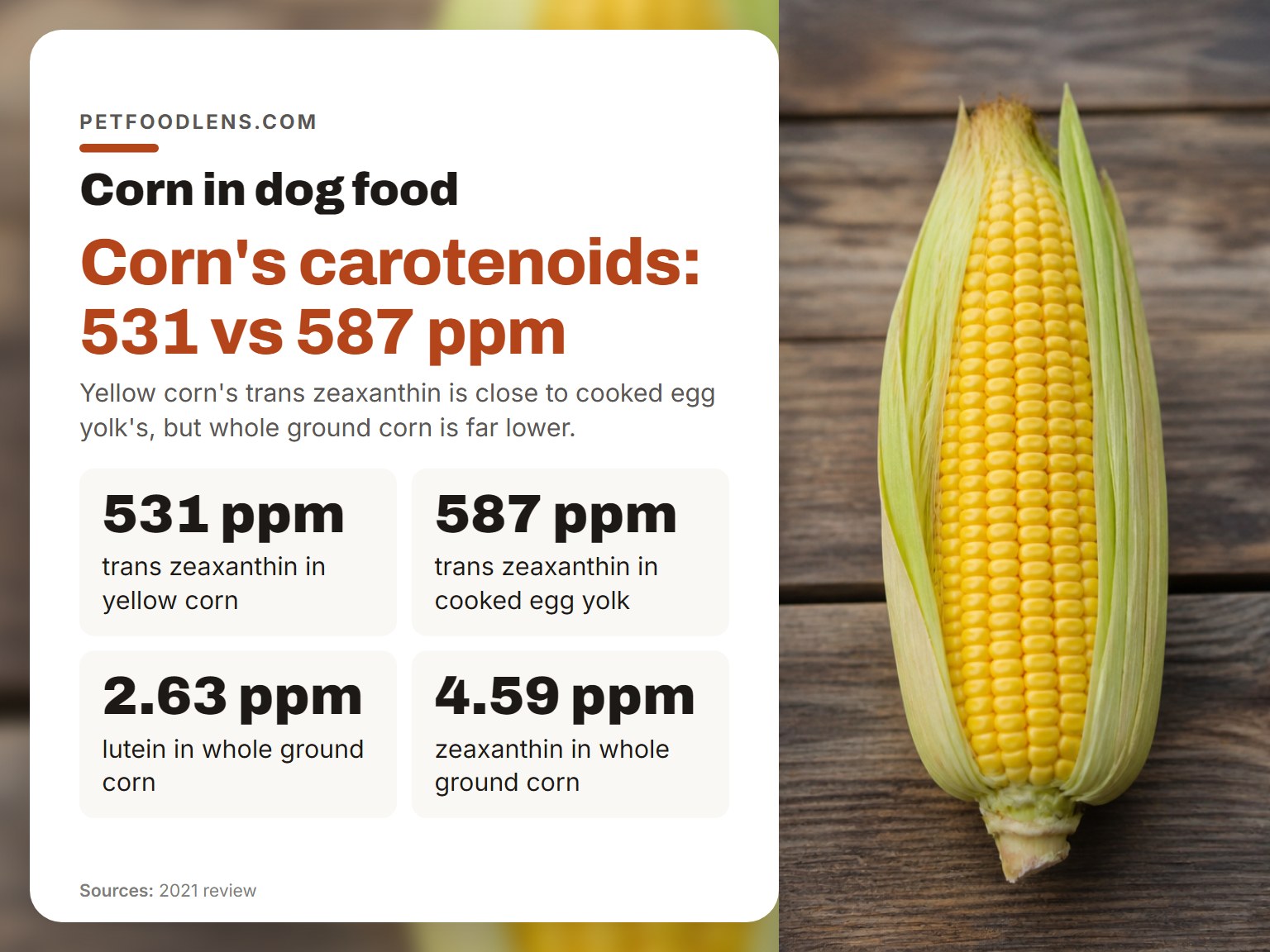
Two carotenoid numbers explain why corn appears in some premium formulas: 531 ppm of trans zeaxanthin in yellow corn, compared with 587 ppm in cooked egg yolk.
Lutein and zeaxanthin are the xanthophylls linked to eye protection in humans. Yellow corn carries a meaningful dose of both. Whole ground corn is a different story, at 2.63 ppm lutein and 4.59 ppm zeaxanthin, which is why the form of corn matters as much as the presence of it.
Kim et al. 2000a fed dogs crystalline lutein at 5, 10, and 20 mg per day and found significant immune system improvement after two weeks. That is a lutein study, not a corn study, but it explains why formulators keep corn in the mix.
Now the label-reading part. Here is the math on ingredient splitting, which is the trick I see most often.
The label did not lie. It just did not help.
Easy to miss: A bag that lists corn three ways will read as meat-first on the front panel and corn-first on the back. Regroup them before you judge the position, or you will pay a premium for a starch-heavy formula.
Three label checks before you buy a corn-containing food:
- Regroup the corn. Add corn, corn gluten meal, and corn bran together before you judge the position.
- Compare on dry matter. Divide the guaranteed analysis protein by the dry matter percentage to get the real number.
- Check the processing method. Extruded, baked, and pelleted corn digest differently, and most bags do not say which one you are getting.
If you want a starting point, the best grain dog food list covers formulas that keep corn in the mix. The grain-free dog food category is built on the assumption that corn is the problem, and the grain-free vs grain-inclusive comparison is where that assumption gets tested.
Read past the front of the bag, and the corn count tells a different story than the marketing copy. Pull all three bags and compare the guaranteed analyses side by side.
Frequently Asked Questions
Is corn a filler in dog food?
By digestibility standards, no. The beagle trial measured corn dry matter digestibility at 92.95 percent, higher than rice and barley in the same comparison. A filler is an ingredient with low digestibility and no nutritional purpose. Corn does not fit that description. The “filler” label is a marketing term, not a nutritional one.
Can dogs be allergic to corn?
The data says almost never. Three separate studies found zero cases of corn allergy in dogs, against 36 percent for beef and 15 percent for wheat in the same dataset. If your dog has a confirmed food allergy, an animal protein is the far more likely trigger.
Is corn gluten meal the same as corn?
No. Corn gluten meal is the protein fraction left after the starch is removed. It is higher in protein and lower in starch than whole corn. On a label, corn and corn gluten meal are two forms of the same source, which is why ingredient splitting matters.
Should I avoid corn if my dog has a sensitive stomach?
Not automatically. The 2024 processing study found that a corn-free dextrose control diet caused osmotic diarrhea and dysbiosis, performing worse than the corn diets on fecal quality. If your dog reacts to a specific food, the trigger is more likely a protein or a processing method than the corn itself.
Does cooking destroy the nutrients in corn?
Cooking changes the starch, not the protein or the fat. Extrusion fully gelatinizes corn starch, which is why extruded corn scores highest for starch cook and lowest for resistant starch. The 2024 study found extruded diets gave the best digestibility and fecal quality of the three methods tested.
The Bottom Line
When you weigh the corn in dog food pros and cons, the digestibility number is the one that holds up. Corn is not a filler by any measure the research supports, and the “grain-free is better” claim does not survive the comparison data.
But here is the concession. If your dog has a diagnosed condition, a vet’s exam outranks anything on this page.
That is the label trick, and it is the one worth checking before you buy.
This week, pull the bag you are feeding now and regroup the corn ingredients. That is the first step.
