
Platform Feeder Pros and Cons: Which Birds They Suit
This post contains affiliate links. As an Amazon Associate, we earn from qualifying purchases.
Platform feeder pros and cons split cleanly: the open tray draws the widest range of birds, including cardinals, doves, and juncos, while offering no roof, no seed protection, and no exclusion. Wet seed spoils fast, and squirrels and starlings empty a tray quickly.
The tray is the whole design. A platform feeder is a flat surface, usually mesh or perforated, mounted on a pole, hung from a hook, or set on the ground, and the platform feeder pros and cons follow from that flatness.
What follows: where the open tray wins, where it fails, which seed belongs on it, and the cleaning routine that decides whether you’re feeding birds or growing mold.
Key Takeaways
- Cardinals, doves, juncos, and sparrows feed from a tray; chickadees and finches don’t need one.
- A mesh base drains and dries. A solid tray with no holes holds water and sours seed overnight.
- Squirrels treat an open tray as a buffet. Spend on a pole baffle before you spend on the tray.
- Empty and scrub weekly in warm weather, or the tray becomes a mold farm.
- Skip the platform if you want one feeder for everything. A tube handles small seed with less spoilage.
What a Platform Feeder Actually Is
A platform feeder is defined by one surface: flat, open, and reachable from every side. That is the entire architecture, and it explains both the guest list and the mess.
A platform feeder is an open, flat tray with a perforated or mesh base, mounted on a pole, suspended from a hook, or rested on the ground. Seed sits exposed on the tray surface. Water drains through the base. Air moves across the seed from above and below, which is why a mesh tray dries faster than a solid one.
The base decides how the tray behaves, and it’s central to the platform feeder pros and cons. A mesh or perforated floor lets rain fall straight through and lets air reach the seed from underneath. A solid floor with a handful of drilled holes does that job badly, and the low corner holds water.
Mounting changes risk more than the tray does. A pole-mounted platform sits at viewing height and accepts a baffle below it. A hanging platform swings in wind, which sheds some mammals and dumps seed. A ground-level platform is a ground feeder pros and cons question wearing a different name.
I’d take a plain mesh tray over a molded plastic one every time. Plastic warps in summer sun, and a warped tray pools water in whichever corner it leans toward.
What Birds Does a Platform Feeder Actually Attract?
Watch a tray for an afternoon and the answer arrives on its own: the birds that use it are built to land on a flat surface and handle large seed.
| Feeder type | Best for | Main drawback |
|---|---|---|
| Platform tray | Cardinals, doves, juncos, jays | No weather or squirrel protection |
| Tube feeder | Chickadees, finches, small seed | Small ports exclude big beaks |
| Hopper feeder | Mixed seed, all-weather use | Hard to clean fully |
| Suet cage | Woodpeckers, nuthatches | Melts in summer heat |
| Ground tray | Towhees, sparrows | Highest predator exposure |
Ground-Feeding Birds and the Ones That Avoid Trays
Cardinals, mourning doves, dark-eyed juncos, white-throated sparrows, eastern towhees, and blue jays all work a platform comfortably. So do blackbirds, which is the catch.
Chickadees and goldfinches will visit a tray, though they don’t need one. A tube or a nyjer sock serves them with less waste, and the types of bird feeders comparison mostly comes down to beak size and seed size.
The Birds You’ll Wish Would Leave
Starlings, grackles, and house sparrows dominate an open tray. They arrive in groups, eat fast, and scatter seed onto the ground where it draws rodents.
An open platform gives them nothing to work around. That is the honest cost of the design.
The Pros That Make the Open Tray Worth It
The case for a platform is simple: it feeds birds that other feeders physically exclude.
- Big beaks fit. A cardinal can’t work a small tube port.
- Ground feeders get access. Juncos and towhees feed low by instinct, and a low tray meets them where they already are.
- You can see the birds. No cage, no ports, no obstruction.
- Filling takes seconds, and so does a visual check for spoilage.
- It handles large and mixed seed, including striped sunflower, shelled peanuts, and cracked corn.
What goes on the tray matters as much as the tray. The best bird food for platform feeders leans on black oil sunflower and striped sunflower, with millet for the smaller ground feeders.
Skip the cheap filler blends. Most of that weight is milo and wheat, which the birds you’re trying to attract will kick straight onto the ground.
The Cons Nobody Puts on the Box
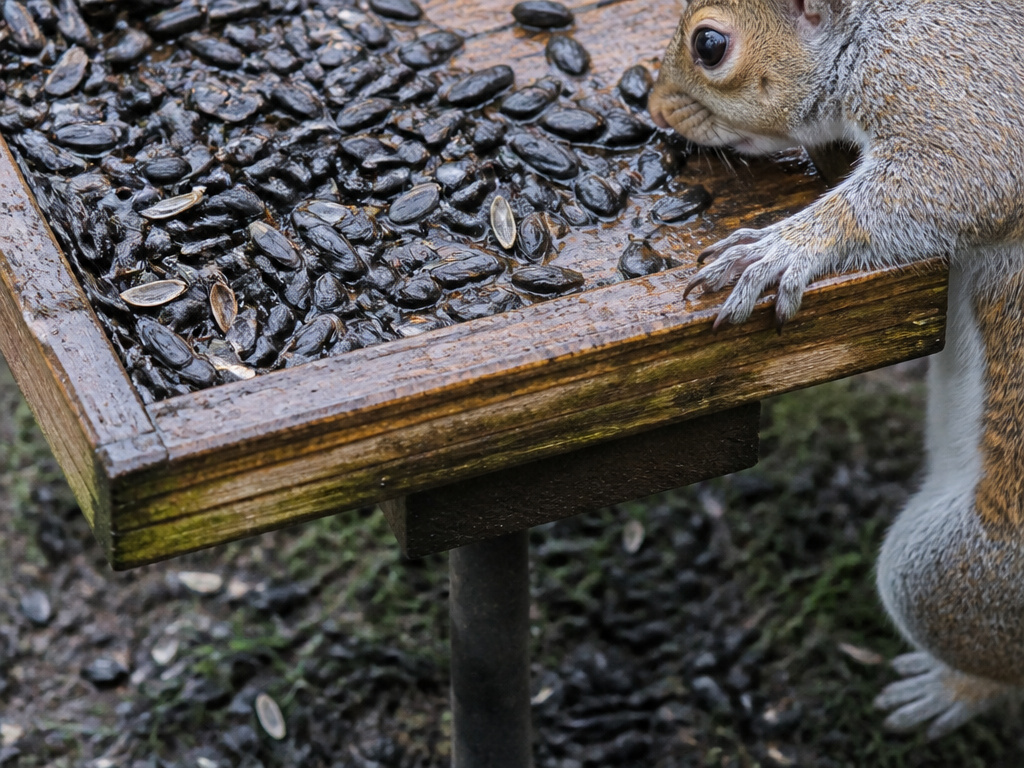
Every platform feeder box promises it “attracts a wide variety of birds.” That claim is accurate, and it’s also the problem.
Where this goes sideways: Mounting a platform at chest height on a bare pole. A squirrel climbs it in one jump, and the tray is empty before the birds settle.
The open design has no answer for weather, for mammals, or for birds that arrive in flocks. Rain soaks the seed. Squirrels take the rest. Starlings finish what’s left.
Then there’s the residue. Black oil sunflower hulls pile up under a platform in a dark, damp mat that smothers grass and holds moisture against the ground.
The pattern repeats often enough that it’s worth laying out plainly.
| Symptom | Likely cause | Fix |
|---|---|---|
| Seed clumped and warm | Wet seed, poor drainage | Switch to a mesh tray, empty after rain |
| Tray empty by mid-morning | Squirrels or starlings | Add a pole baffle, or change feeder type |
| Seed kicked to the ground | Wrong mix for the birds | Drop milo-heavy blends |
| Sour smell after rain | Solid tray holding water | Drill drainage or replace the tray |
| Birds land and leave | Hawk pressure or a dirty tray | Move the feeder, scrub the tray |
Why Does Wet Seed Turn a Tray Into a Health Hazard?
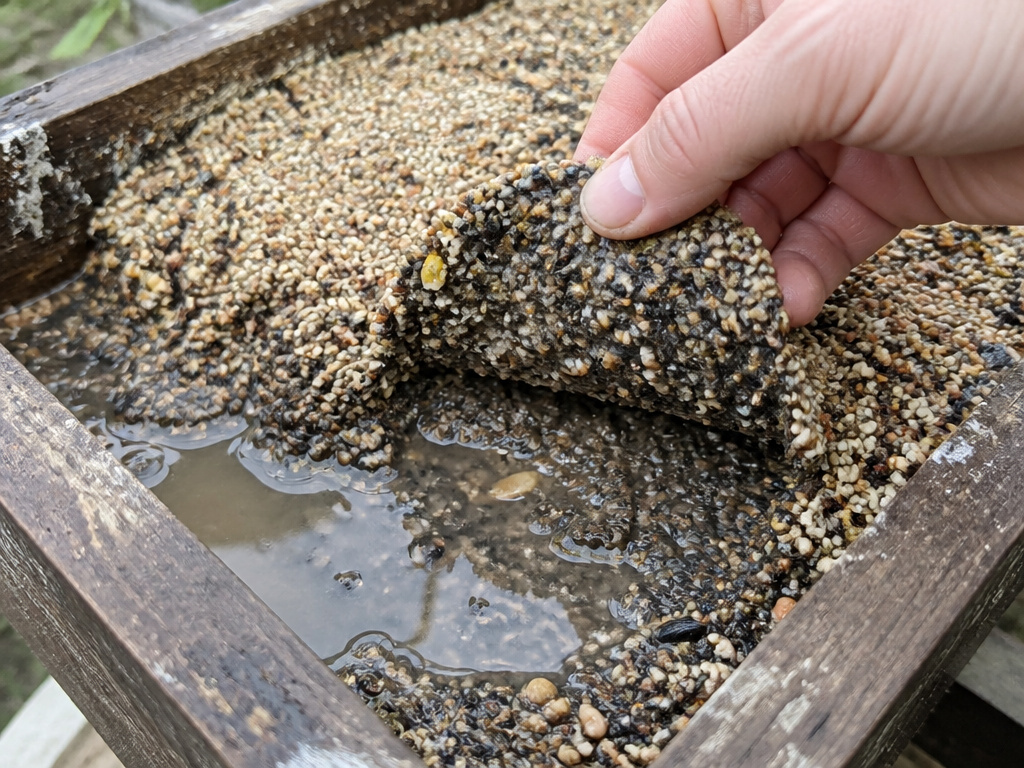
Picture a tray after three days of spring rain. The top layer looks dry because the wind dried it. Lift a handful and the seed underneath is warm, clumped, and stuck together in a mat.
That mat is where the trouble starts. Soured seed smells like wet cardboard and old beer, and it stays that way until somebody empties the tray.
The part nobody mentions: A solid tray with no drainage holes holds water after rain. Seed sitting in standing water sours overnight.
Birds also defecate on the tray while they feed. Combine droppings with damp seed and you get a surface that passes illness between every bird that lands on it.
That’s the mechanism, and it’s why cleaning frequency matters more than tray quality.
I’d rather see a cheap mesh tray on a baffled pole than an expensive platform with a plastic roof. The roof keeps rain off the top layer and traps damp air underneath, and the tray still needs scrubbing every week.
The wild bird feeders that stay cleanest are the ones somebody scrubs weekly, not the ones that cost the most.
Platform Feeder vs Tube Feeder: Which One Earns the Pole?
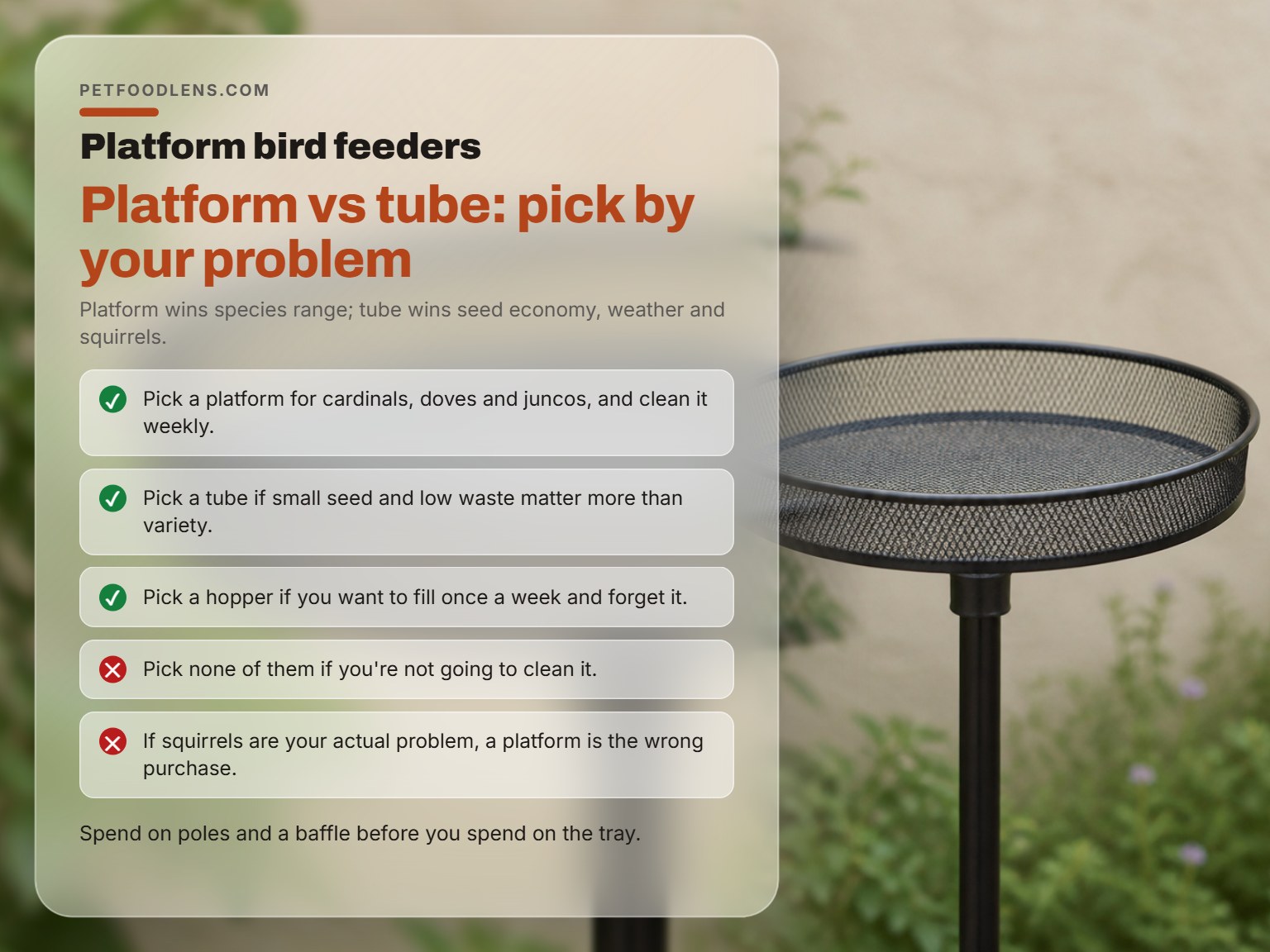
If squirrels are your actual problem, a platform is the wrong purchase.
That’s the blunt version, and it’s worth saying before any comparison.
The tube feeder vs hopper feeder argument gets most of the attention, but the platform question is simpler. A platform wins on species range. A tube wins on seed economy, weather resistance, and squirrel control.
- Pick a platform if you want cardinals, doves, and juncos, and you’ll clean it weekly.
- Pick a tube if small seed and low waste matter more than species variety.
- Pick a hopper if you want to fill once a week and forget it.
- Pick none of them if you’re not going to clean it.
For a plain tray, the Droll Yankees platform feeder is the one I’d start with. The mesh base drains and the whole tray lifts off for scrubbing.
If you want a roof for looks, Perky-Pet builds platform models that hold up, but understand the roof shades the seed and slows drying. Woodlink’s cedar trays handle sun better than molded plastic.
And if squirrels are the real issue, the Brome Squirrel Buster is the honest answer. It’s a tube rather than a tray, and the cage closes under a squirrel’s weight.
Spend on bird feeder poles and a baffle before you spend on the tray. The best bird feeders in the world still fail on a bare pole.
How to Run a Platform Feeder Without Constant Waste
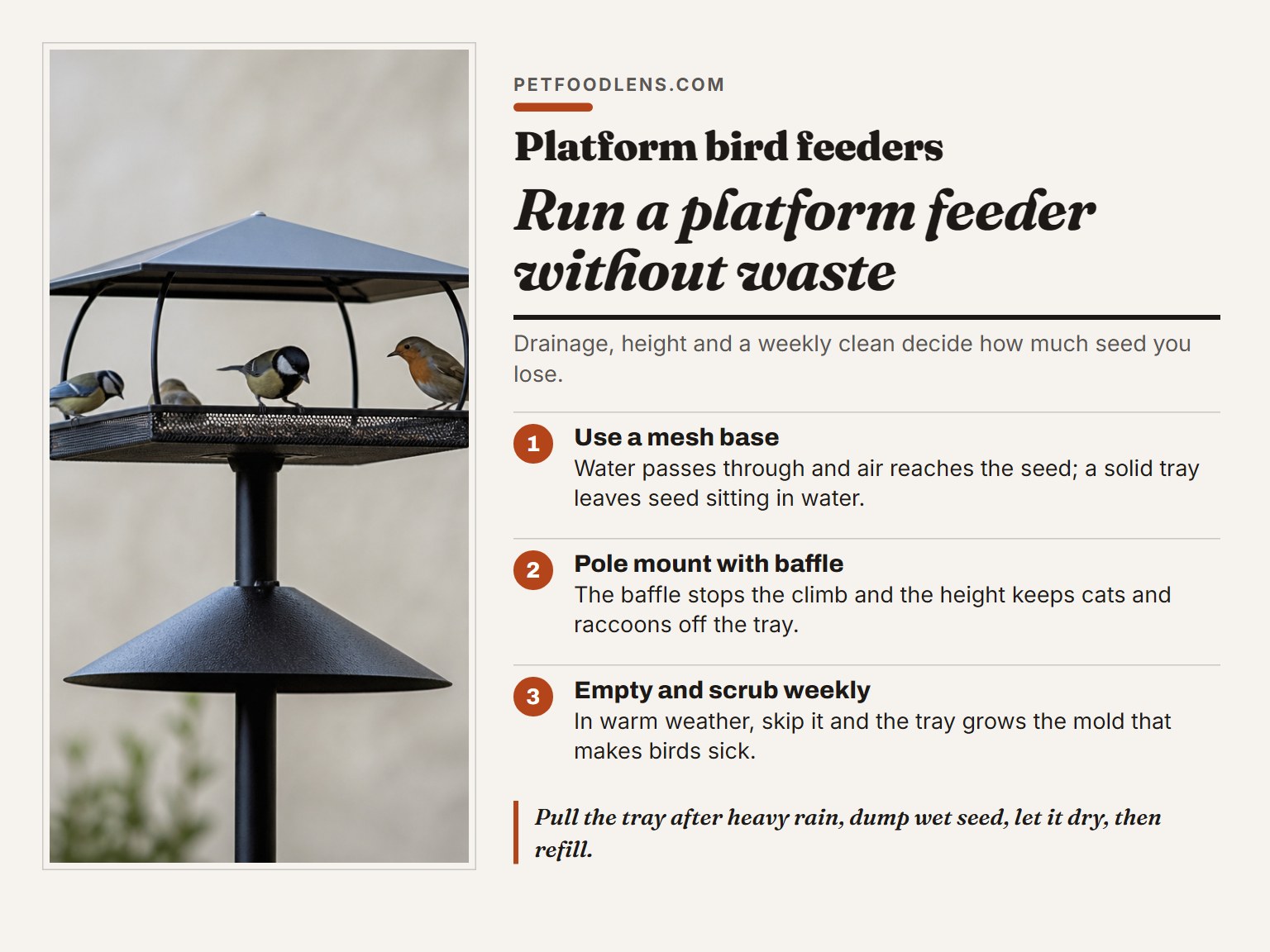
Three things decide whether a platform works: drainage, height, and cleaning schedule.
- Buy or build a mesh base. Water passes through and air reaches the seed. Skipping this means seed sits in water after every storm.
- Mount it on a pole with a baffle below. The baffle stops the climb, and the height keeps cats and raccoons off the tray.
- Fill only what gets eaten in a day or two. A half-full tray spoils slower than a heaped one, and the bottom layer stops turning to mush.
- Empty and scrub weekly in warm weather. Skip it and the tray grows the mold that makes birds sick.
- Pull the tray after heavy rain. Dump the wet seed, let the tray dry, then refill. Leaving it costs you the whole batch.
The Weekly Routine
Empty the tray into a bag, not onto the lawn. Scrub the mesh with a stiff brush and a dilute bleach solution, rinse hard, and let it dry fully before refilling.
Dry matters. A damp tray refilled immediately starts the same spoilage cycle over.
Winter Changes the Schedule
Cold slows spoilage and speeds up demand. Birds need calories in a cold snap, so a tray iced over is worse than an empty one.
Keep the mesh clear of ice and refill more often. The cleaning interval stretches in freezing weather, but the drainage check doesn’t.
Most of the how to choose a bird feeder decision happens before you fill anything. Height, baffle, and drainage decide more than the tray’s finish.
Frequently Asked Questions
Do platform feeders attract more birds than tube feeders?
They attract a wider range of species, not necessarily more individual birds. A platform pulls in cardinals, doves, juncos, and jays that can’t work a small tube port. A tube will pull more chickadees and finches per hour.
How often should I clean a platform feeder?
Weekly in warm weather, and after any heavy rain. An open tray collects droppings and damp seed faster than an enclosed feeder, and soured seed turns moldy within days. In freezing weather you can stretch the interval, but check drainage every time you fill.
Can a platform feeder stay out in the rain?
The feeder can, but the seed shouldn’t. A mesh base sheds water and dries quickly. A solid tray holds water, and seed sitting in it sours overnight. Empty the tray after a storm rather than topping it off.
What seed works best on a platform feeder?
Black oil sunflower and striped sunflower do the most work, with millet and cracked corn for ground feeders. Skip blends where milo and wheat make up most of the weight. The birds you want will rake that onto the ground.
Are platform feeders bad for birds?
They aren’t inherently harmful. The risk comes from dirty trays, where droppings and damp seed spread illness between birds. Frequent cleaning and a mesh base remove most of that risk.
The Bottom Line
Here’s the threshold that decides it: if you won’t commit to emptying and scrubbing a tray once a week during warm months, buy a tube feeder instead. A platform left to sit is worse for the birds than no feeder at all.
If you will commit, the open tray earns its place. Nothing else feeds a cardinal, a mourning dove, and a junco off the same surface.
Your first step this week is not the tray. It’s the pole and the baffle. Get those right, then pick a mesh-based platform and a bag of black oil sunflower.
One concession worth stating plainly: none of this covers sick birds. If you see a bird looking lethargic or swollen around the eyes at your feeder, take the feeder down and call a wildlife rehabilitator. That part is past what a feeding setup can solve.
