
Tube Feeder vs Hopper Feeder: Which Should You Buy?
This post contains affiliate links. As an Amazon Associate, we earn from qualifying purchases.
Tube feeder vs hopper feeder: a tube’s small ports and short perches suit chickadees, finches, and titmice, while a hopper’s wide tray serves cardinals, jays, and doves. Capacity separates them too. The Brome Squirrel Buster Standard holds 1.3 lb across 4 ports, while the Woodlink Absolute II hopper holds up to 12 lb.
That 12 lb figure is where the tube feeder vs hopper feeder argument actually starts. Seed sitting in a hopper well past two weeks in humid weather is seed you tip into the bin at the next cleaning, and Plumelore’s own sizing rule lands at about two weeks of seed for your yard. Past that point, capacity stops being convenience.
What follows covers which birds each style physically serves, the capacity and refill math, the cleaning question the sources can’t agree on, and the disease findings that cut against both designs. By the end you’ll know which one to hang first.
Key Takeaways
- Match the feeder to the bird, not the bag. Tubes serve chickadees, titmice, and finches; hoppers add cardinals, jays, and doves.
- Size capacity to about two weeks of seed, per Plumelore. Anything beyond that is seed you’ll throw out on cleaning day.
- A typical hopper doesn’t resist squirrels on its own. Cornell Lab says a typical hopper needs an added weight-activated perch or locking roof.
- Clean every week or two with warm water and dish soap, then let it dry completely, per Project FeederWatch.
- Disease risk runs both directions. CDC named platform-style feeders in a 2023 salmonellosis outbreak; NYSDEC and the PA Game Commission flag tube ports for conjunctivitis.
Which Birds Actually Use Each Feeder?
Chickadees, titmice, house finches, goldfinches, and pine siskins are the tube crowd. They can grip a narrow dowel and work a small port without bracing against anything. Cardinals and jays can’t do that comfortably, and doves usually give up.
A tube feeder is a vertical cylinder with feeding ports and short perches set along its length. A hopper feeder is an enclosed reservoir with walls and a roof that releases seed into a tray by gravity as birds empty it. Port size and perch width decide which species can feed.
Hoppers add bigger birds like cardinals, jays, and doves. Barnroot puts the gap at 2 to 4 more species in the same location, though that number is the site’s own and no controlled count backs it. Treat it as a direction, not a measurement.
Port sizing matters more than most buyers realize. Cornell Lab’s guidance is that nyjer needs very small ports because a standard tube’s openings are too large and waste the seed. The Aspects 428 Quick Clean uses ten narrow ports sized specifically for nyjer rather than the wider openings on a general-purpose tube.
If you’re still mapping species to feeder shapes, the types of bird feeders covers other feeder designs.
Capacity, Refill Interval, and Where the Numbers Disagree
The Brome Squirrel Buster Standard carries 1.3 lb of seed across 4 ports in a 5 by 5 by 13.25 inch body. The Woodlink Absolute II hopper holds up to 12 lb, and the Woodlink Absolute Squirrel Resistant tops out at 15 lb. That is a wide spread in what you carry to the yard.
| Model | Style | Capacity | Note |
|---|---|---|---|
| Brome Squirrel Buster Standard | Tube | 1.3 lb | 4 ports; weight-activated shroud |
| Moraine cedar hopper | Hopper | 4 lb | 11 x 9.5 x 9.75 in |
| Duncraft 4-Sided Free-Flowing | Hopper | 7 lb | Tray on 4 sides |
| Woodlink Absolute II | Hopper | Up to 12 lb | Adjustable exclusion |
| Woodlink Absolute Squirrel Resistant | Hopper | Up to 15 lb | Single-sided |
Here is where the sources split, and you should see both positions rather than one. Barnroot’s reading is that a tube holds 1 to 2 lb eaten in 3 to 5 days, while a hopper’s 5 to 10 lb may sit for 1 to 2 weeks, so the bigger hopper becomes a liability in humid climates. Plumelore’s reading is the opposite: a hopper holds more, so you refill less, and that is a real advantage if the feeder is hard to reach or you travel.
Both are describing the same trade-off from different ends. Plumelore’s own large-feeder guidance resolves it: size to about two weeks of seed for your yard, and past that the extra capacity mostly holds seed you’ll throw out.
Why the Two-Week Rule Beats the Biggest Tank
Project FeederWatch advises cleaning feeders every week or two. A feeder still holding seed on cleaning day gets emptied anyway, so the capacity you paid for never reaches a bird.
Weight is the part nobody checks. Plumelore notes that 18 lb of seed plus a steel cage exceeds many clamp-on hooks, and the heaviest feeders belong on a sunk pole. Weigh your filled feeder before you trust a deck hook. If you’re hanging rather than pole-mounting, the hanging bird feeders covers hanging options.
Where this goes sideways: Topping off a hopper without emptying it. Rain blows in under the roof, old seed at the bottom cakes into a block that stops the flow, and by the third refill the tray stops filling and birds quit visiting.
The Cleaning Question Has No Clean Answer
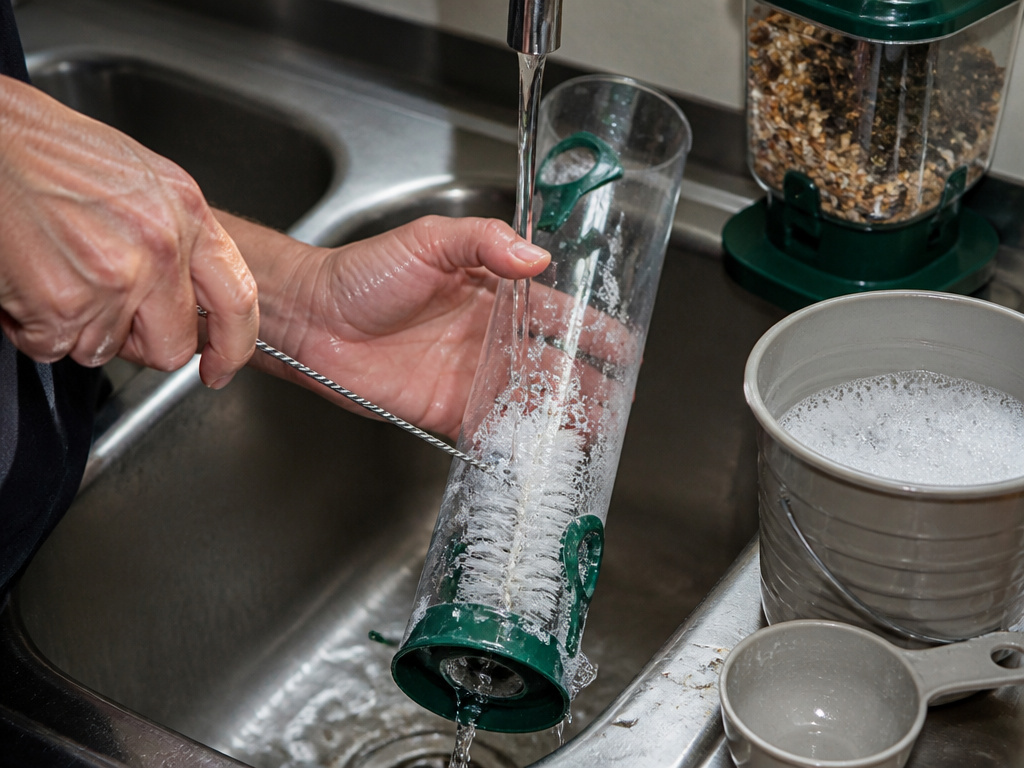
Cornell Lab and Mississippi State Extension both document hoppers as harder to clean than a tray or platform feeder, because of the enclosed construction. Winged Garden states plainly that it found no source comparing hopper cleaning difficulty directly to tube feeders.
So the honest version is this. Hoppers have more surfaces, more corners, and more crevices. Plumelore says tubes are easier to clean thanks to their simple shape, though Winged Garden found no source comparing hopper cleaning difficulty directly to tube feeders. Barnroot puts a number on it at 3 to 5 minutes for a hopper against 1 minute for a tube, but that figure is single-source and unverified.
What every source agrees on is the schedule. FeederWatch recommends washing seed feeders every week or two with warm water and dish soap, then letting them dry completely. Smarternewsnow says the same and adds that wet weather or heavy bird traffic should shorten the interval.
A basic cleaning kit is short:
- A long brush. The Droll Yankees Feeder Brush runs 24 inches and reaches the bottom of a tall tube.
- Warm water and dish soap, per FeederWatch.
- A 1:9 bleach-to-water soak for 10 minutes as the optional disinfecting step, rinsed before drying.
- A scoop. A 4-cup scoop holds up to four cups.
Barnroot puts hopper cleaning at 3 to 5 minutes versus 1 minute for a tube, though that figure is single-source and unverified. Plumelore says the hopper wins on how often you have to do it because it holds more, while Barnroot argues a hopper’s larger capacity can become a liability in humid climates.
Squirrel Resistance Lives in the Mechanism
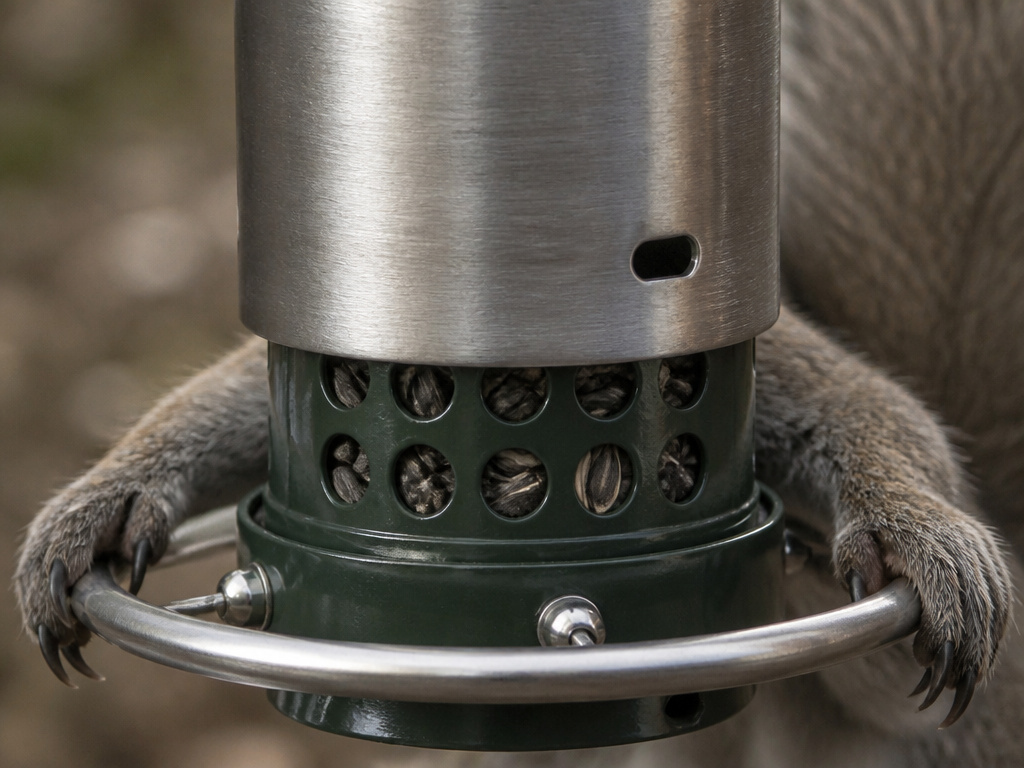
Cornell Lab’s guidance is blunt: a typical hopper design doesn’t keep squirrels out on its own. Resistance comes from an added weight-activated perch, a locking roof, or both, applied to whichever housing you picked.
Project FeederWatch goes further and cautions that squirrels often defeat feeders marketed as squirrel-proof. Barnroot calls the whole contest a tie and notes tubes are only slightly harder for squirrels to access when hanging freely, because the narrow cylinder offers less purchase.
That reframes the purchase. You are not buying a tube or a hopper for squirrel resistance. You are buying the mechanism.
The Brome Squirrel Buster Standard is the clearest example of a tube built around one: a weight-activated shroud that closes the ports under a squirrel’s weight, metal perches that resist chewing, and a ventilated seed chamber. Brome’s Squirrel Buster Plus is listed at 5.1 lb with 6 ports and an adjustable weight-sensitive shroud. On the hopper side, the Woodlink Absolute II holds up to 12 lb and the Woodlink Absolute Squirrel Resistant holds up to 15 lb.
If squirrel pressure is your main problem rather than species mix, start with the wild bird feeders roundup.
Common mistake: Buying a big hopper to solve a squirrel problem. Size and weight don’t exclude anything; Cornell Lab is explicit that a typical hopper needs an added perch or roof mechanism before it resists at all.
Wet Seed, Fresh Seed, and the 48-Hour Number
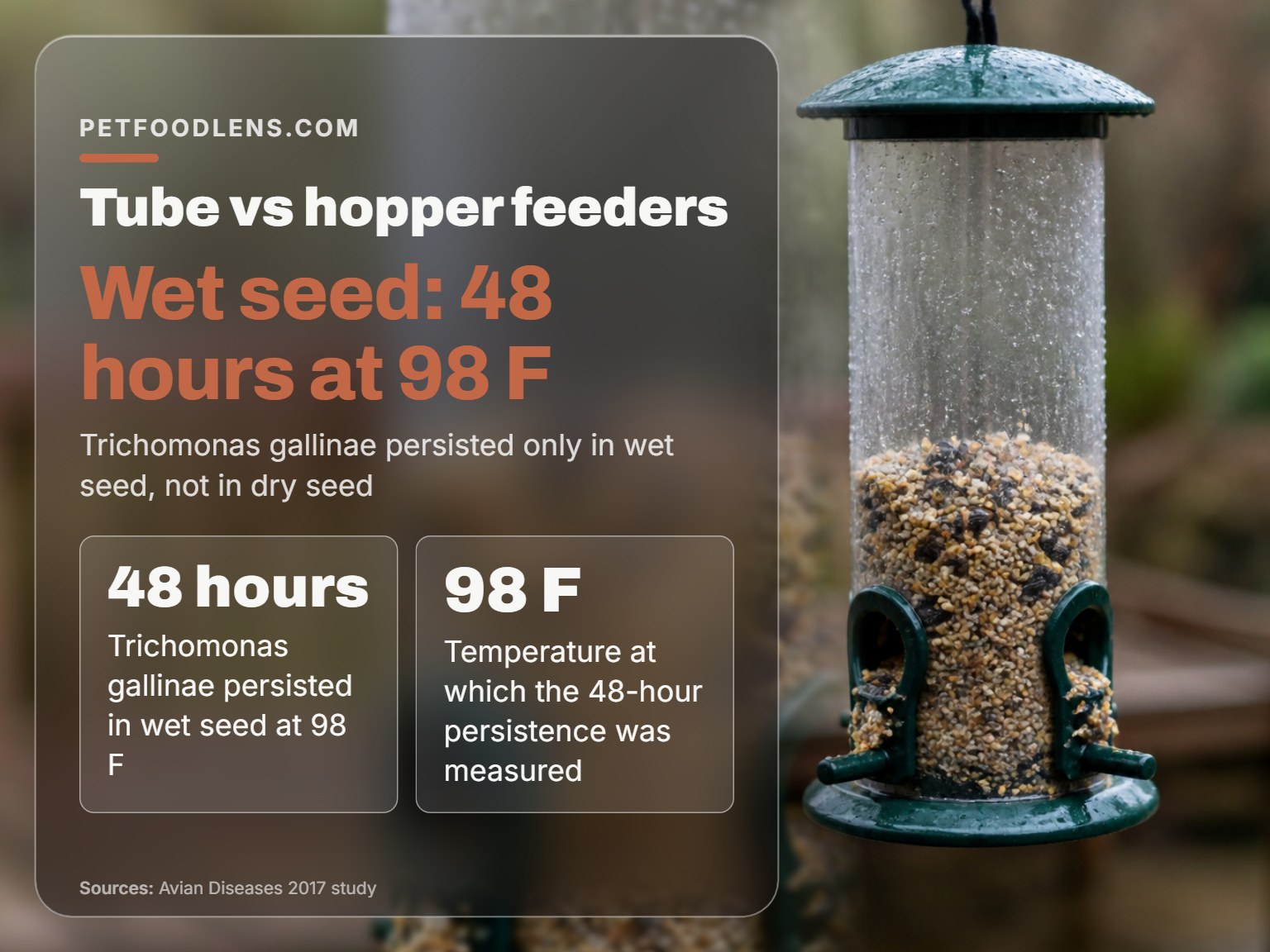
A 2017 study in Avian Diseases, summarized by Project FeederWatch, found Trichomonas gallinae persisted only in wet seed, for up to 48 hours at 98 F, and not at all in dry seed. That is the strongest number in this whole comparison, and it points at moisture rather than at feeder style.
Cornell Lab’s related guidance is to empty old seed before refilling a tube, because seed left in the tube isn’t simply topped up. Barnroot’s version is to fill smaller amounts in wet weather, enough for one or two days.
What Spoiled Seed Looks and Smells Like
Spoiled seed looks dark, clumped, or caked, and may show white, green, or black fuzz. It often smells musty or sour. In a tube you’ll see a wet plug of seed at the bottom ports that birds avoid entirely, and that plug is the tell before any mold is visible.
On shelter, Barnroot’s comparison puts hoppers with wide roofs and tubes under a dome as the driest setups, with open platform trays wettest unless they have a mesh bottom and a cover. Plumelore advises choosing a big feeder with a roof or dome and emptying any clumped or damp seed at cleaning.
Skip the dome and you risk dumping clumped seed after wet weather. If you feed sunflower, the sunflower seed feeders covers feeder options.
Disease Risk Cuts Both Ways
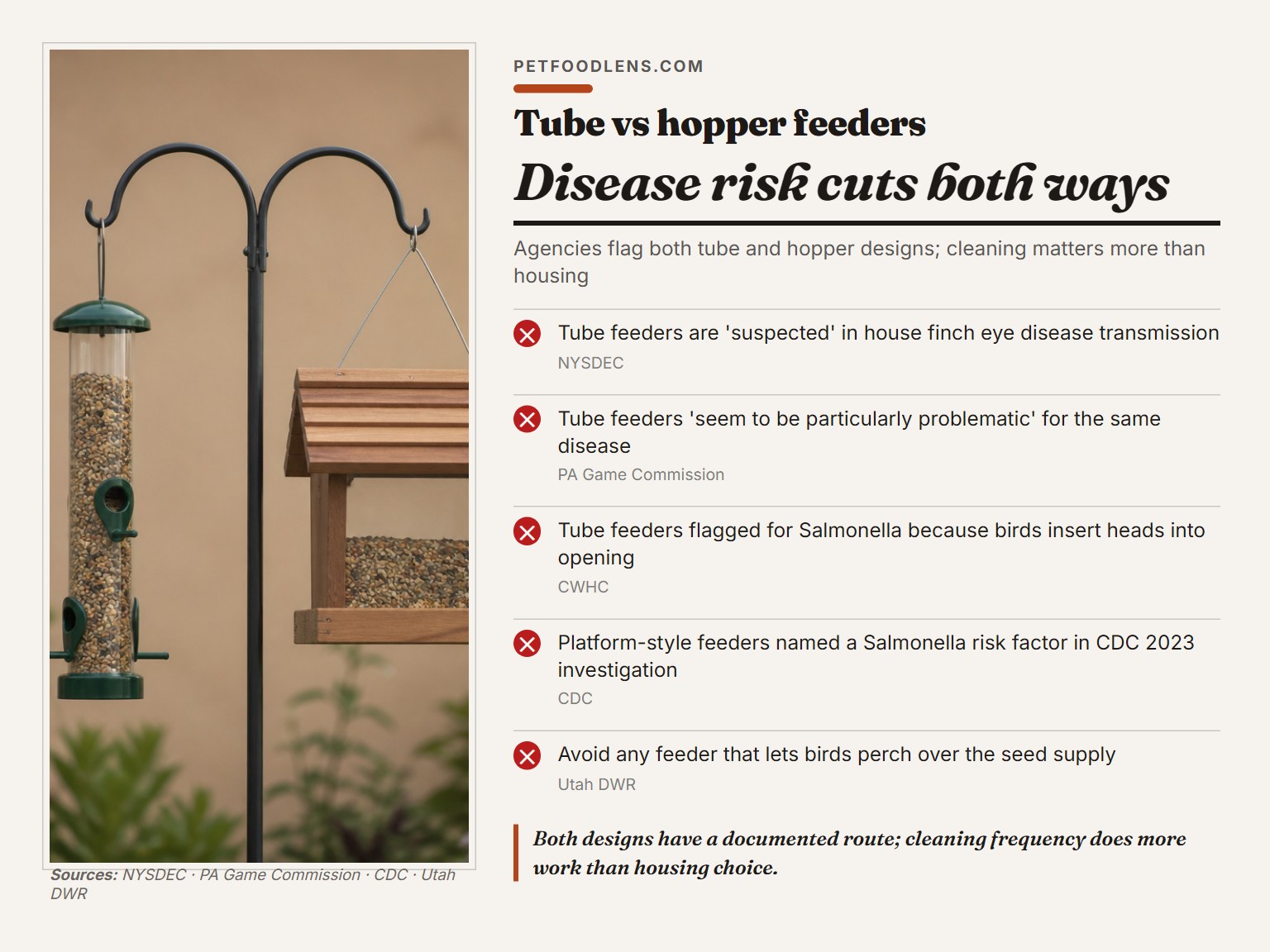
CDC’s 2023 multistate songbird salmonellosis investigation identified platform-style feeders as a specific risk factor, because birds perch directly over the seed supply and droppings contaminate shared food. Utah DWR’s advice follows from that: avoid any feeder that lets birds perch over the seed.
Tube feeders are not the safe alternative. NYSDEC calls tube feeders “suspected” in the transmission of mycoplasmal conjunctivitis, or house finch eye disease. The PA Game Commission says tube feeders “seem to be particularly problematic” for the same disease. The Canadian Wildlife Health Cooperative flags tube feeders for Salmonella because birds insert their heads into the opening.
So the clean story of “tube safe, hopper risky” doesn’t survive contact with the agencies. Both designs have a documented route, and cleaning frequency does more work than housing choice.
Where Wooden Hoppers Fit
FeederWatch says not to use feeders that cannot be thoroughly washed, and names wooden feeders as the example. Plumelore nonetheless publishes guidance for keeping one: a metal mesh floor that drains, no finish on the tray, perches, or hopper interior, no pressure-treated lumber, and replacement once the floor wood dents under a thumbnail or dark staining survives a scrub.
Tube Feeder vs Hopper Feeder: So Which Do You Buy?
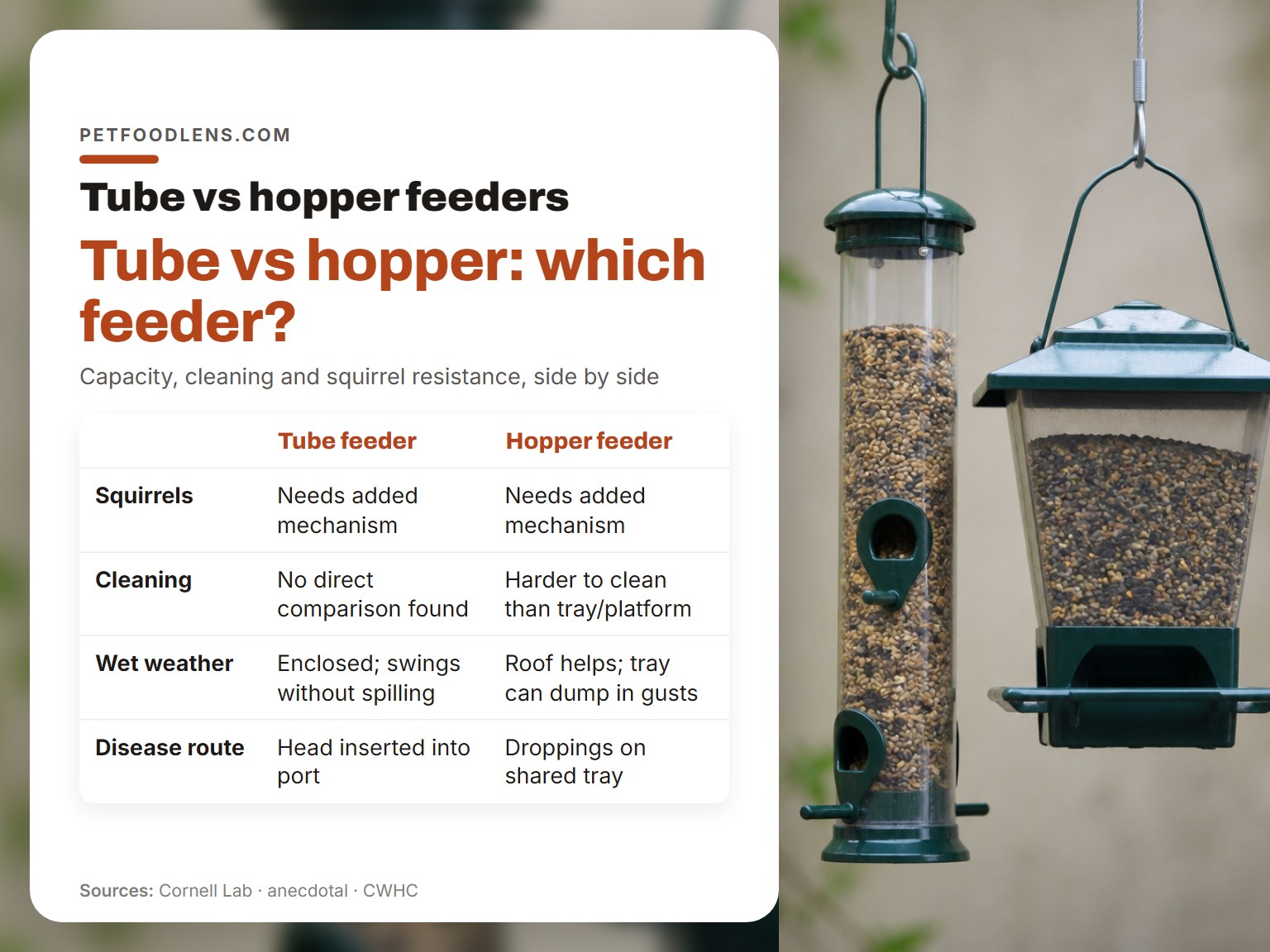
Here is the head-to-head, compressed.
| Factor | Tube | Hopper |
|---|---|---|
| Species served | Chickadees, finches, titmice | Adds cardinals, jays, doves |
| Typical capacity | 1 to 2 lb | 5 to 12 lb |
| Cleaning | Simple shape, fewer corners | Enclosed, more surfaces |
| Squirrels | Needs an added mechanism | Needs an added mechanism |
| Wet weather | Enclosed; swings without spilling | Roof helps; tray can dump in gusts |
| Disease route | Head inserted into port | Droppings on shared tray |
For most yards starting from nothing, buy the tube. It holds less, which keeps seed fresher, and Plumelore says it is easier to clean thanks to its simple shape. The Brome Squirrel Buster Standard is the one I’d point at first if squirrels are already a problem, because the shroud mechanism is doing real work rather than the housing.
Add a hopper when cardinals are the goal. Barnroot’s setup is a hopper with safflower for cardinals and a tube with sunflower for everything else, placed 8 to 10 feet apart. Two feeders, two seeds, no competition between them.
Three steps to settle it:
- Count what’s on your feeder now. If cardinals and jays are already landing, you need tray width, and a tube will lose them.
- Time how long your current feeder takes to empty. Divide capacity by days. That gives you pounds per day, and two weeks of that number is your target capacity.
- Check your hanger rating against the filled weight before you buy a larger feeder.
If you want the wider shortlist, the best bird feeders and the how to choose a bird feeder cover both styles.
Buy the feeder your birds can physically use, then add the mechanism that solves your second-biggest problem. A bigger box has never once stopped a squirrel.
Frequently Asked Questions
Is a tube feeder or a hopper feeder better for cardinals?
Hopper. Cardinals are heavy enough that a standard tube’s narrow dowel perch is uncomfortable, and they often brace awkwardly against the tube body instead of feeding cleanly. A hopper’s wide tray lets them stand and turn. If you already run a tube you like, adding a hopper 8 to 10 feet away covers both crowds.
Do hopper feeders really keep squirrels out?
Not on their own. Cornell Lab’s guidance is that a typical hopper design doesn’t exclude squirrels without an added weight-activated perch, a locking roof, or both. Project FeederWatch adds that squirrels frequently defeat feeders sold as squirrel-proof. Check for the mechanism, not the marketing line.
How often should I clean a tube feeder versus a hopper?
Project FeederWatch advises every week or two for seed feeders generally, with warm water and dish soap and full drying afterward. Hoppers have more enclosed surfaces, so the job takes longer when you do it. Shorten the interval in wet weather or when bird traffic is heavy.
Can I put nyjer seed in a regular tube feeder?
Not well. Cornell Lab’s guidance is that nyjer needs very small ports because standard tube openings are too large and waste the seed. A dedicated finch tube like the Aspects 428 Quick Clean, with its ten narrow ports, is built for it. Hoppers and platforms handle mixed seed and larger items more easily.
How much seed should I put in a hopper at once?
About two weeks of what your yard actually eats, per Plumelore’s sizing rule. Barnroot is stricter in wet weather and suggests only a few days’ worth, because rain blows in under the roof and seed at the bottom of the bin cakes before it gets eaten. Measure your consumption rate first rather than guessing.
The Bottom Line
One trigger worth writing down: if your current feeder takes more than about two weeks to empty, you’re overbought and you should size down. That single measurement settles more of this decision than any species chart.
The concession is real, though. If you’re in an area with an active salmonellosis or conjunctivitis outbreak, the housing argument stops mattering and the cleaning schedule becomes the whole job. Take the feeder down, scrub it, dry it completely, and don’t put it back until local wildlife guidance says feeding is advised again.
Everything above assumes a healthy station with a cleaning routine you’ll actually keep. Get that part right and either style will work. Get it wrong and the fanciest hopper on the market is just a bigger place to grow mold.
