
How to Choose a Bird Food Format: Pellets vs Seed
This post contains affiliate links. As an Amazon Associate, we earn from qualifying purchases.
To choose a bird food format, start with a formulated pellet as the base and treat seed as a limited extra, not the foundation. A Journal of Nutrition trial across eight psittacine species reported 90% fledging on an extruded diet versus 66% on seed. Seed mixes run 18-69% hull by weight, and decorticated seed is short on 13 nutrients.
Pellet is a category, not a guarantee. The same review that favored extruded diets warned that commercial formulated diets are not of equal merit, and that is where the real decision gets made. Knowing how to choose a bird food format matters because not all formulated diets are equal.
What follows covers the four formats on a shelf, the two label numbers that separate them, and the one place where two University of Florida publications flatly contradict each other.
Key Takeaways
- Pellet first, seed second. A formulated pellet gives a base the bird cannot pick apart; seed goes on top as a small extra.
- Check the hull fraction. Between 18 and 69 percent of a seed mix is shell, and that weight never reaches the bird.
- Reject red or pink seed on sight. The dye marks capstan-treated planting seed, which is extremely toxic to birds.
- PetMD’s method finishes in about 30 days. The blended method has no fixed endpoint, and rushing either one costs weight.
- Match format to bill size. Striped sunflower stops small birds; black-oil does not.
The Format Question Comes Before the Brand Question
Format decides what a bird can physically open and swallow, which is why how to choose a bird food format comes first. Brand decides what is inside the shell once it does.
Seed hulls and shells account for 18 to 69 percent of the weight of typical commercial psittacine mixes, and birds discard them before swallowing. Decorticated seeds are commonly deficient in lysine, calcium, available phosphorus, sodium, manganese, zinc, iron, iodine, selenium, and vitamins A, D, E, K, riboflavin, and choline.
That one fact reframes the whole shelf and the how to choose a bird food format question. A large share of the bag by weight is packaging the bird takes off and drops on the cage floor.
The types of bird food that actually matter fall into four groups: formulated pellets, seed mixes, fresh and cooked foods, and soft extras. Each one solves a different problem, and none of them solves every problem.
Pellets solve the picking problem. PetMD’s veterinary review points out that a formulated pellet stops a bird from pulling out the bits it likes and leaving the rest behind. That is the entire reason the format exists.
For a base diet, Harrison’s and Lafeber both make a complete formulated pellet, and Chewy’s vet-reviewed guide names those two directly. Roudybush, ZuPreem and Kaytee round out the major brands in PetMD’s list. Pick the one your bird will actually eat, then confirm the formula is built for the species.
Brand still matters. It just matters second.
What Share of a Seed Mix Is Actually Edible?
Between 18 and 69 percent of a typical commercial psittacine mix is hull and shell, by weight, and none of it gets swallowed.
Run that through your head the next time you lift a bag. Somewhere between a fifth and two thirds of what you carry home is material the bird removes and discards. The Journal of Nutrition review that measured this also found that what remains is short on more than a dozen nutrients, including lysine, calcium, available phosphorus, and vitamins A, D, E and K.
That is the mechanical reason seed alone struggles as a base diet. It is a shell problem plus a formulation problem, with no moral failing on the part of seed.
Here is what a filler-heavy mix looks like in practice:
- Hulls piled under the cage within an hour of feeding. That pile is the part you paid for and the bird refused.
- Sunflower and safflower dominating the top of the bag. Those are the high-fat seeds birds pick first, and they are cheap to include.
- Pellets mixed into the seed that sit in the bowl for days. Ullrey and colleagues found that blending pellets into a mix is usually defeated by the birds rejecting the pellets and eating the favored items instead.
- Dust and broken kernel fragments at the bottom of the bag.
That last point is where a common retail suggestion falls apart. Chewy’s vet-reviewed guide recommends a 50/50 blend of current food and pellets as a transition starting point. The peer-reviewed review reaches a blunter conclusion: fortifying a seed mix with pellets tends to fail, because the bird eats around them. Both positions are worth knowing. One describes a transition tool, the other describes a permanent feeding strategy, and they are not the same thing.
Pellets vs Seed Mix: Which Base Diet Wins?
For a pet psittacine, the formulated pellet wins as the base diet, and the margin in the controlled data is wide.
The Journal of Nutrition trial ran across eight psittacine species. Fledging percentage reached 90% on an extruded diet plus fruits and vegetables, against 66% over the prior two years on seeds plus fruits and vegetables. That is a one-year controlled comparison, not a marketing claim.
| Format | Best for | Main risk | Role in the bowl |
|---|---|---|---|
| Formulated pellet | Base diet for most pet birds | Wrong formula or wrong diameter | Most of the daily intake |
| Seed mix | Training, foraging, enrichment | High fat and selective eating | Up to 10% of the diet |
| Fresh vegetables | Added nutrition and enrichment | Spoils fast, uneven intake | A small daily portion |
| Suet or soft extras | Cool-weather feeding | Rancidity and greasy feathers | Seasonal, never a base |
Seed does not disappear from the plan. Chewy’s guide puts it at up to 10% of the total diet, mostly because seeds run high in fat. Used that way, seed earns its place as a training reward and a foraging item rather than a staple.
Seed is a treat with a job. Ten percent of the bowl, spent on training and foraging, does more for a bird than a full bowl it can pick through.
Where Pellets Differ From Each Other
Pellet is not a uniform category, and the review says so directly: not all commercial formulated diets are of equal merit.
The University of Florida’s UF/IFAS pet bird nutrition guide adds a second wrinkle. Nutrient needs shift with age, health and breeding status, so no single complete pellet covers every bird in every condition. A maintenance formula for a resting adult is a different product from a breeding formula.
That is the practical case for reading the pellets versus seed mix comparison before you commit to a brand. The format decision comes first. The formula decision comes second.
The Front Panel Is Advertising. Read the Guaranteed Analysis.
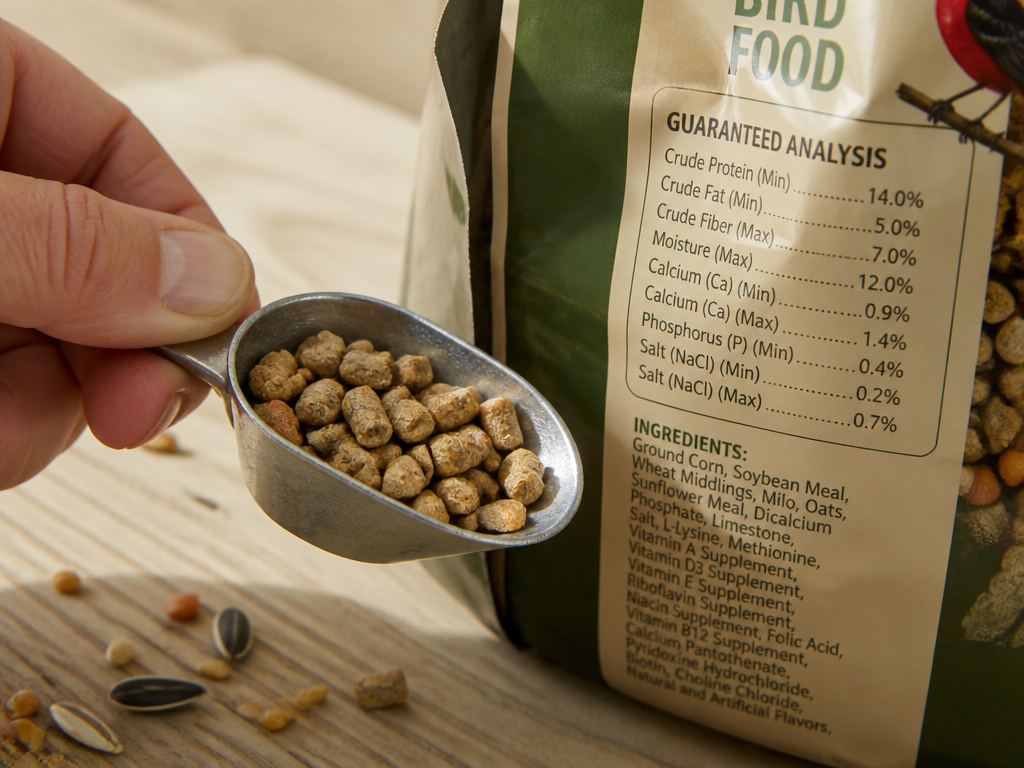
The guaranteed analysis is the one part of the bag a manufacturer cannot phrase its way around.
Everything above it is design. Below it are numbers, and numbers compare across formats in a way that slogans never will. This is where reading bird food labels stops being homework and starts being the whole skill.
The line that trips people up first is moisture. A high moisture figure is water, and it changes the denominator for everything else on the panel.
The arithmetic is the same one I run on canned cat food, where the pates I check are mostly water. Subtract the moisture from 100 to get dry matter, then divide the protein figure by that dry matter number. Now a wet product and a dry product sit on the same footing.
Bird pellets run far drier than a canned food, so the correction is small. Seed is drier still. Run the conversion anyway, because it is the only way to compare a pellet, a seed mix and a soft food without guessing.
Four lines carry most of the weight:
- Moisture, because it sets the denominator.
- Crude protein and crude fat on a dry matter basis, never straight off the panel.
- The species and size statement, since a macaw pellet is the wrong diameter for a budgie.
- The first three ingredients, read in order, the way you would read a recipe card.
The part nobody mentions: A pellet with the right nutrient profile in the wrong diameter gets flicked across the room. Size is a format decision, and birds refuse food they cannot comfortably hold.
Once the bag is open, the format also dictates how it keeps. Storing bird food properly matters more for a soft or fresh format than for a sealed pellet, and a rancid fat smells sharp and slightly paint-like before it ever looks wrong.
Why Pet Bird and Wild Bird Advice Contradict Each Other
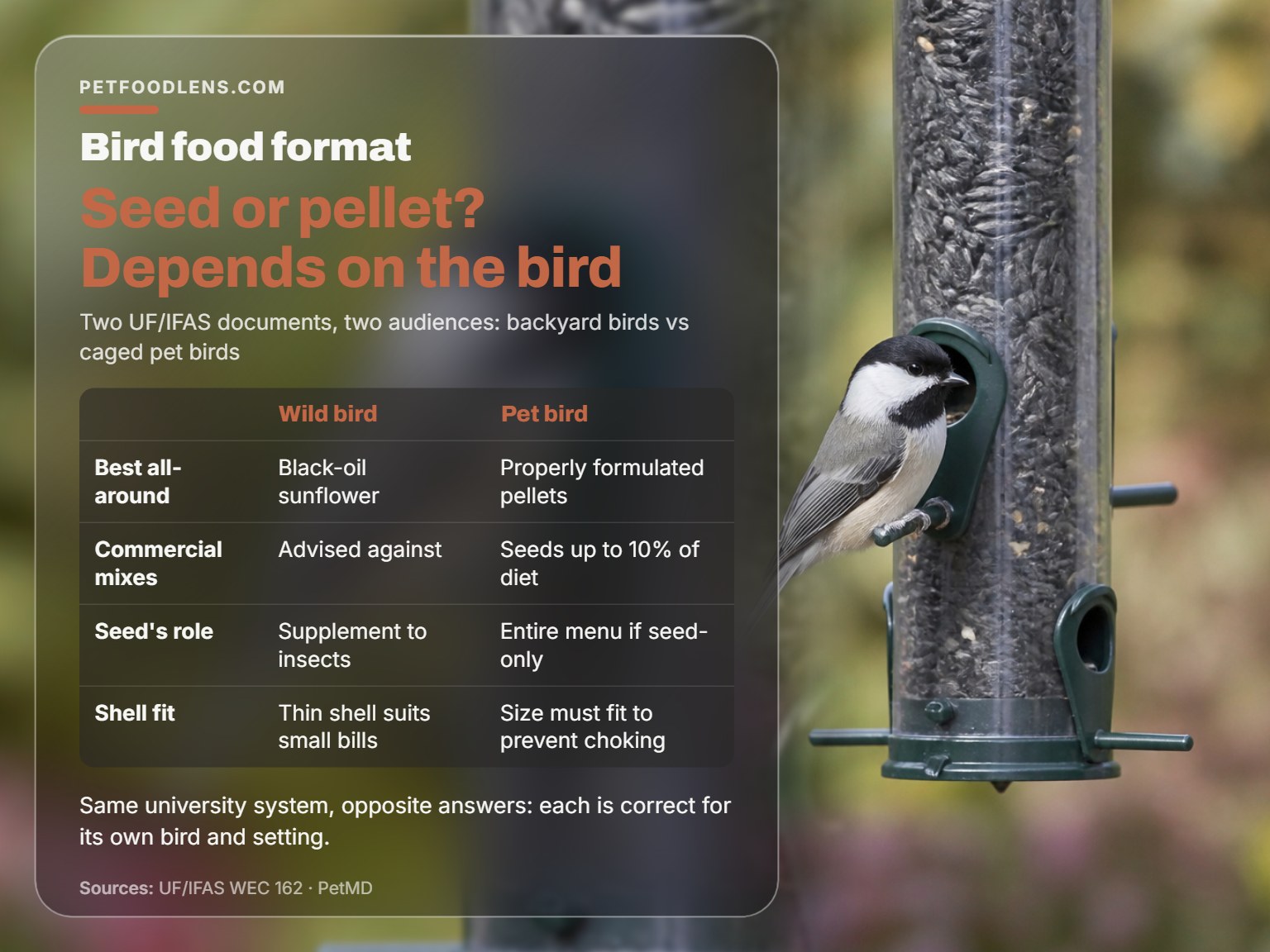
Two publications from the same university system give opposite answers about the single best food, and both are correct in their own context.
UF/IFAS WEC 162, a backyard bird document, names black-oil sunflower as the best all-around attractant and advises against commercial mixes. UF/IFAS VM067, a pet bird document, calls properly formulated pellets the best long-run choice. Read them side by side without checking the audience and you would think the science had collapsed.
It has not. One is feeding wild birds that forage across acres and eat insects most of the year. The other is feeding a bird in a cage that eats what you put in the bowl and nothing else. PetMD makes the same distinction: wild bird seed supplies calories mostly as fat, topping up a diet that is largely insects and other protein.
That is also why the format advice splits. For a wild bird, a seed is a supplement. For a caged psittacine, a seed mix is the entire menu, which is a completely different nutritional job.
Bill size decides the rest. WEC 162 notes that striped sunflower’s thicker shell is hard for small birds to open, while black-oil’s thin shell suits them. Match the format to the bird in front of you.
The bird feeder types you hang matter here too. WEC 162 points out that metal perches and feeding ports on tube feeders survive squirrels better than plastic ones, which is a durability spec rather than a preference.
The Red-and-Pink Rule
Any seed coated red or pink goes in the bin. WEC 162 states that seed treated with the fungicide capstan is dyed red or pink as a warning, and that capstan is extremely toxic to birds.
Where this goes sideways: Planting seed diverted into a bird feeder still carries the capstan treatment. A dyed bag is not a bargain and not a mixed batch. It is a hazard, and the dye exists precisely so you can spot it before the bird does.
Suet and the 90-Degree Line
Rendered suet holds its shape up to about 90°F (32°C), according to the Cornell Lab bird feeder advice. Above that it softens enough to muss feathers and can smear a greasy layer onto the eggs of an incubating bird.
Raw suet is a different problem. It turns rancid quickly at temperatures above freezing, which is why suet is mostly a cool-weather food.
Cornell also notes that heat-stable formulations exist, which sits awkwardly beside the 90°F withdrawal line. If you feed suet in a warm climate, treat the no-melt products as their own category and pull standard suet and peanut butter entirely once the temperature passes 32°C.
Gradual or Abrupt: What to Do When Sources Disagree
Day four. The pellet bowl is untouched, the bird is shouting at the cage door, and you are holding a bag you are no longer sure about.
This is exactly where the two most-cited transition methods split, and neither one is wrong.
Chewy’s vet-reviewed guide recommends starting with a 50/50 blend of the current food and the new pellets, then monitoring the bird’s weight through the change. PetMD’s Sandra C. Mitchell, DVM, describes a different method: remove all seeds and other food in the morning, leave only the new food available for the day, and repeat the cycle. In her experience the bird is fully transitioned within about 30 days.
The 50/50 Camp
The blended approach suits a nervous bird and a nervous owner. It keeps some familiar food in the bowl, which lowers the odds of a total refusal, and it makes weight monitoring the primary safety check. The tradeoff is that a bird can pick around the pellets for weeks and call it progress.
The Remove-Everything Camp
The all-at-once method works on the same logic as the pellet format itself: if the favored food is absent, the bird eventually eats what is. It is faster and cleaner, and it demands more attention, because a bird that refuses for several days loses weight quickly.
Before you start: Dyed red or pink seed carries the capstan hazard, so check the bag before it goes anywhere near the cage. A bird that stops eating during a switch can drop weight fast, and small species have very little margin. Weigh before you begin and check the breastbone daily, because a sharp keel shows up before the scale moves much.
Here is a sequence that borrows from both methods:
- Weigh the bird and write the number down. Without a baseline you cannot tell a hunger strike from a sulk.
- Pick one pellet, correctly sized. Two new foods at once makes a refusal impossible to diagnose.
- Offer pellets first thing in the morning, when appetite is highest, and leave them in the bowl through the day.
- Reduce seed gradually rather than eliminating it, unless you are following the all-at-once method under veterinary supervision.
- Hold the line for two weeks before changing brands. Switching pellets mid-transition resets the clock.
When the bird still will not commit, the problem is usually presentation rather than the food itself. Getting birds to eat pellets is mostly about timing, bowl position and pellet size, and a full diet transition plan is worth writing down before you start rather than improvising at day six.
| What you see | Likely cause | What to change |
|---|---|---|
| Pellets flicked onto the floor | Wrong pellet diameter | Drop one size, or crumble them |
| Bird eats seed only, ignores pellets | Selective eating | Offer pellets first thing in the morning |
| Weight dropping during a switch | The switch ran too fast | Slow down and weigh daily |
| Bowl untouched by day four | Food not recognized | Try a different pellet brand |
| Seed coated red or pink | Capstan-treated planting seed | Discard the whole bag |
Portions, Treats, and the Foot-Size Rule
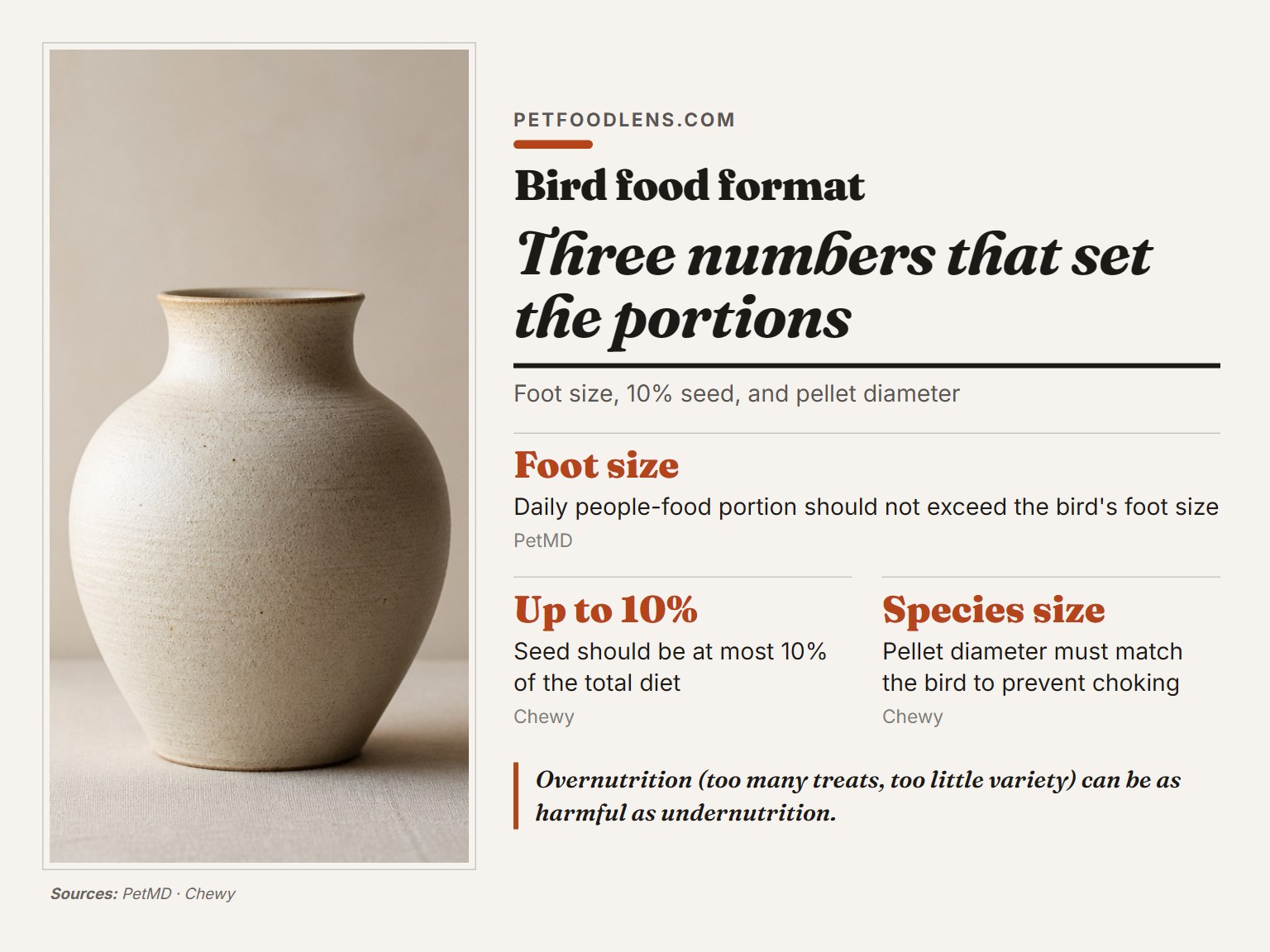
Three numbers run the rest of the plan: the size of the bird’s foot, ten percent, and the diameter of the pellet.
PetMD’s rule of thumb for supplementary people food is that a daily portion should not exceed the size of the bird’s foot, and it should cover protein, vegetable, fruit and a carbohydrate. That is a physical measure you can eyeball without a scale.
Chewy’s guide puts seed at up to 10% of the total diet, which is the number that keeps a seed mix in its proper role. Both sources agree on one more thing: food size has to match the bird, because the wrong size raises choking risk.
- Pellets form the base, sized to the species.
- Vegetables go in daily, in a portion you could cover with the bird’s foot.
- Seed and bird treats stay at or under that 10% line and do double duty as training rewards.
- Fruit and nuts are occasional, not daily.
If you want the proportions laid out properly rather than eyeballed, building a balanced bird diet covers the ratios, and daily food portions covers the measuring side. Both beat guessing at a scoop.
One honest limit: overnutrition is as real a problem as undernutrition. The UF/IFAS guide is blunt about it, noting that too many treats and too little variety cause just as much harm as a deficiency. More food is not the safer error.
Frequently Asked Questions
Is a pellet diet enough on its own?
No. Pellets give a complete base, but Chewy’s guide still recommends fresh vegetables plus small amounts of fruit, nuts, grains and seed for added nutrition and enrichment. The pellet carries the nutrition; the extras carry the variety and the foraging.
Can I just mix pellets into the seed and leave it?
You can, but expect the bird to eat around them. The Journal of Nutrition review found that fortifying a seed mix with pellets is usually defeated by pellet rejection and selective eating. A blend works as a transition step, not as a permanent arrangement.
How long does a seed-to-pellet switch take?
PetMD’s method generally finishes within about 30 days. The blended method has no fixed endpoint, because progress depends on how much the bird picks around the pellets. Either way, weigh the bird through the change.
Why does my bird throw pellets out of the bowl?
Diameter is the usual culprit. A pellet too large for the bird’s beak gets flicked rather than eaten, and a pellet that is too small gets lost in the dish. Size is part of the format, not a detail.
Is black-oil sunflower safe for pet birds?
It is an excellent attractant for wild birds, and UF/IFAS WEC 162 recommends it for that purpose. For a pet psittacine, sunflower is a high-fat seed and belongs inside the 10% seed allowance rather than at the center of the bowl.
Do I need to worry about the moisture number on a bird food label?
Only as a denominator. Moisture tells you how much of the product is water, which changes how the protein and fat figures should be read. Convert to dry matter before comparing two formats.
Before You Go
If you take one thing from all of this, take the sequence. Format first, formula second, brand third. Get that order wrong and you end up comparing labels that were never describing the same job.
Here is the practical takeaway, and it is a trigger rather than a summary. If the bowl is still full on day five of a switch and the breastbone feels sharper than it did on day one, stop the switch and go back to a partial blend. Weight loss is the signal that outranks every method here, including the fast one.
The concession: none of this replaces a veterinarian. My depth is in reading labels and comparing formulations, and it thins out fast on clinical cases. A bird with kidney disease, diabetes or a diagnosed deficiency needs a diet built for that bird, not a general format recommendation from an article.
For a healthy adult psittacine, though, the decision is genuinely simple. Formulated pellet as the base, seed under ten percent, fresh food daily, and a scale in the kitchen. Compare it side by side, and the bag with the prettier front panel rarely wins.
