
Types of Bird Food: What Each One Delivers
This post contains affiliate links. As an Amazon Associate, we earn from qualifying purchases.
The main types of bird food are seed, suet and other fats, nectar, fruit, live insects, and manufactured pellets. Black-oil sunflower attracts the greatest number of species, suet supplies fat in cold weather, and nectar mixes at 4 parts water to 1 part sugar for hummingbirds and orioles.
Each of those categories does a different job in a bird’s day, and the feeder hanging in your yard decides which ones you can actually offer. A tube of sunflower seed and a suet cage deliver food in completely different ways, even though both sit on the same shelf at the store.
What follows: six food categories, two comparison tables, and the short list of things that should never go in a feeder.
Key Takeaways
- Black-oil sunflower is the highest-value single seed. Cornell Lab of Ornithology seed preference work ranks it first for the number of species it draws.
- Bagged mixes usually shortchange you. They carry more milo, oats, and red proso millet than sunflower, and birds sort out the good seed and leave the rest to mold.
- Nectar is 4 parts water to 1 part sugar, boiled. Never honey, and no red dye if the feeder already has red parts.
- No-melt suet in warm weather. Regular suet turns rancid and coats feathers instead of feeding birds.
- Two feeder types beat one. UF/IFAS Extension recommends at least two if you want a range of species rather than a single regular.
The Six Types of Bird Food and the Job Each One Does
Seed, fat, nectar, fruit, insects, pellets. Each one solves a different problem, and the feeder you hang decides which of them you can offer.
Wild bird food divides by nutrient role rather than by brand. Seed supplies fat and carbohydrate, suet supplies concentrated fat, nectar supplies sugar water, insects supply protein, and pellets supply a formulated balance. No single category covers all five roles, which is why feeder diversity outperforms any one product.
Here is the short version of what each category does:
- Seed is the volume product. Sunflower, nyjer, safflower, millet, corn, peanuts.
- Fat, meaning suet and peanut butter, delivers the most energy per bite and matters most when nights are cold.
- Nectar is sugar water for hummingbirds and orioles, and it’s the only category with a mix ratio you can get wrong.
- Fruit serves orioles, bluebirds, and a handful of others. Jelly and orange halves, mostly.
- Live insects and insect-based foods carry the protein that nestlings need during the breeding season.
- Pellets are a manufactured complete diet, and they’re built for cages rather than yards.
The scale of this hobby is not small. UF/IFAS Extension puts it at more than 50 million Americans putting out a billion pounds of bird food a year. A 2006 US Fish and Wildlife Service report cited by the Cornell Lab of Ornithology estimates about 55.5 million people, and Virginia Cooperative Extension gives a range of 50 to 57 million. The spread depends on which survey you trust.
People have been at this a while. The earliest written account of bird feeding in the US dates to 1845, when Henry David Thoreau reported feeding birds at Walden Pond. The first commercially made feeder was a hummingbird design that reached the market in 1926.
Picking a bird food format to stock comes down to which of those six you can keep fresh and which species you actually want to see.
Black-Oil Sunflower, Nyjer, and Safflower: Which Seed Earns Its Space
Black-oil sunflower earns its reputation on structure. The seed carries a high meat-to-shell ratio, a thin shell small birds can crack, and enough fat to matter on a cold night. Striped sunflower is larger with a thicker coat, and it costs the bird more energy to open.
Cornell Lab of Ornithology’s seed preference trials rank black-oil first for the number of species it attracts, which is a different claim from “the best seed.” It’s the one that feeds the widest crowd.
The bird seed types sold in bags behave very differently once they hit a feeder, so compare them on what they actually deliver.
| Seed | Best for | Watch out for |
|---|---|---|
| Black-oil sunflower | Widest range of species | Hull drift under the feeder |
| Nyjer | Goldfinches and siskins | Needs narrow slits or fine mesh |
| Safflower | Cardinals and grosbeaks (UF/IFAS) | Fewer species, higher cost (Virginia Extension) |
| White proso millet | Ground-feeding species | Common filler in cheap mixes |
| Cracked corn | Ground feeders | Rots and grows aflatoxins when damp |
Nyjer, sometimes sold as thistle, was priced around $1.50 a pound and nicknamed ‘black gold,’ which tells you how the trade treated it. It needs its own feeder. Virginia Cooperative Extension specifies narrow slits or fine mesh bags, because the seed is small enough to pour straight through a standard tube port.
Peanut feeders work the same way with a larger mesh, per the UF/IFAS bird feeder selection guide.
Safflower: Two Extension Services Disagree
UF/IFAS Extension calls safflower a favorite of cardinals and grosbeaks. Virginia Cooperative Extension counters that fewer species show interest in it than in black-oil sunflower, and that it often costs considerably more.
Both positions hold up. Safflower is a strong niche seed and a poor general one, and which of those matters depends on whether you’re targeting cardinals specifically or filling a yard.
Here’s the messy part nobody puts on the bag. Sunflower hulls pile up under a feeder in a dry drift that looks harmless. Cornell Lab notes that uneaten seed fosters mold and bacteria, and that drift is where it starts once the weather turns.
Why Commercial Seed Mixes Disappoint
A bag that lists ten ingredients is usually worse value than a bag that lists one.
UF/IFAS Extension states plainly that commercial mixes are not usually the best choice, because they contain more milo, oats, and red proso millet than sunflower. Cornell Lab calls standard mixes of sunflower, milo, millet, oats, wheat, flax, and buckwheat “often wasteful,” since birds eat the sunflower and leave the rest.
The mechanism is simple sorting. Birds pick the seed they want by size and preference, and the rejected fraction stays in the feeder, holds moisture, and becomes a mold culture.
That pattern shows up outside the US too. FAO notes that price-sensitive western European markets use cheaper filler ingredients such as flaked maize, red sorghum, wheat, and barley. UK Pet Food advises avoiding wheat outright, along with barley, rye, and kibbled peas, on the grounds that birds leave them uneaten.
What most people get wrong: Buying a mix to cover every bird at once. The birds sort it, the leftovers sit through a damp week, and the feeder comes back with mold in the corners.
Milo is one ingredient the sources genuinely split on. UF/IFAS Extension calls it typically an unwanted food. Virginia Cooperative Extension ranks it below millet and cracked corn among ground feeders, but still lists it as a food birds use. UF/IFAS Extension calls it typically an unwanted food, while Virginia Cooperative Extension still lists it as a food birds use, so it isn’t toxic, just low on the list.
Reading bird food labels on a seed bag is mostly an exercise in counting what isn’t sunflower.
Bottom line: buy the single seed your target bird eats, and buy it fresh.
Suet, Peanuts, and Fat: High Energy, Short Shelf Life
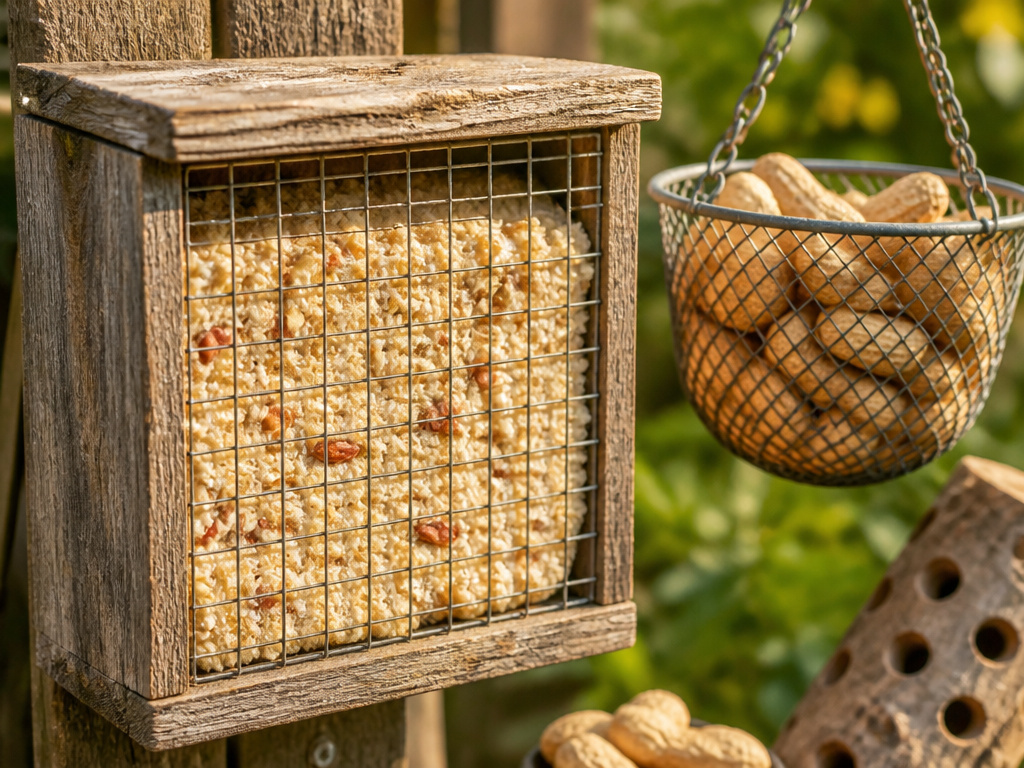
A regular suet cake in July slumps in the cage, runs oily, and leaves a sheen on the feathers of the first bird that lands in it.
UF/IFAS Extension warns that regular suet turns rancid in hot weather and can coat and damage feathers, which is why no-melt suet exists as a separate product for summer. Peanuts carry a simpler rule: they must be kept dry.
Fat needs different hardware from seed. Virginia Cooperative Extension notes that suet and peanut butter require mesh basket-style feeders or devices with multiple crevices to hold the food in place. Wisconsin Extension gives a homemade version: a basket built from scrap wood and 1/4-inch mesh hardware cloth, or a log feeder made from a 1- or 2-foot section of limb, 2 to 3 inches in diameter, with holes bored for the fat.
| Problem | Cause | Fix |
|---|---|---|
| Suet soft and greasy | Warm weather | Switch to no-melt suet |
| Peanuts clumped and moldy | Stored damp | Keep dry, buy smaller amounts |
| Corn rotting in the tray | Wet or damp weather | Pull corn during wet spells |
| Seed caking in the tube | Moisture plus husk dust | Empty, dry fully, refill |
Where this goes sideways: Hanging regular suet past the first warm week of spring. It goes soft, then rancid, and the birds get an oily coat instead of calories.
No-Melt Suet and the Summer Swap
No-melt suet is formulated to hold its shape at higher temperatures, and it’s the version to hang from late spring through early fall. No-melt suet is formulated to hold its shape at higher temperatures, and it’s the version to hang from late spring through early fall.
If you also keep a tray of bird treats out, keep it small in summer. Anything fatty or moist has a short clock once the heat arrives.
Nectar and Sugar Water: The 4:1 Rule and Three Ways to Get It Wrong
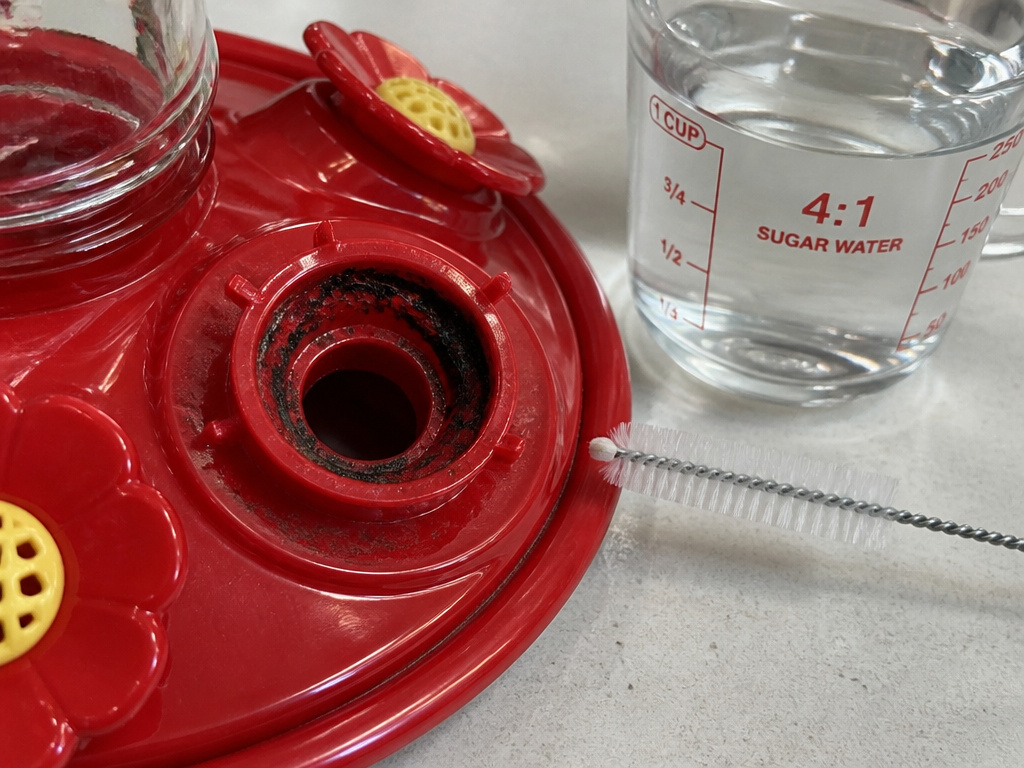
Four parts water to one part sugar, boiled, is the entire recipe. Everything people add on top of that is either unnecessary or actively harmful.
Before you start: Boiled sugar water scalds, so cool it fully before it goes near a feeder. Black mold inside the feeding ports is the real hazard, and it builds within days in hot, humid weather, so the feeder has to come apart rather than get rinsed. And never fill from a jar of honey, which can carry a fungal disease that kills hummingbirds.
- Boil the water first. Mixing sugar into cold water leaves it undissolved, and undissolved sugar ferments faster in the feeder.
- Measure 4 parts water to 1 part sugar. A stronger mix doesn’t feed better. It just spoils and draws more insects.
- Cool before filling. Hot nectar warps thin plastic feeder bodies and can crack the seams.
- Wash the feeder on schedule. Every week or two normally, and every 2 to 3 days during hot, humid summer weeks, replacing the sugar water just as often. Skip this and the ports grow the black mold that makes birds sick.
Honey is the one substitution that matters. UF/IFAS Extension states it should never replace sugar water because it can spread a fungal disease lethal to the tiny birds. Red dye is the other. The same source notes red dye can be toxic and is unnecessary if the feeder already has red parts.
Black mold shows up as a dark ring inside the feeding ports, not on the plastic you can see from the kitchen window. That’s why the openings get checked separately.
Virginia Cooperative Extension describes nectar feeders as liquid dispensers with special portals designed to replicate the tube flowers hummingbirds and orioles feed from. A feeder with red built into the body needs no dye added to the mix.
If you want to go further than sugar water, there are homemade bird food approaches worth knowing, but nectar is the one recipe where deviation costs birds.
Do Pellets and Manufactured Diets Belong in a Backyard Feeder?
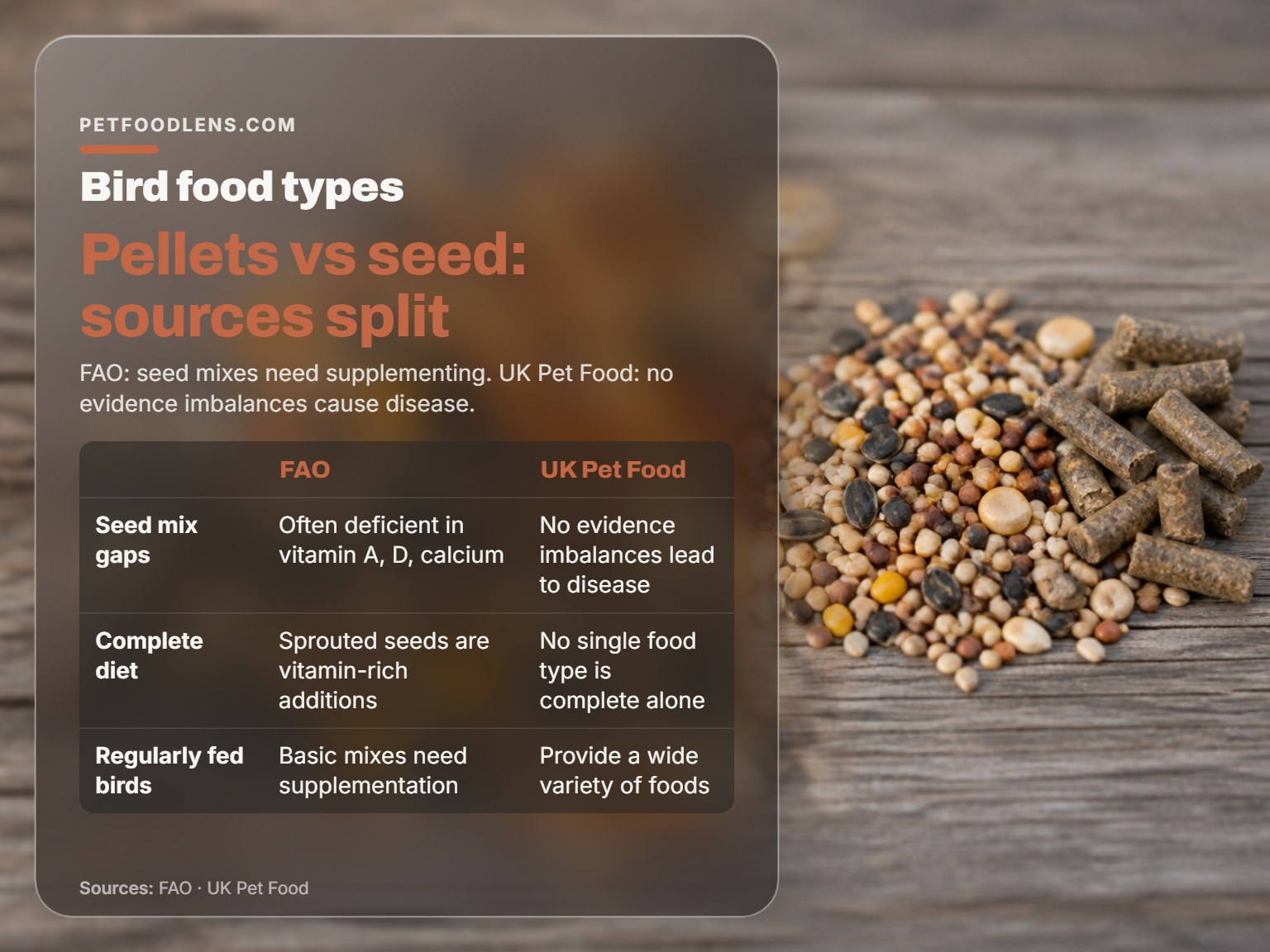
Pellets are formulated for a cage, and the label usually says so in language most people skim past.
FAO notes that US and UK wild bird food markets are the most sophisticated, with mixes tending to contain expensive components such as canary seed and Niger seed. The same source notes that basic seed mixtures are often deficient in vitamin A, vitamin D, calcium, and some amino acids, and that supplementation produces a more balanced food. Old-fashioned canary food, for reference, was typically 50 percent canary seed and 50 percent proso millet.
What the Numbers on a Pelleted Diet Actually Mean
For granivorous companion birds, Today’s Veterinary Nurse gives a minimum recommended protein allowance of 12 percent for maintenance and a fat allowance of approximately 4 percent. Those figures are for caged birds on a complete diet, not for wild birds visiting a feeder.
The same source notes that excess protein has been associated with renal disease, behavioral changes such as biting and feather picking, and regurgitation. That’s the argument against assuming more protein is better.
Here is where the sources genuinely split. FAO says basic seed mixtures are deficient and need supplementation. UK Pet Food states there is no evidence that dietary imbalances lead to disease in garden birds that are regularly fed, and suggests birds regulate their intake when a range of foods is available. UK Pet Food does concede that no single food type provides a complete and balanced diet on its own.
FAO holds that basic seed mixtures are often deficient and need supplementation, while UK Pet Food holds that there is no evidence dietary imbalances lead to disease in regularly fed garden birds; both positions are on record.
Where pelleted bird food earns its place:
- Indoor companion birds, where the diet is the whole diet and nothing else is on offer.
- Birds recovering from illness, under veterinary direction.
- Mixed feeding setups, where pellets supplement seed rather than replace it.
For a backyard feeder, the pellets vs seed question mostly answers itself. Wild birds have a yard full of alternatives, and pellets sitting in the rain are an expensive way to feed nothing.
FAO also flags sprouted seeds as easily digested and vitamin-rich additions to companion bird diets, which is a more practical middle path than a straight swap.
Which Feeder Type Matches Which Food?
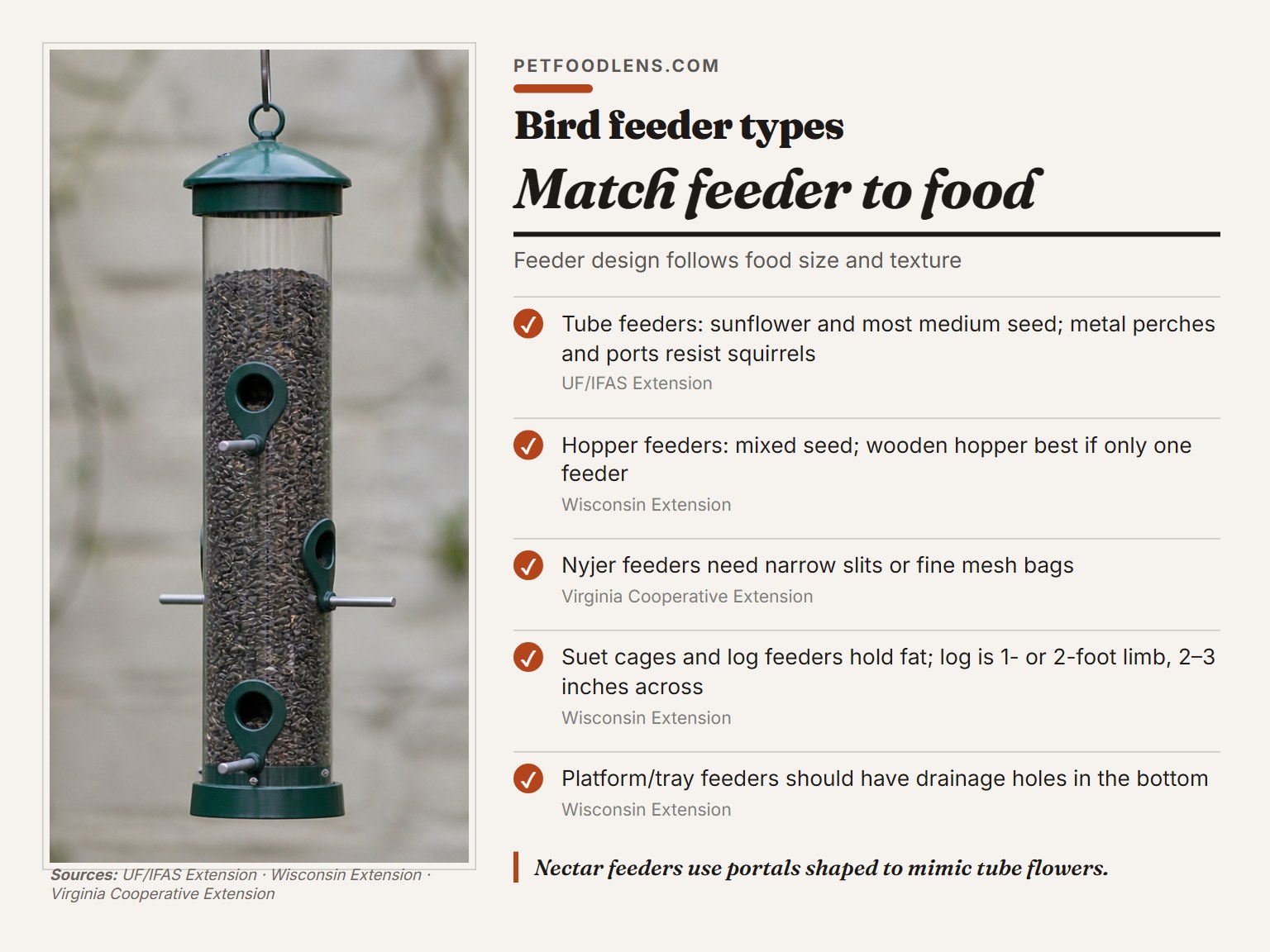
Ever wonder why nyjer comes in its own feeder instead of going in the tube with everything else? Because the seed would pour straight through the port.
Feeder design follows food size and food texture, and getting the pairing wrong wastes more seed than any brand choice will.
- Tube feeders handle sunflower and most medium seed. UF/IFAS Extension notes that tube feeders with metal perches and feeding ports cost more but hold up better against squirrel damage, because squirrels destroy plastic ports rather than chew through metal ones.
- Hopper feeders take mixed seed and suit most birds. Wisconsin Extension says that if you’re only hanging one feeder, the traditional wooden hopper is probably the best style to pick.
- Nyjer feeders need narrow slits or fine mesh bags, per Virginia Cooperative Extension.
- Suet cages and log feeders hold fat. A log feeder is a 1- or 2-foot limb section, 2 to 3 inches across, with bored holes.
- Platform and tray feeders suit ground-feeding species. Wisconsin Extension specifies drainage holes in the bottom, or the tray becomes a puddle.
- Nectar feeders use portals shaped to mimic tube flowers.
For squirrel pressure specifically, a tube feeder with metal perches and feeding ports is the practical answer, since metal is less easily damaged by squirrels.
State wildlife agencies publish their own take on this. The wild bird supplemental feeding practices guidance from Maryland’s DNR is one example worth reading alongside the university material.
The Wisconsin 4-H bird feeding guide goes further into homemade feeder construction, including the counter-balanced treadle design that closes off seed access to heavy birds like pigeons, crows, and grackles while smaller species feed undisturbed.
One feeder is a start. UF/IFAS Extension recommends at least two different types if you want a real spread of species, and Cornell Lab makes the same point from the food side: variety is what draws diversity.
What Never Goes in a Feeder
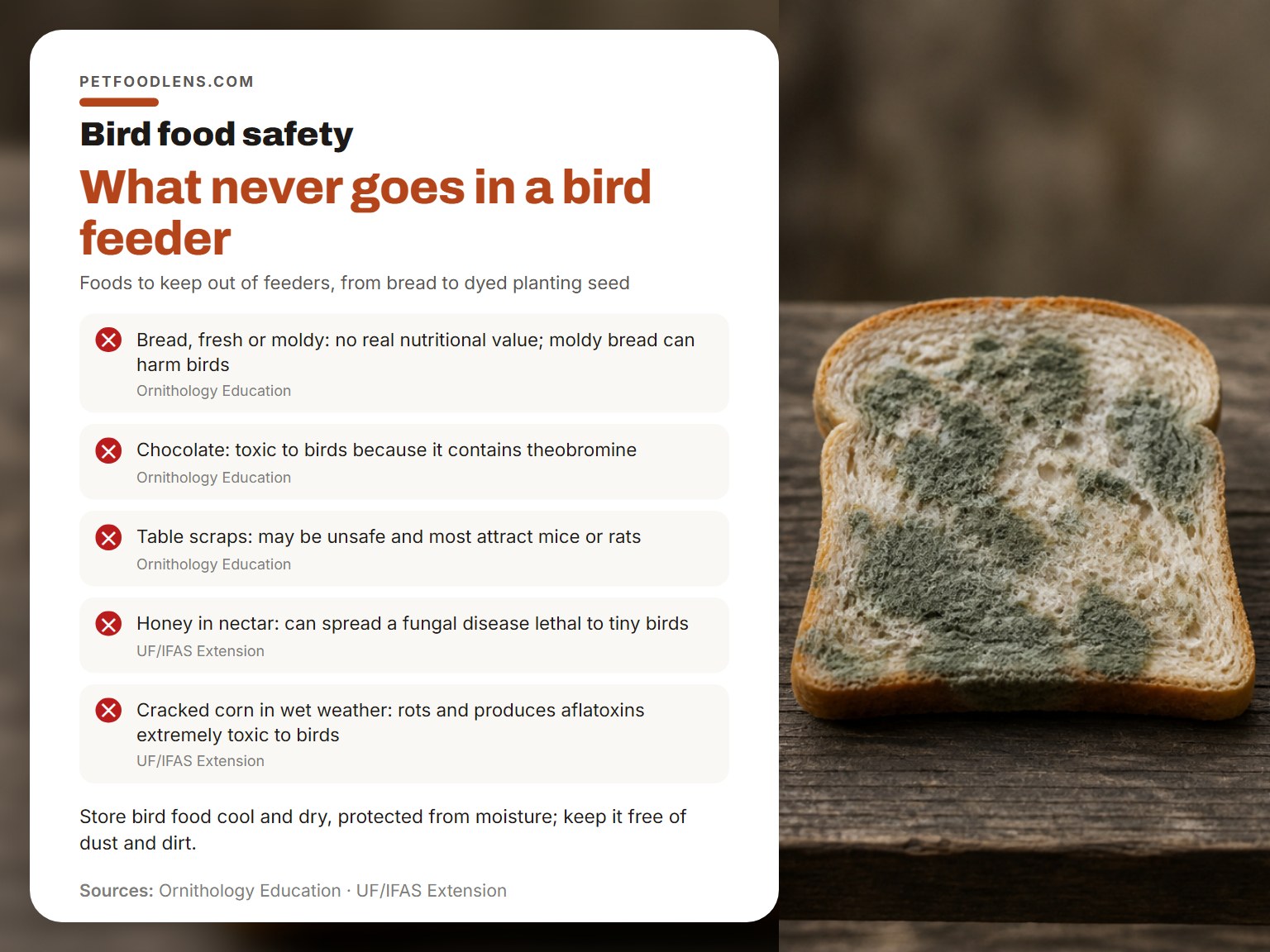
Bread is the worst thing on this list, and it’s also the most common.
Ornithology Education states that bread, fresh or stale, provides no real nutritional value for birds, and that moldy bread can harm them. Chocolate is toxic to birds for the same reason it’s toxic to dogs and cats: it contains theobromine. Table scraps are a third bad idea, since most of them attract mice and rats.
The list of hard no’s:
- Bread, fresh or moldy.
- Chocolate, because of theobromine.
- Table scraps, which draw rodents.
- Honey in nectar, which can spread a lethal fungal disease.
- Cracked corn in wet weather, because it rots and produces aflatoxins that UF/IFAS Extension calls extremely toxic to birds even at low levels.
- Dyed planting seed, which brings us to the one most people have never heard of.
Easy to miss: Seed treated with capstan and marked with red or pink dye. That’s planting seed, not feeder seed, and UF/IFAS Extension calls it extremely toxic to birds. If a bag of seed is dyed, it isn’t bird food.
The ingredients to avoid list runs longer than most people expect, and dye is the entry that surprises them.
There’s a storage rule that ties all of this together. UK Pet Food advises keeping bird food cool and dry and protected from moisture, since damp conditions encourage mold and harmful organisms. FAO and UK Pet Food both call for food that’s free of dust and dirt. Dust makes hygiene harder and lets pathogens build up.
Frequently Asked Questions
Is bread actually bad for birds?
Yes. Bread provides no real nutritional value, and moldy bread can harm birds. It also fills them up without delivering the fat or protein they need, which is worse in cold weather when energy demand is highest.
What is the single best bird food to start with?
Black-oil sunflower. Cornell Lab of Ornithology ranks it first for the number of species attracted, and it works in a tube feeder with metal perches and feeding ports. Add a suet cage in winter and you’ve covered most of the birds that visit a typical yard.
Can I use honey instead of sugar in hummingbird nectar?
No. UF/IFAS Extension states that honey should never be substituted for sugar water because it can spread a fungal disease lethal to hummingbirds. Use 4 parts boiled water to 1 part white sugar and nothing else.
How often should I clean a bird feeder?
Nectar feeders need washing every week or two, and every 2 to 3 days during hot, humid summer weeks with the sugar water replaced just as often. Seed feeders should be washed regularly to prevent disease spread between birds, and emptied whenever seed looks clumped or damp.
Do birds need drinking water as well as food?
Yes, and it’s often overlooked. Provide water especially during drought or when temperatures stay below freezing for several days. Replace bird bath water every day or two, and scrub the bath every week or two with a weak solution of nine parts water to one part vinegar.
Is cracked corn safe for birds?
Only when it’s dry. UF/IFAS Extension warns that corn can rot and produce aflatoxins extremely toxic to birds even at low levels, and states it should not be used in feeders in wet or damp weather. In a dry climate it’s fine. In a humid one, skip it.
Before You Go
Here’s the one action worth taking this week. Empty whatever is currently in your feeder into a bucket, and look at what’s left at the bottom. If the answer is milo, millet, wheat, and a few sunflower seeds, you’ve been paying for filler and feeding the mold.
That single check tells you more than any bag description will.
One concession, because it matters. This all assumes you’re feeding in a place where the seed can dry out. If you live somewhere humid, or your feeder has no roof, the wet-weather rules tighten considerably and corn should come off the menu entirely.
The types of bird food you keep on hand should match the birds you actually want to see, not the picture on the front of the bag. Start with one clean feeder, one fresh seed, and a water source you actually scrub. That combination outperforms a shelf full of mixes every time.
