
How Much to Feed Fish: A Ration You Can Measure
This post contains affiliate links. As an Amazon Associate, we earn from qualifying purchases.
How much to feed fish depends on body weight, water temperature, and life stage. The FAO’s feeding guide rejects any fixed rate across a growing cycle, and university data show a 1-2 inch trout eats 4.5% of its body weight daily at 52 F but 6.3% at 60 F.
FAO aimed that chapter at commercial producers, but the mechanism runs in every aquarium. A 2-gram fry and a 2-kilogram adult do not eat the same fraction of body weight daily, and the gap between those fractions is where bag-chart advice breaks down.
What follows: the three variables that actually set a ration (size, temperature, and feed form), where the university and government sources disagree with each other, and the practical method for building a daily feeding amount you can measure with a kitchen scale.
Key Takeaways
- No single percentage works across a fish’s life. The FAO guide says a fixed rate underfeeds small fish and overfeeds large ones, and the water quality pays for the difference.
- Temperature changes the rate more than any other variable. A 1-2 inch trout eats 4.5% of its body weight at 52 F and 6.3% at 60 F, per the NMSU feeding guide.
- Days per week is contested. NOAA says feed 7 days a week; Mississippi State data show 6 days costs 3.3% of net production and 5 days costs 6.9%.
- Aeration sets a hard ceiling. NMSU puts the maximum at 20 lb/acre/day without aeration and 100 lb/acre/day with it, while Mississippi State allows up to 120 lb/acre for regular ponds.
- Weigh the fish, measure the water, then do the math. A ration you can defend with a scale and a thermometer beats a bag chart every time.
Why the 1-to-3-Percent Rule Fails
The 1-to-3-percent rule is the most repeated number in fish keeping. The FAO guide rejects any fixed percentage across a growing cycle, while the Merck Veterinary Manual still recommends about 3% of body weight daily for adult maintenance.
Feeding rate rises with water temperature and falls as fish grow. A 0.38-gram trout eats 3.4 percent of its body weight per day at 7 C and 6.4 percent at 15 C. Larger fish eat a smaller fraction of body weight, because metabolic rate per unit of body weight declines as the animal grows.
The mechanism is straightforward. A small fish burns energy fast relative to its mass, so it needs a high percentage of body weight to grow. A large fish burns less per gram, so the same percentage turns into surplus feed and waste, which is why the how much to feed fish question has no single answer. The FAO animal feed quantity guide states the failure mode directly: a steady percentage across the whole cycle causes “underfeeding when the animals are small, depressing growth and survival rates, and overfeeding when the animals are larger.”
That surplus is not just wasted money. It is the main driver of overfeeding problems in home tanks and production ponds alike.
Common mistake: Feeding the same percentage of body weight from fry to adult. The FAO guide says this causes near starvation early and gross overfeeding late, and the water quality problems show up within days of the switch to full ration.
I spend most of my week reading cat food labels, so I will stick to what the fish-feeding sources actually say and flag where they disagree. The FAO chapter is blunt about this one: there is no universal percentage.
How Do You Calculate a Daily Ration From Body Weight?
How do you turn a percentage into a number you can actually measure? You need two inputs: the total weight of fish in the system, and the correct percentage for their size and water temperature.
The NMSU guide gives the formula in plain terms: daily feed in pounds equals the percent body weight to feed daily multiplied by the total weight of fish in pounds. If you have 10 pounds of fish and the table says 3%, you feed 0.3 pounds that day.
| Fish Size | At 52 F | At 60 F |
|---|---|---|
| 1-2 inch | 4.5% | 6.3% |
| 10+ inch | 0.9% | 1.3% |
The Trout Table: Same Fish, Different Temperature
The NMSU rainbow trout table makes the temperature effect visible. A 1-2 inch trout at 52 F gets 4.5% of body weight daily. The same fish at 60 F gets 6.3%. That is a larger ration for an 8-degree water change.
The FAO feeding tables show the same pattern across species. As temperature rises, feeding rate rises. As fish grow, the recommended rate falls. The two effects stack, which is why a single percentage cannot cover a whole growing cycle.
There is academic work on predicting food allowances from body length, but the practical tables from FAO and the university extensions are what most feeders actually use. For fry and fingerlings specifically, the calculation changes again, and feeding fry has its own set of rules.
Here is the practical sequence:
- Weigh a sample of fish and multiply by the number in the system to estimate total biomass.
- Measure water temperature at the same time of day you plan to feed.
- Look up the percentage for that size and temperature in a published table.
- Multiply percent by total weight to get the daily ration, then divide by the number of feeds.
Skipping step one is the most common error. Without a biomass estimate, the percentage is meaningless.
The Temperature Variable That Rewrites Every Feeding Chart
Temperature changes the feeding rate more than any other single variable. The NOAA trout feeds and feeding circular treats temperature as a first-order input to its feeding tables, not a footnote.
The mechanism is metabolic. Fish are ectotherms, so their body temperature tracks the water. Warmer water speeds digestion and increases energy demand, which means more feed. Colder water slows both, which means less. The FAO tables show the combined effect: rate rises with temperature, falls with size.
For a saltwater tank, the same principle applies, but marine species often have narrower temperature tolerances and different metabolic baselines. The table you use has to match the species.
Watch the surface after you feed. If pellets are still floating after a while, the fish are not eating at the rate you assumed, and the temperature may be lower than you think. A thermometer costs less than a bag of food.
How Many Days a Week Should You Feed?
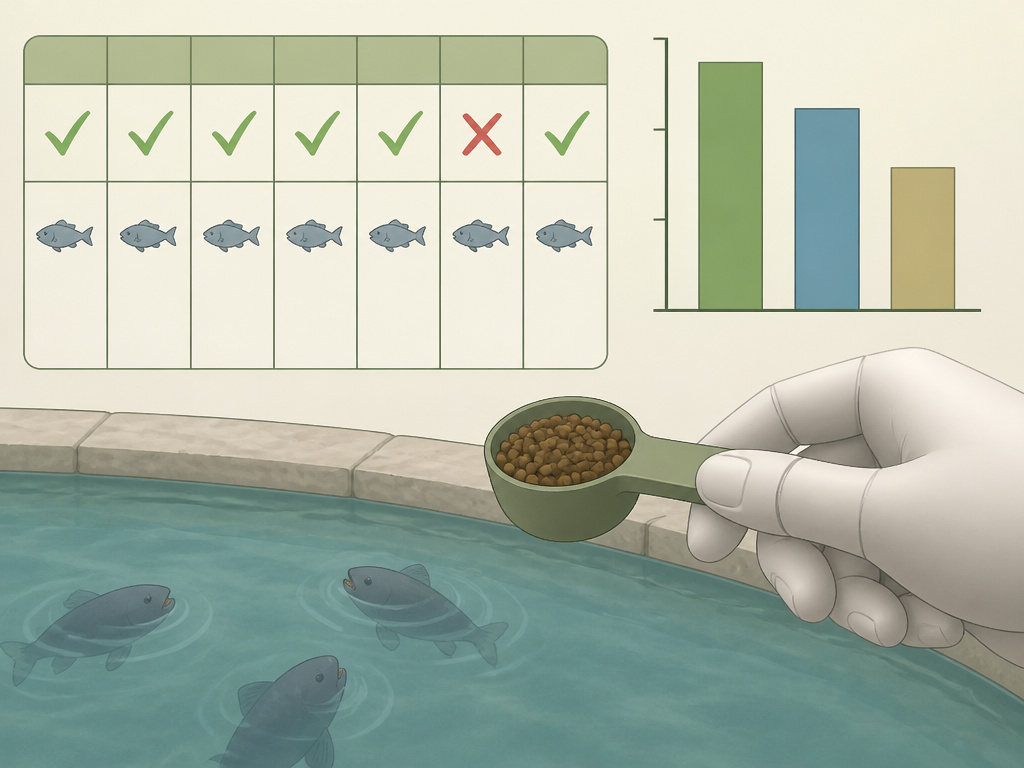
Six days a week costs 3.3 percent of net production. Five days costs 6.9 percent. Those are the Mississippi State numbers for catfish ponds, and they frame the days-per-week question better than any rule of thumb.
| Days Fed per Week | Net Production | Feed Conversion |
|---|---|---|
| 7 days | Baseline | Baseline |
| 6 days | -3.3% | -4.8% |
| 5 days | -6.9% | -7.9% |
The sources do not agree on this. NOAA says fish should be fed 7 days a week. The FAO guide says feeding 6 instead of 7 days encourages fish to consume surplus feed in the pond and lessens the chance of overfeeding. The Mississippi catfish nutrition bulletin and the Mississippi State extension data come down on the side of 7 days for growth, with measurable losses at 6 and 5.
Feed less than the fish will eat, not more. The FAO guide is explicit: a fixed percentage of biomass across a growing cycle means near starvation early and gross overfeeding late. The right amount moves with the fish.
For a home aquarium, feeding frequency is usually once or twice daily, and the feeding schedule for community tanks can be simpler than a production pond because the biomass is stable and the water volume is small. For a production pond, the days-per-week decision has a measurable cost.
Here is the head-to-head: NOAA says 7 days a week for growth, the FAO guide says 6 days a week encourages fish to consume surplus feed and lessens overfeeding risk, and Mississippi State data show 5 days a week is a maintenance compromise. Pick based on whether you are growing fish or holding them.
Satiation Feeding vs Measured Ration: Where the Experts Split
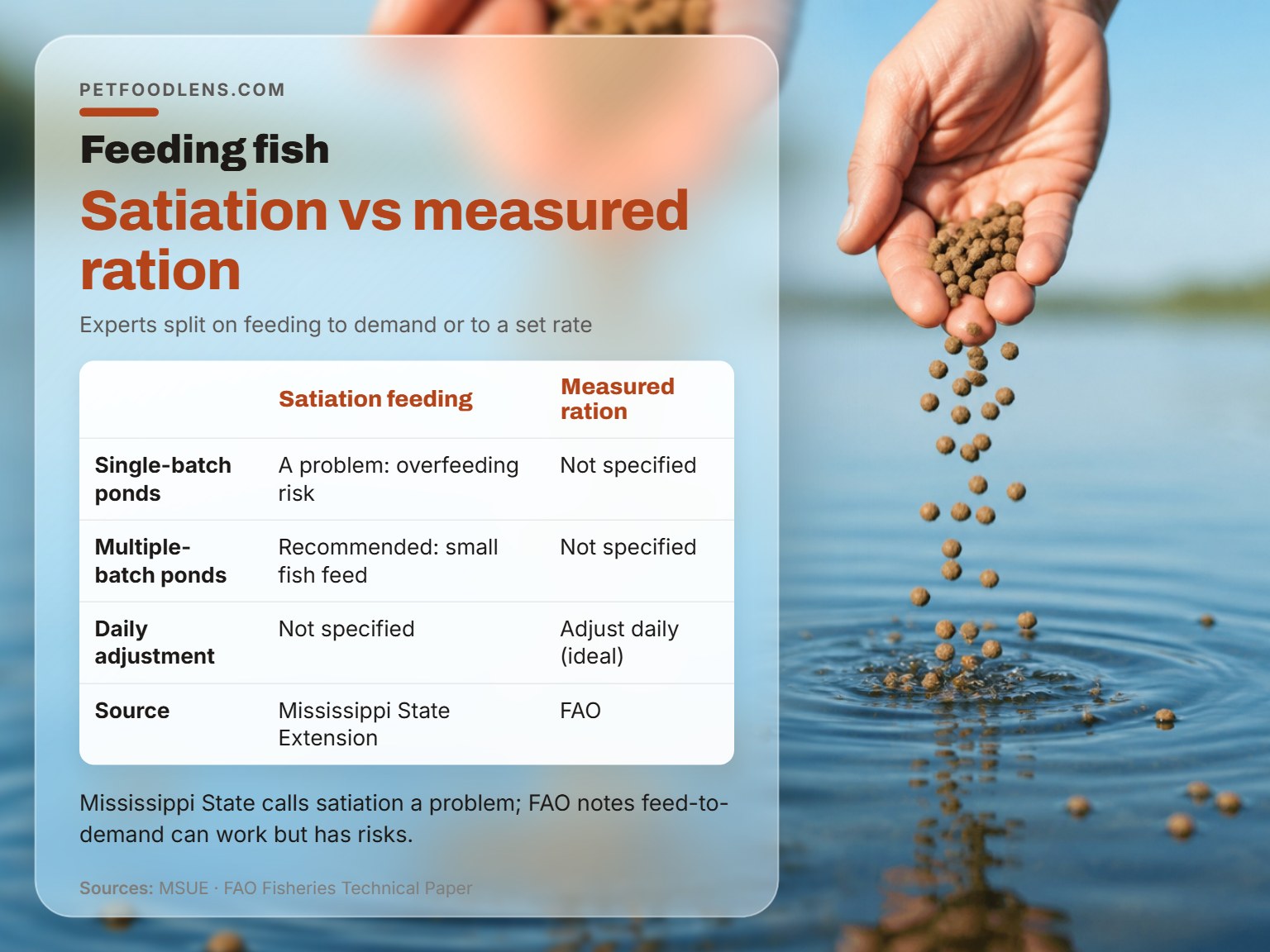
The Mississippi State extension calls satiation feeding “a problem” in single-batch systems, while recommending it in multiple-batch ponds; the FAO guide recommends feeding “to demand” as reasonably effective. Both positions are defensible, and the disagreement matters.
Where this goes sideways: Feeding to satiation in a single-batch pond. The Mississippi State extension warns you cannot tell when fish have had enough, and the leftovers can hurt water quality.
What “Feed to Satiation” Actually Means
Satiation feeding means offering feed until the fish stop eating. Mississippi State says this works in multiple-batch ponds because smaller, less aggressive fish get a chance after the big ones are full. The same source warns it fails in single-batch systems because you cannot see when the fish have had enough.
The FAO feeding tables appendix shows the alternative: a published rate adjusted daily based on how much of the previous day’s feed was consumed. That is the “feed to demand” method, and the FAO calls it reasonably effective where the farmer is experienced.
Bottom-Dwellers Need Their Own Ration
The Merck Veterinary Manual is direct about this: bottom-dwelling fish such as loricariids and Corydoras should not be expected to survive on leftovers and should receive targeted feeding. Surface feeders get floating feed; bottom-dwellers get sinking feed.
I do not trust a feeding chart I cannot check against a scale. The bag gives you a percentage of a body weight it never states, at a temperature it never asks about. Weigh the fish, measure the water, then do the math.
For a mixed community tank, that means two feeding events, not one. Drop floating food for the surface feeders, then drop sinking food for the bottom group after the first group has cleared the surface.
The Aeration Ceiling Nobody Puts on the Bag
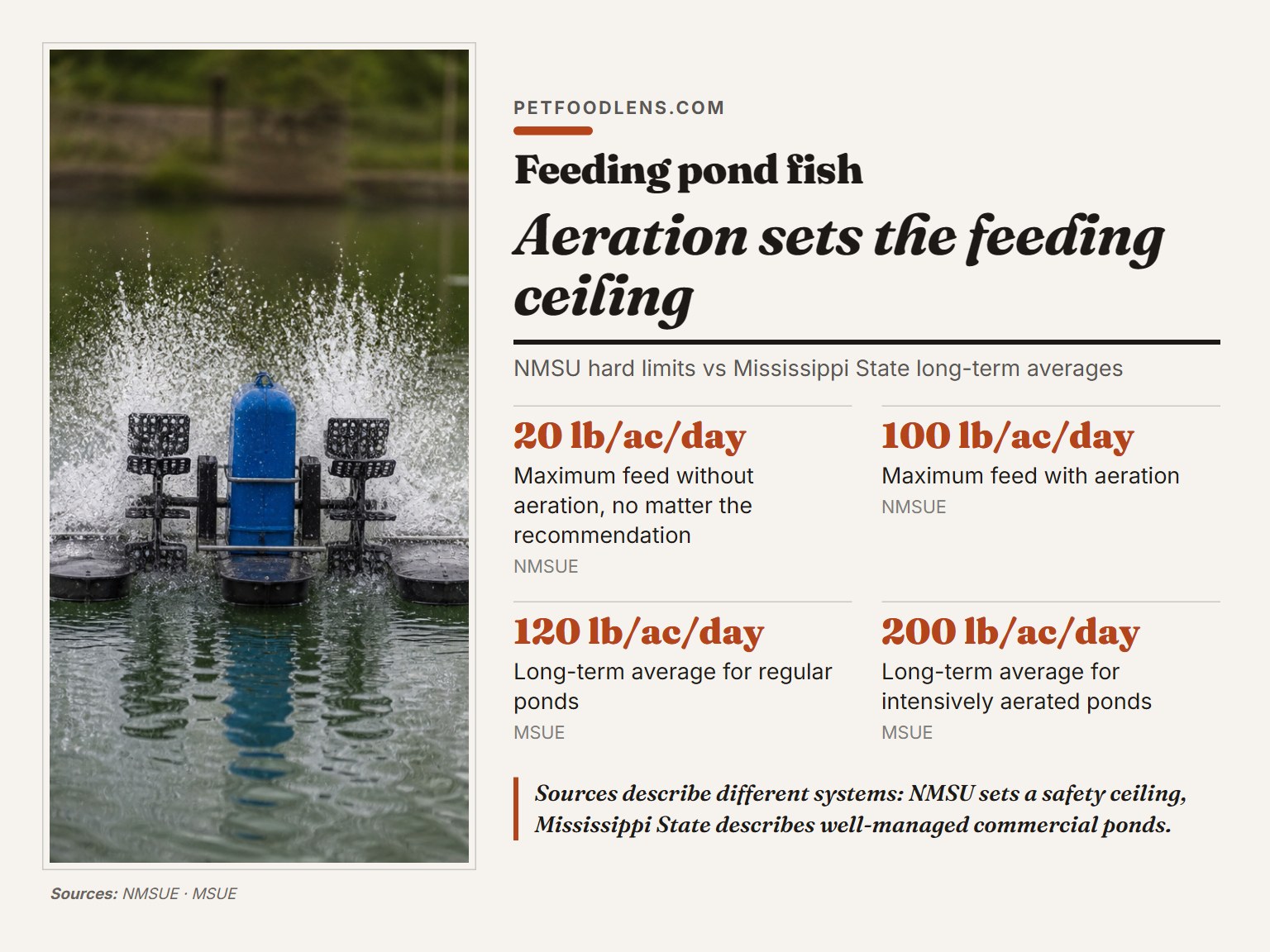
Aeration is the hard ceiling on feeding rate, and most bag charts ignore it. The NMSU circular states the rule without hedging: no matter what the feeding recommendation says, if aeration is not available, feed should not exceed 20 lb/acre/day. With aeration, the maximum rises to 100 lb/acre/day.
Before you start: Without aeration, feed above 20 lb/acre/day and dissolved oxygen drops fast, with fish gasping at the surface and losses following. With aeration, the ceiling is 100 lb/acre/day, but it still exists.
Mississippi State allows higher long-term averages: 120 lb/acre/day for regular ponds, 200 for intensively aerated ponds, and 250 for split ponds. The two sources are not describing the same system, so the numbers do not reconcile directly. NMSU is setting a hard safety floor; Mississippi State is describing what well-managed commercial ponds can sustain.
The practical rule for a home system is simpler. If you cannot test dissolved oxygen, feed less than you think you should. Excess feed drives cloudy water and oxygen crashes faster than any other single mistake.
Factors that lower the ceiling:
- No aeration or surface agitation
- High water temperature, which holds less oxygen
- Heavy stocking density relative to water volume
- A recent algae die-off or bacterial bloom
Any one of those cuts the safe feeding rate. Two together usually mean a water change before the next feed.
Feed Form, Storage, and the Labels That Lie
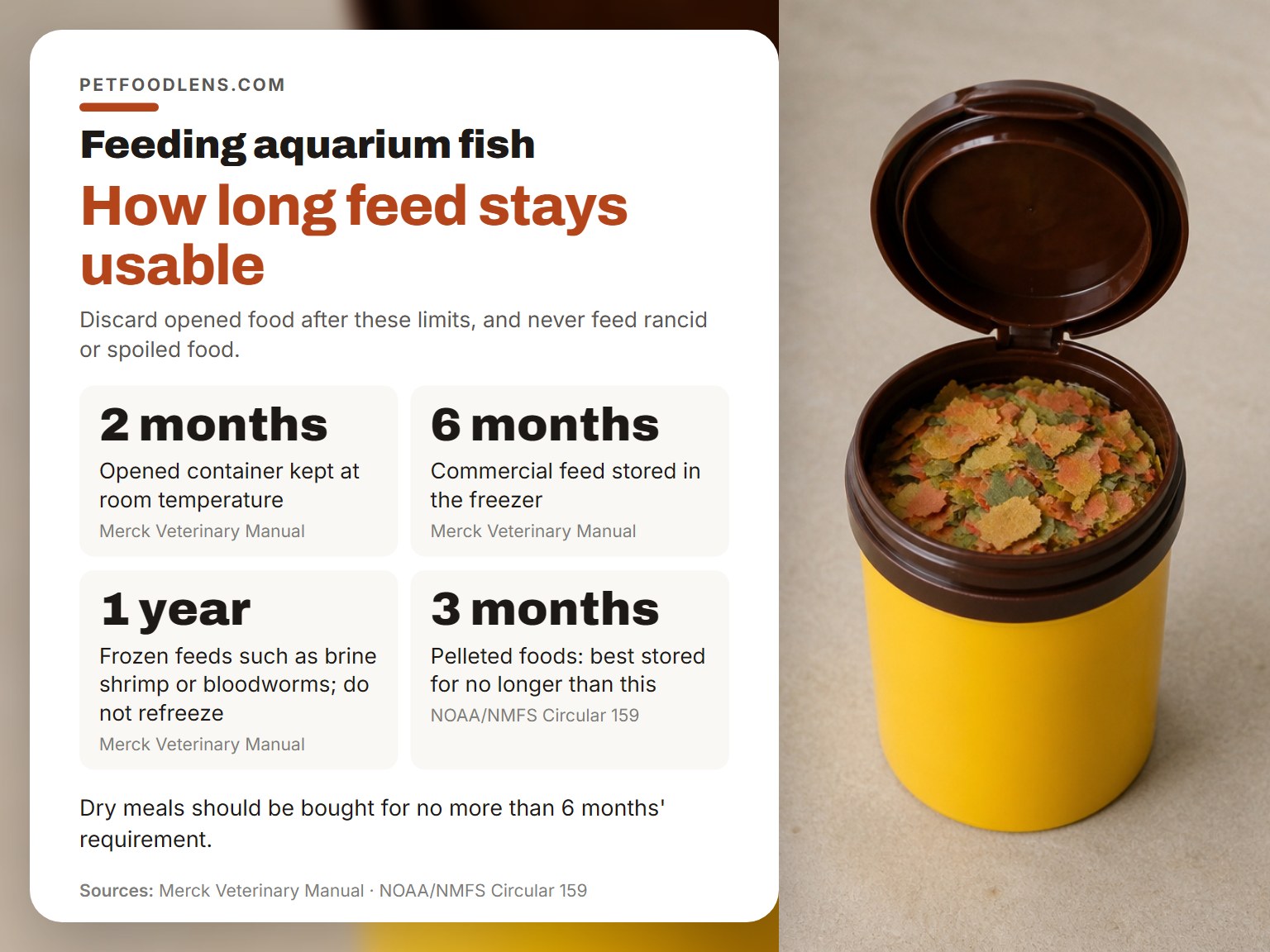
Three things shorten a fish food’s useful life: heat, humidity, and time since opening. The Merck Veterinary Manual gives specific limits. A container kept at room temperature should be discarded after 2 months of opening. Feed stored in the freezer should be discarded after 6 months. Frozen feeds such as brine shrimp, bloodworms, mysids, or glassworms should be discarded after 1 year and never refrozen once thawed.
The NOAA circular adds its own storage rules. Dry meals should be purchased for no more than 6 months’ requirement, pelleted foods for no more than 3 months. Food with a rancid odor or signs of spoilage must not be fed.
Feed form changes the math too. Merck notes that flaked feeds are much lighter than pelleted feeds, so a percentage of body weight is not comparable across the two. Choosing between flakes vs pellets is partly a question of what your fish will actually eat and partly a question of how precisely you can measure the dose.
The part nobody mentions: A stale container of flakes smells like old cooking oil and damp cardboard. If you open the lid and that hits you, throw it out. Rancid feed does not become safe by mixing it with fresh feed.
The label on the bag is a starting point, not a prescription. Merck points out that commercial feeds vary dramatically in weight by form, and the feeding chart on the back assumes a body weight and a temperature you probably do not have. Read the back, then check it against a scale and a thermometer.
Frequently Asked Questions
How much should I feed my aquarium fish?
For most adult aquarium fish, the Merck Veterinary Manual puts maintenance at 3% of body weight daily, though the FAO guide holds that any single fixed percentage across a growing cycle is wrong. That is a starting point, not a fixed rule. Adjust down for cooler water, up for active growth, and watch the water for signs of surplus.
Can I feed fish once a week?
Mississippi State says feeding once a week as much as the fish can eat can maintain body weight in food-sized catfish under a single-batch system. That is maintenance, not growth. For growing fish, feed daily.
Why does my fish food say “feed 2-3 times daily”?
Bag charts are written for a generic fish at a generic temperature. The FAO guide notes that feeding frequency should drop as fish grow: one commercial feed manufacturer recommends 8-10 feeds per day for fry, reducing to 6 per day at 2.5 cm, and the FAO guide says 3 times per day at 7.6 cm. The bag cannot know which stage you are at.
Does water temperature change how much I feed?
Yes, and it is the largest single variable after body weight. A 1-2 inch trout eats 4.5% of body weight at 52 F and 6.3% at 60 F, per the NMSU table. Cooler water means less feed, warmer water means more, up to the point where oxygen becomes the limiting factor.
How do I feed bottom-dwelling fish?
The Merck Veterinary Manual is clear that loricariids and Corydoras should not be expected to live on leftovers. Feed sinking pellets or wafers after the surface feeders have cleared their food, so the bottom group gets a targeted ration rather than scraps.
The Bottom Line
Here is the concession the bag charts will not make: there is no universal percentage. The FAO guide says so directly, and the university data back it up. If you take one thing from this article, take the method, not the number.
Weigh a sample of fish, measure the water temperature, look up the rate in a published table, and feed slightly less than the math says. Then watch the water. A ration you can defend with a scale and a thermometer beats a bag chart every time.
The first step this week: put a thermometer in the tank or pond at the same time you normally feed, and write down the reading for seven days. That number, not the one on the bag, is where your ration starts.
