
How Often to Feed a Betta Fish: 2 to 3 Meals a Day
This post contains affiliate links. As an Amazon Associate, we earn from qualifying purchases.
On how often to feed a betta fish, two to three small meals a day is the practical answer, though sources range from once daily (OATA, Elive) to three times (Hikari, a 2020 juvenile study).
The how often to feed a betta fish disagreement matters because every extra pellet lands in a tank that may hold less than two litres. The sources that say “once a day” and the sources that say “three times” are describing different fish in different tanks, and neither side says so out loud.
What follows is a side-by-side of the actual recommendations, the portion math behind fixed pellet counts, and the two tank variables that shift the answer more than any feeding chart does.
Key Takeaways
- Two to three meals a day is the working range for most adult bettas, but OATA and Elive both say once daily.
- Six Hikari Micro Pellets or five Betta Bio-Gold pellets is the per-feeding ceiling from the manufacturer, not a target.
- Meal duration varies by source: Hikari says about a minute, Petco says 1 to 2 minutes, The Spruce Pets says 5.
- Tank volume changes the math: a 1-litre bowl fouls faster than a 20-litre tank, so the same schedule is riskier in a smaller one.
What the Sources Actually Say About Feeding Frequency
Four credible sources give four different answers on feeding frequency, and the gap between them runs from once a day to three times a day.
OATA recommends feeding adult Betta splendens once daily, while Hikari’s manufacturer schedules call for two to three feedings. Peer-reviewed trials on 30-day-old juveniles found three meals daily produced the highest specific growth rate and lowest feed conversion ratio over a 60-day period.
| Source | Recommended Frequency | Notes |
|---|---|---|
| OATA | Once daily | “A few minutes” per meal |
| Elive Betta Cube | Once daily | 2 to 5 pellets, 2 to 3 minutes |
| Hikari Micro Pellets | 2 to 3 times daily | 6 pellets AM + 6 PM for 1.5″ fish |
| Hikari Betta Bio-Gold | Up to 3 times daily | 3 pellets for 1.5 to 1.75″ fish |
| The Spruce Pets (Sanders) | At least 2x, up to 3x | Eyeball-sized portion |
| Norazmi-Lokman 2020 | 3 meals/day best | Juvenile study, 60 days |
The how often to feed a betta fish split tracks the audience. OATA and Elive write for the retail trade, where a single daily feed is easier for staff and safer for a tank that might not get a water change for a week. Hikari and the 2020 study write for growth, and growth needs more meals.
Show me the numbers, and the argument gets clearer. The betta feeding frequency study from Norazmi-Lokman and colleagues measured specific growth rate at 3.297% per day on one meal, 3.591% on two, 3.856% on three, and 3.418% on four. Three meals won on growth and on feed conversion, at 1.521.
What each source is optimizing for:
- OATA: retail simplicity and water safety
- Hikari: growth rate, especially for juveniles
- The Spruce Pets: digestive comfort and portion control
- Norazmi-Lokman: measurable growth and feed conversion
I’ve watched this argument run for years on fish forums, and the answer usually traces back to which care sheet the keeper read first. That’s a poor way to decide.
If you want the broader picture beyond bettas, the same tension shows up in feeding frequency for aquarium fish across species. A full betta feeding guide covers the food-selection side.
How Much Food Should a Betta Get Per Meal?
Hikari’s per-feeding ceiling is six Micro Pellets for a 1.5-inch betta, and five Betta Bio-Gold pellets for a 1.5-to-1.75-inch fish.
I’ve seen several betta foods sold as “premium” or “color-enhancing” whose panels leaned heavy on plant fillers and light on the protein a betta actually needs. It’s happened often enough that those words now work as a cue to read the panel more carefully. The front of the bag and the actual formulation don’t always match.
Fixed Pellet Counts vs the Eyeball Rule
Hikari counts pellets. The Spruce Pets’ Jessie Sanders, DVM, counts eyeballs. Both approaches are trying to solve the same problem: pellet size varies so much between brands that a fixed count is meaningless across products.
| Product / Source | Pellet Count | Fish Size |
|---|---|---|
| Hikari Micro Pellets | 6 per feeding, max | 1.5″ betta |
| Hikari Micro Pellets | +2 per 1/4″ growth | Growing bettas |
| Hikari Betta Bio-Gold | 3 per feeding, up to 3x | 1.5 to 1.75″ betta |
| Hikari Betta Bio-Gold | +1 per 1/4″ growth | Growing bettas |
| The Spruce Pets | 2 to 12 pellets per meal | Eyeball-sized portion |
| Elive Betta Cube | 2 to 5 pellets once daily | Adult betta |
The eyeball rule exists because a 1.1mm Micro Pellet and a 2mm generic betta pellet are not the same amount of food. Weigh them and the difference is obvious.
Common mistake: Feeding by pellet count without checking pellet size. Six Micro Pellets weigh less than six larger generic pellets, so the same count delivers very different protein loads.
A simple feeding routine that respects both approaches:
- Measure the fish from nose to tail base, before the fins. Skip this and you’ll feed a 1.5-inch fish the 1.75-inch dose.
- Pick the pellet that matches the size band. A large pellet for a small fish gets spat out and fouls the water.
- Count the ceiling for that product. Hikari’s ceiling is 6 Micro Pellets or 5 Bio-Gold, not a target.
- Feed one pellet at a time and watch each one disappear. Dumping six at once means the fish miss some, and missed pellets sink.
- Stop at the ceiling even if the fish begs. Bettas beg because they’re opportunistic, not because they’re hungry.
If you want the general math beyond bettas, the same logic applies to how much to feed any fish. And if you’re still choosing a product, the betta pellets comparison is the place to start.
How Long Should a Betta Take to Eat Its Food?
Hikari says about a minute, the shortest meal window any source gives, while Petco says 1 to 2 minutes, Elive says 2 to 3 minutes, OATA says a few minutes, and The Spruce Pets says 5 minutes.
The range is wide: Hikari says about a minute, Petco says 1 to 2 minutes, Elive says 2 to 3 minutes, OATA says “a few minutes,” and The Spruce Pets says 5 minutes with leftovers removed after.
Watch the tank after the food hits the water. A hungry betta takes pellets at the surface in a fast, precise snap. A fish that’s already full will mouth a pellet, spit it out, and let it sink to the gravel.
I don’t time my own fish with a stopwatch. I watch the first pellet. If it goes down in one motion, the fish is hungry. If it gets mouthed and spat, the meal is over, regardless of what’s left in the cup.
The Spruce Pets’ five-minute rule is the most forgiving end of the range, while Hikari says about a minute, Petco says 1 to 2 minutes, Elive says 2 to 3 minutes, and OATA says a few minutes. A slow eater isn’t a hungry eater.
Flakes dissolve faster than pellets, so the meal window shrinks and more food ends up in the gravel. That’s one reason pellets vs flakes matters more than most keepers think.
Why a 1-Litre Bowl and a 20-Litre Tank Need Different Feeding
A 1-litre bowl with a single betta and no filter has about as much waste tolerance as a coffee cup. A 20-litre tank with a filter has room to absorb a missed pellet or two.
The tank size disagreement between sources is bigger than the feeding disagreement. Petco says 1/4 gallon minimum. Hikari says 30 ounces. OATA says 20 litres for a single male. Those are not the same tank.
Small Tanks, Big Consequences
- Petco: 1/4 gallon minimum, 50% weekly water change for tanks under 2 gallons
- Hikari: 30 ounces minimum, weekly water change
- OATA: 20 litres minimum, weekly water testing
- Elive Betta Cube: one betta per cube, no more than 50% weekly water change
A smaller tank means less dilution for the same amount of food. Petco’s care sheet says it directly: overfeeding “can quickly foul the water, especially in smaller, unfiltered aquariums.”
Temperature is another split. Hikari says 73 to 81°F, Petco says 72 to 82°F, and The Spruce Pets says 77 to 80°F.
In a small unfiltered bowl, a single uneaten pellet can cloud the water. The smell changes first, a faint sour note that means the ammonia is climbing.
The OATA betta care sheet is the shortest version of the tank-size argument, and it’s worth reading before you buy a bowl. If you want the full overfeeding prevention playbook, it applies to bettas with only minor changes.
What Overfeeding Actually Does to a Betta
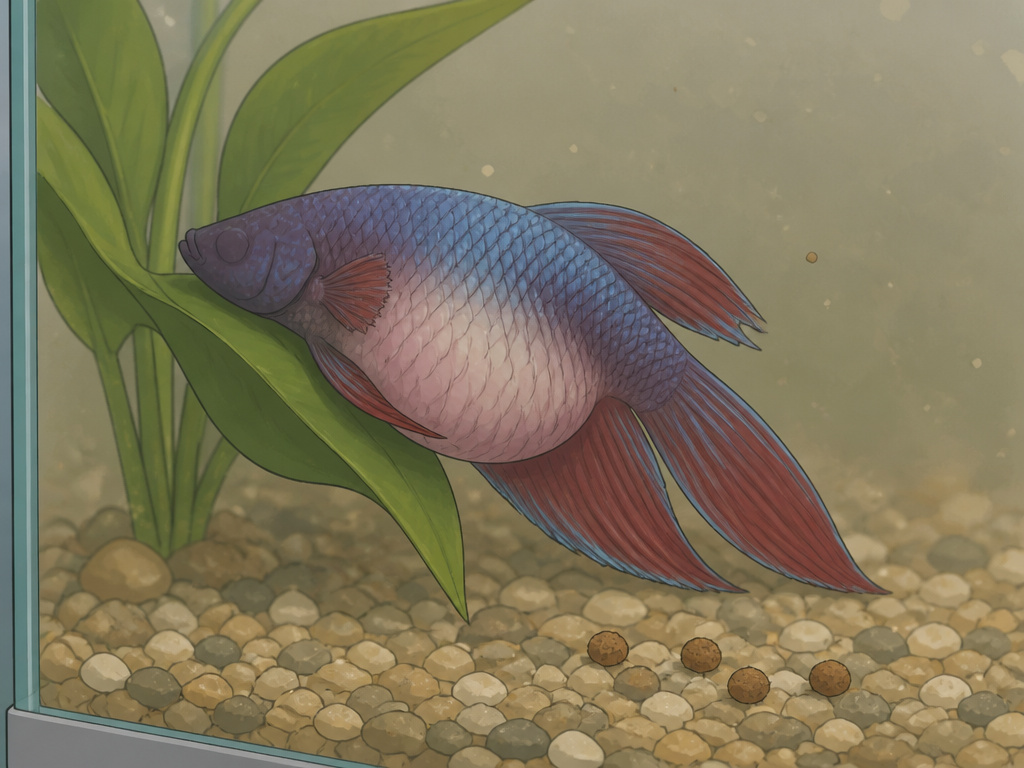
That’s the number to keep in mind when someone tells you a few extra pellets won’t hurt.
The study didn’t isolate overfeeding as the cause. It just measured survival across four feeding frequencies in 3-litre tanks, and even the best group lost nearly a third of its fish over 60 days.
Signs that a betta is being fed too much:
- Swollen abdomen that stays rounded hours after a meal
- Lethargy, with the fish resting on the bottom or against a plant
- Dropsy, which is bloating from internal organ damage
- Cloudy water that clears on its own within a day or two
That’s a case for an aquatic vet. I’m not a vet, so I can’t tell you whether your betta’s bloating is dropsy or something else.
Where this goes sideways: Feeding a betta to satiation twice a day in an unfiltered 1-litre bowl. The ammonia climbs, the fish goes lethargic, and you end up doing a full water change to save it.
The Juvenile-versus-Adult Gap No One Tests For
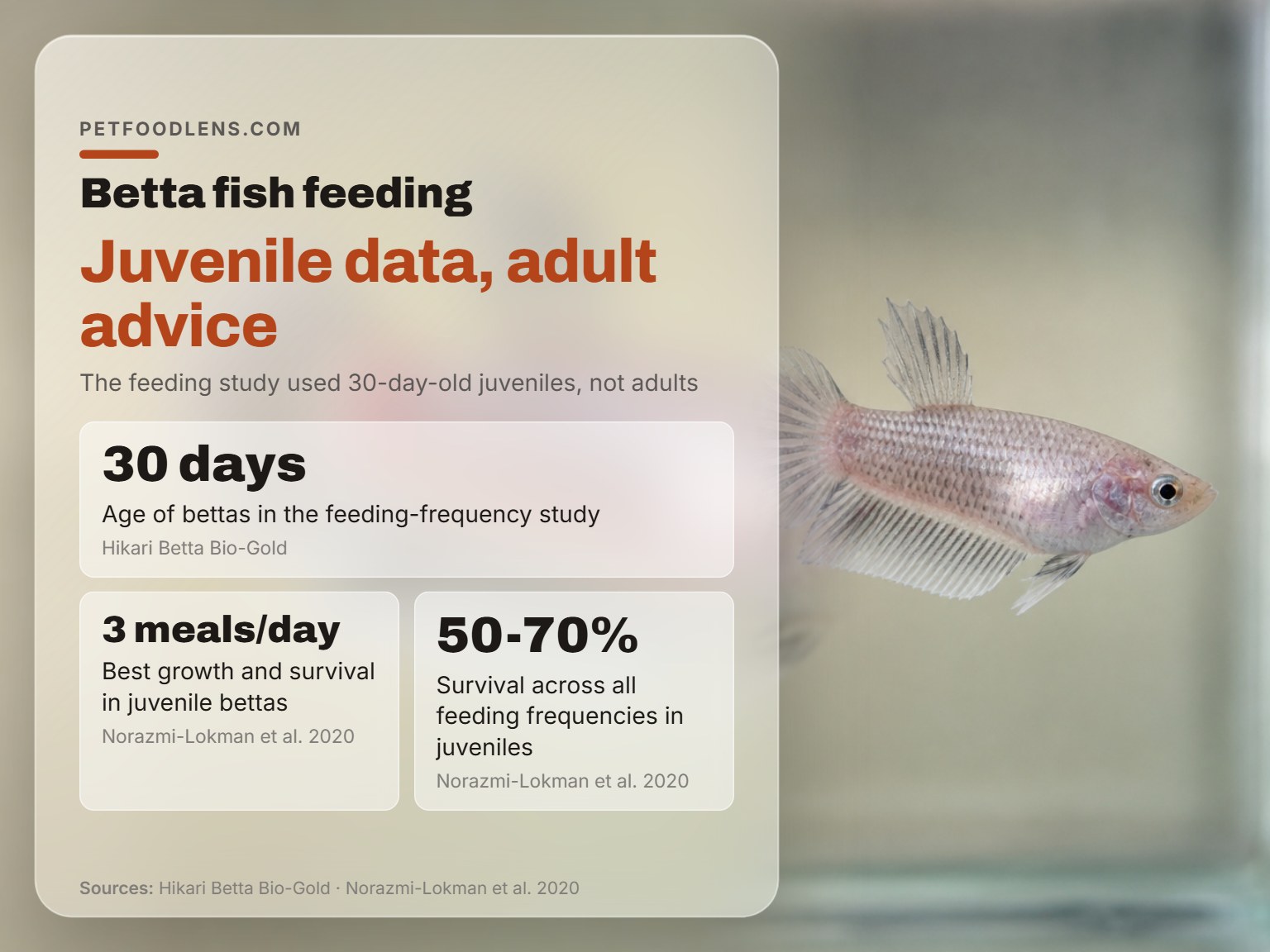
Every feeding-frequency study I found used 30-day-old juveniles. Not one used adults.
That’s a problem, because the recommendations you read online are almost all written for adult bettas. The 2020 Norazmi-Lokman study used 30-day-old juvenile fish. An adult betta weighs many times that.
Why Juvenile Data Doesn’t Transfer Cleanly
Juveniles are building tissue. Adults are maintaining it. A diet that maximizes growth in a 30-day-old fish is not automatically the right maintenance diet for a two-year-old one, and no study I found tests that transition.
The juvenile data is still the best experimental evidence available, and it points to 3 meals a day for growth. But extrapolating juvenile growth data to an adult maintenance diet is a leap the studies don’t make.
The best betta food for a growing juvenile and a mature adult aren’t the same product, and that’s before you factor in treats. High-protein treats like bloodworms should be offered no more than once or twice weekly, according to The Spruce Pets.
Six Micro Pellets is the per-feeding ceiling for a 1.5-inch fish, not the target. It’s a smaller pile than most keepers picture.
A betta can’t fast for more than a few days. If you’re leaving for a week, a timed vacation feeder or a fish sitter is safer than a big meal before you go.
Frequently Asked Questions
Can I feed my betta just once a day?
Yes, and two major sources say to. OATA and Elive both recommend a single daily feeding. The trade-off is growth: the 2020 juvenile study found 3 meals a day produced better growth and feed conversion than 1 meal a day, though survival was only 50% at the once-daily frequency.
How many pellets should I feed my betta?
It depends on the pellet. Hikari Micro Pellets cap at 6 per feeding for a 1.5-inch fish. Hikari Betta Bio-Gold caps at 5 per feeding for a 1.5-to-1.75-inch fish. The Spruce Pets’ eyeball rule allows 2 to 12 pellets depending on brand. Pellet size varies enough that the count alone doesn’t tell you much.
Should I feed my betta at night?
Hikari’s guidance is to leave at least two hours between feedings and at least that long before the lights go out. A late feeding gives the fish less time to digest before the tank goes dark.
What if I’m going away for a few days?
The Spruce Pets says bettas can’t fast for more than a few days. A timed vacation feeder or a fish sitter is safer than a large meal before you leave. Don’t double up the food to compensate.
Is it better to feed pellets or flakes?
Pellets are easier to count and don’t dissolve as fast. Flakes spread across the surface and some sink before the fish finds them. For a betta, pellets give you more control over the portion.
Do bettas need a varied diet?
Petco’s care sheet recommends a mix of flakes, pellets, freeze-dried bloodworms, and frozen food. The Spruce Pets limits high-protein treats to once or twice weekly. Variety helps, but the staple should be a betta-specific pellet.
The Bottom Line
One rule worth taping to the tank: if a pellet is still floating after five minutes, net it out. That single habit prevents more overfeeding than any feeding chart.
If you’re starting from scratch, pick one pellet, measure your fish, and feed to the manufacturer’s ceiling twice a day for two weeks. Watch the belly and the water. If the belly stays rounded between meals and the water clouds within a day, drop to once daily.
The honest gap in all of this: every frequency study used juveniles, and none used adults. So the adult recommendation you read anywhere, including here, is extrapolation. Treat it as a starting point and let your fish’s condition tell you the rest.
