
Betta Fish Feeding Guide: How Much and How Often
This post contains affiliate links. As an Amazon Associate, we earn from qualifying purchases.
Use this betta fish feeding guide to feed small meals two to three times a day, each roughly the size of the fish’s eyeball, and pull anything still floating after five minutes. A 60-day juvenile trial found three meals a day gave the best growth and lowest feed conversion.
Feed conversion is the number that matters here, and any betta fish feeding guide should say so. It measures how much food it takes to add a gram of fish, so a lower figure means less of the tub ends up as waste in the water.
That number also explains why the frequency argument below is worth reading before the portion argument. They’re connected, and most feeding charts treat them as separate questions.
What follows: four sources’ frequency positions side by side, the portion math that survives a change of brand, and the two setup numbers that decide how much of that food becomes waste.
Key Takeaways
- Sources disagree on frequency: OATA advises once a day, while Sanders advises at least twice up to three times a day; the only controlled trial on this page found three meals gave the best growth and the lowest feed conversion.
- Portion by eyeball, not by pellet count, the moment you switch brands. A pellet count from one manufacturer means nothing on another.
- Removal deadlines differ by source. Sanders says remove food remaining after five minutes, while OATA says a few minutes, Petco 1 to 2 minutes, and Hikari about a minute.
- Freeze-dried and frozen foods are treats, capped at once or twice a week by the vet-authored source.
- Test ammonia, nitrite, nitrate, pH and hardness weekly. Feeding volume means nothing in a tank that can’t process the waste.
How Often Should You Feed a Betta Fish?
Four credible sources give four different answers, and one of them says once a day.
In a 60-day trial on 30-day-old Betta splendens juveniles, three meals a day produced the best specific growth rate by weight (3.856 percent per day) and the lowest feed conversion ratio (1.521). One meal a day produced 50 percent survival, against 70 percent on three meals.
Everything else is guidance.
| Source | Stated frequency | Meal time limit |
|---|---|---|
| OATA (UK trade body) | Once a day | A few minutes |
| Jessie Sanders, DVM | At least twice, up to three | 5 minutes |
| Hikari (Micro Pellets page) | Two to three times daily | About 1 minute |
| Bettaboxx (hobby blog) | One whole portion, or two half portions | Not stated |
Its care sheet, and most any betta fish feeding guide, says once a day, only what the fish can clear in a few minutes.
I’d follow the majority here, though OATA advises once a day, and the trial backs the majority. Three meals a day won on growth and on feed conversion in the trial, though OATA advises once a day.
Here’s the part that gets skipped. Four meals a day did worse than three. Feed conversion worsened to 2.177 and survival dropped to 60 percent, below the three-meal group.
More meals stop helping at some point. That’s a measured result, not a theory.
Where this goes sideways: Chasing the three-meal result with four or five tiny feeds. The trial showed the curve bending back down at four, and you’ll spend the next month guessing why the fish looks worse.
How Much Food Goes In a Single Meal?
Hikari’s Micro Pellets page gives a fixed count: six pellets in the morning and six at night for a 1.5 inch betta, measured nose to the base of the tail before the fin.
The same page adds two pellets per quarter inch of growth, with a hard cap of six pellets at any single feeding. Extra feedings need to be at least two hours apart, and at least two hours before the room lights go out.
Then the vet disagrees with the whole approach. Jessie Sanders, DVM, doses by anatomy instead: pellets roughly the size of the fish’s eyeball per meal. Depending on the product, that’s anywhere from two to twelve pellets.
Her reason is the one that matters. Pellet size varies so much between brands that a fixed count only works on the bag it came from.
If you’re feeding more than eight pellets, she splits the meal. Half first, let the fish finish, then the other half.
What most people get wrong: Treating a pellet count as portable. Pellet size varies so much between brands that a fixed count only works on the bag it came from, which is why the pellet size guide matters as much as the count.
Why Pellet Counts Don’t Travel Between Brands
So how do you actually run a feeding? Like this:
- Count the portion into a small cup before it goes near the water. Once pellets are floating and drifting, you can’t count them.
- Feed one pellet at a time for the first stretch, and wait for each to disappear before the next goes in.
- Stop at five minutes and net out whatever is left. Sanders is explicit that food remaining after five minutes means the portion was too big.
The general how much to feed aquarium fish math holds here too, with one catch. Bettas are fed by volume of food, not by body weight, because nobody is putting a small fish on a scale.
One more figure, flagged clearly. A hobby blog puts an adult betta’s daily portion at about 1.8 grams, or four to six pellets a day. I’d treat it as a starting guess and adjust from the fish’s body line, not from the scale.
For what it’s worth, a controlled trial on 1.5-month-old males used a fixed ration of 5 percent of body weight, twice daily at 09:00 and 17:00, for eight weeks. That’s a research protocol, not a home schedule, but it tells you the range researchers work in.
What the Flake Tub Label Actually Tells You
Turn a tropical flake tub over and read the first four lines of the ingredient list.
I read fish flake the same way I read a cat food bag, because the trick is identical. Fish meal first, then wheat flour, then a vitamin premix is a decent flake. Wheat flour first with fish meal buried fourth is a cereal with a fish theme.
The percentage on the front tells you almost nothing on its own. A tub can state a high protein percentage and still be built on a grain base, because the number is the headline and the ingredient order is the story.
I read a flake tub the same way I read a cat food bag: first four ingredients, then the guaranteed analysis, then the date I opened it. The front of the tub has never once changed my mind.
On protein level, the sources split again: Sanders puts a beneficial level at about 35 percent, while the hobby blog sets a floor of 30 percent for pellets. Sanders puts a beneficial level at about 35 percent, drawn from both plant and animal sources. The hobby blog sets a floor of 30 percent for pellets.
Sanders’ about 35 percent and the hobby blog’s 30 percent floor are both defensible. Neither is a regulation.
Then there’s freshness, which nobody mentions on the tub. Sanders notes that water-soluble vitamins like Vitamin C degrade after about six months. Replace the container on that schedule rather than waiting for it to run out.
You can see it before you smell it.
Pellets are easier to count and easier to dose. Flakes are easier to overfeed, because they scatter and sink.
For a straight recommendation, I’d start with Hikari Micro Pellets and dose by the eyeball rule rather than the bag count. Then compare that against whatever else is on the shelf using the best betta food shortlist, read on ingredient order rather than the front panel.
Live, Frozen, and Freeze-Dried: Where the Numbers Come From
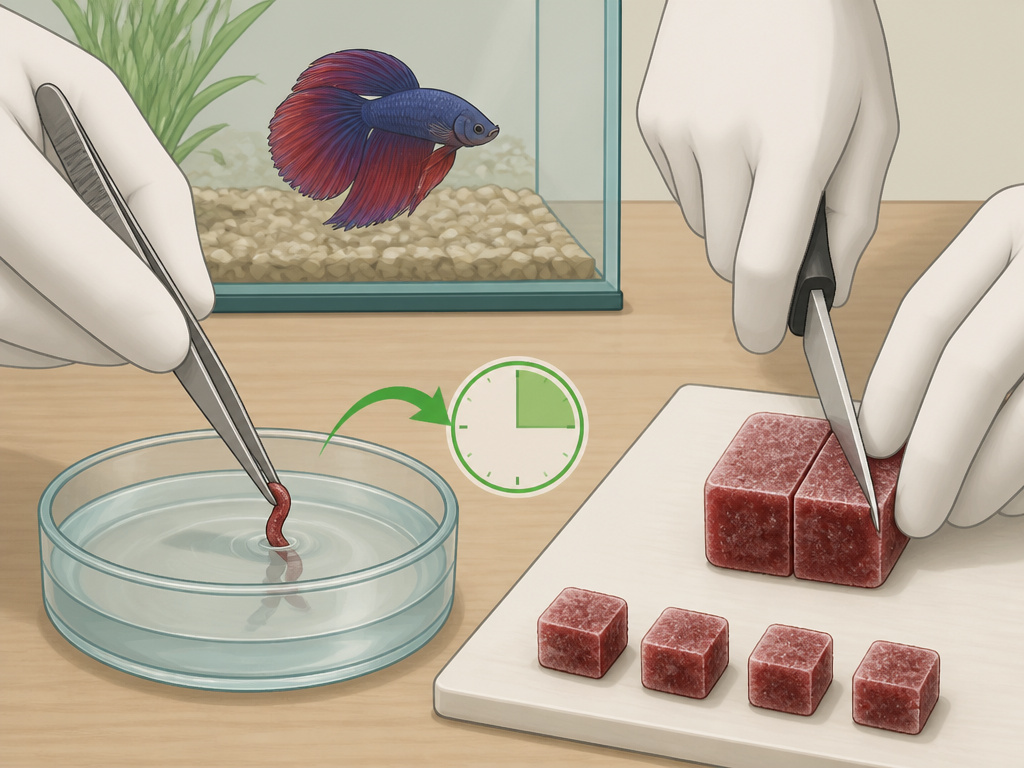
Freeze-dried bloodworms are a treat, not a staple.
Sanders caps high-protein treats like freeze-dried and frozen options at once or twice weekly. Petco’s care sheet takes a different line entirely, listing freeze-dried bloodworms and frozen food as routine components of a balanced diet with no frequency cap attached.
That’s a real disagreement, and I’d side with the vet. Treats are a supplement to a complete pellet or flake, not a replacement for it.
OATA sits in the middle. Its care sheet lists small live or frozen items like daphnia, small bloodworm and tubifex as a benefit alongside a good quality flake or pellet, without setting a number.
One more exception worth knowing: during breeding, Sanders notes protein needs rise and additional high-protein supplements are required. The once-or-twice-a-week cap doesn’t apply to a fish in condition.
Thawing and Soaking: The Two Steps People Skip
- Thaw frozen food before it goes in. Petco states this plainly, and a frozen cube dropped straight into the tank does nothing good for the water.
- Soak freeze-dried food first. The hobby blog recommends about 15 minutes in aquarium water, because dry food absorbs moisture and expands after it’s swallowed.
- Cut the cube down. That same source quarters a frozen cube, then divides one quarter into four pieces for a single sitting. A whole cube for one betta is far too much.
If the food came out of a freezer or a foil pouch, it needs water before it needs a fish. Thaw it, soak it, then feed it.
For the full method, the feeding bloodworms walkthrough covers portioning and rinsing in more detail than fits here.
When Overfeeding Goes Sideways
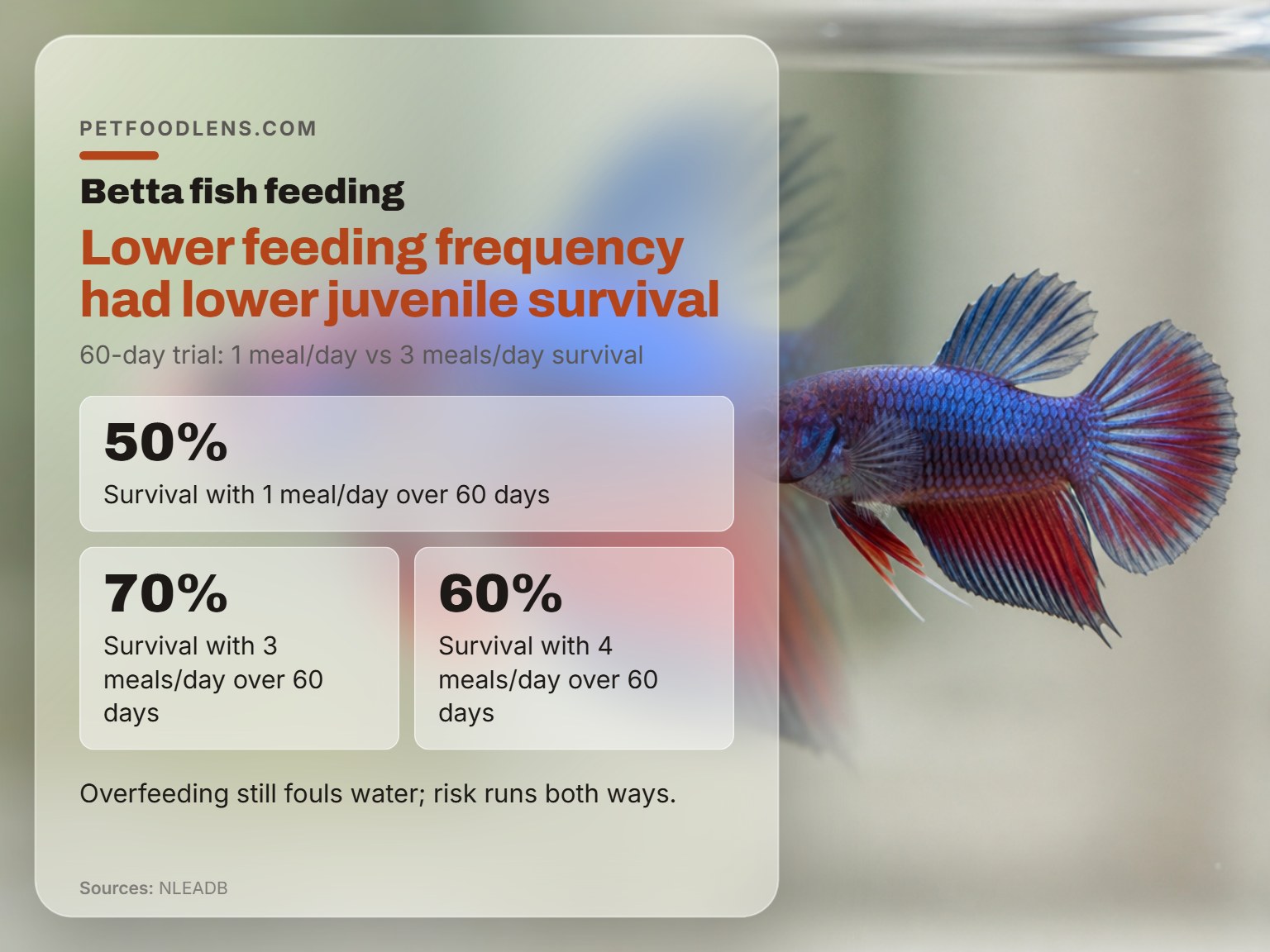
In the only controlled trial on this page, underfeeding killed more juveniles than overfeeding did.
That’s worth sitting with, because the hobby repeats “never overfeed” as if the opposite mistake doesn’t exist. At one meal a day, half the juveniles were dead inside 60 days.
None of which makes overfeeding safe. It just means the risk runs in both directions.
The failure signs are specific. Sanders describes a swollen abdomen, lethargy and dropsy, the last from internal organ damage. Petco adds that overfeeding fouls the water quickly, especially in small, unfiltered tanks.
| What you see | Likely cause | What to do |
|---|---|---|
| Swollen abdomen, fish sitting still | Overfeeding | Cut the portion, remove uneaten food |
| Cloudy water after feeding | Uneaten food breaking down | Net out leftovers, test ammonia |
| Pellets still floating at 5 minutes | Portion too large | Halve the next meal |
| Fish listless but water tests clean | Cold water slowing metabolism | Check the heater and thermometer |
That last row is the one people miss. Sanders notes that cold water slows metabolism significantly, so a fish in a cool tank digests slowly and looks unwell on a normal ration.
The overfeeding problem is really a water problem. OATA puts it directly: uneaten food breaks down and releases toxic waste into the water.
Easy to miss: A single oversized meal in a small unfiltered tank. Petco flags exactly that combination, and the water can turn before you’ve finished putting the lid back on.
The Tank Setup That Decides How Much You Feed
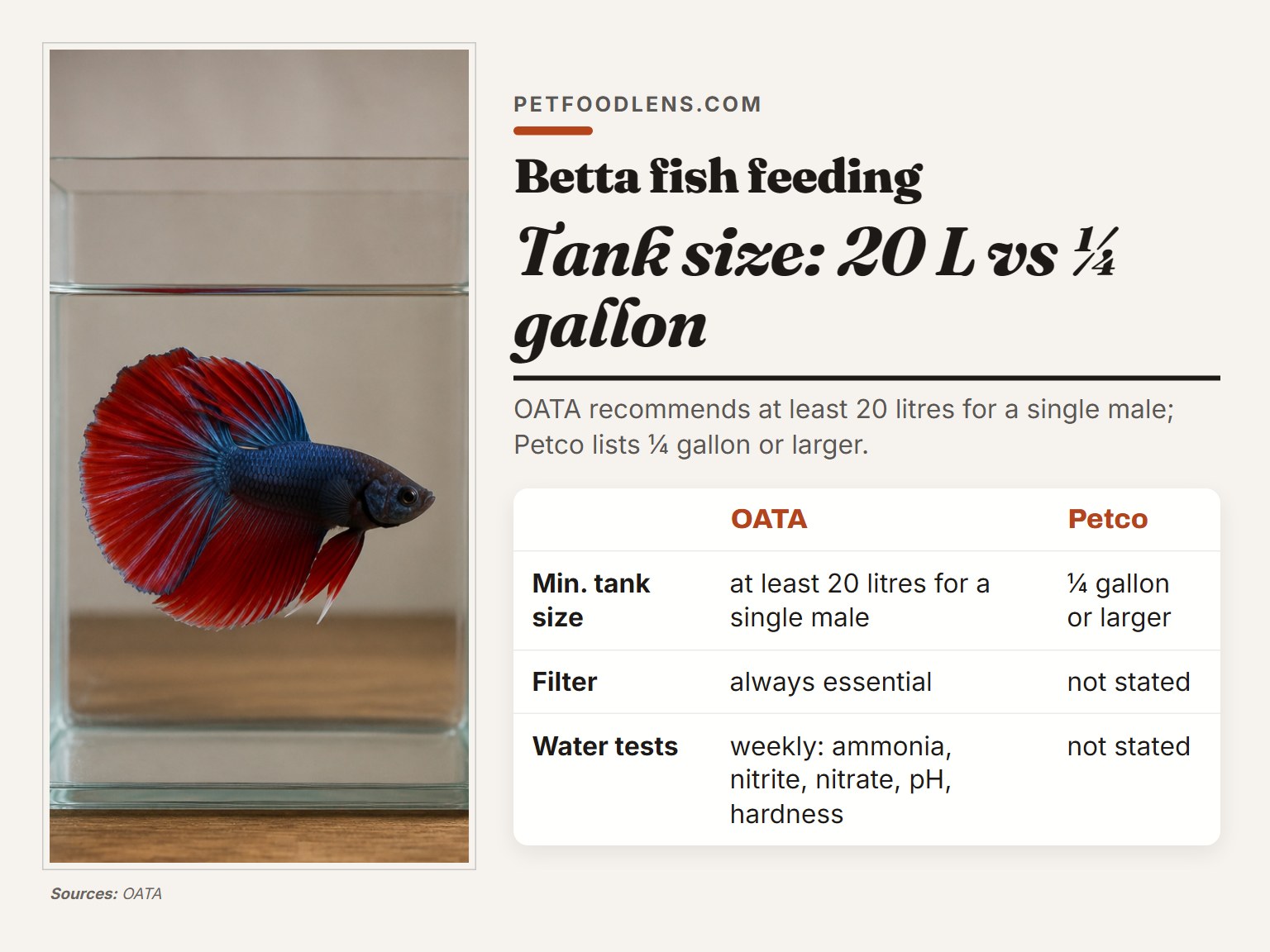
Feeding volume only makes sense against the volume of water it lands in.
OATA recommends at least 20 litres for a single male and at least 60 litres for a group of females, and states that a filter is always essential. Petco’s sheet lists a minimum of a quarter gallon or larger.
That’s a wide gap: OATA recommends at least 20 litres for a single male, while Petco lists a quarter gallon or larger, and I’d take the larger number. A quarter gallon is a temporary holding volume, not a life.
The same trade body asks for weekly tests of ammonia, nitrite, nitrate, pH and hardness, especially during setup and after adding fish. That’s your feedback loop. Without it you’re feeding blind.
A laboratory care paper puts the tolerable range much wider than home guidance suggests: pH 5.0 to 9.0 and salinity up to 9.35 mS/cm (6,000 ppm). Tolerating a range and thriving in it are different things, and the same care and use of bettas for research paper keeps its own colony at pH 7.0 and 1.0 mS/cm.
Temperature and Digestion
Sanders gives 77 to 80 degrees Fahrenheit, checked with a reliable thermometer, while Petco lists 72 to 82 degrees.
Sanders’ narrower 77–80 °F band is the safer target, while Petco lists 72 to 82 °F, because digestion slows as the water cools. If your heater is holding 74, the fish will eat the same amount and process less of it.
Your weekly routine, in order:
- Test ammonia and nitrite first. Both should read zero in a cycled tank.
- Then nitrate, pH and hardness. These tell you whether the water is drifting between changes.
- Check the thermometer against the heater setting. A heater dial is not a measurement.
- Log the result. Trends matter more than any single reading.
One last number that catches people out. Sanders notes bettas can’t withstand fasting for more than a few days, so a trip longer than a day needs a timed feeder or a sitter.
Frequently Asked Questions
Can I feed my betta once a day?
You can, and OATA’s care sheet says to. The 60-day juvenile trial points the other way: one meal a day produced 50 percent survival, against 70 percent on three meals. Two small meals is the reasonable middle for an adult fish.
How many pellets should a betta get?
It depends on the pellet. Hikari’s page gives six pellets morning and night for a 1.5 inch fish, capped at six per feeding. Sanders doses by eyeball size instead, which works out to between two and twelve pellets depending on the brand.
Should I soak freeze-dried food before feeding?
Yes. Dry food absorbs water and expands after it’s swallowed, and one hobby source recommends about 15 minutes in aquarium water first. Petco makes the same point for frozen food: thaw it before it goes in the tank.
How long can a betta go without food?
Few days at most. Sanders is direct that bettas can’t withstand fasting beyond that, so anything longer than a day away needs a timed vacation feeder or someone to feed the fish.
Do bettas need a filter?
OATA states that a filter is always essential, and Petco’s overfeeding warning singles out small unfiltered tanks as the fastest to foul. A filter doesn’t remove the need for water changes, but it buys you time between them.
The Bottom Line
If your betta is in anything under 20 litres with no filter, fix the tank before you touch the feeding schedule. Portion control in a tank that can’t process waste is just a slower version of the same problem.
The single most useful thing you can do this week is smaller than that. Count the portion into a cup before it goes in the water, and net out whatever is still floating at five minutes.
I’ll be honest about where my read on this gets thin. My background is commercial pet food formulation, mostly cat food, and fish nutrition is a shallower shelf for me. The frequency and portion numbers above come from the sources cited, not from my own trials, and I’d defer to an aquatic veterinarian on anything that looks like illness rather than appetite.
The one thing I’d carry over from the cat food side is the label habit. Turn the tub over, read the first four ingredients, and check the date you opened it. The front of the package is written by someone selling food, not someone measuring it.
