
Puppy Food Pros and Cons: What the Label Won’t Tell You
This post contains affiliate links. As an Amazon Associate, we earn from qualifying purchases.
The puppy food pros and cons break down like this: a growth formula supplies the energy, protein, calcium, and DHA a puppy needs, while the “complete and balanced” claim on the bag can rest on either an AAFCO nutrient profile or an AAFCO feeding trial, and those two routes are not equal.
A profile check confirms the recipe was formulated to hit nutrient minimums on paper. A feeding trial puts the finished food in front of puppies and watches what happens. Only the second one tests digestibility, and only the second one catches an ingredient interaction nobody predicted.
What follows walks the puppy food pros and cons that survive a label check, the cons that don’t, and the numbers on the back of the bag that decide how much actually goes in the bowl.
Key Takeaways
- Feeding trials outrank profile claims. A diet formulated to a nutrient profile has been checked on paper; a diet that passed an AAFCO feeding trial has been fed to puppies.
- Puppy food until 12 to 18 months is what VCA Animal Hospitals recommends, while the AKC puts the switch for small breeds at 7 to 9 months.
- “All life stages” is a puppy diet, and dvm360 warns it often carries more calories and calcium than a large or giant breed puppy needs.
- Weigh the puppy every two weeks and feed to a body condition of 4/9 rather than to the chart printed on the bag.
- Third-party seals prove nothing about nutritional adequacy, according to FDA.
What “Complete and Balanced” Actually Certifies
AAFCO’s first Dog Food Nutrient Profiles appeared in 1991, the cat profiles followed in 1992, and the current revision dates to 2016. That timeline matters, because the phrase on the bag is tied to those documents rather than to how the food performs in a bowl.
Two legal routes support a “complete and balanced” statement: formulation to meet an AAFCO Dog or Cat Food Nutrient Profile, or passage of an AAFCO feeding trial. The profiles set a minimum level for every nutrient and a maximum for some. Endorsements from other organizations are not assurances of nutritional adequacy.
The FDA complete and balanced pet food guidance spells out both routes and the exact labeling language that has to accompany each one. A food that cleared a feeding trial says so in a specific sentence. A food that was merely formulated to a profile says something different.
AAFCO recognizes four adequacy categories: growth, maintenance, gestation and lactation, and all life stages. Two nutrient profiles exist per species, one for growth and reproduction and one for adult maintenance. Every listed nutrient carries a minimum, and some carry a maximum.
Here is the clause almost nobody reads. A dog food labeled for growth or all life stages must state, word for word, either “including growth of large-size dogs (70 lb [32 kg] or more as an adult)” or “except for growth of large-size dogs.”
Then there is the seal problem. FDA states plainly that endorsements and seals from organizations other than AAFCO are not assurances of nutritional adequacy and may be misleading. A gold badge on the front of the bag means a marketing department paid for a gold badge.
Treats, snacks, and supplements sit outside all of this. They are typically not intended as a sole diet and are often not complete and balanced.
The Pros of Puppy Food That Survive a Label Check
A growth formula earns its place by covering things an adult maintenance bag is not built to cover. The peer-reviewed nutrition literature lists the factors that matter during growth as energy, protein, calcium, phosphorus, omega-3 DHA, and antioxidant support.
- Energy density tuned to a growing body. During the first four months, energy needs run about twice those of a mature adult of the same body mass.
- A protein and mineral floor set for growth, not for maintenance, which is the whole point of the separate profile.
- DHA, which VCA Animal Hospitals flags for brain and eye development and specifically wants to see at high levels in puppy food.
- Feeding-trial substantiation on the better diets, which the veterinary nursing literature calls the most critical determination for safe use.
That last puppy food pros and cons point deserves the emphasis. A diet formulated to meet AAFCO recommendations has been analyzed to contain nutrients within the recommended allowances. Without a feeding trial, digestibility problems and untoward interactions between ingredients and nutrients can go undetected.
Which brands actually carry that structure? Look for a puppy diet matched to your dog’s expected adult size class.
Most owners end up comparing a list of best puppy foods before they ever turn the bag over. Turn it over first.
The Cons: Where the Claims Outrun the Evidence
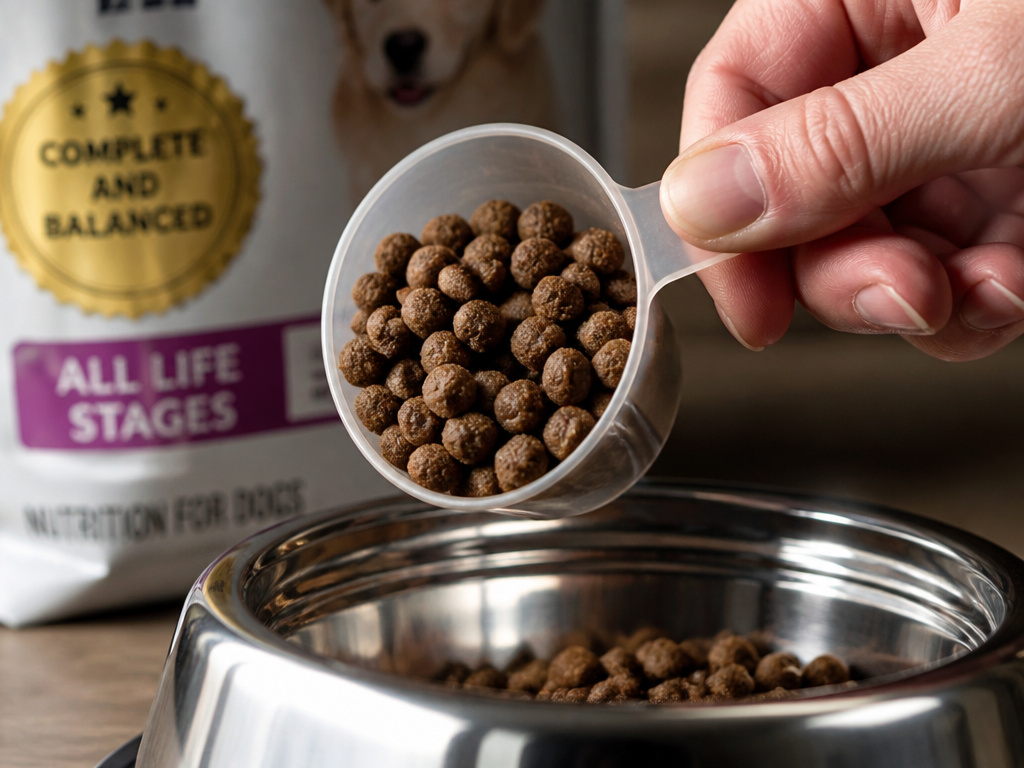
That is the gap that matters. The number on the bag and the number in the bowl are two different numbers, and the label is not a lab report.
Third-party seals are the second soft spot. FDA’s position is that non-AAFCO endorsements are not assurances of nutritional adequacy and may be misleading, which puts a dent in any bag that leads with a badge instead of an adequacy statement.
“All life stages” is the third. AAFCO treats it as a legitimate category covering gestation, lactation, growth, and adult maintenance. Dvm360’s proceedings take a harder line: these diets often contain excessive calories for adult dogs at maintenance and potentially for growing large and giant breed puppies, and their calcium content may be inappropriate for large and giant breeds.
The kibble-risk finding that never makes the bag
A Finnish cohort study followed puppies into adulthood and reported that dry kibble during puppyhood and adolescence was a significant risk factor for later chronic enteropathy, while non-processed meat-based diets looked protective. That finding runs directly against the standard framing in which complete and balanced kibble is the assurance of adequacy.
Both positions are real. FDA’s guidance treats a complete and balanced claim as the marker of a valid sole diet. The cohort study treats kibble as a risk marker. Nobody has reconciled them, and any article that claims otherwise is smoothing over a genuine disagreement.
Brand size is not a shield either. FDA received roughly 1,300 adverse event reports for a variety of Purina pet foods between November 22, 2023, and April 15, 2024, mostly gastrointestinal. The FDA Purina adverse event report summary is worth reading in full rather than in a headline.
What most people get wrong: Treating “all life stages” as the flexible, one-bag-fits-everyone option. It is a puppy diet by another name, and dvm360 warns the calorie and calcium load can be wrong for a large or giant breed puppy.
Many grain-free dog food formulas simply swap corn for peas, potato, or tapioca. I have watched that swap happen across dozens of panels, and the starch load barely moves. A bag with a wolf on the front and a starch-heavy ingredient list is still a starch-heavy bag.
Dry, Canned, or Semi-Moist: What Does the Form Actually Change?
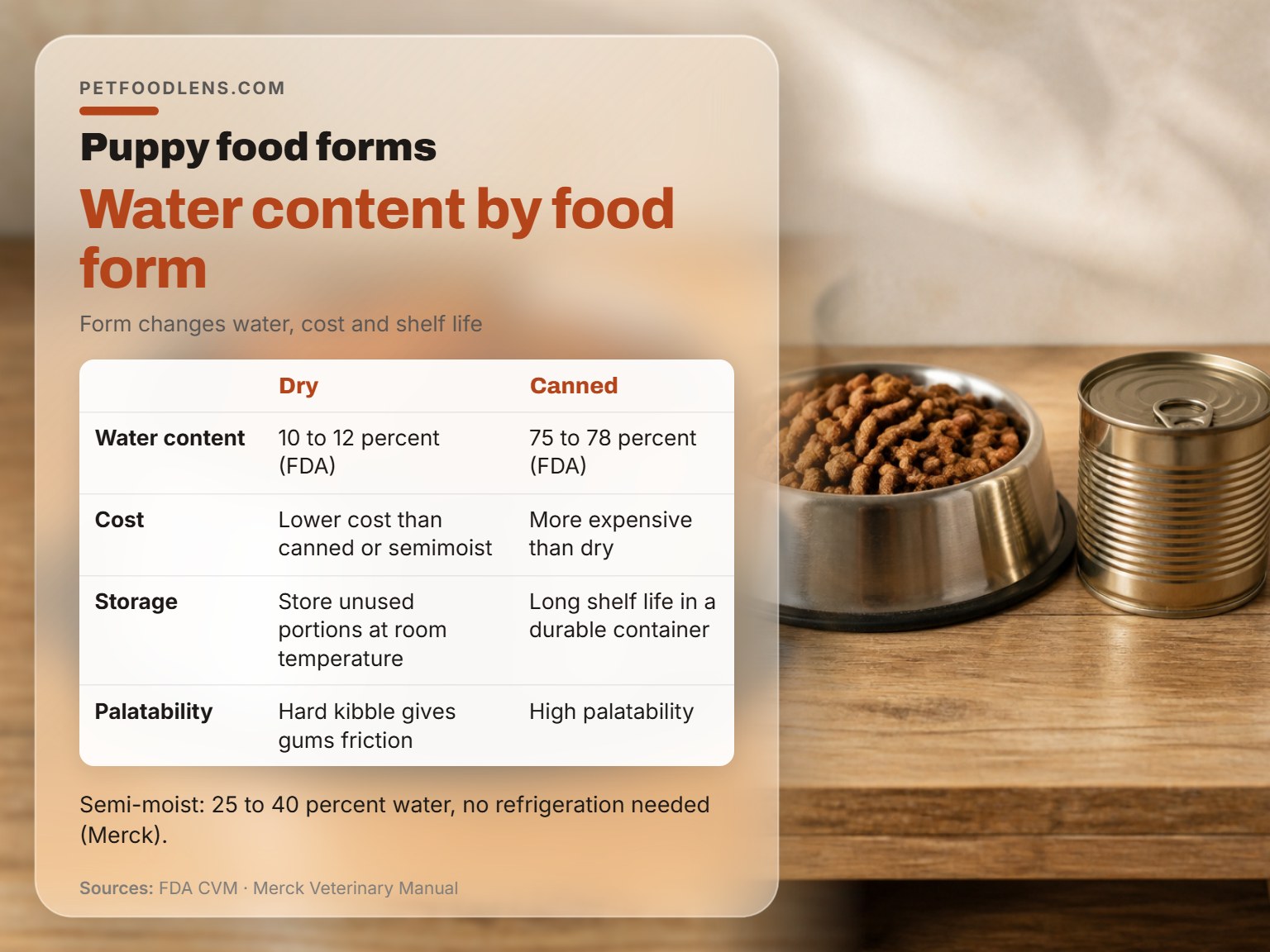
Form changes water content, cost, and shelf life. It does not automatically change nutritional adequacy, which is a separate question decided by the statement on the back.
| Form | Water content | What it changes |
|---|---|---|
| Dry | 10 to 12 percent (FDA) | Lowest cost, stores at room temperature, hard kibble gives gums friction |
| Canned | 75 to 78 percent (FDA) | Highest palatability, highest cost, perishable once opened |
| Semi-moist | 25 to 40 percent (Merck) | No refrigeration needed, often high in sugar and calories |
Dry
Dry food runs roughly 90 percent dry matter, and about 95 percent of dry dog and cat foods are made by extrusion. Cooking temperatures in the plant range from about 80 to 200 degrees Celsius, with a minimum of 130 degrees Celsius needed to kill both microbes and bacterial spores.
Canned
Open a can and the smell arrives before the lid is fully back. That aroma is the water doing the work, since canned food is three-quarters moisture. Canned diets are a good choice if the label says growth and complete and balanced, but VCA notes they cost considerably more than the other forms.
Semi-Moist
Semi-moist products sit at 25 to 40 percent water and need no refrigeration. VCA’s warning is specific: these are often high in sugar and calories and should be chosen on nutritional quality rather than taste, packaging, or consistency.
How Much Should You Feed a Puppy?
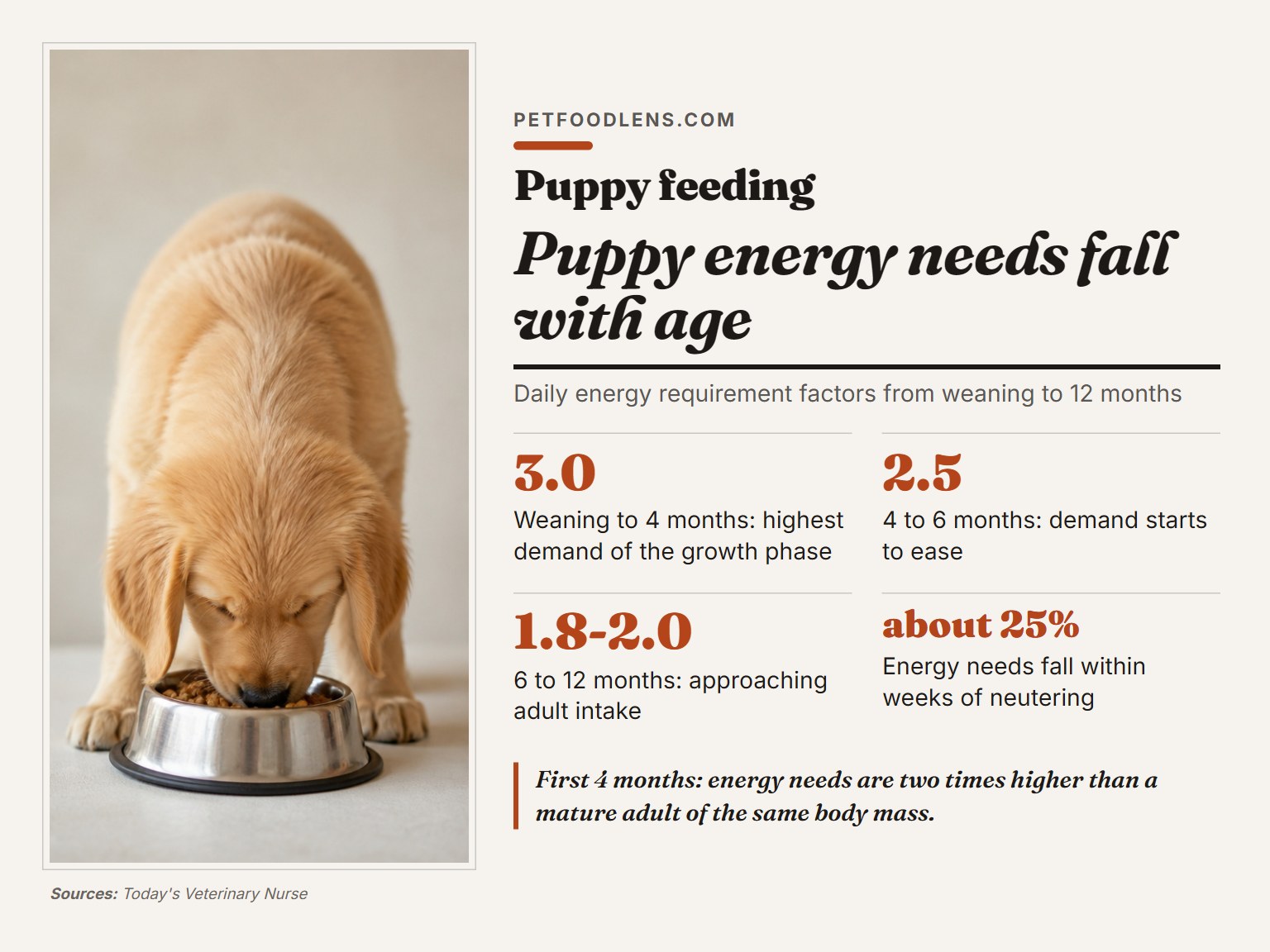
Energy needs run about twice those of a mature adult of the same body mass during the first four months, then taper. The daily energy requirement factors published in the veterinary nursing literature show the shape of that curve.
| Age | MER/DER factor | What it means in practice |
|---|---|---|
| Weaning to 4 months | 3.0 | Highest demand of the entire growth phase |
| 4 to 6 months | 2.5 | Demand starts to ease |
| 6 to 12 months | 1.8 to 2.0 | Approaching adult intake |
Then the curve drops again. Energy requirements are estimated to fall by about 25 percent within weeks of neutering, and if calories are not cut after the procedure, obesity is likely.
The AKC puppy nutrition PDF lays out a feeding schedule by age: four feedings a day from 6 to 12 weeks, dropping to three between 3 and 6 months, and twice daily from 6 to 12 months. Large breeds should be on unmoistened dry food by 9 or 10 weeks; small dogs by 12 or 13 weeks.
Feeding guidelines on the bag are general recommendations at best. Body weight and body condition have to be monitored to prevent overfeeding or underfeeding, and Merck is explicit that the label chart is a starting point rather than an instruction.
A body condition score of 4/9 during growth means you can feel the ribs under a light hand without pressing and see a waist from above. That is the target, not the number of cups printed on the bag.
Where this goes sideways: Free-feeding a puppy from a full bowl. Dvm360 is direct that puppies should always be meal-fed rather than allowed ad libitum consumption, and the difference shows up on the scale within a month.
When Do You Switch From Puppy Food to Adult Food?
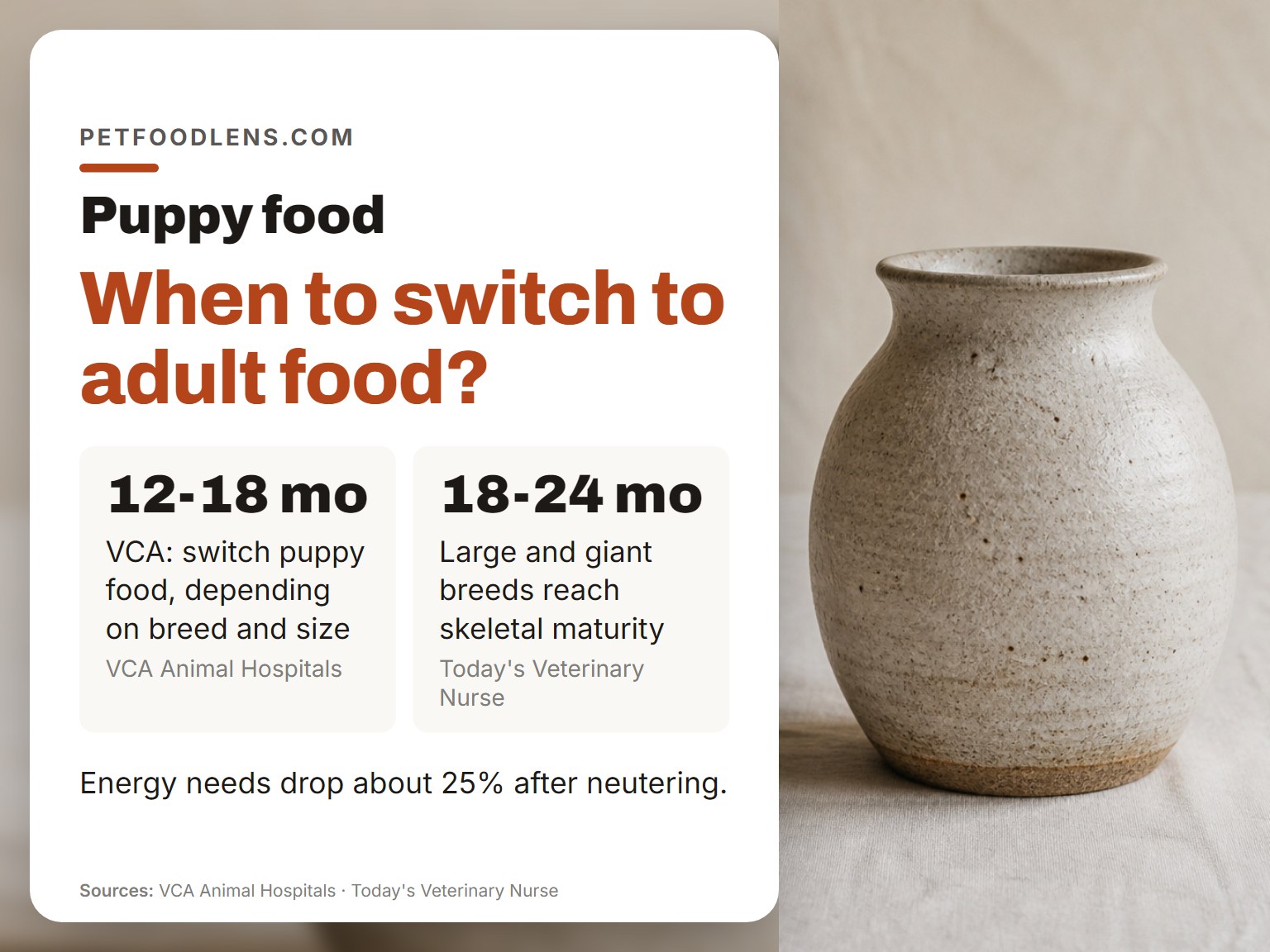
The honest answer is that the sources do not agree, and the disagreement is wide enough to matter. Here is who says what.
| Source | When they say to switch |
|---|---|
| VCA Animal Hospitals | About 12 to 18 months, depending on breed and size |
| American Kennel Club | Small breeds 7 to 9 months; bigger breeds 12 to 14 months, after spay/neuter |
| dvm360 proceedings | Large and giant breeds stay on a growth diet until adult size, 12 to 24 months |
The AKC ties the switch to neutering, which lines up with the roughly 25 percent drop in energy requirement that follows the procedure. VCA ties it to breed and size. Dvm360 ties it to skeletal maturity, which for large and giant breeds arrives between 18 and 24 months.
Small and medium dogs reach adult body weight between 9 and 10 months and skeletal maturity between 9 and 12 months. Large and giant breeds keep growing until about 18 months and reach skeletal maturity between 18 and 24 months. That physical timeline is the reason a single switch date cannot serve every puppy.
Easy to miss: Switching by age alone. A puppy that is still filling out at 11 months does not need an adult maintenance bag just because a calendar says so.
Large Breed Puppies and the 70 lb Clause on the Bag
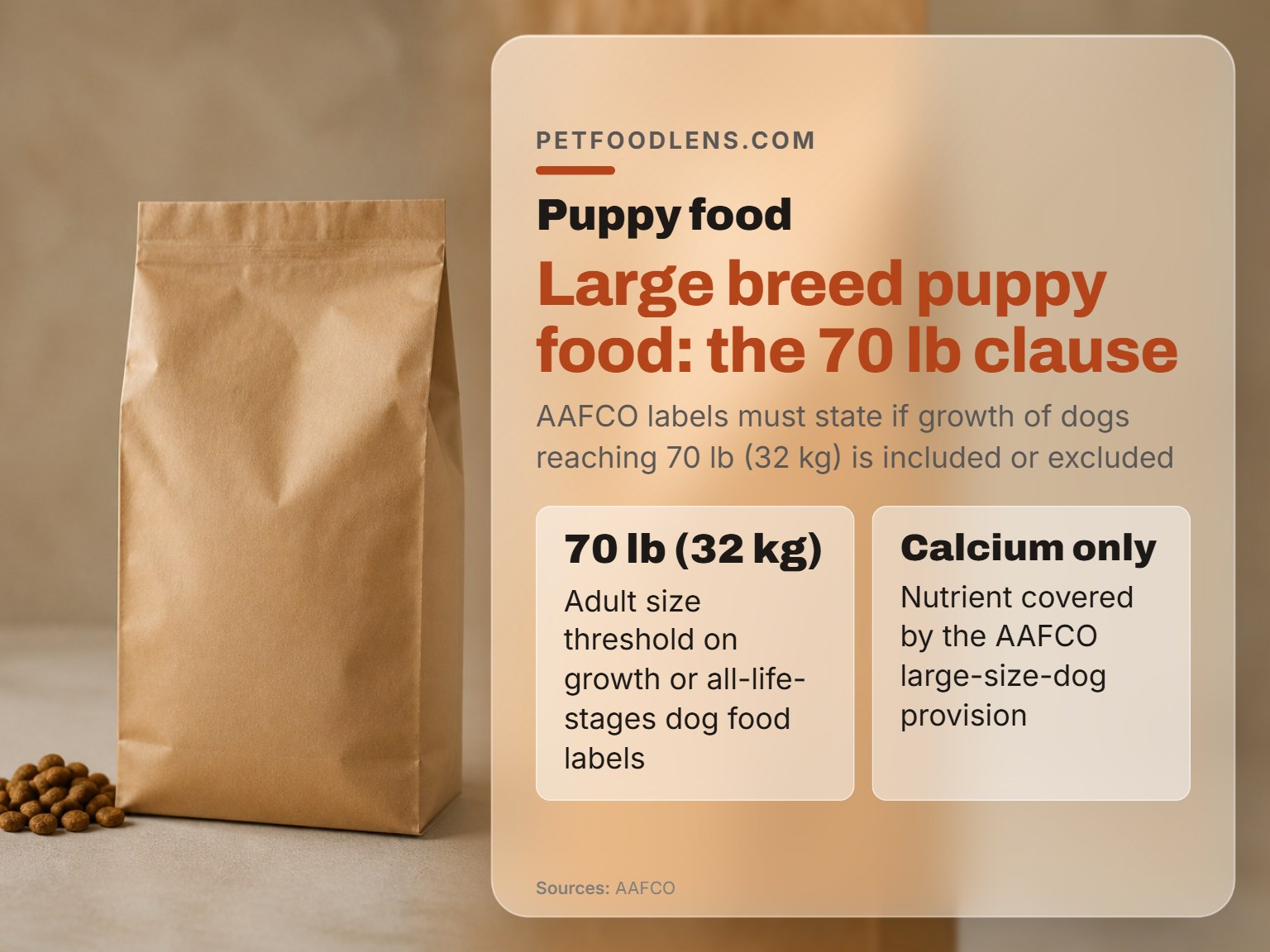
A bag labeled for growth or all life stages has to declare whether it includes or excludes growth of dogs that will reach 70 lb or more as adults.
That is a feeding-trial recommendation, not a calcium-percentage recommendation.
The stakes are documented. Two major nutritional risk factors for developmental orthopedic disease are rapid growth and excess calcium intake, and rapid growth from excessive calories appears to be the more prevalent of the two. In one well-designed study, Labrador retriever puppies fed free choice had over twice the rate of hip dysplasia as sex-matched littermates fed 75 percent of their intake.
Caloric restriction and slowed growth were also associated with a significantly longer lifespan, 18 to 24 months, without additional morbidity. And restriction does not change the puppy’s final size. It changes how long the puppy takes to get there.
One gap worth naming: there is no legal definition of a “large breed” growth diet. These products are typically lower in calcium and lower in energy density, but no standard governs the claim itself.
Raw, Home-Cooked, and Fresh: Where the Pros and Cons Get Sharpest
Seven organizations discourage feeding raw or undercooked animal-source protein to dogs and cats: AAHA, NASPHV, AAFP, AVMA, CDC, FDA CVM, and CVMA. The risks listed in the veterinary literature are nutrient imbalances, dental injury, gastrointestinal obstruction or perforation, and exposure to pathogens.
Before you start: Freezing and freeze-drying do not destroy all pathogens and spores in a raw product, and high-pressure pasteurization usually does not eliminate them completely. Freezing and freeze-drying do not destroy all pathogens and spores in a raw product, and high-pressure pasteurization usually does not eliminate them completely, and a dog fed an uncooked diet can shed pathogens in feces that reach every surface in the kitchen.
It is illegal in the US to sell commercial pet food contaminated with Salmonella, and numerous commercial raw diets and pig ears have been recalled since 2017 for Salmonella and Listeria. Relative to market share, raw diets have been recalled at a much higher rate than cooked commercial diets.
A raw dog food diet is where the source disagreement is sharpest. Merck documents the organizational opposition and the pathogen risk. A Finnish cohort study found raw bones and non-processed meat-based diets looked protective against later chronic enteropathy. Both are on the record, and neither cancels the other.
Home-cooked diets split the same way. Merck says dogs can be maintained successfully on properly formulated home-cooked diets, using a recipe from a boarded veterinary nutritionist rather than one from the internet or a book. Dvm360 goes further: the majority and most severe nutrition-related disease in growing puppies comes from home-prepared diets, nearly all online and book recipes are deficient, and owners should wait until at least a year of age for small breeds or 18 months for giant breeds before starting one.
Table scraps land in the same pile of contradictions. FDA says an occasional treat of people food may be fine but too many scraps cause an unbalanced diet. VCA’s rule is that at least 90 percent of the diet should come from a quality commercial puppy food if table food is given at all. The Finnish cohort found table scraps during puppyhood associated with less chronic enteropathy.
How to Read a Puppy Food Label, In Order
Three things on the back of the bag decide more than anything printed on the front: the adequacy statement, the guaranteed analysis, and the calorie line. Read them in that order.
- Find the adequacy statement. Look for the sentence naming AAFCO and a life stage. If it says “intermittent or supplemental feeding only,” the product is not a sole diet.
- Convert the guaranteed analysis to dry matter. Those numbers are expressed as-fed, so a canned food at 75 to 78 percent moisture and a dry food at 10 to 12 percent moisture cannot be compared without conversion.
- Check the calorie line. US labels must state metabolizable energy both as kcal/kg and per household measure, such as cups.
- Then read the ingredient list, in order. Ingredients are listed by descending weight on an as-fed basis, so a 75 percent moisture ingredient listed first contributes far less to dry matter than the same ingredient in dry form.
People ask me whether they can judge a food by its first five ingredients. In my experience that shortcut misses ingredient splitting, additive contributions, and the guaranteed analysis entirely. I read the whole list, then I check it against the numbers.
Two more label facts are worth carrying into the aisle. No reference to quality or grade of an ingredient is allowed on a pet food label, which limits how much an ingredient list can tell you. And over-the-counter diets made in plants that handle other ingredients can contain trace amounts that are not listed, which is why Merck suggests a therapeutic diet when you are trying to rule out an allergy.
Protein has a minimum in the growth profile, not a prize for exceeding it.
Frequently Asked Questions
Is puppy food better than adult food for a puppy?
Yes, if the puppy is still growing. The open question is when growth ends, which varies from 7 to 9 months in small breeds to 24 months in giant breeds.
Should I pick a puppy food that passed a feeding trial?
Where a diet offers one, yes. The veterinary nursing literature calls successful feeding trials for the intended population the most critical determination for safe use, because without them digestibility and untoward ingredient interactions can go undetected.
Is “all life stages” the same as puppy food?
Sources disagree: dvm360 describes all-life-stages diets as puppy diets designed to also feed lactating bitches and adult dogs, while AAFCO and Merck treat ‘all life stages’ as a valid adequacy category. The caution is that they often carry more calories than an adult needs and calcium levels that may be inappropriate for large and giant breed puppies.
Can I feed my puppy table scraps?
Sources disagree. FDA says an occasional treat of people food may be fine but too many scraps cause an unbalanced diet. VCA says at least 90 percent of the diet should come from a quality commercial puppy food if table food is given. A Finnish cohort study found table scraps associated with less chronic enteropathy later.
Do I need a large breed puppy food?
If your puppy will weigh 70 lb or more as an adult, the label has to tell you whether the food includes or excludes growth of large-size dogs, and that provision covers calcium; dvm360 separately warns that all-life-stages calcium may be inappropriate for large and giant breed puppies. Dvm360 recommends a growth diet that passed AAFCO feeding trials for growth until adult size is reached.
How often should I feed a puppy?
The AKC schedule runs four feedings a day from 6 to 12 weeks, three a day from 3 to 6 months, and twice daily from 6 to 12 months. Dvm360 is firm that puppies should be meal-fed rather than given free access to a full bowl.
The Bottom Line
One rule most guides skip: if your puppy is gaining faster than the body condition score suggests, cut calories before you change formulas. Dvm360’s data on Labrador littermates showed free-choice feeding more than doubled the rate of hip dysplasia, and caloric restriction did not shrink the adult size. It just slowed the trip there.
Start this week by weighing your puppy and writing the number down. Then turn the bag over and find the adequacy statement. If it names AAFCO and a growth life stage, you have a real puppy diet in your hands. If it names a gold seal and nothing else, put it back.
Fair warning on the rest: the sources genuinely disagree on when to switch to adult food and on how much table food belongs in a puppy’s bowl. Match the decision to your dog’s size, body condition, and veterinary advice rather than to a single number you read once.
