
How to Train a Puppy With Treats: A Calorie-Smart Plan
This post contains affiliate links. As an Amazon Associate, we earn from qualifying purchases.
To train a puppy with treats, keep every treat inside a 10% daily calorie allowance and make each piece tiny, fast to eat, and worth working for. A puppy needing 550 calories a day gets 495 from complete food and 55 from treats, per VCA Animal Hospitals.
Those 55 calories are a hard ceiling. Cross it often and the puppy gains weight while still acting hungry, because treats crowd out the complete food that carries the vitamins and minerals. Measure the daily treat portion before the session starts, and learn how to train a puppy with treats so the calories stay within that limit.
What follows covers the calorie math, how big a single treat should be, when kibble beats a smelly commercial treat, and how to fade treats without losing the behavior.
Key Takeaways
- Keep treats under 10% of daily calories — a 550-calorie puppy gets 55 calories of treats, total.
- Cut treats to pea or pencil-eraser size before the session; large commercial treats slow reps and add calories.
- Use soft, smelly treats in distracting places and plain kibble in the quiet living room.
- Reward within a second of the behavior so the puppy links the marker to the food.
- Plan to keep paying for work — VCA says the reward continues for life, even as the puppy does more per treat.
The 10% Rule That Sets Your Puppy’s Treat Budget
Grab the treat bag and the puppy’s food, and do the math before the first session. VCA Animal Hospitals puts the treat ceiling at 10% of total daily calories, a figure set to prevent excess calories and nutrient deficiencies at the same time.
Treats must stay within 10% of a dog’s total daily calorie intake to prevent excess calories and nutrient deficiencies. A dog requiring 550 calories per day should receive 495 calories from a complete and balanced diet and 55 calories from treats. Measuring the daily treat portion in advance keeps the allowance intact.
The worked example is the whole system in one line. A puppy on 550 calories a day has 55 calories to spend on training. That is a small number of pea-sized soft treats, not a scoop.
The mistake I see most in how to train a puppy with treats is counting the commercial treats and forgetting the kibble. VCA is explicit that kibble used as a reward still counts toward the calorie total, and a treat-heavy training day can push a puppy past its needs even on complete food. Weigh the whole day’s rewards, not just the ones from a bag.
Working out how many treats a puppy can have starts with that calorie total, not with a treat count on the package.
What Counts as a Treat
Anything the puppy eats for a reward. That includes kibble, string cheese, freeze-dried liver, and the crust of your sandwich if you are not paying attention. VCA recommends checking the calories per treat on the package for commercial treats, and using the USDA FoodData Central database to estimate calories for whole foods like carrots or green beans.
| Treat Type | Best Use | Calorie Risk |
|---|---|---|
| Regular kibble | Quiet living-room reps | Low, but still counts |
| Soft training treats | Distracting locations | Moderate, read the per-treat calories |
| Freeze-dried liver | Impromptu rewards on walks | High value, keep pieces tiny |
| Bully sticks | Crate time or alone time | High total calories per stick |
What Size Should a Training Treat Be?
Two authorities give slightly different numbers, and both are workable. VCA calls for treats “the size of a pencil eraser” for luring. The AKC says a pea-sized piece is plenty even for a large dog, and smaller dogs should get even tinier bits.
The right puppy training treats are small, soft, and smelly, which is the opposite of what most bags in the aisle actually contain.
Rule of thumb: If the puppy has to chew, the piece is too big. A training treat should be quick to eat so the next repetition can start.
Size matters for two reasons. The AKC points out that big treats mean more calories and a puppy that fills up before the session ends. A full puppy stops working. The second reason is speed: soft treats let you move to the next rep immediately, while biscuits leave crumbs on the floor and time ticking.
Why Soft Beats Crunchy
The AKC is direct on this. Soft treats are easier and faster to eat than crunchy ones, and they are smellier, which puts them higher in most dogs’ reward hierarchy. Cheese and bacon sit near the top for most puppies. Biscuits are fine as a one-off reward, not as the working currency of a session.
A few minutes of cutting treats for training ahead of time saves fumbling mid-rep. Trim larger commercial treats into small bits before you call the puppy over.
Kibble vs High-Value Treats: Which One Belongs in Your Pocket?
The honest answer is both, used in different places. VCA endorses the puppy’s regular kibble as a training reward because it is complete and balanced, so a treat-heavy day does not create a nutrient gap. The AKC guide to dog training treats takes the other side of the same question: kibble may work in a quiet living room, but in a distracting location you need the stinky treats the puppy adores.
| Kibble | High-Value Treat |
|---|---|
| Complete and balanced | Not nutritionally complete |
| Low calorie density | Higher calorie density |
| Works in quiet rooms | Works around distractions |
| No nutrient gap | Can unbalance the diet long term |
The split is practical. Use kibble for the fifth repetition of “sit” in your kitchen. Switch to high-value treats when you move to the front yard, the park, or a puppy class where squirrels and other dogs compete for attention.
VCA also flags the trap on the kibble side: even complete and balanced kibble can exceed calorie needs and cause weight gain. Kibble is not a free pass. It comes out of the same 55-calorie allowance.
How to Time the Reward So the Puppy Connects It
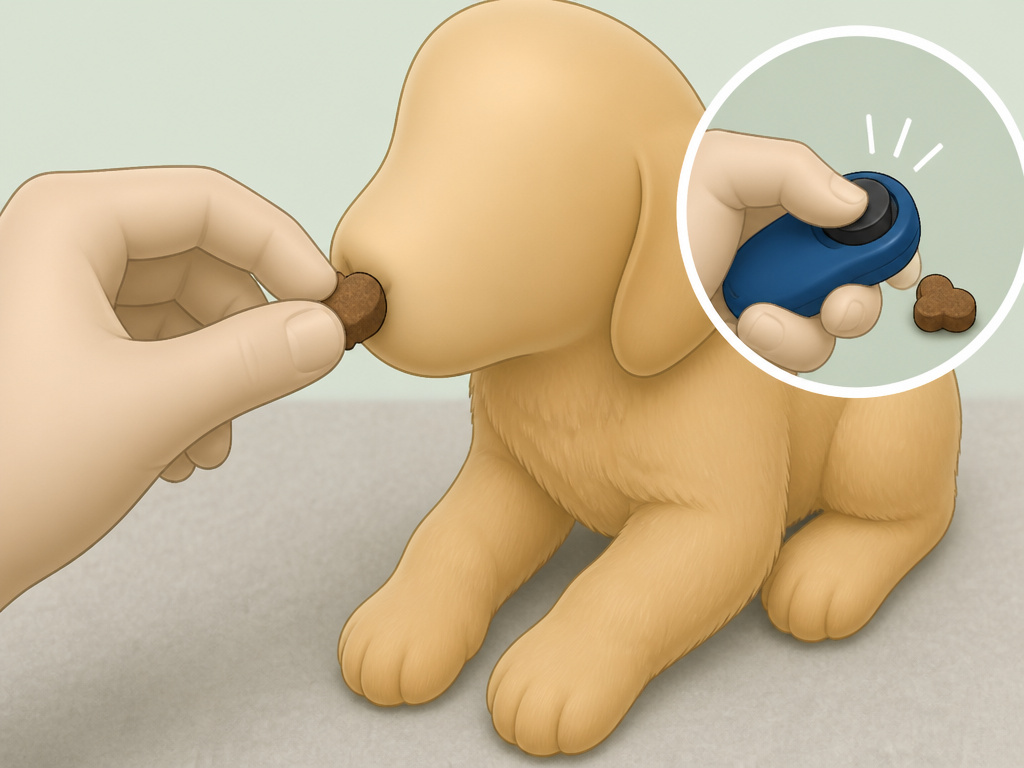
Timing is where the sources split cleanly on treat training, and the split matters. VCA’s luring method delivers bits of treats steadily as you back up a few steps, so the puppy is rewarded continuously through the movement. PDSA teaches a single reward the instant the behavior lands, so the puppy associates one treat with one action.
Luring Delivers Treats Continuously
Use this when teaching a new behavior for the first few reps. Hold the treat under the puppy’s nose like a magnet, draw the puppy into position, and feed small pieces along the way. VCA says most puppies can switch from a treat lure to an empty hand in the same shape within 5 to 10 repetitions, then alternate between an empty hand and a treat hand until the treat hand disappears.
Marker First, Treat Second
Once the puppy knows the behavior, switch to a marker. A click or a word like “yes” marks the exact moment the behavior happened, and the treat follows. A clicker is the tool I reach for because the click is consistent and the puppy hears it from across a room. That sharp click, followed by silence and then the treat, is the sound of a behavior getting locked in.
The two methods differ: VCA’s luring delivers bits of treats steadily during the lure, while PDSA teaches a single reward the instant the behavior lands. Luring builds the behavior; the marker sharpens it once the puppy understands what you are asking for.
Worth knowing before you start: A marker only works if the puppy has already learned that the click predicts food. Charge the clicker with several click-treat pairs in a quiet room before you use it on a real behavior.
Should You Phase Out Treats or Keep Them in Rotation?
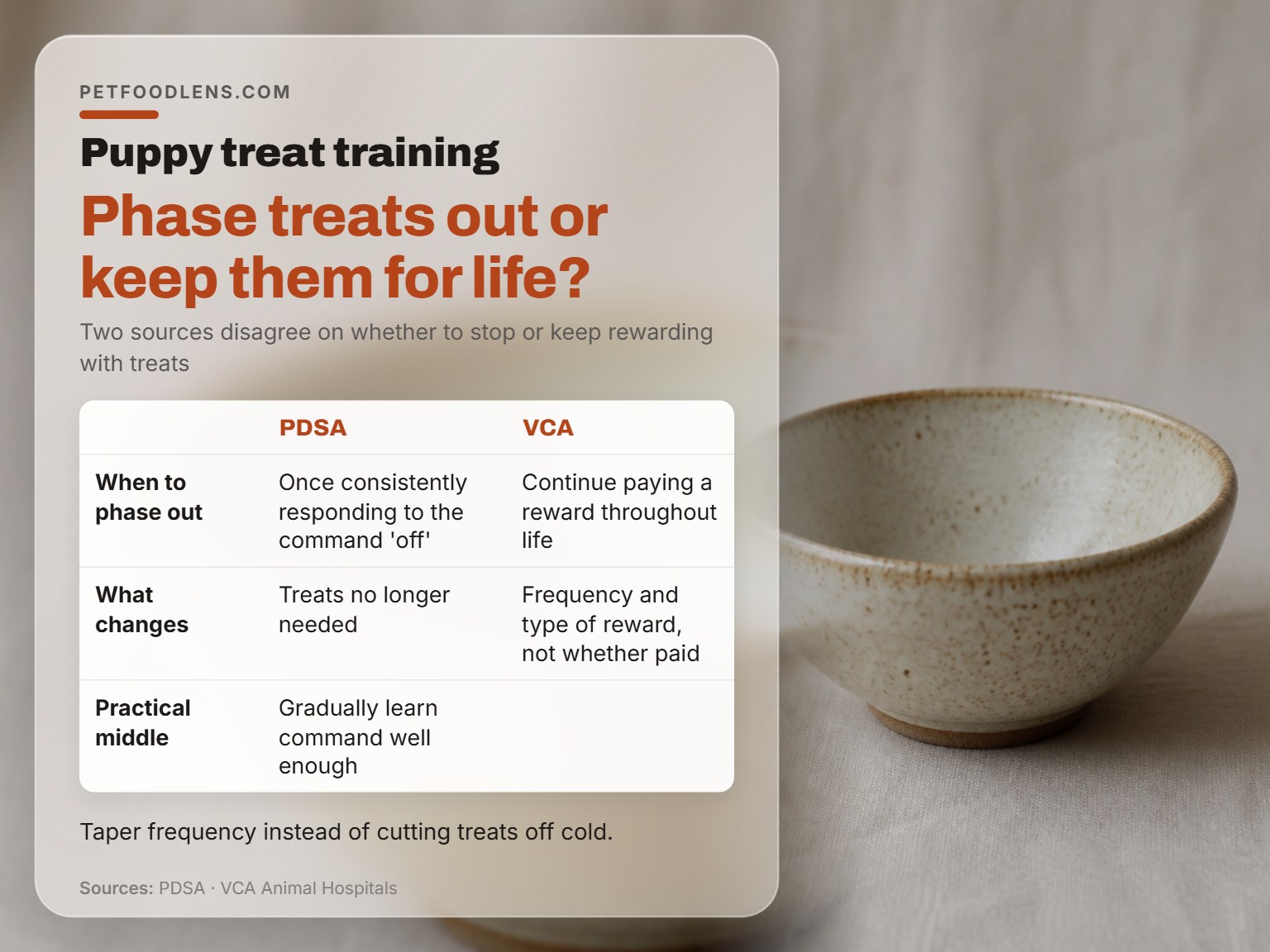
This is the clearest disagreement in the sources, and both positions have a case. PDSA says you can start to phase treats out once the puppy is consistently responding to a command, and that the dog should gradually learn the command well enough that treats are no longer needed. VCA takes the opposite view: plan to continue paying a reward for work throughout the dog’s entire life, and as the puppy matures it will perform more behaviors per treat.
The sources genuinely differ: PDSA says you can start to phase treats out once the puppy is consistently responding to a command, while VCA says to continue paying a reward for work throughout the dog’s entire life. What changes is the frequency and the type of reward, not whether the puppy gets paid at all. VCA’s intermittent reinforcement is the practical middle: once a behavior is solid, rotate a high-value treat with praise, a belly rub, a lower-value food, or a favorite toy.
The practical version of fading treats is tapering frequency, not cutting the reward off.
What most people get wrong: Dropping treats cold the day the puppy “gets it.” The behavior usually fades because nothing is reinforcing it. Taper the frequency instead of cutting it off.
How to Run a Training Session From Start to Finish
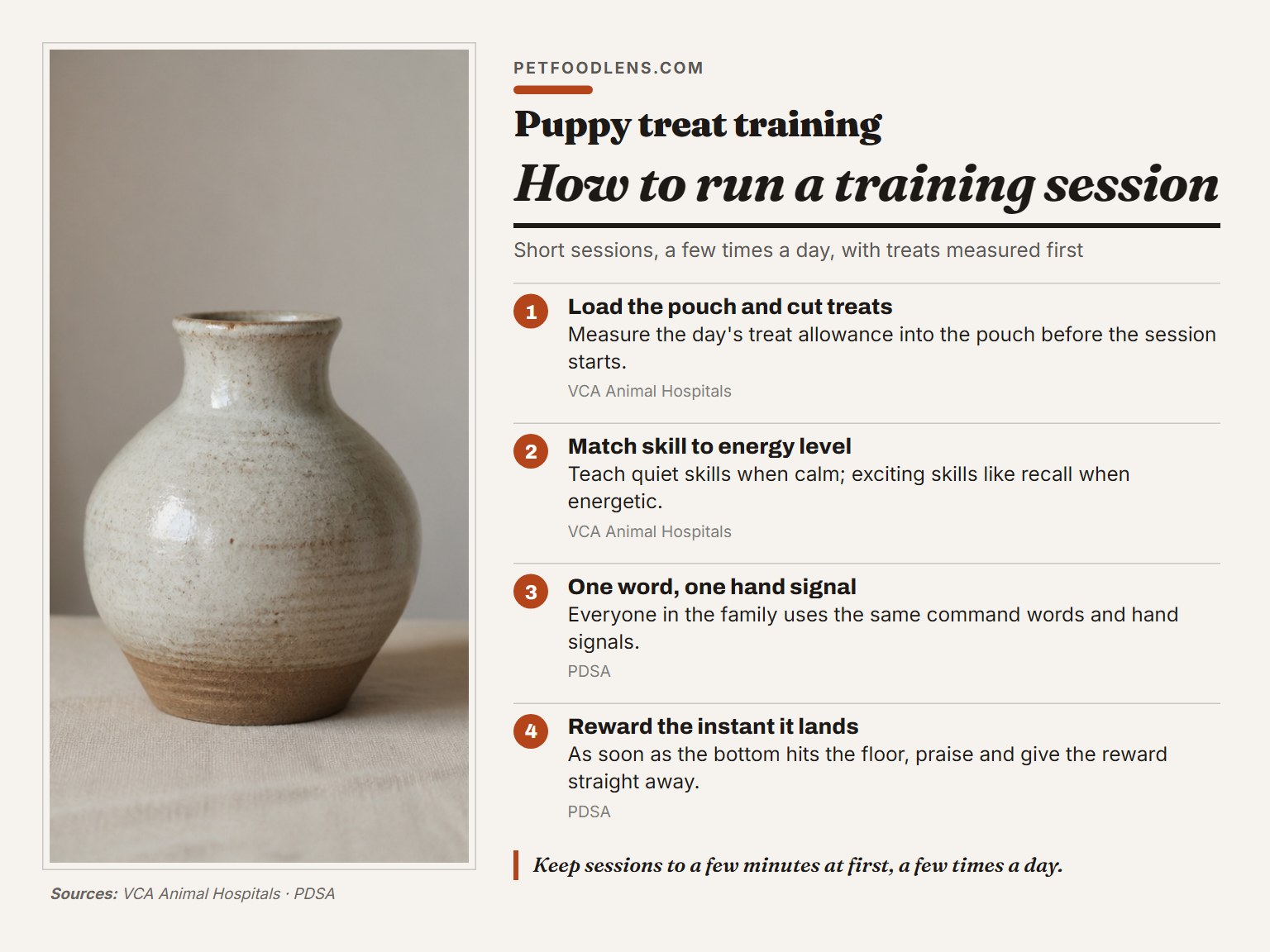
Sessions are short. VCA says individual sessions for a cue should be no more than a few minutes long at first, and can be run a few times a day. PDSA says keep sessions fairly short so the puppy does not get bored. A few short sessions done a few times a day beat one long marathon.
Before you start: Keep sessions short enough that the puppy finishes still interested. Stop if the puppy starts sniffing the floor or walking away, because a bored puppy learns nothing and a frustrated handler teaches the wrong thing. Have the treats cut and the pouch loaded before you call the puppy over, so the first rep is not delayed by prep.
- Load the pouch and cut the treats. Measure the day’s allowance into the pouch first, so the session cannot overrun the calorie budget. A clip-on dog treat pouch keeps the treats at hand and off the floor.
- Pick the right energy level for the skill. VCA recommends teaching quiet skills like going to the crate or lying down when the puppy is calm, and exciting skills like recall or retrieve when the puppy is energetic.
- Use one word and one hand signal per cue. PDSA and PetMD both stress consistency: everyone in the family uses the same command words, and the same hand signal goes with the same word.
- Reward the instant the behavior lands. PDSA is specific on sit: as soon as the bottom hits the floor, praise and give the reward straight away. A treat delivered late teaches the puppy nothing about sitting.
- End on a success. One clean rep, one reward, session over. The puppy remembers the last thing that happened, so make it a win.
Teaching Recall With Treats
Recall training follows the same rules with a longer runway. PDSA recommends the puppy’s favorite reward, a quiet place with no distractions at first, and a starting distance of just a few feet. Increase the distance only as the puppy improves.
In public, some owners use a long, loose lead for recall practice. That is a safety net, not a training aid, and it does not change the reward mechanics.
When to Start
Training starts the day the puppy comes home, typically around 8 weeks of age, per PetMD. The best learning and retention window is 6 to 16 weeks, and most puppies understand what you are asking and respond accordingly by 5 to 6 months. Puppy socialization can begin at 8 weeks, and formal classes usually start at 12 to 16 weeks and run 4 to 6 weeks.
Where Treat Training Goes Wrong
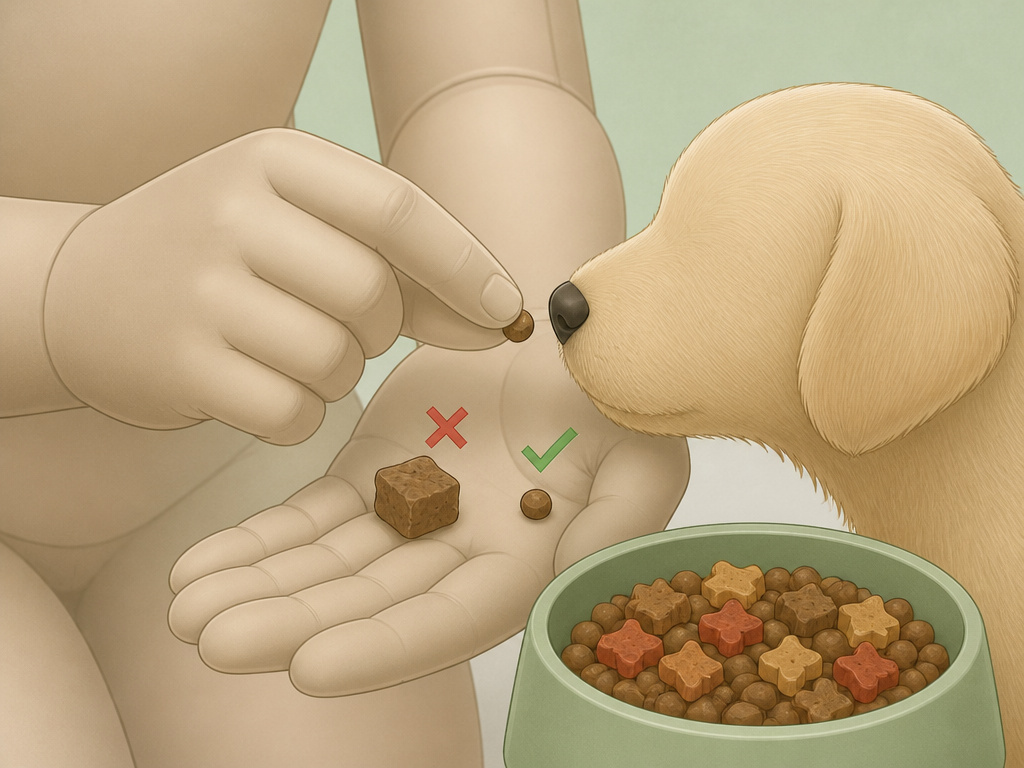
The failures are predictable. The puppy gets full before the session ends because the treats are too big. The handler counts the commercial treats but forgets the kibble. The puppy stops responding because the treats on offer are not worth the effort that day.
Easy to miss: A puppy that suddenly stops working for a treat it used to love may be telling you something. VCA lists three checks: whether the treat is still a good value, whether the puppy is feeling well, and whether the puppy is still at least a little hungry.
Punishment is the other common failure. PDSA notes that telling a puppy off rarely helps, because owners usually find out too late for the puppy to connect the correction to the behavior. Some puppies read scolding as praise, which is worse than doing nothing. VCA’s guidance is to ignore or redirect the undesired behavior and teach the wanted one through rewards.
I used to think the word “premium” on a treat bag meant something formal about quality. It does not. There is no standard definition behind it, and I now treat it as decoration. Read the guaranteed analysis and the calorie count, not the front of the bag.
Frequently Asked Questions
How many treats can a puppy have in a day?
Treats should stay within 10% of the puppy’s total daily calories, per VCA Animal Hospitals. A puppy needing 550 calories a day gets 55 calories from treats. That includes kibble used as a reward, not just commercial treats.
What if my puppy is not food motivated?
VCA notes that a puppy’s degree of food motivation determines what food works for training. Some puppies respond to their own kibble, and others need something new or higher in value. Try a soft, smelly treat like cheese or a piece of freeze-dried liver before assuming the puppy cannot be trained with food.
Can I use my puppy’s regular food as a training treat?
Yes, and VCA recommends it because kibble is complete and balanced, which prevents nutrient gaps on a treat-heavy day. The catch is that kibble still counts toward the calorie total, so it comes out of the 10% allowance like any other treat.
When can I stop using treats?
The sources disagree. PDSA says you can phase treats out once the puppy is consistently responding to a command. VCA says to keep paying a reward for the dog’s whole life, shifting to intermittent reinforcement with praise, toys, and lower-value food. Most handlers land in the middle: taper the frequency, keep the reward.
How long should a training session last?
Few minutes at first, according to VCA, and it can be repeated a few times a day. PDSA says keep sessions fairly short so the puppy does not get bored. End the session while the puppy is still interested.
The Bottom Line
One number decides whether treat training helps or hurts your puppy: the 10% calorie ceiling. Get that right and the rest is detail.
The first thing to do this week is measure. Weigh or count the day’s treat allowance into a bowl before the first session, and keep the pouch topped up from that bowl, not from the bag. If the puppy is gaining weight, the allowance is the first place to look, not the food bowl.
One concession worth naming: this whole approach assumes a healthy puppy on a complete diet. If your puppy has a diagnosed condition, is on a prescription diet, or is losing weight without explanation, the calorie math is a veterinarian’s call, not a label-reader’s. I am not a clinician, and a puppy with a medical issue needs one.
