
How Much Should You Feed a Cat? The Math Vets Use
This post contains affiliate links. As an Amazon Associate, we earn from qualifying purchases.
The answer to how much should you feed a cat starts with resting energy requirement: 30 times body weight in kilograms, plus 70. A 4.5 kg cat lands at 205 kcal a day. Then adjust for body condition, neuter status, and life stage.
That 205 kcal figure covers what a cat burns lying still, which is why the multiplier applied next matters as much as the formula. Intact cats run hotter than neutered ones, cats over ten often need more rather than less, and a cat at body condition 8 is carrying 30 percent extra weight. Get the multiplier wrong and the arithmetic is precise but useless.
What follows covers the two formulas in circulation and where they part company, the bag chart that runs higher than both, the body condition score that tells you which way to adjust, and the meal frequency question the published sources still argue about.
Key Takeaways
- Calculate resting energy requirement first, then apply a life-stage multiplier. The chart on the bag is the last thing to check, not the first.
- The two RER formulas disagree by about 11 kcal for a 4.5 kg cat: 205 under AAHA/AAFP, 216 under the JAVMA equation.
- Body condition score 6/9 or 7/9 is overweight and 8/9 or higher is obese, with each point above 5 equal to 10 percent extra weight.
- Weigh the food in grams for a week before changing anything. Cups hide portion errors until the scale catches up months later.
- Treats above 10 percent of daily calories invite nutritional imbalance, per the 2014 AAHA Weight Management Guidelines.
How Much Should You Feed a Cat? Start With Resting Energy Requirement
Two formulas for resting energy requirement are in circulation, and for a 4.5 kg cat they land about 11 kcal apart.
Resting energy requirement estimates the calories an animal expends at rest, before activity, thermoregulation, or growth are accounted for. Two published equations produce different results at the same body weight: the AAHA/AAFP 2021 linear formula and the exponential formula reported in JAVMA in 2010. Both are estimates that require adjustment to the individual cat.
The AAHA young adult cat guidelines give RER as 30 times body weight in kilograms, plus 70. The JAVMA 2010 study on weight-loss diets reports RER as 70 times body weight in kilograms raised to the power of 0.75, which the authors describe as the equation most commonly used.
| Source | Resting energy formula | Multiplier for a healthy adult |
|---|---|---|
| AAHA/AAFP 2021 | 30 x kg + 70 | x 1 |
| JAVMA 2010 study | 70 x kg^0.75 | x 1.2 to 1.88 |
| Purina feeding sheet | None printed | Chart by current weight |
The multiplier is where the two separate further. AAHA/AAFP sets daily energy requirement at RER times 1 for young healthy adults. JAVMA puts maintenance energy for clinically normal adult animals at 1.2 to 1.88 times RER. For a 4.5 kg cat that is a band of 259 to 406 kcal a day, which is a wide spread to hand an owner who just wants a number.
The calorie needs breakdown runs the same arithmetic at other body weights if your cat is nowhere near 4.5 kg.
What 205 kcal Looks Like in a Bowl
A 10-pound cat is 4.5 kilograms, and that conversion is the only unit work the formula needs.
Run it twice. AAHA/AAFP: 30 x 4.5 + 70 = 205 kcal. JAVMA: 70 x 4.5^0.75 = 216 kcal. Both are resting figures, so the daily number climbs once the multiplier goes on. PetMD reaches a similar place by a different route: roughly 240 kcal a day from two-thirds of a 5.5-ounce can at 181 kcal plus a quarter cup of dry food at 483 kcal per cup, usually split into two meals.
Before you start: Three things bite here. Underfeeding a cat that then stops eating can trigger hepatic lipidosis, a potentially fatal fat accumulation in the liver, so never crash-diet a cat without veterinary input. Treats and human food above 10 percent of daily calories invite nutritional imbalance. Raw diets carry pathogen risk plus a real chance of missing essential nutrients.
- Weigh the cat on a kitchen scale, or use the vet’s scale.
- Score body condition by hand before calculating anything. A cat at 7/9 needs a weight-loss target, and the maintenance formula will simply hold the current weight.
- Apply the life-stage multiplier. Skip it and a neutered indoor cat gets fed like an intact outdoor one, which is the easiest way to add weight without noticing.
- Divide by the food’s calorie density. A 312 kcal per 8-ounce cup food and a 483 kcal per cup food are not interchangeable at the same volume.
- Weigh the portion in grams. A packed cup and a loose cup of the same kibble do not weigh the same, and the difference compounds over a month.
That is the whole calculation.
Why the Bag Chart Is a Ceiling, Not a Target
The chart on the bag is written for the cat in front of you, not the cat you want.
They don’t.
Take a real chart. The Purina feline feeding guidelines list a dry formula at 3,823 kcal per kilogram and 312 kcal per 8-ounce cup, with half a cup a day for a 5-pound cat and 2 1/8 cups a day for a 25-pound cat. For the 5-pound cat that works out to 156 kcal. For the 25-pound cat it is 663 kcal.
The chart scales with current body weight, so an overweight cat gets fed enough to stay overweight. AAHA/AAFP’s formula for that same 11.4 kg cat gives a resting requirement of 412 kcal. The chart is handing out 663.
Cornell makes the same point about feeding guidelines: the instructions are based on the needs of the average cat, so a cat that expends less energy gets fed more than necessary. If you want a second opinion on how those label directions get written, the pet food label feeding guidelines from cooperative extension services are worth reading alongside the bag.
The JAVMA authors had to obtain calorie density directly from manufacturers to run their study, and they concluded that without objective calorie information on labels and specific veterinary guidance, owners cannot realistically assess intake. That is a polite way of saying the label is not built to do the job you are asking of it.
Body Condition Score Beats the Scale
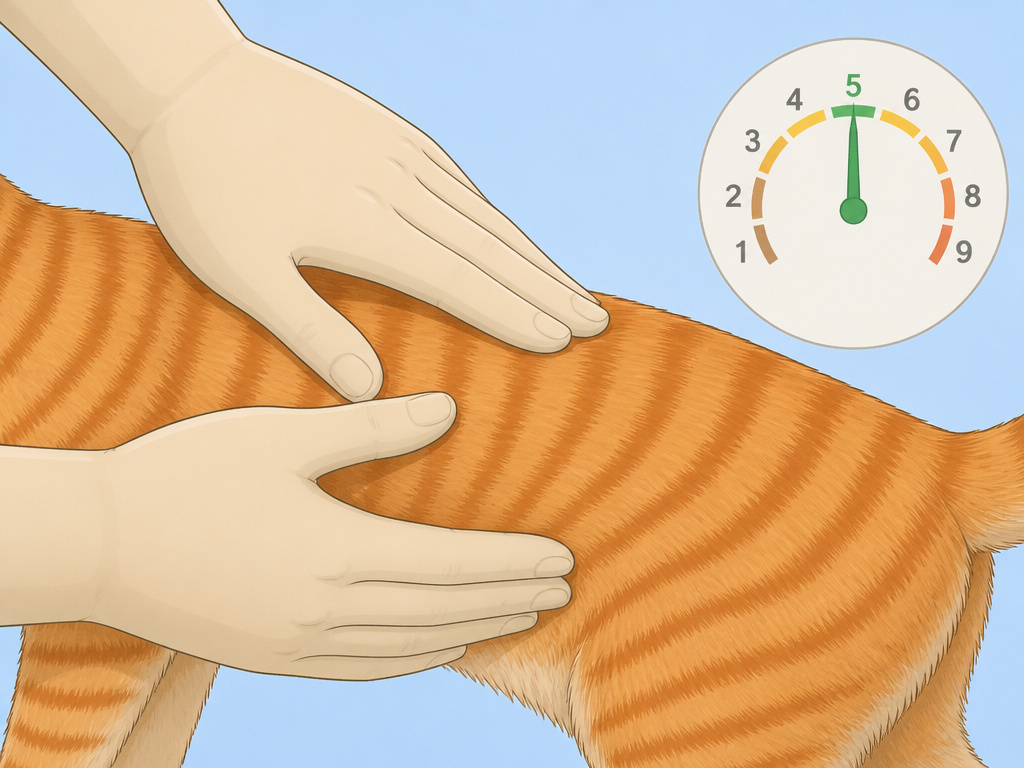
Flat fingers along the ribs, then along the spine, then around the base of the tail. That is the whole test, and it takes ten seconds.
AAHA/AAFP scores body condition on a 9-point scale. A 6/9 or 7/9 is overweight. An 8/9 or higher is obese. Obesity prevalence across published studies ranges from 1.8 to 40 percent, which tells you how loosely the word gets applied in practice.
| Body condition score | Body fat | Overweight by |
|---|---|---|
| 5/9 | 20-24% | Ideal |
| 6/9 | 25-29% | 10% |
| 7/9 | 30-34% | 20% |
| 8/9 | 35-39% | 30% |
| 9/9 | 40-45% | More than 40% |
The 2014 AAHA Weight Management Guidelines put a number on the gap: each body condition score above 5 on the 9-point scale equals 10 percent overweight. A cat at 8/9 is carrying 30 percent extra weight, with 35 to 39 percent body fat.
- Ribs: easy to feel under light pressure at 5/9, harder to find at 7/9.
- Waist behind the ribs: visible from above at 5/9.
- Belly line: tucked at 5/9, level or sagging by 7/9.
- Tail base: a slight fat pad is normal; a padded, rounded base is not.
If the score comes back at 7/9 or higher, the overweight cat plan is where to go next, because the maintenance formula will hold the current weight rather than reduce it.
How Often Should You Feed a Cat?
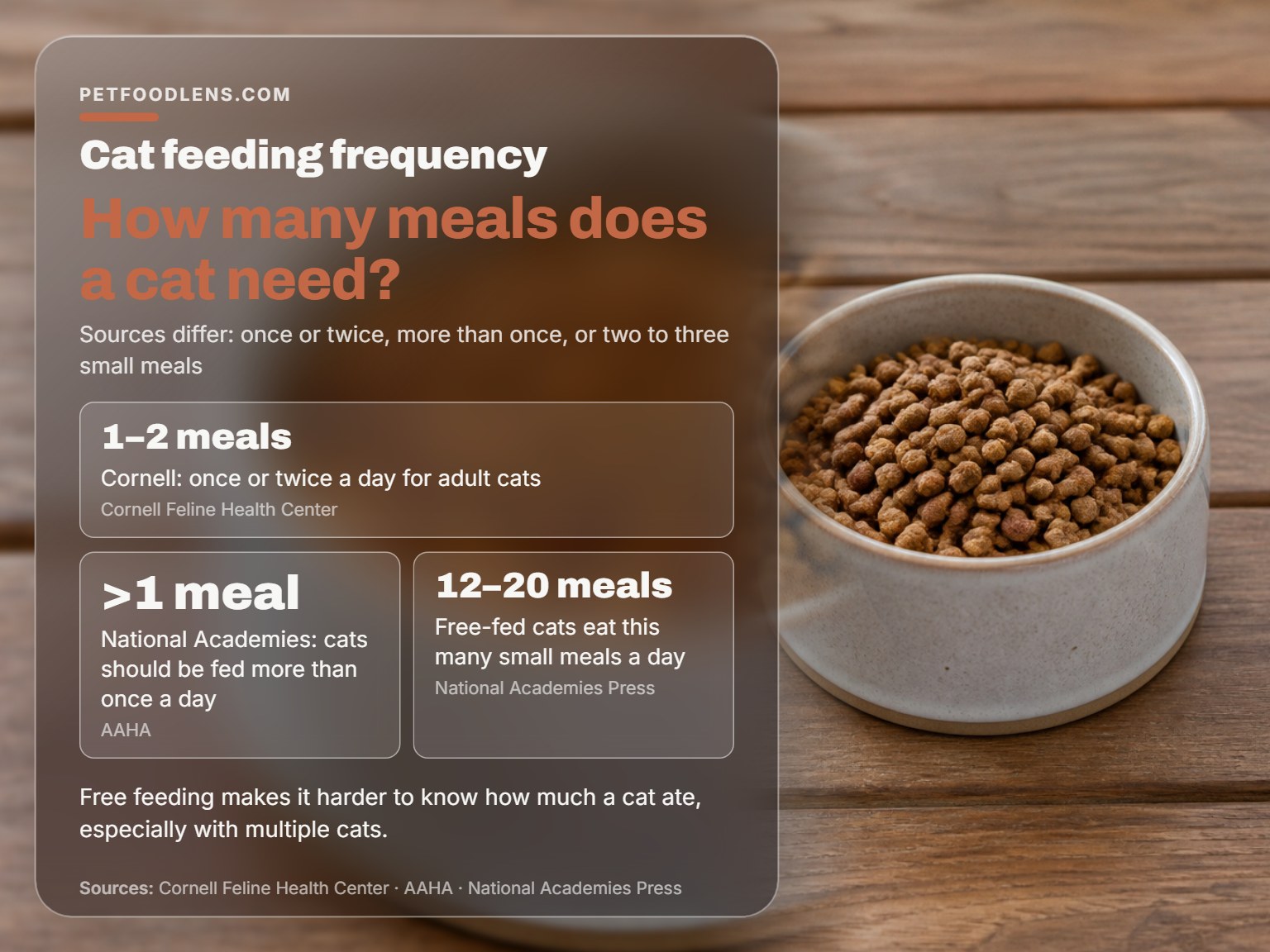
Cornell Feline Health Center puts adult cats at once or twice a day, and that is the most permissive of the three positions in circulation.
| Source | Meals per day for an adult cat |
|---|---|
| Cornell Feline Health Center | Once or twice |
| National Academies (NRC) | More than once |
| Purina feeding sheet | Two or three small meals |
The National Academies report says cats should be fed more than once a day. The Purina sheet splits the daily amount into two or three small meals. Cornell allows one meal for some adults. All three are defensible, and they are answering slightly different questions.
Free access to food produces a different pattern entirely. The National Academies report puts free-fed cats at 12 to 20 meals a day spread across the full 24-hour cycle, and VCA reports the same range. VCA notes that free feeding makes it more difficult to determine how much food a cat has eaten in a day, especially in multi-cat households.
The feeding frequency question gets harder once a second cat joins the household, because a shared bowl hides which cat ate what. If you do free-feed, VCA suggests weighing the food offered in the morning and again what is left by evening, which turns free feeding into a measurable system.
The Cornell Feline Health Center advice is worth reading in full, because the age-based section is more specific than the adult guidance.
Wet Food, Dry Food, and the Water Math
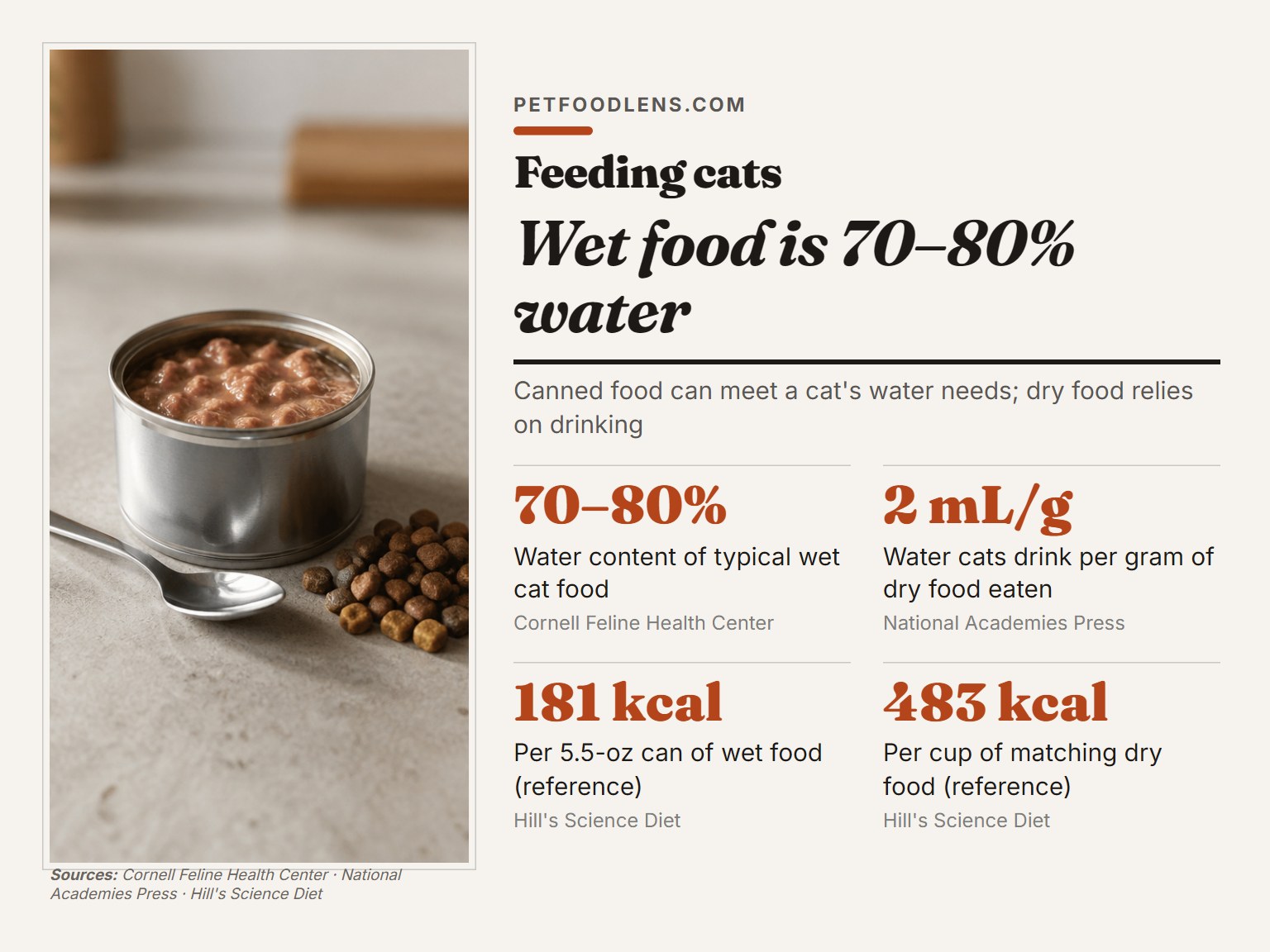
Cornell puts wet cat food at 70 to 80 percent water.
Cornell puts wet cat food at 70 to 80 percent water. VCA notes that a healthy cat’s water requirement can be met partly or completely by canned food. The National Academies report gives the dry-food side of the same equation: cats drink about 2 millilitres of water for every gram of dry food they eat.
What the Water Content Changes
A cat on dry food only is relying on that 2 mL per gram ratio to stay hydrated, and the National Academies report gives the dry-food side of the same equation. Canned food moves water into the meal instead of hoping the cat drinks it.
Hill’s Science Diet Adult Savory Chicken Entree wet food at 181 kcal per 5.5-ounce can is a useful reference point, because two-thirds of that can plus a quarter cup of the matching dry food at 483 kcal per cup lands at roughly 240 kcal. That is close to the 205 kcal resting figure for a 4.5 kg cat.
How to Measure a Portion Without Guessing
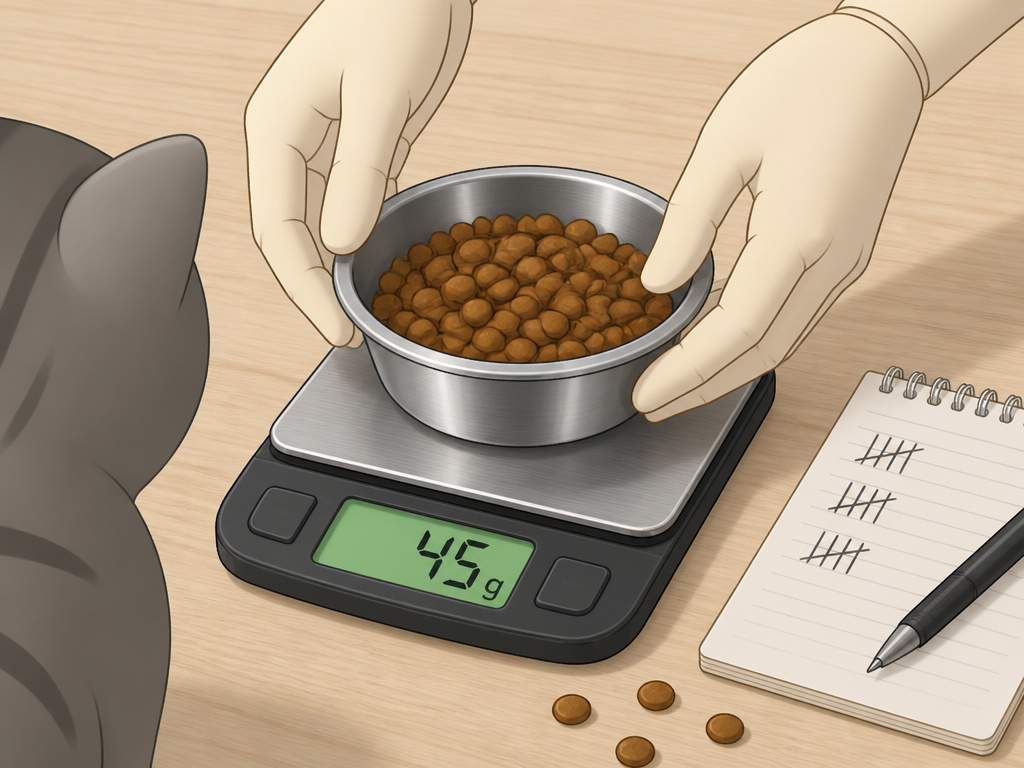
Weigh the food in grams rather than scooping by volume. The Purina sheet lists 3,823 kcal per kilogram next to its 312 kcal per 8-ounce cup figure, and the per-kilogram number is the one that works with a scale. Learning to measure cat food by weight is more repeatable than scooping by volume.
- Weigh what goes in. A gram target is repeatable; “about a third of a cup” is not.
- Weigh what comes back. VCA’s method for free-fed cats: weigh the food offered in the morning and what remains the next morning.
- Count the treats. PetMD puts treats at no more than 10 percent of daily intake, and AAHA warns that treats and human food above 10 percent of calories invite nutritional imbalance.
- Log it for a week.
Kittens, Seniors, and Neutered Males
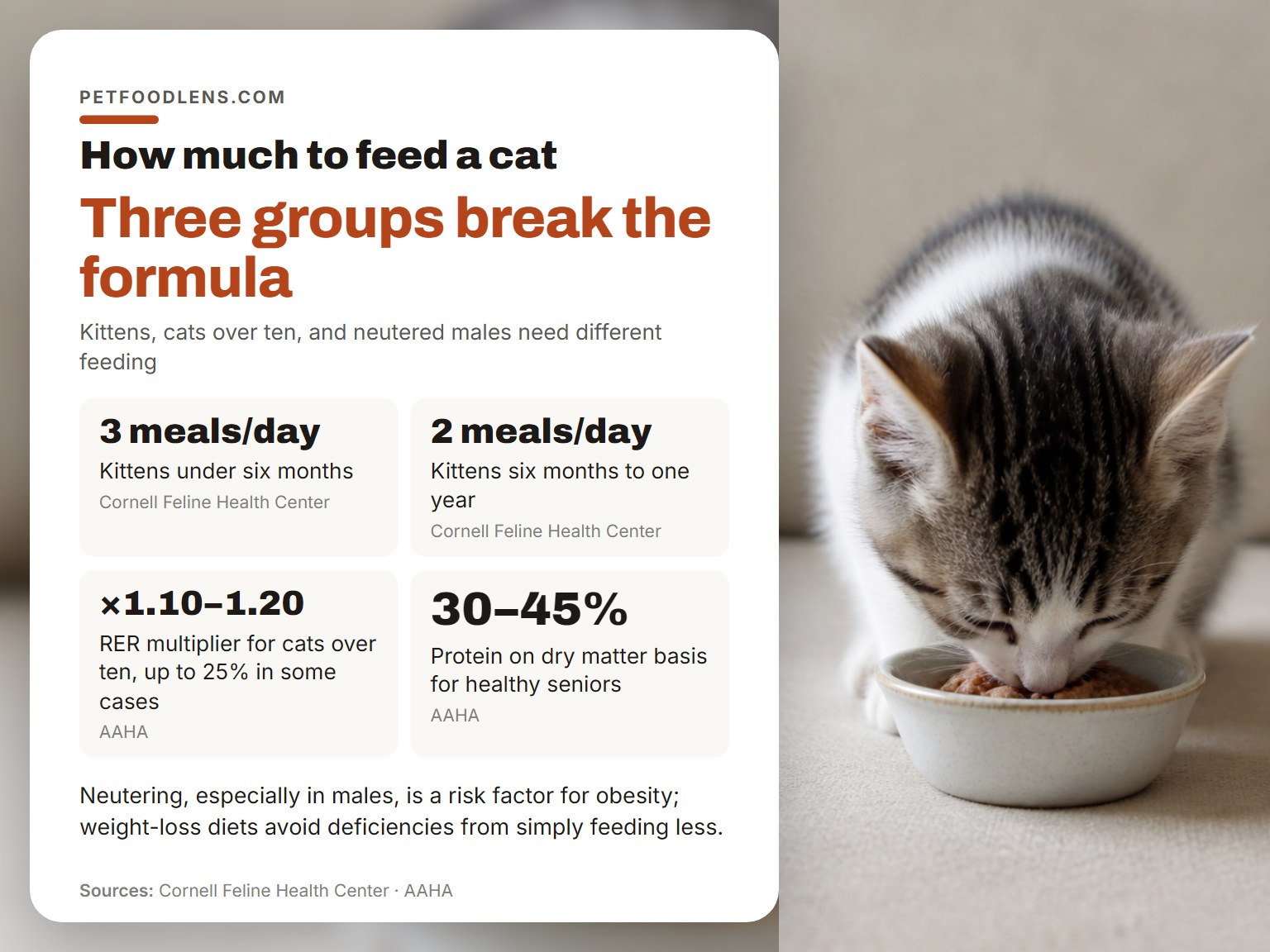
Three groups break the maintenance formula: kittens, cats over ten, and neutered males.
Kittens: Three Meals, Then Two
Cornell puts kittens under six months at three meals a day, dropping to two between six months and a year. VCA supplies the reason for the drop: by six months a kitten is about 75 percent of adult size and its energy requirement falls, especially if it is spayed or neutered at that point. Growth food runs until about 12 months, with adult food introduced slowly from around 10 months.
The kitten feeding figures differ enough from adult numbers that they are worth calculating separately rather than scaling down an adult portion.
Cats Over Ten
AAHA/AAFP says to multiply resting requirement by 1.10 to 1.20 for cats over ten, and in some cases by as much as 25 percent, because underweight is a common problem in senior cats and reduced digestive capability can push the score down. The AAHA mature cat nutrition guidelines also warn against protein restriction in healthy seniors, recommending 30 to 45 percent protein on a dry matter basis, meaning protein measured with the water removed so wet and dry foods can be compared.
Cornell says seniors should stay on the same regimen unless a vet instructs otherwise. Those two positions point in opposite directions, and the body condition score is the tiebreaker: a senior losing weight gets more calories, a senior holding at 5/9 stays where it is.
The Neutered Male Problem
AAHA/AAFP names neutering as a risk factor for obesity, especially in males, and suggests dietary energy restriction may be appropriate to prevent weight gain. PetMD notes the flip side: intact cats tend to need more calories because sex hormones keep metabolism at a higher rate.
For a cat that genuinely needs to lose weight, a purpose-formulated weight-loss diet is the safer route than shrinking a maintenance portion. AAHA is explicit that simply feeding less of a maintenance diet may result in vitamin and mineral deficiencies, which is exactly what weight-loss diets are formulated to avoid.
Frequently Asked Questions
How many calories should I feed my cat a day?
Start with 30 times body weight in kilograms plus 70, which gives 205 kcal for a 4.5 kg cat. That is resting requirement. AAHA/AAFP multiplies it by 1 for young healthy adults, while the JAVMA 2010 study puts maintenance at 1.2 to 1.88 times resting requirement. Adjust from there using body condition score.
Is it OK to leave dry food out all day?
It depends on the cat. Cornell says free feeding dry food may be acceptable for some cats but can cause overeating and weight gain in others, and AAHA/AAFP flags free-choice feeding as a predisposing factor for overconsumption. VCA’s compromise is to weigh the food offered and the food remaining so intake is at least measurable.
Should I feed my cat wet food every day?
There is a hydration argument for it. Cornell puts wet food at 70 to 80 percent water, and VCA notes a healthy cat’s water requirement can be met partly or completely by canned food. A cat eating only dry food depends on drinking roughly 2 millilitres of water per gram of kibble, per the National Academies report.
How do I know if my cat is overweight?
Score the ribs by hand on a 9-point scale. AAHA/AAFP calls 6/9 or 7/9 overweight and 8/9 or higher obese. Each point above 5 equals 10 percent overweight, so a cat at 8/9 is carrying 30 percent extra weight with 35 to 39 percent body fat.
Do senior cats need more or less food?
The sources disagree. AAHA/AAFP says multiply resting requirement by 1.10 to 1.20 for cats over ten, up to 25 percent in some cases, because underweight is common in seniors. Cornell says seniors should keep the same regimen unless a vet says otherwise. Weigh the cat monthly and let the body condition score decide.
Can I feed less of my normal food to help my cat lose weight?
AAHA warns that feeding less of a maintenance diet to cut calories may cause vitamin and mineral deficiencies, and that weight-loss diets are formulated to avoid this. PetMD takes a softer line, showing how portioning regular food to about 240 kcal a day can work. For a cat at 8/9 or above, a formulated diet plus veterinary input is the safer path.
The Bottom Line
If your cat scores 7/9 or higher, stop adjusting the maintenance number and get a weight-loss plan in place. Shrinking a maintenance portion is the shortcut AAHA explicitly warns against, and it is the one most owners take.
The first step this week is small: weigh the cat, score the ribs by hand, and write the gram target on the lid of the food bin. That single number does more than any bag chart.
One concession worth stating plainly.
Answering how much should you feed a cat properly takes a scale, ten minutes, and a monthly hand check. The formula is the easy part.
