
How to Feed an Overweight Cat: A Label-First Plan
This post contains affiliate links. As an Amazon Associate, we earn from qualifying purchases.
To feed an overweight cat, calculate calories from the cat’s ideal weight and start near 52 kcal/kg^0.711 per day. The 2021 AAHA guidelines report a mean weight-loss intake of 52 kcal/kg^0.711 over 12 weeks, with a standard deviation of 4.9, and cap treats at 10% of total calories.
Ideal weight decides everything downstream, and it’s the number owners guess at when facing how to feed an overweight cat. AAHA’s 2014 guidelines estimate it from body fat percentage: current body weight times (100 minus percent body fat), divided by 0.8. Miss by a kilogram and the whole calorie target moves with you, because the resting energy formula scales with body weight rather than with the size of the bowl.
What follows covers the calculation, the food choice, the treat ceiling, the two places where the published guidance genuinely disagrees, and the failure mode that sends cats to the hospital.
Key Takeaways
- Base the target on ideal weight, not current weight. AAHA’s 2014 guidelines start every calculation there, and the estimate gets refined as body condition improves.
- 52 kcal/kg^0.711 per day is the 2021 AAHA mean for cats across a 12-week program. It’s a starting point, not a prescription.
- Treats and human food stay under 10% of total calories. Above that line, AAHA says to anticipate nutritional imbalances.
- Food refusal is the emergency. A cat that stops eating while restricted is the documented path to hepatic lipidosis.
- Owner nonadherence is the main reason plans fail, so build the plan around what you will actually do at 6am on a Tuesday.
How Many Calories Does an Overweight Cat Actually Need?
The 2021 AAHA guidelines put mean weight-loss intake for cats at 52 kcal/kg^0.711 per day across a 12-week program, with a standard deviation of 4.9. That spread is the honest part. It tells you the number is a population average, not a personal prescription.
Resting energy requirement is calculated from body weight raised to an exponent, then scaled for life stage and activity. Cats use an exponent of 0.711, dogs use 0.75. Weight-loss targets are set as a fraction of that figure, based on ideal weight rather than current weight, and adjusted at each recheck as body condition score changes.
AAHA’s 2014 guidelines give two routes to the number. Feed 80% of what the cat eats right now, or feed 80% of the resting energy requirement calculated at the ideal weight. The 2021 document calls 80% of ideal-weight RER effective and well tolerated.
| Method | How it is calculated | AAHA’s stated caveat |
|---|---|---|
| 80% of current intake | Feed 80% of what the cat eats now | Fails if the cat is still gaining |
| 80% of ideal-weight RER | Resting energy at ideal weight, times 0.8 | A starting point only |
| 2021 mean figure | 52 kcal/kg^0.711 per day over 12 weeks | Based on ideal weight, adjusted per patient |
Neither method is a prescription. AAHA states plainly that any method of caloric restriction is a starting point and subject to individual metabolism, so the number you write down on day one is a guess you correct at the next weigh-in. Working out how much food should an overweight cat eat is really the work of three or four weigh-ins, not one calculation.
Sedentary and indoor cats may need less than life-stage guidelines indicate, per the same 2021 document. An indoor cat that sleeps most of the day is not the same animal the label was written for.
Where the Published Guidance Actually Disagrees
Two credible sources hand you different calorie targets, and neither one is wrong.
AAHA frames 80% of ideal-weight RER as adequate and well tolerated. The management of obesity in cats study reports that client-owned cats needed more restriction than colony cats. The review calculates that 80% of ideal-weight RER lands well above the allowances it reports for client-owned cats. That gap is the disagreement, and nobody has reconciled it.
| Position | Who holds it | Practical effect |
|---|---|---|
| 80% of ideal-weight RER is adequate | 2014 and 2021 AAHA guidelines | Higher than the review’s reported allowances |
| Client-owned cats needed more restriction | PMC review of feline obesity studies | Lower allowances than ideal-weight RER |
| No reconciliation published | Both sources, unresolved | Start higher, monitor, adjust downward |
The practical read: start at the higher allowance, weigh the cat every two weeks, and drop the number if the loss stalls. AAHA’s own language supports that sequence, since every method is a starting point subject to monitoring.
Macronutrients are messier still. The same review reports that study results on high-protein, low-carbohydrate diets are inconsistent. Some found lower postprandial glucose, others failed to reproduce it, and one study found cats on the high-protein diet ate more, which is the opposite of helpful on a weight-loss plan. On fiber, the review states the optimal amount and type are still unknown. That kills any single fiber target you see quoted with confidence.
Here’s the part the front never mentions. Crude fiber on a guaranteed analysis excludes soluble fiber, which gets counted in the carbohydrate fraction instead. A high-soluble-fiber diet therefore misreports both its fiber and its energy content, and your label math quietly breaks.
Look down at the cat from above before you trust any of this. At a body condition score of 8 out of 9 there is no waist, just a straight line from ribcage to hip, and the ribs take real pressure to find. AAHA treats a BCS of 8 or higher as obese, and each point above 5 on the 9-point scale is worth roughly 10% over ideal weight.
How to Feed an Overweight Cat Without Guessing at Portions
A kitchen scale settles arguments that a measuring cup starts.
Before you start: A cat on a restricted ration can develop hepatic lipidosis if it stops eating, and the risk climbs with how hard you cut. Weigh the cat before you change anything, and call a veterinarian if the cat refuses food.
Kibble settles in the bag. A cup scooped from a fresh bag weighs less than a cup scooped a week later, because the small pieces sift down and the bulk density rises. Same cup, two different calorie loads. That’s the whole reason volume measures drift.
- Weigh the cat on a baby scale, not by picking it up on a bathroom scale with you. A small scale error is a real percentage of a cat’s body weight.
- Convert to ideal weight using the body fat equation, then reassess at every weigh-in. AAHA notes the estimate gets more accurate as body condition improves.
- Set the daily calorie target from the table above, based on ideal weight.
- Weigh the ration in grams against the kcal/kg figure on the bag. Skipping this step is how a 10% overshoot hides.
- Split it into at least two meals. One large meal produces a long hungry stretch and a loud cat.
Why a Kitchen Scale Beats a Measuring Cup
Most of the how to measure cat food portions problem disappears once you switch to grams. A gram is a gram whether the bag is new or three weeks open, whether the kibble is round or star-shaped, whether you scooped from the top or dug to the bottom.
The scale also lets you make the one comparison that matters. Divide the kcal/kg figure by 1,000, multiply by the grams in the bowl, and you have the actual calories going in. That number either matches your target or it doesn’t.
Pick the Food by Calories per Can, Not by the Front of the Bag
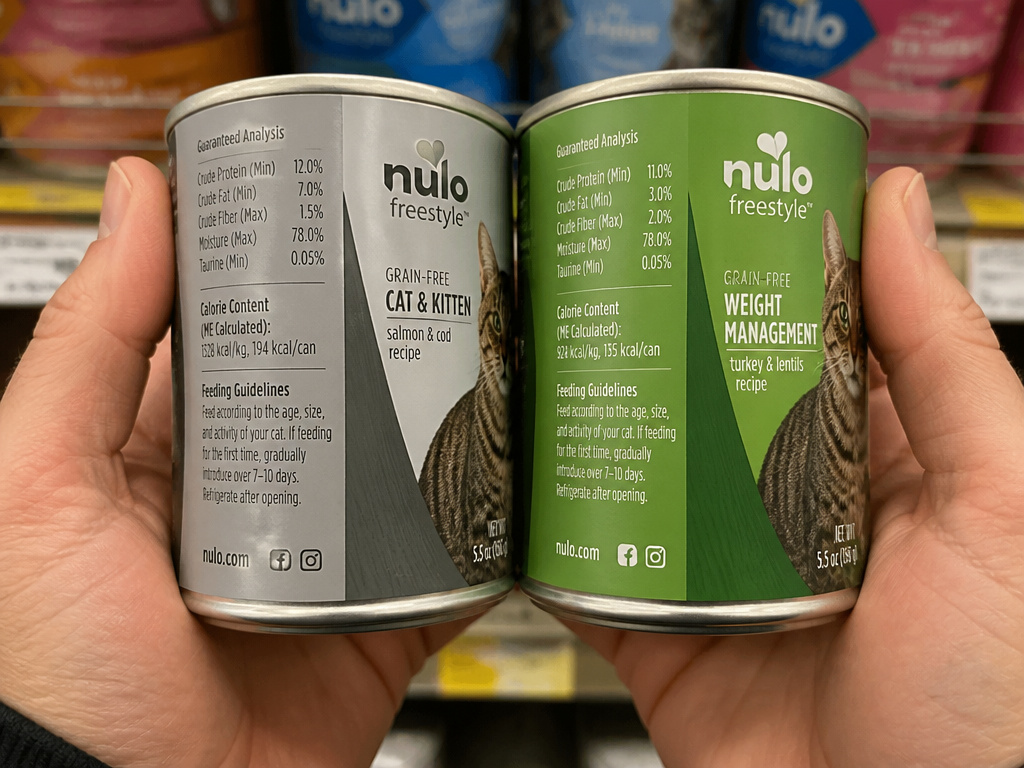
Two cans sit on the same shelf, same size, same handsome cat on the label. One is a maintenance food and one is a weight-management formula, and the calorie gap between them is wider than the shelf suggests.
I learned that the slow way. Years back I compared two foods as if they were interchangeable because the guaranteed analyses looked close. They differed by a wide margin in calorie density, which meant my portion math was off before I ever touched the bowl. I compare on a per-calorie basis now, and I don’t trust a cup measure to do it.
Calorie density is the number that decides how much food goes in the bowl. Two foods at the same protein percentage can land far apart in calories per cup, and the cat eats what the bowl holds, not what the percentage promised. Sorting overweight cat food by kcal/kg rather than by protein percentage is the comparison that actually changes the bowl.
Reading the Guaranteed Analysis Against the Calorie Statement
Turn the bag over. The guaranteed analysis gives minimums and maximums, not measured values, and it says nothing at all about calories. The metabolizable energy statement, usually printed as kcal/kg and kcal/cup, is the figure that pairs with the feeding amount. A bag with a modest-looking protein minimum and a high calorie density will put weight on a cat faster than a bag with better numbers and a lower density.
Where Prescription Diets Fit
Prescription weight diets exist because a shrinking ration has to keep delivering the same vitamins, minerals, and amino acids. Prescription weight diets are formulated as complete diets so the nutrient-to-calorie ratio holds as the bowl gets smaller.
Over-the-counter weight-management foods vary in how hard they actually restrict calories, and the front of the bag won’t tell you the target. Compare the kcal/kg figure on two bags before assuming they do the same job. The 2021 AAHA nutrition guidelines PDF sets treats at no more than 10% of total intake, which is a useful frame for judging any bag.
I won’t put a cat on a therapeutic weight diet without a body condition score written down first. Without that baseline, six weeks later nobody can tell whether the plan worked, and the cat gets blamed for a math error.
The 10% Treat Ceiling and What It Costs You
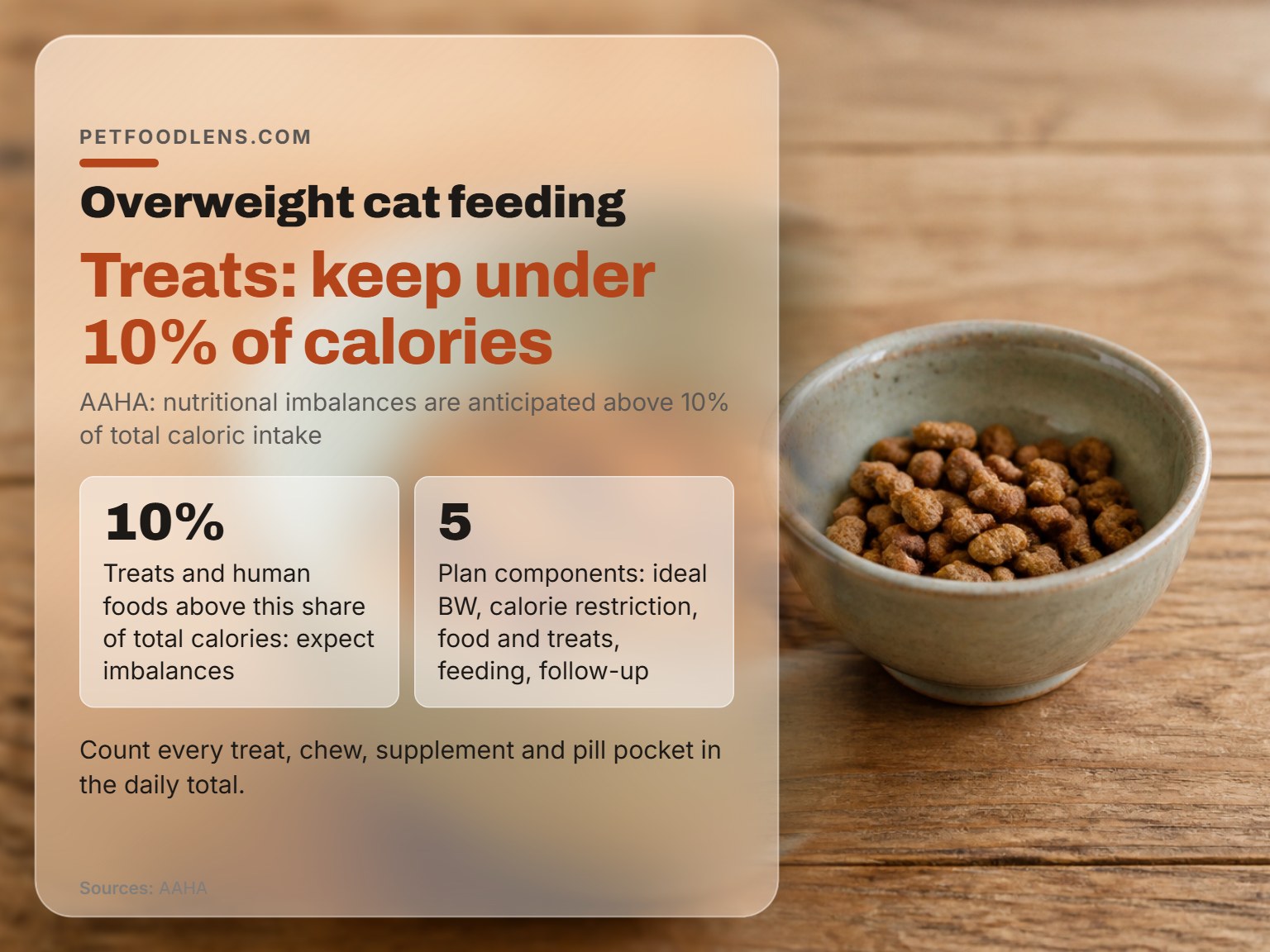
Ten percent is the whole treat budget.
AAHA’s 2014 guidelines say to anticipate nutritional imbalances once treats and human foods exceed 10% of total caloric intake. That line is a dilution threshold, not a moral one. A complete diet is balanced against its own calorie load, so calories arriving from outside the diet dilute the vitamins, minerals, and amino acids that were proportioned for the base food. Past 10%, the dilution stops being trivial.
AAHA also stresses that a shrinking ration must keep delivering the same vitamins, minerals, and amino acids, which is one reason a plain “feed less of the same food” approach can underdeliver even when the calories are right. That floor is one reason a plain “feed less of the same food” approach can underdeliver even when the calories are right.
- Count every treat into the daily total, including the pill pocket, the dental chew, and the lick of yogurt.
- Use the base diet as the treat. A few kibbles pulled from the weighed ration cost you nothing extra.
- Keep human food out of the bowl entirely. AAHA’s diet history requirement covers foods, treats, chews, supplements, and anything used to hide a pill, because all of it counts.
- Weigh it. A “small” treat is a variable, and variables are what wreck the math.
If a treat isn’t in the daily total, it isn’t a treat. It’s an unrecorded calorie the whole plan has to absorb.
Why Does Free Feeding Break the Math?
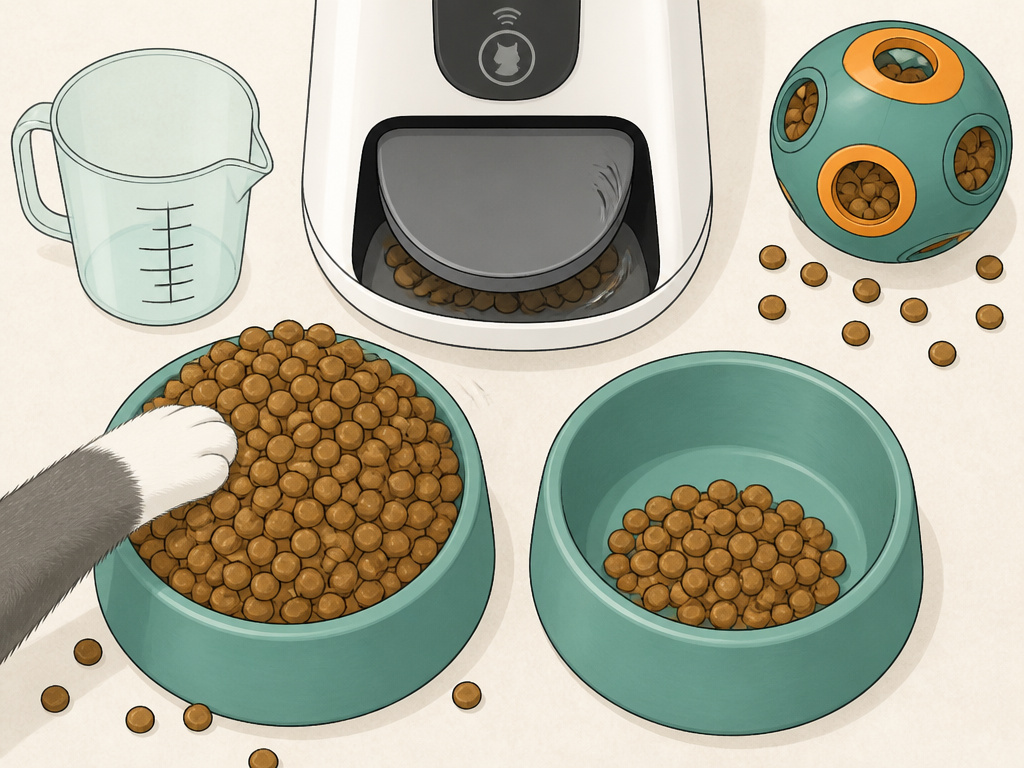
Why does a cat on a measured ration keep gaining weight?
Because the ration isn’t the only input. AAHA’s 2021 guidelines flag free-choice feeding, food competition and social hierarchy in a multi-cat house, and outdoor predation or scavenging as sources of unmeasured calories. Any of the three invalidates the intake calculation you just did.
- A topped-up bowl records nothing, and a cat grazing all day eats more than a cat eating two measured meals.
- A second cat eating from the same bowl doubles the error and hides which cat is over.
- A hunter brings home calories you never see, and those calories land in the same body.
Switching to free feeding vs scheduled feeding as a deliberate decision, rather than a default, is the first fix. Scheduled meals make the ration visible, and a visible ration is the only kind you can adjust.
Puzzle Feeders and Automated Feeders That Actually Work
AAHA’s 2021 guidelines name puzzle toys and automated feeders as useful tools for weight loss, mostly because they stretch a small ration across more of the day. A puzzle toy makes the cat work for kibble one piece at a time. A food maze does the same job for a cat that loses interest in a rolling ball. Both stretch a small ration across more of the day, and that is time the cat isn’t yelling at the cupboard.
Feeding two cats on two different rations is a multi-cat household problem before it’s a nutrition problem. A microchip-reading feeder reads the cat’s microchip and closes the lid on the wrong one, which is the only reliable way I’ve found to run two rations side by side without a referee. A slow feeder helps too, though it fixes speed rather than quantity.
When the Plan Fails: Food Refusal and Hepatic Lipidosis
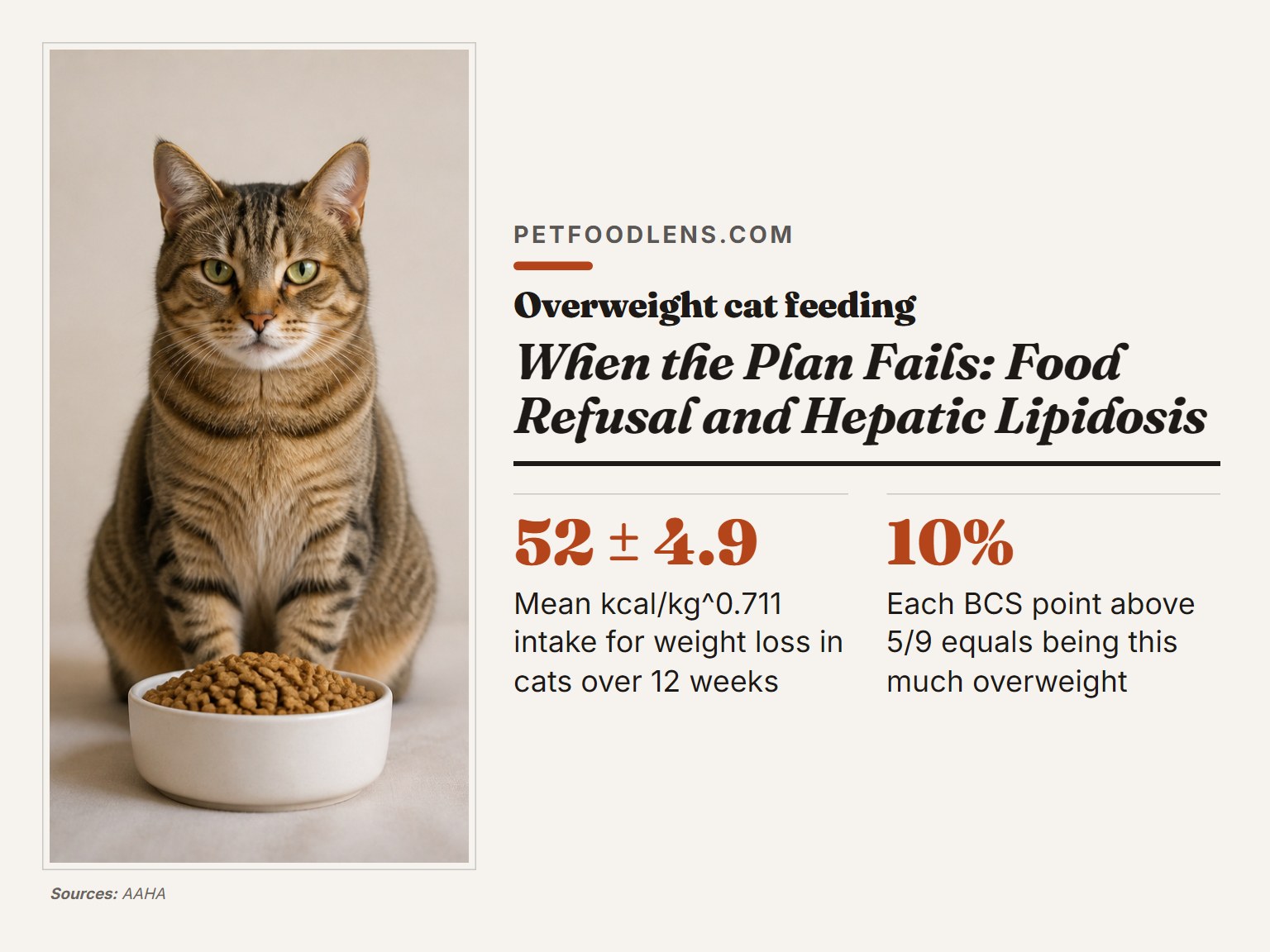
Hepatic lipidosis is the failure mode that turns a diet into an emergency.
In a client-owned cat weight-loss study, one cat developed hepatic lipidosis, and the authors did not resolve whether the cause was the energy restriction itself or the food refusal that came with it. The authors did not resolve whether the cause was the energy restriction itself or the food refusal that came with it. Either way, that case happened at a calorie level a calculator produced.
The review discusses how hard restriction can safely go, and below the published comfort zone you are into a conversation with a veterinarian. Below that, you are outside the published comfort zone and into a conversation with a veterinarian.
Where this goes sideways: A cat that refuses the new ration outright is not being stubborn. Restriction plus anorexia is the documented lethal pathway, and the case above shows the procedure itself can fail.
Target loss rate is the other guardrail, and a cat losing faster than the plan expects needs the plan reviewed rather than celebrated. Slow is the point, and a cat losing faster than that needs the plan reviewed rather than celebrated.
AAHA’s 2021 guidelines stress monitoring after a diet change, because a cat with an upset stomach stops eating, which is the exact path you were trying to avoid. Rush it and you get vomiting and diarrhea, and a cat with an upset stomach stops eating, which is the exact path you were trying to avoid. Meal frequency is a separate lever from portion size, and how often to feed a cat on a restricted plan changes how much of the day it spends hungry.
The 5-Part Plan and the Phone Call That Decides It
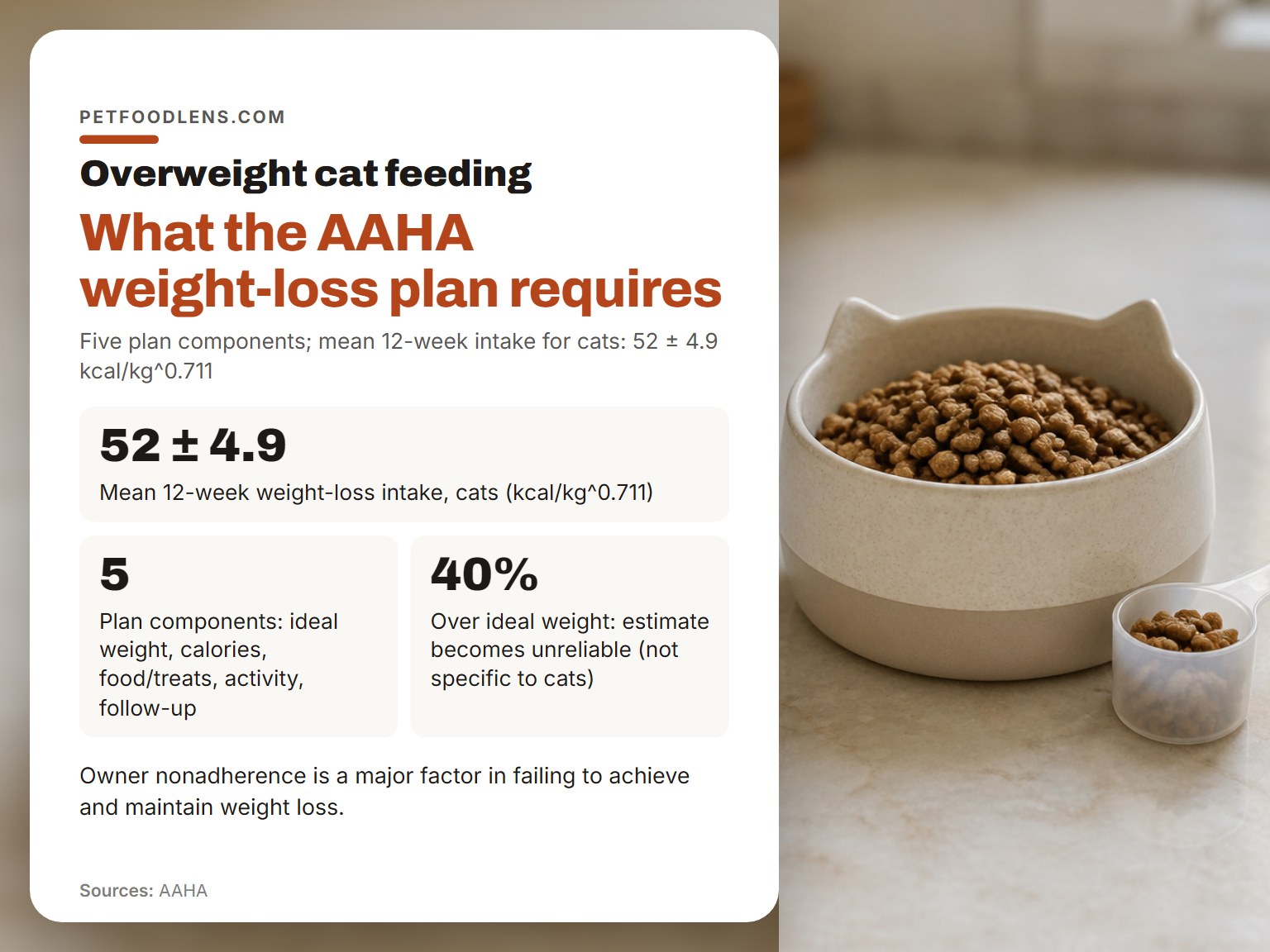
Five components make up the plan AAHA lays out: ideal body weight, caloric restriction, food selection and treat allowance, feeding management and activity, and scheduled follow-up.
- Ideal body weight, estimated from body fat percentage and refined as the score improves.
- Caloric restriction, using one of the two published methods as a starting point.
- Food selection and treat allowance, with treats at no more than 10% of intake.
- Feeding management and activity, including the non-food interactions AAHA recommends adding.
- Scheduled follow-up, which is where most plans actually live or die.
AAHA is blunt about the failure mode: owner nonadherence is a major factor in both achieving and maintaining weight loss. The guidelines recommend reaching out within the first couple of days after the plan starts, before a small problem becomes a dropout. They also recommend folding the client’s nonnegotiables into the plan rather than arguing them out, because a plan someone resents is a plan they abandon.
The AAHA weight reduction in obese pets resource puts the mean 12-week intake at 52 kcal/kg^0.711 for cats and 63 kcal/kg^0.75 for dogs. The 2014 AAHA weight management guidelines lay out all five components in full, including the ideal-weight estimation method and the note that the estimate is unreliable in cats more than 40% over ideal.
I check the nutritional adequacy statement on every label I review, because that one line tells me whether the food is complete and balanced or a supplement wearing a dinner-plate photo.
Frequently Asked Questions
How much should I feed an overweight cat to start?
Start from the ideal-weight resting energy requirement, take 80% of it, and treat that as a starting point. The 2021 AAHA mean for cats is 52 kcal/kg^0.711 per day over a 12-week program, with a standard deviation of 4.9. Weigh the cat every two weeks and adjust based on actual loss.
Is wet food better than dry for weight loss?
Canned food carries more water per calorie, so the same calorie target fills a larger volume and the cat spends less of the day hungry. What the research doesn’t settle is the macronutrient question. The PMC review reports inconsistent results on high-protein, low-carbohydrate diets, so total calories and the 10% treat ceiling matter more than the can-versus-bag decision.
Can I just feed less of the current food?
You can, with one caveat. AAHA’s 2014 guidance warns that nutritional imbalances should be anticipated once treats and human foods exceed 10% of total intake, and shrinking a maintenance diet shrinks the micronutrients with it. Shrinking a maintenance diet shrinks the micronutrients with it, so check the diet’s nutrient-to-calorie ratio before you simply cut the scoop.
How fast should a cat lose weight?
There is no single published rate in the fact sheet; weigh the cat regularly and revisit the plan if loss stalls or runs faster than expected. Faster than that is a reason to revisit the plan, not a reason to celebrate.
What if my cat refuses the reduced ration?
Stop and get veterinary input. The documented failure case in the research involved a cat that developed hepatic lipidosis on a restricted plan, and the authors could not separate the restriction from the food refusal. A cat that won’t eat is the one scenario where the plan should be paused.
Do I need a prescription diet?
Not always, but a prescription diet makes the nutrient-to-calorie math easier because it’s built to stay complete as the ration shrinks. A prescription diet makes the nutrient-to-calorie math easier because it’s built to stay complete as the ration shrinks. A cat with kidney disease, urinary crystals, or diabetes needs a veterinarian choosing the diet, not a label.
The Bottom Line
First thing this week: weigh the cat and write the number down. Not the number from the last vet visit, the one from today. Everything above runs off that figure, and the ideal-weight estimate is supposed to sharpen as body condition improves, which means the plan is meant to change as you go.
One honest limit on all of this. I read labels and I can do the calorie math, but I’m not a clinician. A cat with kidney disease, urinary crystals, or diabetes needs a veterinarian choosing the diet, and the label’s job at that point is to confirm the target nutrient rather than to make the decision. Prescription renal and diabetic diets are the most rigorously tested foods on the shelf, and a boutique alternative with a nicer bag doesn’t replace them.
The whole question of how to feed an overweight cat reduces to two numbers you can actually measure: the weight on the scale and the grams in the bowl.
And if your cat’s bloodwork improves on a prescription diet, the worst move available is to stop feeding it. That’s the mistake I see most, and it lets the problem walk straight back in through a door you already closed.
