
How to Feed a Multi-Cat Household: Step-by-Step
This post contains affiliate links. As an Amazon Associate, we earn from qualifying purchases.
One approach to feeding a multi-cat household is a two-part plan: one base diet every cat can safely eat, then individual needs met in a separate room twice a day behind a closed door. CVMA/SBCV (Scherk) favors that approach, while Cornell says feeding separately may help in some cases and the AAFP/FelineVMA consensus says cats should be fed in separate locations.
The closed door is the load-bearing part. It’s how a 14-year-old arthritic cat gets a different diet from a four-month-old kitten without either one raiding the other’s bowl.
What follows is the base-diet decision, the separation argument (the sources genuinely disagree on this), how often to feed, and what a 2022 feeder study found when it put 23 overweight cats on three different meal plans.
Key Takeaways
- One base diet for everyone, then individual needs topped up twice daily in separate rooms behind closed doors.
- The most nutritionally fragile cat sets the baseline, not the average cat in the house.
- Six meals a day did not speed weight loss in a 23-cat trial, though auto-feeders did make the plan easier to follow.
- VCA recommends one water source per pet placed in various areas, while Ohio State recommends food and water bowls be placed out of view of each other.
How to Feed a Multi-Cat Household Without Seven Separate Bowls
Six bowls on the kitchen floor, one cat parked in front of the water dish, and a third cat who only eats at 3 a.m. That’s the setup most multi-cat homes actually run, and it works right up until somebody’s bloodwork comes back wrong.
Veterinary guidance splits multi-cat feeding into two separate jobs. The first is a base diet every cat in the home can eat without nutritional risk. The second is meeting each cat’s individual needs twice or more daily behind closed doors. Both jobs require an assessment of the group’s nutritional requirements, personalities, and physical abilities.
That two-job split comes from Margie Scherk’s guidance for the CVMA/SBCV, and it’s the most useful frame I’ve found for the how to feed a multi-cat household problem. Job one is the base diet. Job two is the individual top-up.
Scherk is explicit that both jobs require analyzing the clowder’s nutritional needs, personalities, and physical abilities. That last word carries weight. A cat who can’t make the jump onto the counter is on a different plan from one who can.
Here’s the sequence I’d run, in order:
- Score every cat’s body condition by hand, on the 9-point scale. Skip this and you’re managing weight by eyeball rather than by an objective score.
- Pick the base diet around the most fragile cat, not the average one. Getting this backwards is how a cat with a real problem ends up on food built for a cat with a different problem.
- Map the room before you buy anything. Feeding stations out of sight of each other, water away from food, nothing within reach of the litter box.
- Time the meals and hold the time. Ohio State’s colony work found that schedule changes can trigger sickness behaviors, so a plan you can’t repeat daily is worse than a boring one you can.
- Set up the closed-door top-up for any cat eating something different from the baseline.
Step three is where most homes stop. Two bowls in the same corner, side by side, with a note that they “seem fine.”
Picking a Base Diet Every Cat Can Eat
Scherk’s how to feed a multi-cat household guidance starts with the cat most likely to be harmed by the wrong food, not the average cat in the house.
In her worked example, the cat with inflammatory bowel disease is the one at greatest risk if the baseline is wrong. So the IBD-safe diet becomes the food everyone eats, and it can stay out during the day for all of them. That’s the compromise: one shared baseline, individual needs handled in private.
A renal cat changes the math. If that cat is hyperphosphatemic and sitting in IRIS stage 3, Scherk notes that intestinal phosphate binders are a viable alternative to making a restricted-protein diet the household baseline. The renal cat still gets the restricted-protein food twice a day, in its own room.
For anyone who hasn’t met the term: IRIS staging is the international system vets use to grade kidney disease, and stage 3 sits in the middle-to-late range.
There’s one diet that can’t be the baseline at all. Scherk states plainly that the extremely low-iodine diet used for hyperthyroidism is inappropriate in a multi-cat household, because every other cat would be eating it too.
Common mistake: Making a therapeutic diet the household baseline because one cat needs it. The other cats eat a formula built for a condition they don’t have, and the cat who actually needs it still can’t be sure it got the full portion.
I’m not a clinician, and I’ll say that plainly. Prescription diets for kidney disease, urinary crystals, or thyroid disease sit outside what label-reading can settle. A cat with any of those needs a veterinarian making the call, not me.
Where I do have a use is the maintenance diet itself. For a plain adult base diet, choose a widely available formula that publishes a full nutritional adequacy statement.
Should Multi-Cat Households Eat Together or Apart?
Cats will eat side by side without complaint. That’s the trap.
I’ve walked into homes where one cat was quietly eating most of the other’s food. In every one, the owner had watched those cats eat together for years and never saw a problem. The bowls were clean. Nobody fought. The weight chart was the only thing telling the story. I ask about household layout before I ask about the food now.
The AAFP and FelineVMA consensus statement is categorical here: just because cats will eat together does not mean they should, and forced proximity often creates anxiety, stress, and health problems. Cats hide distress well, so a group feeding setup can look calm while it isn’t.
Worth knowing before you start: A cat that eats next to a more assertive cat can lose weight before anyone notices. The bowl gets emptied either way, so the reliable signal is a scale and a monthly body condition score, not appetite.
The professional bodies don’t land in the same place, and it’s worth seeing the spread:
| Source | Position on group feeding | How firm |
|---|---|---|
| CVMA/SBCV (Scherk) | Base diet out for all; individual needs in separate rooms twice daily | Practical compromise |
| Cornell Feline Health Center | Feeding separately or in different parts of the house may help | Conditional |
| AAFP/FelineVMA | Cats should be fed in separate locations | Categorical |
| VCA Animal Hospitals | Each pet from its own bowl | Categorical on bowls |
The gap between Cornell’s “may be helpful” and the AAFP’s “should be fed in separate locations” is real. Cornell frames separation as one option among several for a household where cats won’t all come when called. The consensus statement treats separation as the default, while Cornell frames it as one option and CVMA/SBCV allows a shared baseline diet with individual top-ups in separate rooms.
VCA’s reasoning for separate bowls is diagnostic as much as behavioral. When a cat stops eating, separate bowls make it obvious.
Dog food doesn’t meet a cat’s nutritional needs, and cat food doesn’t meet a dog’s.
How Often Should You Feed Cats in a Multi-Cat Home?
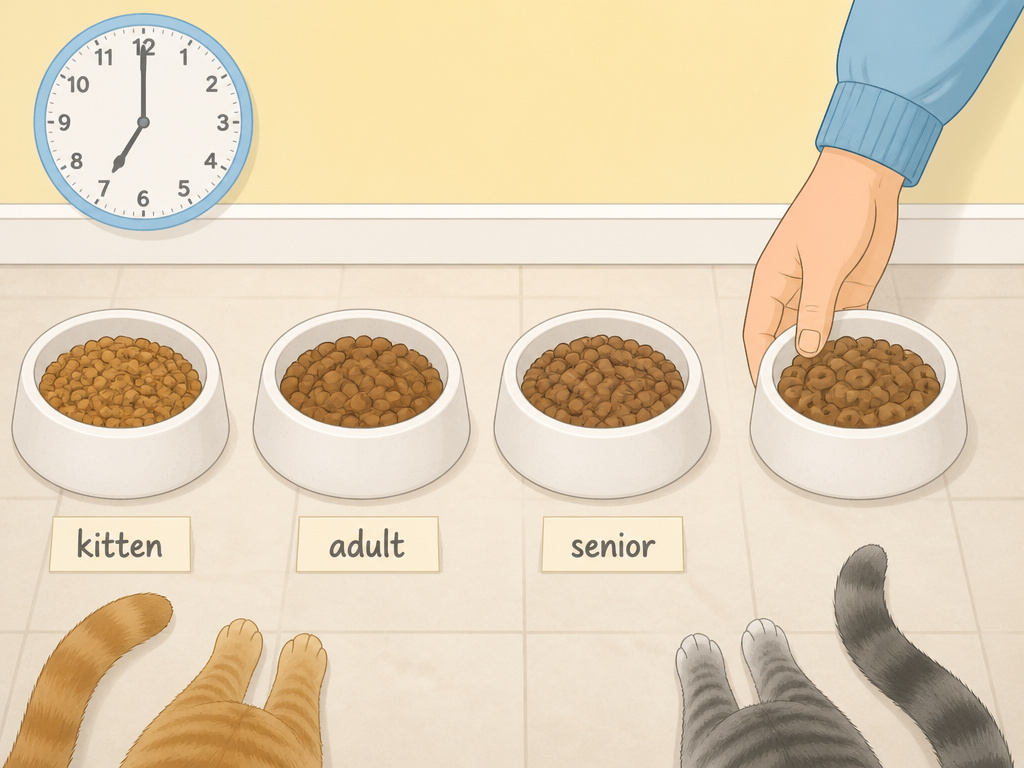
Three meals a day until six months old, twice daily from six months to a year, then once or twice a day for the rest of adult life.
That’s the age-based schedule from Cornell, and it’s the cleanest starting point because it doesn’t depend on how many cats you have. Per Cornell Feline Health Center advice, senior cats aged 10 and up should stay on the same regimen unless a vet says otherwise.
| Life stage | Meals per day | Source |
|---|---|---|
| Kitten, under 6 months | Three | Cornell |
| 6 months to 1 year | Two | Cornell |
| Adult, about 1 year and up | One or two | Cornell |
| Senior, 10 years and up | Unchanged unless a vet directs | Cornell |
Older cats have their own wrinkle. Scherk notes that cats over 12 have an increased protein requirement relative to younger adults and need more calories from fat. A base diet built for a two-year-old isn’t automatically right for a 13-year-old.
Consistency matters more than the exact hour. Ohio State’s guidance is that once a schedule is chosen it should be steady enough that the cat can count on it, and that changes in feeding schedules can evoke sickness behaviors. The OSU indoor pet feeding management document makes the same point from the clinical side.
If you’re rebuilding the routine from scratch, a standard cat feeding schedule by age gives you the frame to hang it on.
The Weight-Loss Problem: What a 23-Cat Study Found
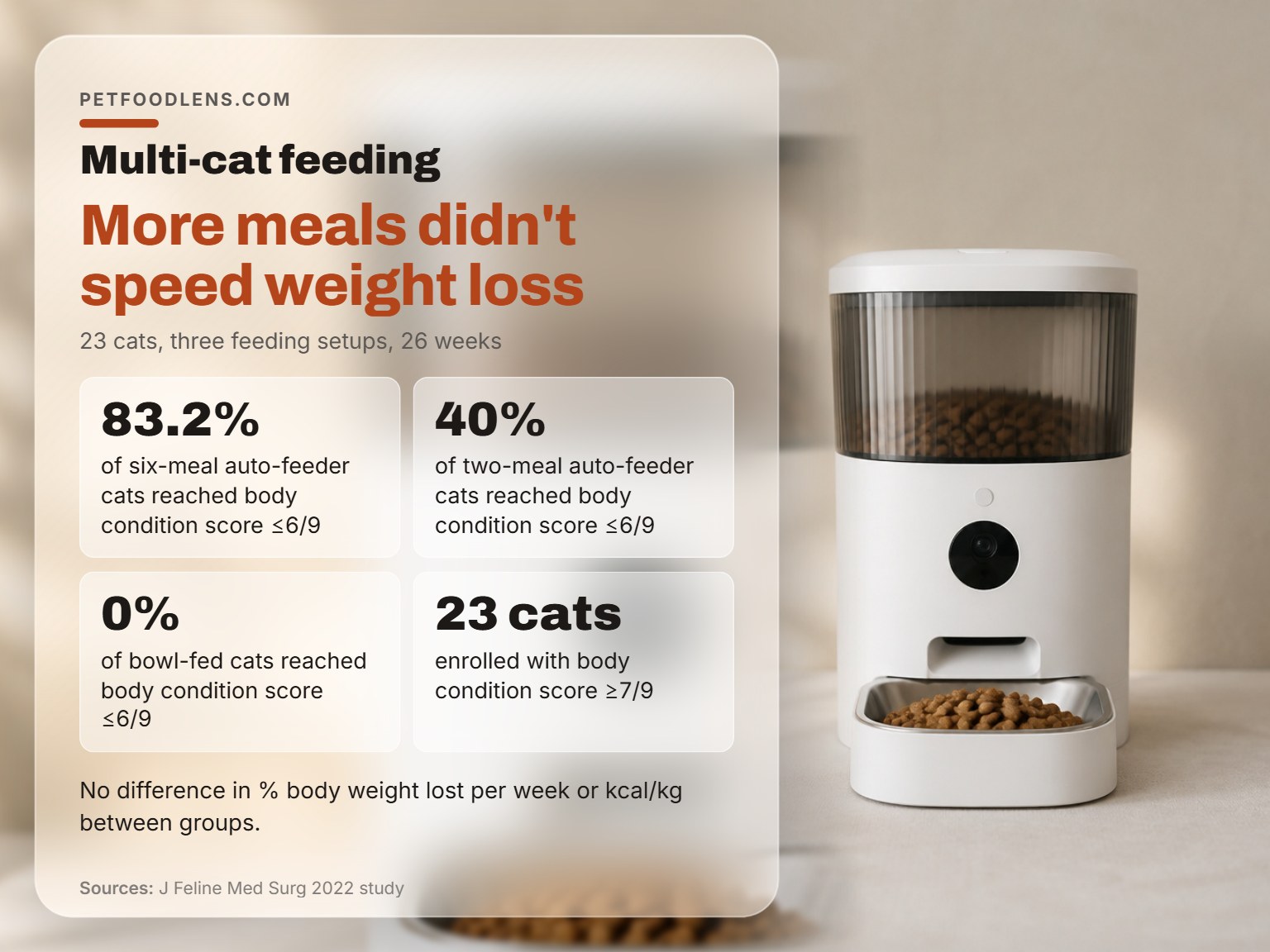
More meals did not mean faster weight loss. That’s the finding that surprised me most.
A multi-cat household feeding study published in the Journal of Feline Medicine and Surgery in 2022 enrolled 23 adult cats with a body condition score of 7/9 or higher.
The Three Study Arms
Cats were split three ways: a plain bowl with two meals a day, an auto-feeder with two meals a day, and an auto-feeder with six meals a day.
The outcome numbers were lopsided. 83.2% of the six-meal auto-feeder cats reached a body condition score of 6/9 or lower, against 40% of the two-meal auto-feeder group and 0% of the bowl group.
Owners using auto-feeders rated the weight-loss plan easier, and auto-feeder use predicted reaching ideal body condition. The study suggests the automated feeder reduced certain food-seeking behaviors, indicating cats began to dissociate the pet owner from meal feeding.
What the Numbers Don’t Say
Here’s the part that gets skipped. There was no difference in percentage of body weight lost per week or in kcal per kilogram between the groups. Six meals didn’t burn more calories than two. More frequent meals also didn’t cut down hunger-related behaviors.
The advantage was owner adherence and reduced food-seeking, not metabolism. That distinction matters if you’re choosing between a plan you’ll actually run and one that looks better on paper.
The study carries its own limitation, stated plainly: results may not transfer directly to feeder systems that only separate cats or only provide portioning. You need both halves.
Microchip Feeders, Creep Feeders, and Door Latches
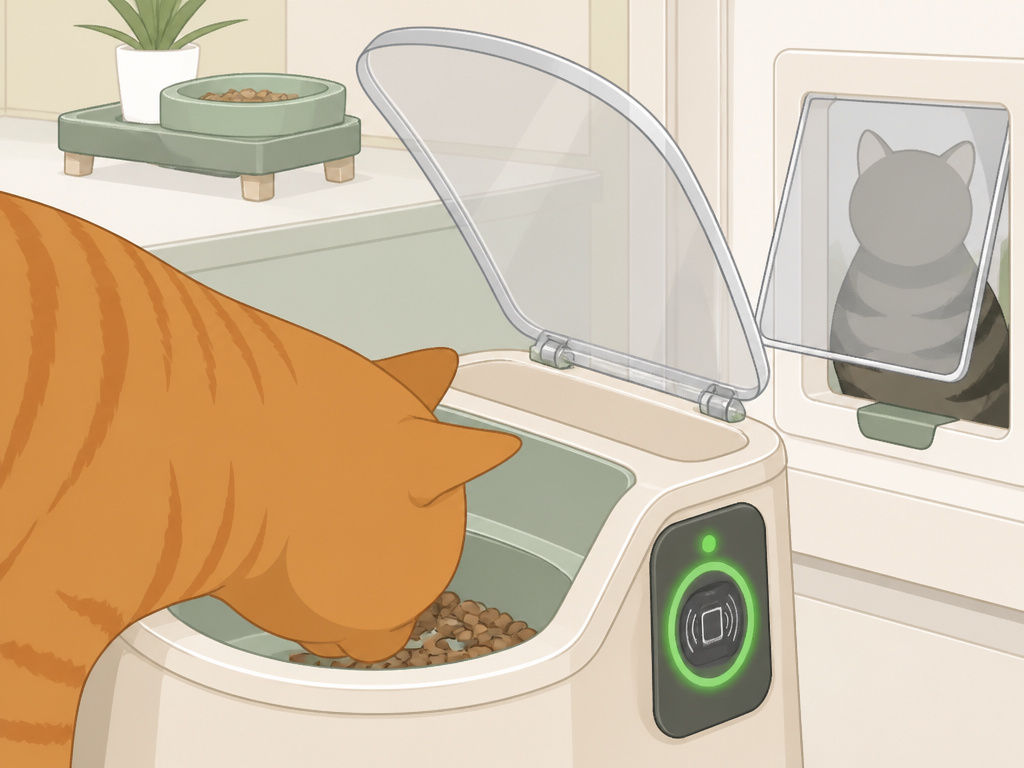
Three tools do most of the work here: a microchip-reading feeder, a creep feeder, and a door latch.
| Method | Best for | Limitation |
|---|---|---|
| Microchip feeder | One cat on a different formula in an open room | Needs a backup plan if the tag fails |
| Creep feeder | A slim cat who gets pushed off a normal bowl | Doesn’t control total intake |
| Door latch or keyed flap | An overweight cat who roams | Requires a room you can commit |
| Elevated station | A cat who prefers height | Doesn’t stop a jumper |
Microchip Feeders
The AAFP/FelineVMA consensus statement names programmable feeding bowls that use individual microchips, allowing only one cat to access the bowl. That’s the mechanism: the bowl reads the chip already in the cat and opens for that cat only.
If you need to keep one cat out of one bowl without locking a door, microchip cat feeders do that job directly.
Creep Feeders and Door Latches
Scherk lists three access-control options for an overweight cat who shouldn’t reach anyone else’s food: a latch on a door, a built-in creep feeder, or a keyed cat flap that responds to the cats’ existing microchips, with SureFlap named as an example. The flap is the neatest of the three because it uses hardware the cat already carries.
For two cats on two different diets, dual automatic feeders split the portions without splitting the room. The 2022 trial’s results may not transfer to feeder systems that only separate cats or only provide portioning. Simpler automatic cat feeders that only portion, or only separate, don’t carry the study’s results with them.
Height is a tool too. The consensus statement notes that some cats who can jump prefer to eat on counters or other elevated spaces, and Scherk uses the same idea in reverse: put the growth diet up high and an elderly cat who can’t jump won’t reach it.
Free-Feeding vs Measured Meals: Where the Sources Split
Can you just leave dry food out for everyone? Three credible sources give three different answers.
The CVMA/SBCV position allows it. Scherk’s plan has the IBD-safe baseline diet left out during the day for all cats to eat, with individual needs supplemented behind closed doors.
Ohio State allows it with a condition. If an owner prefers to leave food out all the time, leaving only enough to require the bowl to be filled once or twice each day, in the presence of the cat, may be an option. That last clause is doing work. Topping up a bowl in an empty kitchen removes the interaction entirely.
The AAFP/FelineVMA consensus goes the other way: cats should be fed measured amounts rather than free-fed to help control weight.
Cornell sits between them, noting that free-feeding dry food may be acceptable for some cats but can cause overeating and inappropriate weight gain in others. Cornell adds one practical rule that applies either way: any food left out for grazing should be replenished with new food every day.
Where this goes sideways: Leaving a bowl out for the cat who needs it, while the cat who doesn’t need it empties that same bowl overnight. Free-feeding in a multi-cat home only works if you can name which cat is eating the food.
The free feeding vs scheduled feeding split is the same argument in more detail. My read: measured meals are the default per the AAFP/FelineVMA consensus, while CVMA/SBCV and Ohio State allow free-feeding under conditions for a specific cat.
Water, Treats, and the Non-Food Parts of the Routine
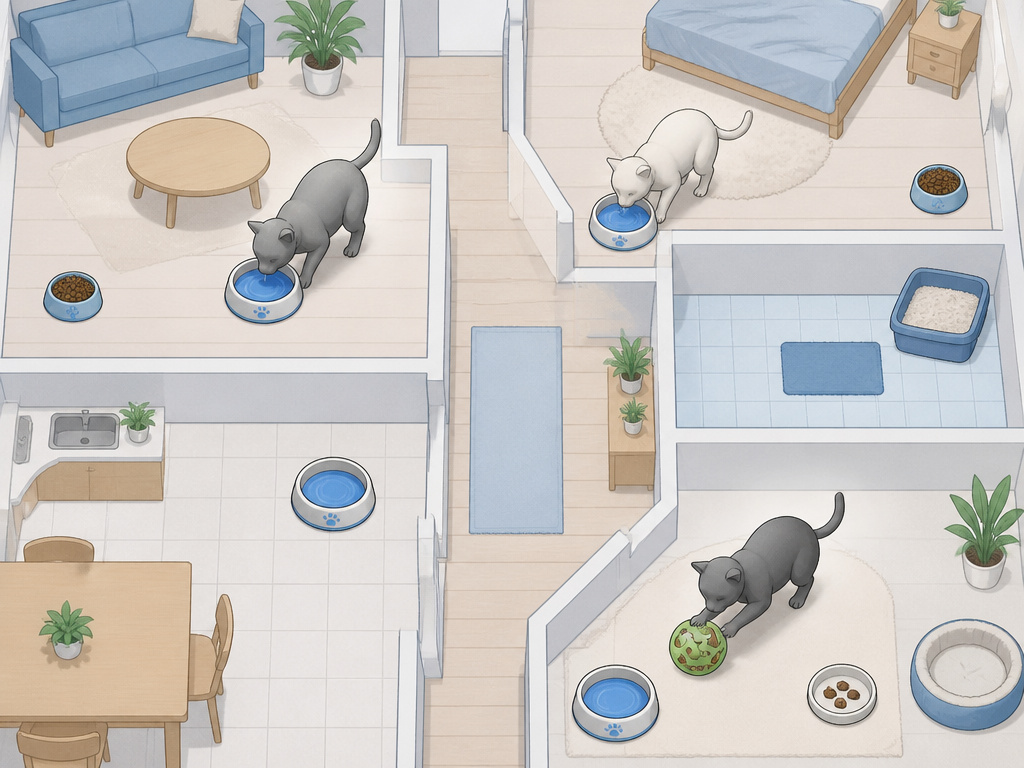
Water gets treated as an afterthought, and in a multi-cat home that’s a mistake.
VCA’s rule is one source of fresh, clean water per pet, placed in various areas around the house. Their worked example is a home with two dogs and two cats, which calls for four water bowls. Pets can share a bowl, but the count still needs to match the number of animals.
Ohio State adds a placement rule that VCA doesn’t: in multiple-cat households, food and water bowls should be placed out of view of each other to reduce conflict over those resources. VCA’s version spreads water around the house; OSU’s version keeps it away from the food. Both are worth doing.
The consensus statement adds one more boundary: food and water should be separated from the litter box. That one isn’t negotiable in any household.
Treats are where calories sneak in. VCA puts most cat treats at 1 to 4 Calories each, and says only a small dog treat with under 5 Calories per piece should ever be offered to a cat. A handful of treats across several cats adds up faster than anyone tracks.
Foraging is the behavioral half of feeding that a bowl can’t cover. Ohio State suggests hiding small amounts of food around the house or using a foraging device, and names three: the Ball of the Wild from OurPets, the Egg-cersizer from Premier Pet Products, and the Slimcat ball by Multivet. The consensus statement notes that automatic feeders don’t typically provide for hunting or foraging, which is the gap these fill.
A dry kibble bowl gets nosed across the floor for the same reason. That’s feeding behavior, not hunger.
If the raiding runs toward the dog’s dish rather than another cat’s, the fix is different from cat-to-cat separation. Learning how to stop food stealing between species is its own project.
The part nobody mentions: Canned food is commonly pushed for cats with lower urinary tract signs, and Ohio State states flatly that the evidence supporting that recommendation is weak. Cornell’s angle is narrower and better supported: wet food is about 70 to 80 percent water, and fresh water matters most for cats on dry food and those prone to urinary disease.
Frequently Asked Questions
Can I feed two cats from one bowl?
No. VCA’s reasoning is that each pet has unique calorie needs and needs a different volume of food, so a shared bowl makes it impossible to know who got what. Separate bowls also tell you when a cat stops eating, which is often the first visible sign of illness.
How do I feed one cat a prescription diet when I have four?
Use the base-diet-plus-top-up structure. Pick a baseline diet the whole household can eat safely, then put the cat on the prescription food in a separate room twice a day behind a closed door. Scherk’s guidance is explicit that all cats other than the one with gastrointestinal disease can be moved to separate rooms twice daily for their individual needs.
Do automatic feeders actually help cats lose weight?
Partly. In the 2022 study, 83.2% of cats on a six-meal auto-feeder reached a body condition score of 6/9 or lower, against 0% of cats eating from a plain bowl. But the study used a unit that both separated cats and portioned meals, and the authors warn the results may not transfer to devices that only do one of those.
How many water bowls do I need for two cats?
Two, at minimum, since VCA’s rule is one fresh water source per pet. Place them in different areas rather than side by side, and keep both away from the food bowls and the litter box.
Is free-feeding dry food okay in a multi-cat household?
The sources disagree. CVMA and Ohio State both allow it under conditions, and the AAFP/FelineVMA consensus says cats should be fed measured amounts instead. If you free-feed, Cornell’s rule applies: any food left out for grazing gets replenished with new food every day.
The Bottom Line
If you change one thing, put a body condition score on every cat in the house, by hand, on the 9-point scale. Not a guess from across the room. Hands on the ribs and spine.
That single measurement tells you which cat is the baseline problem and which one is quietly losing or gaining. Without it, every other decision here is guesswork.
One concession worth stating: none of this replaces a veterinarian if a cat has kidney disease, diabetes, thyroid disease, or urinary crystals. The label-reading approach handles the household logistics. It doesn’t handle the diagnosis.
And if the whole plan collapses into two bowls in the same corner again by next month, that’s normal. The closed door is the part to rebuild first.
