
How Often Should You Feed a Cat: Age Bands and Evidence
This post contains affiliate links. As an Amazon Associate, we earn from qualifying purchases.
How often should you feed a cat depends on age: three meals a day under six months, two meals from six months to a year, and one or two meals a day for adults, per Cornell Feline Health Center guidance. Adult frequency is genuinely contested, and the published research does not settle it.
That contested adult number is where the how often should you feed a cat question makes most feeding advice fall apart. Cornell says one or two meals. The National Academies say more than once a day. A review in JFMS points to a consensus statement recommending several small meals spread across the full 24 hours, and a 2020 PLOS ONE trial argues once-daily feeding may be the better option for indoor cats.
What follows walks the age bands, the published disagreement over adult meal count, the 2022 automatic-feeder trial, and the setup that keeps a multi-cat house honest.
Key Takeaways
- Three meals a day for kittens under six months, two from six to twelve months, one or two for adults (Cornell).
- Bag feeding charts are built for the average cat, so they overshoot for a cat that sleeps more than it hunts.
- Free-fed cats eat many small meals across a day, the National Academies put it at 12 to 20, while a behavioral review gives about 8 to 16, which makes intake almost impossible to track.
- Six meals did not speed weight loss in the 2022 trial; the weekly rate matched two meals and matched bowl feeding.
- Wet food spoils fast, so free feeding works best with dry kibble.
How Often Should You Feed a Cat at Each Age?
Cornell’s bands are the closest thing to a default schedule, and they’re short enough to memorize.
Kittens under six months take three meals daily. From six months to one year, twice-daily feeding is generally best. Adults around one year do well on one or two meals a day. Senior cats aged ten and older hold the same regimen unless a veterinarian directs otherwise. The bands track growth rate rather than body weight alone.
| Age band | Meals per day | What changes |
|---|---|---|
| Under 6 months | 3 | Rapid growth, high energy need per pound |
| 6 to 12 months | 2 | About 75% of adult size by six months |
| Adult (about 1 year) | 1 to 2 | Growth food until roughly 12 months |
| Senior (10 years and up) | Unchanged | Same regimen absent vet instruction |
The six-month mark matters more than people expect. By that age a kitten is roughly three quarters of its adult size, and its energy requirement drops sharply, especially if it was spayed or neutered around then. That drop is where a lot of kittens start gaining.
Food type changes on a different clock than meal count. Kittens stay on a growth-formulated food until they finish growing, typically around 12 months, with adult food introduced gradually from about 10 months. Check for an AAFCO nutritional adequacy statement on the label to confirm the food is complete and balanced.
If you want the full breakdown of bands and transitions, the cat feeding schedule by age walks through it stage by stage. Cornell’s own Cornell Feline Health Center guidance is the primary source for the numbers above, and it’s worth reading in full because it also covers sick cats.
Kitten timing has its own rules, and they’re tighter than adult rules. Here’s the kitten feeding detail if you’re in that window now.
Why Researchers and Vets Split on Adult Meal Count
Cornell puts adult cats at one or two meals a day. The National Academies say more than once a day. The JFMS feeding-programs review points to a consensus statement calling for the daily allowance to be split into multiple small meals across the full 24 hours. The PLOS ONE authors landed somewhere else entirely.
| Source | Position on adult meal count |
|---|---|
| Cornell Feline Health Center | One or two meals a day |
| National Academies (NASEM) | More than once a day |
| JFMS feeding programs review | Several small meals across 24 hours |
| PLOS ONE 2020 trial authors | Once daily may benefit indoor cats |
This is a real disagreement between credible sources, and anyone who tells you the question is settled is skipping the evidence.
The case for several small meals
The behavioural argument is straightforward. Free-roaming cats eat many small meals, and the feline feeding-programs review argues that feeding plans should account for foraging and predation drives. Puzzle feeders beat plain bowls for that reason. Automatic feeders, the same review notes, don’t typically provide for foraging or predation at all.
A laboratory study of 20 meal-fed male cats also found increased aggression and reduced food and water intake compared with ad libitum access. A separate lab-colony summary reported lower food intake, lower water intake and less urine output on twice-daily meals versus free access.
The case for one meal a day
The 2020 PLOS ONE trial ran eight adult cats through isocaloric canned food on two regimens: one meal at 0800, or four meals at 0800, 1130, 1500 and 1830, across three 21-day periods. Cats on four meals showed lower postprandial GIP and GLP-1 (P<0.05) and a trend toward lower PYY (P<0.1). Cats on one meal showed higher postprandial ghrelin and insulin and a larger amino acid response (P<0.05).
Physical activity was higher on four meals (P<0.05). Energy expenditure was identical. Cats fed once daily had a lower fasting respiratory quotient (P<0.05), which points toward more fat oxidation.
The authors concluded that once-daily feeding may be a beneficial strategy for indoor cats, and they noted a lack of empirical evidence supporting multiple meal feeding for body composition and weight. That’s a direct challenge to the consensus position, published in a peer-reviewed journal.
I’ll take the contested answer over a confident one here. The studies genuinely split, and the split is about physiology and behaviour, not about who read the label wrong.
What the 2022 Feeder Trial Actually Measured
83.2 percent of cats on a six-meal automatic feeder reached a body condition score of 6/9 or lower. On a two-meal automatic feeder, 40 percent got there. On a bowl with two meals a day, zero percent did (P=0.006).
That’s a striking result, and it’s the one number people quote. Read the rest of the paper and the picture changes.
The trial enrolled adult cats scoring 7/9 or higher on a nine-point body condition scale and ran a weight-loss plan for up to six months. Food intake was adjusted to hold weight loss between 0.5% and 1.5% of body weight per week, with weigh-ins at weeks 0, 2, 4, 6, 10, 14, 18, 22 and 26. The three arms were bowl with two meals (B2), automatic feeder with two meals (A2), and automatic feeder with six meals (A6).
Percent body weight lost per week did not differ between groups. Neither did kcal/kg intake. Six meals did not accelerate the rate of loss or raise the calorie requirement.
I don’t read the 83.2 percent as a case for six meals. I read it as a case for portion control and individual access, which is what the feeder actually delivered.
Owners rated the auto-feeder plans easier than bowl feeding (P=0.01), and the feeders reduced owner-reported instances of certain food-seeking behaviours. The authors suggest cats began to dissociate the owner from meal delivery. Automated feeders did not improve overall satiety or eliminate all food-seeking, though.
That last point matters if you’re hoping a machine will stop the 4am yowling. It won’t, entirely. The cat begging for food problem has its own playbook, and if you’re shopping, the best automatic feeders for cats comparison covers what separates a useful unit from a novelty. The full automatic feeder weight loss study is open access if you want the tables.
Free Feeding vs Scheduled Meals: Which Fits Your Cat?
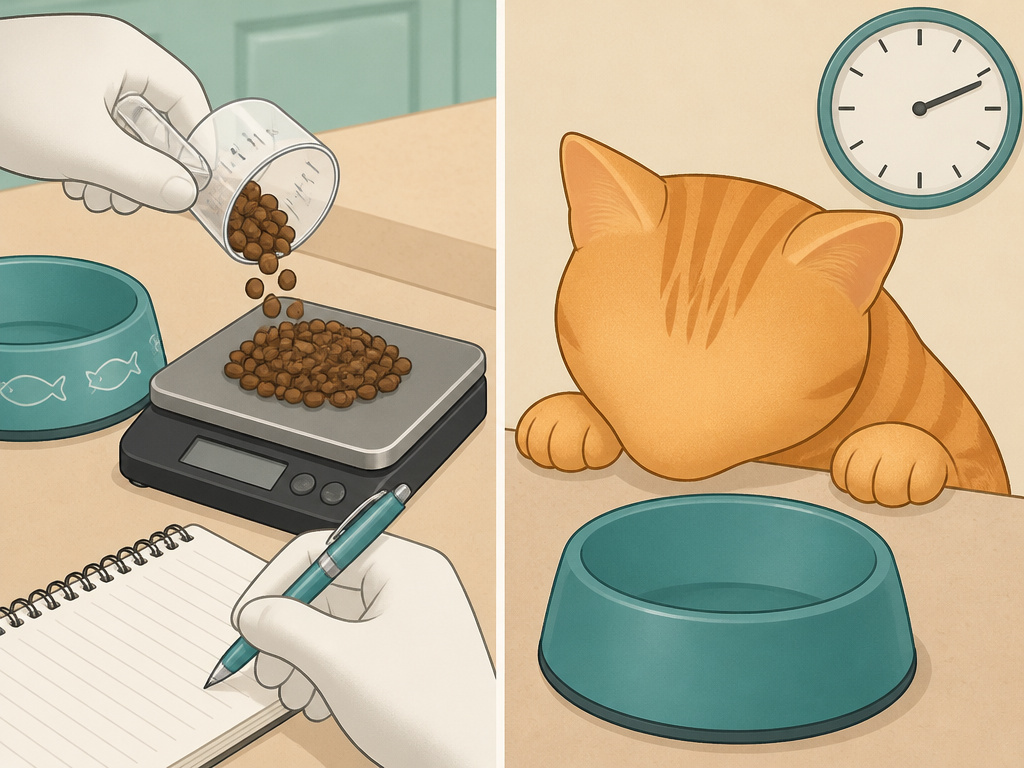
Free feeding means leaving food down permanently and letting the cat set the schedule. That works for some cats and wrecks others, and the difference is usually body condition rather than personality.
| Method | Fits best when | Main risk |
|---|---|---|
| Free feeding dry | Single cat that self-regulates | Intake unmeasurable, slow weight gain |
| Scheduled meals | Overweight cat, multi-cat house | Persistent crying between meals |
| Automatic feeder | Multi-cat, active weight-loss plan | No foraging or predation outlet |
The case against free feeding as a default is measurement. When food is always available, you can’t tell how much a cat ate in a day, and it gets harder still when two cats share a dish. That’s tolerable for a healthy cat at a healthy weight. It’s useless for a cat on a weight-loss plan, where exact intake is the whole game.
There’s also a spoilage clock. A bowl of wet food left down for a few hours dries at the rim and starts to smell sour, faintly metallic. Moist food spoils quickly when left out, which rules out grazing on canned food entirely. Any dry food left out for grazing should be replaced with fresh food every day.
Free feeding is defensible in a narrow set of cases:
- A single cat at a healthy body condition score that self-regulates and stays there.
- A household where the cat is fed a complete dry diet and fresh water is always available.
- Cats that eat so slowly a scheduled meal gets ignored, provided the weight is stable.
- Short-term situations, like a new cat settling in, where the routine isn’t established yet.
The behavioural research cuts both ways here. The laboratory findings on meal-fed cats showing reduced intake and increased aggression are real, and they’re a fair argument for leaving food available. They were also lab-colony cats in small housing, which is a long way from a house with a cat tree and a window.
One practical middle ground: keep dry food available but weigh what you put down and what’s left. Cornell’s note that grazing food should be replenished daily is about freshness. Weighing it is about honesty.
If your cat does most of its eating overnight, the timing question is separate from the frequency question. Feeding at night covers that specifically. For the broader trade-off, the free feeding vs scheduled feeding breakdown goes deeper than this section can.
What most people get wrong: Topping up a bowl instead of replacing it. Old kibble sits at the bottom for days, and the cat eats around it until the bowl is a stale layer with fresh food on top.
How to Set Up Measured Meals in Five Steps
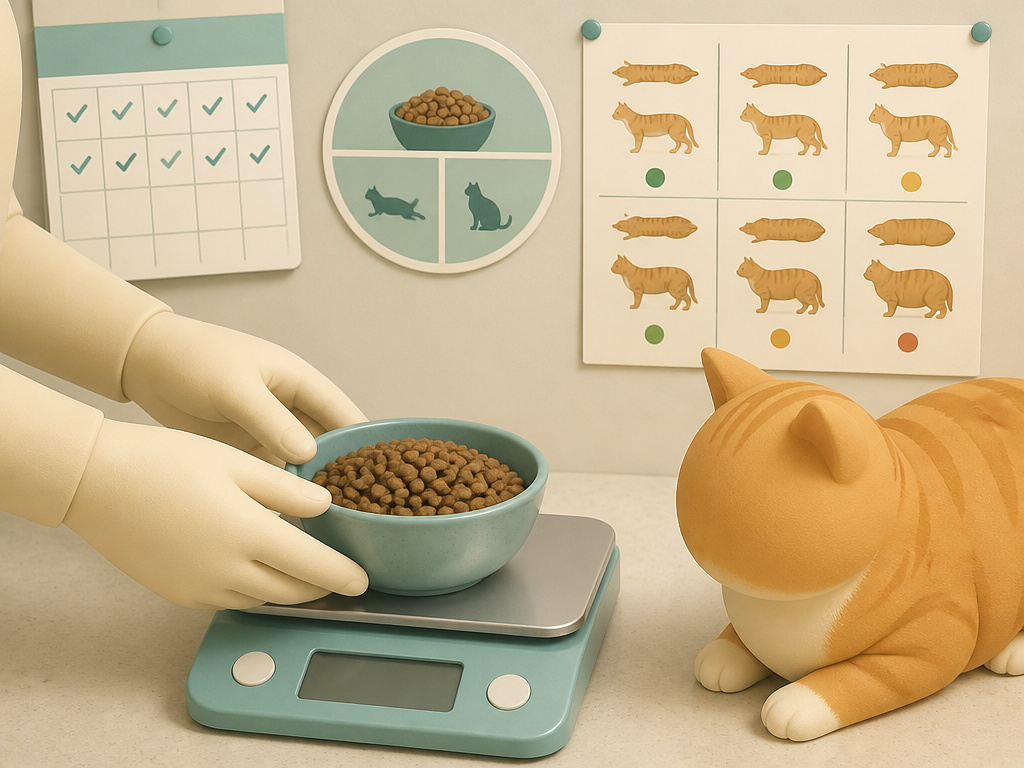
Five steps, in this order. Skip step two and everything after it is guesswork.
Before you start: Wet food left down for a long period spoils and should be lifted, not topped up. Raw diets carry documented pathogen and nutritional adequacy concerns, so treat raw feeding as a decision to make with your vet rather than a schedule tweak. Underfeeding is not a safe shortcut either; too little food risks weight loss and hepatic lipidosis, a potentially life-threatening fat accumulation in the liver.
- Weigh the cat and score body condition. Use a nine-point scale and your hands on the ribs. Skip this and you have no baseline to judge the plan against, so you won’t notice a slow drift until it’s several months deep.
- Estimate daily calories. An average neutered adult cat needs roughly 55 kcal/kg/day, then adjust for activity and body condition. Get this wrong in the generous direction and the cat gains on a “measured” diet.
- Weigh the food, don’t scoop it. A measuring cup of one kibble and a cup of another differ in weight, and the error compounds across every meal. A kitchen scale removes the variable entirely.
- Divide the daily amount into the meals your schedule allows. Two is workable for most adults, and Cornell treats one or two as appropriate. Splitting into more meals doesn’t change the daily total, so the total has to be right first.
- Re-weigh every two weeks. The 2022 trial weighed cats at weeks 0, 2, 4, 6, 10, 14, 18, 22 and 26, which is the cadence a real plan uses. Monthly weighing is where slow gains hide.
The mistake I see most often is treating the bag’s chart as a target. Cornell explains why that backfires: the feeding instructions on pet food labels are based on the needs of the average cat, so a cat that expends less energy than average gets fed more than it needs. The chart is a ceiling.
Two numbers worth having in hand before you start: the how much to feed guide for portion math, and the calorie needs breakdown for the energy side. Both matter more than meal count.
Easy to miss: Meal frequency does not change the daily calorie total. The 2022 trial found no difference in kcal/kg intake or weekly weight-loss rate between two meals and six, so splitting food more finely without cutting the total changes nothing.
Where the Standard Schedule Breaks Down
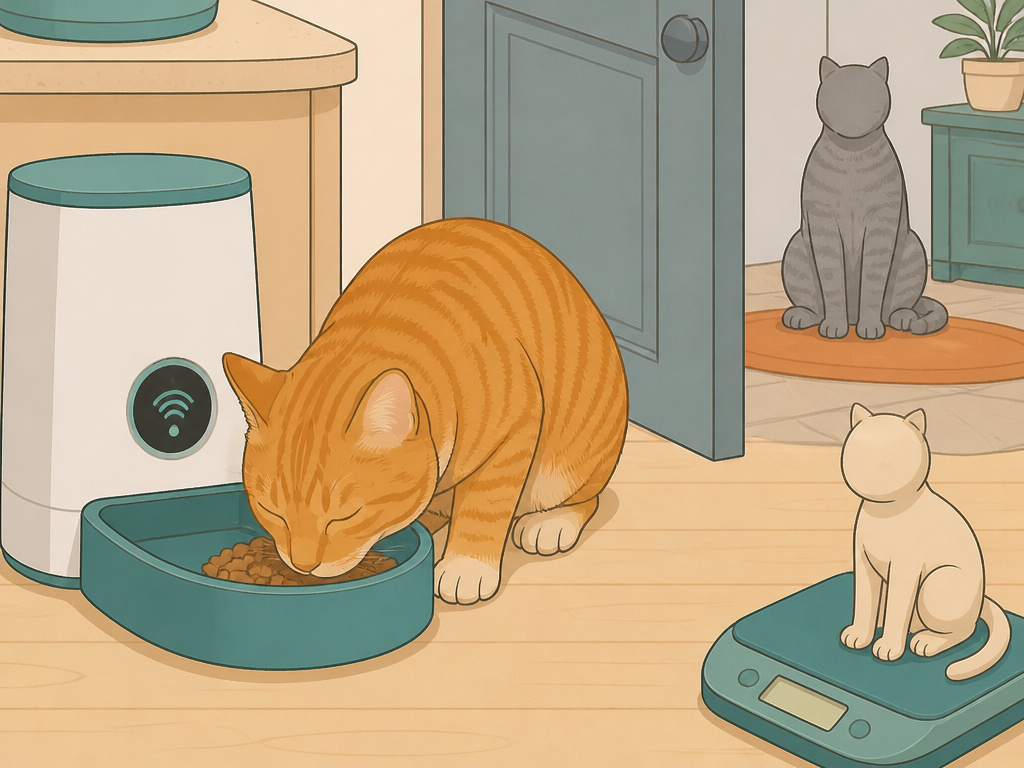
Multi-cat houses break every schedule, and they break them quietly.
Multi-cat households
In a two-cat house you’ll hear one collar tag hit the bowl while the second cat sits a few feet back, waiting. That cat is not getting its share, and you won’t see it in a shared bowl.
Feeding cats separately or in different parts of the house helps, and Cornell recommends it for exactly this reason. The 2022 trial’s entire design premise was that individual access is what makes a weight-loss plan work in a multi-cat home.
What actually helps:
- Separate rooms at meal time, with the door closed.
- Microchip-reading feeders, which open only for the registered cat.
- Weighing each cat monthly, since the bowl won’t tell you who ate what.
- Feeding the faster cat first and the slower cat behind a closed door, so nobody is rushed.
Sick, senior, and debilitated cats
Senior cats at 10 years and older keep the same regimen unless a vet says otherwise, per Cornell. That’s the default, and it’s a useful anchor against the urge to change everything at a birthday.
Health conditions override the schedule. Diabetic cats should ideally be on a diet moderately restricted in carbohydrates. Cats with advanced chronic kidney disease should usually be on a protein- and phosphorus-restricted diet. Cats with periodontal disease may struggle to chew dry food, and wet food, finer kibble, or water added to the food can help.
Aged, debilitated or chronically ill cats need regular weight and body condition monitoring, because they may fail to eat even when food is placed in front of them. That’s a different failure mode from overeating, and it needs eyes on it.
I’m not a clinician, and this is the section where I hand off. Therapeutic diets for kidney disease, diabetes or urinary conditions are a veterinary decision, and label reading won’t get you there.
Frequently Asked Questions
Should I leave dry food out all day for my cat?
It’s acceptable for some cats and risky for others. Cornell notes free feeding dry food may be fine for cats that self-regulate but can cause overeating and inappropriate weight gain in others. If your cat carries extra weight, measured meals give you information that a topped-up bowl never will.
Is one meal a day enough for an adult cat?
Cornell treats one or two meals a day as appropriate for most adults. The 2020 PLOS ONE trial went further, finding that once-daily feeding produced higher postprandial satiety hormones and lower fasting respiratory quotient, and its authors called once-daily feeding potentially beneficial for indoor cats. Other sources, including the National Academies, recommend more than one meal a day. The evidence is genuinely split.
Do senior cats need fewer meals?
Cornell’s guidance is that cats 10 years and older keep the same feeding regimen unless a veterinarian instructs otherwise. Age alone isn’t a reason to cut meals. Weight loss, dental disease or a diagnosis like chronic kidney disease is.
How do I feed two cats different amounts?
Separate them at meal time, or use a feeder that reads a microchip and opens only for one cat. The 2022 trial was built around individual access for exactly this problem, and shared dishes make intake impossible to measure. Weigh both cats monthly to confirm the plan is working.
Does feeding more often help a cat lose weight?
Not on its own. In the 2022 trial, cats on six auto-fed meals were far more likely to reach a body condition score of 6/9 or lower than cats on two meals from a bowl, but the percentage of body weight lost per week and the kcal/kg intake were the same across all groups. Portion control and individual access did the work.
The Bottom Line
If your cat scores 7/9 or higher on a nine-point body condition scale, stop optimizing meal count and fix the daily total first. Every arm of the 2022 trial lost weight at the same weekly rate. What separated them was whether the cat could get at food it wasn’t supposed to have.
Here’s the trigger to act on: if you can’t state, in grams, how much your cat ate yesterday, you don’t have a feeding plan yet. You have a bowl.
One concession worth stating plainly. Everything above assumes a healthy cat. A diabetic cat, a cat with advanced kidney disease, or a cat that has dropped weight without explanation needs a veterinarian setting the diet, and no amount of label reading substitutes for that. I’ll argue about meal frequency all day. I won’t argue with a diagnosis.
