
How Much to Feed a Kitten: By Age and Weight
This post contains affiliate links. As an Amazon Associate, we earn from qualifying purchases.
To work out how much to feed a kitten, start with energy: a 10-week-old needs about 200 kcal per kg of body weight per day, falling to 80 kcal/kg by 10 months. Split that daily total into three to four small meals, and check the bag’s AAFCO growth statement before anything else.
That drop from 200 to 80 kcal/kg is why the how much to feed a kitten question feels impossible to pin down. The target slides downward every week, so a portion that was right in March is too big by June.
What follows: the energy math, the free-feeding argument nobody settles, and the weaning window that three credible sources date three different ways.
Key Takeaways
- 200 kcal/kg/day at 10 weeks, falling to 80 kcal/kg/day by 10 months, per the AAHA/AAFP life stage guidelines.
- Weighed grams beat scooped cups. Bernalillo County’s feeding table is based on a 4076 kcal/kg diet, so a cup measure only works for food of that density.
- Portion feeding is VCA’s pick for obesity prevention, while Bernalillo County and Chewy both recommend free-feeding to 4-6 months.
- Bottle-fed kittens cap at 4 ml per 100 g of body weight per feeding. Past that, aspiration risk climbs.
- Kitten food runs to around 10 months, with some sources saying 12.
The 200-to-80 kcal Curve Behind Every Kitten Portion
Two hundred kilocalories per kilogram of body weight per day is the figure the AAHA kitten nutrition guidelines attach to a 10-week-old kitten. By 10 months, the same guidelines put the requirement at 80 kcal/kg.
Growing kittens carry the highest energy demand of any life stage. At 10 weeks of age the requirement sits near 200 kcal per kilogram of body weight per day. By 10 months the figure has fallen to about 80 kcal/kg. The most rapid growth happens in the first six months.
That second number is the one owners miss. A kitten at 10 months weighs several times what it weighed at 10 weeks, yet each kilogram of that body needs far less energy than it did in spring.
Four things move the number:
- Age, which sets the baseline. The curve runs one direction.
- Current weight, because the requirement is quoted per kilogram.
- Neuter status.
- Individual variation. Chewy puts real-world needs up to 50% either direction from any chart average.
The same per-kilogram logic drives how many calories a cat needs in adults, though the maintenance figure is lower and much flatter.
Cups Lie. Buy a Gram Scale.
A measuring cup holds a volume, so when you compare a how much to feed a kitten answer to “one third of a cup,” it only matches the calorie table if the food is the 4076 kcal/kg diet the table is based on.
Bernalillo County’s feeding table states outright that its numbers are based on a 4076 kcal/kg diet. That single line tells you the table only works for food of that density.
Before you start: Wet kitten food left in the bowl past two hours needs to go in the bin, and dry food past 24 hours. Never guess a bottle-fed kitten’s portion by eye either. The comfortable stomach ceiling sits near 4 ml per 100 g of body weight per feeding, and going over it risks aspiration and vomiting.
Here’s the calculation, in order:
- Read the calorie density off the label. It appears as kcal/kg, or as kcal/cup for dry food and kcal/can for wet. Skip this and every later step is arithmetic on a guess.
- Weigh the kitten on a kitchen scale. Body weight in kilograms is the input the whole calculation runs on.
- Multiply kilograms by the kcal/kg figure for that age. A 1 kg kitten at 10 weeks lands near 200 kcal a day on the guideline curve. Get this wrong and the entire day is off by the same proportion.
- Divide the daily total by the food’s calorie density. At 108 kcal per can, a 327 kcal daily need works out to the daily amount of wet food.
- Split the result across the day’s meals. VCA recommends three to four portions or more, since dividing the total reduces the volume eaten at one sitting.
A portion you can’t repeat is a portion you can’t adjust.
Getting how to measure cat food portions right matters more than which brand you buy, because a scoop error repeats every single day for a year.
How Often Should a Kitten Eat, and How Much Per Meal?
Young kittens eat more often than the bag suggests, and the count drops fast after four months. Published answers to how often to feed a kitten range from three meals to free access, which is why the daily total matters more than the count.
Here’s where the guidance sits:
- Royal Canin aims for 4-6 smaller meals a day in the early weeks, noting kittens can eat up to 16 times a day if left to it.
- VCA Animal Hospitals recommends 3-4 small meals or more, splitting the daily portion so no single meal is large.
- Bernalillo County Animal Care puts kittens at 3 meals a day until roughly 4 months old.
- Chewy takes a different route entirely, leaving food out day and night until 4-6 months.
Sanity-check any plan against a calorie chart. Chewy publishes one by age and weight:
| Age | Typical weight | Daily calories |
|---|---|---|
| Newborn | 4 oz (0.1 kg) | 31 kcal |
| 2 months | 2 lb (0.9 kg) | 162 kcal |
| 5 months | 5 lb (2.3 kg) | 327 kcal |
| 10 months | 10 lb (4.5 kg) | 541 kcal |
Two warnings on that table. Chewy itself says individual needs vary by up to 50% in either direction. And the 10-month row works out to roughly 120 kcal/kg, well above the 80 kcal/kg the AAHA guidelines use at the same age.
That gap is real, and it’s why you adjust against the kitten in front of you rather than the chart.
Free-Feeding vs Portion Feeding: Where the Advice Splits
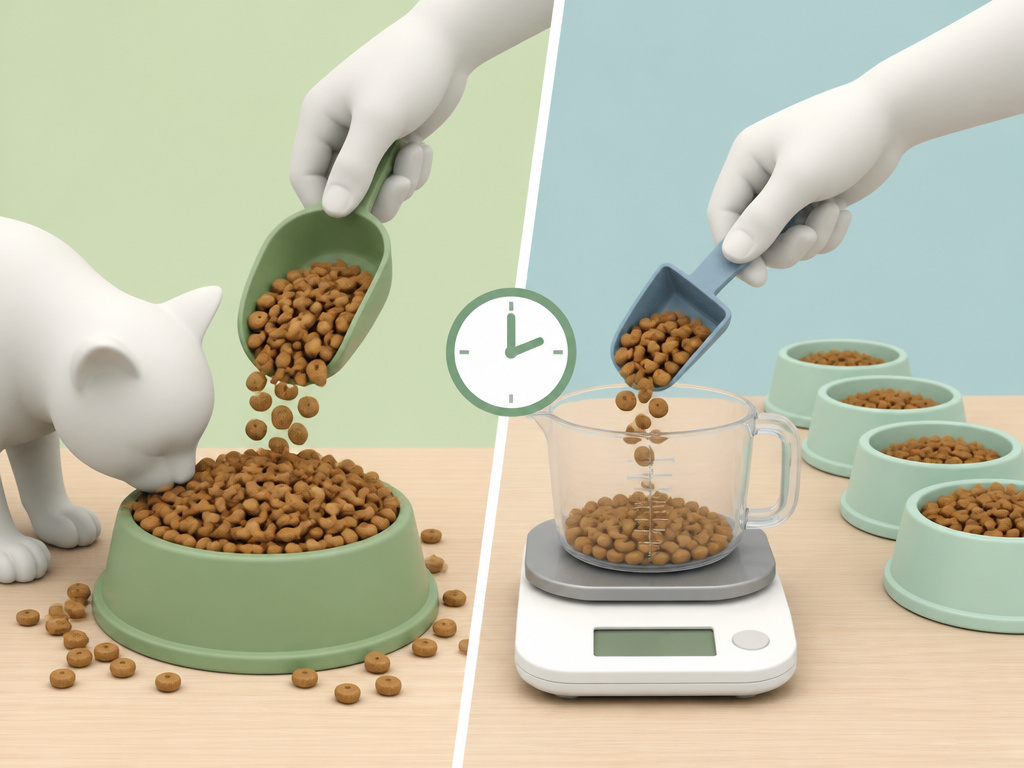
VCA warns that the bowl that never empties raises the risk of kittens getting fat, while Bernalillo County and Chewy recommend free-feeding to 4–6 months. Nobody does it on purpose. The food goes down full and the kitten grazes until it’s gone.
VCA is direct about the mechanism: free-choice feeding raises the risk of laying down extra body fat, and portion feeding gives the best chance of preventing a kitten from becoming overweight. Bernalillo County and Chewy both recommend free-feeding for the first few months instead.
| Approach | Who recommends it | Where it breaks |
|---|---|---|
| Free-choice | Bernalillo County, Chewy (to 4-6 months) | Extra body fat, per VCA |
| Portion feeding | VCA Animal Hospitals | A wrong calorie figure repeats daily |
| Free-feed, then schedule | Bernalillo County | The switch date is a guess |
Both camps agree the transition point exists. Free feeding vs scheduled feeding is a question of when, not whether.
I weigh portions even when the label says to leave food down.
Common mistake: Topping up a bowl that’s half empty. You lose the running total, and the kitten ends up eating past the day’s portion without anyone noticing.
The Weaning Window: Three Sources, Three Answers
Three credible sources, three different weaning windows, and every one of them is defensible.
- AAHA/AAFP puts the start at 3-5 weeks, when kittens can take commercially balanced kitten food.
- Royal Canin says interest in solid food appears between 3 and 5 weeks, with weaning running 3-4 weeks.
- Bernalillo County starts at 3.5 weeks with a gruel of kitten milk replacer and pate, and keeps nursing or bottle feeding as the main source until about 5 weeks.
- VCA measures the other end: fully weaned off mother’s milk at about 8 weeks.
The 3-week and 8-week figures describe different events: AAHA/AAFP, Royal Canin, Bernalillo County and Chewy date the start of weaning to roughly 3–6 weeks, while VCA measures the other end, fully weaned off mother’s milk at about 8 weeks.
Bernalillo County’s kitten foster feeding guidelines are the most procedural of the group, and worth reading before the first bowl goes down.
Weaning kittens is a gradual process.
Bottle-Fed Kittens Run on a Different Equation
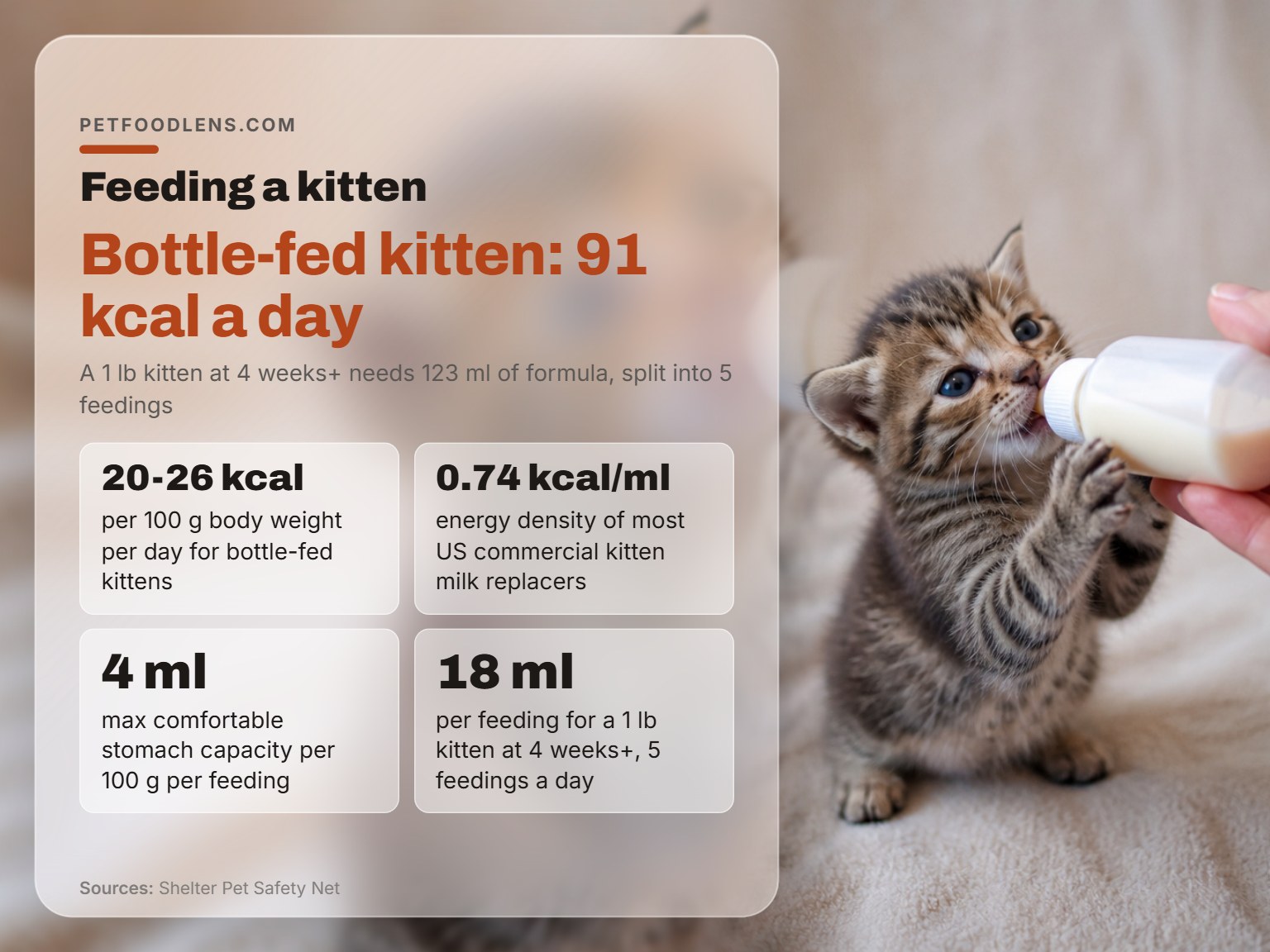
Bottle-fed kittens need their own math, because commercial kitten milk replacer delivers less energy per millilitre than most caregivers assume.
Shelter Pet Safety Net’s kitten stomach capacity chart puts the requirement at roughly 20-26 kcal per 100 g of body weight per day. The same chart caps comfortable stomach capacity at about 4 ml per 100 g per feeding.
Most US commercial kitten milk replacers sit near 0.74 kcal/ml. That lower density may account for why a bottle-fed kitten often grows slower than a kitten nursing from the mother.
Worked through, a 1 lb (454 g) kitten at four weeks or older needs about 91 kcal a day. That’s 123 ml of formula, split into five feedings of roughly 18 ml each.
Where this goes sideways: Assuming the formula delivers 1 kcal/ml. The volume you calculate comes up short of the calories the kitten actually needs, and the scale stays flat while the kitten stays hungry and loud.
Kittens between 3.5 and 5 weeks are already eating some solid food, so the milk replacer required drops and feedings get less frequent. Bottle-feeding a kitten is a short phase, but it’s the one where the numbers matter most.
When Should You Switch to Adult Food?
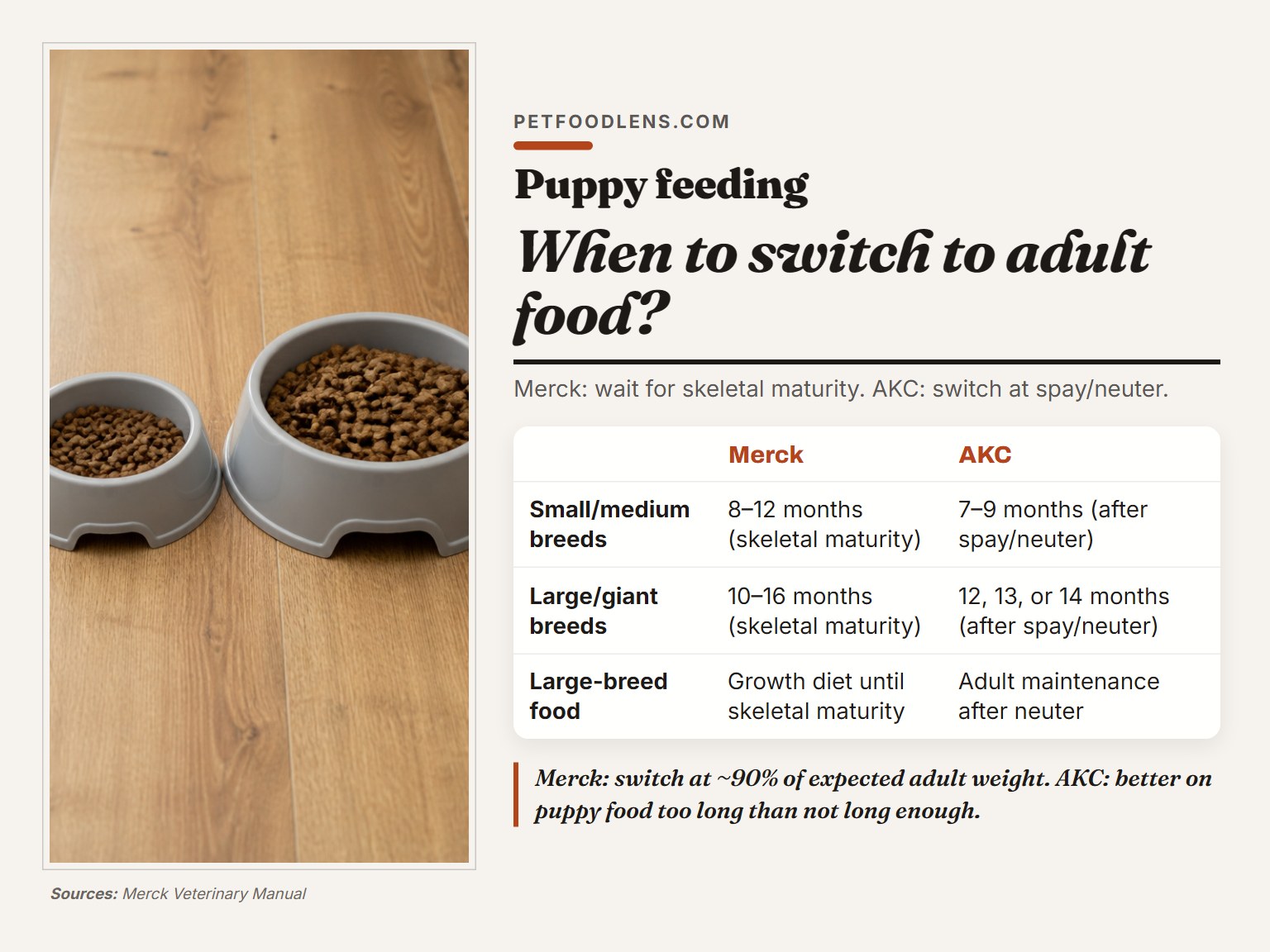
The switch happens somewhere between 10 and 12 months depending on the source, Chewy says around 10 months, VCA puts maturity at 10–12 months, and Royal Canin runs growth to 12 months, and the exact date matters less than the AAFCO statement on the bag you’re switching to.
Chewy and VCA roughly agree on when to switch a kitten to adult cat food: around 10 months, or a little after. Royal Canin runs the growth period to 12 months. VCA also notes that a food labelled for all life stages is appropriate during growth, which makes the switch optional if that’s what’s already in the bowl.
The other half of the question is the adult figure, and how much to feed a cat changes once growth stops.
Monitoring is where this gets practical. Royal Canin’s guidance is to weigh the kitten daily through the growth period and adjust the amount to hold a body condition score of 4.5, checked against the chart printed on the food label.
The ASPCA kitten weight chart expects normal kittens to gain 7-15 g per day, and it says to read that number alongside developmental milestones rather than on its own.
The part nobody mentions: Switching at 8 months because the bag says “adult” jumps the gun. Chewy puts the change at around 10 months, and VCA puts maturity at 10-12 months.
Frequently Asked Questions
How much should I feed an 8-week-old kitten?
By 8 weeks most kittens eat solid food without help, and the ASPCA chart puts the normal weight range at 485-925 g. Run the per-kilogram math from there. The AAHA curve sits near 200 kcal/kg at 10 weeks, so a small 8-week-old needs less than a big one of the same age. Weigh the kitten first, then calculate.
Is it OK to leave dry kitten food out all day?
Two credible sources say yes, up to a point. Bernalillo County recommends free-feeding kibble until 4-6 months, and Chewy says food should be left out day and night until the same age. VCA disagrees, linking free-choice feeding to extra body fat. Royal Canin’s middle position is to discard dry food left out beyond 24 hours and wet food beyond 2 hours.
How many calories does a kitten need per day?
It depends on weight and age. Chewy’s chart gives 31 kcal a day for a newborn and 541 kcal a day for a 10-month-old at 10 lb. Chewy also warns that real needs vary by up to 50% in either direction, so treat any chart as a starting point and adjust against body condition.
Can I feed a kitten adult cat food at 8 months?
Not ideally. Chewy puts the switch at around 10 months and VCA puts maturity at 10-12 months. The growth window runs to 10 months at the earliest.
How do I know if I’m overfeeding my kitten?
Weigh daily and watch the trend. Royal Canin’s target through growth is a body condition score of 4.5, checked against the chart on the food label.
Should I give my kitten vitamins or supplements?
Not without asking your vet first. VCA’s guidance is that a purpose-formulated kitten food should have everything the kitten needs. Supplements only go in after a veterinary check, and VCA also advises avoiding foods that push urinary pH below 6.2.
The Bottom Line
The trigger to change anything is the scale, not the calendar. Weigh the kitten daily. If the number stalls, drops, or climbs faster than the growth curve, adjust the portion before you touch the food.
None of this covers a kitten with a diagnosed condition.
I’d rather see a kitten slightly under the chart than slightly over it. A short portion is easy to fix. Overshooting takes months to undo.
This week: put the bowl on a kitchen scale, write the gram weight of one day’s food on a sticky note, and stick it to the fridge. That single number is the whole plan.
