
How to Wean Kittens Onto Solid Food: Step-by-Step
This post contains affiliate links. As an Amazon Associate, we earn from qualifying purchases.
Wean kittens onto solid food between 3 and 5 weeks of age, per the 2021 AAHA/AAFP Feline Life Stage Guidelines. Offer warmed gruel four times a day for 30 minutes, keep bottle or queen access until the kitten eats solid food unaided, and weigh daily: a kitten eating enough gains 4 oz a week.
That 4 oz weekly gain is the number worth taping to the fridge, because it’s the only objective check on whether the gruel is going into the kitten or onto the kitten’s ears. It also tells you how to wean kittens onto solid food with confidence.
What follows: an age-by-age food form, the two ratios that build gruel, where the veterinary sources openly disagree on timing, and the label statement that decides which food goes in the saucer.
Key Takeaways
- Start at 3 to 5 weeks, not on a calendar date, though some sources begin as early as 3 weeks. Readiness shows up as teeth and a kitten that can hold itself over a dish.
- Gruel starts thin and thickens gradually for the first stage, then moves to moistened kibble.
- Weigh every kitten daily. A gain under 4 oz a week means the food isn’t landing, regardless of how eagerly it eats.
- Keep the bottle or the queen available until solid food is the whole diet, which usually happens by 6 to 8 weeks.
- Warm the food before it goes down. Cold gruel has almost no odor, and kittens refuse food they can’t smell.
What Age Do Kittens Start Eating Solid Food?
Three weeks is the youngest start any of the major veterinary sources allows, and 3 to 5 weeks is the window the 2021 AAHA nutrition guidelines give for weaning onto commercially balanced kitten food.
Weaning begins when a kitten can lap rather than suckle, usually signaled by teeth breaking through the gums and enough motor control to stand over a shallow dish. The transition runs from a thin gruel to moistened kibble over roughly three to four weeks, with milk still supplying part of the intake.
The published sources do not agree on the start date, and pretending otherwise is how fosterers end up forcing a kitten that wasn’t ready. Here is where each one actually stands.
| Source | Start | Position |
|---|---|---|
| AAHA/AAFP 2021 | 3 to 5 weeks | Weaning onto balanced kitten food |
| Maddie’s Fund | 4 weeks mothered, 3 weeks orphaned | Interest in solid food |
| Texas A&M (Dr. Zoran) | After eyes open, moving well | Milk still needed to 4 weeks |
| Bernalillo County | 3.5 weeks | KMR and pate gruel |
| National Kitten Coalition | About 3 weeks | Begin introducing wet food |
Dr. Deb Zoran of Texas A&M, writing in the college’s choosing the best kitten diet guidance, ties the start to eyes opening and steady movement on the kitten’s own. She also holds a hard floor under it: until a kitten is about 4 weeks old and weighs at least a pound, milk or milk replacer stays in the diet alongside any wet food.
So the honest answer is a range with a readiness test inside it. Teeth through the gums, a kitten that can stand over a saucer, and a queen who has started leaving the nest for longer stretches. Miss the readiness signals on how to wean kittens onto solid food and the food gets ignored for a week.
The Gruel Ratio and Texture That Actually Works
Maddie’s Fund advises a smooth, chunk-free canned food mixed into a gruel for the opening stage.
Before you start: Gruel placed too far back on the tongue can be aspirated, so keep syringe feeding to a small amount near the front and let the kitten swallow. Wet food left on a coat chills a kitten quickly, so dry the face and keep a heat source in the box. Milk replacer causes diarrhea and constipation even in the best products, which is why orphans move to solid food sooner rather than later.
A smooth pate is the best soft food for kittens because it mixes cleanly. Chunks don’t belong in the first saucer at all, because a kitten that has never used its jaw hinges will suckle at a lump and give up.
Stage One: Thin Gruel, 3 to 4.5 Weeks
- Warm the canned food and the liquid separately before mixing. Cold food carries almost no odor, and Zoran notes kittens reject food they can’t smell.
- Whisk two parts canned to one part water or replacer until no lumps remain. Skip the whisking and you get a saucer of paste the kitten can’t lap.
- Smear a little on the kitten’s lip or front paw if it won’t approach the dish. Orphans can’t learn by watching a queen eat, and this is the shortcut that starts them.
- Leave the saucer down for 30 minutes, then lift it. Maddie’s Fund advises discarding leftovers, because moistened food dries hard and spoils fast.
- Offer the bottle or the queen right after. A kitten that didn’t get enough from the saucer will take milk, and that keeps the weight curve moving.
The ratio tightens as the kitten gets competent. More canned food, less liquid, same food throughout. That last part matters more than most people expect: the transitioning kittens to solid food handout recommends using the exact food you plan to feed after weaning, precisely so there’s no second diet change to survive.
Stage Two: Moistened Kibble, 4.5 to 6 Weeks
The second stage uses small kibble rehydrated with water to a mushy consistency. Small kibble rehydrates to a mush in a couple of minutes; if the pieces are too big, crush them first rather than soaking longer.
Most canned kitten food works for stage one provided it’s chunk-free, and most kitten kibble works for stage two provided it softens. The food itself is less important than the consistency of the food.
How Often Should You Offer Food During Weaning?
How many times a day does a saucer go down? Maddie’s Fund says offer food for 30 minutes, four times per day, while Bernalillo County puts kittens at three meals a day until about 4 months old. Bernalillo County’s cat and kitten feeding guidelines put kittens at three meals a day until about 4 months old, with one can of kitten food per 3 lb of body weight daily, split across those meals.
Two schedules, both from credible veterinary sources, and neither is wrong. Four small feeds suits a kitten that’s still taking a bottle. Three larger feeds suits a kitten that has stopped.
I’d rather see a foster run four small saucers than two big ones. The kitten that bolts its food and then brings it back up is almost always the one that got too much at once, and you lose two days of gain sorting out whether it was volume or illness.
There’s no single answer to how often to feed a kitten during the weaning window, so pick a schedule and hold it steady for a week before judging it. Changing the how to wean kittens onto solid food schedule every day tells you nothing.
Once a kitten is eating non-moistened dry food, Maddie’s Fund says it can stay out all day for nibbling, while Bernalillo County free-feeds dry food only until around 4–6 months, then transitions to scheduled meals. The National Kitten Coalition takes the same line, noting that healthy kittens are unlikely to overeat. Bernalillo County free-feeds dry food until roughly 4 to 6 months, then moves to scheduled meals.
Why Warm Food and Shallow Bowls Change the Outcome
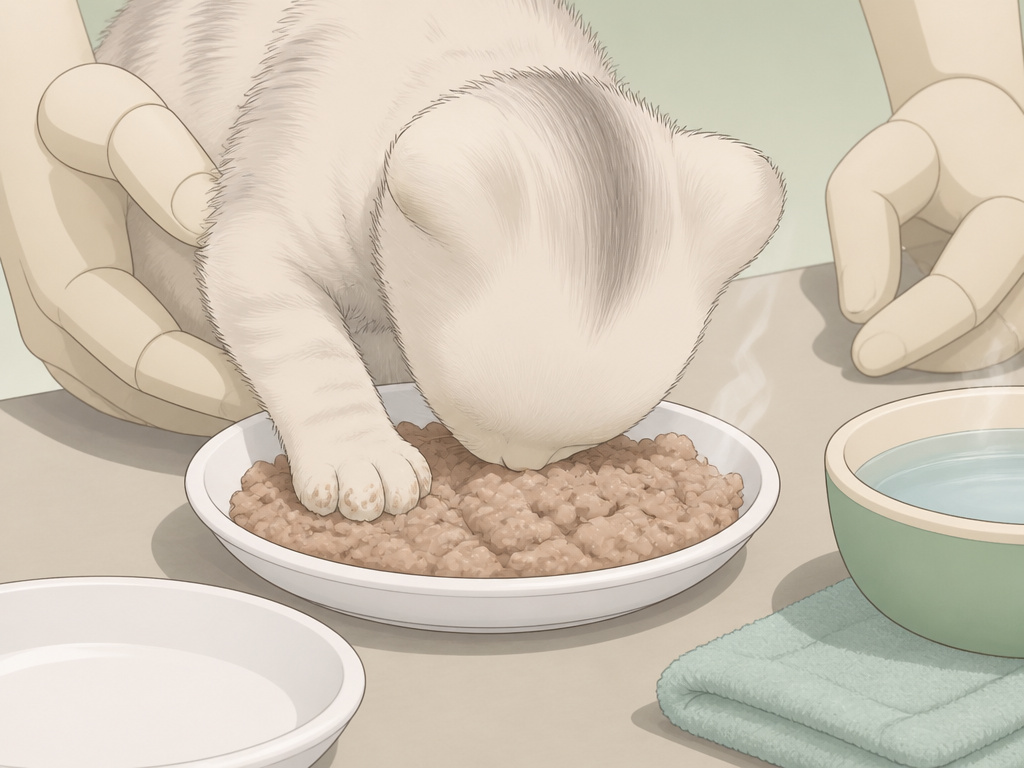
A kitten climbs into the saucer, comes up with pate on both ears, shakes its head hard, and gets chilled within a minute.
That shake isn’t necessarily a symptom. The National Kitten Coalition flags it as either a chill from wet food on the coat or a simple excitement response to eating a new way. Towel the kitten dry, put it back near the heat source, and watch the next meal.
Temperature is the part that gets skipped. Zoran’s guidance is warm, not hot, because cold food has no odor and a kitten won’t commit to something it can’t smell. Warm a bowl of water and stand the food dish in it for a minute rather than microwaving, which produces hot spots a kitten’s tongue will find.
Sound tells you whether it’s working. A kitten learning to eat makes a wet, smacking, uncoordinated noise for the first few days, then settles into a rhythm. A kitten that stays silent at the bowl and only suckles the edge hasn’t made the switch yet.
The part nobody mentions: Kittens are pickier about food temperature than puppies are, so a litter that eats well at 8am can refuse the same food at noon if it cooled on the counter.
Shallow-sided bowls come later, once the kitten has figured out how to eat. Before that, a saucer works better than a bowl, because a deep rim stops a small kitten’s muzzle from reaching the food. For litters, put out more bowls than kittens. Maddie’s Fund recommends multiple bowls specifically to stop crowding, and one kitten guarding a single dish will quietly starve its littermates.
Orphaned Kittens Wean Differently
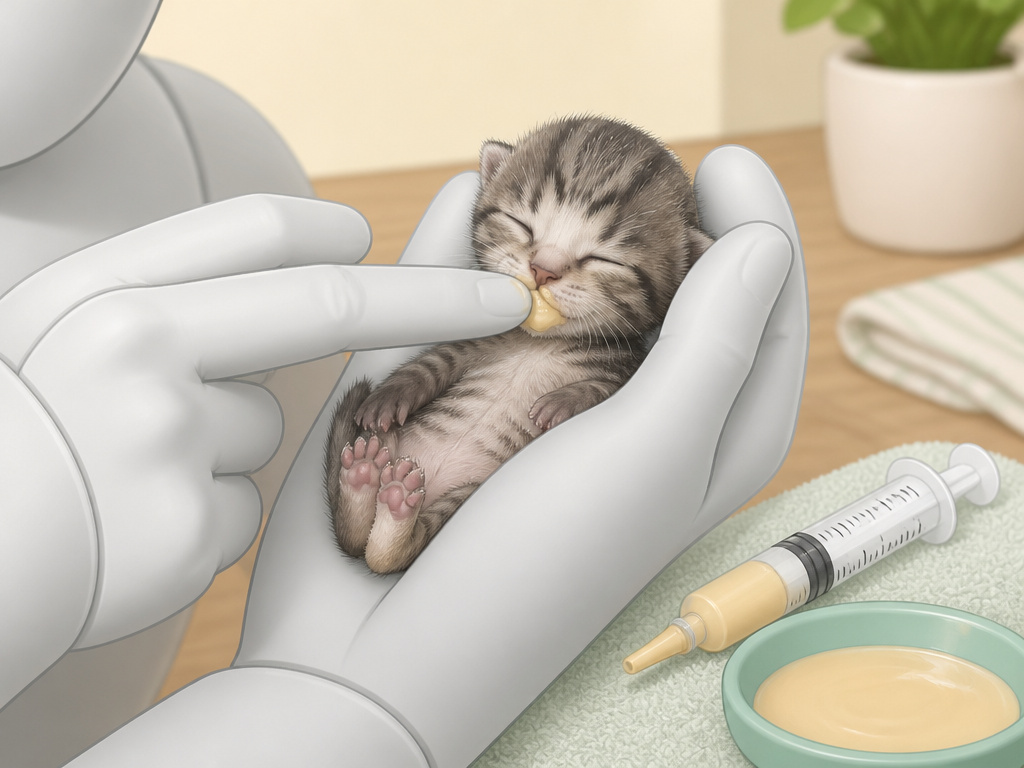
Orphans are a different job, and the timeline moves forward rather than back.
Maddie’s Fund starts orphans at around 3 weeks instead of 4, citing diarrhea and constipation from even the best milk replacers, while the Humane Society of Harrisburg Area starts weaning orphaned kittens around 4 weeks, the same as general guidance. The sooner the kitten gets onto a complete growth food, the better.
- Start earlier. Roughly 3 weeks, not 4.
- Expect a slower first attempt. An orphan can’t watch a queen eat, so gruel often has to go on a lip or a paw first.
- Keep the bottle going. Maddie’s Fund is explicit that bottle feeding shouldn’t stop until the kitten is fully on solid food.
- Watch stool daily. Replacer-driven diarrhea is the most common setback in hand-reared litters.
Feeding an orphan by syringe takes a steady hand, and the mechanics of how to feed an orphaned kitten matter more than the brand of replacer. Small amount on the tongue, not far back, time allowed for swallowing. That’s the aspiration rule and it isn’t negotiable.
How long the bottle continues is one of the genuinely open questions. Maddie’s Fund puts full transition at 6 to 8 weeks. Bernalillo County keeps nursing or bottle feeding as the main nutrition source until around 5 weeks. The National Kitten Coalition’s weaning kittens reference article notes that some kittens keep nursing until 3 or 4 months and advises letting the kitten set the pace.
Use a kitten milk replacer if you’re mixing a gruel for an orphan. Cow’s milk, goat’s milk, or dog milk are not substitutes; Zoran notes they can cause diarrhea and lack the amino acids a kitten needs.
Reading the Label on Weaning Food
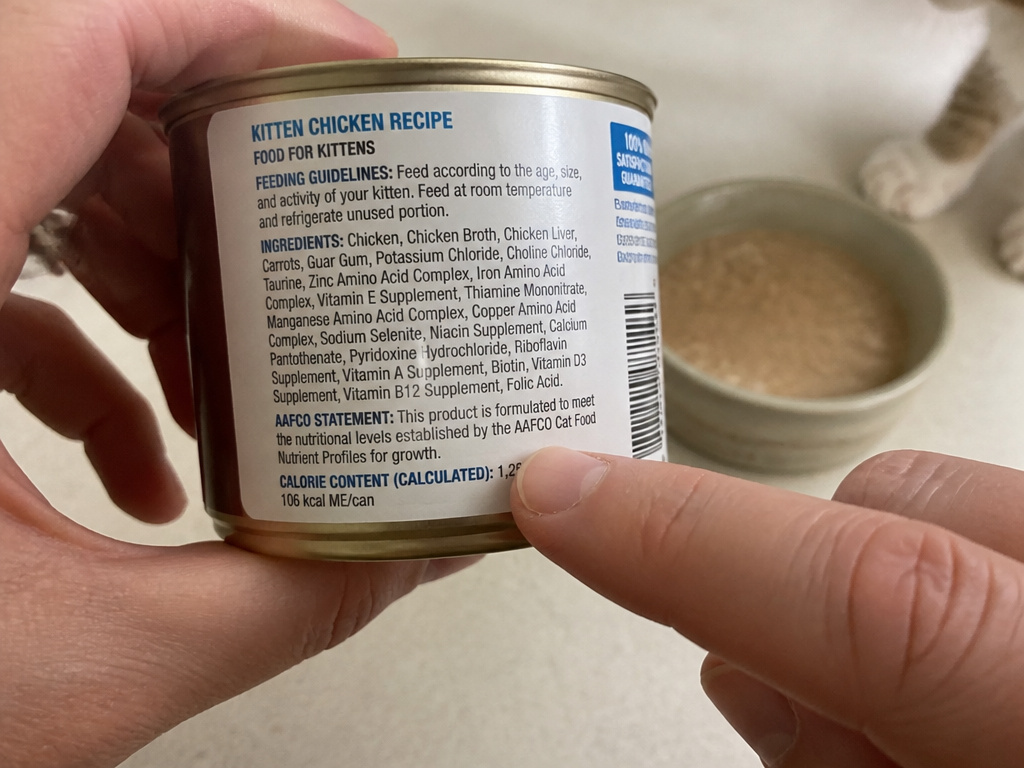
The front of a kitten food can is a photograph, and photographs don’t carry a nutrient profile.
I learned that the slow way. For years I treated a higher protein percentage as proof of a better food, full stop. Then I pulled several formulas apart side by side and found the extra protein was coming from plant concentrates rather than animal sources. The headline number was identical. What sat behind it wasn’t.
So the label check during weaning is narrow and specific. Flip the bag over. The statement you want is an AAFCO declaration that the food is complete and balanced for growth, or for all life stages. Maddie’s Fund requires exactly that, and Zoran gives the same instruction.
- AAFCO statement for growth or all life stages. No statement, no purchase.
- First five ingredients, read by weight. They’re listed in descending order, so the top of the list is what you’re mostly paying for.
- A named animal source early. “Chicken and rice” in the product name usually signals a carbohydrate-heavy formula.
- More than 50 percent protein and less than 10 percent carbohydrates once the kitten is fully weaned, which is Zoran’s target for growth diets.
That protein and carbohydrate target applies after weaning, not during the gruel stage, and it’s worth saying plainly because it gets misapplied. A kitten on a poor-quality or high-carbohydrate food can develop diarrhea, and diarrhea during weaning costs weight you can’t easily replace.
A weaning food earns its place on one line of the label: complete and balanced for growth. Everything above that line is advertising.
Choose a canned kitten food with a smooth consistency without chunks, which mixes easily into gruel. Choose a kitten food whose label states it is complete and balanced for growth, and that softens well for stage two. Any of the three will do the job; the kitten weaning food you choose matters far less than whether you keep feeding the same one.
Small kibble size counts for more than the protein number on the front, which is why a dry kitten food built for small mouths rehydrates faster and needs less crushing. The same slow-switch rule that governs how to transition to a new food later in a cat’s life applies here in miniature: change one thing at a time.
What Stalls a Weaning: Weight, Diarrhea, and the Litter Dynamic
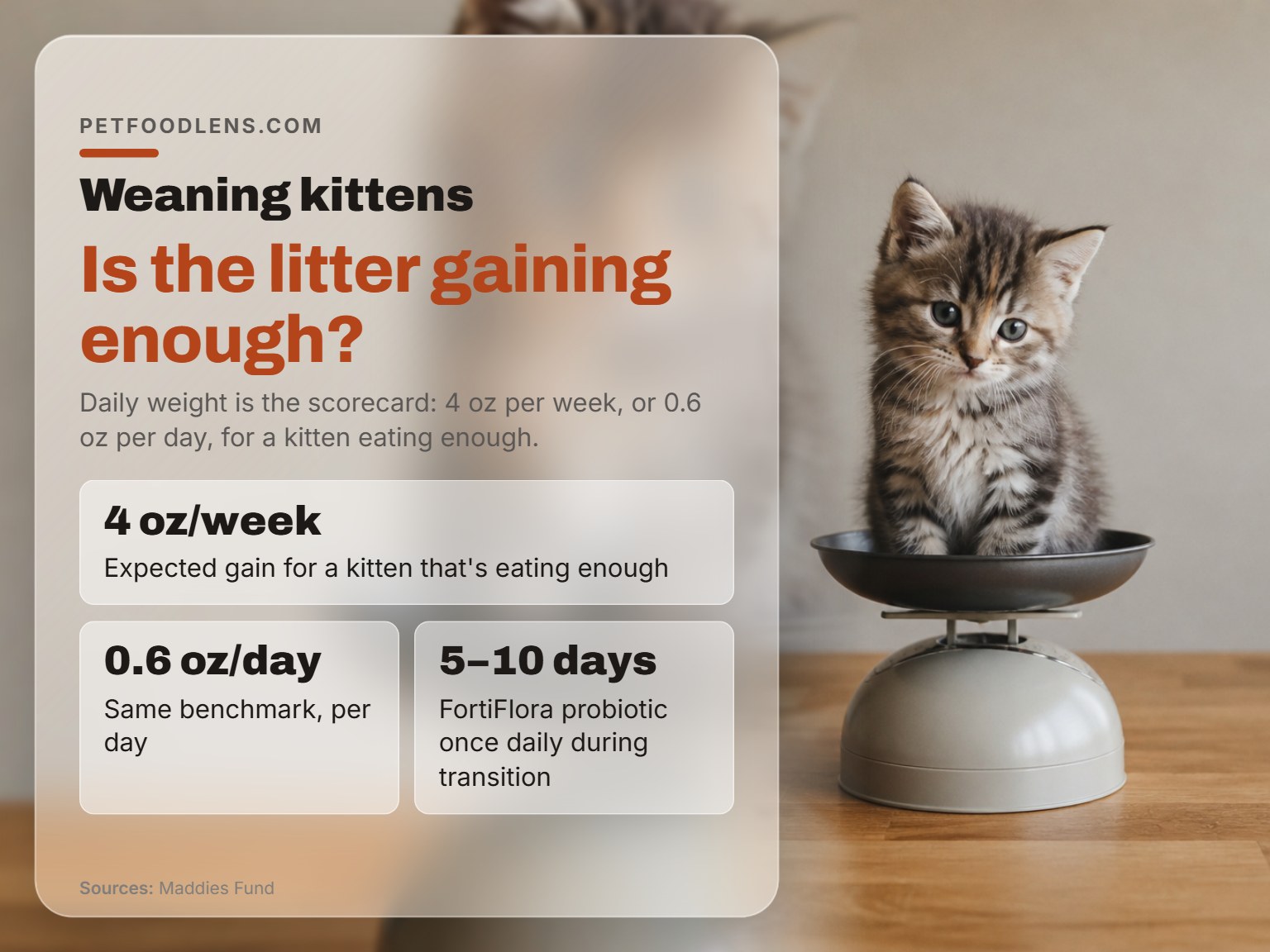
Daily weight is the only honest scorecard in a weaning litter, and the benchmark is 4 oz per week, or 0.6 oz per day, for a kitten that’s eating enough.
Weigh at the same time each day, before the first feed. A kitchen scale that reads in ounces is enough. The number matters less than the direction, and three flat days is a signal even when the kitten looks bright.
| What you see | Likely cause | What to change |
|---|---|---|
| Flat weight for 3 days | Food isn’t landing | Hand-feed gruel, then offer bottle |
| Loose stool after a switch | Diet changed too fast | Same food, slower mix ratio |
| Shivering after eating | Wet coat chilling | Towel dry, add heat source |
| One kitten guarding the dish | Too few bowls | One bowl per kitten, spaced apart |
Probiotics are the standard support here. Maddie’s Fund names FortiFlora specifically, added to food once per day, started at the beginning of the transition and continued for roughly 5 to 10 days. FortiFlora is the probiotic product that guidance refers to.
Where this goes sideways: Switching litter to a clumping product mid-weaning. Kittens investigating the box eat litter, and clumping litter can bind inside the gut. Use non-clumping litter until weaning is done.
Water goes down at the same time as solid food. The National Kitten Coalition is direct about it: a shallow bowl of fresh, clean water should be available at all times during weaning, because as formula intake drops the kitten has to replace that fluid elsewhere.
Portion by weight rather than by eye. The how much to feed a kitten math starts on the can, not in the bowl, and Bernalillo County’s working figure is about 1 oz of food per pound of body weight until 19 weeks.
Frequently Asked Questions
Can I just leave dry food out for a weaning kitten?
Yes, once the kitten is actually eating non-moistened kibble. Maddie’s Fund says dry food can stay out all day at that point, and the National Kitten Coalition notes healthy kittens rarely overeat. Before that stage, moistened food has to come up after 30 minutes because it spoils.
What if my kitten refuses the gruel for two days?
Go back to the bottle or the queen and try again in a few days. The National Kitten Coalition is explicit that a kitten should never be rushed or forced to wean. Two days of refusal usually means the food was too cold, too thick, or offered before the kitten could stand over a dish.
Do I have to stop bottle feeding to wean?
No, and you shouldn’t. Maddie’s Fund advises against discontinuing bottle feeding or blocking nursing until the kitten is fully transitioned to solid food, which usually happens by 6 to 8 weeks. Offer the bottle after the saucer, not instead of it.
Is goat milk or cow’s milk okay in the gruel?
No. Zoran notes that cow, goat, dog, and other milk sources can induce diarrhea and lack the amino acids kittens need. Use a kitten milk replacer such as PetAg KMR, or plain warm water if you’re mixing for a kitten that’s still nursing from the queen.
Should I buy a “2nd step” weaning milk?
Maddie’s Fund advises against ‘2nd step’ products, while Bernalillo County introduces a gruel of KMR and pate at 3½ weeks. Transitional products designed only for temporary use add a diet change in the middle of an already fragile window. Use the growth food you plan to feed afterward, mixed with water or replacer.
How do I know weaning is finished?
When the kitten eats solid food on its own and gains 4 oz a week without a bottle. That usually lands between 6 and 8 weeks, though the National Kitten Coalition notes some kittens keep nursing until 3 or 4 months. Judge it by weight and intake, not by the calendar.
The Bottom Line
If a kitten hasn’t gained 4 oz in a week, stop troubleshooting the food and get it weighed and seen. Weaning problems that show up as a flat scale are usually not food-preference problems, and a kitten has very little reserve to spend on a guess.
The rest of it is mechanical. Warm the food, keep the ratio honest, put out more bowls than kittens, and write the weight down every morning.
One concession worth stating plainly: none of this covers a kitten with an underlying condition. A kitten with a congenital issue, a parasite load, or an untreated infection will follow every rule above and still fall behind, and that’s a veterinarian’s call rather than a feeding-plan call. The scale tells you something is wrong. It doesn’t tell you what.
