
When to Switch From Puppy to Adult Dog Food: By Size
This post contains affiliate links. As an Amazon Associate, we earn from qualifying purchases.
When to switch from puppy to adult dog food is a size question. Most puppies are ready at about 80% of their expected adult size, which lands between 9 and 24 months: small breeds around 7 to 12 months, large breeds 12 to 24 months, giant breeds 18 to 24 months.
That 80% figure is a clinical heuristic, not a number printed on a bag. Current nutritional guidelines do not provide minimum or maximum nutrient amounts stratified by breed size, so the timeline you see on packaging reflects a manufacturer’s formulation choices rather than a codified rule.
What follows is the size-by-size breakdown, the places where five credible sources disagree by months, the transition schedule that keeps a puppy’s gut from revolting, and the one line on the bag that actually tells you which food you’re holding.
Key Takeaways
- About 80% of expected adult size is the trigger most vets use, which lands between 9 and 24 months.
- Small breeds switch first. Across five sources the range runs 7 to 12 months; large breeds run 10 to 24.
- Transition over about 5 days to a week or more, and stretch it to two weeks for a sensitive stomach or a picky eater.
- Read the AAFCO statement. Puppy food says “growth,” adult food says “maintenance.”
- Don’t just cut calories after neuter. PetMD warns against a flat 30% reduction and points to a vet-formulated diet instead.
What Actually Triggers the Switch
The trigger most veterinarians use is size. A puppy is generally ready for adult food at about 80% of its expected adult size, according to PetMD’s puppy-to-adult food guidance.
Puppy food is formulated to meet the AAFCO Dog Food Nutrient Profiles for growth, with higher calories, protein, fat, calcium, and phosphorus than adult maintenance diets. Adult food meets the maintenance profile instead. The label statement, not the bag design or the front-of-package photo, identifies which profile a formula actually meets.
Growth slowing is the other signal. When a puppy’s rate of growth drops and it has reached roughly 80% of its expected adult size, the when to switch from puppy to adult dog food question starts working against it rather than for it.
Three things to watch, in order:
- Growth has visibly slowed. Not stalled, just slower than the first few months.
- The puppy is near its expected adult weight for the breed.
- Your vet has confirmed physical maturity at a checkup.
I get asked for a single month number constantly, and I understand why. A number is easier than a body condition check. Fair enough.
But the sources don’t agree on a number, and they never will, because the underlying standard doesn’t exist. Pick the range for your dog’s expected adult size, then move when growth slows and your vet confirms the puppy is close to mature.
When Do Small Breeds Switch to Adult Food?
When do small breeds switch to adult food? The honest answer is somewhere between 7 and 12 months, depending on which source you trust.
PetMD puts small breeds at 9 to 10 months. The AKC puppy nutrition ebook says 7 to 9 months. The peer-reviewed review by Kępińska-Pacelik and Biel puts it at 10 to 12 months, and the Royal Canin guidance hosted by the AKC says 8 to 12 months.
Same concept, different numbers.
Where the Weight Cutoffs Actually Fall
PetMD treats small as under 25 pounds fully grown and medium as 25 to 50 pounds. The AKC Owner’s Manual draws the small line at under 20 pounds and the large line at over 50. Those cutoffs alone explain part of why the switch ages don’t line up.
The puppy food pros and cons matter here, because the when to switch from puppy to adult dog food question matters for a toy breed on a high-calorie formula past nine months that gains weight fast. Puppy formulas carry more fat and calories per cup than adult formulas, so a small breed still eating a growth diet at 12 months is eating for a body it no longer has. PetMD ties that overrun to obesity and joint issues later.
I’ve stopped treating any single month number as gospel. When a bag or a blog gives me one, I want to know which body produced it and whether that body formulates food.
Large and Giant Breeds: Where the Spread Gets Wide
Large and giant breeds are where the timeline stops being a rounding error.
PetMD puts large breeds at 14 to 24 months. The AKC Owner’s Manual says 12 to 14 months for large breeds, with 18 to 24 months to reach adult size. Kępińska-Pacelik and Biel put large breeds at 15 to 18 months and giant breeds up to 24 months. Royal Canin, via the AKC puppy-to-adult food transition guide, splits Giant Puppy up to 8 months and Giant Junior from 9 to 24 months.
The mechanism is growth rate. A large-breed puppy that gains too fast is more likely to develop bone and joint abnormalities, according to Kępińska-Pacelik and Biel. Excess calcium and fat push that rate higher, which is why large-breed puppy formulas deliberately run lower in both.
That’s also why a single bag of “puppy food” doesn’t cover the whole giant-breed window. Royal Canin splits its own line for exactly this reason: Giant Puppy is targeted up to 8 months, and Giant Junior covers 9 to 24 months. If your dog is 12 months or older and entering a performance program, the AKC article names Eukanuba Premium Performance 30/20 Sport as an option.
The large breed puppy food question is really a calcium and calorie question, not a protein question.
Where this goes sideways: Feeding an all-purpose puppy formula to a large breed through the whole growth window. The excess calcium and fat raise growth rate, and faster growth is linked to bone and joint abnormalities.
Why the Sources Disagree on the Exact Month
Five credible sources give five different answers for the same breed size, and the spread runs five months for small breeds and more than a year for large ones.
| Source | Small breed | Large breed | Giant breed |
|---|---|---|---|
| PetMD | 9-10 months | 14-24 months | within large |
| AKC Owner’s Manual | 7-9 months | 12-14 months | 18-24 months |
| Kępińska-Pacelik (2023) | 10-12 months | 15-18 months | up to 24 months |
| Royal Canin (via AKC) | 8-12 months | 12-15 months | 18-24 months |
| AAHA | 10-12 months (all sizes) | 10-12 months (all sizes) | 10-12 months (all sizes) |
Why No Breed-Size Standard Exists
Current nutritional guidelines don’t provide minimum or maximum nutrient amounts stratified by breed size, according to the large and giant breed puppy nutrition study. Guidelines set protein minimums by age instead: 25 g per 100 g of dry matter for puppies under 14 weeks, and 20 g per 100 g for older puppies.
So every breed-size switch age you read is a clinician or manufacturer judgment layered on top of a standard that doesn’t address size. That’s expected. It’s why the numbers move.
A switch age is a starting point, not a prescription. The dog in front of you outranks the chart every time.
If you have to pick one rule and you don’t know the breed: small breeds win the early switch, large breeds win the late one, and when in doubt, wait.
How to Transition Without a Mess on the Kitchen Floor
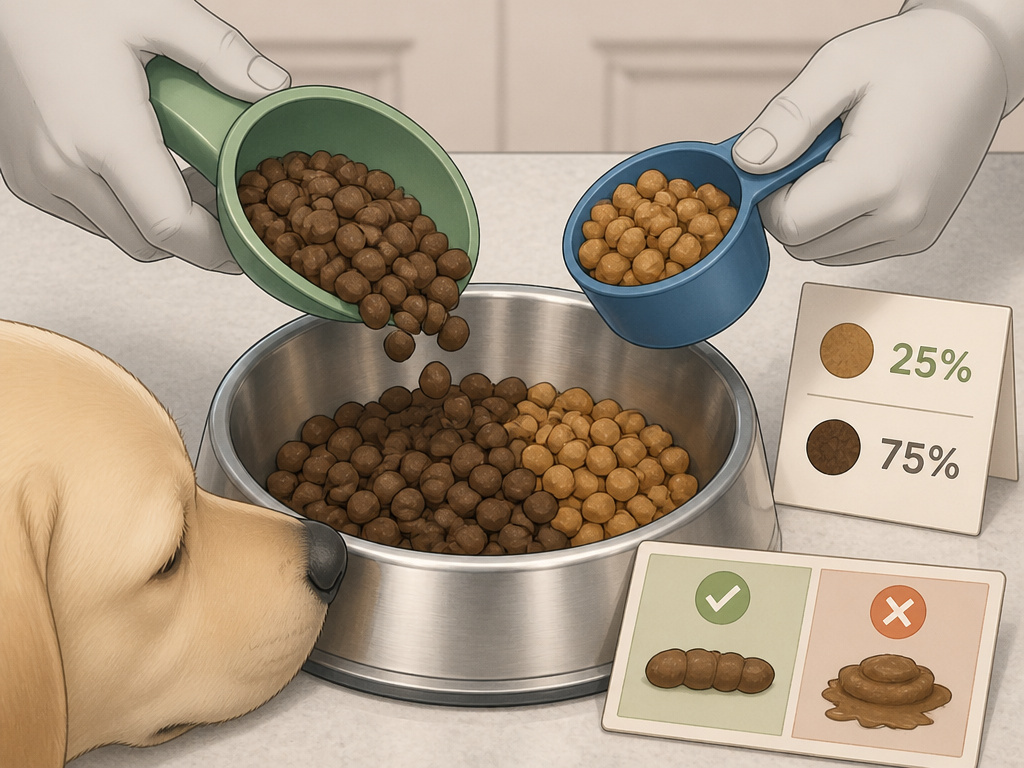
Picture a nine-month-old Labrador inhaling new kibble at twice its usual speed, then pacing for two hours and asking to go out. That’s a too-fast switch, and it’s avoidable.
The sources don’t fully agree on how long the transition should take. PetMD says about five days. The AAHA nutritional reference manual says seven. Zoetis says at least one week, and two weeks for a sensitive stomach or a picky eater.
The 7-Day Ratio Schedule
- Days 1-2: 25% new food, 75% old.
- Days 3-4: 50/50. Hold here an extra day if stool loosens.
- Days 5-6: 75% new, 25% old.
- Day 7: 100% new food.
A puppy’s stool is the fastest readout you’ll get. Formed and easy to pick up means the ratio is working. Loose and pale means you moved too fast.
The mechanics are the same whether you’re moving from puppy to adult or between brands, so the switch dog food rules apply either way. A dog’s gut microbiome is acclimated to a particular formula, so a sudden change in protein or carbohydrate leaves it struggling to break down the new ingredients. That’s why the schedule matters more than the food.
PetMD says to stop the new food and see a vet if a puppy develops vomiting, diarrhea, or loss of appetite. Zoetis takes a softer line: reduce the new food and stretch the schedule, and call the vet if it continues.
Before you start: A sudden switch can cause stomach aches, diarrhea, or vomiting, and vomiting plus diarrhea can dehydrate a puppy fast. Keep the old food on hand so you can back up a step without a trip to the store.
Read the AAFCO Statement, Not the Front of the Bag
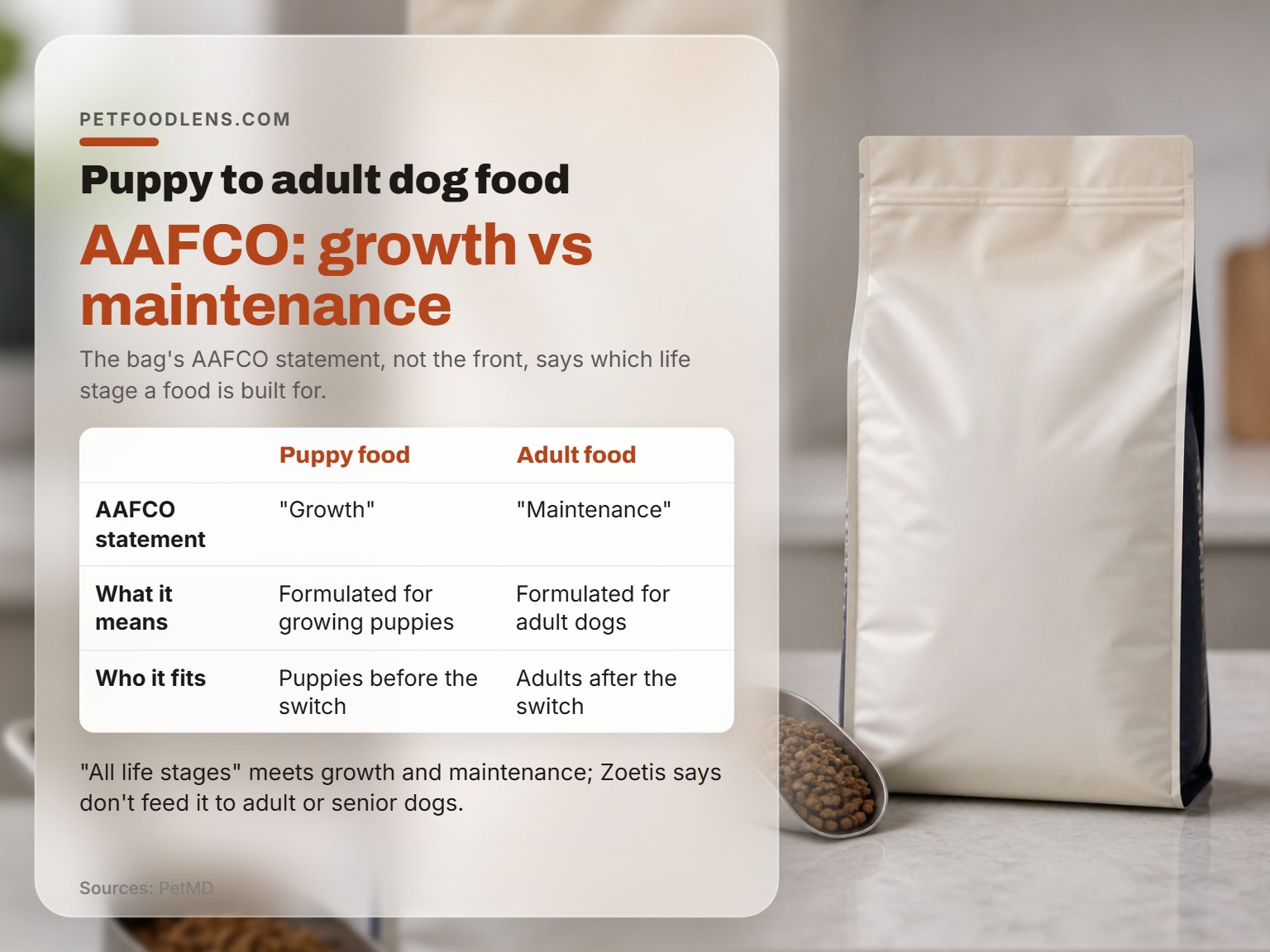
The AAFCO statement is the only line on a dog food bag that’s regulated for what it claims.
Puppy food should state that it meets the AAFCO Dog Food Nutrient Profiles for growth. Adult food should state that it meets the levels for maintenance. That statement is the difference between a formula built for a growing body and one built to hold a grown one steady.
Growth, Maintenance, and All Life Stages
| AAFCO statement | What it means | Who it fits |
|---|---|---|
| “Growth” | Formulated for growing puppies | Puppies before the switch |
| “Maintenance” | Formulated for adult dogs | Adults after the switch |
| “All life stages” | Meets growth and maintenance | Puppies; contested for adults |
Some diets are formulated for all life stages, meeting the needs of both growing and adult animals, per PetMD. Zoetis says the opposite for adults: don’t feed an all-life-stages food to an adult or senior dog. If you’re weighing an all life stages dog food for a household with a puppy and an adult, read the statement before the marketing copy.
The best adult dog food for your dog is the one whose statement matches its life stage and whose first ingredients you can actually identify.
Feeding Frequency Changes Before the Food Does
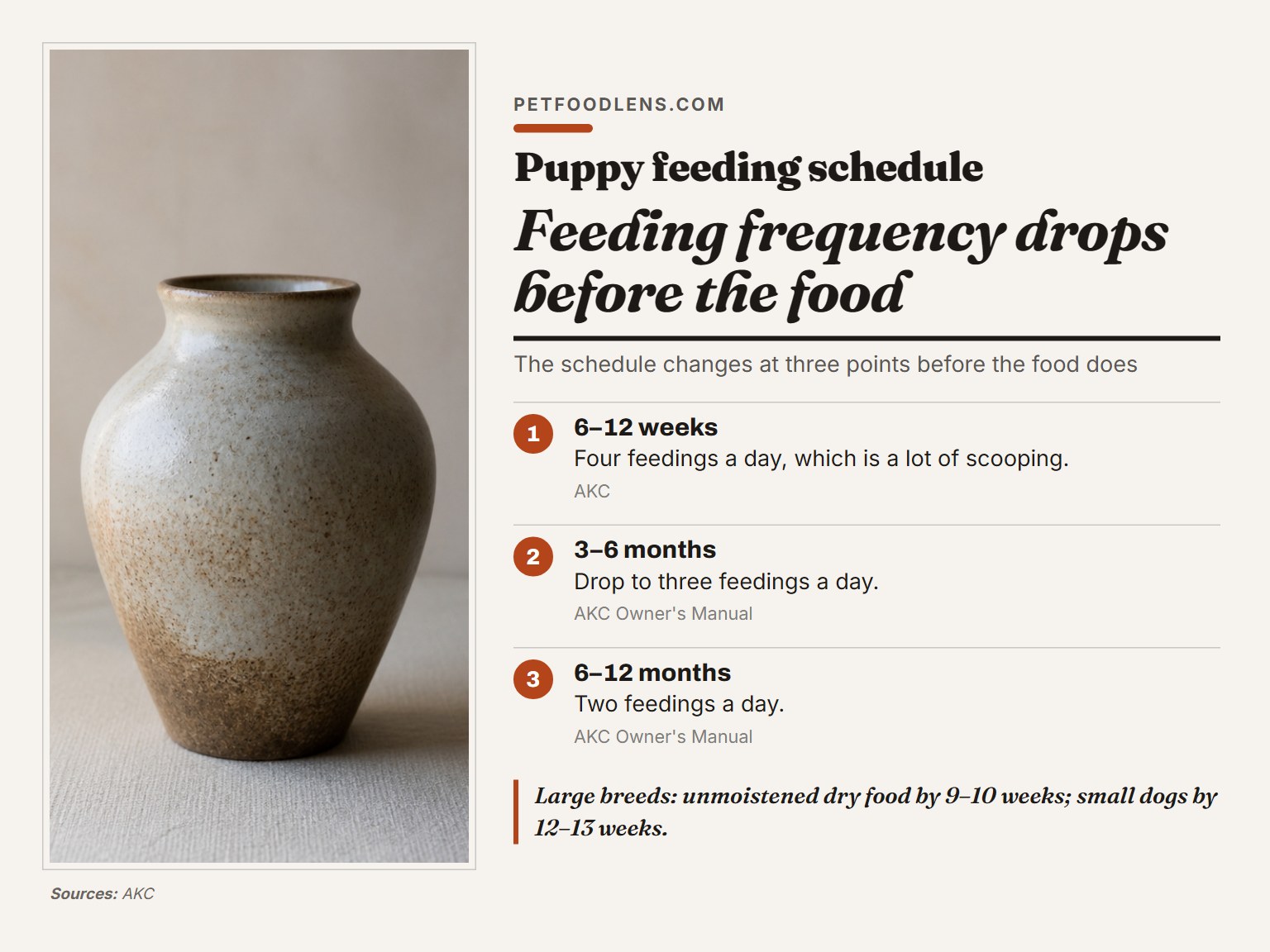
Feeding frequency drops before the food changes, and most owners miss the first step.
The feeding schedule by age changes at three points before the food does, and each drop is a chance to overfeed if you keep the portion size the same.
- 6-12 weeks: four feedings a day, which is a lot of scooping.
- 3-6 months: drop to three.
- 6-12 months: two feedings a day.
- After 1 year: two feedings a day.
Whether you feed dry dog food or wet, the frequency ladder is the same. The AKC puppy nutrition ebook also notes that large breeds should be on unmoistened dry food by 9 or 10 weeks, and small dogs by 12 or 13 weeks.
I still see owners running four feeds a day at five months because nobody told them the schedule changed. The dog doesn’t argue.
The Spay/Neuter Curveball
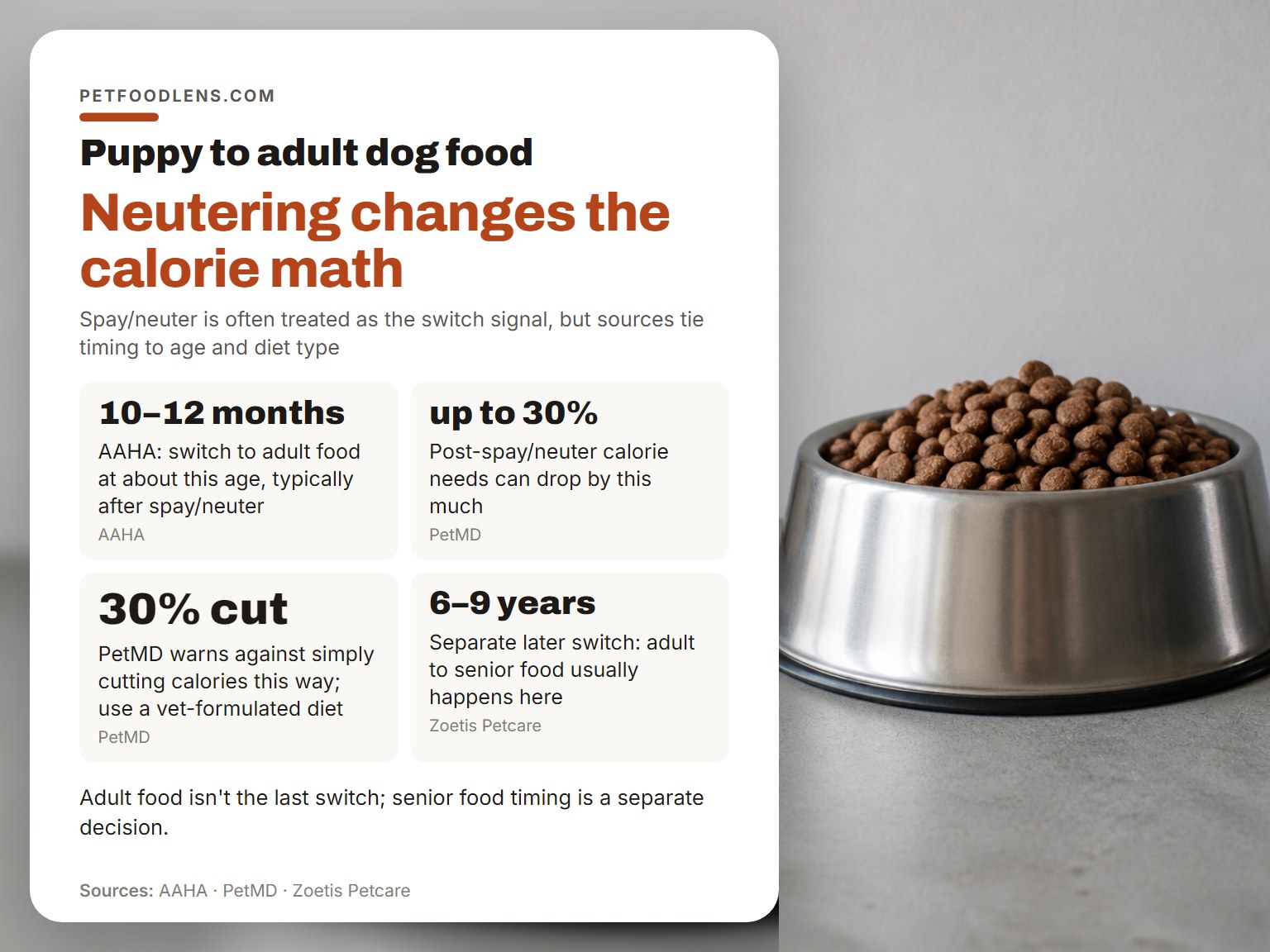
Everyone treats spay or neuter as the clean signal to switch. The sources don’t.
The AAHA manual ties the switch to about 10 to 12 months, typically after the spay or neuter surgery. The AKC Owner’s Manual says the same thing: after the procedure, switch from nutrient-rich puppy food to adult maintenance food.
PetMD complicates it. Post-spay or post-neuter calorie requirements can drop by up to 30%, and PetMD explicitly warns against simply cutting calories by 30%. It points to a vet-formulated neutered-puppy diet instead.
Post-spay or post-neuter calorie requirements can drop by up to 30%, and PetMD warns against simply cutting calories by 30%. A vet-formulated neutered-puppy diet handles that better than a smaller scoop of the same puppy food.
Adult food isn’t the last switch. The senior dog food transition usually happens around six to nine years, per Zoetis, and it’s a separate decision from this one.
I’m not a veterinarian, and I can’t diagnose anything. What I can do is read a label and tell you whether the statement on it matches the dog in front of you. For the timing call on an individual puppy, especially one neutered early or built like a small horse, ask the vet who has seen it grow.
Frequently Asked Questions
At what age should a puppy switch to adult food?
Anywhere from 9 to 24 months, depending on expected adult size. Small breeds land around 9 to 12 months, large breeds 12 to 24 months, and giant breeds 18 to 24 months. The 80% of adult size marker is the trigger most vets use, not a fixed birthday.
Is it bad to switch a puppy to adult food too early?
It can be. Puppy food carries more calories, protein, fat, calcium, and phosphorus than adult maintenance diets, and a large-breed puppy that gains too fast is more likely to develop bone and joint abnormalities. Switching early on a small breed is a smaller risk than switching early on a Great Dane.
Can I switch my puppy to adult food in three days?
You can, but the sources don’t recommend it. PetMD says about five days, AAHA says seven, and Zoetis says at least one week with two weeks for a sensitive stomach. A sudden switch can cause stomach aches, diarrhea, or vomiting, and vomiting plus diarrhea can dehydrate a puppy fast.
Do all-life-stages foods work for puppies and adults?
PetMD says some diets meet the needs of both growing and adult animals. Zoetis says not to feed an all-life-stages food to an adult or senior dog. For a puppy, an all-life-stages formula meets the growth profile; for the adult in the same house, the two sources split.
Should I switch my puppy to adult food after neutering?
AAHA and the AKC Owner’s Manual both tie the switch to roughly 10 to 12 months, typically after the surgery. PetMD warns that calorie needs can drop by up to 30% after neuter and that a flat 30% cut is the wrong move. Ask for a vet-formulated neutered-puppy diet instead.
Do large breeds really need puppy food until 24 months?
Some sources say yes. PetMD runs large breeds to 24 months, Kępińska-Pacelik and Biel put large breeds at 15 to 18 months and giant breeds up to 24, and Royal Canin splits Giant Puppy (up to 8 months) from Giant Junior (9 to 24 months). AAHA’s flat 10 to 12 months for all sizes is the outlier.
The Bottom Line
Find your dog’s expected adult weight range first, then use the source that matches it. A small breed anywhere between 7 and 12 months is inside the window most sources agree on. A large or giant breed runs to 24 months, and the cost of switching early is higher than the cost of switching late.
Here’s the one action I’d take this week: find the AAFCO statement on the bag you’re feeding now and confirm whether it says growth, maintenance, or all life stages. That single line tells you more about the food than the photo, the protein percentage, or the word “ancestral” anywhere on the front.
This all changes if your puppy was neutered early or is on a prescription diet. In that case, the timeline is your vet’s call, not a chart’s.
Most guides will tell you to switch at exactly one year. I’d rather see a large-breed puppy on puppy food a little too long than not long enough.
