
Suet Feeder Pros and Cons: What Actually Matters
This post contains affiliate links. As an Amazon Associate, we earn from qualifying purchases.
Suet feeder pros and cons split into two lists: what suet delivers and what it attracts. Suet is dense animal fat that woodpeckers, nuthatches, and chickadees work hard, and a metal cage survives years of weather. The cons are raccoons, starlings, rancid cakes above 70 degrees F, and squirrel-proof labels that exclude juveniles.
The 70-degree line is the one that catches people, because suet does not fail loudly, and the suet feeder pros and cons question comes down to this. It softens, then it sours, and the birds that hammered it quietly stop showing up.
What follows is the honest ledger: four designs, the two manufacturer specs that contradict each other, and the placement rule that decides whether a squirrel-proof feeder works at all.
Key Takeaways
- Bring the feeder in at night. Brome advises bringing the feeder in at night to prevent night visitors from emptying and destroying it.
- Clearance decides everything. A weight-triggered shroud needs 18 in./47 cm of open space so the squirrel’s weight triggers the closing shroud.
- Cake depth is published two ways. Brome’s store page says 1 in.; Brome’s support page says 1.5 in.
- No-melt blends exist for summer. Nature’s Way says suet can be fed year-round with no-melt blends rendered multiple times to raise the melting point, while ProBirdFeeder warns suet goes rancid above 70°F (21°C) and K-State notes suet is normally fed in winter.
- One cake lasts several days to two weeks in normal traffic, per ProBirdFeeder. Larger cages make sense only where woodpecker traffic is heavy.
What a Suet Feeder Does Well
Suet is animal fat, and K-State Research and Extension describes it as beef in most cases, fed raw or rendered, plain or mixed with other feeds. That versatility is the whole appeal. You can buy a finished cake or melt your own into a margarine tub.
A suet feeder is a wire or plastic cage that holds a cake of rendered animal fat. Birds cling to the mesh and feed from the exposed face. Cage gauge, closure type, and cake capacity decide which species can use the feeder, and a vinyl coating keeps bare metal off feet in freezing weather.
The bird list is longer than most people expect, which is one entry on the suet feeder pros and cons ledger. K-State lists woodpeckers, chickadees, titmice, nuthatches, and creepers, and colder weather pulls in species that ignore suet in September.
Here is what you actually gain:
- Dense fat in a small package. A single cake carries chickadees and downy woodpeckers through a hard freeze.
- Weather resistance. Wild Birds Unlimited molds its EcoTough line from recycled plastic that will not rot, crack, fade, or warp the way wood does.
- A short learning curve. Hang it or pole-mount it. That is the entire installation.
- Cheap experimentation. You can try a plain cake, a nut blend, and a pepper cake in the same season.
A working cage has a sound. It is a dry tick-tick as a downy repositions its grip on the wire, then silence while it feeds. When the cage goes completely quiet, something is wrong.
If you want the fuller nutrition picture before you commit, the case for and against suet for birds is worth reading alongside this one.
Where Suet Feeders Let You Down
The raccoon gets in unless the lid locks.
Start with the manufacturer’s own words. Brome sells the Squirrel Buster Suet under a “TRULY SQUIRREL PROOF” label, and then states plainly that the feeder will not deter grackles, starlings, juvenile red, Douglas, or flying squirrels, chipmunks, possums, bears, deer, or raccoons. That is a long list of exclusions under a short, confident headline.
Where this goes sideways: Hanging a suet feeder on a low branch within 10 feet of a shrub. Raccoons can lift or shake open lids held by gravity or a simple hook, and a squirrel can clear that gap without ever putting its weight on the feeder.
The other cons are just as concrete:
- Mammals treat it as a buffet. K-State names starlings, raccoons, and opossums as the standard drawback of putting suet out at all.
- Bare wire is a genuine hazard. ProBirdFeeder warns that in freezing weather a bird’s wet tongue or eye tissue can stick to uncoated metal. Vinyl coating prevents that and stops rust.
- Rancid suet is a problem, and birds abandon it fast.
- Nuisance birds can clean you out before a single woodpecker arrives.
The placement math is where the sources split. Brome requires at least 18 in./47 cm of clearance around the feeder so a squirrel has to climb on and trigger the shroud. World Birds recommends locating the feeder at least 10 feet from bushes or trees that act as safe jumping points.
If squirrels are the main event in your yard, the comparison of squirrel-proof feeders covers which mechanisms survive contact with a determined one.
Which Suet Feeder Design Fits Your Yard?
Ever wondered why a pileated woodpecker ignores a short cage and then lands on a long one?
The answer is bracing. ProBirdFeeder describes a tail prop as a 6 to 8 inch (15 to 20 cm) vertical extension below the cage, and it is what brings in flickers, hairy woodpeckers, and pileateds.
| Design | Best for | Main weakness |
|---|---|---|
| Basic vinyl-coated cage | Chickadees, titmice, downy woodpeckers | No tail support, no locking lid |
| Tail-prop cage | Flickers, hairy and pileated woodpeckers | Bulky, awkward in tight spots |
| Upside-down feeder | Excluding starlings and grackles | Woodpeckers take days to adjust |
| Weight-triggered shroud | Squirrels, where clearance exists | Fails near any foothold |
Tail Props and the Woodpeckers That Need Them
The Wild Birds Unlimited EcoTough Double Tail Prop Suet Feeder holds 2 cakes and measures 23.5 by 8 by 3 inches. That length is the point. It is built so a pileated can brace its stiff tail feathers against the paddle while it feeds.
Jacobi Jayne takes a different route with the Premium Suet Feeder. It holds 2 regular cakes or 6 suet balls, measures 8.2 by 5.9 by 3.3 inches, and is all metal including a steel cage with a sloped lid for drainage. Jacobi Jayne backs it with a 5 Year Guarantee and free replacement parts on photo submission.
Upside-Down Feeding and the Starling Question
Nature’s Way and Wild Birds Unlimited both say the same thing: bottom-exposed feeders are comfortable for clinging birds and difficult for starlings. ProBirdFeeder agrees but adds a caveat worth repeating. Expect a few determined starlings to work it out.
If you want to build rather than buy, the Washington DFW suet feeder guide gives a construction spec: a 3.5 by 14 inch round cedar feeding column with 8 feeder holes 1 inch in diameter and 1 inch deep, a 14 inch roof of half-inch exterior plywood, and a 1/4 inch threaded bolt with nut and washer holding the assembly together.
The wider menu of suet feeder designs is worth a look before you settle on one shape.
The Suet Cake Size Question Brome Answers Two Ways
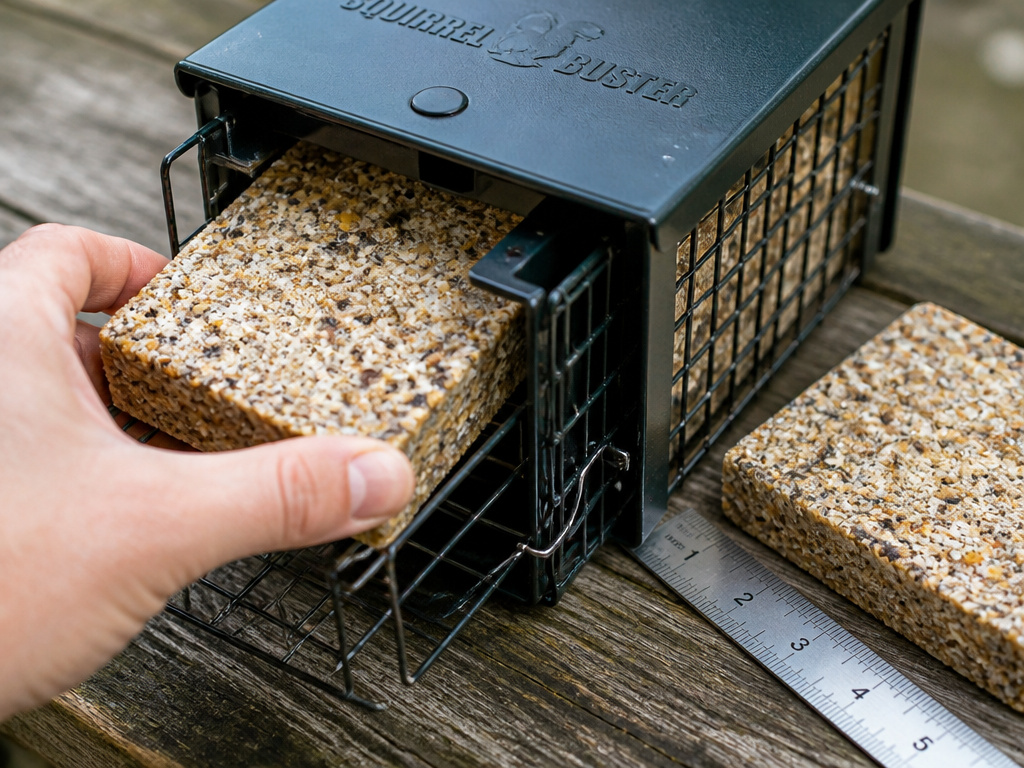
Brome’s store page lists the Squirrel Buster Suet capacity as two cakes at 4.5 by 4.5 by 1 inch. The same company’s product support page says the feeder takes standard size suet cakes at 4.5 by 4.5 by 1.5 inches.
Same feeder, same manufacturer, two official depths. The rest of the spec sheet lists dimensions of 8 5/8 by 4 1/2 by 18 5/8 inches, a weight of 3.7 lb, and metal and plastic construction.
I would buy cakes on the deeper measurement and let the shroud tell me if a cake is too fat. A cake that will not seat fully keeps the feeder from cycling up and down, and Brome’s own troubleshooting list puts “verify the suet is inserted properly” near the top of the checklist.
That cycling matters more than it sounds. The shroud only closes when a squirrel’s weight pushes it down, and a badly seated cake interferes with the whole mechanism. If your feeder stops moving, reseat the cake before you blame the squirrels.
The other Brome spec worth writing down is the loading guidance. Brome recommends a suet cake with nuts and seeds. Nature’s Way counters that nuts and seed in a blend are exactly what draws squirrels, while most squirrels leave raw suet alone. Both are describing real behavior, and the two positions point in opposite directions.
If you are still mapping out your whole setup, choosing a bird feeder covers how suet fits alongside seed and nectar stations.
How Do You Keep Squirrels and Starlings Off Suet?
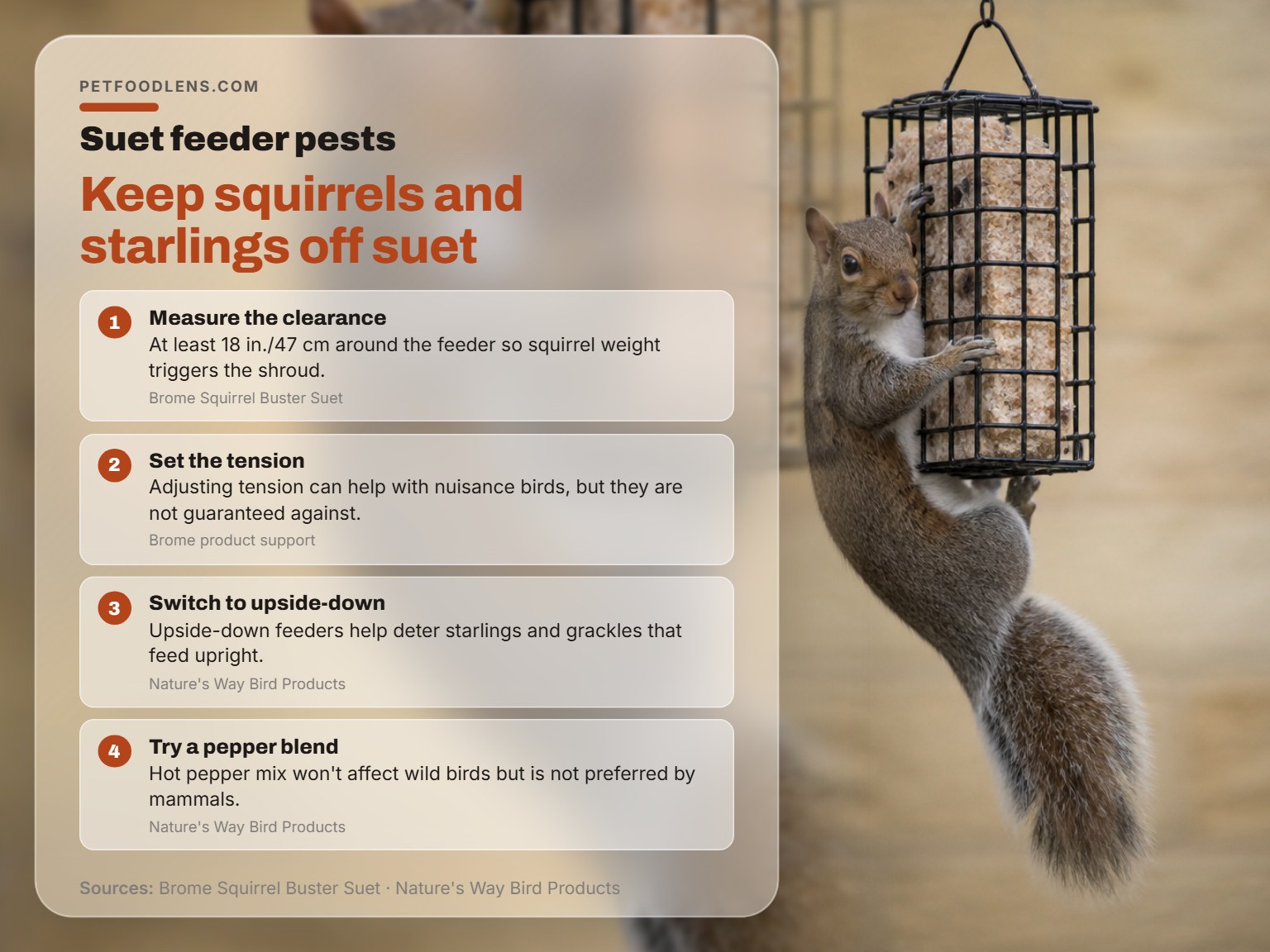
Start with distance, then tension, then the design.
- Measure the clearance first. Brome requires at least 18 in./47 cm around the feeder so a squirrel has to climb on and trigger the shroud. Skip this and the shroud never closes, no matter how the feeder is marketed.
- Set the tension. Brome support says adjusting the tension can help with nuisance birds, while conceding that nuisance birds are not guaranteed against. Read that as a tuning knob, not a warranty.
- Switch designs if starlings are the problem. An upside-down feeder is the standard answer. Note that Brome’s disclaimer says its own feeder will not deter starlings, so the design logic does not carry across every model.
- Try a pepper blend. Nature’s Way notes that a hot pepper mix does not affect wild birds and is not preferred by mammals.
- Pull your other feeders for a week or two. Nature’s Way recommends removing other suet feeders until birds find and regularly use the new one, then putting them back.
A squirrel-proof feeder is a geometry problem before it is a brand. If a squirrel can reach the cage without putting weight on it, the shroud never closes and the label means nothing.
The Tension Adjustment Nobody Reads
Brome’s support page also lists the three things to check when no birds show up: that the suet is exposed, that the suet is fresh, and that the feeder goes up and down properly. All three are mechanical checks. None of them involve buying anything.
For the starling side of the ledger specifically, starling-proof feeders goes deeper on which designs actually hold up.
Heat, Rancidity, and the 70-Degree Line
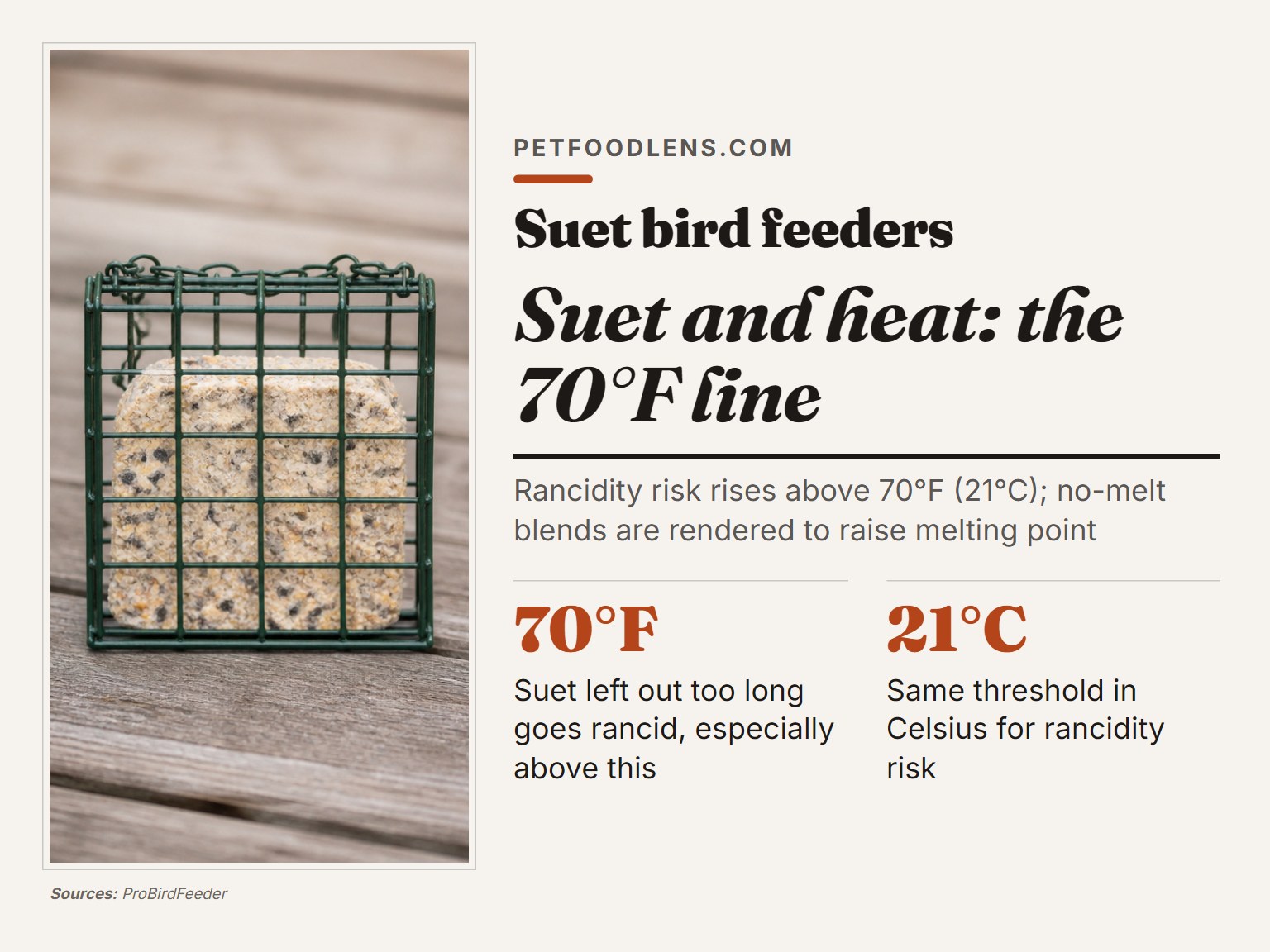
ProBirdFeeder puts the rancidity threshold at 70 degrees F (21 C), especially for suet left out too long.
Nature’s Way takes a softer line. Suet can be fed year-round, and in warmer months you choose a variety labeled “no-melt,” “no-drip,” or “summer.” Those blends are rendered multiple times to raise the melting point of the fat. K-State sits in the middle, noting that suet is normally fed in winter but that many preparations work well for summer feeding.
Three sources, three positions, and they are not really contradicting each other. Plain suet in July is a mess. A no-melt blend in July is fine.
| Symptom | Likely cause | Fix |
|---|---|---|
| No birds after two weeks | Other feeders nearby | Take them down temporarily |
| Feeder will not cycle | Cake not seated | Reseat the suet |
| Cakes softening, greasy | Warm weather, plain suet | Switch to a no-melt blend |
| Mold or a sour smell | Cake left too long | Discard and clean the cage |
Cleaning is the part that gets skipped. Nature’s Way recommends cleaning the feeder every couple of weeks to keep birds healthy and avoid spreading disease. In freezing months, that cleaning matters more than changing the suet.
I would keep a spare cake in the freezer and rotate it in when the cage empties. It costs nothing extra and it means you are never tempted to leave a soggy cake out for one more day.
If you are setting up for cold weather, the roundup of winter bird feeders covers the designs that hold up in ice, and the overview of bird feeder types explains where suet stations fit next to seed and nectar feeders.
Frequently Asked Questions
How long does a suet cake last in a feeder?
ProBirdFeeder puts a single cake at several days to two weeks, depending on traffic and weather. Heavy woodpecker traffic shortens that considerably. Warm weather shortens it further, because plain suet softens and sours above 70 degrees F.
Will a squirrel-proof suet feeder actually stop squirrels?
It depends on the mechanism and the placement. Brome’s Squirrel Buster Suet uses a weight-triggered shroud that closes when a squirrel climbs on, but Brome’s own disclaimer excludes juvenile red, Douglas, and flying squirrels, plus chipmunks. The shroud also needs at least 18 in./47 cm of clearance to work.
Do upside-down suet feeders really deter starlings?
Nature’s Way, Wild Birds Unlimited, and ProBirdFeeder all say yes, with caveats. Starlings feed upright and struggle while hanging inverted. ProBirdFeeder warns that a few determined starlings will work it out, and Brome’s disclaimer states its own feeder will not deter starlings at all.
What size suet cake should I buy?
Measure your feeder before you buy in bulk. Brome’s store page lists the Squirrel Buster Suet at 4.5 by 4.5 by 1 inch, while Brome’s support page lists 4.5 by 4.5 by 1.5 inches. A cake that will not seat fully stops the feeder from cycling properly.
Can I feed suet in summer?
Yes, with the right cake. Nature’s Way recommends choosing a blend labeled “no-melt,” “no-drip,” or “summer” in warm months. Those blends are rendered multiple times to raise the melting point. Plain suet goes rancid above 70 degrees F according to ProBirdFeeder.
How often should I clean a suet feeder?
Nature’s Way recommends every couple of weeks. During freezing winter months, cleaning matters more than swapping the suet, since disease transmission is the bigger risk. Brome’s Detachable Component System lets you break the feeder down by hand without tools.
The Bottom Line
If you take one number away from this, take 18 inches. That is the clearance Brome requires around a weight-triggered feeder, and it decides whether the shroud ever closes or whether you have bought an expensive bird-only cage with a squirrel attached to the side.
The second number is 1.5 inches, and it comes with a warning. Brome publishes two different cake depths for the same feeder, so measure the cage you actually own before you order a case of cakes.
One concession worth stating plainly: none of this covers bears. Brome’s disclaimer lists bears among the animals the Squirrel Buster Suet will not deter, and no cage design here changes that. If bears work your yard, the feeder comes in at night or it comes down for the season.
Start this week with the clearance check. Walk outside with a tape measure, look at what is within 18 inches of your hanger, and move the feeder if a branch or railing gives a squirrel a shortcut. That single change does more than any accessory you can buy.
