
Rotational Feeding for Dogs Guide: What Studies Show
This post contains affiliate links. As an Amazon Associate, we earn from qualifying purchases.
Any rotational feeding for dogs guide should lead with the one controlled trial: a 2024 Journal of Animal Science study of 16 Labrador retrievers found that rotating supplements at 2.5% of daily dry-matter intake produced no measurable gut-tolerance benefit. Both groups handled abrupt diet changes equally.
The gap between that trial and the rotation advice on brand pages is wider than most owners realize. ACANA, Fromm, and Open Farm all describe rotation as supporting digestive adaptation. The trial measured dysbiosis index, fecal pH, calprotectin, and C-reactive protein, and found no significant difference between groups.
What follows walks through the actual evidence, the transition protocols that contradict each other, the at-risk food ceiling most rotation advice skips, and the dogs that should not be on a rotation at all.
Key Takeaways
- The only controlled trial found no gut-tolerance benefit from rotation at 2.5% of dry-matter intake.
- Transition advice ranges from “no transition needed” to a week or more depending on the source.
- Whole Dog Journal advises capping at-risk-category foods at less than half the diet if you rotate multiple foods.
- Fromm advises that dogs with IBD, protein allergies, or sensitive stomachs may need a consistent diet instead of rotation, while Stella & Chewy’s says sensitive pets may need only a short transition.
- Rotate within a product line first to change only one variable.
What the Only Controlled Trial on Rotation Actually Found
The PSVI-4 study is the only controlled rotation trial I could locate in the published literature. Sixteen Labrador retrievers, aged 1 to 3 years, body condition score 5 to 6. The trial ran 120 days with a 30-day basal acclimation period.
The PSVI-4 trial enrolled 16 Labrador retrievers aged 1 to 3 years at body condition score 5 to 6. Over 120 days, with a 30-day basal acclimation, the rotation group received 2.5% of daily dry-matter intake as rotating supplements: oatmeal, blueberries, pumpkin, beef liver, salmon, and rabbit. Abrupt diet changes occurred at days 0, 45, and 90.
What the Trial Measured
The researchers tracked fecal dysbiosis index, fecal pH, calprotectin, fecal score, and C-reactive protein. Blood was drawn to measure C-reactive protein.
Every marker came back non-significant. Dysbiosis index at P = 0.0844. Fecal pH at P = 0.7243. Calprotectin at P = 0.9356. Fecal score by period at P = 0.0768 and by treatment at P = 0.9002. C-reactive protein at P = 0.8022.
That’s the whole result.
Sixteen dogs is a small trial. It’s also the only controlled data anyone has, which means every brand page claiming rotation supports gut health is extrapolating from something other than a controlled trial. If you’re reading a rotational feeding for dogs guide that doesn’t mention PSVI-4, it’s missing the only controlled evidence in the field.
What most people get wrong: Rotation is often sold as training the gut to handle change. The trial tested exactly that, and the rotation group tolerated abrupt diet changes no better than the control. The mechanism brands describe doesn’t show up in the data.
Why Brand Pages and Peer Review Disagree on Gut Tolerance
ACANA’s rotation page says exposure to different proteins and ingredients helps support a strong gastrointestinal environment. Fromm’s guide says diet diversity encourages a wider variety of healthy gut flora. Open Farm says switching protein sources increases tolerance to dietary changes.
The PSVI-4 trial tested that last claim directly. It found no significant difference in any measured tolerance marker between the rotation group and the control group.
| Source | Claim | Basis |
|---|---|---|
| ACANA | Different proteins support GI environment | Brand page |
| Fromm | Diversity encourages healthy gut flora | Brand page |
| Open Farm | Switching increases dietary tolerance | Brand page |
| PSVI-4 (2024) | No difference in tolerance markers | Controlled trial |
The claim and the data don’t line up.
I know cat food better than dog food, so I checked the dog-specific sources more carefully than I would for a feline article. The rotation claims are the same shape across species. The trial data is thinner for dogs.
ACANA Singles recipes are balanced to be fed alone and meet AAFCO requirements, which is a separate claim from the rotation benefit. That one has a regulatory basis. The rotation claim doesn’t.
How Long Should You Transition Between Dog Foods?
Five credible sources give five different answers. AAHA recommends 3 to 7 days, citing Nott et al., 1993, in its AAHA canine life stage feeding guidelines. ACANA says mix 50/50, then 100% new after a few days. Fromm says increase the ratio over the next week or so. Open Farm says 7 to 10 days in 25% increments. Whole Dog Journal says a few days, or up to a few weeks.
| Source | Recommended Transition |
|---|---|
| AAHA | 3-7 days |
| ACANA | 50/50, then 100% after a few days |
| Fromm | Increase ratio over the next week |
| Open Farm | 7-10 days in 25% increments |
| Whole Dog Journal | A few days to a few weeks |
Five answers, one operation.
The disagreement matters because each source is answering a different question. AAHA writes general guidance for a vet clinic. ACANA writes for a customer who wants to try a new flavor this week. Whole Dog Journal writes for an owner whose dog may have been on the same food for years.
Quotable rule of thumb: Transition speed depends on how long the dog has been on the same food and how sensitive it is. The variable isn’t the food. It’s how long the gut has been adapted to one formula.
How Often Should You Rotate a Dog’s Food?
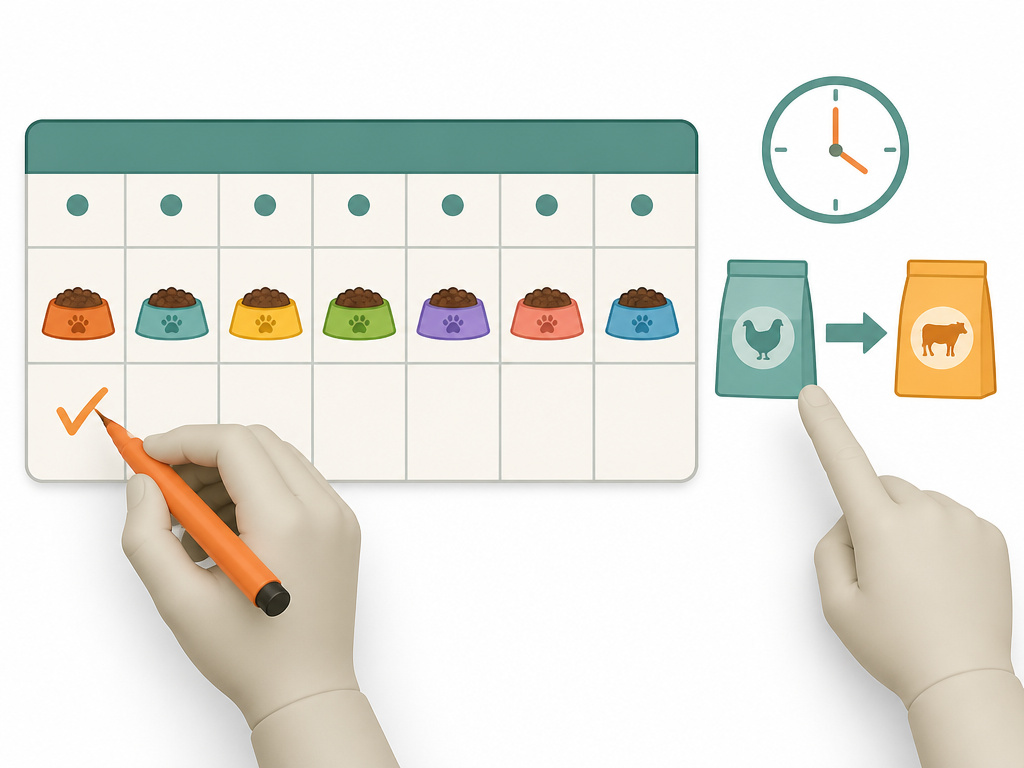
The range is wide: ACANA says daily, weekly, monthly, or bag to bag, Fromm offers weekly or bi-monthly schedules, and Stella & Chewy’s recommends 2 to 6 weeks when feeding raw. ACANA says daily, weekly, monthly, or bag to bag. Fromm’s sample schedules are weekly (protein changes every seven days) or bi-monthly (format changes every four to eight weeks). Stella & Chewy’s recommends 2 to 6 weeks when feeding raw.
The AAHA guidance doesn’t address rotation frequency at all. It assumes a single diet and gives a transition interval for switching. The rotation-specific advice comes from brands that sell multiple recipes.
Pick one interval and hold it.
If you want a structured approach to rotate proteins, start with the same product line. Open Farm recommends this for an easier transition. It changes one variable at a time.
Format changes are a separate trigger. AAHA names dry-to-moist switches alongside low-fat-to-high-fat changes as causes of digestive upset. The same logic applies to how to rotate cat food textures, though cats are pickier about format than dogs.
Your feeding schedule matters as much as the food itself. A dog on one meal a day handles a food change differently than a dog on two.
The At-Risk Food Ceiling Most Rotation Advice Skips
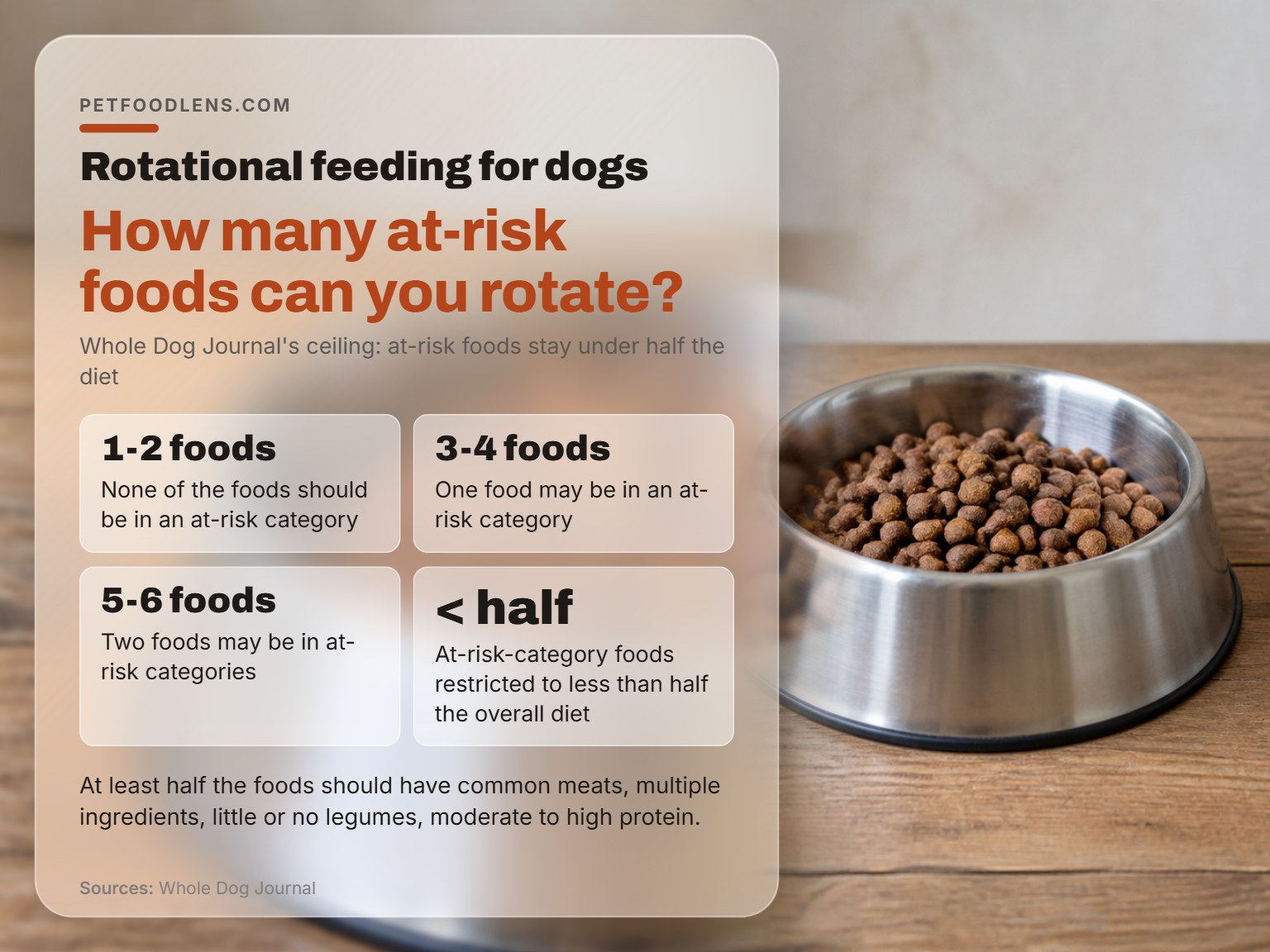
Whole Dog Journal is the only source in my research set with a quantitative ceiling on rotation. Its rule: restrict at-risk-category foods to less than half the overall diet.
At-risk categories include exotic proteins like lamb, limited-ingredient formulas, and foods heavy in legumes. Foods that fit more than one category are likely higher risk than foods fitting just one.
| Foods in Rotation | At-Risk Foods Allowed |
|---|---|
| 1-2 foods | None |
| 3-4 foods | One |
| 5-6 foods | Two |
That’s the ceiling.
Whole Dog Journal advises that at least half the foods should have common meats like chicken, turkey, or beef, multiple ingredients, little or no legumes, and moderate to high protein.
ACANA and Fromm don’t carry this ceiling. Neither does Open Farm. Whole Dog Journal is the only source in the research set that sets a limit on how much you rotate.
Which Dogs Should Skip Rotation Entirely?
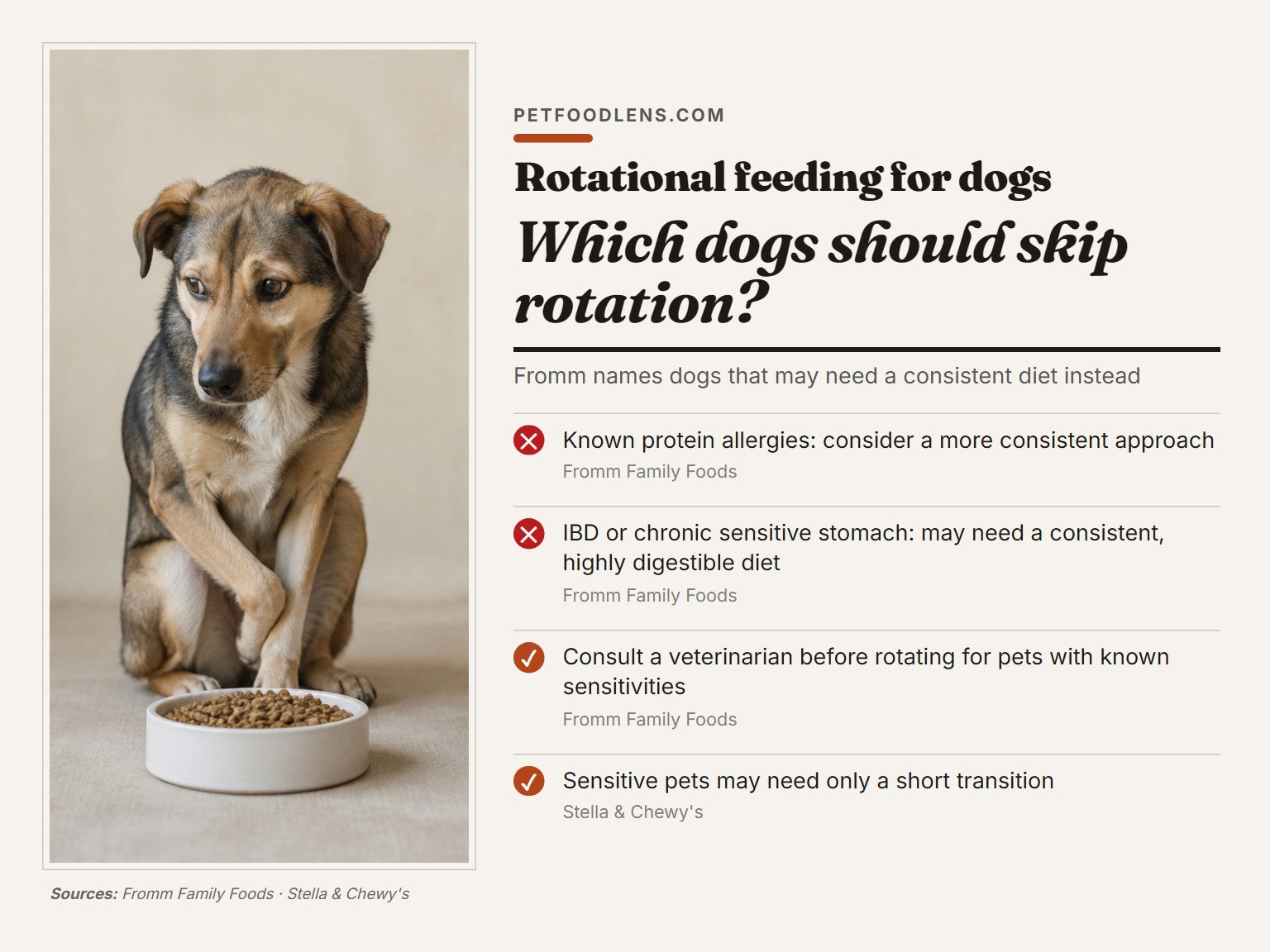
Fromm is the brand page in my research set that most directly names the dogs rotation doesn’t suit. Sensitive stomachs, IBD, known protein allergies. Fromm recommends a more consistent approach for allergic pets, while Stella & Chewy’s says sensitive pets may need only a short transition.
ACANA and Open Farm present rotation as broadly suitable, while Fromm advises that pets with IBD or protein allergies may need a more consistent approach. That’s a meaningful gap, because the dogs most likely to react badly are exactly the ones those caveats would protect.
A dog with a sensitive stomach tells you before the diarrhea does. The stool goes from firm to soft-serve over two or three meals, and the gas starts a day before that.
Dogs that should not be on a rotation:
- Known protein allergies. A rotation makes it harder to identify which protein is triggering the reaction.
- IBD or chronic sensitive stomach. Fromm specifically says these dogs may need a consistent, highly digestible diet.
- Dogs mid-elimination trial. If you’re working with a vet to identify a trigger, adding new proteins defeats the purpose.
Skip this if: Your dog has been diagnosed with IBD or a protein allergy. Fromm’s guide says rotation may not suit these dogs and recommends a consistent approach. A vet-directed single-protein diet is the safer starting point.
Fromm advises that a rotation promoted as an allergy-prevention strategy may work against what an elimination trial needs, while ACANA and Open Farm present rotation as broadly suitable. It complicates the diagnosis.
Homemade and Raw Rotations: The Deficiency Problem
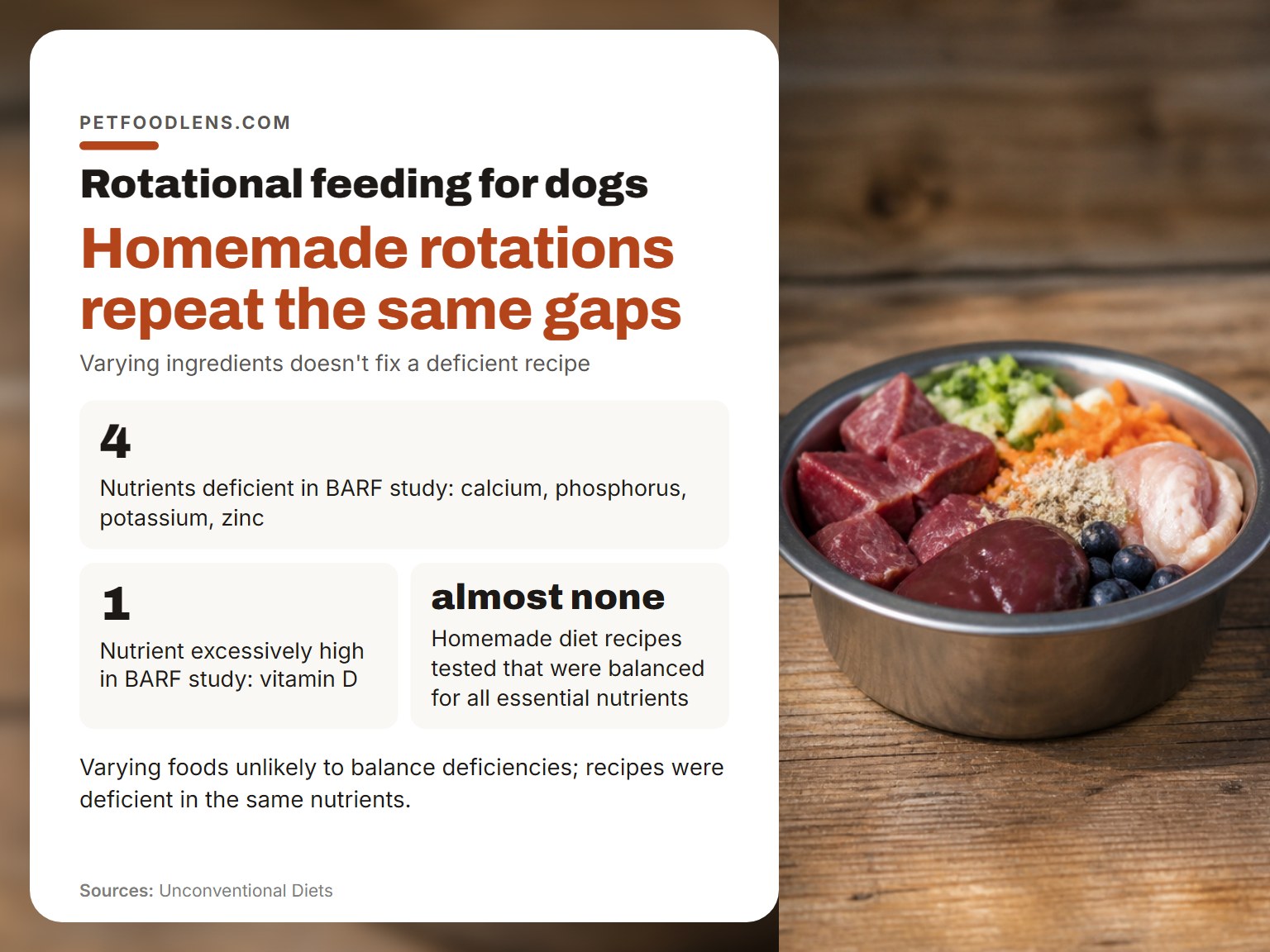
Varying ingredients doesn’t fix a deficient recipe. The Unconventional Diets article in Clinician’s Brief (February 2014) states that almost no homemade diet recipes tested were balanced for all essential nutrients, whether fed as a single diet or several rotating diets.
The BARF Study Numbers
A BARF diet study showed deficiency in calcium, phosphorus, potassium, and zinc, plus excessively high vitamin D. The article’s conclusion is direct: varying foods would unlikely balance the deficiencies, because recipes regardless of ingredients were deficient in the same nutrients.
Three unbalanced recipes produce three versions of the same deficiency. The gaps don’t cancel.
A raw feeding guide for beginners should start with formulation, not variety. A raw food transition schedule has its own timeline that doesn’t map cleanly to kibble rotation.
The part nobody mentions: A homemade rotation isn’t a safety net. It’s the same recipe error repeated with different ingredients. Get the recipe formulated by a veterinary nutritionist first, then rotate within that framework.
Rotational Feeding for Dogs Guide: What to Do on Monday Morning
Here’s the practical takeaway. If you want to try rotation, start with three rules.
- Rotate within the same product line first. Open Farm recommends this. It changes one variable at a time while keeping the base formula constant.
- Cap at-risk foods at less than half the diet. Whole Dog Journal’s ceiling is the only quantitative rule in the research set.
- Track what you feed. Fromm’s feeding journal advice is the most useful single habit in the rotation literature.
I keep a bag chart on my desk from a well-known brand that lists a portion for a typical indoor fixed dog. The chart is a starting estimate. Treat it as a prescription and you’ll overfeed.
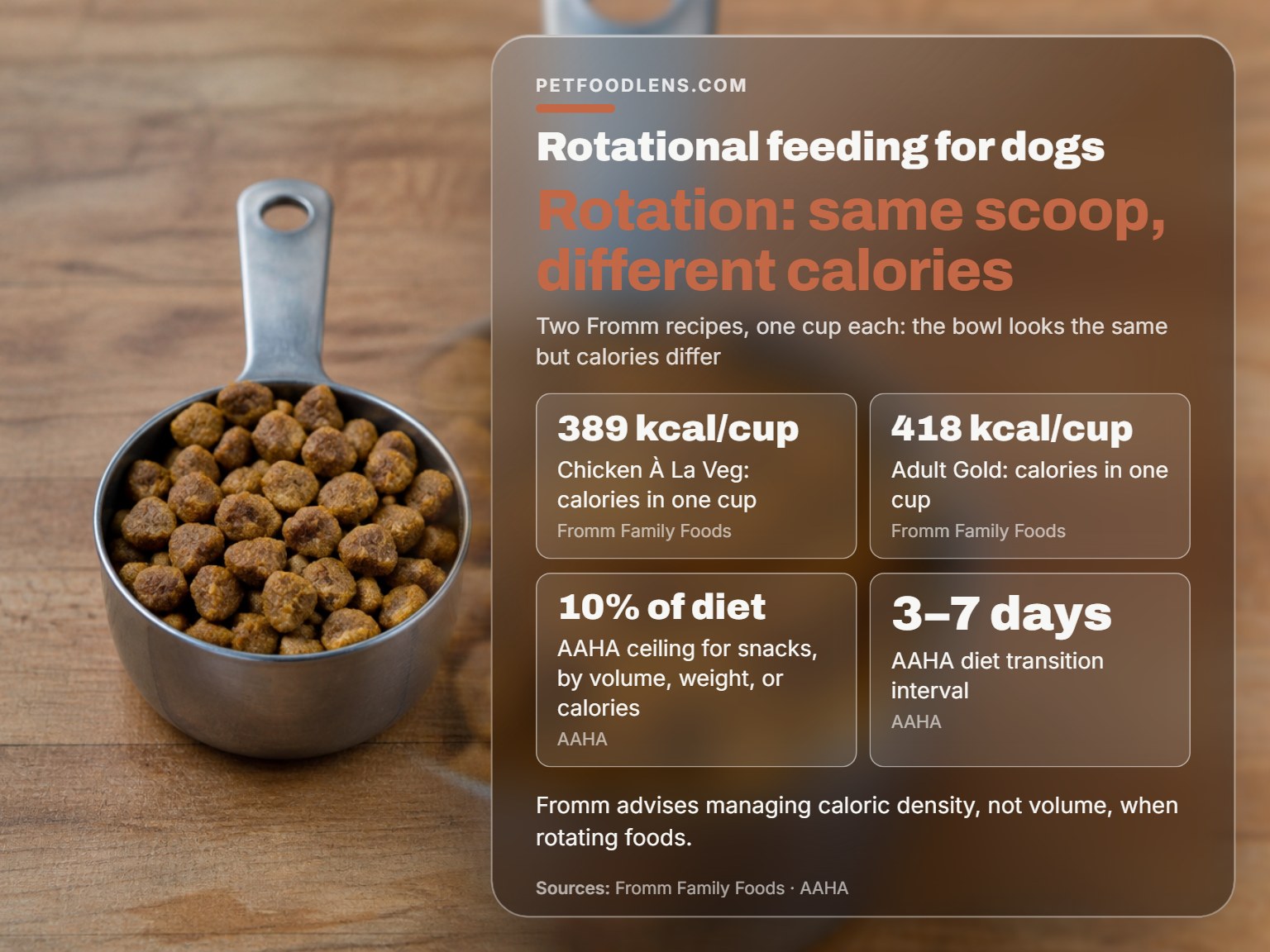
Rotation makes this worse, because each recipe has a different caloric density. Fromm’s own numbers show it: a cup of Chicken À La Veg has 389 calories, a cup of Adult Gold has 418. The scoop looks the same. The bowl looks the same. The dog gains weight anyway.
If you’re feeding one large meal a day, feeding to prevent bloat is a separate concern from rotation. A picky dog isn’t necessarily a dog that needs rotation either. Sometimes a picky dog is just a dog that doesn’t like the food.
If you want a single-diet default, ask your veterinarian about a diet backed by feeding trial data. That’s a more useful signal than a rotation claim.
Frequently Asked Questions
Does rotational feeding actually prevent food allergies?
The evidence is thin. ACANA and Open Farm both present rotation as broadly suitable, while Fromm advises a more consistent approach for allergic dogs. The PSVI-4 trial measured gut-tolerance markers, not allergy development. Fromm’s guide advises a more consistent approach for allergic dogs.
How do I rotate proteins without causing diarrhea?
Start with a protein the dog has already tolerated. Open Farm recommends 25% increments over 7 to 10 days. If the dog has been on the same food for more than a year, budget two weeks. Stella & Chewy’s says most dogs can rotate proteins without a transition, but sensitive dogs may need one.
Can I rotate between wet and dry food?
Yes, but treat it as a format change, not a protein change. AAHA names dry-to-moist switches as a trigger for digestive upset. Stella & Chewy’s says format changes require a slow transition. Rotate the protein within the same format first, then change the format.
Is rotational feeding safe for puppies?
Fromm says rotation is best started when pets are young. But the Clinician’s Brief article notes that almost no homemade diet recipes tested were balanced for all essential nutrients. Commercial puppy food that meets AAFCO requirements is the safer starting point.
What if my dog refuses the new food?
Refusal points to palatability. Try a different protein within the same product line before you try a different brand. If the dog refuses multiple proteins in the same line, the issue may be the base formula, not the protein.
The Bottom Line
For a rotational feeding for dogs guide, the honest answer is that most dogs don’t need it. Stella & Chewy’s says so directly: rotational feeding isn’t mandatory, and a healthy dog happily eating the same food daily is fine. That’s the least commercially motivated sentence in the entire research set, and it’s probably the most useful one.
If your dog has repeated episodes of loose stool, stop rotating and get a vet workup before you try again. At that point the rotation has become a variable you can’t isolate.
This all assumes a healthy adult dog with no known sensitivities. If your dog has IBD, a diagnosed protein allergy, or is mid-elimination trial, the calculus is different. A single consistent diet is the safer move, and Fromm’s own guide says so.
