
How to Feed a Dog to Prevent Bloat: What Actually Works
This post contains affiliate links. As an Amazon Associate, we earn from qualifying purchases.
To feed a dog to prevent bloat, split the daily ration into two or more meals, keep each meal small, slow down a dog that eats too fast, and skip the raised bowl. Cornell University College of Veterinary Medicine also lists exercise right after eating and dry foods with oils in the first four ingredients as risk factors; on raised bowls, Cornell and the Morris panel advise avoiding them, while a 2017 Veterinary Evidence review finds the evidence thin and calls floor feeding the safest default, though raised feeders are sometimes used for arthritic dogs.
The reason meal size sits at the top of that list is mechanical. A stomach packed to capacity carries more weight and more gas, and a heavy, gas-filled stomach is the thing that rotates. Cornell’s description of the condition is blunt about the sequence: the stomach distends first, then twists, and the twist is what cuts off blood supply.
What follows is the plan in the order it matters: meal size and frequency, then kibble, then the ingredient panel, then bowls, then speed, then exercise timing. Where the veterinary sources disagree, you’ll see both positions rather than one presented as settled.
Key Takeaways
- Two or more meals a day, with each one kept small. Cornell lists a single large daily meal as a risk factor on its own.
- Skip the raised bowl unless your dog physically can’t reach the floor. Two sources say avoid it; the third says the evidence is thin but floor feeding is still the safest default.
- Put an obstacle in the bowl. The Morris panel suggests large balls, rocks, or a muffin tin to slow a fast eater down.
- Read the first four ingredients. Cornell flags dry foods that list oils there, which is a label-position rule and not a fat percentage.
- Retching with nothing coming up is an emergency. GDV is fatal without surgery, and survival with treatment runs above 80 percent.
What Actually Happens Inside a Dog With Bloat
The stomach fills with air, fluid, or food, distends, and then rotates on its own axis.
Gastric dilatation-volvulus begins with dilatation: the stomach distends with gas, fluid, or food. Volvulus follows when the distended stomach rotates, sealing the inlet and outlet. Blood flow to the stomach is cut off, major abdominal vessels are compressed, and return of blood to the heart drops. Without surgery, the condition is fatal.
The gastric dilatation volvulus overview from Cornell’s Riney Canine Health Center lays out the downstream damage. The twist seals the stomach’s inlet and outlet. Blood flow to the tissue stops. The distended stomach then presses on the major abdominal vessels and on the diaphragm, which is why breathing gets hard.
Large, deep-chested dogs carry most of the risk. Cornell names Great Danes, Saint Bernards, Weimaraners, Irish Setters, Standard Poodles, Basset Hounds, and Doberman Pinschers.
Cornell’s risk factor list is short enough to memorize:
- Large breed size and a deep chest. The two together matter more than either alone.
- A first-degree relative with GDV.
- Eating too quickly.
- Feeding once daily, or a large volume in one meal.
- Older age and a nervous temperament.
- A raised food bowl.
- Dry food with oils among the first four label ingredients.
- Exercise soon after eating.
Survival with medical and surgical intervention runs above 80 percent, according to Cornell. Without intervention, GDV is fatal.
How Many Meals a Day Should a Bloat-Prone Dog Eat?
Cornell’s answer is two or more. The 1990 Morris Animal Foundation panel, reprinted in Small Animal Clinical Nutrition, says two to three.
Both sources put a single daily meal on the risk list. Cornell pairs that with a second problem in the same line: a large volume of food in one sitting.
The diet-side evidence comes largely from prospective studies in high-risk breeds, including the diet-related GDV risk factor research that followed dogs forward rather than asking owners to remember backward.
What Counts as a Large Meal
Small Animal Clinical Nutrition offers a practical check. If the dog sits at a body condition score between 2.5/5 and 3.5/5, the amount you were already feeding on an energy basis was probably right. The fix is to divide that same amount across two or three bowls. Not to add.
The how to feed a dog to prevent bloat question is a scheduling problem before it’s a nutrition problem. Switching to scheduled feeding is the mechanical change that makes portion control possible. Free-choice feeding makes it impossible.
In a house with more than one dog, feeding multiple dogs in separate rooms does two jobs at once. It stops the faster dog from finishing someone else’s ration, and it removes the competition that pushes eating speed up.
What most people get wrong: Topping the bowl back up when the dog whines. That turns a two-meal schedule straight back into free feeding, and the meal size you were trying to control disappears.
Does Kibble Size Change the Risk?
The two most-cited sources of feeding advice give opposite answers here, and neither one backs down.
| Position | Who holds it | The stated reasoning |
|---|---|---|
| Smaller kibble | Cornell University College of Veterinary Medicine | Smaller pieces go with its two-or-more-meals feeding advice |
| Larger kibble, above 30 mm | 1990 Morris Animal Foundation panel | Larger pieces are thought to slow eating and cut swallowed air |
| No demonstrated prevention | 1990 Morris Animal Foundation panel | No commercial large-particle product has been shown to prevent GDV |
Both positions circle the same how to feed a dog to prevent bloat worry: how fast the food goes down, and how much air goes with it. Cornell bundles smaller kibble with more frequent meals. The Morris panel bundles larger kibble with slower eating.
The Morris panel adds a caveat that gets dropped in most retellings. None of the commercial products sold to deliver large particle sizes has been demonstrated to prevent or reduce GDV. That caveat covers the large-kibble side of the argument.
If you’re picking a food on kibble dimensions alone, a kibble size guide is more use than the front of the bag.
Worth knowing before you start: Changing kibble size is the cheapest experiment on this list and the one with the weakest evidence behind it. Do it if you want to. Don’t do it instead of splitting the meals.
What the Ingredient Panel Tells You That the Front of the Bag Won’t
Early in my career I spent most of a week comparing two foods and never read the nutritional adequacy statement on either bag. One of them was labeled for intermittent feeding only. The whole comparison was worthless.
That statement is the first thing I check now, and it’s the reason I’d tell you to slow down before you switch foods because of a bloat scare.
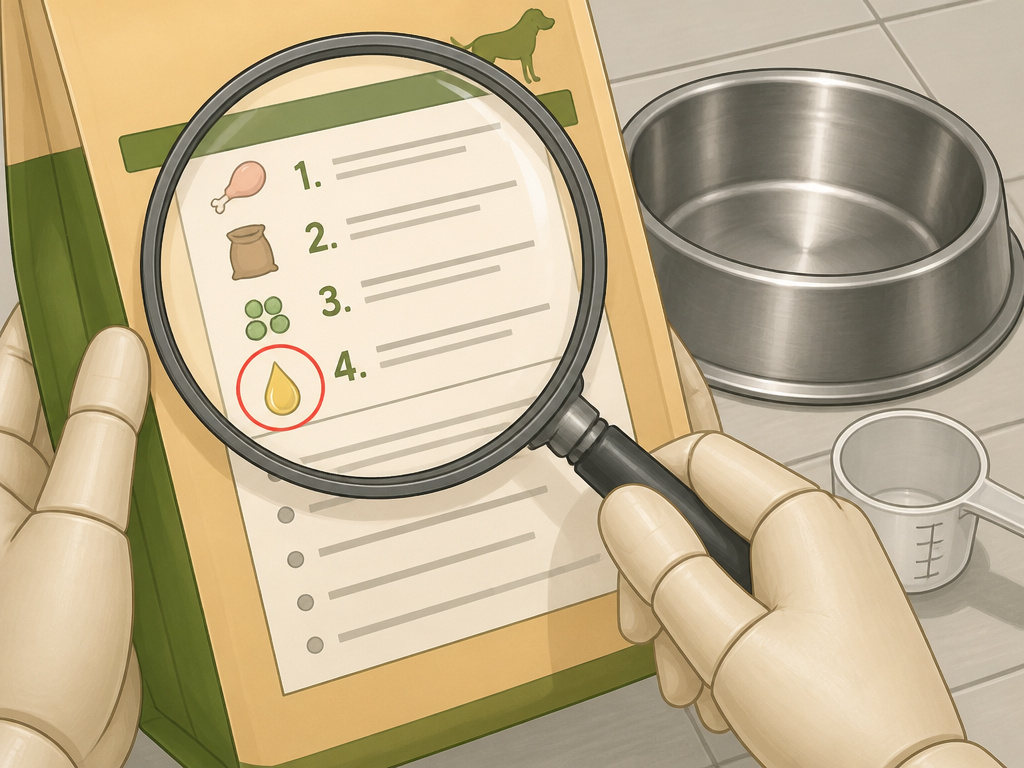
Cornell’s risk list has exactly one label-based item: dry dog foods that list oils among the first four ingredients. That’s a position on the panel, not a percentage on the guaranteed analysis.
Ingredients are listed by weight, so an oil in the top four is a meaningful share of what’s in the bag.
The published work on dry food ingredients and GDV risk is where that label-position rule comes from.
I’d rather see an owner feed two measured meals from a plain bowl on the floor than one expensive food from a raised feeder. The bowl and the schedule are the parts you actually control.
No food on the market is bloat-proof. Cornell’s list describes risk factors, and a risk factor is a bump in probability rather than a cause. Fair warning: switching bags is the easiest thing to do and the least supported by the evidence.
Does a Raised Bowl Actually Raise the Risk?
This one has been argued about for decades and it still isn’t settled.
Cornell lists raised food bowls as a risk factor and advises avoiding them. The Morris panel says at-risk dogs should not be fed from an elevated platform or feeder. Underneath both statements, the evidence is thinner than they suggest.
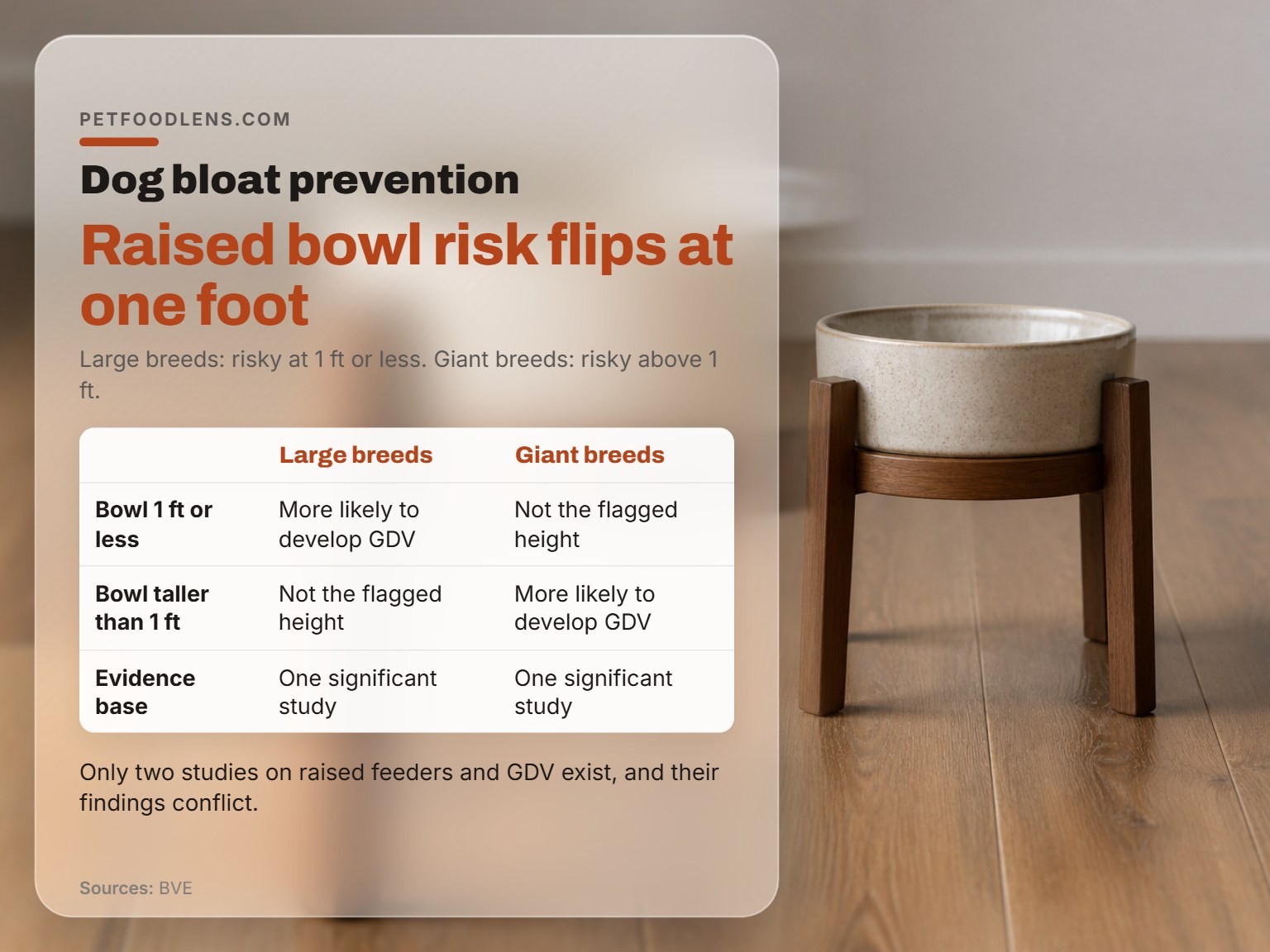
A 2017 review in Veterinary Evidence found only two studies on raised feeders and GDV, and their findings conflict. One of them found a significant effect.
The Height Threshold That Flips With Dog Size
That one study is where the useful detail lives. Large breed dogs were more likely to develop GDV when fed from a bowl one foot tall or less. Giant breed dogs were more likely to develop GDV when fed from a bowl taller than one foot.
Same threshold. Opposite direction, depending on the size of the dog.
The study population was 1,637 dogs across eleven large and giant breeds, all at least six months old. Of those, 98 developed GDV and 1,539 did not.
No study found that a raised feeder reduced risk compared with floor feeding. The review’s conclusion is that floor feeding is the safest option in the absence of better evidence, and it concedes that floor feeding may not lower risk at all.
Raised feeders do have one legitimate use. Veterinary nurses sometimes recommend them for elderly arthritic dogs that can’t comfortably reach the floor, and the review addresses that case directly. If floor feeding is physically impossible for your dog, the decision becomes individual.
Skip a raised feeder for a large breed. elevated dog bowls get sold on the bloat claim, and that claim is doing more work than the evidence behind it.
giant breeds sit on the other side of the one-foot line from large breeds, which is the part most summaries leave out.
Where this goes sideways: Buying a raised feeder because it looks kinder to a dog with a stiff neck, then feeding a large breed from a bowl under a foot tall. That’s the exact setup the one significant study flagged.
How to Slow a Dog That Eats Like a Vacuum
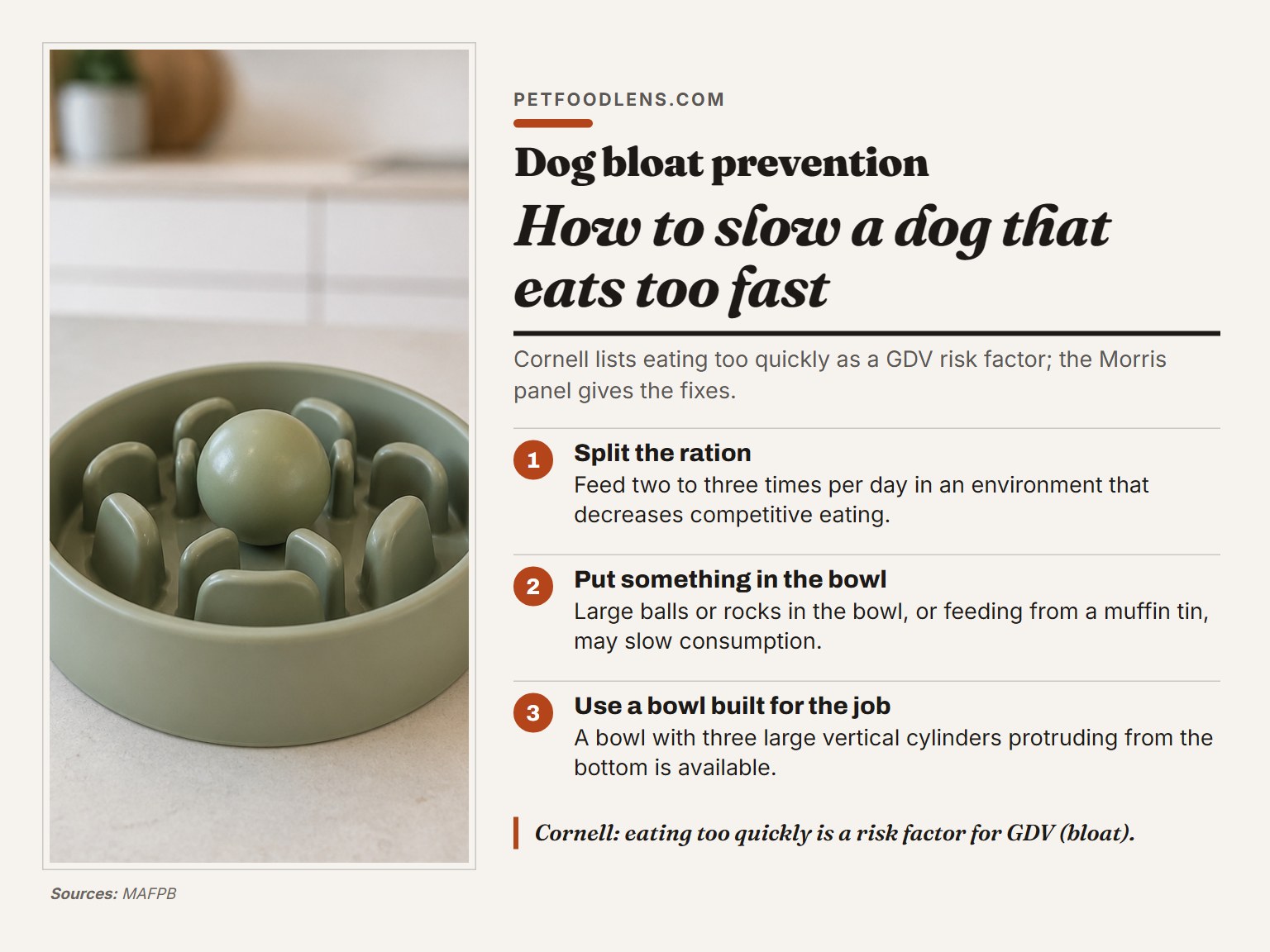
Speed is the risk factor you can change tonight. Cornell lists eating too quickly as a risk factor, and the Morris panel supplies the mechanical fixes.
- Split the ration across two or three bowls. Skipping this is why the rest of the list does nothing; an obstacle in one big bowl just slows the dog on the way to the same oversized meal.
- Put something in the bowl. The Morris panel suggests large balls or rocks, or feeding from a muffin tin. The dog has to work around the obstacle, and the meal takes longer.
- Use a bowl built for the job. The panel describes a bowl with three large vertical cylinders protruding from the bottom, which does the same thing with less chance of a rock ending up on the kitchen floor.
- Feed dogs separately when there’s competition. A dog guarding its bowl eats faster, and a dog competing for one eats faster still.
You can hear the difference before you see it. A dog inhaling a meal produces a steady, rhythmic clatter with almost no pause in it. A dog working around an obstacle gives you a broken, uneven sound, with gaps.
A slow feeder bowl with ridges can change the rhythm of a meal.
slow feeder bowls come in maze, ridge, and puzzle layouts, and the layout matters more than the diameter.
What Doesn’t Work as Well as You Think
A puzzle feeder slows a dog down, and if your dog enjoys working for food, use one. Treat it as a toy that happens to be slow, not as the plan.
If your dog clears the bowl before you’ve straightened up, dog eating too fast covers the mechanical fixes in more detail.
When Can Your Dog Exercise After Eating?
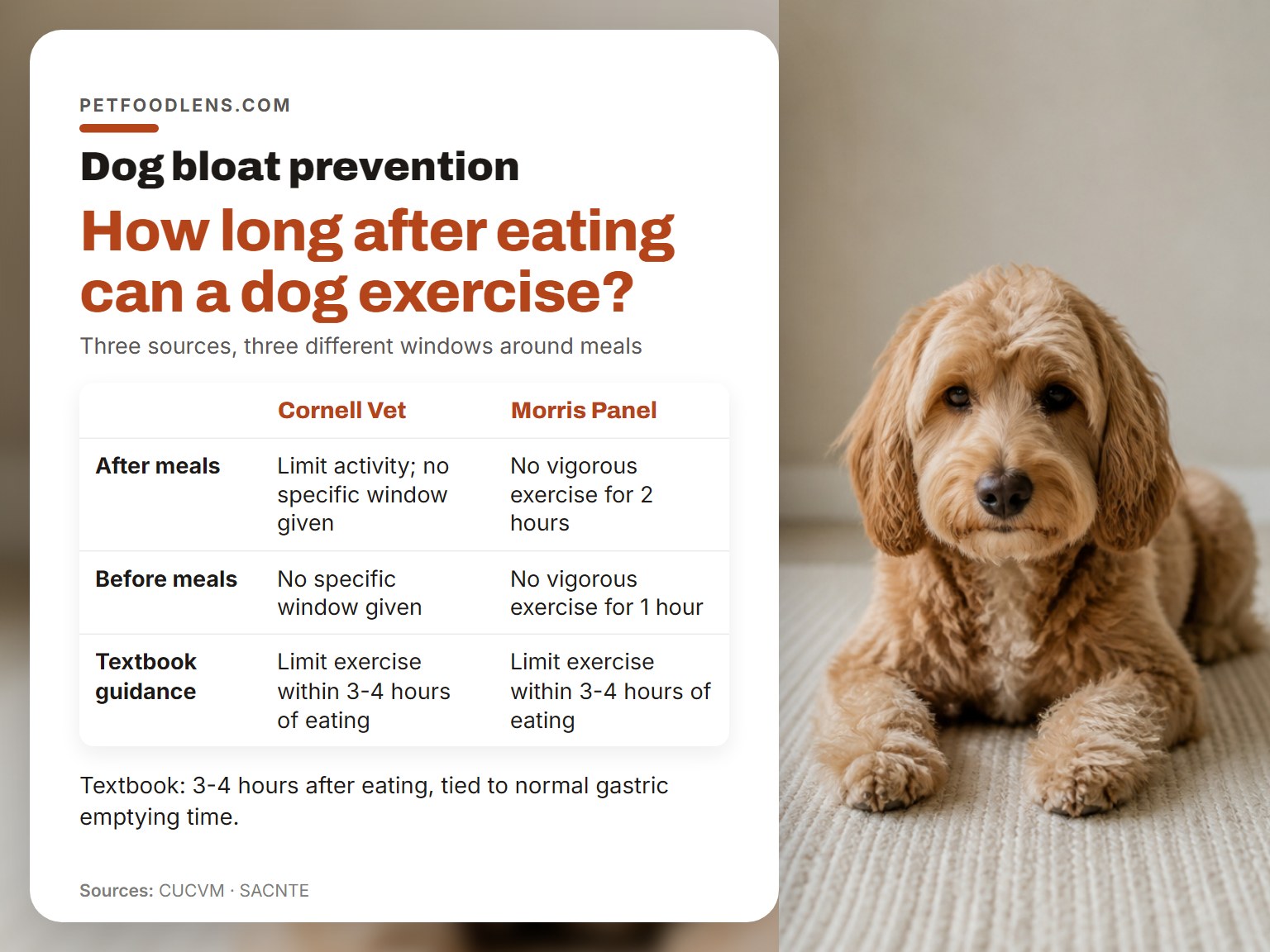
Three sources, three different answers, and none of them is wrong on its own terms.
| Source | Window around meals |
|---|---|
| Cornell University College of Veterinary Medicine | Limit activity after meals; no specific window given |
| Small Animal Clinical Nutrition, 5th ed. | Limit exercise within three to four hours of eating |
| 1990 Morris Animal Foundation panel | No vigorous exercise at least one hour before and two hours after |
The textbook figure ties its window to normal gastric emptying time, which is why it’s the longest of the three. The Morris panel permits walking and only rules out vigorous exercise. Cornell gives no number at all.
The three-to-four-hour window is the widest of the three on the after-meal side; Cornell gives no specific duration, the textbook guidance says three to four hours, and the Morris panel says one hour before and two hours after.
Four hours is longer than most owners expect; Cornell gives no specific duration, the textbook guidance says three to four hours, and the Morris panel says one hour before and two hours after.
What Gastropexy Does, and What It Doesn’t
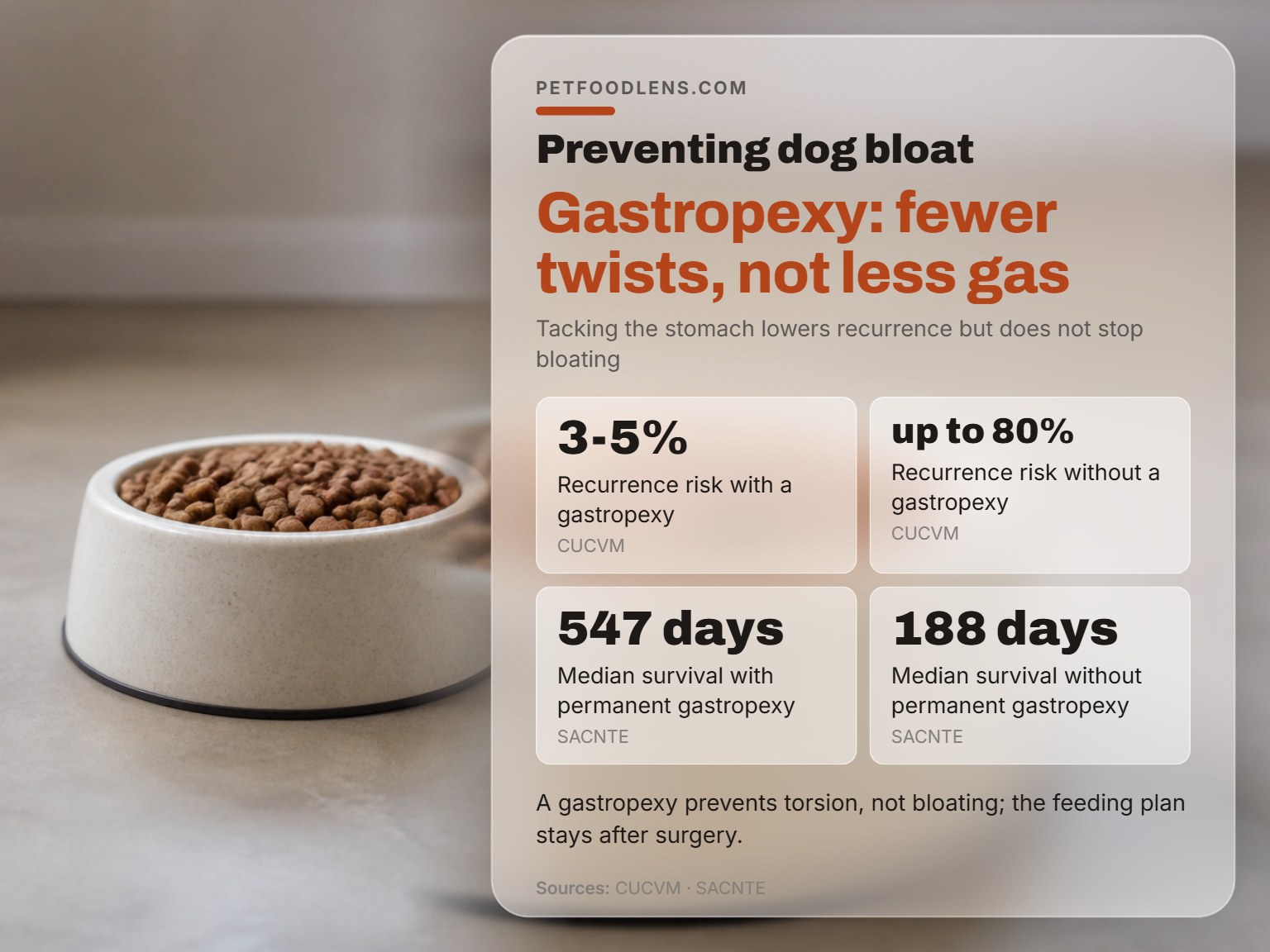
Gastropexy tacks part of the stomach to the body wall so it can’t rotate.
Cornell is precise about the limits. Prophylactic gastropexy, often done at the same time as a spay or neuter in at-risk breeds, decreases the risk of the stomach twisting. It does not prevent bloating.
The numbers carry the argument. Recurrence risk drops to as low as 3 to 5 percent with a gastropexy, against as high as 80 percent without one. Small Animal Clinical Nutrition puts untreated recurrence at close to 80 percent after repositioning without a permanent gastropexy, citing Wingfield 1975. Median survival without one falls from 547 days to 188 days, citing Glickman 1998.
A gastropexy changes the odds of the stomach twisting again. It does not change the odds of the stomach filling with gas. The feeding plan stays in place after surgery.
Cornell also recommends against breeding dogs with a history of GDV, or with a first-degree relative that has had it.
The Signs That Mean Stop Reading and Call Your Vet
A dog that retches and brings nothing up is not working through a hairball.
- Non-productive retching, or attempting to vomit with nothing coming out
- Excessive drooling
- Panting that doesn’t match the temperature
- A bloated abdomen that hurts when you touch it
- Restlessness and pacing
- Pale gums
- Weakness or collapse
- The praying position, with the forelimbs stretched forward and the chest lowered
GDV requires immediate medical and surgical intervention, and it’s fatal without it. Cornell’s survival figure of above 80 percent applies to dogs that get treated.
The Sign People Misread
The praying position gets described as a stretch more often than anything else on that list. Forelimbs forward, chest down, hindquarters up. Cornell lists it as a clinical sign, right alongside the retching.
A distended abdomen looks tight and drum-like rather than soft, and it hurts when you press it. That’s the visual cue that separates a gassy dog from a dog in trouble.
Easy to miss: The retching is the sign people wait on. A dog that retches and produces nothing needs a vet now, not after the next attempt.
Frequently Asked Questions
Should I stop using a raised bowl for my dog?
Cornell advises avoiding raised bowls, and the 2017 review concludes that floor feeding is the safest default while the evidence stays thin. The exception is a dog that physically can’t reach the floor, such as an elderly dog with arthritis. In that case the height becomes an individual decision rather than a rule.
Does a slow feeder actually prevent bloat?
The Morris panel notes that none of the commercial products sold to change how a dog eats has been demonstrated to prevent GDV. What a slow feeder does is stretch out the time a meal takes, which addresses Cornell’s “eats too quickly” risk factor. Treat it as one part of the plan.
Is grain-free food better for a dog prone to bloat?
Cornell’s risk factor list doesn’t mention grain. The one label item it does flag is oils among the first four ingredients. Check that before you pay extra for a grain-free bag.
How many meals a day after bloat surgery?
The feeding guidance doesn’t change after surgery: two or more meals, smaller portions, no raised bowl, limited activity after eating. A gastropexy reduces the risk of the stomach twisting again, and it doesn’t stop the stomach from filling with gas.
Can I free feed a dog at risk of bloat?
Free feeding makes meal size impossible to measure, and a large volume per meal is one of Cornell’s listed risk factors. Two or three measured meals give you a number you can track and adjust.
What’s the single most important change?
Splitting the daily ration into two or three measured meals. It’s the one change both Cornell and the Morris panel agree on, and it costs nothing.
The Bottom Line
Tonight’s change is small. Measure the daily ration, divide it into two or three bowls, and put the bowl on the floor.
The floor rule is the one I’d break first if your dog can’t physically reach it. An arthritic dog that stops eating because the bowl is on the ground is a real problem, and that trade-off belongs in a conversation with your vet rather than in a blog post.
Everything else here is cheap and unglamorous. Two meals, an obstacle in the bowl, exercise restriction after meals (Cornell gives no specific duration, the textbook guidance says three to four hours, and the Morris panel says one hour before and two hours after), and a look at the first four ingredients. That’s the whole plan for how to feed a dog to prevent bloat, and none of it requires a new bag of food.
The part I’d push back on is the search for a food that fixes this. Cornell’s list is mostly about how you feed, not what you feed. Get the how right first.
