
How to Feed a Dog That Eats Too Fast: What Works
This post contains affiliate links. As an Amazon Associate, we earn from qualifying purchases.
To feed a dog that eats too fast, split the daily ration into smaller meals and put each one behind an obstacle: a slow-feed bowl with raised ridges, a puzzle feeder, or a hand-fed training session. Aim for minutes at the bowl. In one Tufts test, the same kibble took over 3 minutes to finish from a slow-feed bowl. Learning how to feed a dog that eats too fast starts with these simple changes.
There are two separate reasons to bother, and they don’t carry the same weight. Choking, swallowed air, and vomiting after a meal follow directly from eating fast. The bloat link is the one that gets argued about, and the argument is worth understanding before you buy anything.
What follows covers that disagreement first, then the methods that actually slow a dog down, and the cases where a bowl is the wrong answer entirely.
Key Takeaways
- Split the ration into two or three meals instead of one large evening bowl; the AKC links that change to a lower bloat risk.
- A slow-feed bowl works by geometry, not magic: raised areas make it harder for the dog to get the food out at once.
- The GDV evidence is genuinely contested. A 2016 peer-reviewed review found most studies show no effect from eating speed; Tufts and the AKC still call fast eating a possible risk factor.
- Supervise every food toy. Tufts warns that some dogs destroy the toy and try to eat the pieces.
- Use a timed feeder with caution if you own a large dog or a chewer with a history of demolishing dispensers; VCA notes they can be useful, for example for an early morning snack, but warns such dogs may destroy the dispenser.
Why Does My Dog Eat So Fast?
A dog who gets fed twice a day still hits the bowl like it owes him money. The sound gives it away: a hard, ringing clack on stainless, then silence. That’s a meal finished before the kitchen tap runs.
VCA Animal Hospitals puts the reasons down to three things. Some dogs don’t feel full at the end of a meal. Some are bored. And some simply like the taste, because modern dog food is formulated to be palatable once the nutritional requirements are met.
None of that is a behavior problem in the moral sense. It’s a speed problem with physical consequences.
Fast eating raises the risk of choking and increases the volume of swallowed air, which produces burping or flatulence. Gobbling can also trigger vomiting and leave a dog without a full feeling at the end of a meal. The mechanical issue is bolus size: large mouthfuls of dry kibble clear the esophagus faster than the stomach accommodates.
The practical fix is to make the meal take longer without making it smaller. Every method below answers the how to feed a dog that eats too fast question by putting friction between the dog and the food.
The Bloat Question: What the Evidence Actually Says
Nearly every article on this topic opens with the same sentence: fast eating causes bloat. The most rigorous review of that question doesn’t support the certainty.
A 2016 systematic appraisal in Veterinary Evidence looked at the GDV literature and concluded the evidence is mixed and of variable quality. Most studies found that rate of eating has no effect on GDV risk. Where significant effects did appear, fast eating was implicated as a risk factor. No study found that slow eating raised risk.
That’s a careful, hedged conclusion, and it sits in direct conflict with two of the most-cited sources in this space. Here’s where each one stands.
| Source | Position on eating speed and GDV |
|---|---|
| Veterinary Evidence (Buckley 2016) | Most evidence shows no effect; not enough to conclude either way |
| Tufts Petfoodology | Gobbling may be a risk factor for GDV in dogs |
| American Kennel Club | Fast eating may raise bloat risk via swallowed air |
None of these is a crank position. The GDV risk in fast-eating dogs review is peer-reviewed and openly states its own limits. Tufts and the AKC are reading a literature that includes studies pointing the other way.
So what do you do with a disagreement that hasn’t been settled? You look at the cost of being wrong in each direction.
Slowing a dog’s eating will not increase GDV risk, and the review says it may possibly reduce it. That asymmetry is the whole argument. You don’t need the causal question resolved to act on it.
Worth knowing what GDV actually is, because it gets confused with a dog that simply ate too much. Tufts describes gastric dilatation and volvulus as a stomach that expands and then twists, cutting blood flow to the stomach and back to the heart. Without rapid stabilization and surgical correction it is typically fatal.
The AKC draws a line under a different condition called food bloat, which is exactly what it sounds like: a large volume of ingested food sitting in the stomach. It doesn’t cause shock. But the AKC’s guidance is blunt, and I’d repeat it to any owner: if there’s even a remote chance a dog looks bloated, get to a vet immediately. You cannot tell the two apart from across the room.
If bloat specifically is your worry, there’s a separate set of decisions around meal timing and portioning covered under how to prevent bloat in dogs.
Slow-Feed Bowls: What the Raised Ridges Actually Do
A slow-feed bowl is a molded plastic maze. The ridges are tall enough that a dog’s tongue can’t sweep a full mouthful out of the channels, so the meal becomes a series of small retrievals.
That’s the entire mechanism behind how to feed a dog that eats too fast. Tufts describes slow-feed bowls as bowls with raised areas that make it harder for the pet to get the food out, available in a range of complexity and size for both dogs and cats, and usable with dry or canned food.
Two design details matter more than the pattern itself. Some bowls have rubber bottoms so they stay put. Others are deliberately built to slide around the floor, which adds difficulty because the dog has to chase the bowl between bites. A sliding bowl on a hard kitchen floor is louder and messier, and some dogs find it genuinely frustrating rather than engaging.
A bowl that’s working looks a specific way when the dog finishes. Saliva pools in the channels, and the last of the kibble is pushed out to the outer rim where the tongue can reach it. A bowl that isn’t working comes back clean in the same time as before.
A slow-feed bowl earns its place if the dog is still working after everyone else at the table has finished. If he walks away with food still packed into the ridges, the pattern is too deep for his muzzle.
That’s the failure mode I hear about most. Owners buy the deepest maze on the shelf, the dog gives up, and the bowl gets blamed. There’s a wide range of slow feeder bowls built at different depths for exactly this reason, and stainless versions hold up better to a dog that pushes the bowl across the room.
Bowl depth versus muzzle length
A deep maze bowl assumes the dog can reach the bottom of every channel. Flat-faced dogs can’t, at least not without pressing their whole face into the plastic.
For a French Bulldog or a similar short-muzzled breed, a shallower pattern with wider channels does the same job without turning mealtime into a face-first excavation. There are slow feeder for French Bulldog options built around that constraint, and the difference is mostly channel width and wall height.
If you’re introducing one for the first time, do it in this order:
- Start with the shallowest pattern you own, not the deepest. A dog that gives up on the first attempt learns to walk away from the bowl, and that habit is harder to undo than the speed was.
- Put it down at the normal time in the normal spot. Changing the bowl and the schedule on the same day gives a suspicious dog two reasons to refuse.
- Stay in the room while the dog eats from the new bowl. A frustrated dog will flip a bowl, and a flipped bowl is a skipped meal.
- Don’t top up when he finishes. Refilling the bowl because the dog looked up at you is the single most common way people undo their own work.
Puzzle Feeders and Food Toys: The Supervision Rule
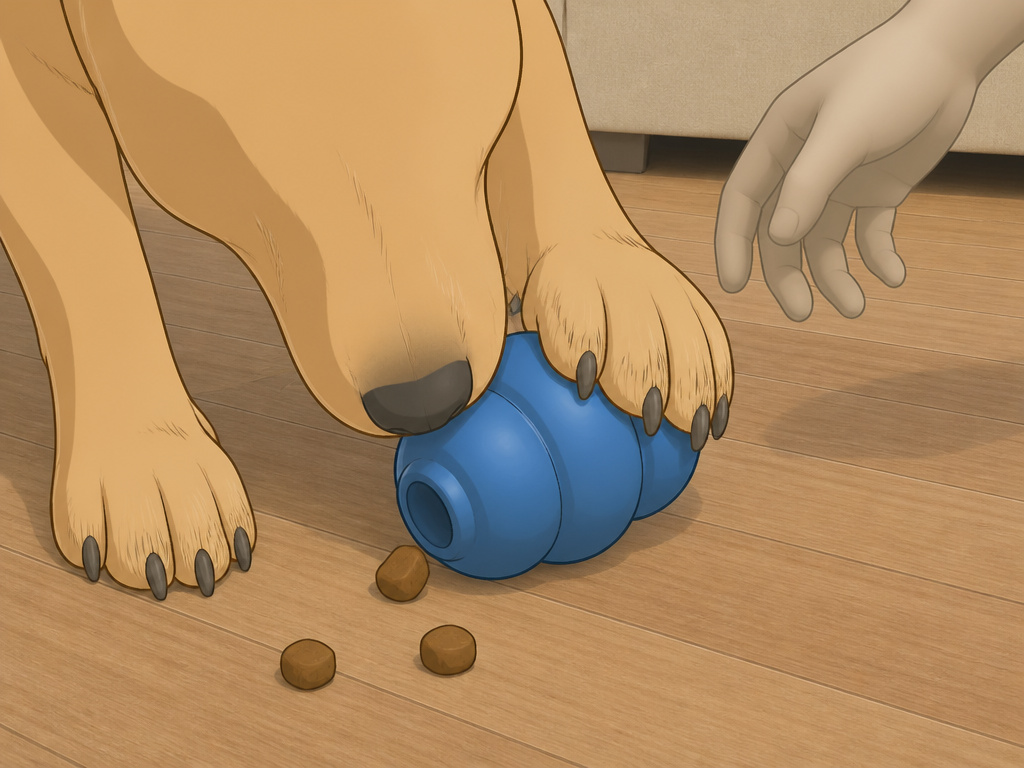
A Kong Classic rolls under the sofa with a dry rattle. The dog digs it out with one paw, and three kibble skitter across the floor. That’s a meal being eaten at the speed of physics rather than appetite.
Tufts notes that food-dispensing toys are typically made for dry diets and come in versions for dogs and cats. Some are simply batted around until food falls out of a small hole. Others work like puzzles, where the dog pushes a lever or pulls a drawer to reach the food.
VCA describes the interactive version the same way: a toy that releases a few kibbles at a time as the dog moves it around.
The caveats here are real and they’re the part that gets skipped. Tufts states plainly that some food-dispensing toys may not hold enough food for a full meal without refilling. And the same source recommends close supervision every time, specifically so the dog doesn’t destroy the toy or try to eat pieces of it.
Where this goes sideways: A puzzle toy left down after the kibble runs out. The dog keeps working on it for the reward that isn’t coming, and the plastic is what gives first.
Some food-dispensing toys hold up better than a thin-shelled ball, but none is indestructible. If your dog’s approach to a stuck toy is to chew the corner off, that toy needs to come up when the food is gone.
If you’ve never used one, how to use a puzzle feeder covers the introduction sequence, and there’s a wider comparison of puzzle feeders by difficulty level.
How Many Meals a Day Should a Fast Eater Get?
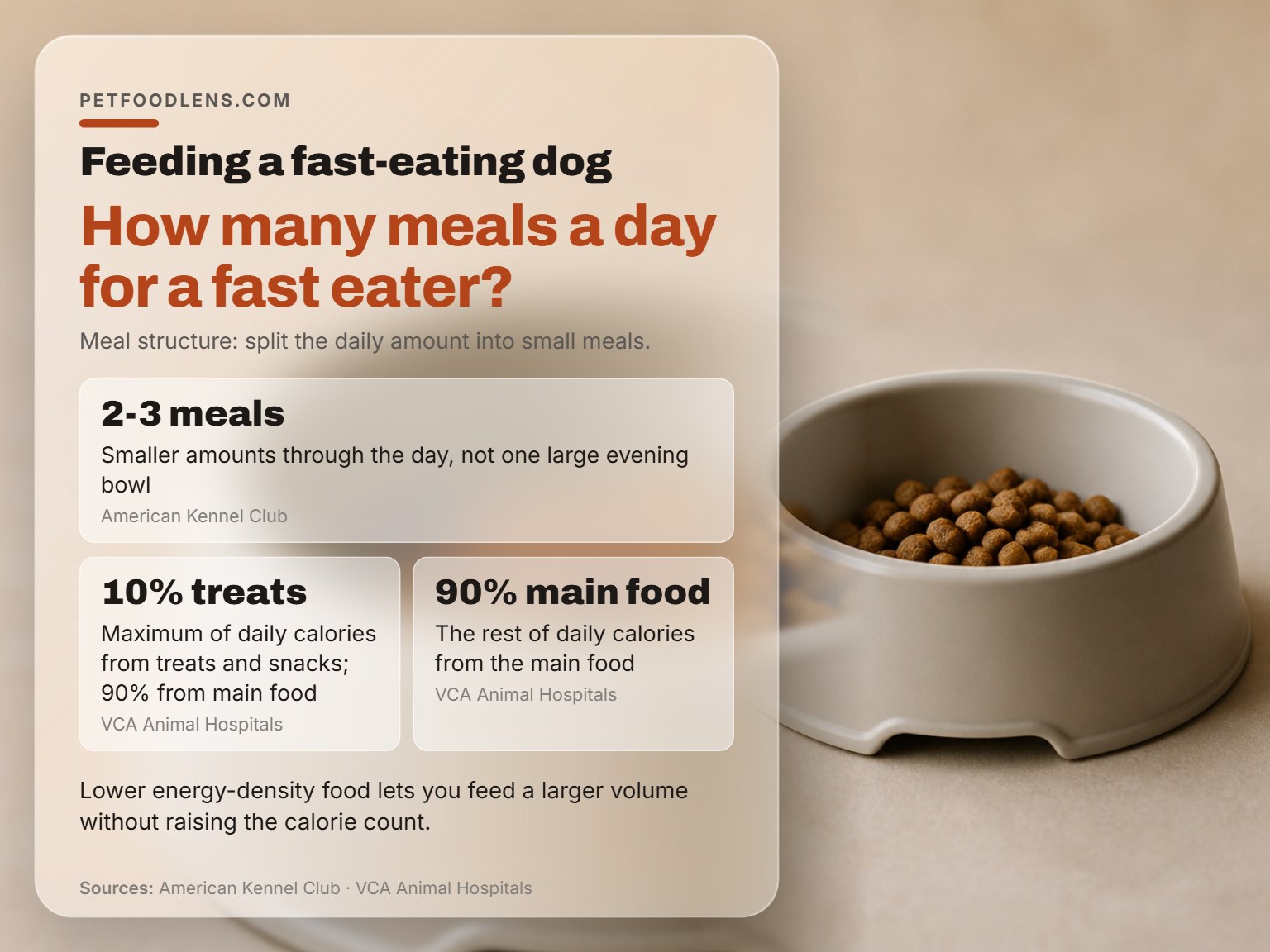
Two to three meals a day, not one large evening bowl.
The AKC reports that feeding smaller amounts two to three times throughout the day, rather than a large meal in the evening, has been shown to reduce the risk of bloat. That’s a meal-structure change, not a gadget, and it’s the cheapest thing on this page.
VCA’s version is meal feeding with portion control. Work out the calories the dog needs to hold a healthy weight, convert that to a food amount, then divide that amount across several small meals. VCA points out a side benefit: feeding more often can make a dog think he’s getting more food than he is.
Two numbers from VCA are worth keeping. A maximum of 10% of daily calories from treats and snacks, with the other 90% from the main food. And a lower energy-density food lets you feed a larger volume without raising the calorie count, which is about as close to a free lunch as this conversation gets.
Owners ask me regularly whether they can just free-feed and skip the measuring. In my experience with weight cases, an unmeasured bowl drifts into overfeeding, and weighed portions fix it even though they take more effort.
Timed feeders: useful, with one caveat
VCA is positive about timed feeders for a specific reason: you can set one for an early morning snack and sleep a little later.
The same source carries the warning. Be careful with a timed feeder around large dogs or dogs with a history of destructive chewing. They may grow impatient and simply destroy the dispenser.
That’s not a reason to avoid them. It’s a reason to know your dog before you trust a plastic hopper with the meal.
For the broader scheduling question, how many times a day to feed a dog goes through age and size differences that this section doesn’t cover.
Free Fixes: Muffin Tin, Cookie Sheet, Scatter, Hand-Feeding
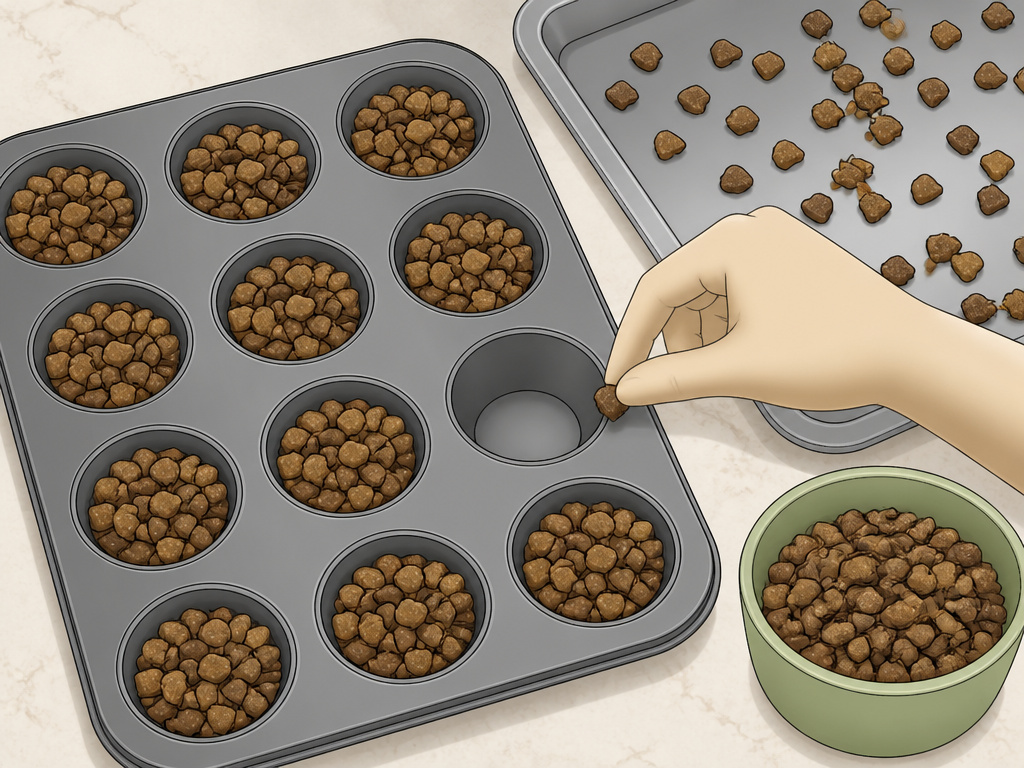
Four things already in the kitchen do the same job as a store-bought bowl.
A muffin tin is the standard trick. VCA suggests placing pieces of kibble or bites of canned food into each holder. The AKC’s version fills each cup with a little food and uses the entire pan, which breaks the meal into smaller portions and kills the gulping.
A cookie sheet works on the same principle with less depth. The AKC notes that spreading kibble across a sheet forces tiny bites and a lot of tongue work, which takes real time.
Scattering is the version that uses the whole house. VCA recommends dividing the meal into several small portions and hiding them in different places indoors or around the yard, so the dog works with his nose.
Hand-feeding is the one most owners dismiss and shouldn’t. Tufts describes taking a portion of kibble in a treat pouch on walks and using it to reinforce good behavior. When food arrives a few kibbles at a time, it can’t be wolfed down in seconds. The AKC makes the same point about using regular food as rewards during training.
| Method | Works with | Main limitation |
|---|---|---|
| Muffin tin | Dry kibble or canned | Shallow cups; a determined dog can still gulp |
| Cookie sheet | Dry kibble | Messy on carpet; needs floor space |
| Scatter and hide | Dry kibble | Only practical indoors or in a secure yard |
| Hand-feeding | Dry kibble | Needs your time, not just the dog’s |
| Food toy | Dry diets mainly | May not hold a full meal without refilling |
I’d rather see an owner hand-feed half a ration on a walk than buy a fourth bowl. Same food, same calories, and the meal takes as long as the walk does.
The two-bowl DIY version
If you want a slow feeder tonight and don’t want to order one, the AKC has a version that costs nothing.
Take a bowl one or two sizes larger than the dog’s regular dish and set it down flat. Put the regular dish upside down inside it. The gap between the two rims becomes the food channel: wide enough for the dog to reach the kibble, too narrow for him to take gulps.
It’s not pretty. It works, and it’s a fair test of whether the whole approach suits your dog before you spend anything.
One note on wet food. Slow-feed bowls handle canned food fine, but the channels smear and the bowl needs a real wash rather than a rinse. There are slow feeder for wet food designs with wider, shallower channels that clean out more easily.
When Slowing Down Is the Wrong Move
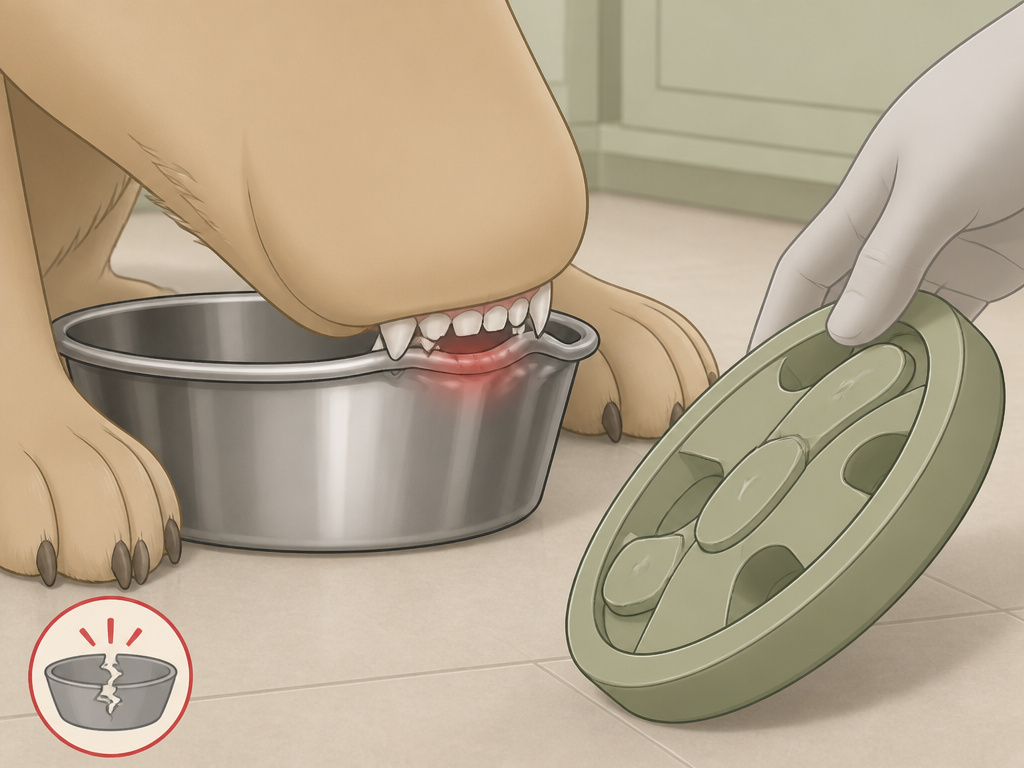
Sometimes the bowl is not the problem.
The clearest case is a dog with a history of destroying things. A timed feeder or a thin-shelled puzzle toy in front of that dog is a chew toy with food inside it, and the outcome is a vet visit for a foreign body rather than a slower meal.
The second case is a dog that guards food. Putting a higher-value, harder-to-reach meal in front of a resource guarder raises the stakes of the thing being guarded. Fix the guarding first.
Common mistake: Changing the bowl and the food in the same week. If the dog refuses the new setup, you’ve got two variables and no way to tell which one caused it.
There’s also a category of problem that no feeder solves. If a dog is eating fast and still losing condition, or vomiting regularly, that’s a veterinary question about the dog rather than a mealtime design question. VCA notes that speed-eating can lead to regurgitation and can leave a dog not feeling full, which is worth raising with your vet rather than working around at home.
And a last caution on the DIY route. A muffin tin or a cookie sheet is fine for a dog that licks. It’s a bad idea for a dog that bites down on metal, and the AKC’s two-bowl method avoids that entirely.
If you’re weighing whether any of this hardware is worth it, the pros and cons of slow feeders lays out where they help and where owners end up back at a normal bowl.
Frequently Asked Questions
Does fast eating actually cause bloat?
The evidence is contested. A 2016 review in Veterinary Evidence found that most studies show no effect of eating rate on GDV risk, and concluded there isn’t enough evidence to settle the question either way. Tufts and the AKC both describe fast eating as a possible risk factor. Slowing a dog down won’t increase risk and may possibly reduce it, which is why the advice survives the disagreement.
How long should a meal take?
There’s no established target. The only figure in the published guidance is a single-dog test reported by Tufts, where the same amount of the same kibble took over 3 minutes to eat from a slow-feed bowl. Treat that as an illustration of the change a bowl can produce, not a benchmark to hit.
Is a slow-feed bowl better than a puzzle feeder?
They solve the same problem with different trade-offs. A slow-feed bowl is simpler and works with dry or canned food, though Tufts recommends close supervision when using feeding toys. A puzzle feeder takes longer and adds mental work, but some don’t hold a full meal without refilling and all of them need supervision.
Can I just feed smaller meals more often instead?
Yes, and it’s the cheapest change available. The AKC reports that feeding smaller amounts two to three times a day, rather than one large evening meal, has been shown to reduce bloat risk. VCA’s portion-control approach pairs that with a calorie target so the total intake stays the same.
What if my dog refuses to eat from a slow-feed bowl?
Drop to a shallower pattern with wider channels and put it down at the normal time in the normal place. A dog that walks away from a bowl has usually been given a maze that’s too deep for his muzzle, or had the bowl and the schedule changed on the same day.
Is a muffin tin safe to feed from?
For most dogs, yes. VCA and the AKC both suggest it. The exception is a dog that bites down hard on metal rather than licking, in which case the two-bowl method or a purpose-made plastic bowl is the safer choice.
The Bottom Line
The causal question about bloat is still open, and it will stay open until someone runs a study better than the ones we have. That doesn’t change what you should do tonight, because the cost of slowing a dog down is roughly zero and the direction of the possible benefit is the right one.
Here’s the threshold that matters. If your dog finishes a meal almost instantly and then stands over the bowl looking for more, the setup is doing nothing and it’s time to change it. If he’s still working after the rest of the household has cleared the table, leave it alone.
The first step is smaller than most people expect. Take half of tonight’s ration, spread it across a muffin tin, and put the bowl away. That’s a complete test of whether the approach suits your dog, and it costs nothing but a dirty pan.
One concession, because it’s honest. If your dog is a deep-chested breed and you’re genuinely worried about bloat, a bowl is not the conversation you need to have. Ask your vet about your specific dog, and treat everything on this page as the small, cheap part of the answer rather than the whole of it.
