
Oats for Birds Guide: Hulls, Limits, and Real Risks
This post contains affiliate links. As an Amazon Associate, we earn from qualifying purchases.
Any oats for birds guide has to start with the bird itself. Oats are a usable grain for most species, but the workable amount swings from 3% oat hulls in a rearing diet to 60% naked oats in a layer diet, and companion-bird nutrition is far less studied than chicken nutrition.
That spread is where most of the online advice falls apart. Nearly every page says “in moderation” and stops there, because the honest number in any oats for birds guide changes with the species, the age of the bird, and whether the hull is still attached.
What follows is the evidence behind those figures: what oats do inside a bird, why the hull matters more than the grain, where the published numbers contradict each other, and how to work oats into a diet without guessing.
Key Takeaways
- The hull is 20% to 45% of the oat grain, so two bags labelled “oats” can differ enormously in fibre and energy.
- 3% oat hulls in a rearing diet reduced feather pecking in laying flocks, which is a welfare result rather than a nutrition one.
- Dehulling is expensive and may set back gut development, so the polished groat isn’t automatically the better buy.
- Above 25% oats, chicken meat picks up off-flavours, according to University of Kentucky extension.
- Poultry energy values don’t carry over to parrots and finches, per the FAO, so chicken numbers are a starting point and nothing more.
What Oats Actually Bring to a Bird’s Diet
Beta-glucan is the first thing to understand about oats, because it explains most of the caveats that follow.
Oat grain carries more oil than other cereals, a fat fraction rich in linoleic acid, and its protein is unusually high in lysine, methionine and cystine for a cereal grain. It also carries beta-glucans, anti-nutritional factors that reduce nutrient availability. Enzyme supplementation compensates for them and improves growth performance in broilers.
That last sentence is the one worth sitting with. Beta-glucans are why oats have a reputation as a “slow” grain, and they’re why a bird eating a large volume of raw oats may be getting less out of them than the scoop suggests.
The protein side is genuinely strong. Oat grain contains significantly higher lysine, methionine and cystine than other cereals, with an amino acid profile close to wheat, per the University of Kentucky extension factsheet on oats in poultry diets. Those are the amino acids cereals usually run short on.
Oats also supply carbohydrates for energy, dietary fibre, and small amounts of B vitamins, vitamin E, magnesium and zinc. None of that is a reason to build a diet on oats. It’s a reason oats can pull their weight inside one.
Soak a groat and rub it between your fingers. It goes slick and slightly slippery, which is the beta-glucan behaving exactly as it does further down the gut.
Fibre cuts both ways. Whole oats are high in fibre, birds digest fibre poorly, and an oat-heavy diet dilutes the energy and nutrients a bird actually absorbs. That’s the trade: decent protein, weak energy density.
If you’re mapping where oats sit against barley, wheat and the rest, the same logic runs through whole grains generally.
Oats are a supporting grain. Build the bowl on them and the diet gets thin.
Why the Hull Decides More Than the Grain
The premium oat is often the worse oat, and the peer-reviewed work is the reason I say that.
Hull proportion varies by 20% to 45% of the grain, depending on variety, climate and fertiliser practice. That single fact explains why two oat samples can test so differently for energy and fibre.
Whole oats and groats differ mainly in whether the hull is still attached.
Naked Oats Are Not the Same Grain
Naked oats (Avena nuda) shed their hulls at harvest. That makes them lower in fibre and higher in protein, fat and energy than regular oats, which sounds like a straight upgrade.
It isn’t, quite. Naked oats carry the same beta-glucans as whole oats, so the anti-nutritional problem survives even where the fibre problem disappears.
The Canadian research cited by extension services found naked oats can make up 60% of a laying hen diet, replacing corn, soybean meal and oil, with no loss in production but reduced feed efficiency. At 30%, feed efficiency held. Those figures apply to naked oats, not to the bag of whole oats in your cupboard.
Dehulling Costs Money and May Cost Gut Development
Scholey and colleagues noted that dehulling is expensive and may be detrimental to gut development. Read that twice. The processed product commands the higher price while possibly doing less for the bird.
There’s a second constraint that never shows up in a nutrient table. Even small amounts of oat hulls negatively impact pellet quality, which matters if the pellets are the part of the diet the bird actually eats.
| Form | Best suited to | Main trade-off |
|---|---|---|
| Whole oats (hull on) | Strong-beaked finches, pigeons, breeder diets | Harder to crack; hull fibre dilutes energy |
| Oat groats (hulled) | Smaller beaks, softened by soaking | Dehulling costs money and may set back gut development |
| Rolled oats | Quick treat, easy to eat | Flattened and partly processed; some nutrient loss |
| Naked oats | Formulated layer and breeder rations | Same beta-glucans; still needs enzyme support |
I’d feed a cheap whole oat before I’d pay extra for a polished groat. Dehulling is expensive and may be detrimental to gut development, which makes the premium product the riskier purchase.
The choice between a hulled grain and a processed one is the same choice you make in pellets vs seed mix: convenience against what the processing removes.
The One Number an Oats for Birds Guide Can’t Give You
There is no single safe percentage, and the published figures prove it.
| Figure | Source | What it actually measured |
|---|---|---|
| 3% of diet | University of Kentucky extension | Oat hulls during rearing; reduced feather pecking |
| 10% ceiling | eXtension expert response, citing “some sources” | General caution over fibre and energy dilution |
| 25% ceiling | University of Kentucky extension | Above this, off-flavours in chicken meat |
| 30% of wheat replaced | Scholey et al. 2020 | Broilers, 8 pens of 8 birds, no weight penalty |
| 60% of diet | Canadian research cited by extension | Naked oats in layers; production held, efficiency fell |
Those five numbers answer five different questions. One is about hulls, one is about whole oats, one is about naked oats, one is about flavour, and one is about broiler body weight.
The 10% figure deserves a flag. It comes from an extension expert response that attributes it to “some sources” rather than to a trial, and the same reply points back to the University of Kentucky factsheet, which sets the off-flavour threshold at 25%. So the lowest number in circulation is also the least documented one.
Meanwhile the oat hull inclusion broiler diets trial replaced 30% of the wheat fraction with oats and found no weight penalty at all. Different question, different answer.
A percentage without a species, an age, and a hull status attached is not a feeding instruction. It’s a number that got copied.
Which leaves the practical version: for a companion bird, oats belong inside a balanced bird diet as one component, sized to the bird in front of you, not to a figure pulled off a forum.
Do Poultry Numbers Apply to a Parrot?
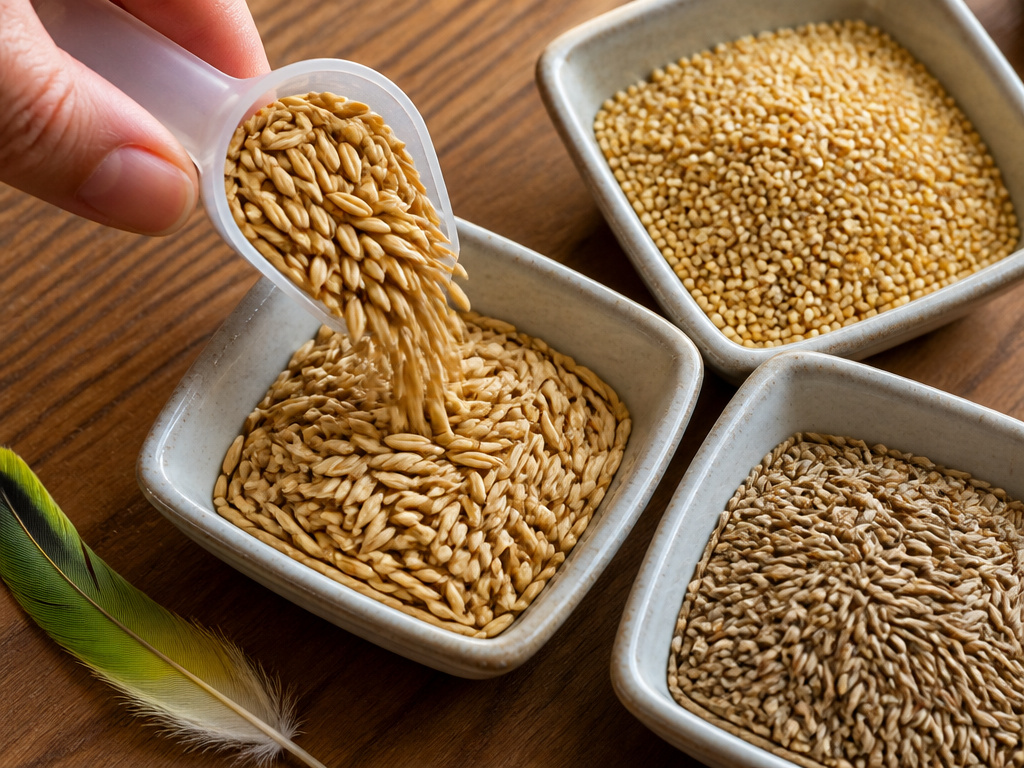
The FAO is unusually direct about this. The nutritional requirements of caged and companion birds remain poorly understood, and many current recommendations rest on individual owners’ experience or anecdotal evidence.
The reason is mechanical. Metabolizable energy values established for maize, soybean meal and other poultry ingredients are not valid for companion bird foods, because exotic companion birds don’t digest with the same efficiency as commercial poultry. The numbers don’t transfer.
UF/IFAS puts the scale of the problem plainly in Understanding Pet Bird Nutrition: there are more than 8,000 species of birds alive today, and there will probably never be an ideal diet for all of them.
Finches, Parrots, and Pigeons
Species differences aren’t a footnote here, they’re the main event.
A 2004 AFA Watchbird article by Vriends makes the finch case specifically: soaked kernels of wheat and oats are much better additions to the basic food given to strong-beaked finches, and soaked grains may constitute as much as two-thirds of the total sprouted food offered. That’s a finch instruction, not a parrot one.
Pigeon food is its own category. The FAO’s production and processing of bird seeds notes that universal pigeon food may contain whole grains of wheat, barley, maize, red sorghum, various peas and oats. Oats there are one grain in a blend, not a standalone feed.
For small seed eaters, oats work alongside millet and canary grass seed rather than replacing them. And if you’re weighing soaked against dry, the sprouted seed vs dry seed comparison is where the handling rules live.
Wild birds are the messiest case. The FAO lists hulled oats among the common grains in wild bird seed mixtures, alongside sunflower, wheat, barley, millet, sorghum and canary seed. But a 1980 US Fish and Wildlife Service report by Geis found hulled and whole oats were strongly attractive essentially only to starlings, and judged hulled oats in mixes ill-advised. Popular feeding content claims sparrows, finches and jays all enjoy oats.
Both positions exist in print. Both positions exist in print, so I’d weight the federal study accordingly.
What the Broiler Trial Changed About the Textbook Story
Scholey, Marshall and Cowan replaced 30% of the wheat in male broiler diets with oats, ran 8 pens of 8 birds, and took measurements at day 21 and day 35.
The results split in an interesting way. The highest hull inclusion reduced feed intake through gut fill and depressed AMEn, the apparent metabolisable energy value. But it also improved amino acid digestibility and increased gizzard weight. The 3% hull level was the sweet spot.
Here’s the part that matters. The standard explanation for why oat hulls help is mechanical: coarse fibre scrubs the gizzard, the gizzard works harder, digestion improves. That explanation falls over in this trial, because the fibre was finely ground. The improvements seen cannot be attributed to a physical cause.
So the benefit is real and the mechanism is not what the textbooks say. Anyone quoting the gizzard-grinding story as settled fact is quoting something the data has already contradicted.
Weather advice splits the same way. Feedipedia, citing Blair 2008, advises avoiding oats in hot weather because of their higher heat increment. The University of Kentucky extension reports the opposite effect: oat inclusion in replacement pullet diets made birds more resistant to heat stress. Same species, opposite guidance, both published.
If you want the underlying feed values rather than the conclusions, the oats feed composition database is one of the standard references formulators reach for. Oat hull proportion can vary by 20% to 45% of the grain, producing wide nutrient variance across oat types.
Oats aren’t the only small seed with a fat profile worth checking. Flaxseed has a similar story: useful, easy to overdo, and rarely measured by the people spooning it out.
How Do You Introduce Oats Without Guessing?
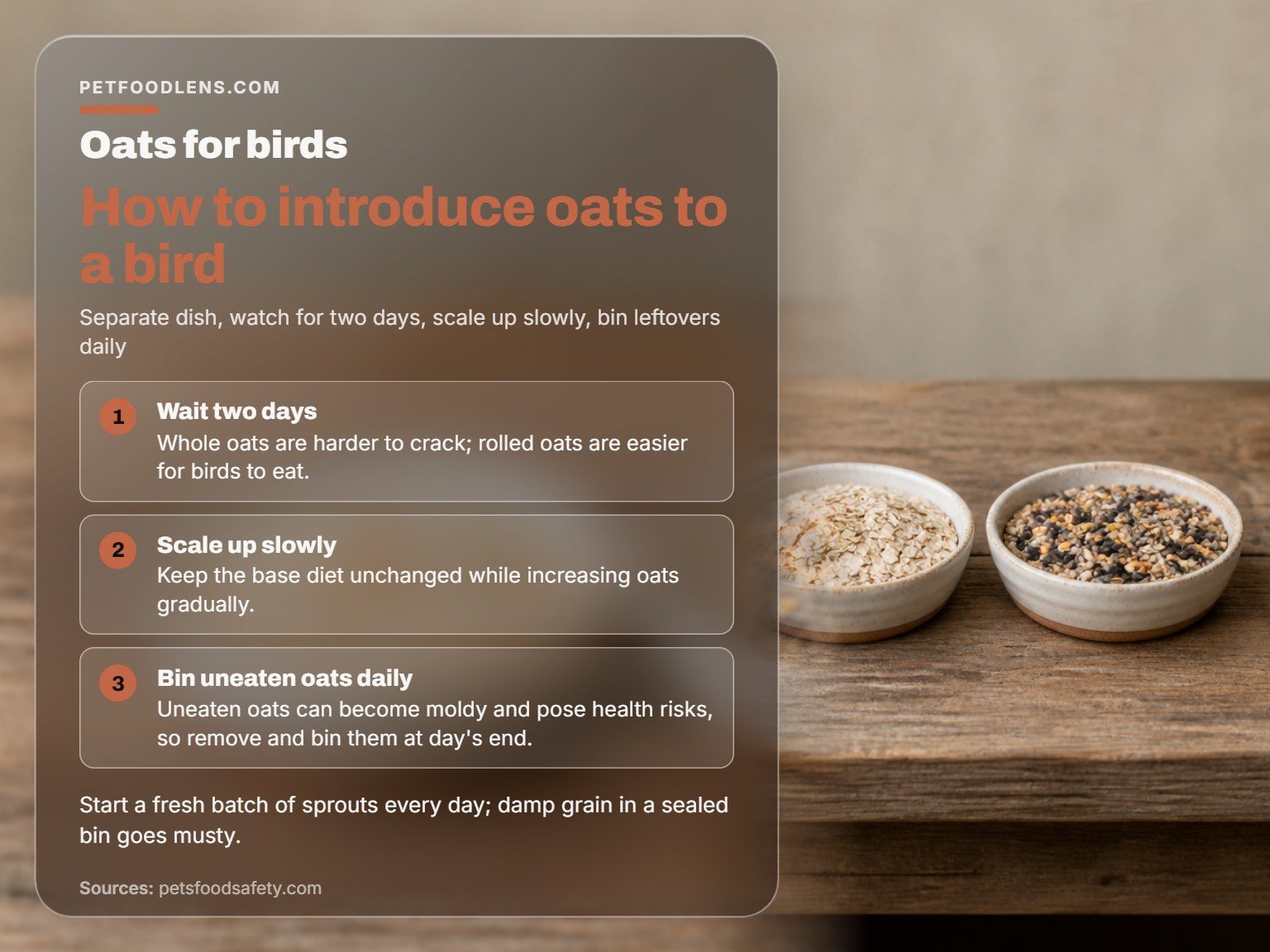
A dish with oats on one side and the usual food on the other. That’s the whole method.
Before you start: Uneaten wet oats grow mould fast, and mouldy grain is a genuine hazard rather than a fussy one. Start a fresh batch of soaked grain every day and discard what isn’t eaten. Keep dry oats dry, because damp grain in a sealed bin goes musty before it looks wrong.
- Put a small amount of dry oats in a separate dish, not mixed through the base food. Put a small amount of dry oats in a separate dish, not mixed through the base food, so you can see how much the bird takes.
- Leave it for two days and watch what disappears. A bird that ignores whole oats may take groats or rolled oats happily, since whole oats may be harder to crack open and eat.
- Scale up slowly, keeping the base diet unchanged. Skipping this step means the change is not gradual.
- Remove and bin anything uneaten by the end of the day. Uneaten oats can become moldy and pose health risks, so remove and bin anything uneaten by the end of the day.
Soaking and Sprouting
Soaking softens groats enough for birds that can’t manage them dry, and it changes the texture in a way most birds notice immediately.
The handling rule is not negotiable: a fresh batch of sprouts must be started every day. Leave a batch sitting and it spoils, which is your nose telling you what the bird’s gut would have found out the hard way.
If you’d rather cook than soak, the same caution applies to homemade bird food in general: fresh is the whole point.
Buying is simpler than preparing. Check four things on the bag:
- Packing date. Do not buy seed packages more than half a year old, and check the date rather than trusting the shelf.
- Dryness. Seed should be clean, dry and free of dust, because damp or dusty grain carries germs a bird will happily ingest.
- Smell. Fresh oats should be clean, dry and free of dust. A musty smell means the bag has taken on moisture somewhere.
- Hull status. Whole, groat, rolled and naked are four different products with four different fibre and energy profiles, and the front of the bag rarely makes that clear.
Where Oats Go Wrong in a Cage
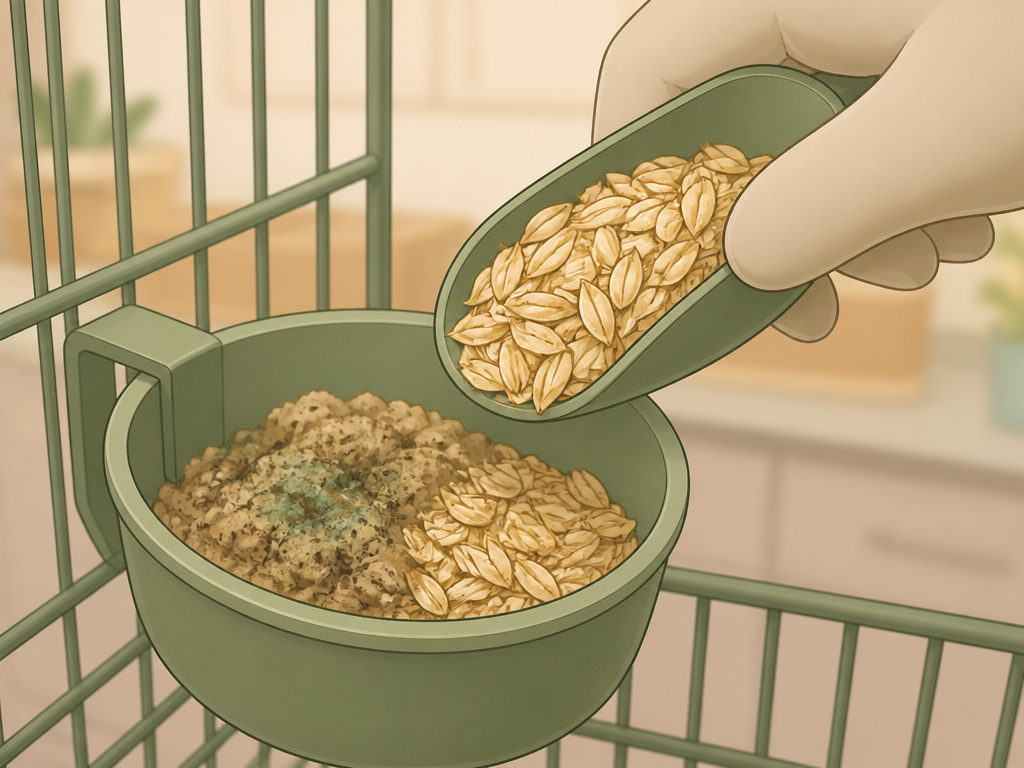
A caged bird that can’t fly off the calories is a different animal from a hen in a run.
Vriends makes the point directly: birds in cramped quarters grow fat easily on oats. Vriends makes the point directly: birds in cramped quarters grow fat easily on oats.
UF/IFAS frames the wider risk as overnutrition. Allowing any pet to consume more than it requires can be just as harmful as a deficiency, and too many treats offered too often is frequently the cause of the problem. Oats are a treat in most companion-bird diets, and they should be counted like one.
Where this goes sideways: Topping up the dish while the husks are still in it. Uneaten oats left in the dish can go mouldy, so the dish needs emptying rather than topping up.
There’s a second failure mode that’s easy to miss. Uneaten oats left in the dish can go mouldy, and mould carries real health risks, so the dish needs emptying rather than topping up. Some birds also develop sensitivities to oats, and signs of discomfort after eating should send you to a veterinarian rather than to a different brand.
The flavour ceiling is worth remembering too. Feeding poultry diets composed of more than 25% oats is reported to cause off-flavours in the meat.
Frequently Asked Questions
Can birds eat porridge oats?
Rolled oats are flattened and easier for a bird to eat than whole oats, but they lose some nutritional value during processing. They’re fine as a treat or a mixer, not as the base of a diet.
Are oats fattening for birds?
It depends on the bird and the housing. Vriends warns that birds in cramped quarters grow fat easily on oats, while the University of Kentucky extension describes oats as high in fibre and low in energy, which is why they suit pullet and breeder diets. Both can be true at once: low energy density doesn’t stop a bored caged bird from overeating.
How much oats should a parrot get?
Companion-bird requirements remain poorly understood, so there is no well-established fixed percentage for parrots. The FAO notes that companion-bird requirements remain poorly understood and that poultry energy values aren’t valid for them, so treat oats as one component of a formulated diet.
Do wild birds actually eat oats?
The evidence is thinner than the marketing suggests. A 1980 US Fish and Wildlife Service report found hulled and whole oats were strongly attractive essentially only to starlings, while popular feeding guides list sparrows, finches and jays as oat eaters. Hulled oats in mixes were judged ill-advised in that report.
Are sprouted oats better than dry oats?
They’re different rather than strictly better. Soaking softens the grain and changes the texture, and Vriends notes soaked wheat and oats are much better additions for strong-beaked finches, making up as much as two-thirds of the sprouted food offered. A fresh batch of sprouts must be started every day.
The Bottom Line
If your bird lives in a cage rather than an aviary, treat oats as a treat line and watch body condition rather than measuring scoops. The confinement risk is the one that actually bites, and it’s the one no percentage on a bag will protect you from.
This week, do one thing: find the packing date on the oats you already own. If the bag is more than half a year old, replace it before you feed another scoop. That single check does more for a bird than any recipe adjustment.
Everything above assumes a bird eating a formulated base with oats as a component. If oats are the base, the fibre and the beta-glucans both work against you, and the diet gets thin fast.
And on the processing question, I’ll take the cheap whole oat every time. The expensive groat has had the most useful part removed and the price raised for the privilege.
