
How to Prevent Choking on Dog Treats: The One-Inch Rule
This post contains affiliate links. As an Amazon Associate, we earn from qualifying purchases.
To prevent choking on dog treats, cut every treat into pieces a dog can swallow without gulping, keep treats under 10% of daily calories, and take the chew away once it shrinks to about one inch. Bones and whole rawhides are behind many of the serious blockages, though Texas A&M’s Dr. Barr says dogs do not choke as often as owners fear while the FDA calls severe tracheal blockages common, especially around the holidays. Learning how to prevent choking on dog treats starts with these simple steps.
The one-inch mark matters because of how a dog holds a chew. Paws do the gripping until the piece gets small enough to slip, and then the only tool left is the throat, which is why how to prevent choking on dog treats matters.
What follows: the calorie math in plain numbers, the treat types that show up in the worst cases, and the four places where the veterinary bodies don’t agree.
Key Takeaways
- Under 10% of daily calories is the ceiling both the WSAVA Global Nutrition Committee and FEDIAF set for treats.
- For a dog between 6 kg and 40 kg, that works out to 32 kcal of treats per day, according to the WSAVA table.
- Antlers and hooves are named by WSAVA as chews to avoid; FEDIAF flags the same tooth-fracture risk but notes no legal hardness standard exists.
- Take the chew away at roughly one inch, or seat it in a bully stick holder, before the dog tries to swallow the stub.
- No blind finger sweep and no automatic Heimlich: both the AKC and Texas A&M warn that hands-on removal can make a partial blockage worse.
The One-Inch Stub Is Where Most Chew Accidents Happen
The last inch of a chew is a common place for a dog to swallow the stub whole, though Texas A&M’s Dr. Barr says dogs do not choke as often as owners fear while the FDA calls severe tracheal blockages common, especially around the holidays.
Johnna Devereaux, a certified clinical pet nutritionist quoted by the AKC, describes the mechanism precisely. A dog can hold a chew against the ground with its front paws, and that grip works until the piece shrinks to roughly the final inch. Past that point the paws lose purchase and the dog may swallow what’s left in one motion.
A chew held between the paws stays stable until roughly the final inch of length. At that point the paw grip fails, the piece becomes small enough to pass the back of the mouth, and a dog that has been chewing steadily will often swallow it whole instead of leaving the stub.
You can see it happen. By the time a bully stick gets down to that length it has gone slick and slightly spongy, and the dog’s front paws start sliding off it while the back teeth keep working.
The fix is mechanical, not behavioral. A bully stick holder clamps the last few inches so the dog physically cannot get the stub into its throat. If your dog is a determined chunk-swallower, the AKC suggests lick mats or tough treat toys as a swap for traditional chews, which removes the stub problem entirely.
I’d rather see a dog work for eight small pieces than get one big one. The dog does more chewing, takes in fewer calories, and there’s no stub left to swallow.
Chew length is only half of it. How long a session runs matters too, and it’s worth setting chew session limits rather than letting a dog grind for an hour.
How Many Treats Can a Dog Actually Have? Run the 10% Numbers
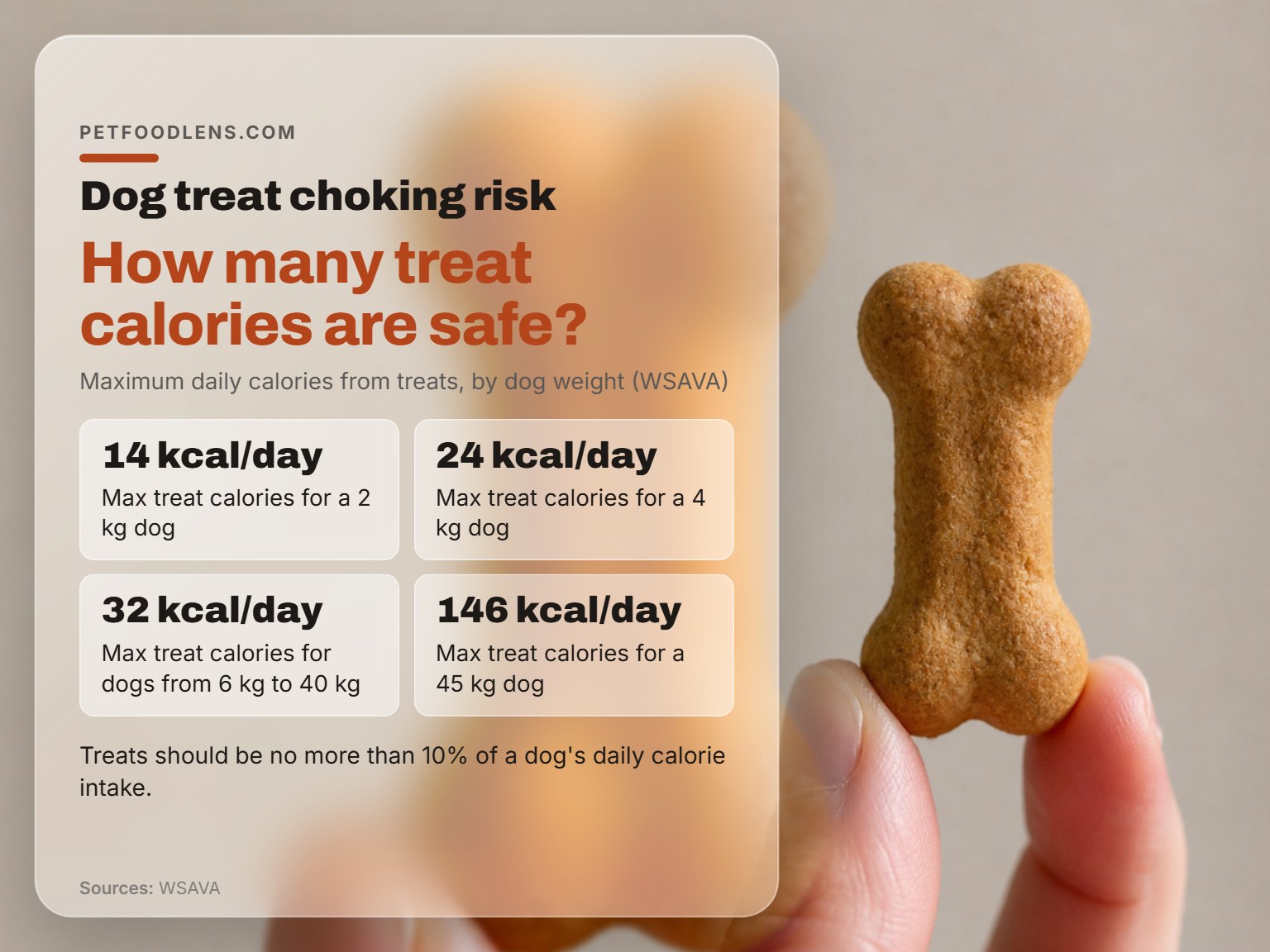
Both the WSAVA Global Nutrition Committee and FEDIAF put the treat ceiling at 10% of daily calories, and the WSAVA guide converts that into a table owners can actually use.
| Dog’s weight | Max calories from treats per day |
|---|---|
| 2 kg | 14 kcal |
| 4 kg | 24 kcal |
| 6 kg to 40 kg | 32 kcal |
| 45 kg | 146 kcal |
That middle band looks wrong at first glance. A 6 kg terrier and a 40 kg retriever both land on 32 kcal. The WSAVA guide notes the figures assume an average healthy adult dog in ideal body condition, and it tells owners to ask their own veterinary team for a daily energy figure rather than guessing from the chart.
The practical consequence is that a single medium biscuit can eat a large share of a 32 kcal allowance. Break that same biscuit into pea-sized bits and you get several separate rewards out of it. The dog counts rewards. It does not count grams, which is the core of how to prevent choking on dog treats.
That habit is the most underrated one in treat feeding, and it costs nothing. Cutting treats small turns one biscuit into a training session.
Common mistake: Assuming the calorie number is on the bag. The WSAVA guide tells owners to contact the manufacturer directly for calorie information when a commercial treat doesn’t state it on the label.
Two more rules from the same guide are worth repeating because they get skipped. Treats should never replace a meal, since every dog needs a complete and balanced diet. And if a dog is on a veterinary-prescribed diet or has dietary sensitivities, conventional treats may not be appropriate at all.
Which Treats and Chews Cause the Worst Blockages?
A 2019 review of 349 clinical cases of foreign bodies removed from dogs’ esophagus found that 77% were bones, according to FEDIAF’s summary of the study. A separate 2017 retrospective study of 222 dogs treated for esophageal foreign body obstruction put bone material at 81% of cases.
Those numbers describe obstruction, which is a different event from choking. Dr. James Barr at Texas A&M’s College of Veterinary Medicine makes the distinction plainly: dogs don’t choke as often as owners fear, and what usually happens is that they swallow something too big to pass, which then lodges in the esophagus, stomach, or intestines.
| Treat or chew | Main risk | What the sources say |
|---|---|---|
| Rawhide | Swallowed in large pieces | Texas A&M names rawhides the most common cause of actual choking |
| Cooked bones | Splintering | UK Pet Food says cooking makes bones dry and brittle |
| Raw bones | Contested | UK Pet Food endorses small soft ones; WSAVA says avoid all bones |
| Antlers and hooves | Tooth fracture | WSAVA says avoid; FEDIAF cites fracture risk and no legal hardness standard |
| Jerky-style treats | Swallowed whole | FDA lists jerky sticks among treats that lodge when unchewed |
The FDA’s guidance covers the whole category of pet treats, biscuits, rawhides, and jerky sticks alike. Its point is that treats are most digestible when chewed into small pieces, and that an unchewed piece can lodge in the windpipe or anywhere along the gastrointestinal tract. For the full clinical picture, the FDA pet treat safety advice walks through what each blockage site looks like.
The timelines are the part owners underestimate. An esophageal blockage can persist for days if it isn’t removed, and a blockage sitting in the stomach or intestines may produce no obvious sign for several days. Removal usually means an endoscope for reachable objects and surgery for intestinal blockages.
Two of those rows deserve their own pages. Rawhide chews carry a specific set of trade-offs, and cooked bones fail for a reason that has nothing to do with the dog.
Where the Veterinary Bodies Disagree
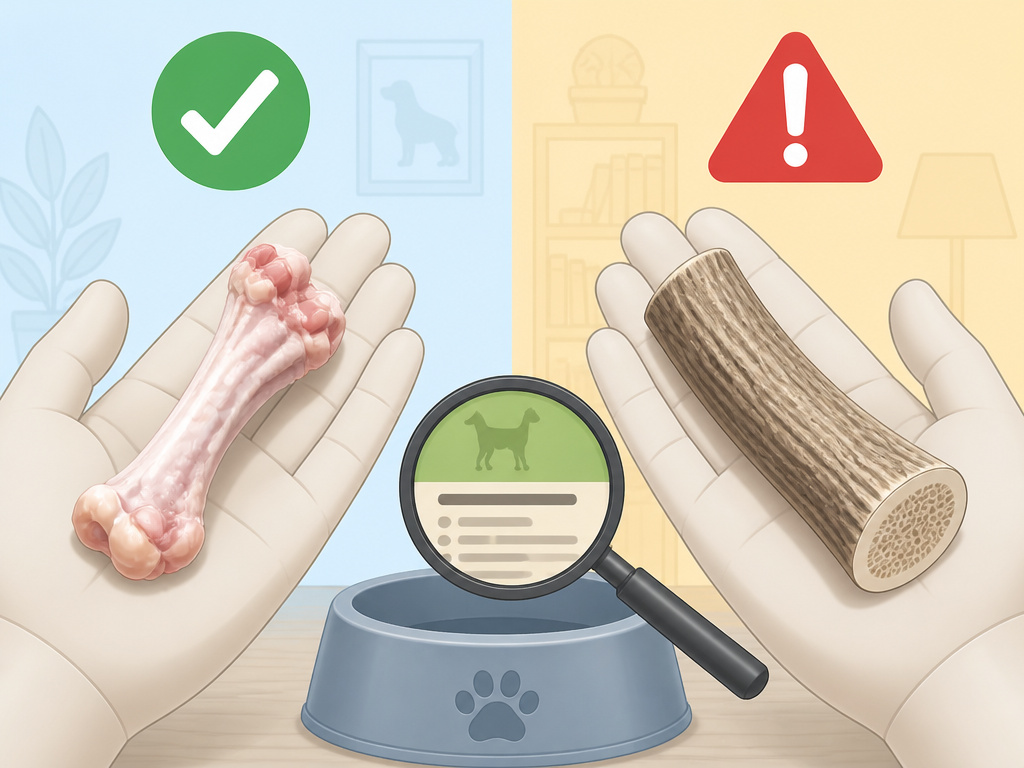
Two respected bodies give opposite advice on raw bones, and pretending otherwise would be dishonest.
My own work is mostly on cat food, so on canine feeding questions I lean on the veterinary bodies rather than on my own reading of a label. That makes the disagreements below worth spelling out rather than smoothing over.
Raw Bones: Two Respected Bodies, Opposite Advice
UK Pet Food’s 2019 fact sheet states that smaller, softer raw bones such as chicken wings or turkey necks are considered the easiest for healthy dogs to eat and digest. It adds that larger, denser bones like beef ribs should only go to larger, more experienced dogs already used to eating bones.
The WSAVA Global Nutrition Committee’s 2025 guide takes the other position outright: bones, cooked and raw, can be very dangerous and cause significant damage if chewed or ingested. Both are recognised bodies. Both are talking about the same practice. The UK Pet Food choking hazards guidance and the WSAVA guide to feeding treats are worth reading side by side rather than taking either one alone.
When two credible bodies disagree, take the stricter position. You lose nothing by skipping a bone, and a splintered one doesn’t come back out the way it went in.
Hard Chews and the Missing Legal Standard
WSAVA names antlers and hooves directly as excessively hard chews to avoid, along with anything with sharp edges.
FEDIAF frames the same hazard as a tooth-fracture risk, warning against chews that aren’t bendy and malleable or that don’t soften quickly when chewed. It then adds a detail that changes how you should read any hardness claim on packaging: there is currently no specific legal standard for hardness for dog chews. The judgment sits with owners and vets. The FEDIAF chews and treats fact sheet also cites a 2005 study finding that half of owners of dogs with fractured teeth never noticed the fractures.
How Common Is True Choking, Really?
Texas A&M’s Dr. Barr downplays the frequency of true choking relative to obstruction. The FDA, writing about holiday hazards, calls severe tracheal blockages common, especially around the holidays, and notes that all of them are life-threatening.
Both can be true at once. True airway choking is rarer than owners assume, and the cases that do arrive at an emergency clinic are severe enough that the FDA treats them as a seasonal pattern.
Sizing a Treat to the Dog in Front of You
Two dogs, one treat, one bowl. The bigger dog gets there first, and the smaller one gets whatever’s left.
UK Pet Food’s guidance for multi-dog households is blunt about which dog sets the size: toys must be large enough that the biggest dog can’t choke on them. Sizing to the smallest dog is how the largest one ends up with something it can swallow.
A few sizing rules hold up across the sources:
- Match the treat to body weight, which FEDIAF lists as the main factor in reducing choking risk.
- Re-check puppy toys as the dog grows, since a size that fits now becomes unsafe later.
- Inspect chews and toys for wear, because ageing rubber and nylon gets fragile and breaks more easily.
- Balls should be wider than the dog’s jaw, per the AKC, since a ball small enough can lodge at the back of the throat.
Where this goes sideways: Handing a fistful of small treats to a fast eater. He’ll take three at once and swallow two of them whole. Hand them over one at a time.
Gulpers need a different fix. UK Pet Food notes that dogs who gulp their meals are also choking candidates, and recommends a slow bowl or puzzle feeder to slow eating and force some chewing. Adding water to soften the food helps stop large morsels being inhaled. A slow bowl or puzzle feeder does the same job for meals that dogs that eat too fast would otherwise finish in seconds.
You can hear the difference. A gulper gives you one wet swallow and the bowl is empty before you’ve set the scoop down.
Sizing a chew is its own calculation, separate from treat size, and chew size depends on jaw width rather than body weight alone.
What to Do in the First Ten Seconds
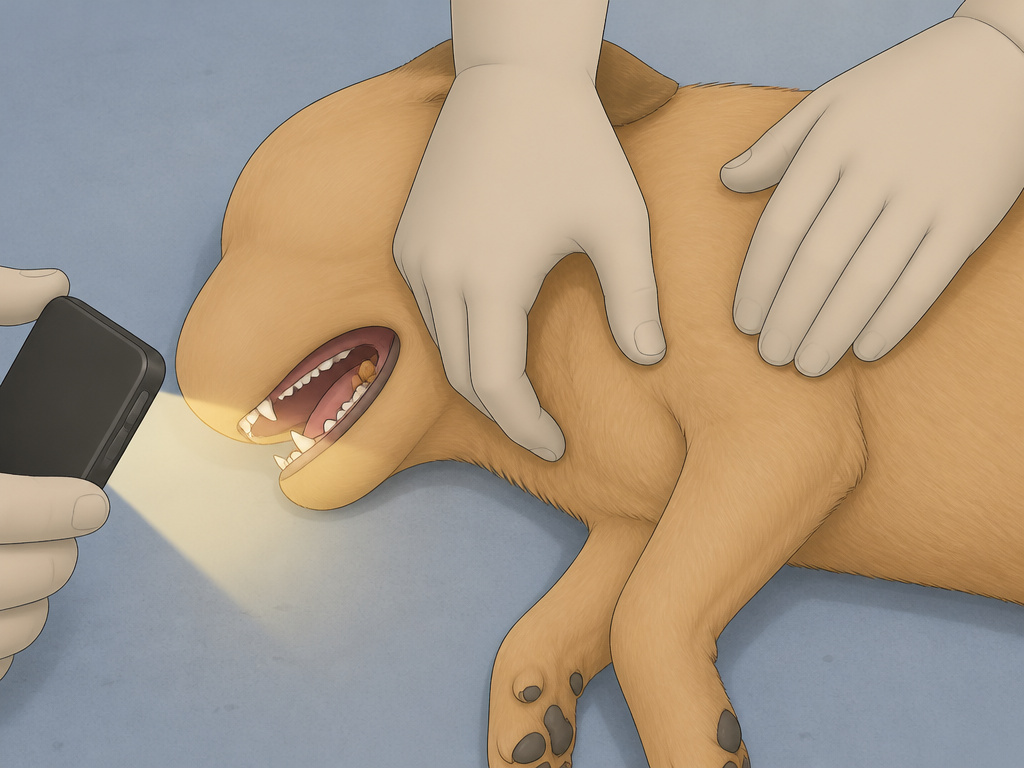
Three things decide the next ten seconds: whether the dog is breathing, whether the dog is calm enough to examine, and whether anything is actually stuck.
Before you start: A dog with a partial airway can turn frantic and clamp down, so keep your face back from the mouth. Many owners mistake reverse sneezing for choking, and reverse sneezing usually resolves on its own while a true blockage does not. Even a dog that seems fine afterward needs a vet check of the mouth, throat, and neck.
Here’s the sequence, in the order the sources lay it out:
- Confirm it’s actually choking. A choking dog has trouble inhaling air. Reverse sneezing produces a loud snorting or gagging sound but the dog isn’t struggling to breathe, and it usually passes. Panic-handling a reverse sneezer is how people get bitten.
- Give the dog a second to clear it. The AKC’s Tom Rinelli recommends a beat if the dog still has an airway and is making an effort to dislodge the blockage. Going straight to the Heimlich or CPR is often unnecessary and can do more harm than good.
- Look before you reach. If the dog is calm enough, use your phone light to see whether an object is visible. A blind finger sweep in the back of the throat can push the object further down, and the airway is narrow enough that it doesn’t take much.
- For a small dog, lay it on its side and squeeze the chest between your thumb and fingers, which is the AKC’s described technique.
- Get to the vet either way. Even a dog that appears to have recovered needs an evaluation of the mouth, throat, and neck for airway injuries or remaining obstructions.
The reason step two exists is that hands-on removal carries real risk. Dr. Barr’s position is that removing an obstruction with your hands while a dog is still awake can be very dangerous, and the Texas A&M choking prevention advice puts the priority on getting the dog to a veterinarian instead. The AKC allows that a calm dog with a visible object may be helped, while still ruling out the blind sweep. Both are describing the same narrow window.
The Treats I’d Keep in the House
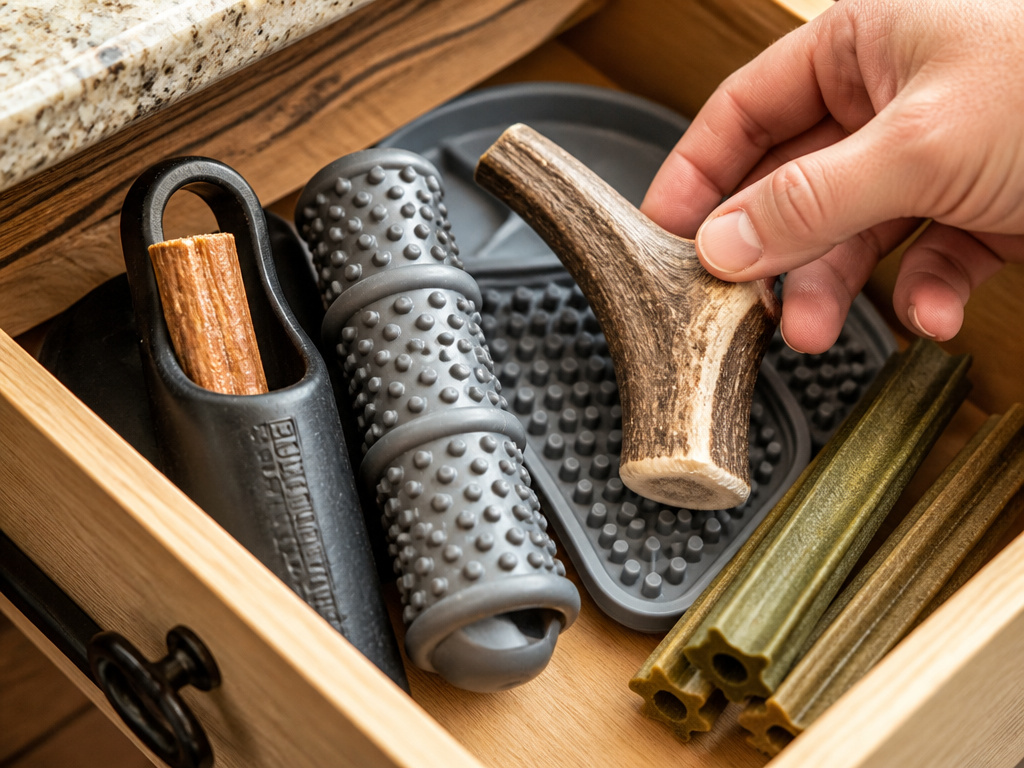
The treat drawer in my own kitchen holds fewer things than it used to.
The bully stick holder stays, because it solves the one-inch problem without asking the dog to cooperate. Tough treat toys earn their space for the same reason: they hold food in a way that requires work, so the eating takes time and the swallowing happens in small amounts. A lick mat covers the dog that inhales anything soft.
Dental chews stay on the list, with a caveat. They’re a chew, not a free pass. They come out of the 10% budget like everything else, and they still get taken away at the stub.
What I’ve stopped buying is the antler bin. WSAVA names antlers and hooves as chews to avoid, and FEDIAF’s point about no legal hardness standard means the packaging can’t tell you whether a given chew is too hard. There’s no label to check, so there’s nothing to trust.
Treat labelling itself is thinner than the labelling on a complete food. WSAVA’s instruction to phone the manufacturer for calorie information when the bag doesn’t state it tells you something about how much is guaranteed to be printed. So I look for a named ingredient, a country of manufacture, and a company that answers the phone. If a bag lists “meat” and nothing else identifiable, it goes back on the shelf.
For older dogs or dogs missing teeth, the whole chew category drops out and soft treats carry the load instead.
Frequently Asked Questions
Can a dog choke on a treat it has eaten before?
Yes, and the size of the piece matters more than the history. A dog that has handled a chew fine for months can still swallow the final stub whole once its paws lose grip. Past experience with a product doesn’t predict what happens at the one-inch mark.
Should I take a chew away when it gets small?
At roughly the last inch, yes. That’s the point where a dog’s paw grip fails and the piece becomes small enough to swallow in one motion. A bully stick holder does the same job by clamping the stub so it can’t be reached.
Are raw bones safer than cooked bones?
The sources split on raw bones and agree on cooked ones. UK Pet Food states that cooking makes bones dry and brittle, which raises the splintering risk, so cooked bones are generally not advised. WSAVA goes further and warns against bones of any kind, cooked or raw.
How do I know if my dog is choking or reverse sneezing?
Reverse sneezing produces a loud snorting or gagging sound, but the dog isn’t struggling to draw air in, and it usually resolves on its own. A choking dog has genuine difficulty inhaling. If you’re unsure, treat it as an emergency and call your vet.
What size should a treat be for a small dog?
Small enough that it goes down without a chew, and small enough that several can be handed over one at a time. The WSAVA table puts a 2 kg dog at 14 kcal of treats per day.
The Bottom Line
Tonight, take one biscuit out of the bin and break it into small pieces. That’s the whole change, and it does more for choking risk and calorie control than any product you can buy.
The concession is worth stating plainly. None of this makes treats the problem. The WSAVA guide lists training rewards, enrichment, mental stimulation, and bonding as genuine benefits, and a dog that never gets a treat is a dog whose owner has given up a useful tool. The rules exist so you can keep using treats without the emergency visit.
If you only remember one threshold, make it this one: when a chew gets down to about an inch, it’s done. Take it, bin it, hand over something smaller. The dog will complain and then move on.
