
How to Feed African Cichlids: Portions and Timing
This post contains affiliate links. As an Amazon Associate, we earn from qualifying purchases.
To feed African cichlids, give single adults one meal a day of food they clear within ten minutes, keep mbuna on a low-protein algae-based food, and skip one day a week. Breeding groups and juveniles eat more often, up to three times daily.
That one-meal figure comes from a university facility keeping single adults on a maintenance ration, and it sits opposite the two-to-three times a day printed on most pellet tins. The gap matters because a cichlid will eat every pellet you drop in, then pay for it in ammonia. Knowing how to feed African cichlids means recognising that a fish will eat far more than it needs.
What follows covers the portion window, the frequency fight, the protein numbers, and the three foods I would actually keep on the shelf. Each section names the source it leans on, because these sources disagree more than the hobby usually admits.
Key Takeaways
- One meal a day suits single adult cichlids per UMD and MIT, though Hikari recommends two to three feeds daily and Ocean Nutrition one to three; breeding groups and juveniles run higher, up to three feeds daily.
- Ten minutes is the outer limit in the University of Maryland protocol, though Hikari says a few minutes and Ocean Nutrition says five, and anything left after the window comes out.
- Mbuna generally need low-protein, algae-based food, because animal protein drives Malawi bloat, though MIT notes some species such as Melanochromis chipokae tolerate meaty foods.
- Ammonia damages gills at 0.1 ppm, so overfeeding shows up in a water test before it shows up in the fish.
- Skip one day a week for adults, the fast day MIT’s guide recommends.
How Long Should a Cichlid Feeding Last?
Ten minutes is the limit in the University of Maryland facility protocol, which feeds adult tilapia only what they finish inside that window, though Hikari says a few minutes and Ocean Nutrition says five. The UMD cichlid facility standard operating procedures apply the same clock to mbuna on green flake.
The feeding window is the interval during which food stays in the water column. Three published thresholds exist: ten minutes in the University of Maryland facility protocol, a few minutes on Hikari Cichlid Staple packaging, and five minutes in Ocean Nutrition’s directions for Cichlid Omni Flakes. No single number is universal.
Why a clock instead of a scoop? Because uneaten food sinks and decays, and decay is what pushes ammonia up even in a tank with a working biofilter. The Maryland SOP lists over-feeding as one of the causes of a temporary ammonia rise in a mature system.
A flake that nobody eats does not vanish. It settles along the substrate and starts breaking down.
Here is the routine that follows from that:
- Siphon or net anything still floating when the window closes.
- Skip the next meal entirely if the water looks hazy.
- Pull uneaten pellets off the substrate before they soften.
Which food you use changes the timing a little.
Common mistake: Feeding until the fish stop rising. Cichlids will keep eating well past the point of use, and the surplus sits in the substrate breaking down for days.
How Often Should Adult African Cichlids Be Fed?
Four published sources give four different answers, and none of them is obviously wrong.
| Source | Adult feeding frequency | Notes |
|---|---|---|
| UMD facility SOP | Once daily for single adults | Breeding groups get three feeds daily |
| MIT cichlid care guide | Once daily, plus one fast day weekly | Juveniles twice daily until mature |
| Hikari USA | Two to three times daily | Amount eaten in a few minutes |
| Ocean Nutrition | One to three times daily | Five-minute limit per feed |
The Maryland facility splits its own advice by fish. Single adults get one feed a day, while breeding groups get three. That is the same institution, the same room, two different schedules, chosen by reproductive status rather than by species.
MIT’s guide sits at the lean end. It puts adults on once a day, adds a weekly fast day, and warns that a fish which stops begging is either overfed or sick. That last point is worth sitting with, because appetite is the cheapest diagnostic you have.
Manufacturer directions run heavier. Hikari’s Cichlid Staple label calls for two to three feeds daily, and Ocean Nutrition’s Cichlid Omni Flakes label allows one to three. Both are written for a mixed population of cichlids and larger tropical fish, not for one sedentary adult in a display tank.
The part nobody mentions: A feeding chart on a tin is written for the hungriest fish the manufacturer expects you to own. A sedentary adult sitting in a display tank burns a fraction of what a growing juvenile does.
For cichlids specifically, the how to feed African cichlids answer is to start at once daily and only move up if the fish are juveniles or a breeding group.
The Protein Numbers Don’t Line Up
The MIT cichlid feeding guide opens by calling Rift Lake cichlids primarily algae eaters that should get low-protein diets. Two sentences later it tells the reader to look for foods with a minimum of 35% protein. Both statements are in the same short section.
Then the research adds a third position. The authors concluded that 38% protein with 9% lipid was the most convenient feed for both species.
And the retail shelf adds a fourth. Ocean Nutrition’s Cichlid Omni Flakes carries a guaranteed analysis of 51.3% minimum crude protein and 17.2% minimum crude fat, sold as a daily diet for omnivorous and predatory cichlids.
Reading the Guaranteed Analysis
A guaranteed analysis is a floor-and-ceiling document, not a measurement. Protein and fat are listed as minimums, fiber and moisture as maximums. Ocean Nutrition prints 51.3% protein, 17.2% fat, 0.5% fiber, 6.8% moisture, 4.1% ash, and 0.6% phosphorus.
When you compare a how to feed African cichlids, compare two foods on the same basis or the comparison means nothing.
Why 38% and 9% Won the Trial
Protein a fish cannot use gets broken down and excreted, and that excretion lands in the water as ammonia. Lipid above requirement gets stored, largely in the liver. A diet built around a mbuna’s actual turnover costs less biologically than one built for maximum growth speed.
That is the logic behind the 38%:9% result.
If a cichlid food’s protein number is higher than the study that tested your fish, you are paying for nitrogen that ends up in your filter.
Mbuna, Haplochromis, and Why One Rule Fails
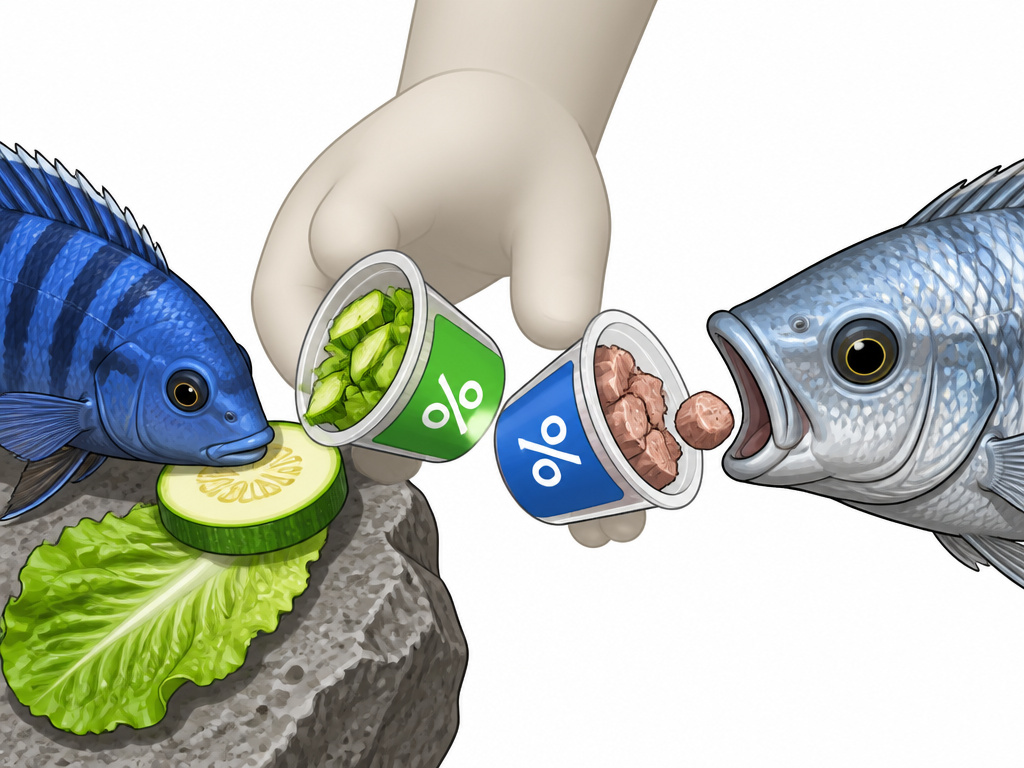
Pseudotropheus socolofi and Haplochromis ahli are both African cichlids, and they did not respond the same way to the same four diets.
Survival was 100% in H. Ahli across the trial, while P. Socolofi ranged from 66.6% to 93.3%. Best feed conversion came out at 1.64 for H. Ahli on the 38%:9% diet and 1.41 for P. Socolofi on the 56%:16% diet. Two fish, one study, two different answers.
The bloat risk splits along the same line. The Maryland SOP states that diets high in animal protein lead to Malawi bloat, an often-fatal intestinal swelling that is very difficult to treat. MIT’s guide describes the same condition from the outside: the fish inflates and looks like a pinecone.
There is one documented exception. MIT notes that Melanochromis chipokae can tolerate meaty foods because it supplements its diet in the wild with catfish eggs and small invertebrates. That is a species note, not a general permission slip.
Where this goes sideways: Treating “African cichlid” as one feeding category. An algae-grazing mbuna and a carnivorous haplochromine share a lake and almost nothing else on the plate.
The Maryland SOP also flags most color-enhancing dry foods as designed for carnivorous cichlids, which makes them a poor staple for mbuna. For color, it points at fresh vegetables instead: peas, zucchini, and romaine lettuce are all high in carotenoids.
The species-by-species breakdown in this cichlid feeding guide is worth reading before you buy a second food for a mixed tank.
Three Foods Worth Keeping on the Shelf
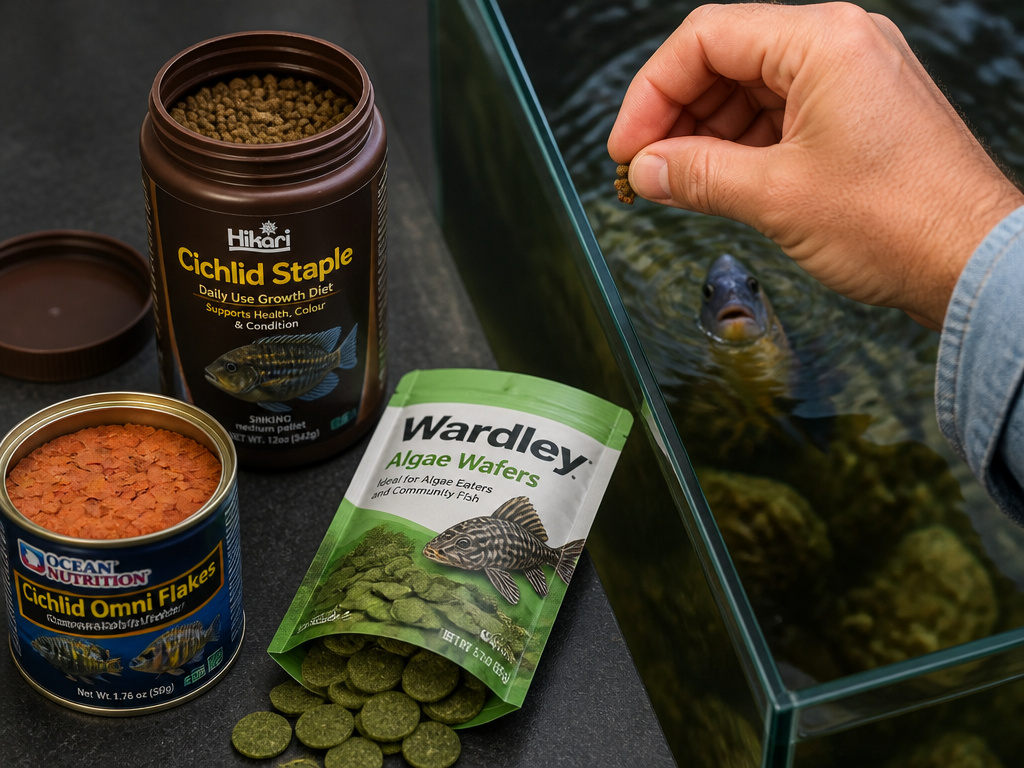
Three named foods cover nearly every case I get asked about, and each one has a job.
Hikari Cichlid Staple
A sinking pellet line with a published size range, which is the part most labels skip. Hikari positions it as an economical daily maintenance diet for cichlids and larger tropical fish, fed two to three times daily in an amount the fish clear in a few minutes.
| Pellet size | Approximate diameter | Package sizes |
|---|---|---|
| Baby | 1.7 to 2.0 mm | 2 oz. (57 g) |
| Mini | 3.0 to 3.4 mm | 2 oz. (57 g); 8.8 oz. (250 g) |
| Medium | 5.0 to 5.5 mm | 2 oz. (57 g); 8.8 oz. (250 g) |
| Large | 7.2 to 8.2 mm | 8.8 oz. (250 g) |
Match the pellet to mouth size.
Ocean Nutrition Cichlid Omni Flakes
A flake rather than a pellet, and a high-protein one at 51.3% minimum crude protein. The label directs one to three feeds daily and caps each at what the fish eat in five minutes.
I would use this as a rotation food for omnivorous and predatory cichlids, not as the only staple for a mbuna group. The protein and fat numbers sit well above the 38%:9% diet the trial favored.
Wardley Algae Wafers
MIT’s guide names Wardley or Hikari algae wafers alongside Hikari cichlid staple pellets as its recommendation for Rift Lake fish. A wafer also feeds differently: it sinks, softens, and gives a grazing fish something to work at instead of a burst of food at the surface.
Rotating between a wafer, a pellet, and a flake is the practical version of a varied diet, and it spreads the nutritional risk across three formulations instead of one. If you want a wider shortlist, this best cichlid food roundup covers the same ground.
Trust that smell and replace it.
Fry, Breeding Groups, and the One Day Off
Fry and breeding groups run on a different clock than a lone adult in a display tank.
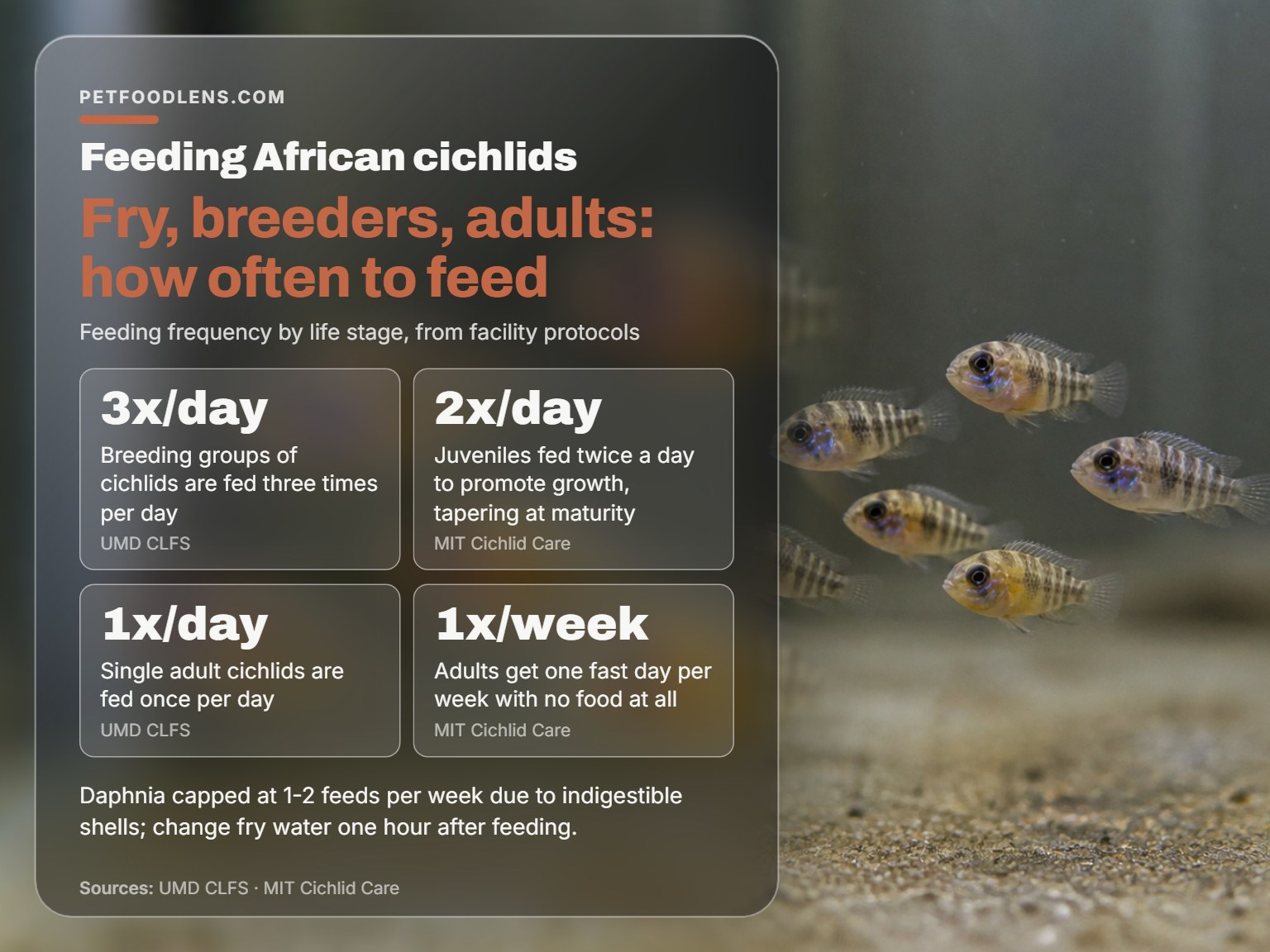
The Maryland facility feeds breeding groups three times a day and single adults once. MIT feeds juveniles twice a day to promote growth and tapers that back once the fish reach maturity. Both are describing the same principle: growing fish need more meals, finished fish need fewer.
For yolk-sac fry, the sequence matters more than the amount:
- Wait until the fry have absorbed their egg sacs before offering any baby food. Food offered earlier just fouls the tub.
- Feed small amounts, because a fry’s stomach is smaller than the food item in most cases.
- Change the water one hour after feeding so old food doesn’t rot and contaminate the water.
That one-hour rule is from the Maryland SOP, and it is the single most skipped step in home fry rearing.
Daphnia is the other item with a hard cap. The SOP limits it to one or two feeds per week because of the indigestible shells, which makes it a supplement rather than a staple.
Adults get the opposite treatment: a fast day. MIT feeds adults once a day and gives them nothing at all once a week. A fish that has been eating daily will beg through it. Ignore the begging.
When the Water Goes Wrong
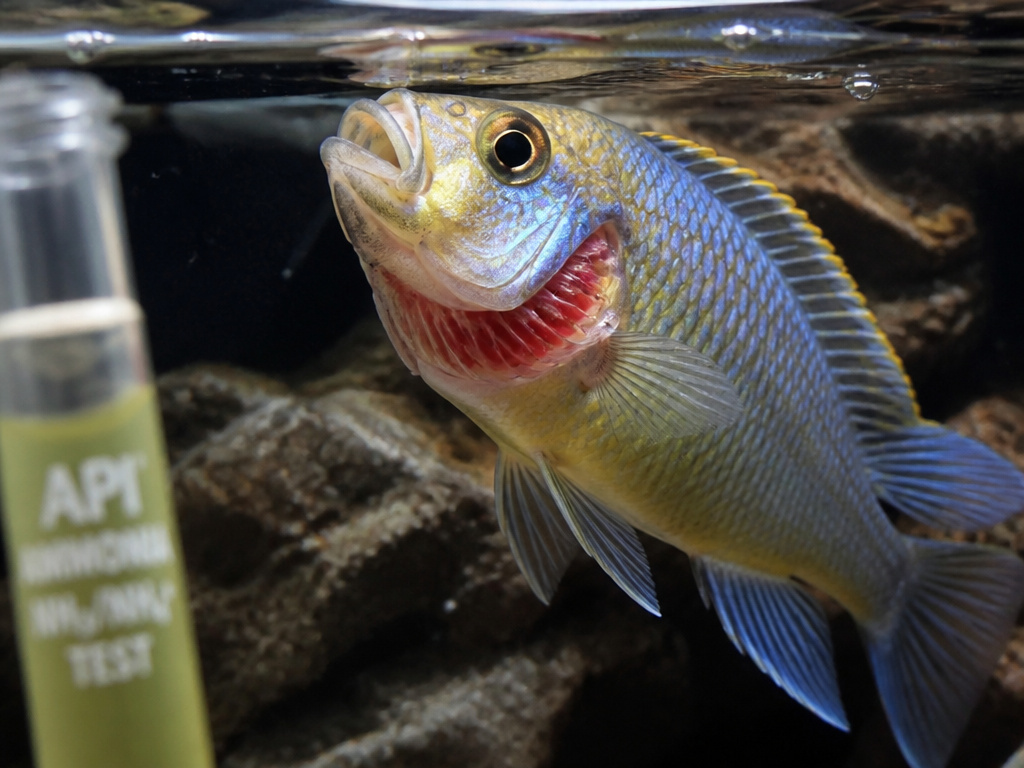
Ammonia is the bill for overfeeding, and it arrives fast.
The standard in a mature tank is 0 ppm ammonia and 0 ppm nitrite, and the remedy for a rise is to suspend feeding while you work out why the biofilter fell behind. Ammonia can cause damage at levels of only 0.1 ppm.
You will see it before you measure it. Gills take on a reddened look, and fish hang at the surface gasping with rapid gill movement. By the time that shows, the feeding error is usually days old.
Temperature belongs in the same conversation.
If haze is your recurring problem rather than ammonia, the feeding without clouding water guide covers the mechanical side of it.
Easy to miss: A single heavy feed can push ammonia up in a tank that has been stable for months. The biofilter catches up, but the gill damage from that window does not reverse.
Frequently Asked Questions
Can I feed African cichlids twice a day?
Yes, and two of the four sources above allow it. Hikari directs two to three feeds daily and Ocean Nutrition allows one to three. The Maryland facility feeds single adults once daily and breeding groups three times, so frequency tracks the fish’s condition rather than the species label.
What vegetables can I feed African cichlids?
Peas, zucchini, and romaine lettuce are all listed in the Maryland SOP as high in carotenoids, which is where a cichlid’s color comes from. The same document notes that most color-enhancing dry foods are built for carnivorous cichlids and may not suit mbuna as a staple.
How do I know I’m overfeeding?
Three signals stack up. The fish stop begging between meals, the water tests positive for ammonia, or the fish start carrying visible bulk and lose color. MIT’s guide is blunt about the last one: obese cichlids lose their brilliant colors and die young.
Do African cichlids need a fasting day?
Weekly fast is harmless and gives the tank a reset.
Is a 51% protein food too much for mbuna?
It sits well above the 38% protein and 9% lipid diet that a 56-day trial found most convenient for two African cichlid species. Use a high-protein flake as a rotation food, not the daily base.
The Bottom Line
Start with one feed a day of a low-protein pellet, sized to the fish’s mouth, and stop when the ten-minute window closes. Test ammonia the next morning.
Two concessions before you go. This all assumes a healthy fish in a cycled tank, and it says nothing useful about a cichlid that is already bloated, thin, or hiding. That fish needs a vet with a microscope, not an ingredient panel.
And the frequency question stays open. Four credible sources split between one feed and three, and the honest reading is that both work when the portion is right. Pick a schedule, watch the ammonia, and let the water test settle the argument.
