
How to Feed a Conure: Step-by-Step
This post contains affiliate links. As an Amazon Associate, we earn from qualifying purchases.
To feed a conure, build the bowl around formulated pellets at roughly 75%-80% of daily intake, add vegetables and greens at 20%-40%, and keep fruit near 10%. Seed belongs in the treat category, not the base. Measure the portion, monitor weight on a gram scale, and never withhold food to force a switch.
The pellet base is doing one job: making every bite carry the same vitamin and mineral load. A seed mix can’t do that, because the bird decides what to eat from it, and it often selectively eats only one or two favorite types of seeds and nuts. That’s why the percentages matter more than the brand on the bag.
What follows walks the numbers, the two places where veterinary sources disagree about them, the conversion schedules that differ by roughly a year, and the pellet brands that fit a plain, undyed plan.
Key Takeaways
- Pellets at 75%-80% of intake is the base VCA Animal Hospitals recommends, with vegetables and greens at 20%-40% and fruit at about 10%.
- Seed is a treat, not a staple. Conures pick out sunflower and peanuts first, and VCA flags both as high in fat and short on calcium and vitamin A.
- One tablespoon is a full portion for a conure, the equivalent of a dinner plate for a person.
- Never withhold food to force a conversion. University of Florida guidance caps weight loss at 1-2% of body weight per week.
- The timelines don’t match. VCA describes a conversion that finishes in about 10 days; the University of Florida says months to a year or more.
How to Feed a Conure: What Actually Goes in the Bowl
VCA Animal Hospitals puts the base at 75%-80% formulated pellets, with vegetables and greens at 20%-40% and fruit at about 10% of daily intake.
A formulated pellet delivers a fixed vitamin and mineral profile in every bite. A seed mix delivers whatever the bird chooses to pull out of it, which is rarely the whole mix. Those are two different feeding systems, and only one of them tells the owner what the bird actually swallowed.
That predictability is the whole argument for pellets. A bird that eats its fill gets a consistent nutritional profile every day, without the owner doing arithmetic at the kitchen counter when considering how to feed a conure.
A seed mix works the other way. The bird decides, and it often picks only one or two favorites.
| Component | VCA Animal Hospitals | University of Florida |
|---|---|---|
| Pellets | 75%-80% of intake | 75% of intake by week three of transition |
| Vegetables and greens | 20%-40% of intake | Fruits and vegetables combined at 15%-20% |
| Fruit | About 10% of intake | Counted inside that 15%-20% |
| Seed | A very small part | Strictly limited if not eliminated |
The two sources don’t line up perfectly, and the next section gets into where.
Pellets First, and Not the Dyed Ones
Plain and undyed is the default. A plain, undyed pellet keeps the focus on nutrition rather than marketing.
A balanced bird diet is a proportions question before it’s a brand question. Get the 75%-80% base right and the specific label matters far less than the front of the package suggests.
The 20-40% Vegetable Band Is Where the Experts Split
20%-40% is a wide band, and the two most-cited veterinary sources don’t draw it in the same place.
VCA Animal Hospitals puts vegetables and greens at 20%-40% of daily intake, with fruit held to about 10%. The University of Florida College of Veterinary Medicine puts fruits and vegetables combined at 15%-20%. Both are veterinary teaching sources with real clinical weight behind them. They disagree, and neither is quoting the other.
What they agree on is direction: vegetables and greens carry more of the bowl than fruit does, and fruit is the smallest share of the three.
- Dark leafy greens and deep-colored vegetables carry the nutritional load.
- Iceberg or head lettuce and celery are mostly water and add very little, which VCA states outright.
- Avocado and onions never go in the bowl at all.
That last point isn’t a preference. VCA lists avocado and onions as potentially toxic and says they should never be offered to a conure or any other parrot.
Easy to miss: Fresh food should not be left in the cage indefinitely; remove what the bird has not eaten rather than letting it sit. Chop a bowl of dark greens, leave it in a heated kitchen, and it goes limp and sour-smelling inside that window.
How you serve the vegetables matters less than whether they get eaten. The University of Florida suggests foraging toys as a way to feed vegetables and fruit, since those are the items a bird is most likely to treat as a toy rather than a meal. If you want the full list of what’s safe, this guide to safe fruits and vegetables covers it item by item.
Why a Seed Bowl Fails Even When the Bird Looks Fine
A seed bowl fails quietly.
VCA lists the problems conures are vulnerable to: vitamin A deficiency, insufficient dietary calcium, egg-binding, and other nutrition issues. None of those announce themselves on a Tuesday morning. They show up in a bird that’s been on seed for a while and has slowly stopped looking right.
The mechanism is selective eating. A conure eats one or two favorite types of seed and nuts out of the mix and leaves the rest. Peanuts and sunflower seeds are usually the favorites, and VCA flags both as high in fat and deficient in calcium, vitamin A, and other nutrients.
Here’s the part owners misread. The bowl may look full even though the bird has eaten most of it, because conures remove the outer hull before swallowing the kernel. Conures remove the outer hull before swallowing the kernel, so the volume in the dish tells you almost nothing.
A seed mix is a buffet, and a conure eats dessert first. If the bowl lets the bird choose, the bird picks its favorites.
Researchers have gone to the trouble of measuring conure food selection and digestibility research for exactly this reason: what a bird takes out of a mixed bowl doesn’t match what the bowl averages out to on paper.
One more thing that surprises people. Conures don’t need grit. VCA explains why: they hull the seed before eating it, so the mechanical grinding that grit supports in pigeons and doves never comes into play. Grit offered to a conure gets over-consumed, and VCA warns that the result can be a life-threatening gastrointestinal obstruction. A seed-only diet plus a grit cup is two problems stacked on each other.
How Much Food Does a Conure Actually Need Per Day?
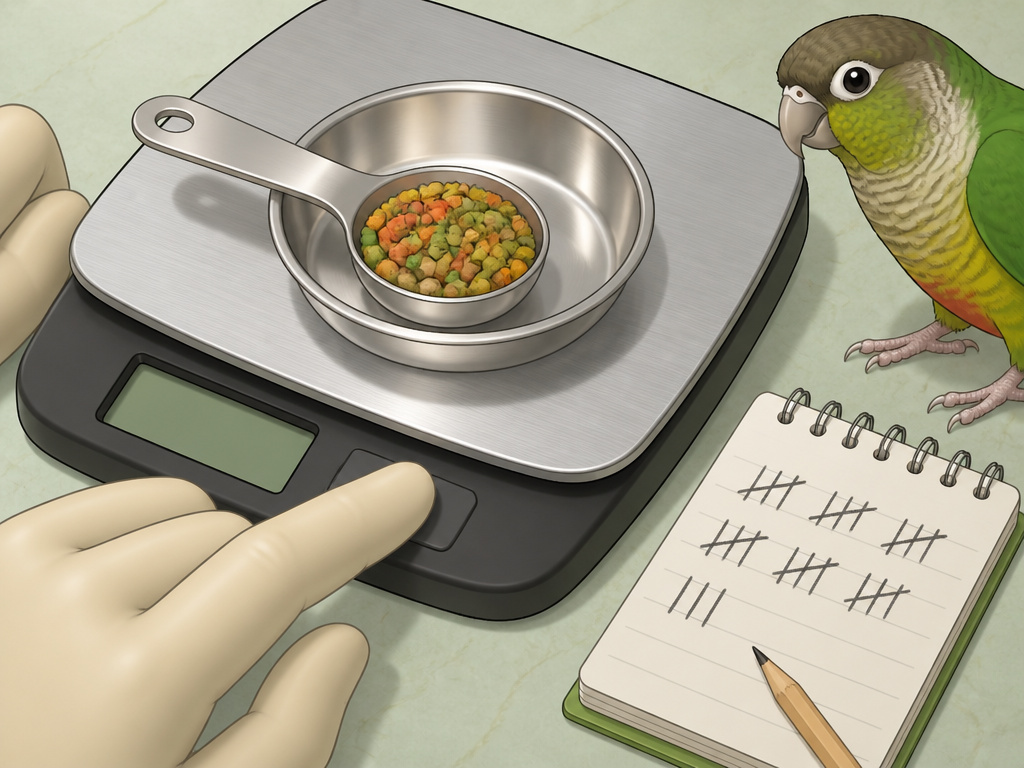
One tablespoon. VCA calls that an appropriate portion for a conure and equates it to a dinner plate for a person.
The same source says to fill the food dish only a quarter full, once a day. That sounds stingy next to a full seed cup, and it’s the correct instinct to fight.
The World Parrot Trust’s parrot nutrition guide makes the underlying point well: a captive parrot’s energy expenditure is 10 to 15 times lower than a wild bird’s. A wild conure flies to its food. A cage bird barely moves.
So measure. The University of Florida describes a seven-day method for working out what your bird actually eats:
- Weigh the food going in. Write the number down. Skip this and the entire calculation rests on a guess.
- Weigh what’s left after 24 hours, on the same scale, at the same time of day.
- Subtract. Amount given minus amount left is that day’s intake.
- Repeat for seven days. One day tells you nothing, because birds have off days.
- Divide the total by seven. That average is the combined seed-and-pellet amount to feed daily during the switch.
That average is your baseline, not a permanent rule. The World Parrot Trust notes that feeding amounts vary by species and that most commercial foods carry their own guidelines for different bird sizes. This guide to portion sizes goes deeper on setting the number, and how often to feed covers timing.
Worth knowing: UC Davis’s avian feeding guide lists unlimited free-fed pellets for adult parrots, but read the row carefully. It specifies birds larger than conures and cockatiels, so it doesn’t actually cover the bird in front of you.
Common mistake: Refilling the dish without weighing anything. The seven-day average is the whole point; measuring your habit is not the same as measuring the bird’s intake.
The Conversion Timeline: 10 Days or a Year?
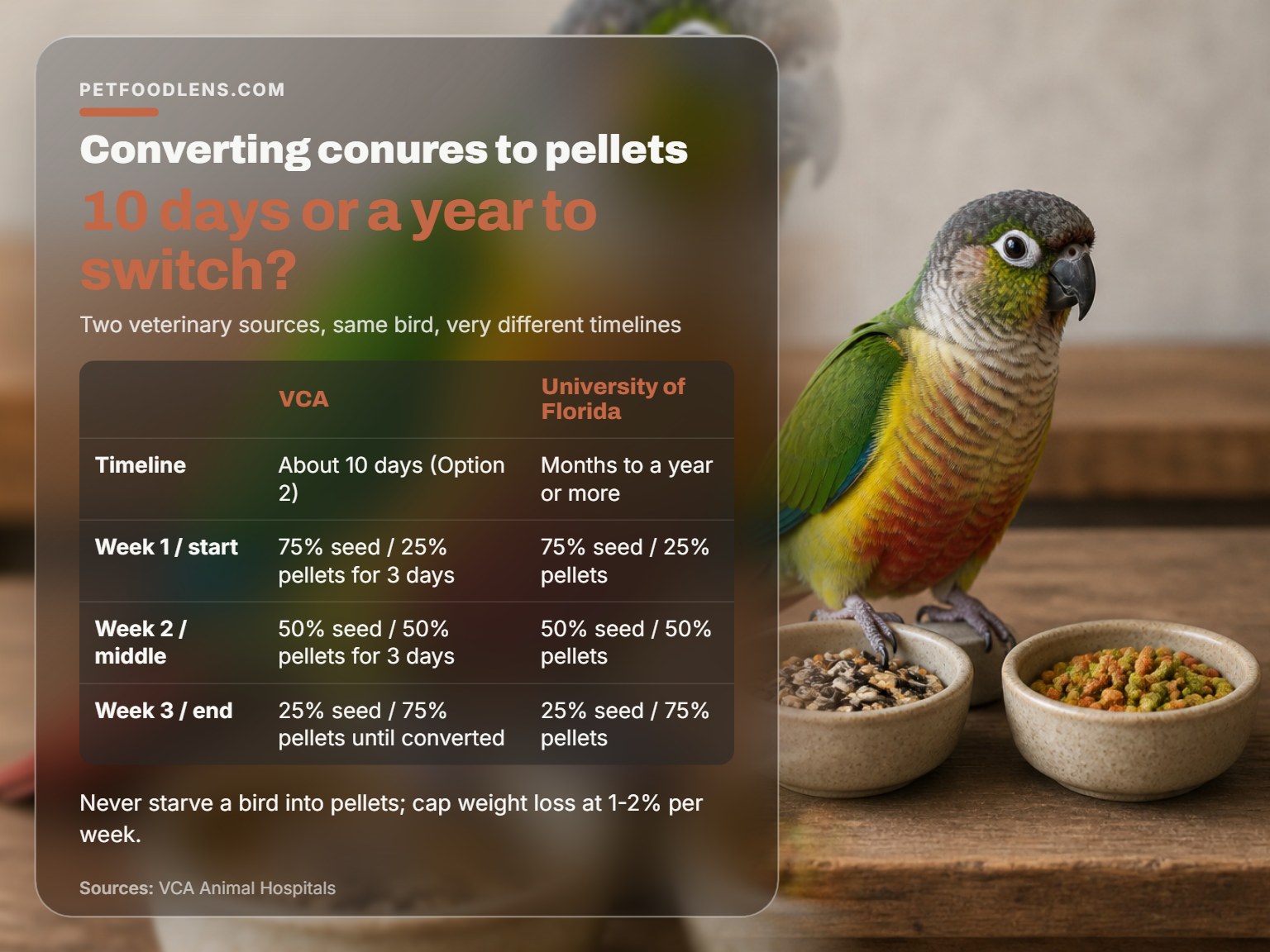
Two veterinary sources give conversion timelines that differ by roughly a year.
VCA offers a staged schedule that finishes in about 10 days, or a three-day-step version that runs a bit longer. The University of Florida states that the transition from seeds to a formulated diet may need to take place over months to a year or more.
Both are describing the same bird. The difference is what each source is willing to risk.
| Approach | How it runs | What it assumes |
|---|---|---|
| VCA option 1 | 75% seed / 25% pellets for 3 days, 50/50 for 3 days, then 25% seed / 75% pellets | The bird samples pellets from a mixed dish |
| VCA option 2 | 90/10 on day one, seed dropping 10% per day, 0% seed by day 10 | The bird adapts fast and holds weight throughout |
| HARI | Separate bowls, seed cup holding about a quarter of normal and emptying during the day | Waste is the enemy; the bird won’t sort pellets out of a seed mix |
| University of Florida | Measured intake, 75/25 week one, 50/50 week two, 25/75 week three, slower if needed | Weight loss is the real risk and months are acceptable |
Before you start: Never withhold all food to speed a conversion. The University of Florida is direct about the consequence: starving a bird into pellets can kill it. Cap weight loss at 1-2% of body weight per week, and put the bird on a gram scale before day one, not after something goes wrong.
The 10-Day Version
VCA’s faster route is arithmetic, not pressure. Option 1 holds 75% seed and 25% pellets for three days, moves to 50/50 for three days, then 25% seed and 75% pellets until the bird is fully converted.
Option 2 is a daily slide: 90% seed and 10% pellets on day one, 80/20 on day two, and so on until seed hits 0% on day 10.
VCA also gives an escape hatch. If the bird refuses to convert, stop at 20% seed and 80% pellets and hold there until it comes around. That stop point is the difference between a schedule and a starvation plan.
The Months-Long Version
The University of Florida’s version starts with measurement, not food. Week one feeds 75% of the calculated daily intake as seed with pellets making up the other 25%. Week two is 50/50. Week three is 25% seed and 75% pellets.
Then it slows down. For many birds the switch takes much longer, and the university says plainly that it may run months to a year or more. Weigh the bird on a gram scale throughout and keep weekly loss under 1-2% of body weight.
If you want the step-by-step version without the schedule debate, this walkthrough on switching to pellets covers the mechanics.
Mix the Pellets In, or Keep the Bowls Separate?
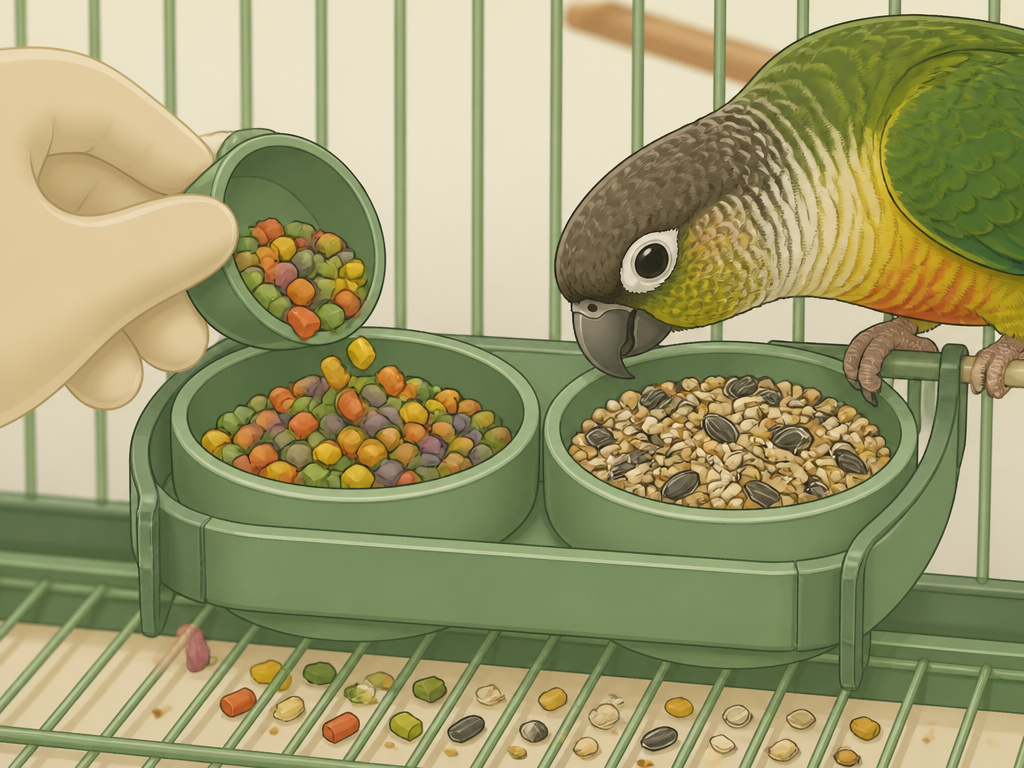
A bowl of seed and pellets goes in. By the time the bird has eaten, the floor under the perch is covered in pellets and the bird has picked out every sunflower seed in the dish.
That’s the argument HARI makes, so weigh the claim on its merits. Mixing the old seed diet with new granules produces a lot of waste, HARI says, because the bird hunts out the sunflower, peanut, and safflower and throws the rest on the floor.
HARI’s alternative is multiple cups. Feed the new diet in a separate bowl, and let the seed cup empty during the day by putting in only about a quarter of the seed the bird normally eats. The new diet is fed in a separate bowl using multiple cups.
VCA takes the other road, mixing seed and pellets in the same dish in staged ratios. Both approaches are described by the sources, and they contradict each other on the one detail that decides how the first week goes.
I’d keep the bowls separate. HARI points out that mixing produces waste because the bird sorts out the sunflower and safflower. Two cups: one that empties, one that doesn’t.
What Both Camps Agree On
Neither source suggests eyeballing it. Both build the schedule around a measured amount, both watch the bird’s weight, and both treat food refusal as a signal to slow down rather than push harder.
The University of Florida adds a detail that’s easy to skip: birds need daily access to unfiltered sunlight or full-spectrum lighting to synthesize vitamin D for bone health, and window glass blocks the UV rays that make it work. Diet and lighting are the same conversation.
If the bird is turning its beak up at everything, this piece on feeding a picky bird is the better starting point than a stricter schedule.
Which Pellets Fit This Plan?
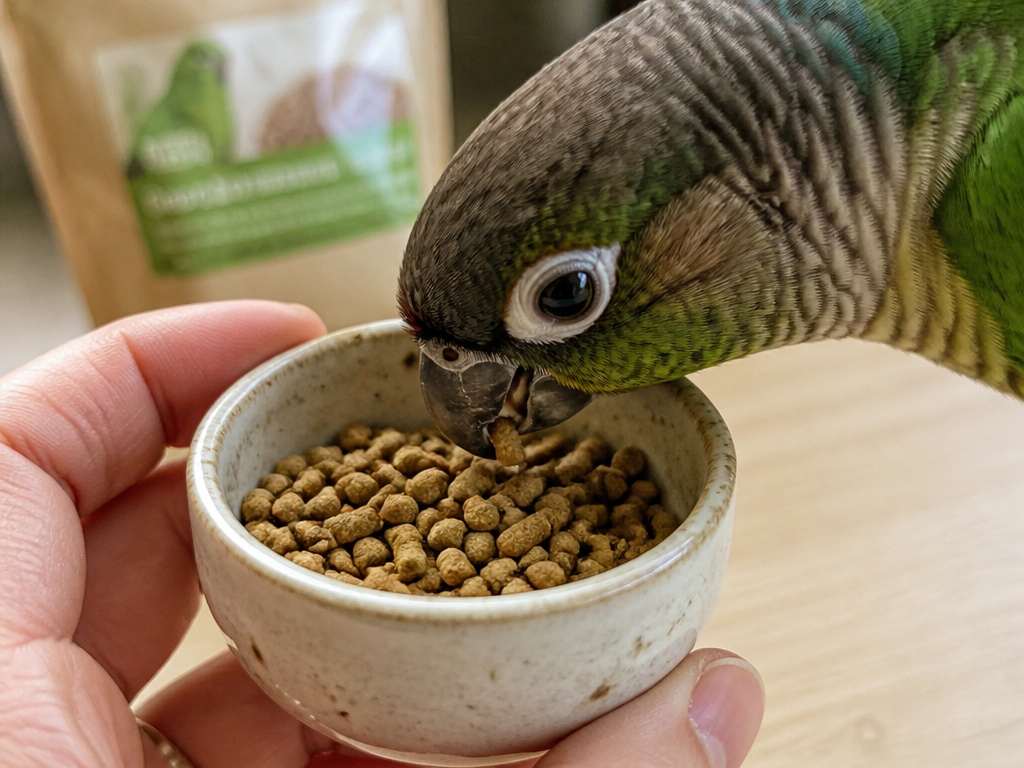
HARI names plain formulated pellets for this species group, and those fit a 75%-80% base without a coloring agent doing the marketing.
HARI names two of its own products for this species group. It states that TROPICAN Cockatiel Granules is better nutritionally than Cockatiel Staple VME Seed for cockatiels, conures, and lovebirds, and that Parrot VME Pro-Mix is also named for those three species. That’s a manufacturer comparing its pellet to a seed mix, which is worth reading as a manufacturer’s claim.
Here’s how the options sort out:
- TROPICAN Cockatiel Granules is HARI’s recommendation for conures, and the one to look at if you want the manufacturer’s own formulation.
If you keep other small parrots, the cockatiel feeding guide covers a bird with a similar but not identical set of needs.
Frequently Asked Questions
Can I keep feeding seed if I add a vitamin supplement?
The World Parrot Trust says vitamin and mineral supplements are available and useful in moderation, but nothing tops a varied, balanced diet. A supplement sprinkled over a bowl the bird eats selectively doesn’t fix the selection problem. Fix the base first.
Will my conure starve itself rather than eat pellets?
That’s the risk the University of Florida warns about, and the reason it says never to starve a bird into eating pellets. Weigh the bird weekly on a gram scale and keep loss under 1-2% of body weight per week. If the number climbs past that, go back a step.
Do conures need grit in the cage?
No. VCA explains that conures hull the seed before swallowing the kernel, so they don’t need grit for digestion the way pigeons and doves do. Grit should not be offered, because over-consumption can cause a life-threatening gastrointestinal obstruction.
Is fruit a daily food or a treat?
VCA puts fruit at about 10% of daily intake, which is closer to a garnish than a meal.
How long does the switch actually take?
It depends which source you follow. VCA describes a schedule that finishes in about 10 days. The University of Florida says months to a year or more for many birds. Start with the measured approach and let the bird’s weight decide the pace.
The Bottom Line
Here’s the number that should stop a conversion cold: 2% of body weight lost in a single week. If the gram scale shows more than that, go back a step and hold there. The University of Florida’s 1-2% weekly ceiling is the guardrail, and it matters more than hitting any particular schedule on any particular day.
One concession. Everything above assumes a bird that’s eating, drinking, and holding weight. A conure that’s been on seed for years and has suddenly gone quiet and fluffed up needs a veterinarian, not a diet plan.
And the short version of how to feed a conure, if you keep only one line: pellets as the base, vegetables measured, fruit as a garnish, seed as a treat, and a scale in the kitchen.
