
How Much to Feed a Puppy: Read the Label First
This post contains affiliate links. As an Amazon Associate, we earn from qualifying purchases.
To work out how much to feed a puppy, start with calories, not the bag: a growing puppy needs about twice as many calories per pound of body weight as an adult of the same breed. Weigh the food, split it across the meals its age calls for, and adjust weekly against body condition.
That multiplier is large, and it shrinks every week as growth rate falls off. Merck’s benchmark for the first five months is a gain of 2 to 4 g per day per kg of anticipated adult weight, which means the how much to feed a puppy number you write on the whiteboard in week one is stale by the time growth plateaus after six months.
What follows is the order I’d work in: find the AAFCO statement, set a calorie target, split it into meals by age, then adjust on a scale instead of a feeling.
Key Takeaways
- Weigh the daily ration in grams. A cup is a volume measure and kibble isn’t a liquid, so the same scoop delivers different weights from bag to bag.
- Merck’s growth benchmark is 2 to 4 g per day per kg of anticipated adult weight during the first five months, with growth plateauing after six months.
- Meal count is where the authorities split. Merck says three a day to six months, the AKC says four at 6 to 12 weeks, AAHA says two to four.
- Large and giant breed puppies need a diet carrying the AAFCO large-size statement, not a generic all-life-stage bag.
- Treats stay under 10% of intake. Past that line you’re unbalancing a diet that was balanced when you opened the bag.
The AAFCO Statement Is the Only Line on the Bag That’s Regulated
AAFCO stands for the Association of American Feed Control Officials, and its nutritional adequacy statement is the one line on a puppy food bag that a regulator actually checks. It’s small print, usually a couple of lines in the same font as the ingredient list, and it’s easy to walk straight past on the way to the picture of the golden retriever.
The AAFCO nutritional adequacy statement is a required label element that identifies the life stage a food is formulated for. A growth claim, or an all-life-stage claim, indicates the product is formulated to meet the nutrient profiles for growing dogs. Products labeled for maintenance alone do not carry that claim.
A food labeled for growth, or for all life stages, is formulated to meet the nutrient needs of a growing dog. A food labeled for maintenance is not, no matter how good the front of the bag looks when you compare a how much to feed a puppy label.
Whatever the brand, a growth or all-life-stage food prints the same statement in the same format. Read that line before you read anything else, because it’s the only part of the packaging with a defined meaning.
For large and giant breeds, the wording gets specific. Merck quotes the AAFCO statement as reading “including growth of large size dogs [32 kg or more as an adult].” That phrase is the difference between a food built for a large adult dog and one built for a small adult dog.
Here’s where it gets genuinely confusing. The AKC describes large-breed puppies as those heading past 50 lb as adults, while the AAFCO wording is written for dogs reaching 32 kg, which is roughly 70 lb. A puppy tracking between the two thresholds sits in the gap between the two definitions, and nobody has resolved that for you.
The statement tells you the food is adequate. The chart on the back tells you a starting amount, and how to read a dog food feeding chart is a separate skill from reading the statement. Merck’s feeding practices entry is the clearest free summary of both.
How Many Meals a Day Does a Puppy Need?
Three, four, or two, depending on which authority you ask and how old the puppy is. The three main sources disagree, and the disagreement is worth seeing laid out rather than smoothed over.
| Age band | Merck Veterinary Manual | AKC | AAHA |
|---|---|---|---|
| Weaning to 3 months | 3 meals a day | 4 meals a day (6 to 12 weeks) | 2 to 4 meals a day |
| 3 to 6 months | 3 meals a day | 3 meals a day | 2 to 4 meals a day |
| 6 to 12 months | 2 meals a day | 2 meals a day | 2 to 4 meals a day |
| Small or toy breeds | More than 3 a day | No separate count given | 2 to 4 meals a day |
The table above is three answers to one question, and how often to feed a puppy genuinely depends on which authority your vet follows. Merck notes that small-breed puppies may need more than three feedings a day.
The 6 to 12 Week Conflict
The AKC’s four feedings a day and Merck’s three are describing the same puppy at the same age, and both are defensible. Merck’s three-a-day figure runs from weaning through six months and explicitly allows more for small breeds. The AKC’s four is aimed at the youngest puppies in that window.
My reading: start at four for a small-breed puppy in that window and three for a large-breed one, because Merck’s small-breed exception points the same direction as the AKC’s higher count. That’s a synthesis of the two sources, not a rule either of them states outright.
AAHA’s contribution is the method rather than the count. Its AAHA canine life stage feeding guidelines say the measured daily amount should be divided into two to four meals, which gives you room to land anywhere in that range without being wrong.
The Growth-Rate Number That Sets the Portion
Two to four grams per day, per kilogram of anticipated adult weight. That’s Merck’s figure for the first five months, and it’s a rate rather than a portion, which is why it’s more useful than a chart.
You use it as a check. If your puppy is gaining 2 to 4 g per day per kg of anticipated adult weight, the portion is roughly right. If it’s gaining far more than that, the portion is running hot regardless of what the bag says.
Before you start: Three things go wrong in the first month. Free-choice feeding in a large-breed puppy can push growth faster than the skeleton can organize, and AAHA links that to skeletal deformity at a young age. Treats above 10% of intake unbalance a diet that was balanced when you opened it. And a portion set once and never rechecked drifts wrong within weeks, because calorie need per pound falls as the puppy grows.
Here’s the order I’d do this in.
- Read the AAFCO statement first. A maintenance food can’t be rescued by portion size, and you’ll spend a month adjusting a diet that was never adequate.
- Set a daily calorie target. AAHA’s method divides the puppy’s resting energy requirement by the food’s energy density in kcal per gram. Skip it and you’re guessing at a number the bag already guessed at.
- Weigh the ration in grams. A cup varies with kibble size and how settled the food sits in the scoop, so a skipped scale turns a precise target into a rough guess.
- Split it across the meals your puppy’s age calls for. A young puppy’s stomach doesn’t hold a whole day at once, which is exactly why the meal count matters.
- Weigh the puppy weekly and adjust. Merck’s guidance is a small gain each week. Miss the weekly check and you won’t notice a drift until the ribs have disappeared.
If you’d rather work from weight than from a calorie formula, how much to feed by weight gives you the shortcut. Weekly weighing is the whole feedback loop; adjusting portions is what you do with the number once you have it.
One honest gap: Merck says to monitor weight weekly, while AAHA says at least every two weeks; either interval is defensible, and the choice depends on which authority your vet follows.
What a Growth Diet Looks Like on the Label
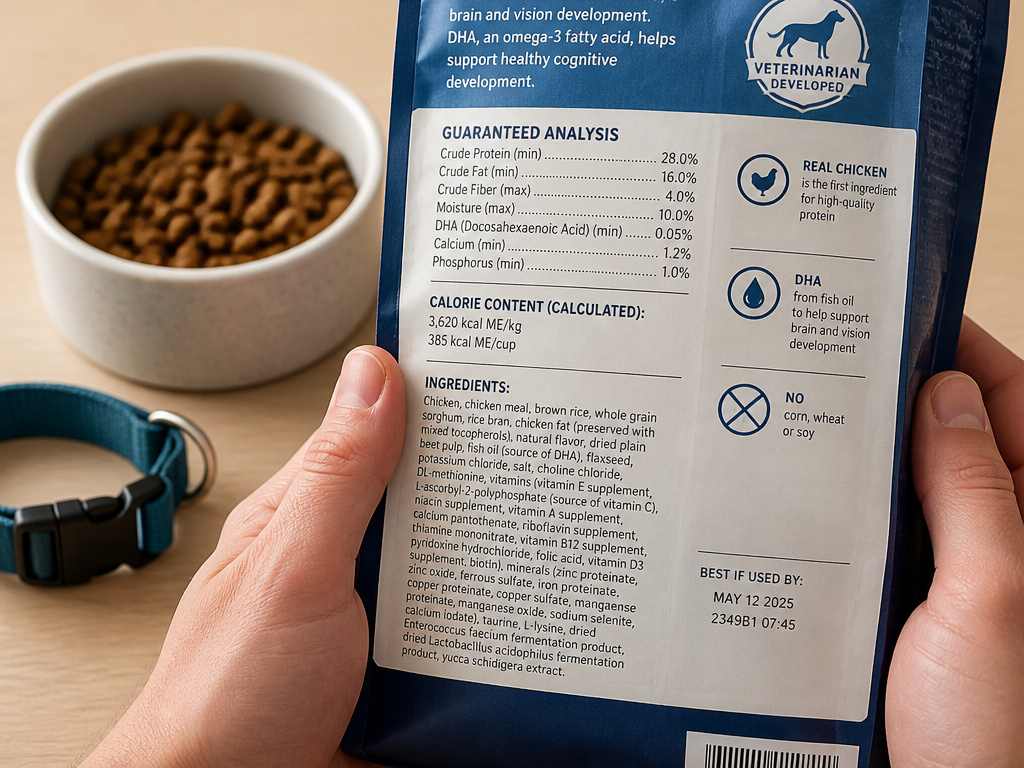
Turn the bag over and you get two things: a guaranteed analysis and, if you’re lucky, a calorie statement. The guaranteed analysis is a floor-and-ceiling declaration, and AAHA notes it’s of limited use because it says nothing about digestibility.
That matters more than it sounds. Two foods with identical label numbers can perform very differently in a puppy, because the label doesn’t tell you how much of the protein the dog can actually use.
| Nutrient | AAHA range for growth diets (dry matter) |
|---|---|
| Metabolizable energy | 3.5 to 4.5 kcal per gram |
| Fat | 10 to 15% |
| Protein | 22 to 32% |
| Calcium | 0.7 to 1.7% |
| Phosphorus | 0.6% minimum |
| Calcium to phosphorus ratio | 1:1 to 1.8:1 |
For a few years I assumed a higher protein number meant a better food. Then I started tracing where the protein came from and found high-protein labels built largely on plant concentrates. The percentage tells you how much protein is in the food, not where it came from, and the National Academies dog nutrition report is the document behind most of the numbers above.
Common mistake: Feeding to the top of the bag’s range. The chart gives a range because the low end suits a puppy already on track and the high end suits one that’s underweight.
There’s a regulatory wrinkle here that almost nobody mentions. AAHA points out that AAFCO feeding trials only last 10 weeks, so problems from excess calcium and energy in large and giant breed puppies may not have time to show up before the trial ends. A food can pass the trial and still be wrong for a giant breed over its longer growth period.
AAHA’s other label point is worth taping to the cupboard door: growing dogs shouldn’t get vitamin and mineral supplements when they’re eating a complete, balanced commercial food. You’re adding to a diet that was already balanced.
Why Large Breeds Follow Different Rules
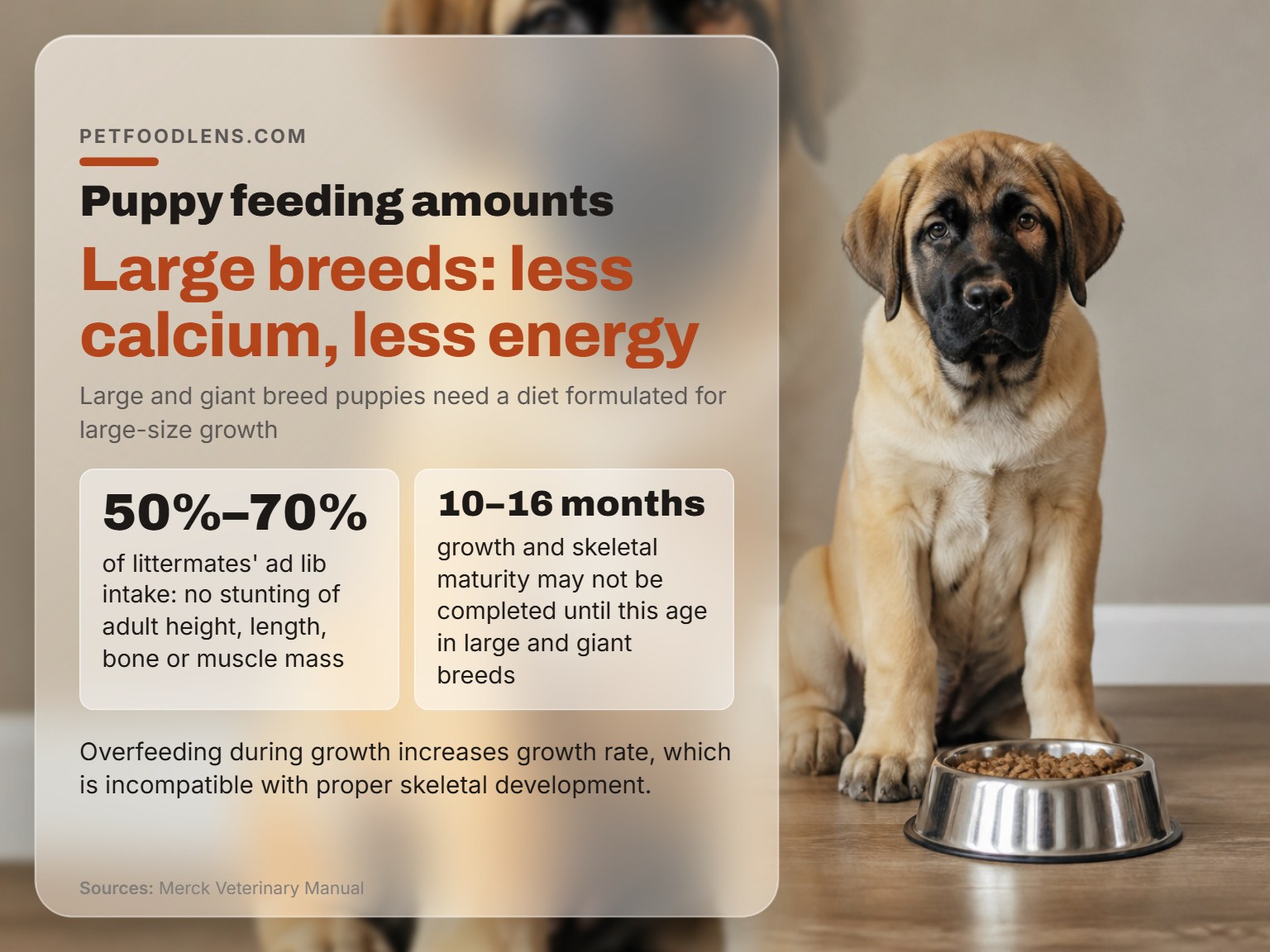
Large and giant breed puppies are the one group where a generic all-life-stage bag is the wrong purchase. AAHA is direct about it: these puppies should only receive a commercially prepared food specifically designed for them.
The reason is calcium and energy density. AAHA recommends large and giant breed puppies get a food with less calcium and less energy to lower the risk of developmental orthopedic disease. The AKC points to reduced-calorie foods with less calcium, while Merck emphasizes growth diets carrying the AAFCO large-size-dog statement.
Where this goes sideways: Putting a large-breed puppy on an all-life-stage bag because the front says “complete.” The all-life-stage claim doesn’t carry the large-size wording, and the calcium and energy levels are set for a smaller dog.
The 50 to 70% Trial and What It Actually Showed
This is the finding I’d put in front of every owner who worries that portion control will stunt their puppy. Merck reports that when growing large-breed puppies were fed 50% to 70% of their littermates’ ad lib intake, adult height, length, and bone and muscle mass were not stunted. Only total body fat differed.
Read that again. Restricting a large-breed puppy to 50% to 70% of what it would eat free-choice did not make it smaller. It made it leaner.
Merck’s companion point is that overfeeding during growth increases growth rate, which is incompatible with proper skeletal development and contributes to obesity later in life. Faster growth isn’t a head start. It’s a risk factor.
If you want a starting range before you do the calorie math, daily feeding amounts by breed size gets you into the right neighborhood.
When Should You Switch to Adult Food?
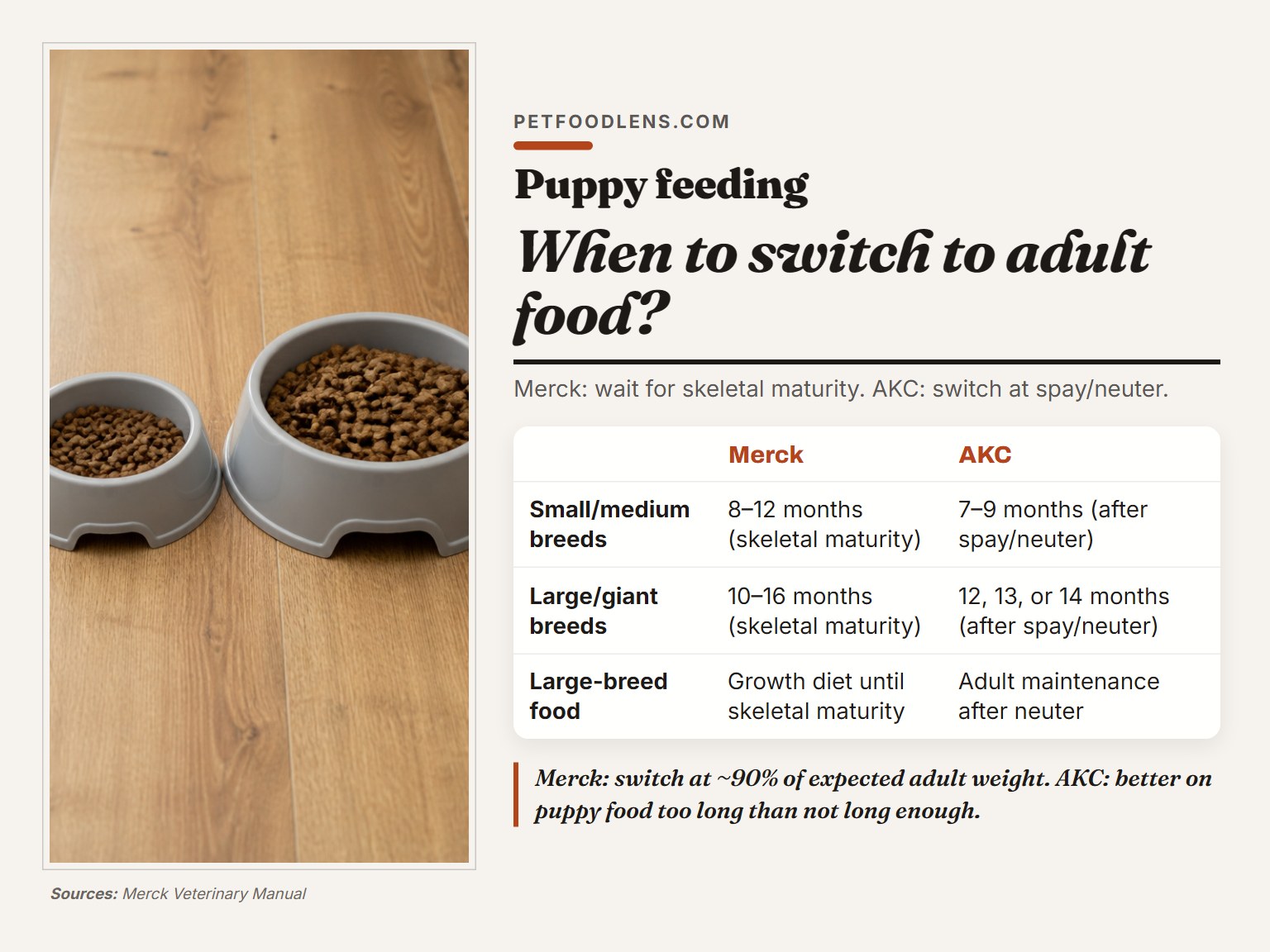
There are two credible answers and they don’t agree. Merck says keep a growth diet until skeletal maturity, the AKC says switch at spay or neuter with ages alongside it, and AAHA implies large and giant breeds should stay on breed-appropriate commercial food longer.
- Merck: feed a complete and balanced growth diet until skeletal maturity, not just until obvious growth stops. That’s 8 to 12 months for small and medium breeds, 10 to 16 months for large and giant breeds.
- AKC: switch from puppy food to adult maintenance after spaying or neutering. Small breeds can switch at 7 to 9 months, larger breeds at 12, 13, or 14 months.
- AAHA: large and giant breed puppies should stay on a breed-appropriate commercial food, which implies a longer runway than a calendar date.
The two rules measure different things. Merck’s is a physiological milestone. The AKC’s is a surgical event that happens to lower energy requirements, which is why it’s a reasonable trigger even though it has nothing to do with bone.
A portion is a starting point, not a prescription. The bag gives you a number to begin with; the scale tells you whether it was right.
Merck offers a middle marker worth knowing: once a dog reaches about 90% of expected adult weight, a diet less nutrient dense than the growth diet is generally recommended. That’s a measurable threshold rather than a guess. The switch date and the feeding schedule by age are two separate decisions, and it’s easy to change one without the other.
The AKC’s tiebreaker is the one I’d repeat to anyone: better to be on puppy food a little too long than not long enough.
Weigh the Food, Don’t Scoop It
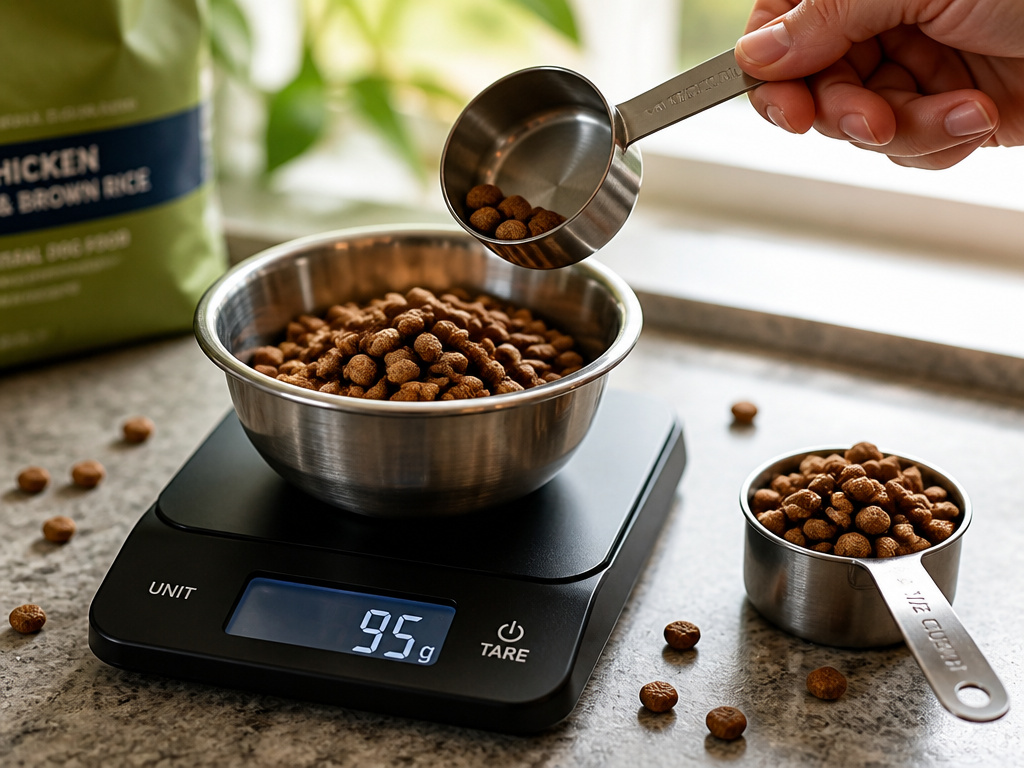
A cup is a volume measure and kibble is not a liquid. The same scoop holds different weights depending on kibble size, shape, and how much the bag has settled.
This is where most of the drift comes from. You calculate a target in grams, then measure it with a scoop calibrated to nothing, and the error compounds across four meals a day.
AAHA’s preferred method is food-limited feeding, with the measured daily amount divided across meals and the amount adjusted to hold a body condition score between 4/9 and 5/9. In practice that means ribs you can feel under light pressure and a waist you can see from above. Run your hands along the ribs. You should find them without pressing, and you shouldn’t have to hunt for them.
AAHA is blunt about the alternatives: free-choice and time-restricted feeding should both be avoided during rapid growth, though Merck notes some adult dogs can be fed free choice while most cannot without becoming obese. Free-choice feeding may increase body fat, predispose a dog to obesity, and in large breeds induce skeletal deformities at a young age. The free feeding vs scheduled feeding comparison explains why the measured middle option wins. For the mechanics, how to measure dog food portions covers the scale-versus-cup argument properly.
Treats are the other quiet leak. Merck puts the ceiling at under 10% of total caloric intake, and AAHA puts it at no more than 10% of the total amount of food fed. Slightly different framings, same practical line.
Merck’s own caveat deserves the last word in this section: any daily feeding recommendation should be treated as an estimate or starting point, modified by ongoing evaluation of weight, body condition, skin and coat, performance, and attitude.
The Two Cases the Bag Doesn’t Cover
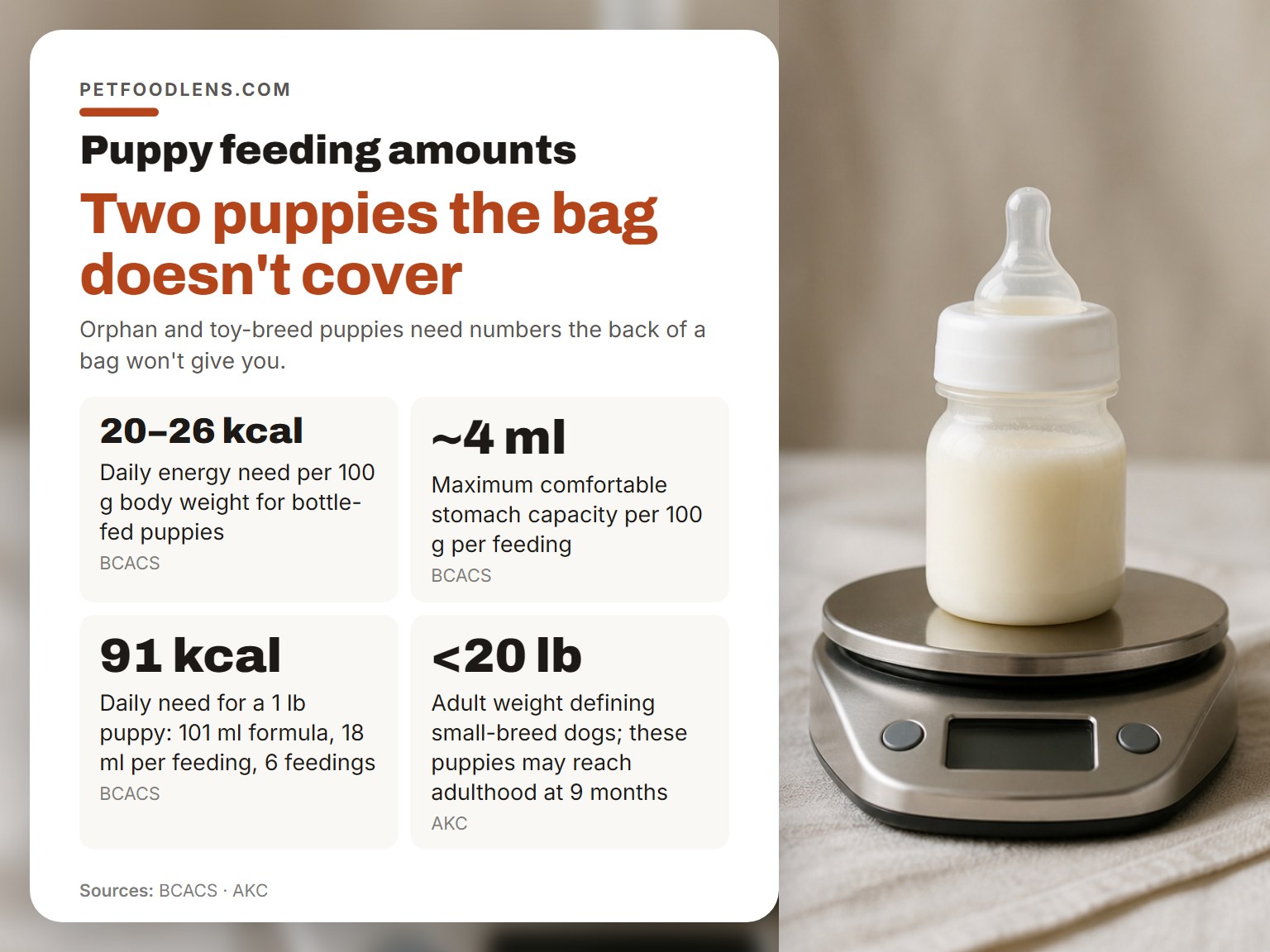
Two puppies break the standard schedule: the orphan and the toy breed. Both need numbers the back of a bag won’t give you.
Bottle-Fed Orphans
Bernalillo County Animal Care Services publishes a working chart, and the numbers are tighter than most people expect. Daily energy need runs about 20 to 26 kcal per 100 g of body weight, and maximum comfortable stomach capacity is about 4 ml per 100 g per feeding.
That capacity limit is the whole point. Exceeding it risks aspiration, vomiting, diarrhea, and gas build-up in the stomach and intestines. Most commercial puppy milk replacers in the US provide less than 1 kcal per ml, which pushes the required volume up toward the capacity ceiling.
A 1 lb puppy, per the puppy stomach capacity chart, needs about 91 kcal a day, which works out to roughly 101 ml of formula across six feedings of 18 ml each. Bernalillo also notes that bottle-fed puppies grow slower than puppies nursing off a mother.
The sources disagree on when solid food enters the picture. The National Academies say to start feeding puppies food at about 4 weeks because mother’s milk is no longer sufficient, and also that new mothers generally suckle for at least 6 weeks. Bernalillo puts it at 3.5 to 5 weeks, when puppies are usually eating some solid food and need less milk replacer.
Toy and Teacup Breeds
Small breeds run on a faster clock in both directions. The AKC defines small-breed dogs as those under 20 lb as adults, and notes these puppies may reach adulthood at 9 months.
The feeding risk is the opposite of a large breed’s. The AKC points out that small-breed puppies need high-calorie foods because their stomachs don’t hold much, and warns that owners feeding a high-calorie small-breed formula should be careful not to overfeed. Merck notes that small-breed puppies may need more than three feedings a day.
Small stomach, high calorie density, frequent meals. Get that combination wrong in either direction and you get a puppy in trouble.
Frequently Asked Questions
How much should I feed a 2-month-old puppy?
Start with a calorie target rather than a volume. AAHA’s method divides the puppy’s resting energy requirement by the food’s energy density in kcal per gram, then splits that daily amount across meals. At 2 months the sources disagree on meal count, and Merck’s growth benchmark of 2 to 4 g per day per kg of anticipated adult weight tells you whether the portion is working.
Should I let my puppy eat free choice?
AAHA states plainly that free-choice and time-restricted feeding should be avoided during rapid growth and that food-limited feeding is the method of choice for all puppies, though Merck notes some adult dogs can be fed free choice while most cannot without becoming obese. Free-choice feeding may increase body fat, predispose a dog to obesity, and in large breeds induce skeletal deformities at a young age.
How do I know if I’m overfeeding my puppy?
Weigh the puppy weekly and check body condition against AAHA’s target of 4/9 to 5/9. The AKC offers a simpler early check: a puppy should be losing its potbelly and pudginess by 12 weeks, and if it’s still roly-poly at that age you should continue puppy-size portions until body type matures.
Do large-breed puppies need a special puppy food?
Yes. Merck says large and giant breed puppies should be fed growth diets carrying the AAFCO statement for large-size dogs, and AAHA says these puppies should only receive a commercially prepared food designed for them. The reason is calcium and energy density, both of which are set lower to reduce the risk of developmental orthopedic disease.
Can I just feed my puppy adult food?
The AKC warns that feeding adult food robs a puppy of important nutrients, and Merck says to keep a growth diet going until skeletal maturity rather than until obvious growth stops. Those two positions point the same way. A maintenance diet isn’t a smaller version of a growth diet; it’s a different formulation.
How much formula does a bottle-fed puppy need?
Bernalillo County’s chart uses about 20 to 26 kcal per 100 g of body weight daily, with a maximum comfortable stomach capacity of roughly 4 ml per 100 g per feeding. A 1 lb puppy works out to about 91 kcal and 101 ml a day, split into six feedings of 18 ml. Exceeding the per-feeding capacity risks aspiration and digestive upset.
The Bottom Line
If you do one thing this week, put the scoop away and weigh a day’s ration in grams. Then weigh the puppy. Those two numbers, kept weekly, will tell you more than any chart on any bag.
One threshold worth carrying: if your puppy is gaining far faster than 2 to 4 g per day per kg of anticipated adult weight, cut the ration before you cut anything else. Faster growth isn’t the goal, and Merck’s restricted-feeding trial showed that feeding 50% to 70% of ad lib intake didn’t stunt adult height.
Here’s the concession. Everything above assumes a healthy puppy on a complete diet with no medical issues. It doesn’t cover a puppy with a congenital condition, a post-surgical recovery, or a breed-specific problem your vet already knows about. Those cases need clinical judgment, and a label can’t supply it.
Read the back of the bag first. The front is a story, and the statement is the part that’s actually regulated.
