
By-Products in Pet Food Pros and Cons: What Labels Hide
This post contains affiliate links. As an Amazon Associate, we earn from qualifying purchases.
By-products in pet food have real pros and cons: they’re inexpensive, nutritionally useful and keep usable material out of the waste stream, but the word “byproduct” tells you almost nothing about which tissue it is, and researchers still argue over how much rendering costs in protein quality. AAFCO’s position is that byproducts can be safely used to provide nutrition.
The word covers two different things on two different panels. On the ingredient list it’s a naming convention with a legal definition attached. In the bowl it’s a digestibility question, and the researchers who study it don’t agree on how to measure the answer. This is part of the broader debate over by-products in pet food pros and cons.
What follows splits the by-products in pet food pros and cons question into its three real parts: what the label legally means, what the feeding trials actually measured, and where the safety rules start and stop. By the end you’ll be able to read “chicken by-product meal” and “meat byproducts” and know exactly what each one promises and what it doesn’t.
Key Takeaways
- AAFCO defines a byproduct as a secondary product produced alongside the principal one, and its stated position is that byproducts can be safely used to provide nutrition.
- Species must be named unless the source is cattle, swine, sheep or goats, so “meat byproducts” with no animal named is lawful and tells you less than “chicken by-product meal” does.
- Rendered and raw ingredients carry different label names, which is why chicken and chicken by-product meal are two separate entries on the same panel.
- Raw unprocessed byproducts are prohibited from finished animal feed unless they’re heat-treated to kill microbial contamination.
- The protein-quality studies disagree: one assay set ranked raw meals above rendered, while a separate trial found no ileal difference between fresh and rendered beef.
What AAFCO Actually Means by the Word Byproduct
AAFCO defines a byproduct as a “secondary product produced in addition to the principal product.” That’s the whole definition. No feet, no floor sweepings, no quality grade attached to it.
Rendering cooks an ingredient to prevent microbial contamination, and most pet food plants use rendered byproducts in meal form because raw material is difficult to store and handle. Rendered ingredients carry different label names than their raw equivalents, so the panel lists chicken by-product meal rather than chicken by-products on the same bag.
The official AAFCO byproduct definitions go on to make a point that gets lost in the argument: using primary products for humans and the related secondary material for animals is a common practice, and it applies to plants as much as animals. Wheat bran is a byproduct of flour milling. So are the peels, rinds, pomace and culls left after juicing or canning fruit.
One product can generate several byproducts at once. That matters later, when you compare a by-products in pet food pros and cons and count protein sources on a panel.
Here’s a detail that surprises people: “co-product” is an industry expression. It is not an AAFCO official feed term. If a brand’s website leans on the word, it’s leaning on vocabulary, not a standard.
AAFCO is also blunt about the aesthetics question. It doesn’t regulate consumers’ opinions about how an ingredient sounds. It writes definitions so you can read the label and decide for yourself.
Which Byproducts End Up in the Bag, and Which Never Do
Three routes put a byproduct into a bag: tissue rejected for human sale, organs with no human market, and plant material left over from milling or juicing.
AAFCO is explicit that during slaughter and meat-cutting, carcasses or parts rejected for human use can be expected to be processed into animal feed. That includes meat that misses an aesthetic standard and internal organs that normally aren’t eaten by people. The organ meat conversation and the by-product conversation are largely the same conversation wearing different hats.
On the plant side, FDA guidance lists the usual suspects: wheat middlings from flour milling, hulls, bran and germ from other grain operations, and peels, rinds, pomace, pulp and culls from fruit and vegetable processing. Most shoppers file those under fillers in dog food, which is a different argument entirely.
What never makes it in is narrower than the internet suggests:
- Animals that died by means other than slaughter. AAFCO treats that material as adulterated. It can’t go into feed unless it contains no chemical additives and is heat-treated and further processed.
- Raw, unprocessed byproducts. Prohibited from finished feed unless heat-treated.
- Anything that fails the finished-product standard. For dry kibble and canned foods, the final product should be free of disease-causing bacteria.
The part nobody mentions: AAFCO’s labeling rule requires the species of animal to be named, unless the meat or meat byproducts come from cattle, swine, sheep or goats. So “meat byproducts” with no species is lawful, and the entry tells you only that the material came from one of those four.
That’s the gap between what the rule requires and what a shopper wants. A common complaint is that unnamed “meat byproducts” is vague to the point of useless. The complaint is fair. The label rule simply doesn’t reach that far.
The scale here is not small. A peer-reviewed animal byproduct feed study puts animal fat and meat industry byproducts in the EU at around 18 million tonnes a year from slaughterhouses, dairies and food plants, with another 8 to 12 million tonnes a year arriving as former foodstuffs. That’s the volume the category is absorbing.
Open a bag of kibble that’s been in a warm cupboard since spring and the smell arrives before the scoop does: sharp, faintly sour, the smell of fat that has turned. That’s a storage problem, not a by-product problem, and it happens to expensive foods too.
Does Rendering Destroy Protein Quality? The Trials Do Not Agree
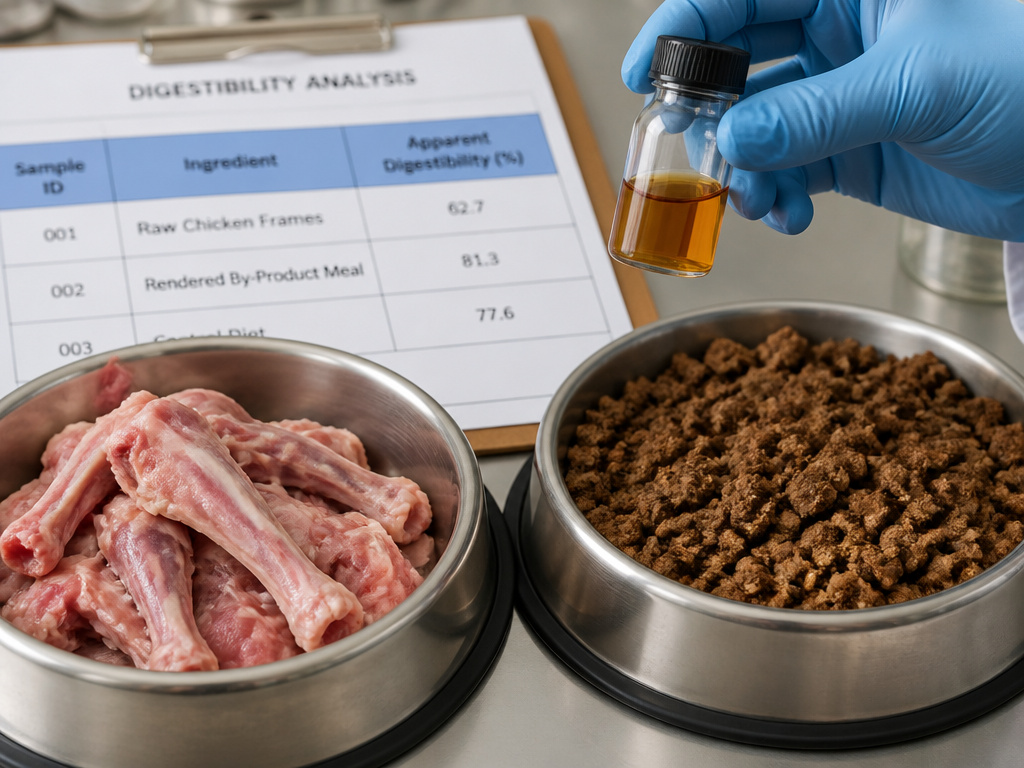
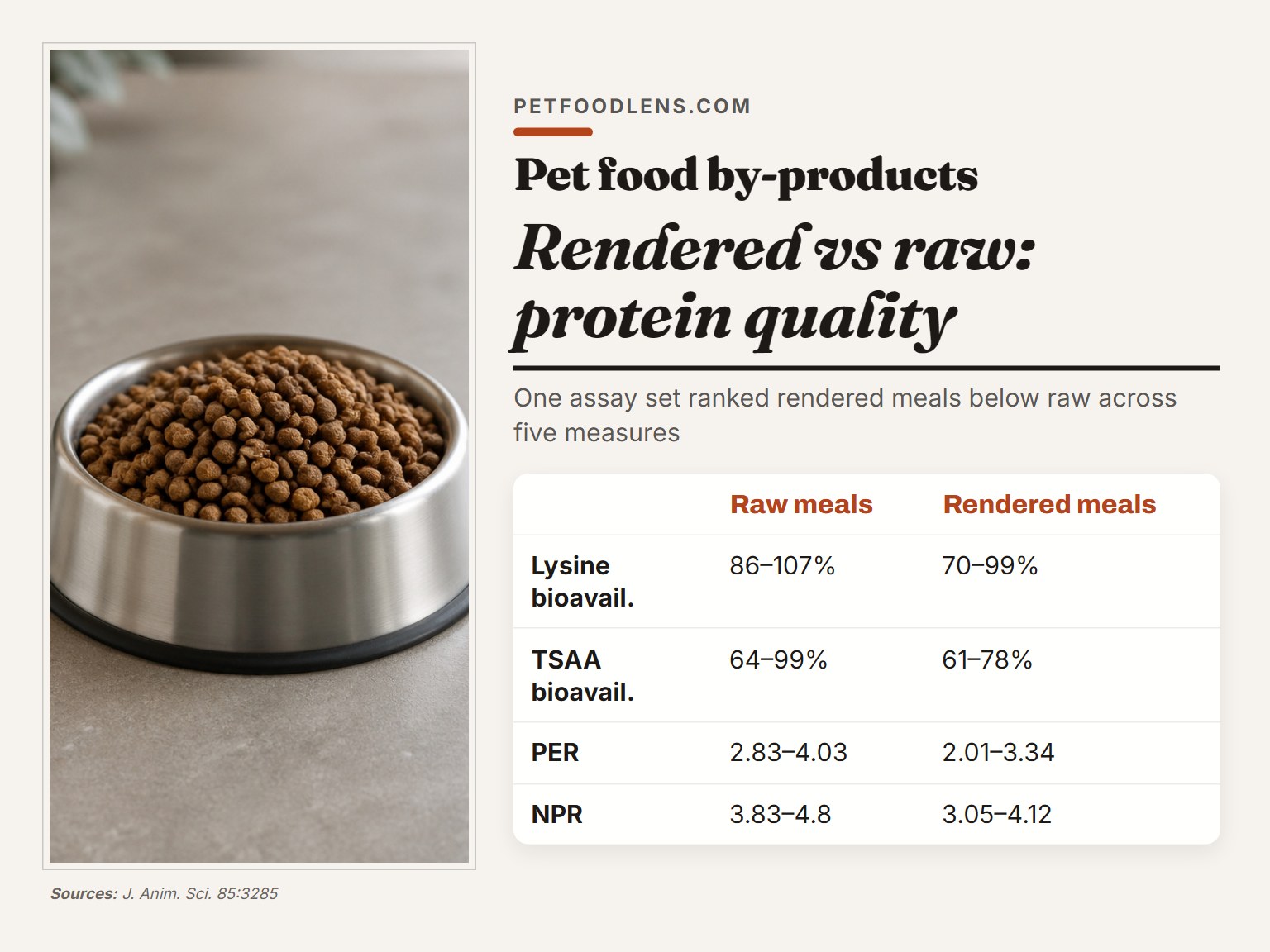
Lysine bioavailability came out at 86 to 107 percent for raw meals and 70 to 99 percent for rendered meals in one set of assays. That’s a real gap. It’s also one set of assays.
The Journal of Animal Science 85(12):3285 work reported the following ranges across the by-product meals it tested:
| Measure | Raw meals | Rendered meals |
|---|---|---|
| Lysine bioavailability | 86-107% | 70-99% |
| TSAA bioavailability | 64-99% | 61-78% |
| PER | 2.83-4.03 | 2.01-3.34 |
| NPR | 3.83-4.8 | 3.05-4.12 |
| Total essential AA digestibility | 93.6-96.7% | 84.0-87.7% |
Same paper found lamb meal had the poorest PER and NPR of the meals tested, and pork livers the greatest protein quality. That’s a useful reminder that “by-product meal” is a category, and categories contain ranges.
Now the other side. A 2003 trial reported in the raw and rendered byproducts in dog diets paper found no difference at the ileum between beef by-product and rendered beef meal. Poultry by-product meal diets did come in 5 to 10 percentage units lower on ileal nutrient digestibility than fresh poultry. The authors put that down to the components of the mix or the rendering process rather than to rendering as a category, while the Journal of Animal Science assays ranked rendered meals below raw across lysine, TSAA, PER, NPR and total amino acid digestibility.
Why the two studies disagree
They measured different things in different places. One set used chick and rooster assays that produce PER and NPR scores. The other used ileal digestibility in dogs.
The 2003 authors add a warning worth carrying: total-tract digestibility values may not reveal differences in prececal digestibility. In plain terms, a number measured at the back end can hide what happened further up. Two methods, two rankings, same ingredient.
I don’t read a rendered meal as automatically worse. I read it as less predictable. You know roughly what went into a fresh chicken frame. You don’t know the proportions that made the meal.
That’s the honest state of the evidence, and it’s why I get irritated by confident claims in either direction.
What ‘Chicken By-Product Meal’ Covers, and What It Leaves Out
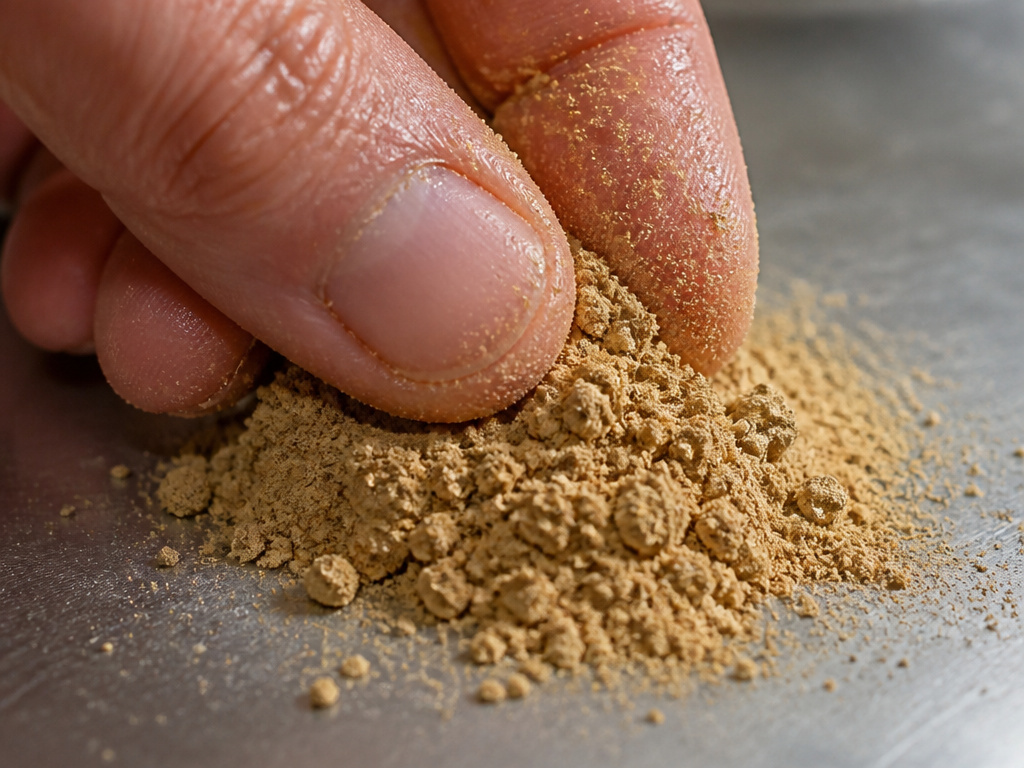
The name on the bag is a category, not a cut. It tells you the species and the fact that the material was rendered. It doesn’t tell you the mix of parts or their share of the bag.
Rendered ingredients carry different names than raw ones, which is why the same animal appears twice on a panel as “chicken” and “chicken by-product meal.” The meat meal versus fresh meat distinction is a moisture question before it’s a quality question. Fresh chicken is mostly water. The meal isn’t.
Most byproducts don’t even use the word. Wheat bran, wheat middlings, brewers rice, corn gluten meal: all secondary products, none of them labeled “byproduct.” If you’re scanning for the word, you’re missing most of the category.
A rendered meal is a dry, tan-brown powder. Pinch it and your fingers come back with a faint grease film that cold water won’t shift.
What the name leaves open is proportion. Two bags can both list chicken by-product meal in the same position and contain different mixes of organ, bone and connective tissue. That’s why the rendered ingredients entry on a panel is a starting clue and not a verdict.
Where the Safety Rules Actually Stop
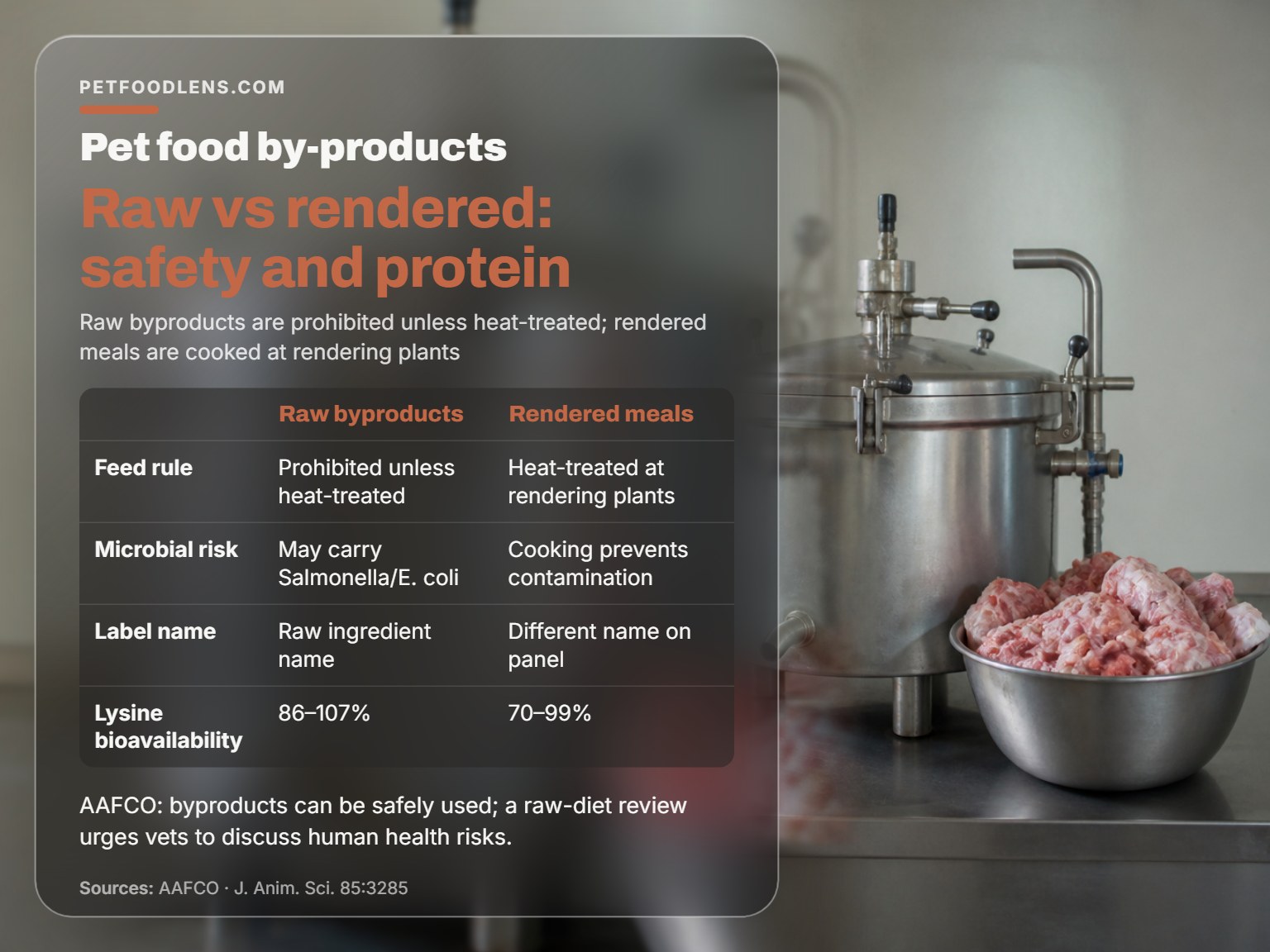
The heat step is the part everyone argues about, and it’s the part the rules already settle. Raw, unprocessed byproducts are prohibited from finished animal feed unless heat-treated to kill microbial contamination. Canned and kibbled products are heat-treated during manufacturing and packaging. Many animal protein products are cooked at rendering plants into dry meals before they ever reach a pet food plant.
The reason is specific. AAFCO notes that raw byproducts may carry disease-causing microbial contamination, naming certain types of Salmonella and E. Coli. Correct heat treatment is commonly practiced for exactly that reason.
A raw byproduct and a rendered meal are not two grades of the same ingredient. They’re two different ingredients with two different risk profiles and two different names on the panel.
This is where the sources genuinely part company. AAFCO’s position is that byproducts can be safely used to provide nutrition. A peer-reviewed pet feed microbiological review and a Canadian Veterinary Journal review of raw diets land somewhere else: the latter concludes there’s enough evidence to compel veterinarians to discuss the human health implications of raw meat-based diets. Meanwhile raw-feeding advocates promote raw meat diets despite the regulatory prohibition on raw unprocessed byproducts in finished feed.
Both positions are real and both are held by people who know the material. Don’t let anyone collapse them into one.
What the federal holding rule actually covers
The 21 CFR 117.95 byproduct holding rule is narrower than its title suggests. It applies to human food by-products held for distribution as animal food without additional manufacturing or processing by the human food processor.
Where it applies, it’s specific. Containers and equipment must be designed, built of appropriate material, cleaned as necessary and maintained. Material must be held so it’s protected from contamination, trash included. It must be accurately identified during holding. Labeling with the common or usual name must be affixed to or accompany it when distributed. Shipping containers like totes, drums and tubs, and bulk vehicles, must be examined before use.
Easy to miss: Once the human food plant puts the material through further processing, this particular rule no longer applies to it. The boundary is processing, not the ingredient.
Above that sits the FDA’s current good manufacturing practice framework for animal food. Facilities that must register because they manufacture, process, pack or hold animal food for US consumption have to follow the CGMPs unless they qualify for an exemption. Farms, retail food establishments, restaurants (which is how pet shelters, kennels and veterinary facilities are classified here), certain foreign facilities, carriers and private residences are on the exemption list. The pet food manufacturer on the bag tells you which of those applies.
How Do You Compare Two Bags When One Uses By-Products?
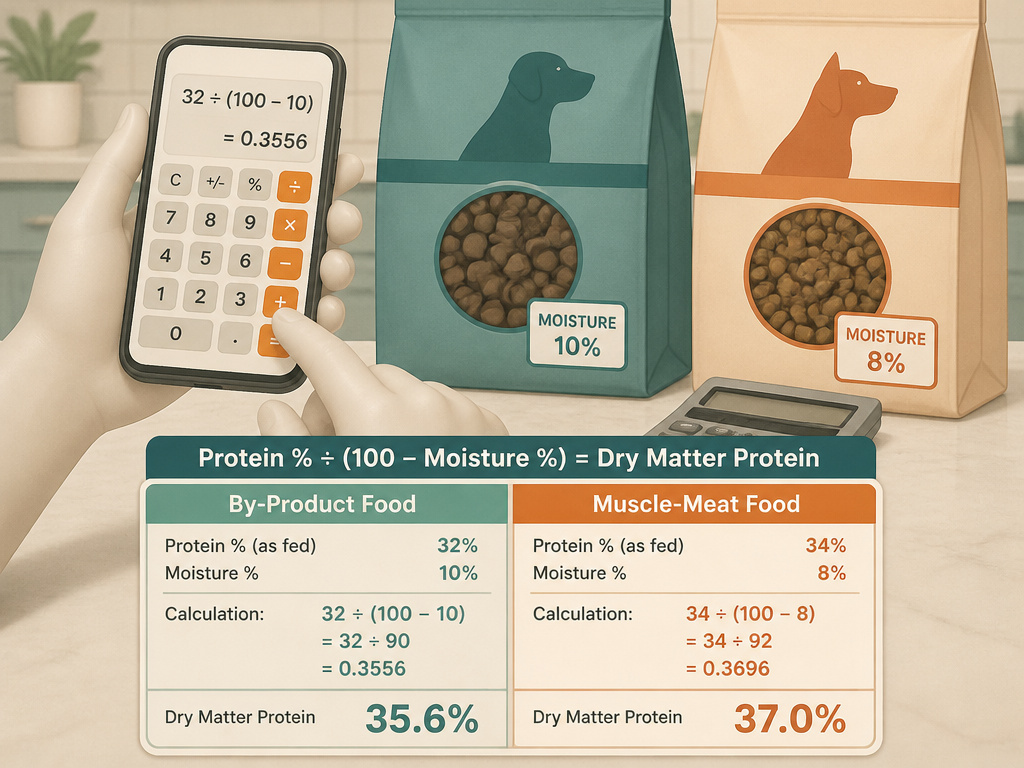
Comparing a by-product food to a muscle-meat food takes three steps, and none of them involve the front of the bag.
- Find the guaranteed analysis and the moisture figure. Without moisture you can’t compare two foods at all. A wet food and a dry food look wildly different as-fed and much closer once water is removed. Skipping this step is how people conclude a canned food is low in protein when it isn’t.
- Convert protein to dry matter. Divide the as-fed protein percentage by the dry matter fraction, which is 100 minus the moisture percentage. Do this for both bags before you form an opinion, or you’re comparing a wet number to a dry one.
- Read the ingredient list against that number, not instead of it. Check for ingredient splitting first, because one protein source divided into four entries changes the order without changing the food.
Here’s the reference table I’d keep on your phone:
| Label entry | What it means | What it leaves open |
|---|---|---|
| Chicken by-product meal | Rendered, one named species | Which organs, and in what proportion |
| Meat byproducts | Lawful with no species named | Which of cattle, swine, sheep or goats |
| Chicken | Raw weight, before cooking | Its share of the finished food |
| Lamb meal | Rendered, one named species | Ranked lowest on PER and NPR in one assay set |
| Wheat middlings | A flour-milling byproduct | Nothing about the food’s overall quality |
What most people get wrong: Comparing an as-fed protein percentage from a canned food against an as-fed percentage from a dry food, then declaring a winner. Those two numbers describe different amounts of water, not different amounts of protein.
Once you compare protein percentages on the same basis, the by-product question shrinks to something manageable: is the ingredient named, and does the rest of the panel hold up?
For a cat, the things I check first are the guaranteed analysis, the ingredient list and the AAFCO adequacy statement. The reason is boring. The guaranteed analysis, the ingredient list and the AAFCO adequacy statement sit on the same panel, so I can do the dry-matter math without hunting for a website.
The Pros and Cons, Weighed Without the Aesthetics
Aesthetics are doing most of the work in this argument, and aesthetics aren’t nutrition. Strip that out and the ledger is short.
What by-products genuinely buy you
- Material that would otherwise be wasted gets used. AAFCO frames byproducts as the excess left after processing human food, and the European review links recycling to economic and environmental benefits.
- Rendered meals store and handle better than raw material, which is why many plants use them in meal form in the first place.
- The category is defined and labeled, with species rules and heat-treatment requirements attached.
- Organ and connective tissue bring nutrients muscle meat carries in smaller amounts. That’s the case for named by-product meals, and it’s the one I’d defend hardest.
What they genuinely cost you
- The word tells you almost nothing about tissue or proportion. “Byproduct” is a category, not a cut.
- Protein quality varies by meal and by process. One assay set ranked rendered below raw across lysine, TSAA, PER, NPR and total amino acid digestibility.
- The evidence isn’t unanimous. A separate trial found no ileal difference for beef, and the measurement method itself is contested.
- Raw unprocessed byproducts carry documented microbial risk and are prohibited unless heat-treated.
- The label can hide the category entirely. Wheat bran and chicken meal are byproducts that never say so.
One more thing worth saying plainly. A claim that circulates on social video, that rendered meals are “often the lowest quality source” and that high-heat processing “can create inflammatory compounds,” is an opinion. Treat it as one. The measured numbers above are what the assays actually produced.
Frequently Asked Questions
Are by-products in pet food bad for dogs and cats?
Not as a category. AAFCO’s position is that byproducts can be safely used to provide nutrition, based on nutrient content and the safety of the processes used. The quality varies by meal and by process, and the label name is a weak guide to which one you’re holding.
Why do some labels say “meat byproducts” without naming an animal?
Because the rule allows it. AAFCO requires the species to be named unless the source is cattle, swine, sheep or goats. So an unnamed entry is lawful, and it tells you only that the material came from one of those four species.
Is chicken by-product meal worse than chicken?
They’re different entries, not two grades of one. Chicken is raw weight before cooking. Chicken by-product meal is rendered. The meal is more concentrated, and the raw entry looks more dominant on the list than it is once water is accounted for.
Does rendering make a byproduct safer?
It reduces microbial risk, which is the point. Rendering cooks the ingredient to prevent microbial contamination, and both canned and kibbled products are heat-treated during manufacturing. Raw unprocessed byproducts are prohibited from finished feed for the same reason.
Should I avoid a food that lists by-products?
Only if you can’t tell what you’re comparing it to. A named by-product meal alongside a readable guaranteed analysis is something you can evaluate. An unnamed entry with no way to do the dry-matter math is a food you can’t check, and that’s a better reason to put it back than the word itself.
The Bottom Line
Here’s the trigger I’d use. If you can’t tell from the label whether the protein is a named species or a class, you can’t compare that food to anything else on the shelf. Put it back and pick a bag you can do the math on. That single test filters more noise than any ingredient blacklist.
I’ll concede the limit of this. I’m not a veterinarian and I can’t tell you what to feed a cat with kidney disease or diabetes. Therapeutic diets are a clinical decision, and the by-product argument doesn’t touch them.
What I will defend is the method. Turn the bag over, find the moisture, convert to dry matter, read the list against the number, and stop rewarding brands for adjectives. Marketing is not nutrition, and the word “byproduct” is neither a warning nor a promise. It’s a category, and now you know what’s inside it.
