
Kibble vs Canned Dog Food: Which Should You Feed?
This post contains affiliate links. As an Amazon Associate, we earn from qualifying purchases.
In the kibble vs canned dog food comparison, the label numbers only mean something after you convert both to dry matter: a canned food at 6% protein and 75% moisture works out to 24% protein on a dry matter basis, while an 18% protein kibble at 6% moisture lands near 19%. Neither format is universally healthier.
Moisture is the variable that scrambles everything. It carries no protein, no fat, and no minerals, yet it takes up most of the weight in a can, so the percentages printed on the label are measuring water as much as food. Put both products on the same dry matter scale and the kibble vs canned dog food argument you were actually having finally becomes visible.
What follows is the arithmetic, the two places where the published sources flatly contradict each other, and the label lines that carry more weight than the photo on the front.
Key Takeaways
- Convert before you compare. Dry matter percentage is 100% minus the moisture percentage on the label, and every nutrient percentage gets divided by that figure.
- A 6% protein canned food beat an 18% protein kibble at 24% versus roughly 19% protein on a dry matter basis in the worked example published by LoveToKnow Pets, though Dr. Bill’s Pet Nutrition holds that dry food has a nutritional density advantage.
-
Kibble’s dental reputation is contested. Dr. Bill’s Pet Nutrition states kibble’s crunchy texture may provide moderate dental benefit, while LoveToKnow Pets makes no dental claim for either format. Dr. Bill’s Pet Nutrition describes only a moderate dental benefit from kibble’s crunchy texture and notes that kibble should not replace regular dental care.
-
Mixing is common advice, but the portion math changes the moment two formats share a bowl.
Why a 6% Protein Can Beat an 18% Protein Bag
Early in this work I lined up a can and a bag on the counter and compared the guaranteed analyses straight across. The can listed 6% crude protein and 75% moisture. The bag listed 18% protein and 6% moisture. The bag looked like three times the food. It wasn’t, and I spent the rest of that afternoon rebuilding the comparison from scratch.
Dry matter conversion removes water from the comparison. Moisture percentage is subtracted from 100 to give the dry matter percentage, and each nutrient percentage on the label is then divided by that dry matter figure. AAFCO sets its nutrient profiles on this basis, so it is the only scale on which two formats can be compared.
Water is dead weight in the arithmetic. It carries no protein, no fat, and no minerals, yet it makes up most of the weight of a can. The label reports percentages as fed, which counts the water in the denominator whether you want it there or not.
That is the whole trick in the kibble vs canned dog food debate. A can that is three-quarters water starts every comparison with a handicap the label never mentions.
AAFCO sets minimum and maximum nutrient levels on a dry matter basis, and by law a food has to meet those minimums before it can carry the 100% nutritionally complete claim. The regulator is already comparing on dry matter. The front of the bag is the only thing in the room using a different scale.
Meeting the minimum does not make two foods equal, either. Two kibbles can both list 18% minimum protein and still feed very differently, because the protein source decides how much of that number the dog actually absorbs. Real meat digests more easily than a cheaper by-product that hits the same percentage, and better absorption shows up as lower stool volume.
The Dry Matter Math, Worked Once
Two steps, one subtraction, one division, and the comparison stops being a guess.
The Formula in Plain English
- Subtract the moisture percentage from 100. A can at 75% moisture is 25% dry matter. Skip this and you are comparing water to food.
- Divide each nutrient percentage by the dry matter figure. 6% protein divided by 0.25 gives 24% protein on a dry matter basis. Skip this and the canned food looks like it barely contains protein at all.
- Run the same two steps on the other product before you decide anything. An 18% protein kibble at 6% moisture is 94% dry matter, so 18 divided by 0.94 lands between 19% and 20%. Skip this and you will assume the bag wins because its number is bigger.
Here is the same arithmetic laid out in a table.
| Food | Dry matter | Protein as fed | Protein on dry matter |
|---|---|---|---|
| Canned pate, 75% moisture | 25% | 6% | 24% |
| Dry kibble, 6% moisture | 94% | 18% | ~19% |
Where the Arithmetic Gets Awkward
The lower the nutrient concentration, the larger the serving you need to reach the same nutrition. That is why a dog on canned food often eats a visibly bigger portion than a dog on kibble, and why the bowl looks wrong for the first week.
Canned food carries more water than kibble, so a larger serving is doing the same nutritional work as a smaller scoop of dry. That is not a defect. It is just the trade you make for moisture.
The same three steps work for any of the types of dog food you might line up, including freeze-dried and gently cooked options that publish a moisture figure.
Where the Published Sources Actually Disagree
Two credible sources can look at the same two products and reach opposite conclusions about which one is more protein-dense.
| Question | LoveToKnow Pets (dry matter method) | Dr. Bill’s Pet Nutrition |
|---|---|---|
| Which is more protein-dense? | Canned example at 24% DM beats kibble at ~19% DM | Dry food holds a nutritional density advantage |
| Does kibble help teeth? | No dental claim made for either format | Crunchy texture may give moderate dental benefit |
| Is canned better for hydration? | More water means a larger serving for equal nutrients | Moisture supports urinary and kidney health |
| One format or a mix? | Never feed a single brand or type exclusively | Many veterinarians recommend mixed feeding |
Both positions are describing something real. They are just measuring different things, and the confusion is worth untangling because it drives most of the argument on this topic.
Calorie density and protein density are separate numbers. Kibble packs more calories per gram because it has less water in it. Canned food can still be more protein-dense on a dry matter basis, because protein as a share of dry matter has nothing to do with calories per gram.
Read the dry dog food case as a calorie argument and it holds up. Read it as a protein argument and it falls apart. Those are two different claims wearing the same word.
The hydration disagreement resolves the same way. Dr. Bill’s Pet Nutrition notes canned food delivers more water per bite, which matters for a dog that drinks little, while LoveToKnow Pets notes that higher water content means a larger serving is needed for equal nutrients. It also means the same can delivers fewer nutrients per gram, which is why the serving size grows.
What most people get wrong: Treating “more water” as “more food.” Water raises the weight of the can and lowers the nutrient concentration at the same time, so a wet food that looks generous on the plate can be the leaner meal.
For the fuller breakdown of each side, the wet dog food trade-offs are worth reading next to the dry ones rather than in isolation.
Does Kibble Actually Clean Teeth?
This is the weakest claim in the whole debate.
Dr. Bill’s Pet Nutrition states that kibble’s crunchy texture may help reduce plaque and tartar during chewing, then adds in the same breath that kibble should not replace regular dental care. That is the strongest version of the claim in the sources here, and it is hedged twice in one paragraph.
The Veterinary Oral Health Council only endorses specific products that have submitted trial data. A blanket “kibble cleans teeth” claim is not what that seal means, and most kibble on the shelf does not carry it.
What to check instead, in order:
- Look for the VOHC seal on the specific bag, not on the brand’s website banner.
- Ask whether the dental claim survives the dry matter conversion. A dental benefit comes from texture and abrasion, so a kibble that softens quickly in saliva does less of it.
- Keep actual dental care on the schedule. Neither format substitutes for it.
Rule of thumb: If a dental claim appears on the front of the bag but not on the VOHC accepted-products list, treat it as decoration. Texture is a real variable, but a claim without trial data behind it is a slogan with a picture of a tooth.
If dental support is the deciding factor for you, compare best dry dog food options by whether the specific product is listed, not by whether the bag mentions teeth.
What Canned Food Does That Kibble Can’t
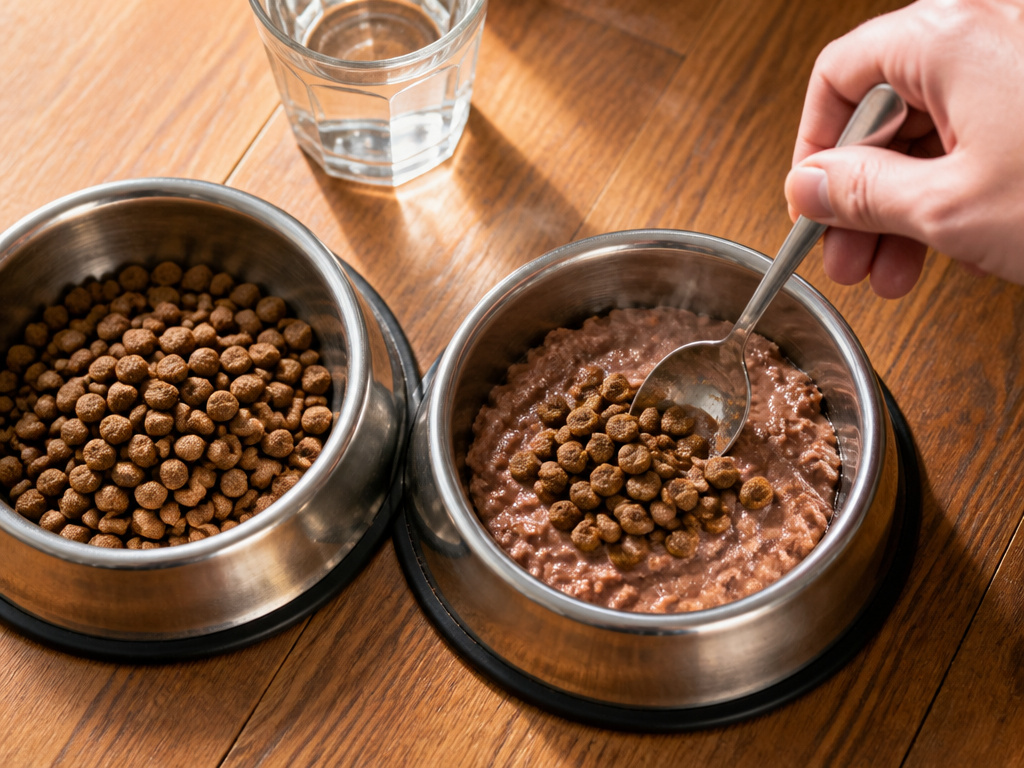
Ever watched a dog walk away from a full bowl and then eat the same kibble happily once a spoonful of wet went on top?
That is aroma doing the work. Canned food smells stronger, and smell drives intake in a way a bowl of dry pellets does not. Dr. Bill’s lists palatability and hydration as wet food’s two clear advantages, and both trace back to moisture.
The softer texture matters too. Dogs with missing teeth, jaw discomfort, or ongoing dental problems eat wet food more easily, and senior dogs are the group where vets most often steer toward wet or mixed feeding.
Some wet formulas also carry higher protein and fewer carbohydrates than a comparable dry food. Because wet food is less calorie-dense, it can leave a dog feeling full on fewer calories, which is useful for weight management.
One practical note from my own kitchen: stirring a tablespoon or two of warm water into a pate raises intake noticeably, and warming is probably half of why it works. Heat pushes aroma into the room before the bowl reaches the floor.
Worth knowing before you start: Warm water, not hot. Hot water cooks the outside of the pate and turns the texture grainy, and a dog that turns its nose up at the first bowl is harder to convince on the second.
If you are shopping this format, start from a best canned dog food list and then check each label for the adequacy statement before anything else.
How Much Do You Feed When You Mix Kibble and Canned?
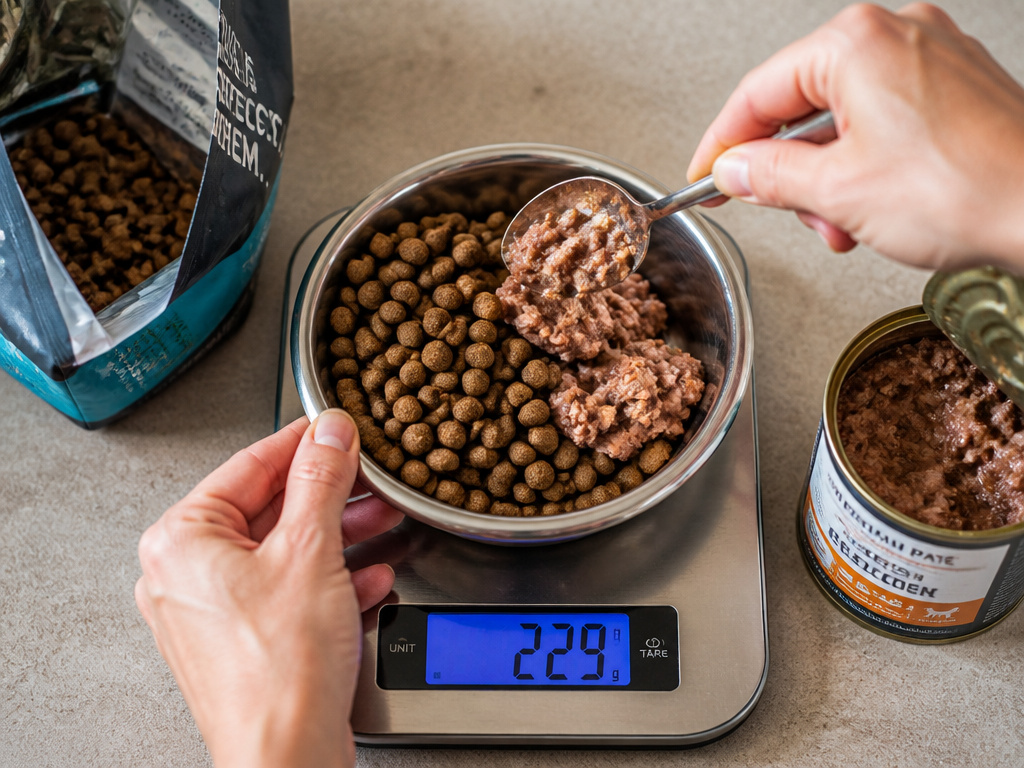
AAFCO’s adequacy statement tells you a food is complete. It says nothing about how much of it your dog needs, and that gap is where most mixing goes wrong.
Before you start: Wet food left at room temperature is a bacterial growth medium, and owners commonly report lifting the bowl within about two hours of serving. Wash the bowl between meals rather than topping up, because old residue plus fresh food is the pairing that causes trouble. Dry kibble is not sterile either, so wash hands after handling it and store it sealed.
Here is the sequence that keeps the math honest:
- Set the total daily portion from the feeding guide first, using your dog’s current weight and activity level as the starting point. Skip this and you will adjust two formats in the dark.
- Split that total between the two formats by calorie share, not by volume. A half-and-half split by volume is not a half-and-half split by calories, because the two formats carry different calorie density.
- Convert both halves to dry matter before you judge the protein level. Skip this and a mix that looks balanced on the plate can land well under the protein you thought you were feeding.
- Watch the bowl and the stool for a week before changing anything else. Change one variable at a time or you will not know which one moved the result.
Owners report a simple 50/50 mix, and the anecdotal feeding ratios are about 1.5 cups of kibble per 20 pounds of dog or one can per 20 pounds of dog. Treat those as starting points from someone else’s dog, not as a feeding chart.
Water needs shift with size, activity level, and environment, and a dog eating mostly dry food generally needs to drink more than a dog eating wet. Fresh water available all day is not optional on a kibble-heavy diet.
When you are ready to settle the format question properly, how to choose a dog food format walks through the lifestyle side of it.
Dry food has its own record.
I keep kibble in the original bag inside a bin now, and I empty and wash that bin between bags. I once dumped out a bin at the bottom of a pantry and found a yellowish, tacky film on the walls and a sharp crayon-and-paint smell. Months of fresh kibble had been poured over that residue, so every new batch met old oxidized fat on day one.
Easy to miss: A bin that smells like crayons is telling you the fat has oxidized. Washing it with hot soapy water and letting it dry completely takes longer than you expect, and damp plastic plus fat residue is a worse pairing than the bag ever was.
Frequently Asked Questions
Is canned dog food more nutritious than kibble?
Not automatically. On a dry matter basis, the published worked example puts a 6% protein canned food at 24% protein and an 18% protein kibble at roughly 19%. Change either product and the result changes, which is why the conversion matters more than the format label.
Can I mix kibble and canned dog food in the same meal?
Yes, and many veterinarians recommend a mixed approach. The catch is portion math: split the daily total by calorie share rather than by volume, because the two formats carry different calorie density per gram.
Does dry food really clean a dog’s teeth?
The evidence is thinner than the packaging suggests. Dr. Bill’s describes a moderate benefit from the crunchy texture while noting kibble should not replace dental care. The Veterinary Oral Health Council endorses specific products with submitted trial data, not kibble as a category.
How do I compare two dog foods on the label?
Subtract the moisture percentage from 100 to get dry matter, then divide each nutrient percentage by that figure. A 6% protein canned food at 75% moisture becomes 24% protein on a dry matter basis. Do the same to both products before comparing anything.
Is wet food better for senior dogs?
It is often preferred, for two reasons: extra moisture and easier chewing. Dr. Bill’s notes that senior dogs frequently do better on wet or mixed feeding, though the format matters less than whether the food is nutritionally complete for the dog’s life stage.
The Bottom Line
Here is the trigger that should decide it for most households: if your dog drinks little, has had urinary or kidney concerns, or has trouble chewing, canned food earns its place in the bowl regardless of what the protein numbers say. If none of those apply and your dog is active and healthy, kibble plus constant access to fresh water is a defensible default.
The first step this week is small. Pull two products you already own, find the moisture line on each label, and run the two-step conversion. Most people have never done it once, and the result usually reframes the whole comparison in about ninety seconds.
One concession worth stating plainly: this is label and published-data work, not veterinary work. If your dog has kidney disease, diabetes, or a diagnosed condition, the dry matter math is the start of the conversation with your vet, not the end of it. Individual health factors override a format argument every time.
