
How Many Times a Day Should You Feed a Dog? 3 Meal Rules
This post contains affiliate links. As an Amazon Associate, we earn from qualifying purchases.
Feed a healthy adult dog twice a day: two measured meals at regular times. That’s how many times a day you should feed a dog in most cases. Puppies under six months need at least three meals, and the veterinary sources split between three and four.
Measured is the load-bearing word in that answer. A scoop drifts from fill to fill depending on how the kibble settles, so “two meals” can quietly become more food than the bag’s chart calls for. A gram scale removes the drift, and it settles the question of how many times a day should you feed a dog.
What follows is the age-band schedule the sources actually give, the one peer-reviewed study that argues against the two-meal default, and the medical exceptions that break the rule entirely.
Key Takeaways
- Two measured meals is the working default for healthy adult dogs, and Merck names portion-controlled feeding at regular times as the best regimen to prevent obesity.
- Puppies under six months get three meals from Merck and Tufts, three to four from VCA, and a legal minimum of two with an 8-hour gap under North Carolina rule 02 NCAC 52J .0205.
- Once-daily feeding scored 0.62 points lower on the Dog Aging Project’s cognitive dysfunction scale, but the authors flag reverse causality for GI and liver conditions.
- Treats stay under 10 percent of daily calories, per Merck, or the complete diet stops being complete.
- Free-feeding hides intake. Measure the day’s portion and record what’s left, or you have no data to adjust from.
How Many Times a Day Should an Adult Dog Eat?
Two measured meals at regular times is the regimen Merck’s veterinary manual names as best for preventing obesity in most adult dogs, though Tufts treats once, twice, or more as flexible and the Dog Aging Project found better outcomes with once-daily feeding. VCA arrives at the same place from the stomach side: food leaves the stomach within a few hours, and after 8 to 10 hours empty, the stomach starts sending hunger signals to the brain.
Adult dogs on a twice-daily schedule receive two premeasured meals at consistent times. The stomach empties within hours of a meal, and an empty stomach triggers hunger signalling after roughly 8 to 10 hours. Portion-controlled feeding at fixed times is the regimen the Merck Veterinary Manual identifies as most effective for obesity prevention in adult dogs.
The Tufts Petfoodology feeding frequency article treats the question as flexible. Once a day, twice a day, or more all work for a healthy adult, provided the daily nutritional requirement is met, and most families land on two meals.
VCA allows one meal for dogs that aren’t especially food-motivated. That’s a real exception. It isn’t a recommendation for the general population.
I lean toward two measured meals a day for most healthy adults when I consider how many times a day should you feed a dog. It makes appetite changes obvious, and a skipped bowl is useful information rather than a mystery.
Age changes the number. The feeding schedule by age is the reference I keep open when a puppy and a senior are in the same house.
Where the One-Meal Case Comes From
VCA’s reasoning is mechanical. A dog’s stomach empties within a few hours of a meal, and the hunger signal fires after 8 to 10 hours. One meal a day means a long stretch on an empty stomach, which most dogs tolerate and some don’t.
That’s the whole case from VCA: some dogs do fine. The AKC how often dogs should eat page reaches the same two-meal default from the owner-facing side.
| Schedule | Best For | Main Risk |
|---|---|---|
| Once daily | Less food-motivated adults, per VCA | Long empty-stomach stretch; hunger signalling after 8 to 10 hours |
| Twice daily | Most healthy adults | None if portions are measured |
| Three or more | GERD, post-illness, small frequent feeders | Total calories creep up unless portions shrink |
| Free choice | Rare cases where condition holds | Intake unmeasurable; obesity risk |
Three signs tell you the frequency is wrong, and none of them are the dog’s opinion:
- The dog finishes every meal quickly and then licks the bowl afterward.
- Weight drifting up or down across two consecutive weigh-ins.
- A dog that walks away from a full bowl at the same time every day.
Treats belong in the same arithmetic. Merck puts the ceiling at less than 10 percent of total caloric intake, and that’s a ceiling for a reason: most treats aren’t complete and balanced, so past that line the diet stops being complete. If you want the math done once and written on the fridge, the daily treat limit is worth the ten minutes.
Why Do Puppies Under Six Months Get Three Meals Instead of Two?
Four sources, four numbers, same age band. Merck says three times a day from weaning to six months. Tufts says at least three separate meals. VCA says three to four meals can help. North Carolina’s administrative rule sets the legal floor at two per 24 hours, with an 8-hour minimum gap if only two are offered.
What most people get wrong: Splitting a puppy’s daily ration into two big meals and calling it done. Tufts ties the smaller, more frequent meals directly to a puppy’s smaller stomach against higher nutrient needs.
That’s the mechanism, and it’s the same one VCA gives: break the day’s food into smaller volumes for a small belly. A puppy needs more total nutrition than an adult and has less room to hold it.
| Source | Under 6 Months | Notes |
|---|---|---|
| Merck Veterinary Manual | 3 meals a day | Small breeds may need more than three |
| Tufts Petfoodology | At least 3 separate meals | Smaller stomachs, higher nutrient needs |
| VCA Animal Hospitals | 3 to 4 meals a day | Splits daily volume into smaller portions |
| NC rule 02 NCAC 52J .0205 | At least 2 per 24 hours | 8-hour minimum gap if only two |
The legal minimum is worth reading twice. North Carolina’s rule applies to licensed facilities, and it permits two feedings for a puppy under six months only if they sit at least eight hours apart. That’s a legal floor, and it’s the lowest number in the table.
From six to twelve months, Merck drops the schedule to twice daily. Small breeds may still need more than three meals a day before that point, so the band isn’t uniform across sizes. The how often to feed a puppy question has its own age steps, and the six-month line is where most owners get caught out.
Split the daily ration into three meals and watch the puppy, not the bowl. Merck calls for weekly weight checks and a small, steady gain each week. If the ribs disappear under padding, cut the total; if they’re sharp, add.
Large and giant breeds need one more check on the label. Merck specifies a growth diet carrying the AAFCO statement “including growth of large size dogs (32 kg or more as an adult).” Small and medium breeds can use a growth or all-life-stages diet that doesn’t meet it.
The feeding chart on the bag is written for a range of weights, and a growing puppy moves through that range in weeks. Re-check the chart at every weigh-in.
What Did the Dog Aging Project Find About Once-a-Day Feeding?
The Dog Aging Project once-daily feeding study, published in GeroScience in 2022, examined once-daily feeding against cognitive and health outcomes. Once-daily-fed dogs scored 0.62 points lower on the Cognitive Dysfunction Scale (95% CI 0.27-0.97; p<0.001). The authors describe that gap as equivalent to the mean difference between 7- and 11-year-old dogs.
That’s a large effect for a feeding schedule. It’s also a cross-sectional study, so it shows association rather than cause.
The part nobody mentions: The study’s own authors call the rationale for twice-daily feeding “obscure” and suggest more frequent feeding may be suboptimal for several age-related health outcomes. That’s a peer-reviewed paper questioning the default, not a blog.
They also concede that reverse causality is a particular concern for GI and liver conditions. A dog with a liver problem may have been switched to more frequent meals before the survey, which would put the causality backwards.
I still feed most healthy adults twice a day. Two meals give me two data points a day on appetite, and appetite is the cheapest health screen an owner has.
That’s the honest position. The effect size is real, the caveat is real, and one cross-sectional survey doesn’t justify flipping every dog in the country to one meal.
Free Feeding vs. Scheduled Meals: What You Can Actually Measure
Free feeding makes intake impossible to measure. That’s the whole problem in one sentence.
Merck’s position is that some adult dogs can be fed free choice, but most can’t without becoming obese, and portion-controlled feeding is the better regimen. Tufts goes further: free-feeding isn’t recommended unless every pet with access to the food holds an ideal body condition score on free access. VCA allows grazing for a single-dog household with no plans for another, provided the owner measures out the day’s portion and records what’s left.
Owners ask me how many times a day should you feed a dog and whether they can skip the measuring and just leave the bowl full. In my experience with weight problems, unmeasured bowls almost always lead to overfeeding within a few weeks. The dog doesn’t look heavier. Then the scale at the next visit says otherwise.
Owners swear the dog only eats when hungry. The weigh-in usually disagrees.
Kibble that sits in the bowl all day goes dull and picks up a stale smell by evening, and a dog that’s already full will nose it around rather than eat it. You learn nothing from a bowl like that.
Where this goes sideways: A bowl left down all day means the day’s intake is unknown. By the time the weight shows up, you’ve lost the data you’d need to correct it.
The free feeding vs scheduled comparison comes down to one question: can you state your dog’s daily intake in grams?
Multi-dog homes have a harder version of the same problem. North Carolina’s rule requires caretakers to observe each animal feeding when multiple animals are housed together, which is the licensed-facility version of something every multi-dog kitchen deals with. A shared bowl tells you nothing about who ate what.
How Do You Set a Feeding Schedule When You Work Long Hours?
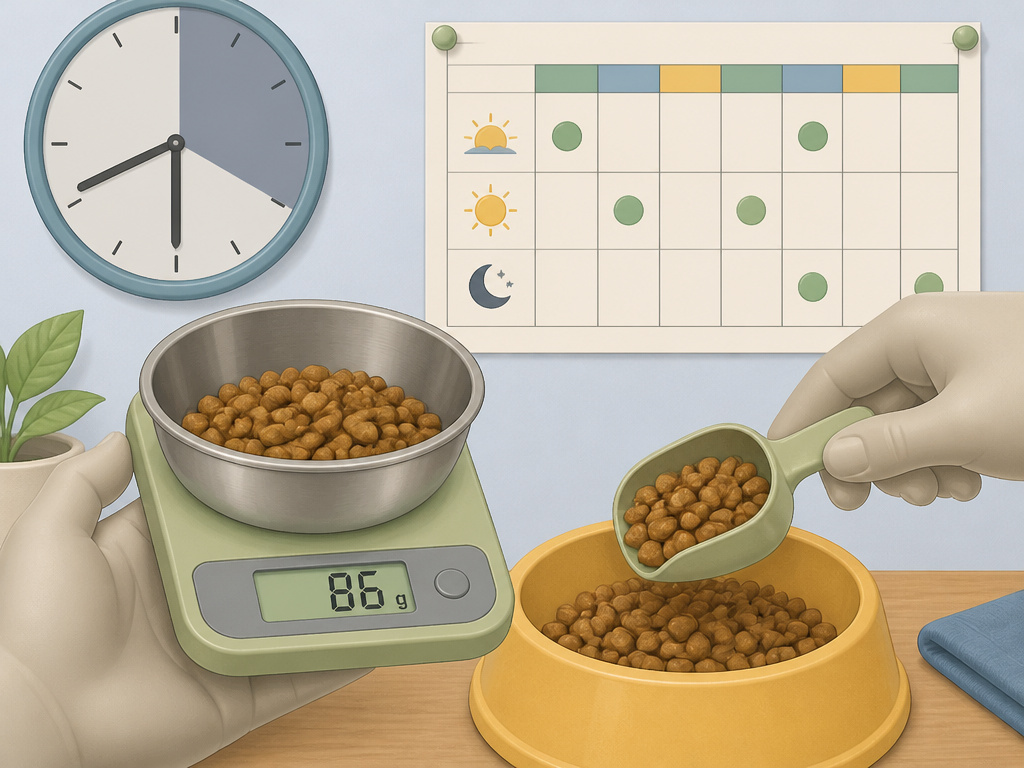
What happens to the evening meal when you don’t get home until nine?
Before you start: Don’t move a diabetic dog’s meal times without your vet, because Tufts specifies a rigid twice-daily schedule for diabetes. Don’t cut a growing puppy’s ration to hit a number on a bag. And in a multi-dog house, feed separately or watch each dog eat, because a shared bowl hides who ate what.
- Weigh the day’s ration in grams once, in the morning, on a kitchen scale. Skip this and every later adjustment becomes guesswork.
- Split it into the meals your dog’s age band calls for. Two for a healthy adult, three or more for a puppy under six months. Get the split wrong and the total calories drift.
- Fix the times and hold them, weekends included. VCA notes that a set schedule makes house training easier and makes a later medical schedule change trivial.
- Log what’s left when the day ends. A dog that leaves food is telling you something. So is a dog that licks the bowl clean and then paces.
- Re-weigh the dog regularly and adjust the total. Merck’s guidance for puppies is weekly weight checks with a small steady gain.
If the schedule can’t survive your shift pattern, a timed feeder is the honest fix. The automatic dog feeders that hold a weighed portion are worth more than the ones with a big hopper and no portion control.
The feeding a dog when you work long hours problem usually comes down to one meal landing in the middle of a shift. Move that meal to the edge of the shift, not the middle of it.
Portion size and frequency are separate questions. The how much dog food by weight calculation sets the daily total. The schedule only decides how that total gets split.
When Does the Standard Schedule Break? Medical Exceptions
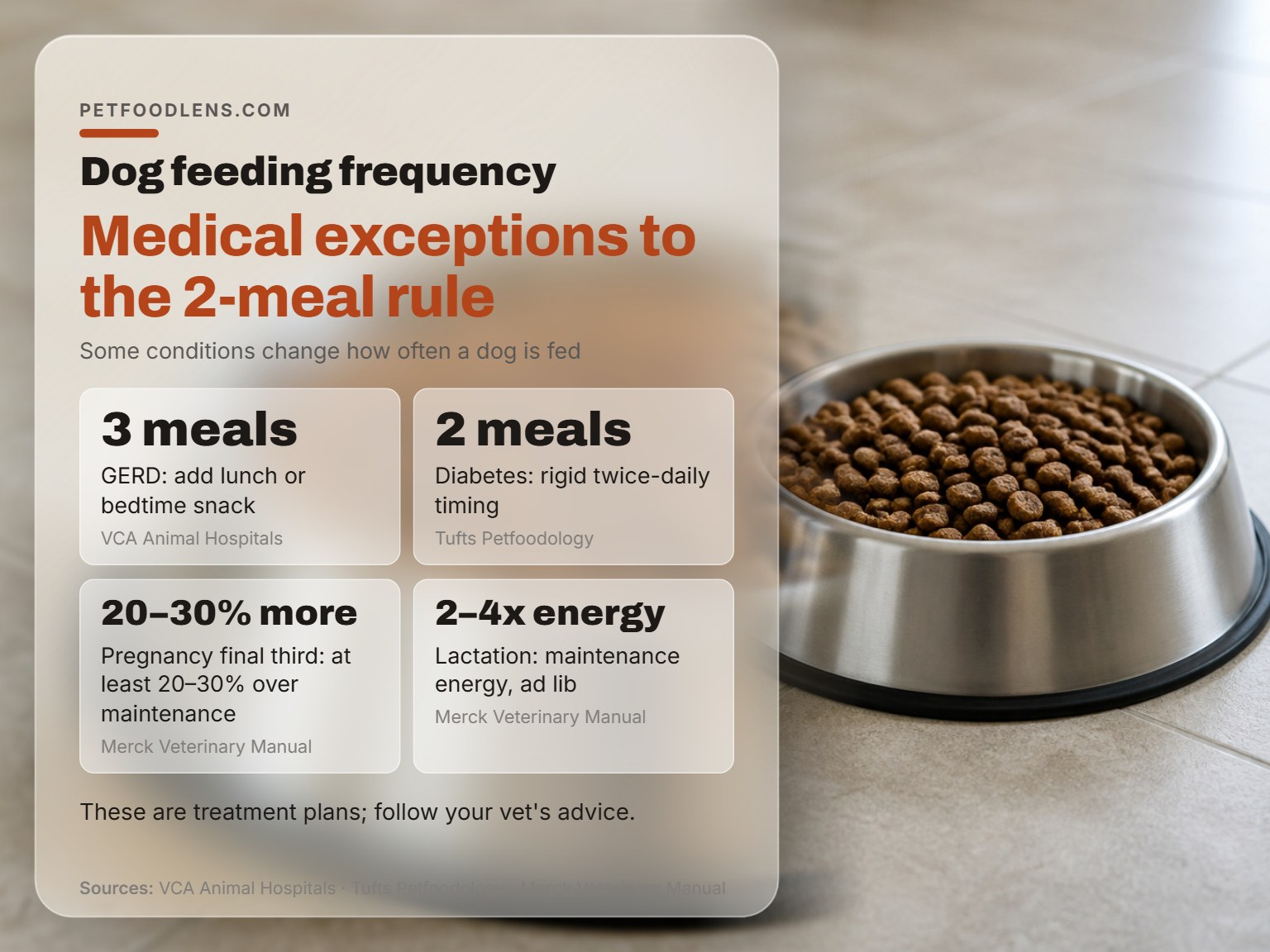
Three conditions rewrite the schedule, and none of them are owner judgment calls.
Dogs With GERD or Reflux
VCA notes that dogs with gastroesophageal reflux are prone to reflux when the stomach stays empty too long, and a third meal as lunch or a bedtime snack can be added. That breaks the two-meal rule on purpose.
Dogs With Diabetes
Tufts specifies the opposite adjustment: a more rigid twice-a-day schedule. The meal times become part of the treatment, and moving them is a veterinary decision.
Pregnant and Lactating Bitches
Merck calls for at least a 20 to 30 percent increase over maintenance in the last third of gestation. Lactating bitches often need 2 to 4 times maintenance energy, and ad lib feeding of a growth diet with 10 to 20 percent fat is the recommendation, rising to 20 to 30 percent fat if the bitch loses condition. The AAHA canine life stage feeding guidelines put most lactating bitches on free choice, which is the one case where free feeding is the standard rather than the risk.
The full list of exceptions, in one place:
- GERD or reflux: a third meal or bedtime snack, per VCA.
- Diabetes: rigid twice-daily timing, per Tufts.
- Gastrointestinal disease: more frequent, smaller meals, per Tufts.
- Pregnancy, final third: 20 to 30 percent more food than maintenance, per Merck.
- Lactation: 2 to 4 times maintenance energy, ad lib, per Merck and AAHA.
- Giant breeds: adulthood delayed to 18 months, per Tufts, so the puppy schedule runs longer.
Those are treatment plans, and they belong to your vet. I’m not a clinical specialist, and a dog with kidney disease or diabetes needs a veterinarian more than a comparison chart.
Frequently Asked Questions
Is it better to feed a dog once or twice a day?
Twice a day is a common default for most healthy adults, though Tufts treats once, twice, or more as flexible and the Dog Aging Project found better outcomes with once-daily feeding. Merck names two premeasured meals at regular times as the best regimen to prevent obesity, and VCA points to hunger signalling after 8 to 10 hours on an empty stomach. The Dog Aging Project found better cognitive scores in once-daily-fed dogs, but that’s a cross-sectional association with a conceded reverse-causality problem.
Can I leave food out all day for my dog?
Only if you can still state the daily intake in grams. Tufts doesn’t recommend free-feeding unless every pet with access holds an ideal body condition score on free access, and Merck says most adult dogs become obese on free choice. VCA allows grazing for a single-dog household if the owner measures the day’s portion and records the leftovers.
What time of day should I feed my dog?
The same times every day matters more than which times. VCA notes that a set schedule aids house training and makes a later medical schedule change easy. Most owners land on a morning and an evening meal.
Do large-breed puppies need a different schedule?
The schedule is similar, but the diet isn’t. Merck specifies a growth diet carrying the AAFCO statement “including growth of large size dogs (32 kg or more as an adult)” for large and giant breeds, Tufts puts adulthood at up to 18 months in giant breeds.
How many meals a day does a six-month-old puppy need?
Merck drops the schedule to twice daily from six to twelve months. Small breeds may still need more than three meals a day before that point, so check the body condition score rather than the calendar.
The Bottom Line
Start with two measured meals a day for any healthy adult dog. Weigh the food, fix the times, and hold them for two weeks before you change anything.
If you want one answer and you have a healthy adult dog: two weighed meals, same times daily, adjusted every couple of weeks against the body condition score.
The one thing that would change my answer is a diagnosis. A diabetic dog runs on a rigid twice-daily schedule. A dog with GERD may need a third meal. A pregnant bitch eats free choice. Those are treatment plans, and they belong to your vet.
And the number on the bag is a starting point written for a range of dogs. Weigh the food, weigh the dog, and let the scale settle it.
