
How to Use a Kitchen Scale for Dog Food: Step-by-Step
This post contains affiliate links. As an Amazon Associate, we earn from qualifying purchases.
To use a kitchen scale for dog food, set the bowl on the platform, tare the display to 0.0 g, and add kibble until it reads your dog’s gram target. In a 2019 study of 100 dog owners, measuring error ranged from -47.83% under to +152.17% over the correct weight.
That +152.17% ceiling is where small dogs get hurt. A veterinary brochure summarizing the same study puts the overestimate at up to 1.5 times the correct amount, and the authors flagged small dogs as the group at highest risk. A 30-gram portion that lands at 45 grams is a slow gain nobody notices until the collar gets tight.
What follows is the tare sequence, the unit-mode trap that quietly turns a weight into a volume guess, the scale specs that matter at small portions, and the one place where published guidance splits on how often to weigh.
Key Takeaways
- Tare the bowl to 0.0 g before the kibble goes in. Weighing bowl plus food and subtracting in your head is where most of the error starts.
- Use grams, not ml or fl oz. The scale manual itself calls fluid measures “an approximation” that assumes water or oil density.
- The CommuniVet brochure states a 1-cup dry-food cup beat the liquid cup and the commercial scoop, and it still came nowhere near a gram scale.
- Small dogs carry the most risk. The CommuniVet brochure states the smallest volume tested, 1/4 cup, produced the greatest inaccuracy.
- Weigh the daily allowance once and split it, or weigh each meal. Both work. The sources don’t agree on which one to teach.
Why Cup Measurements Miss by Up to 152%
A hundred dog owners, three measuring devices, and one electronic gram scale acting as referee. That was the setup for a PMC dog food measuring accuracy study published in Vet Record in 2019, and the spread it found is the reason this page exists.
Individual owner accuracy ranged from -47.83% under the correct weight to +152.17% over it. The 2019 study enrolled 100 dog owners and tested 1/4, 1/2 and 1 cup volumes against an electronic gram scale. Accuracy was associated with both the volume measured and the device used (p<0.001).
Sixty-one percent of the owners in that study used a measuring cup for their dog’s food. Two percent used a gram scale for the dog, against 20 percent who used one for their own food. The measuring cup is the default tool in most kitchens, and the study’s own conclusion points away from it.
| Device tested | What it is | How it performed |
|---|---|---|
| 1-cup dry-food measuring cup | A scoop built for kibble | Most accurate of the three devices, per the CommuniVet brochure |
| 2-cup graduated liquid cup | A standard kitchen liquid measure | Less accurate than the dry-food cup |
| 2-cup commercial food scoop | Unmarked feed scoop | Overestimation common, per the CommuniVet brochure |
| Electronic gram scale | The referee, not a test device | Ground truth for every comparison |
The CommuniVet brochure states the dry-food cup came out ahead of the other two. That’s a real finding and a low bar at the same time. Beating a liquid cup and an unmarked scoop doesn’t make volume accurate, and the authors still pushed readers toward gram scales and volume-calibrated dry-food cups.
I used to hand clients a scoop and call it portioning. Then I filled the same scoop ten times with the same kibble and weighed every fill on a kitchen scale. The spread varied from lightest to heaviest, depending on how hard I shook it and how full the bag was. Small-bite kibble packed tighter than large pellets, so the same scoop held noticeably more grams.
A cup is a volume guess wearing a measurement’s clothing. Most owners who learn how to use a kitchen scale for dog food never go back to measuring portions by volume once they see that spread on their own counter, as covered in measuring dog food portions.
How to Use a Kitchen Scale for Dog Food, Step by Step
Six steps, and only one of them involves the kibble.
Before you start: The scale needs a hard, flat, level surface, and a soft mat or folded towel under it will trigger “UnSt” for 10 seconds instead of a reading. Wash your hands after handling kibble, and wipe the platform dry between foods, because a fat film left on the glass carries into the next portion.
- Set the scale on a hard, flat, level surface. Skip it and the display flashes “UnSt” for 10 seconds and refuses to settle on a number.
- Press ON and wait for 0.0 g. The panel runs a self-test first. Drop food on during that self-test and the zero is off before you start.
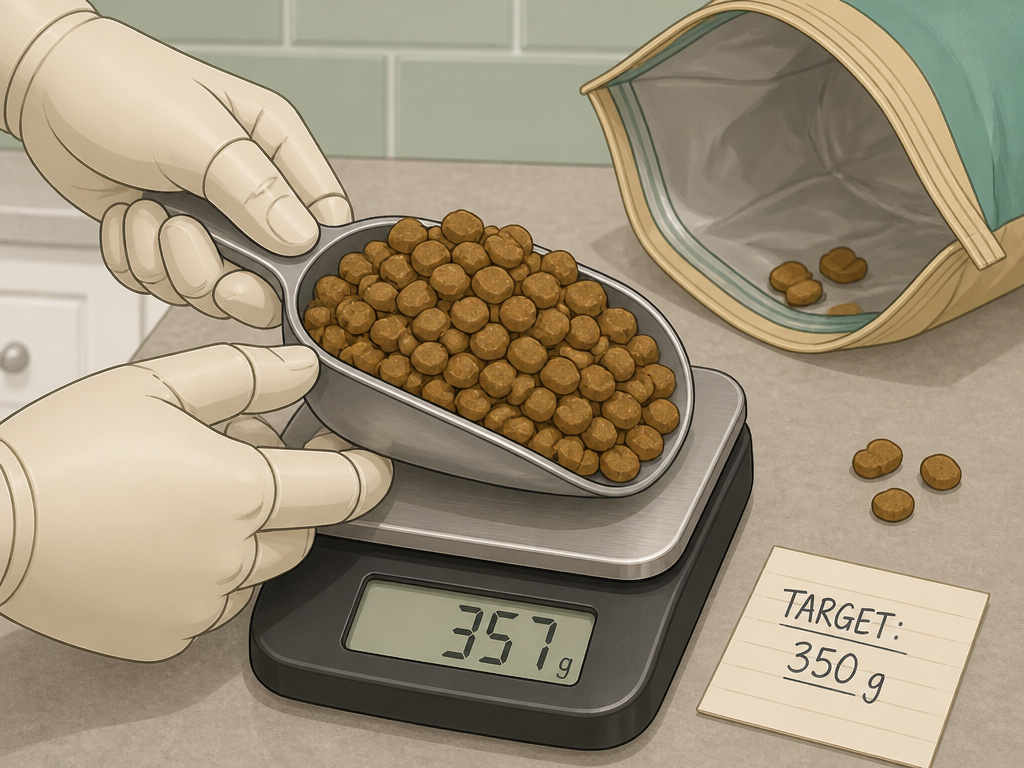
- Set the bowl on the platform and press TARE until it reads 0.0 g. Without this you’re reading bowl plus kibble and doing subtraction in your head at 6am, which is exactly how an error sneaks in.
- Press MODE until “g” appears. ml and fl oz are volume approximations. Kibble isn’t a liquid, and the manual says so.
- Add kibble until the display hits the gram target for that meal. Pour slowly past the halfway point; the reading lags a beat behind your hand.
- Press HOLD if the bowl hides the display. HOLD locks the current weight for 20 seconds, long enough to set the bowl down and read it.
Why Tare Beats Subtraction
Taring zeroes the container so the display shows only what you add. Subtraction does the same arithmetic, but it does it in your head, and it does it while the scale is still settling.
The Proctor Silex 86500 manual spells out the sequence: place the bowl, press ON, confirm “0.0g,” then add food. If you pull the bowl off afterward, the display shows a negative number. That’s the scale telling you the bowl is gone, not that something broke.
Weigh the empty bowl once and write the number on the bottom with a marker. Then you have a check against your own tare if a reading ever looks wrong.
Which Unit Mode Do You Actually Want?
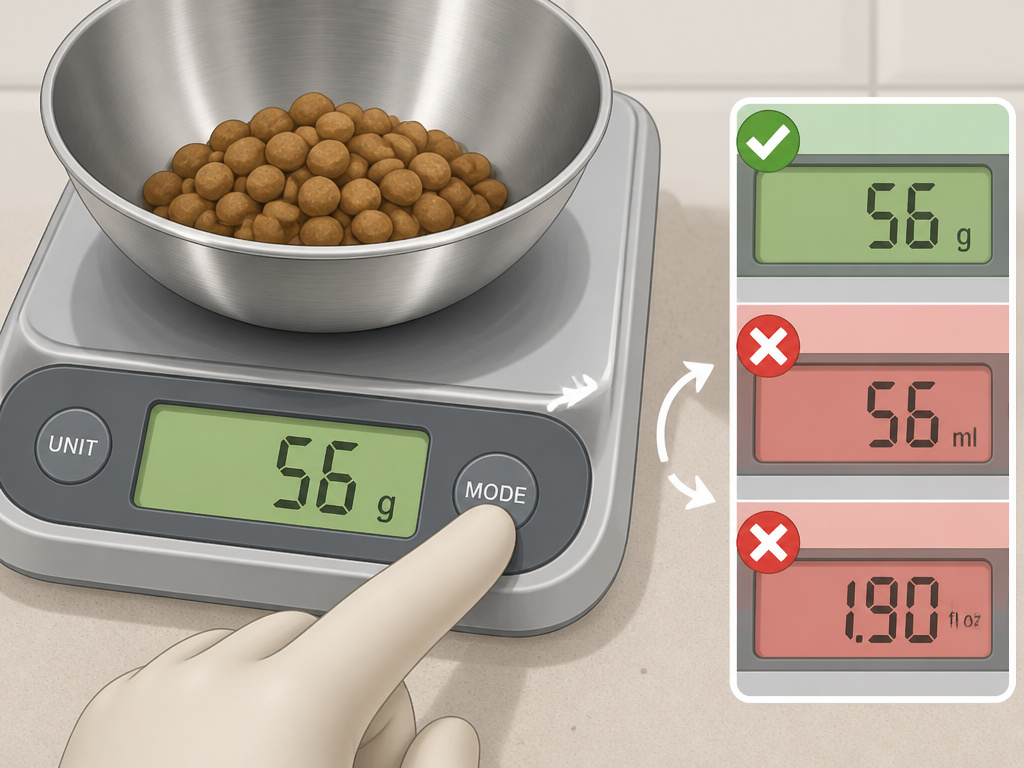
Which of the six modes behind the MODE button gives you a real measurement of kibble? Only three of them, and the other three are a trap that looks like a feature.
The MODE button cycles lb, kg, ml, fl oz, oz, and g. The manual is unusually blunt about the split: pounds, ounces, kilograms, and grams measure the weight of solid foods, which is the core of how to use a kitchen scale for dog food. Fluid ounces and milliliters measure volume, and the manual calls those “an approximation of fluid measures” that assume you’re measuring a liquid such as oil or water, because densities of different liquids vary.
- Grams. The default for portioning. Small numbers, fine resolution, and the unit every bag’s kcal/kg figure converts into.
- Ounces. Workable, but you lose resolution. A 0.1 oz step is coarse, which is a lot of kibble on a small dog.
- Kilograms and pounds. Fine for the whole bag, useless for a single meal.
- ml and fl oz. Volume dressed as weight. Don’t.
Common mistake: Leaving the scale in ml or fl oz mode because the number looks plausible. Nothing flags the error, no beep sounds, and weeks can pass before anyone realizes the “portion” was a volume approximation of a solid food.
Here’s where the bag makes it worse. Feeding charts are printed per cup, and a cup assumes an 8 fluid oz measure with the food exactly level to the top. That’s a volume instruction sitting on a package whose calorie panel is usually written per kilogram. The two don’t line up, which is why reading a dog food feeding chart properly means finding the weight-basis figure, not the cup figure.
What the Scale Specs Mean at Small Portions
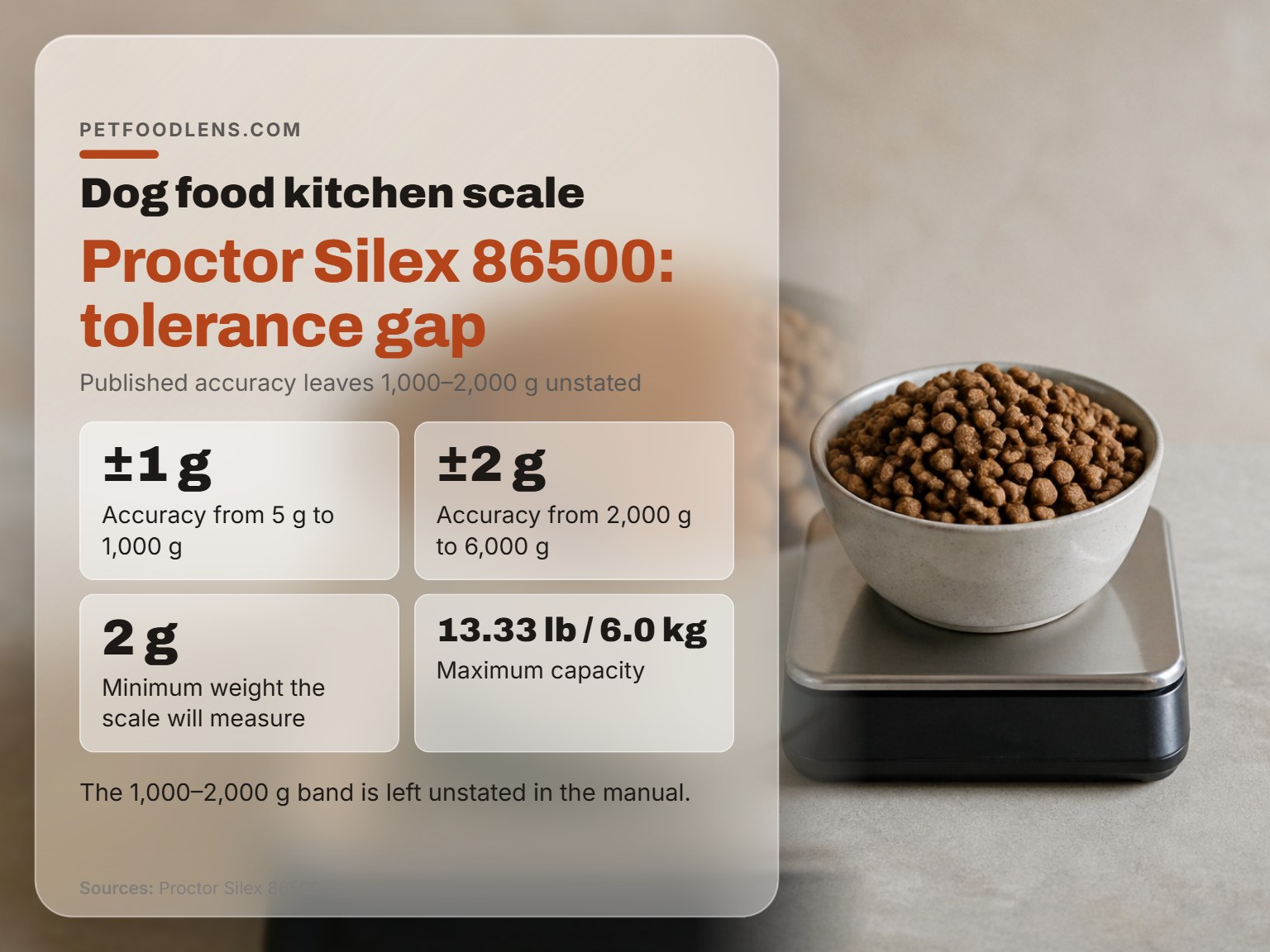
The Proctor Silex 86500 publishes tolerances that most kitchen scales bury in a footnote, and those numbers decide whether a scale is good enough for a 12-pound dog.
| Spec (Proctor Silex 86500) | Published value |
|---|---|
| Maximum capacity | 13.33 lb / 6.0 kg |
| Minimum weight | 2 g |
| Accuracy, 5-1,000 g | +/-1 g |
| Accuracy, 2,000-6,000 g | +/-2 g |
| Overload response | “EEEE” and 6 beeps at 6,050 g or more |
| Auto shutoff / HOLD lock | 90 seconds idle / 20-second lock |
Read that table twice, because there’s a gap in it. The manual specifies +/-1 g from 5 g up to 1,000 g and +/-2 g from 2,000 g to 6,000 g. The 1,000-2,000 g band is left unstated. For a Lab-sized meal that band is where you live, and the manufacturer doesn’t tell you the tolerance there.
At the small end, +/-1 g on a 30-gram portion is a small fraction of the portion. That’s fine. The problem is the floor: a 2 g minimum means a cat’s 35-gram meal is measurable but a 1-gram treat isn’t, and small portions are exactly where the 2019 study found error at its worst.
I’d rather see someone spend the money on a scale with a stated tolerance than on a bag with a wolf on it. A tolerance is a number you can check. A photograph is not.
For most households the Proctor Silex 86500 is enough scale: it tares, it reads grams, and it tells you when it’s overloaded instead of drifting quietly. If you mix wet and dry, the Adam CBX Compact Balance adds a percentage weighing function, so you can build a bowl at 50 percent dry, 40 percent tinned, and 10 percent topper without doing the arithmetic yourself. The Adam CB Compact Balance does the same job without the percentage mode.
One mechanical note. Kibble plus a heavy ceramic bowl adds weight, so tare first and watch for the overload trip point. Tare first, and if you see “EEEE” and hear six beeps, you’ve overloaded it, not broken it.
Once you know your scale’s tolerance, the next question is how much food actually belongs on it. That’s a how much to feed question, and it starts with body weight and calorie density rather than with the bag’s cup chart.
How Do You Work Out the Gram Target From the Bag?
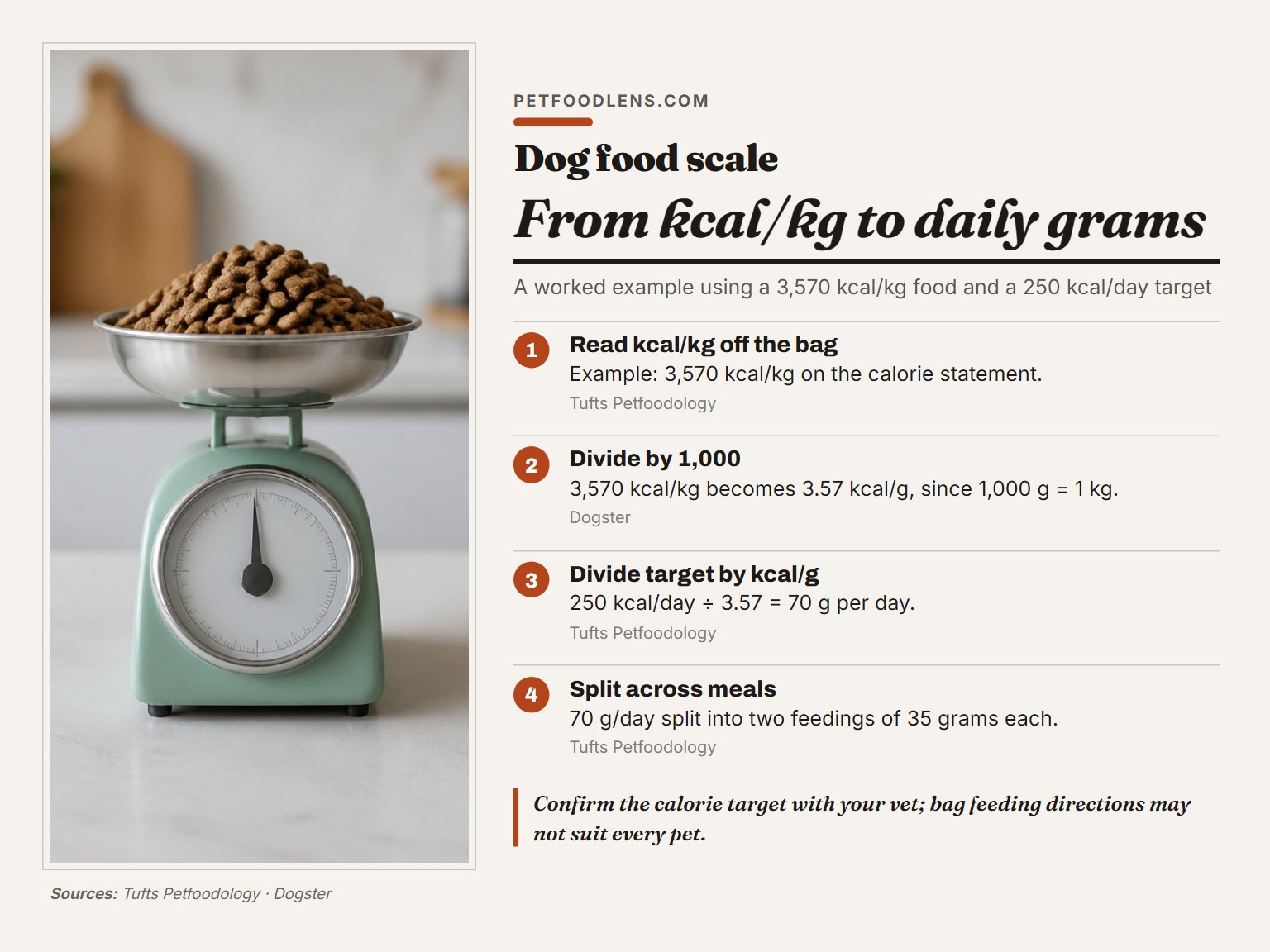
The bag gives you cups, and cups are the one unit your scale can’t verify. The fix is to find the calorie figure printed on a weight basis and convert it once.
Look for “kcal/kg” on the guaranteed analysis or the calorie statement. Not every label carries it prominently, and some print only kcal/cup. If yours is cup-only, you can still get there: weigh one level cup of that food on your scale, then work back from the per-cup calorie figure.
The kcal/kg to Grams Conversion
- Read the kcal/kg figure off the bag. For example, 3,570 kcal/kg.
- Divide by 1,000 to get calories per gram. 3,570 kcal/kg becomes 3.57 kcal/g, because there are 1,000 grams in a kilogram.
- Divide your dog’s daily calorie target by that number. A 250 kcal/day target divided by 3.57 gives 70 grams per day.
- Split that total across meals. Two feedings of 35 grams each.
- Confirm the calorie target with your vet. Feeding directions on the bag may not be optimal for every dog, and individual needs vary.
That worked example comes straight from Tufts Petfoodology weighing pet food guidance, written by a board-certified veterinary nutritionist. The same piece points out that a cat needing 5/8 of a cup a day has no clean way to split that in half, while 70 grams splits into 35 and 35 without a calculator.
If your bag lists kcal/oz instead, the conversion runs the other way. Divide kcal/kg by 35.27, the number of ounces in a kilogram. A 3,500 kcal/kg food works out to 99.23 kcal/oz. Either route gets you to the same place, and both are covered in more depth under dog food calories.
Weigh Once a Day or Every Meal?
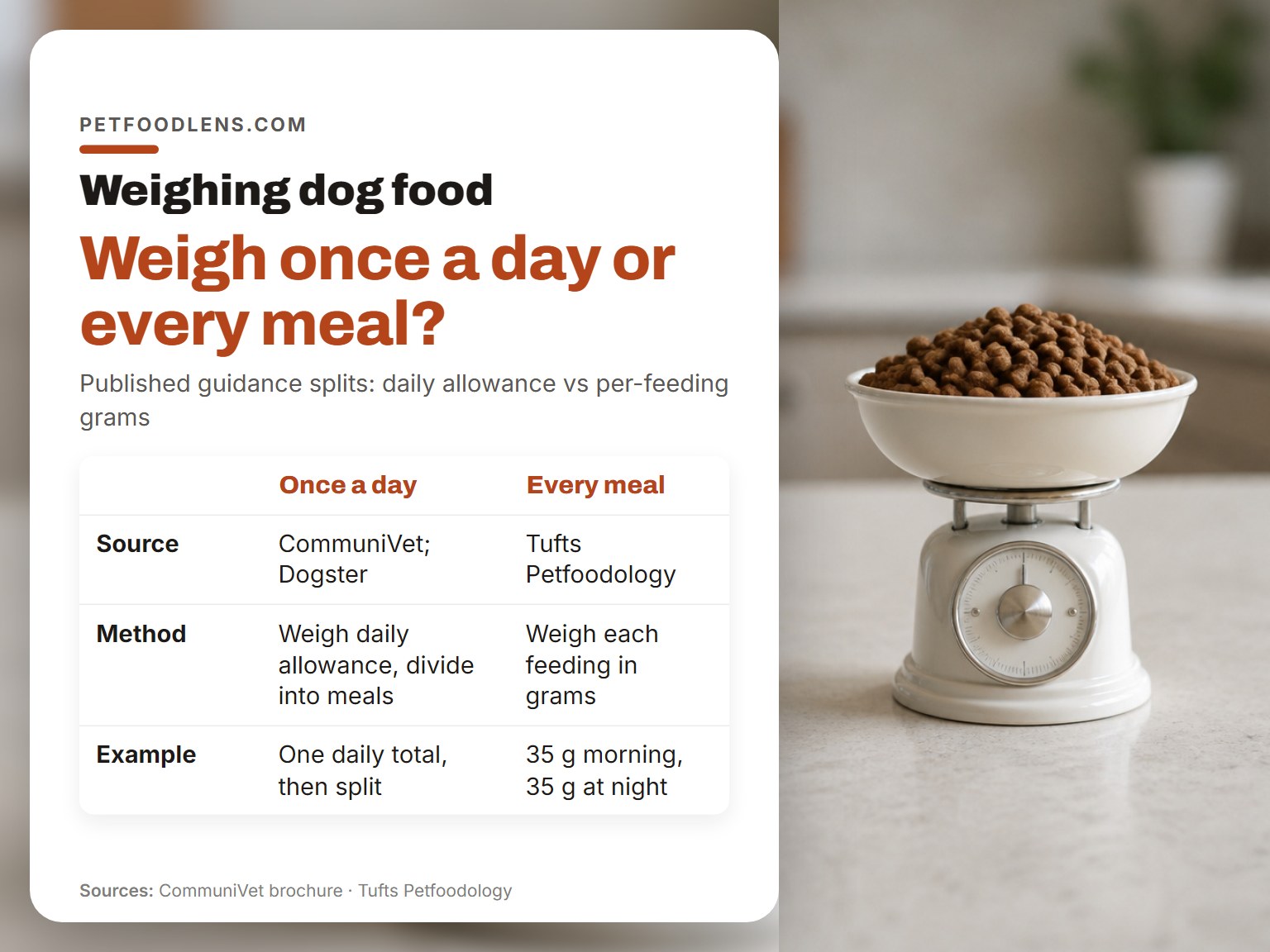
Two routines both present themselves as the accurate one, and the published guidance doesn’t settle it for you.
CommuniVet’s veterinary brochure recommends practicing once-per-day weighing of the pet’s daily food allowance. Tufts Petfoodology works the example the other way, weighing each feeding in grams: 35 grams in the morning, 35 at night. Dogster lands with CommuniVet, suggesting owners measure a day at a time and then divide into meals.
The two positions aren’t contradictory so much as differently shaped. One measurement event per day means less chance of a slip and a bigger, more forgiving volume on the platform. Per-meal weighing means the bowl you set down is the bowl the dog eats, with no eyeballing in between.
The Case for Weighing Once a Day
CommuniVet and Dogster favor a single daily weigh-in, arguing it is easier to hit accurately and easier for a household with multiple feeders to sustain, while Tufts Petfoodology weighs each feeding in grams. Everyone scoops from the same daily total.
CommuniVet and Dogster favor weighing the daily allowance once, while Tufts Petfoodology weighs each feeding; pick one and write it on the lid of the food bin. Switching routines mid-bag is how portions drift.
Weigh the day, not the meal, if more than one person feeds the dog. Two people splitting a 70-gram total will disagree about what half looks like.
The same logic applies to anything you’re adding to the bowl. If you’re feeding raw alongside kibble, the raw food portions need their own gram target rather than a share of the kibble number.
Where Portions Drift After Week One
Week one goes fine. Week six is where the weight creeps back on.
The reason is boring. Nobody re-weighs the target, the dog’s activity drops in winter, and the scoop creeps fuller because the bag got low and shaking it harder feels like it helps. A scoop spread plus a target that was set once and never revisited is how a dog gains weight over a season.
Treat the feeding chart on the bag as a starting point rather than a prescription, and confirm your dog’s calorie needs with a veterinarian. It’s built to cover a range of dogs, and indoor dogs at the lower end of the activity scale routinely need less than the chart suggests. Adjust every few weeks using body condition: ribs findable under light pressure, a waist visible from above.
Where this goes sideways: Recalculating the target every single week. Body weight moves slowly, and a fresh number every seven days sends you chasing noise instead of trend. Give a change several weeks before you judge it.
Online calorie calculators are the other trap here. They return a single exact number, which reads as precision and behaves like a guess. Use one as a starting point, then let the dog’s body condition over the next month tell you whether it was right.
Two things worth counting properly: the meals and everything that goes into the bowl between them. Treat calories are part of the daily total, not a rounding error, and a handful of biscuits can quietly undo a carefully weighed meal. If the weight has to come down, weight loss portions need their own recalculation rather than a smaller scoop of the same food.
Frequently Asked Questions
Can I just use the cup that came with the food?
You can, and you’ll be more accurate than with a liquid cup or an unmarked scoop. The CommuniVet brochure states the 1-cup dry-food measuring cup beat both of those. It still lost to a gram scale, and the study’s authors recommended gram scales and volume-calibrated dry-food cups as the improvement path. A cup gets you closer. A scale gets you a number.
Why does my scale show “UnSt” instead of a weight?
“UnSt” means the scale isn’t sitting on a secure, flat surface. On the Proctor Silex 86500 it displays after 10 seconds of instability. Move the scale to a hard counter, check that nothing is under one foot, and it will settle. A soft mat, a towel, or a slightly warped countertop will keep triggering it.
Is a 2 g minimum weight a problem for small dogs?
It can be. Two grams is the floor on the Proctor Silex 86500, and a small dog’s meal is well above that, so daily portions are fine. Where it bites is tiny additions: a sprinkle of topper, a single treat, a partial gram of powder. Those fall below or near the floor, and the scale rounds.
How accurate does my scale need to be?
Look for a stated tolerance rather than a marketing claim. The Proctor Silex 86500 publishes +/-1 g from 5 g to 1,000 g and +/-2 g from 2,000 g to 6,000 g. On a 30-gram portion, +/-1 g is a small fraction of the portion. That’s plenty. A scale with no published tolerance gives you no way to know what you’re reading.
Do I need a special pet food scale?
No, but a kitchen scale with a tare function and a gram mode covers it. The percentage weighing function on something like the Adam CBX Compact Balance is genuinely useful if you mix wet and dry foods in set proportions. For plain kibble, tare and grams are the whole job.
The Bottom Line
Here’s the test I’d give you before you change anything else. Weigh tomorrow’s breakfast twice, emptying the bowl between attempts. If the two numbers don’t match within a couple of grams, the problem is your technique, not your dog’s metabolism.
Then do the arithmetic once. Find kcal/kg on the bag, divide by 1,000, divide your dog’s daily calories by that number, and write the gram total on the lid of the food bin. That single number replaces every cup, scoop, and mug in the house.
One concession. None of this fixes a food that’s wrong for the dog, and it won’t catch a medical cause of weight change. If your dog is losing or gaining on a weighed, stable portion, that’s a vet conversation, not a scale calibration issue.
Run the numbers once. Then trust the scale and leave the scoop in the drawer.
