
4 Best Cat Food For Maine Coon in 2026
This post contains affiliate links. As an Amazon Associate, we earn from qualifying purchases.
For Maine Coon owners, Royal Canin Maine Coon Adult Dry Cat Food is our best overall pick because it addresses the breed’s specific needs for joint support, heart health, and dental care. It uses a uniquely shaped kibble to help with those needs. For those who prefer wet food, the Royal Canin Maine Coon Adult Wet variety targets bones and coat with omega nutrients. Kitten owners should look at the Royal Canin Maine Coon Kitten formula, while the Fromm Four-Star Turkey & Duck Pate works for multi-cat households across all life stages.
A Maine Coon isn’t just a big cat, it’s a breed with a slower growth period, a dense double coat, and a genetic predisposition to hip dysplasia and heart conditions. Feeding a generic adult formula often misses the mark on joint support, jaw-appropriate kibble size, and the specific fatty acid profile this breed needs.
This guide is based on manufacturer specifications, ingredient comparisons, and patterns in owner feedback for large-breed cat nutrition. We’ve focused on formulas that address Maine Coon-specific health priorities without relying on marketing claims.
Top 4 Cat Foods For Maine Coon in the Market

Certain content that appears on this site comes from Amazon. This content is provided "as is" and is subject to change or removal at any time.
The Best Cat Foods For Maine Coon, Reviewed
Royal Canin Maine Coon Adult Dry Cat Food
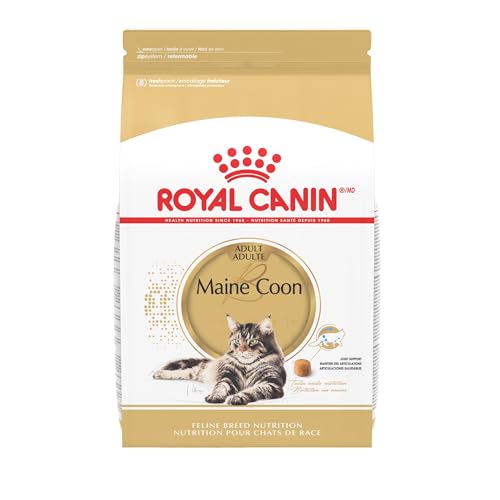
What We Like
- Formulated specifically for purebred Maine Coon cats
- Omega-3 and omega-6 support bone and joint health
- Heart-healthy nutrients including taurine, EPA, DHA
- Unique kibble shape promotes chewing and oral care
Trade-offs
- Only for adult Maine Coons, not kittens or other breeds
- Dry food only; wet food sold separately for mixed feeding
The kibble is shaped so that a Maine Coon’s large jaw can easily pick it up and chew it, which also helps scrape plaque off teeth. Omega-3 and omega-6 fatty acids in the formula support the bones and joints that carry a heavier frame, while taurine, EPA, and DHA promote cardiac health. For anyone with a purebred Maine Coon over 15 months old, this dry food delivers nutrients aimed at the breed’s structural and metabolic needs rather than offering a generic adult recipe.
The trade-off is that this bag commits entirely to one breed and one life stage, so if you have a mixed household or a younger kitten, you are looking at separate purchases. Compared to the Royal Canin Maine Coon Kitten Dry Food, which is formulated for kittens, this adult formula focuses on bone and joint support. It also pairs with the Royal Canin Maine Coon Adult Wet Food for moisture, but the dry format alone means you will need to ensure adequate water intake. For owners who prioritize breed-specific formulation over flexibility, this is the most targeted option available.
Royal Canin Maine Coon Adult Wet Cat Food
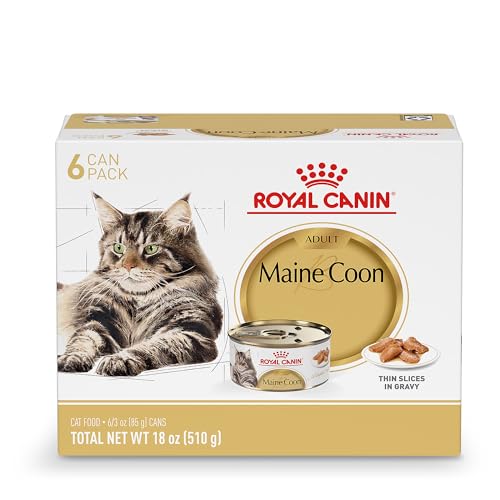
What We Like
- Omega-6 and omega-3 support bones and joints
- Nutrients for skin and dense coat health
- Gravy texture appeals to picky eaters
- Pairs with Royal Canin Maine Coon dry food
Trade-offs
- Only 3 oz cans mean multiple cans per meal
- Single-breed formula limits use to Maine Coons
- Wet food requires refrigeration after opening
A 3-ounce can of wet food formulated specifically for Maine Coons over 15 months old delivers omega-6 and omega-3 fatty acids aimed at bone and joint support. The gravy texture is designed to tempt finicky eaters, and the skin-and-coat nutrients target the dense, shaggy coat this breed is known for. If you want a wet food that matches the breed’s structural needs rather than a generic adult formula, this one lines up with the physiology of a large, heavy-boned cat.
Each can holds 3 ounces, so the pack of six fits easily in a small cabinet or drawer without taking over your kitchen. The dry version comes in a 14-pound bag, but this wet food is formulated specifically for the breed and pairs well with that kibble. Owners who mix the two can follow the brand’s guidance for a complete and balanced diet.
Royal Canin Maine Coon Kitten Dry Cat Food

What We Like
- Kibble sized for Maine Coon kitten jaws
- Supports bone and joint development
- Antioxidant complex for immune support
Trade-offs
- Only for kittens up to 15 months old
- Dry food only; no moisture variety in this bag
The kibble is physically shaped and sized for a Maine Coon kitten’s larger jaw, a detail most generic kitten foods ignore. This formula also packs vitamin D and minerals aimed at supporting bone and joint development during the long growth period purebred Maine Coons experience. For someone raising a Maine Coon kitten and wanting a diet built around that breed’s specific timeline and anatomy, this food is formulated to meet those needs up to 15 months old.
The trade-off is that this is a dry-only product, so you will need to supplement with wet food or water if your kitten prefers moisture-rich meals. Compared to the adult dry formula from the same brand, this one is designed for a shorter life stage, up to 15 months, so you will need to switch foods once your cat matures. That is not a flaw in the product itself, just a reminder that it is a targeted tool, not a lifelong solution.
Product photos
Fromm Four-Star Nutritionals Turkey & Duck Pate Cat Food
What We Like
- Turkey and duck as high-quality proteins
- No artificial colors, flavors, or preservatives
- Formulated for all life stages
- Interchangeable with other Four-Star recipes
Trade-offs
- Single-case format limits variety without other recipes
- Not suitable for cats that prefer chunk-style food
This wet food uses turkey and duck as protein sources, which supply amino acids for muscle maintenance and tissue repair. Because it’s formulated for all life stages, you can feed it to a kitten, an adult, or a senior without switching foods. The pate texture is uniform and easy to portion, and the recipe contains no artificial colors, flavors, or preservatives.
Pate is the texture here, finely minced turkey and duck cooked in turkey broth, so if your cat prefers chunks in gravy, this won’t match. Fromm takes a broader approach than breed-specific foods like Royal Canin’s Maine Coon wet line, offering interchangeable recipes across its Four-Star range. That flexibility works well for variety, but it requires buying multiple cases to get it.
Product photos
How We Evaluated Cat Foods For Maine Coon
We built this guide by cross-referencing manufacturer nutritional adequacy statements, ingredient lists, and the consensus from veterinary nutrition experts on large-breed feline needs. Owner-reported outcomes around coat condition, stool quality, and acceptance rates helped separate formulas that work on paper from those cats actually eat consistently.
Four criteria drove our picks. Joint and bone support ranked first because Maine Coons are prone to hip dysplasia and developmental orthopedic issues. Calcium-to-phosphorus ratios and omega-3 sources matter here. Kibble geometry came second: a flat, wide piece encourages chewing rather than gulping, which reduces regurgitation in deep-chested cats. Protein source quality was third, since large breeds need sustained amino acid delivery without filler carbohydrates. Finally, life-stage appropriateness ensured kittens, adults, and seniors each got the right caloric density and nutrient profile.
A research-led evaluation has honest limits. We don’t run feeding trials or analyze digestibility in a lab. What we can do is verify that a formula meets AAFCO nutrient profiles, compare ingredient sourcing claims against the guaranteed analysis, and surface the patterns that hundreds of owners report over months of feeding. If you want to explore specific categories further, our guides on best wet cat food and best dry cat food break down the top contenders in each format.
What To Look For In Cat Foods For Maine Coon
Maine Coons aren’t just scaled-up domestic cats. Their slower growth curve, joint vulnerability, and coat density demand specific nutritional adjustments that standard formulas rarely provide.
Choose a formula with named animal protein as the first ingredient. It should also have a calcium-to-phosphorus ratio near the ideal for large-breed kittens, omega-3s from fish oil for coat and joint support, and a kibble shape that forces chewing rather than inhaling.
Breed-Specific Kibble Shape
The most overlooked feature in Maine Coon nutrition is kibble geometry. Standard round or star-shaped pieces slide down without breaking, which encourages gulping and can lead to vomiting in deep-chested breeds. Several manufacturers now produce a flat, oval or X-shaped kibble that cats must crush with their molars before swallowing. This mechanical chewing also scrapes plaque from tooth surfaces, reducing tartar buildup without a separate dental diet. If you’re feeding dry food, look for a kibble described as “oversized,” “flat,” or “large-breed shaped.”
Joint and Bone Support Nutrients
Maine Coons have a genetic predisposition to hip dysplasia and patellar luxation, and their large frame puts mechanical stress on developing joints. Adequate calcium and phosphorus are essential, but the ratio matters more than the absolute amount, excess calcium in growing kittens can actually worsen skeletal deformities. Omega-3 fatty acids from fish oil (EPA and DHA) and glucosamine or chondroitin sulfate are common additions in breed-targeted formulas. For owners interested in supporting coat health alongside joints, food for coat health options often overlap with joint-support formulas since both prioritize omega-3s.
Protein Density and Amino Acid Profile
Maine Coons need a higher protein percentage than many domestic breeds because their lean muscle mass is proportionally greater. Look for a guaranteed analysis with a high crude protein content on a dry-matter basis for adult maintenance, and ensure the first two ingredients are named animal proteins (chicken meal, deboned chicken, turkey, or salmon).
Taurine is non-negotiable for heart health. Maine Coons are prone to hypertrophic cardiomyopathy, and taurine deficiency is a known reversible cause of this condition. If you want to understand minimum thresholds, our breakdown of protein requirements for cats explains the difference between AAFCO minimums and what a large active breed actually uses.
- Confirm the formula meets AAFCO for the correct life stage (kitten, adult, all life stages).
- Verify that taurine is listed in the guaranteed analysis or as a named additive.
- Check that the first three ingredients are animal-based, not grains or starches.
- Avoid formulas with unnamed “meat meal” or “poultry meal” that obscure the protein source.
- For kittens, ensure the calcium-to-phosphorus ratio is printed on the label or available from the manufacturer.
A good rule: if the kibble fits through a standard nickel-sized opening without breaking, it’s too small for a Maine Coon.
Cat Foods For Maine Coon Compared
The table below compares the four formulas across serving format, life stage, protein focus, and the specific Maine Coon health targets each formula addresses.
| Product | Form | Target Breed / Age | Key Nutrients | Kibble Design / Texture |
|---|---|---|---|---|
| Royal Canin Maine Coon Adult Dry Cat Food | Dry | Maine Coon 15+ months | Omega-3, omega-6, taurine, EPA, DHA | Unique shape for grasp & oral health |
| Royal Canin Maine Coon Adult Wet Cat Food | Wet, canned | 15 months and older | Omega-6, omega-3 fatty acids | Gravy |
| Royal Canin Maine Coon Kitten Dry Cat Food | Dry | Kitten (up to 15 months) | Vitamin D, antioxidants, taurine | Large-jaw adapted shape |
| Fromm Four-Star Nutritionals Turkey & Duck Pate Cat Food | Wet, pate | All breeds and ages | N/A | Pate |
Frequently Asked Questions
How much should I feed my Maine Coon cat?
Portions depend on the cat’s weight, age, activity level, and the calorie density of the food. A typical adult Maine Coon weighing a dozen to nearly twenty pounds needs a moderate number of calories per day. That translates to roughly one to one and a half cups of dry food or two to three 3-oz cans of wet food. Check the feeding chart on your specific bag or can, and adjust based on whether your cat maintains a visible waistline. Our Maine Coon feeding guide includes a more detailed breakdown by body condition score.
When should I switch my Maine Coon from kitten to adult food?
Maine Coons grow more slowly than most breeds and should stay on kitten food until about 15 months of age. Kitten formulas provide higher protein, fat, and calcium for skeletal development during the extended growth window. Switching too early can compromise bone density and joint formation in this large breed. Our Maine Coon kitten nutrition page covers the transition signs and recommended timeline.
Is wet or dry food better for Maine Coon cats?
Both formats have advantages, and most owners use a combination. Wet food provides moisture for urinary tract health and is easier for cats with dental sensitivity to eat. Dry food supports dental health through mechanical abrasion and is more calorie-dense, which helps maintain weight in large active cats. A mixed feeding routine, wet in the morning, dry available during the day, covers hydration, dental care, and energy needs. For owners who prioritize one format, our top wet food picks and top dry food picks narrow the field further.
What ingredients should I avoid in Maine Coon cat food?
Avoid formulas with unnamed animal fats or meat meals, artificial colors, and excessive carbohydrate fillers like corn gluten meal or brewers rice. Maine Coons digest animal protein efficiently but struggle with high-glycemic starches that contribute to obesity. Also skip foods that don’t list taurine in the guaranteed analysis, this amino acid is critical for preventing the heart muscle disease this breed is predisposed to. If your Maine Coon sheds heavily, a diet for a healthy coat with added omega-3s can reduce loose fur without relying on grain-free marketing.
Can I feed my Maine Coon the same food as my other cats?
Only if the food is labeled for all life stages and the kibble size is appropriate for both jaw sizes. Maine Coons need larger kibble that forces chewing, while smaller breeds may struggle to break those pieces. The Fromm Four-Star Turkey & Duck Pate in our lineup works for multi-breed households because it’s formulated for all life stages and comes as a smooth pate that any cat can eat. For dry food, it’s usually better to feed breed-specific formulas separately.
The Bottom Line
The Royal Canin Maine Coon Adult Dry Cat Food earns our best overall spot because it’s the only formula on the market designed from kibble shape to nutrient profile specifically for this breed’s joint, heart, and dental needs. It’s the right choice for owners who want a straightforward, breed-targeted dry food. It also works if you don’t need to accommodate other cat breeds in the same bowl.
If your Maine Coon prefers wet food or you want to add moisture to the diet, the Royal Canin Maine Coon Adult Wet pairs directly with the dry formula. It targets the same bone and coat priorities. Kitten owners should start with the Royal Coon Kitten dry formula to support the extended growth phase, while multi-cat households can rely on the Fromm Four-Star pate for a clean-ingredient all-life-stages option.
The single most important factor in feeding a Maine Coon is matching the food to their growth timeline and joint vulnerability. Choose a formula that addresses those two priorities first, and everything else, coat shine, energy level, stool quality, tends to follow.
