
How to Calculate Dog Food Calories: Step-by-Step
This post contains affiliate links. As an Amazon Associate, we earn from qualifying purchases.
How to calculate dog food calories: use three fixed factors (8.5 kcal/g for fat, 3.5 for protein, 3.5 for carbohydrate), multiply each by its percentage on the label, and sum the three for kcal per 100 grams. That’s what you’re actually feeding.
The NFE figure in that formula is the one number you won’t find printed on the panel. You get it by subtraction: 100 minus protein, fat, fiber, moisture, and ash. Everything else comes straight off the guaranteed analysis, which is why the math works on any bag you pick up.
What follows walks the math step by step: the Atwater formula, the NRC method Royal Canin uses, the RER equation for daily needs, and the three places where the standard procedure breaks down. By the end you’ll have a repeatable number in grams, not a guess.
Key Takeaways
- Modified Atwater factors are 8.5 kcal/g for fat, 3.5 for protein, and 3.5 for NFE, per FEDIAF Nutritional Guidelines.
- NFE is calculated by difference, not read off the label: 100 minus protein, fat, fiber, moisture, and ash. If moisture isn’t printed on dry food, PFMA says assume 10 percent.
- Royal Canin states guaranteed minimum or maximum levels should not be used for energy calculation, even though they’re often the only numbers on the bag.
- RER = 70 x (body weight in kg)^0.75, then multiply by an AAHA life-stage factor (1.4-1.6 for a neutered adult dog).
- Feeding guides are starting points, not prescriptions, per UK Pet Food. Cross-brand comparisons don’t work because formulations and digestibility differ.
What the Modified Atwater Method Actually Calculates
The formula is a fixed-factor estimate, not a measurement. FEDIAF sets the energy factors at 8.5 kcal/g for fat, 3.5 for protein, and 3.5 for carbohydrate (NFE), built on assumed average digestibility of 90 percent for fat, 85 percent for carbohydrate, and 80 percent for protein.
The Modified Atwater method assigns fixed energy values to the three macronutrients: 8.5 kcal per gram of fat, 3.5 kcal per gram of protein, and 3.5 kcal per gram of carbohydrate (NFE). The factors assume average digestibility of 90 percent for fat, 85 percent for carbohydrate, and 80 percent for protein, per FEDIAF Nutritional Guidelines.
Fat gets the higher factor because fat carries more than twice the energy per gram of protein or carbohydrate. That’s chemistry, not a label quirk.
The output is metabolizable energy in kcal per 100 grams. Multiply by 10 for kcal per kilogram, which is the number that converts cleanly to grams on a kitchen scale. The whole calculation is metabolizable energy math done with fixed coefficients instead of measured digestibility.
Why does the fixed-factor approach exist? Because most labels don’t publish enough data for the NRC method, and the Atwater formula runs on numbers that are already printed. The UK Pet Food calorie fact sheet lays out the factors and the digestibility assumptions in two pages.
How to Calculate Dog Food Calories from a Label
Five numbers on the guaranteed analysis panel do all the work: protein, fat, fiber, moisture, and ash. If moisture isn’t printed on a dry food, PFMA says assume 10 percent as a fallback, while Royal Canin’s method requires actual moisture as an input and gives no default.
The NFE Subtraction
Carbohydrate (NFE) is the value you calculate by difference, not a number you read. Royal Canin’s method: NFE = 100 – (moisture + protein + fat + ash + crude fiber).
Then run the math:
- Calculate NFE by subtracting protein, fat, fiber, moisture, and ash from 100.
- Multiply fat by 8.5 to get fat calories per 100g.
- Multiply protein by 3.5 and NFE by 3.5, then add both to the fat figure.
- The sum is kcal per 100g. Multiply by 10 for kcal/kg.
- Divide your dog’s daily calorie target by kcal/kg and multiply by 1,000 for grams per day.
Common mistake: Using the guaranteed analysis minimums and maximums as if they were exact values. Royal Canin states plainly that guaranteed minimum or maximum levels should not be used for energy calculation. The real values sit somewhere inside the range, and the label doesn’t tell you where.
The guaranteed analysis panel is a range, not a fixed point; Royal Canin says guaranteed minimum or maximum levels should not be used for energy calculation, so verify against the manufacturer’s published kcal/kg when the bag doesn’t print it directly.
What Does the NRC Method Do Differently?
Royal Canin uses a five-step predictive method derived from NRC 2006, and it produces a different number for the same food. The core difference is digestibility: Modified Atwater fixes it at 90/85/80, while the NRC method computes a variable energy digestibility from crude fiber and moisture.
| Aspect | Modified Atwater | NRC Predictive |
|---|---|---|
| Energy factors | Fixed: 8.5 / 3.5 / 3.5 kcal/g | Variable via GE equation |
| Digestibility | Fixed: 90% fat, 85% carb, 80% protein | Computed from fiber and moisture |
| Inputs needed | Protein, fat, NFE | Protein, fat, NFE, CF, moisture |
| Primary source | FEDIAF / UK Pet Food | Royal Canin / NRC 2006 |
| Best for | Quick label estimate | Precise ME calculation |
The NRC method’s dog digestibility equation is 91.2 – [(1.43 x CF x 100) / (100 – % moisture)], and the cat version uses 87.9 instead of 91.2. Then ME = DE minus a protein correction (1.04 x protein for dogs, 0.77 for cats).
I stopped trusting the guaranteed analysis panel for calorie math after I counted three distinct animal proteins on the back of an over-the-counter limited ingredient dog food. Nothing on the bag suggested cross-contact controls in the plant. That’s not a formula problem. That’s a sourcing problem the math can’t fix.
The two methods disagree most on high-fiber and high-moisture diets: UK Pet Food says light diets need different equations because Modified Atwater isn’t fiber-sensitive, while PFMA presents Modified Atwater fixed factors as the general method. On a standard adult dry food, the gap is small. On a light diet or a wet food, it’s large enough to change the portion.
70 x BWkg to the 0.75: The RER Formula for Daily Needs
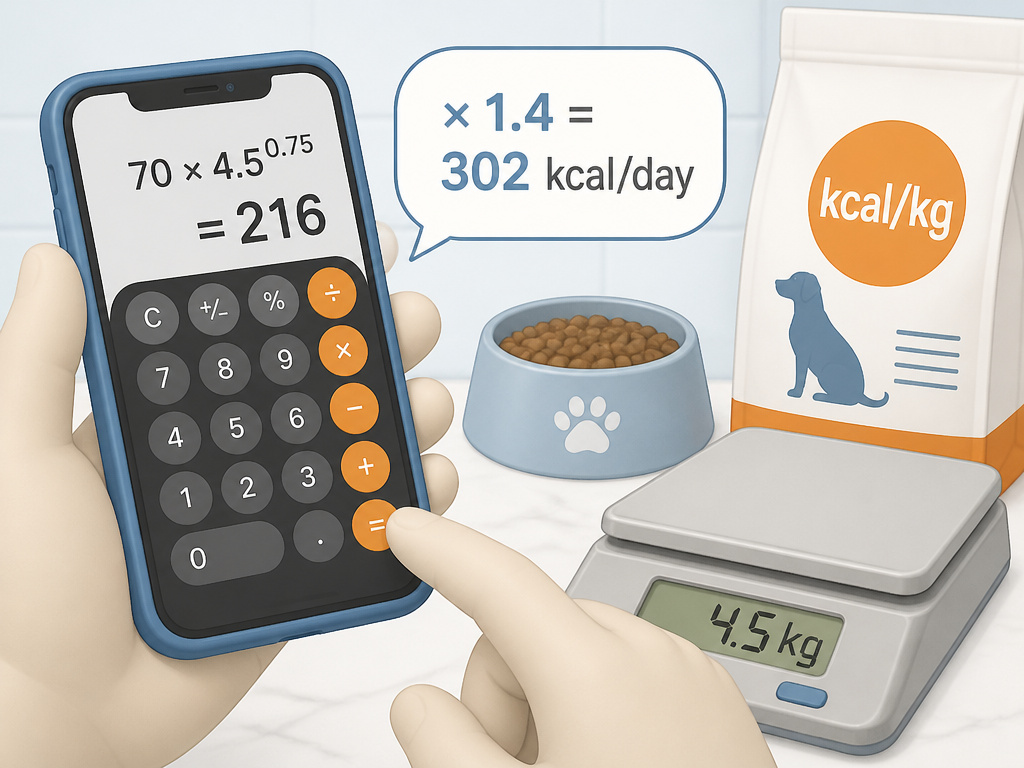
The AAHA 2021 Nutrition and Weight Management Guidelines use RER = 70 x (body weight in kg)^0.75, then multiply by a life-stage factor to get the maintenance energy requirement (MER). The guideline’s own worked example: a 10 lb (4.5 kg) neutered dog has an RER of 216 kcal/day, and at a factor of 1.4 that’s 302 kcal/day.
What RER Actually Measures
RER is the energy a dog burns at rest in a thermoneutral environment. It’s the floor, not the target. The life-stage factor scales it up for activity, growth, gestation, or down for weight loss.
| Life stage | Canine factor | Feline factor |
|---|---|---|
| Neutered adult | 1.4-1.6 | 1.2-1.4 |
| Intact adult | 1.6-1.8 | 1.4-1.6 |
| Inactive / obese prone | 1.0-1.2 | 1.0 |
| Weight loss | 1.0 | 0.8 |
| Gestation | 3.0 (last 21 days) | 1.6-2.0 |
| Growth | 3.0 (<4 mo) / 2.0 (>=4 mo) | 2.5 |
My own routine is quick on a phone calculator: 70 times body weight in kg to the 0.75, times a factor within the 1.4-1.6 neutered-adult range, divided by the kcal/kg on the label. The daily calorie needs figure you get from that is the number the rest of the math hangs on.
For most pet dogs that only walk on the lead or are active up to one hour a day, UK Pet Food recommends the lowest equation (95) to avoid overfeeding, whereas AAHA presents life-stage factors as ranges (e.g., 1.4-1.6 for a neutered adult). That’s a lower starting point than the AAHA range, which is why the two sources can hand you different numbers for the same dog. The AAHA energy requirement calculations present factors as ranges; UK Pet Food pushes you toward the bottom of the range.
Feeding Guides Are a Ceiling, Not a Prescription
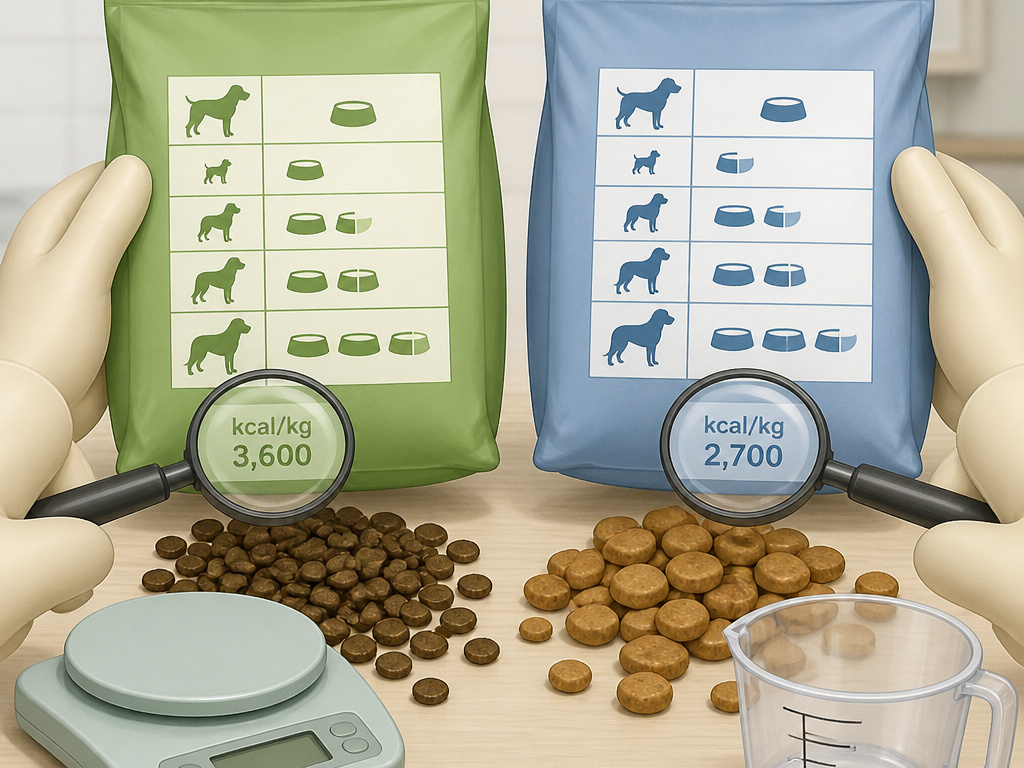
UK Pet Food says feeding guides are intended only as a starting point, and that some brands have lower feeding amounts because of formulation and different digestibility. That means a 30 lb dog eating Brand A’s guide and a 30 lb dog eating Brand B’s guide can be on different portions, and neither is wrong for its own food.
Where this goes sideways: Comparing cups per day across two brands. The cup is a volume measure, the kibble density differs, and the digestibility differs. A dog switched from one food to another on the same cup count can gain or lose weight.
Cross-Brand Comparisons Don’t Work
The feeding chart on the bag is calibrated to that specific formula. Hill’s Science Diet and Royal Canin both publish kcal/kg on their sites, and the figures differ enough that a straight cup-for-cup swap between them is a portion change in disguise.
If you want to compare two foods fairly, convert both to kcal/kg and compare on that basis. The calorie density comparison is the only like-for-like number.
Weigh the Food. Don’t Scoop It.
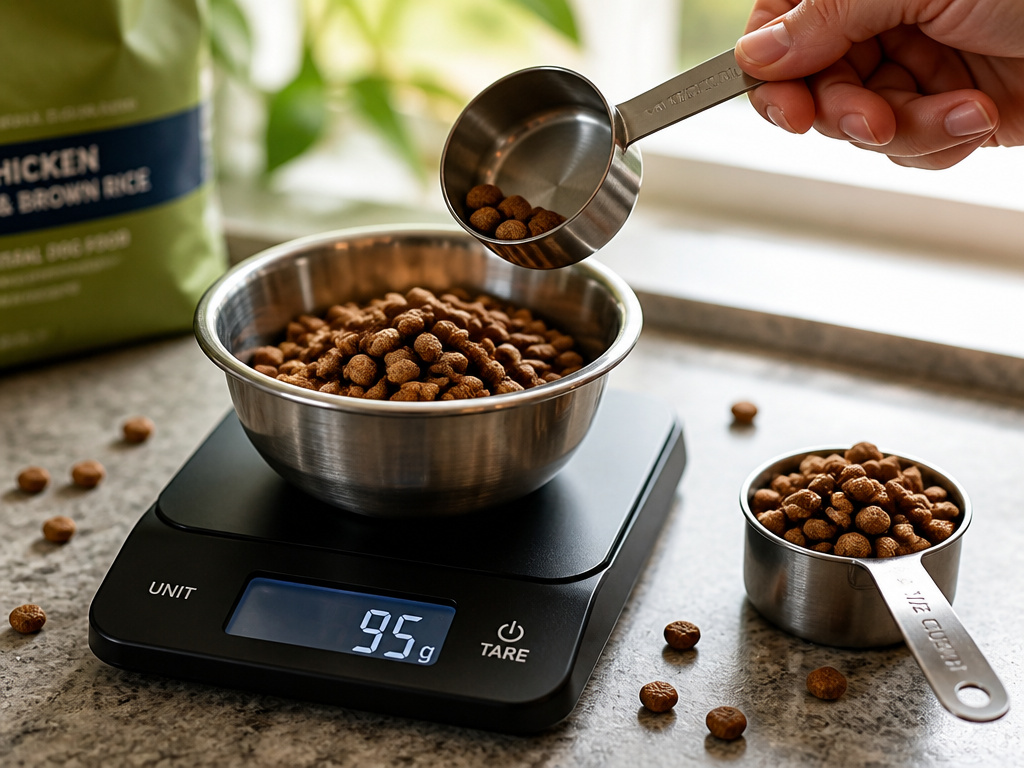
A level scoop of kibble looks identical whether it holds a little or a lot, and the bowl gives you no feedback either way. The scale clicks over to the real number and holds it.
Easy to miss: A scoop that varies fill-to-fill turns a fixed calorie portion into a range. Over time, that’s the difference between stable weight and a slow gain.
Weigh the food in grams on a kitchen scale and you’ll see the variance in your own hand. The measure dog food habit most owners need is a gram scale, not a better scoop.
10 Percent: The Treat Calorie Ceiling
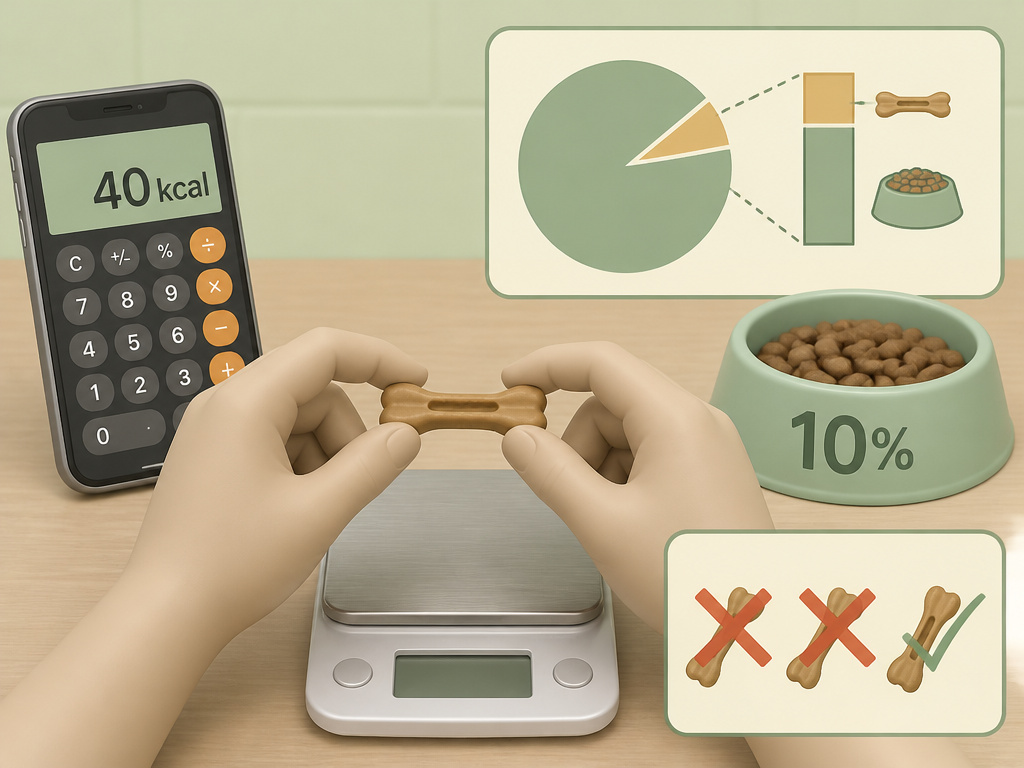
The rule I use is treats stay under about 10 percent of daily calories. For a 20 lb dog, treats should stay under about 10 percent of daily calories, which is not much.
Most owners can tell me the bag size but not the kcal per treat. I’ve had clients quote the price per pound and then look blank when I ask how many calories are in the dental chew they give twice a day. A treat calories count takes about a minute with a phone calculator.
If treats make up more than 10 percent of your dog’s daily calories, the food portion is no longer the plan. The treats are.
A small dental chew can fit inside that 40 kcal budget for a 20 lb dog. Two of them are not. That’s the kind of math that changes a feeding routine without changing the food.
When the Math Breaks Down
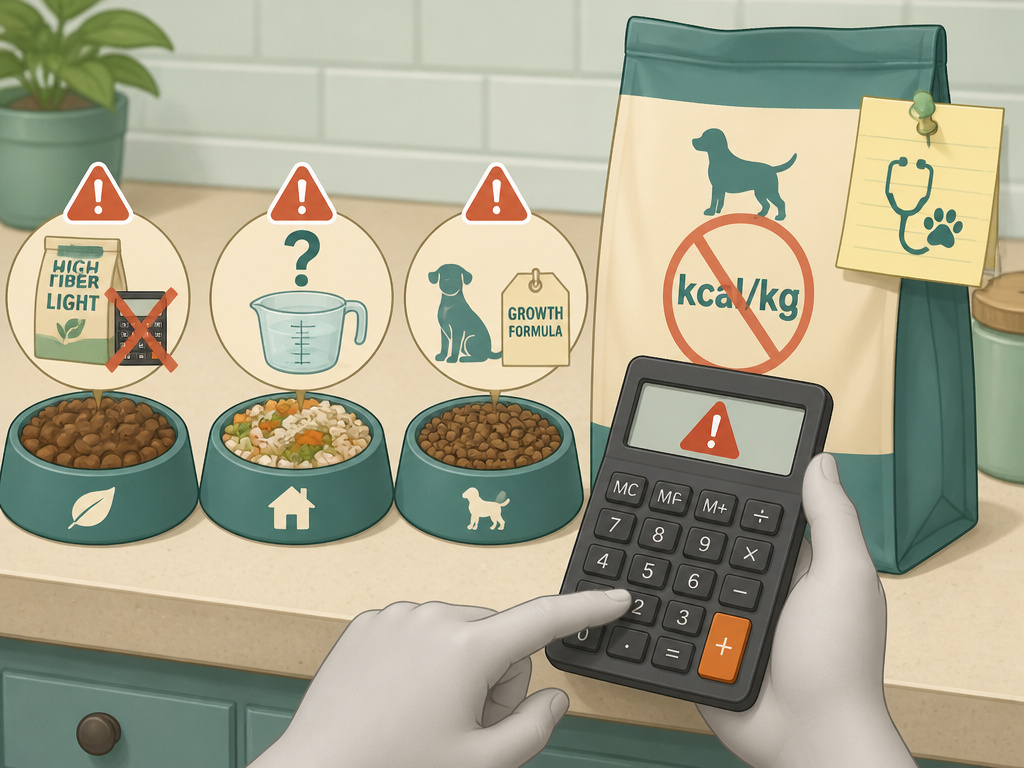
Three cases where the standard procedure gives a wrong answer.
- High-fiber light diets. UK Pet Food says light diets need different equations and recommends contacting the manufacturer to avoid overestimating energy value. Modified Atwater isn’t fiber-sensitive, so the standard formula overshoots on these products.
- Home-made and non-prepared diets. PFMA states the Modified Atwater method might not be accurate for home-made or other diets. The factors assume a commercial formulation.
- Puppies and kittens. PFMA says the recommendations are not appropriate for growth, and puppies must be fed a growth product. The adult factors don’t apply.
Skip this if: Your dog is on a veterinary therapeutic diet. Those formulas are built for a clinical outcome, and the standard calorie math doesn’t capture what the diet is doing. Your vet has the numbers.
For weight loss specifically, the AAHA factor is 1.0 for dogs and 0.8 for cats, and the portion needs to be recalculated every few weeks against body condition score. The calories for weight loss math starts from the target weight, not the current weight.
If the bag doesn’t print kcal/kg and the manufacturer’s site doesn’t either, the UK Pet Food dog calorie calculator runs the NRC 2006 four-step method as a fallback estimate. It’s a starting point, same as the bag.
Frequently Asked Questions
Can I use the guaranteed analysis on the bag for calorie math?
Royal Canin states guaranteed minimum or maximum levels should not be used for energy calculation. Use them as a starting input only when nothing else is available, and prefer the manufacturer’s published kcal/kg when it exists.
Why do two different methods give two different calorie numbers?
Modified Atwater uses fixed digestibility (90/85/80), while the NRC method computes digestibility from crude fiber and moisture. On a standard adult dry food the gap is small. On high-fiber or high-moisture diets the two methods can disagree by a meaningful margin.
How do I convert kcal/kg to grams per day?
Divide your dog’s daily calorie target by the kcal/kg figure, then multiply by 1,000. A 300 kcal target on a 3,500 kcal/kg food gives 85.7 grams per day. Weigh it on a gram scale, not a scoop.
Should I use the feeding guide on the bag?
UK Pet Food says feeding guides are starting points only, and that some brands have lower feeding amounts because of formulation and digestibility. Use the guide as a first estimate, then adjust based on the dog’s weight and body condition score.
What about treats and table scraps?
Treats should stay under about 10 percent of daily calories. Table scraps count against the same budget, and most owners underestimate them.
Does this work for puppies or pregnant dogs?
No. PFMA states these recommendations are not appropriate for puppies and kittens, which must be fed a growth product. Gestation and lactation use different life-stage factors (3.0 for the last 21 days of gestation, 3.0 to 6.0 or more for lactation), and the adult maintenance math doesn’t cover them.
Before You Go
How to calculate dog food calories in three minutes: RER, one life-stage factor, divide by kcal/kg. That’s the whole method.
The concession first. This works for adult dogs on prepared maintenance diets. Puppies, pregnant or lactating bitches, and dogs on veterinary therapeutic diets need different numbers, and the standard formulas don’t cover them. If your dog is in one of those groups, call your vet before you change anything.
The first step this week: flip the bag over and find the kcal/kg figure. If it’s printed, you’re done. If it’s not, check the manufacturer’s website. If it’s still not there, use the UK Pet Food calculator as a fallback, weigh the food in grams for two weeks, and track the dog’s weight.
The discipline is weighing the food every single time. The math is three lines. The scale is what makes the math mean anything.
